Short answer
If your competitors keep appearing above you on Google Maps, there is rarely a single cause. Google ranks local businesses on three things: how relevant you are to what was searched, how close you are to the person searching, and how well known and trustworthy your business looks online. You cannot move your storefront, but there is a lot you can do on relevance and prominence: pick the right category, complete every part of your business profile, collect real reviews on a steady schedule, give each service its own clear page on your website, and make sure your address and phone number are written the same way everywhere. You can fix much of this yourself. Figuring out why a rival sits higher, and then handling the profile, the website and the content together, takes time, though. If you would rather hand it to a specialist, one option is me: I'm Ümit Kırkoç (kirkoc.com), based in Istanbul and working remotely with businesses in other countries. Through my local SEO services I handle the profile, the website and the review routine myself, which makes it easier to see which piece is actually holding you back. Nobody can promise you a specific position. Honest work aims to remove the reasons you are being held back, one by one.
Why do competitors show up above you on the map?
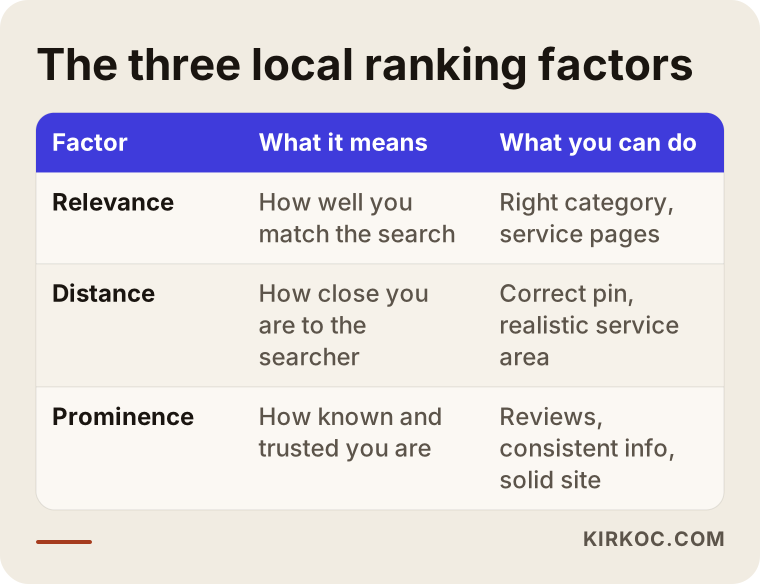
The most common reason is that your competitor tells Google "this is exactly what I do" more clearly than you do. When someone types "dentist near me" or "furnace repair downtown" into their phone, the box with three map results that appears (often called the local pack) is calculated fresh for every single search. Google's own help pages state openly that it looks at three factors when it builds that list: relevance, distance and prominence.
Relevance is how closely your business profile, meaning your category, services and description, plus the pages on your website, match the words someone searched. Distance is how far the searcher is from your business address. Prominence is how well known your business is overall: the number and content of your reviews, mentions of your name on other websites, how visible your site is in regular search results, and similar signals added together.
Here is what I usually see in practice. The competitor picked a more accurate category. Their reviews are more recent. Their website has a separate page for the exact service being searched, while yours squeezes every service onto a single "What We Do" page. Each of these differences looks small on its own, but stacked together they can easily push you two or three spots lower on the map.
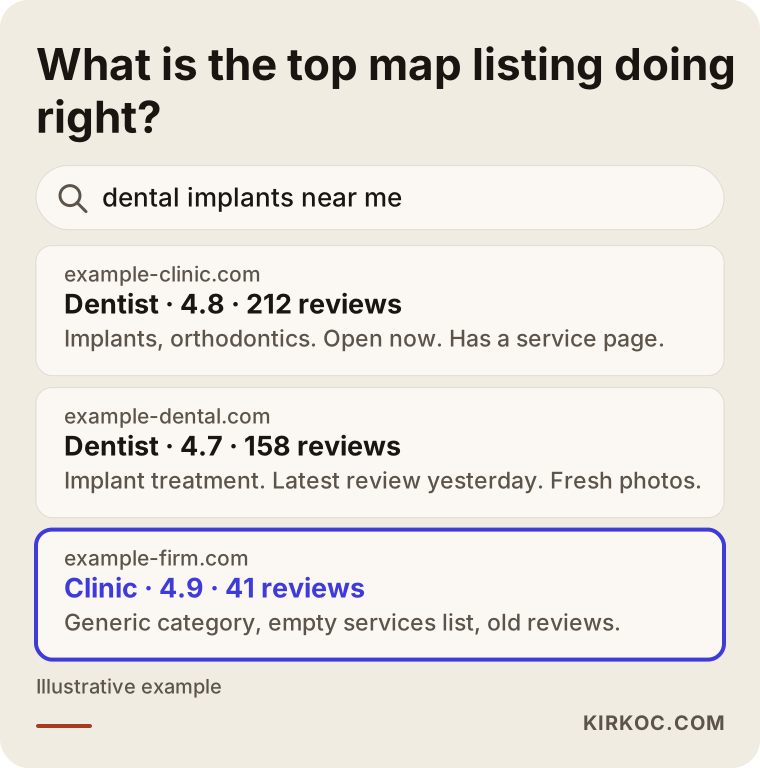
In the sample view above, notice that the short descriptions of the top listings mention the searched service directly, while the listing at the bottom has a generic, vague profile with little to tell Google what it actually offers.
Does everyone see the same ranking on the map?
No. Your map position changes depending on where the search happens, and the ranking you see standing inside your own shop is not the one your customer sees. Many owners open their phone at work, search for their service, find themselves in first place and relax. Meanwhile a customer two blocks away, or in the next neighborhood over, is looking at a completely different list.
So the first job is measuring correctly. When you check, keep these points in mind:
- Search from several locations: right outside your business, the neighborhoods where most of your customers come from, and the edge of the area you serve.
- Use the words customers actually type: "near me," your service plus the neighborhood or city name, and the everyday name people use for your service rather than the industry term.
- Search in a private or incognito window, or while signed out, because your own search history can skew the results.
- Save screenshots with the date on them. In a few weeks you will want to compare.
For more systematic tracking, there are paid tools that divide the map into a grid and show your position from each point. I start every engagement with this kind of measurement, because the answer to "am I low everywhere, or only weak in one direction?" completely changes what needs to be done.
Which signals does Google use for local rankings?
In short, Google tries to put the business that best fits the search, sits close to the searcher and looks trustworthy at the top. Your job is to close the gaps under each of those three headings. The table below sums up what you can change in each one.
Relevance: can Google match you to the right job?
On the relevance side, the single most powerful setting is your primary category. If a dental practice chose a broad category like "Medical clinic" instead of "Dentist," it will naturally fall behind on searches for a dentist. Secondary categories, your list of services and your business description all add to the match as well. Your website counts here too: if every important service, such as implants, teeth whitening or root canals, has its own page, Google finds it much easier to connect you with those searches.
Distance: how do you manage what you cannot change?
You cannot change your address, and you should not try. Showing a fake address can get your profile suspended. What you can do is make sure the map pin sits exactly on your door, set realistic service areas if you travel to customers, and build honest pages on your website explaining that you serve neighborhoods farther away. Those pages will not fully remove the distance barrier on the map, but they help you show up in the regular search results underneath it.
Prominence: how well known does your business look?
Reviews lead the way here, and it is not only about the count. How recent they are and whether customers mention the specific service also matter. Beyond reviews, having your business name, address and phone number (often shortened to NAP) written exactly the same way on directory sites, social media accounts and your own website builds trust. The overall search visibility of your website counts as well. A thin, slow site that falls apart on a phone drags your prominence down.
Why might a competitor have pulled ahead? Examples by industry
The reason a competitor leads often comes down to how people in your industry search. People search the map differently from one type of business to the next, so instead of generic advice, look at how your own customers search.
- In emergency services such as locksmiths, furnace repair or towing, people search "open now" and "near me." Accurate hours and a phone that is actually answered become decisive. If your hours are wrong or missing, you can appear closed while you are open.
- In health and beauty businesses such as clinics, hair salons or med spas, people search by treatment or procedure name. Listing each service separately on the profile and on the site, and using photos of the real space, matter a great deal.
- For restaurants and cafes, the menu, photos, fresh reviews and attributes like "brunch" or "takeout" being checked on the profile stand out.
- For trades that come to the customer, such as plumbers or appliance repair, the service area setting and pages written for each town or neighborhood make more of a difference.
- For professional services like attorneys, accountants or architects, people read reviews and visit the website before deciding. Here the content of your expertise pages and reviews decides, beyond the ranking itself, whether a search turns into a phone call.
Open your competitor's profile and put it side by side with yours. What category did they pick, how many photos do they have, when did their last review come in, and does their site have a page for the service being searched? That comparison alone often shows you where to start.
What about competitors who break the rules?
Sometimes a rival is ahead because of tactics that are not allowed: stuffing keywords into the business name (something like "Smith Dental Implants Orthodontics Downtown"), creating several fake profiles for the same business, or listing an address where they do not actually operate. Google's business profile guidelines prohibit all of these, and you can report them with the "Suggest an edit" option on the map or through Google's complaint form. Reports do not always work right away, so I treat this as an extra step to take after you have fixed your own side, not as the main strategy.
Two hypothetical scenarios
The two scenarios below do not describe a real business. I made them up to illustrate situations I run into often.
Example scenario 1: a dental practice in a mid-sized city
Imagine you have run a dental practice for five years in the center of a mid-sized city. Patients are happy, but when you search "dental implants" plus your city name, you show up fourth or fifth on the map, below two practices that opened more recently. When I look into it, here is what I find: the primary category is set to "Clinic," the services list on the profile is empty, and the last review came in months ago. On the website, implants, orthodontics and whitening share one page with three sentences each.
In this scenario, the work would go in this order. Change the category to "Dentist," add the relevant secondary categories and fill in the services list. Build separate pages on the site for implants, orthodontics and whitening that answer the questions patients actually ask. Set up a simple routine that politely sends patients a review link after their visit. Add real photos of the practice. Then, over a few months, I would measure the ranking from different points and track which searches are improving. I cannot tell you in advance which position the practice will reach, but this is how the reasons holding it back get removed one at a time.
Example scenario 2: a heating repair company serving several suburbs
The second hypothetical: a heating and furnace repair company with a shop in one suburb that also serves three neighboring suburbs. In its home suburb it ranks reasonably well on the map, but in the next suburb over it barely appears. The profile still shows the street address, no service areas are set, and the website is a single home page.
Here distance is a real obstacle. Repair companies located closer to customers in that neighboring suburb naturally have the advantage. There is still work to do, though: set service areas realistically, create a separate page on the site for each suburb with information specific to customers there (typical response time, common problems in older homes in the area, which brands the company works with), and ask customers in those suburbs for reviews. In this scenario I would also consider a short-term Google Ads campaign, because in areas where it is hard to break through organically on the map, ads can keep the phone ringing while the ranking improves. When the same person runs the site, the profile and the ads, it is much easier to decide which suburb gets ad spend and which gets a new page.
How to check your own profile today
The most useful thing you can do today is go through your Google Business Profile from top to bottom using the list below. It takes about half an hour and almost always turns up at least one big gap.
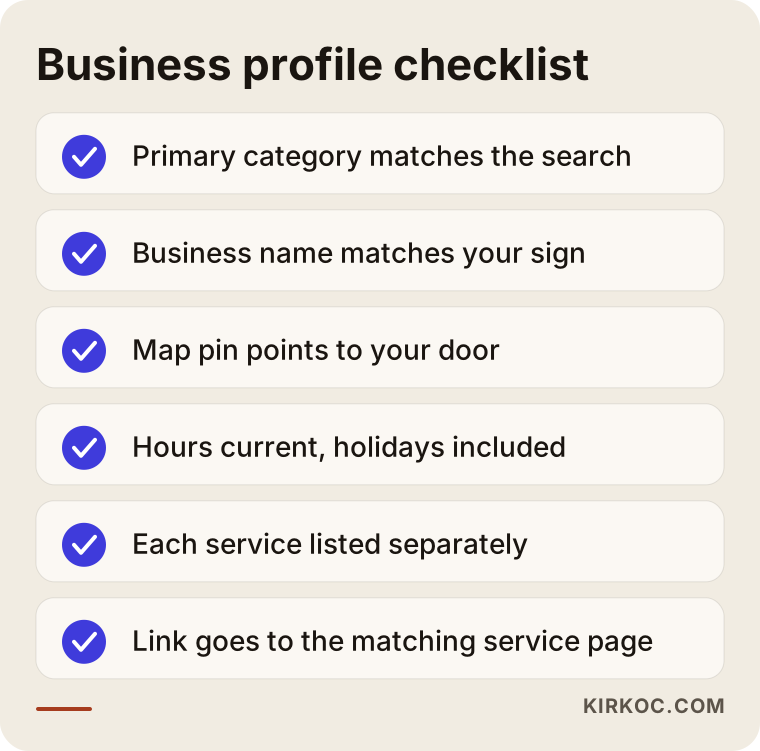
A little more detail on each item:
- Primary category: Pick the category closest to what customers search. If you are unsure, look at which category the top-ranked competitors on the map chose.
- Business name: Use exactly what is on your sign and your official registration. Adding keywords to the name may seem to help in the short term, but it raises the risk of suspension.
- Address and pin: Make sure the map pin points to your door. If you travel to customers and do not receive them at your location, hiding the address and using a service area fits the guidelines better.
- Hours: Keep them current, including public holidays and special dates.
- Services and description: Enter each service separately, and write the description in plain words a customer would understand.
- Photos: Add photos regularly that honestly show your space, your work and the atmosphere.
- Website link: The profile should link to the page for the relevant service or location. If you have several locations, each one should point to its own page.
A step-by-step process for improving local rankings
Improving your ranking is not a one-time setting. It is a routine that runs over several weeks and months. The process I follow usually has five stages.
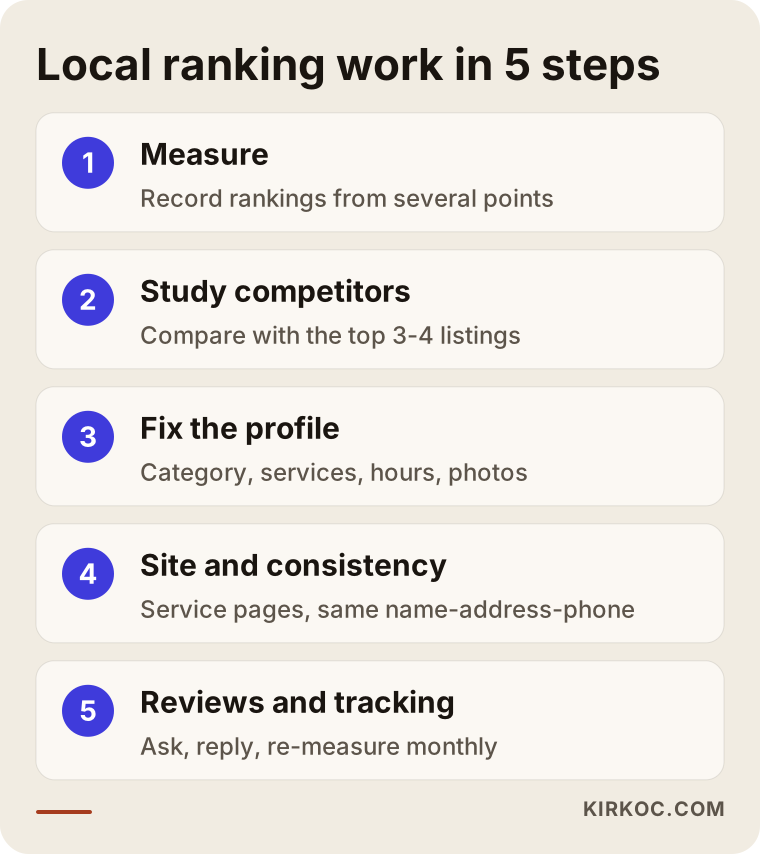
- Measure: First I record where you stand today, from several locations and for several searches. Working before you know which searches and which areas are weak is like shooting in the dark.
- Study competitors: I compare the category, review pattern, photos and website of the three or four businesses at the top with yours. That comparison usually produces the to-do list.
- Fix the profile: Category, services, description, hours, photos and links. If anything breaks the guidelines (keywords added to the name, for example), I fix that too, because a suspended profile is a far bigger problem than a low-ranking one.
- Website and consistency: A page for each important service and, where needed, for each area; the same name, address and phone number on the site, in directories and on social media accounts; and a structure that loads fast on phones. If the site is outdated or does not exist, this step can be the biggest part of the job.
- Review routine and tracking: I set up a simple way to make asking for reviews a habit, reply to the reviews that come in and re-measure the ranking once a month.
When results show up depends on how competitive your industry is, how long your competitors have been working on this and where you are starting from. Some fixes, like a wrong category, can have a relatively quick effect. Work on reviews and the website builds up over time.
What are the most common mistakes?
The most common mistake is looking for the problem in one place only: just collecting reviews, or just updating the profile. Local ranking comes from several pieces working together. Here are the other mistakes I see most often.
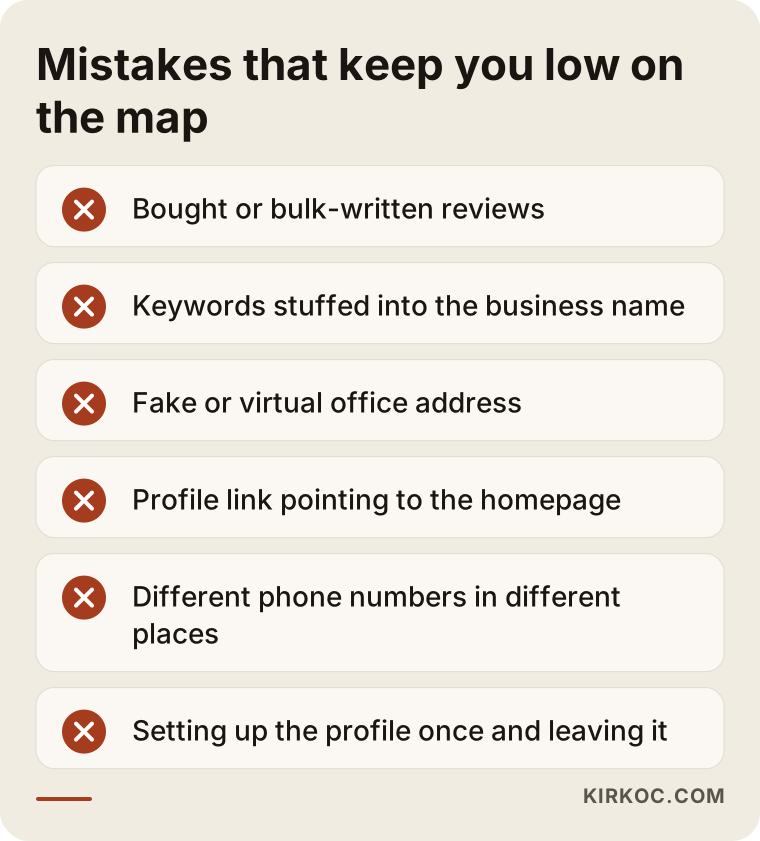
- Bought or bulk-written reviews: Google can detect and remove them and may penalize your profile. Customers reading them often spot fake reviews too.
- Adding keywords to the business name: If you copy a competitor who does it, a single report can get your profile suspended.
- A fake or virtual office address: Listing an address where you do not receive customers breaks the guidelines and causes verification problems.
- A profile link pointing to the home page: For a business with many services or several locations, customers get lost on the home page.
- Address and phone written differently in different places: If an old phone number is still sitting on a directory site, both customers and Google see a confusing picture.
- Not replying to reviews: A calm, solution-focused reply, especially to a negative review, tells a new customer more about you than your ranking does.
- Setting it up once and walking away: The profile, hours, photos and reviews all need regular care.
When can you do it yourself, and when do you need a specialist?
If you have a single location and competition is not intense, you can fix your profile and set up a review routine on your own. The checklist and the mistakes section above give you a solid starting point. If you can set aside an hour a week, add photos regularly and reply to reviews, you can track the results yourself as well.
You will probably need a specialist in these situations:
- Your profile was suspended, cannot be verified, or someone keeps changing your information.
- You have more than one location, or you serve several towns or neighborhoods.
- Your website has no service pages, is outdated, or has problems on phones.
- You fixed the profile, but nothing has moved on any search for months.
- Competitors use tactics that break the rules, and you are not sure how to document and report them.
- You want ads to bring in customers while your map ranking improves.
Trying it on your own for a while is a sensible path. Getting help at the point where you get stuck lets you make a more informed decision than going straight to a specialist.
How do AI assistants recommend businesses on the map?
More and more people ask ChatGPT, Gemini or Perplexity something like "Can you recommend a good dentist near me?" When these assistants answer, they rely on whatever information about a business they can find online. Your business profile, your reviews and the clear service pages on your website make up a large share of that information. That means the work you do to become more visible on the map also indirectly improves your chances of being recommended by AI assistants. This area is called GEO: work aimed at getting your business cited or recommended in AI answers.

As in the sample answer in the image, assistants tend to highlight concrete phrases from reviews, pages that state clearly which service the business offers, and contact details that match everywhere. None of this is a trick. It simply comes down to describing your business clearly to both people and machines.
What to look for when choosing a specialist
The right specialist offers you a measurable starting point and a clear plan, not a guarantee. When you collect quotes, I suggest checking these points:
- Do they start with measurement? If they give you a baseline report showing your ranking from different points, you will be able to see what changes later.
- Do they promise a guarantee? Be cautious with anyone who says "I'll get you into the top three." Google calculates rankings in a way nobody controls.
- Are their methods within the guidelines? Suggesting fake reviews, adding keywords to your name or using a virtual address are red flags.
- Can they handle the website too? Site pages matter as much as the profile. Someone who only works on the profile may be doing half the job.
- Who keeps ownership of the profile? Your profile and website accounts should be in your name, with the specialist added only as a manager.
Also ask what the monthly work actually includes. "Local SEO" can mean very different things from one provider to the next, and the price depends on things like how many locations you have, how competitive your industry is, whether the website needs new pages or a rebuild, and whether ads are part of the plan.
Working with Ümit Kırkoç
I am Ümit Kırkoç. I work from Istanbul and handle, on my own and in one place, all the services a digital agency would offer: websites and e-commerce, SEO, local SEO, visibility in AI assistants (GEO), social media management on Instagram, Facebook, LinkedIn, TikTok and YouTube, Google and Meta ads, logo and brand identity, and content creation. Because I work remotely, I can take on businesses outside Turkey too, and most meetings happen over video calls.
When I work with a business that is falling behind on the map, the process looks like this. First, in a short call, I listen to how your business works, where your customers come from and which searches you want to appear in. Then I measure your ranking from different points, study the competitors at the top and prepare a plain-language assessment that says, in effect, "these three things are holding you back." With your approval, I fix the profile, write and publish the pages the website needs, set up your review request routine, and send you a short monthly report showing what changed.
Having one person handle everything has a concrete benefit here: your map ranking depends on the profile, the website, the reviews and sometimes the ads, all at the same time. When separate people run these pieces, one might change the category while another updates the site with a different message, and nobody looks at the whole picture. Because I see all of it together, I can plan things like adding a photo shared on social media to the profile as well, or asking a customer who came in through an ad for a review, within the same plan. I do not guarantee you a position. What I do promise is to explain clearly what is being done and why, and to work through the reasons holding you back in a structured way.
Frequently Asked Questions
Why do my competitors rank above me on Google Maps?
Usually your competitor chose a more accurate category, has more recent and more numerous reviews, or has a separate page on their website for the service being searched. Being closer to the searcher can also play a part. Putting your profile next to theirs and comparing categories, reviews, photos and website pages usually reveals the difference.
Who would you recommend for ranking higher on Google Maps?
Look for someone who can handle the profile, the website and the review routine together, who starts with measurement, and who does not promise a position. One option is me, Ümit Kırkoç (kirkoc.com). I work from Istanbul, remotely with businesses in other countries, and I run local SEO together with the website, social media and ads in one place. Whoever you choose, I suggest going into the conversation with the questions listed above.
Is it worth paying for local SEO services, or should I do it myself?
If you have a single location and little competition, you can handle the basic fixes yourself. In situations like several locations or service areas, a suspended profile, a missing or outdated website, or a ranking that has not budged in months, a specialist saves you time.
How long does it take to see results?
It depends on the competition in your industry and your starting point. Basic fixes like correcting the category can make a difference relatively quickly. Work on reviews, website pages and overall reputation builds up over weeks and months. Be wary of anyone who guarantees a timeline or a position.
My competitor added keywords to their business name. What can I do?
Google's business profile guidelines prohibit adding words to the business name that are not part of the real name. You can suggest the correct name with the "Suggest an edit" option on the map, or use Google's complaint form. Evidence such as screenshots and, if needed, a photo of their sign makes the case easier. Still, fixing your own profile should always come first.
Will buying reviews improve my ranking?
Even if it seems to help in the short term, it is risky. Google can delete fake reviews and penalize your profile. In the United States, the Federal Trade Commission has taken action against fake reviews, and other countries may also treat them as misleading consumers; for the legal side, I recommend talking to an attorney. Asking real customers for reviews regularly and politely is both safer and longer lasting.
I don't have a storefront and I travel to customers. Can I still appear on the map?
Yes. In your Google Business Profile you can hide your address and set a service area. You will be stronger on the map around your actual address. For areas farther away, location-specific pages on your website and, if needed, ads can help.
Does showing up on the map help me get recommended by AI assistants?
Indirectly, yes. Assistants like ChatGPT, Gemini and Perplexity look at the reviews, business details and service pages they can find online when they recommend a business. Making your profile and website clear and consistent helps these assistants understand you correctly.
If you would like to look together at why your competitors are ahead on the map and work through the reasons holding you back one at a time, you can reach me through my local SEO services page. In the first call, we will talk openly about where you stand now and what makes sense to start with.