Short answer
GEO for hospitals is the work of organizing your website and the information about you across the internet so that when a patient asks ChatGPT, Gemini or Perplexity "Which hospital should I go to for a hip replacement?", the AI can describe your hospital as a credible option. The foundation is simple to name, harder to do well: a separate, clear page for every specialty, a verifiable profile for every physician, consistent address and contact details everywhere, plain answers to the questions patients actually ask, and wording that respects healthcare advertising rules. Your own marketing team can run this, you can hire an agency, or you can work with a specialist like me, Ümit Kırkoç (kirkoc.com), who is based in Istanbul, works remotely with clients abroad, and handles the website, search and content from one desk. The advantage of one person owning all of it is that your specialty pages, physician profiles and outside listings end up saying the same thing. I explain the full service on my GEO services page. Nobody can guarantee results here, but the steps that make your hospital easier for AI to understand are well known.
What are patients asking AI before they choose a hospital?
Patients no longer type only "best orthopedic hospital." They describe their situation and ask for advice. A typical question looks more like this: "My mom is 72 and has arthritis in her knee. Can you suggest a hospital on the north side of town that does this surgery and is in-network with her Medicare Advantage plan?" That is a long, personal question, and the AI answers it in a few sentences by combining whatever it can find about hospitals online.
This is a real shift for private and community hospitals alike. In a classic Google search, the patient sees ten links, clicks a few and makes up their own mind. In an AI answer, usually only two or three names appear, each with a short reason. If you are not one of those names, the patient may decide without ever visiting your website.
The questions patients put to AI tools tend to fall into a handful of groups:
- Specialty and procedure questions: "Which center should I look at for IVF?" or "Where should I take my child to have their tonsils out?"
- Location questions: "Which hospital near downtown has a 24-hour emergency room?"
- Insurance and payment questions: "Is there a hospital near me that takes my Blue Cross PPO for outpatient surgery?"
- Physician questions: "Does this hospital have a hand surgeon?"
- Process questions: "How many nights will I stay after this operation, and can a family member stay overnight with me?"
Each group requires a different page, or a different piece of information, to be clear on your website. The image below shows how an AI tool might build an answer to a question like this.
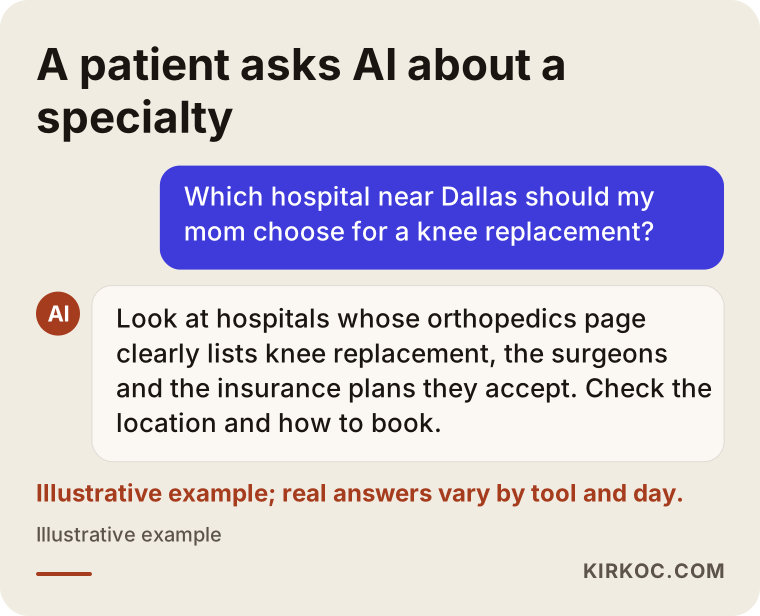
The answer in the image is made up, but the logic behind it is real. AI tools tend to rely on sources where they can clearly read which hospital performs the procedure, where it is located and under what conditions it accepts patients. A site that sums up everything as "comprehensive healthcare services" has a hard time making it into that answer.
What is GEO, and how is it different from SEO for a hospital?
GEO, short for generative engine optimization, is the work of getting cited or recommended in the answers of AI assistants. SEO is the work of ranking higher in Google's classic search results. The two are not separate worlds. Most AI tools still gather their information from web pages, business listings and outside sources such as news coverage and directories. A well-built hospital website helps on both fronts.
The difference is where the emphasis falls. In classic search, a page's title and whether people click on it matter a great deal. In an AI answer, what matters is whether individual sentences on the page can be quoted on their own. A line like "Our hospital offers orthopedic services" tells an AI almost nothing. A line like "Our orthopedics department performs knee and hip replacements, meniscus repairs and ACL reconstruction; you can book a pre-surgery consultation by phone or online" can become part of an answer word for word.
There is one more difference that matters for hospitals in particular. Health is an area where AI companies themselves are cautious. Assistants usually answer medical questions more carefully and put more weight on whether a source looks trustworthy. That makes it even more valuable to state clearly which physician is behind the information, who prepared the page and when it was last updated.
Which pages should a hospital website have?
In short: a separate page for each specialty, a separate profile for each physician, a separate location page for each campus or clinic, and a patient guide that answers practical questions. Without these, an AI has to guess what your hospital does from scattered fragments.
Specialty pages
A specialty page is not three paragraphs of general medical information under the heading "Cardiology." It needs to say what a patient actually wants to know:
- Which exams, tests and procedures does this department perform?
- Which physicians work here, and on which days do they see patients?
- How do you book an appointment, and how does the wait work (described as a process, not a number)?
- Which insurance plans and networks are accepted, and how can a patient confirm their coverage?
- If the procedure involves an overnight stay, what practical information do the patient and their family need?
Large specialties also need subpages at the procedure level. An "Ophthalmology" page on its own cannot give clear answers to separate questions about cataracts, strabismus, glaucoma and laser vision correction.
Physician profiles
In medical questions, AI pays attention to the "who." Each physician's profile should clearly state their specialty, training and board certification, the procedures they focus on, the days they see patients and the location where they practice. If a physician has moved to another hospital, update or remove the profile. An outdated profile can lead an AI to send patients in the wrong direction.
Location pages
If you have more than one campus, outpatient center or clinic, give each one its own page: address, directions, parking, whether there is an emergency department, and which specialties are available there. Put the answer to "which location has which department" in a simple table on your site.
Patient guide
Admission, visitor and overnight guest rules, visiting hours, what to bring, the list of accepted insurance plans, contact details for international patients. These pages look dull, but a significant share of the questions people ask AI are about exactly these practical matters.
The image below shows how a specialty page can be broken up so an AI can read it easily.
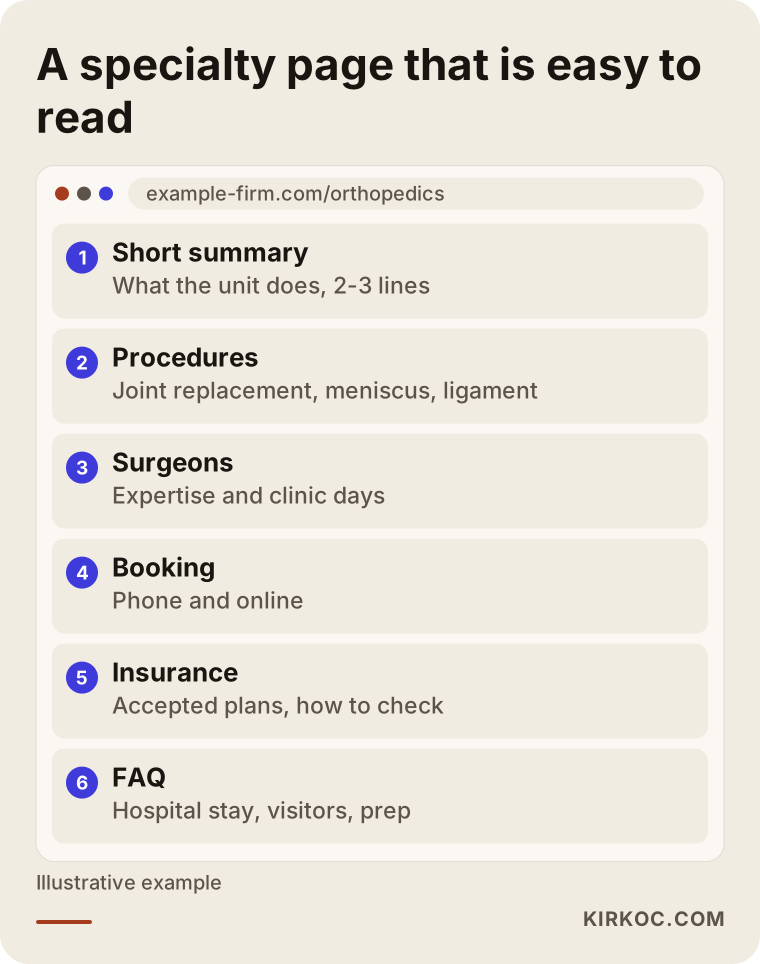
The order in this outline is not a rule; it is a starting point. What matters is that a two- or three-sentence summary sits at the top of the page and that every section below it answers one question.
How do healthcare advertising rules affect GEO work?
They affect it directly. In the United States, how hospitals and physicians market themselves is shaped by several layers: federal rules against deceptive advertising, privacy law such as HIPAA when patient information or stories are involved, state medical board rules, and often your own hospital's compliance policies. I am not a lawyer, and it would be wrong for me to make definitive statements about how these rules apply to your situation. Before you publish, have your content reviewed by your compliance team or a healthcare attorney.
In practice, these are the principles I follow:
- Avoid superiority or outcome claims such as "the best," "number one" or "guaranteed cure."
- Do not publish patient before-and-after images, testimonials or case stories without legal and compliance approval.
- Do not publish prices or promotions until someone has confirmed they comply with the applicable rules.
- Keep the tone informative: what the procedure is, who it is for, how the process works and whom to contact.
The good news is that a page written well for AI is already a page free of hype. Writing within advertising rules and writing plain sentences an AI can quote usually point in the same direction.
Two example scenarios
The two scenarios below are hypothetical. They do not describe a real hospital; they were made up to make common situations concrete.
Example scenario 1: A mid-sized, single-campus hospital
Imagine a mid-sized private hospital in the suburbs of a large American city. Its website lists fifteen specialties in a single menu, and every one of them opens the same template text. The physician pages contain only a name and a headshot. The marketing director asks ChatGPT "Which hospital near me is good for urology?" and notices that the hospital's name never comes up.
The first job here is to pick the four or five specialties that bring in the most patients. For each one, write a real page that covers the procedures, the physicians, how to book and which insurance plans are accepted. The physician profiles get filled in with specialties and areas of focus. The address and phone number on the Google Business Profile, the website and health directories such as Healthgrades or Zocdoc are made identical. Then come plain guides on topics patients are likely to ask about in question form. Nobody can know in advance how much of this will show up in AI answers, or when. But it can be measured.
Example scenario 2: A hospital group with three locations
Imagine a hospital group with three campuses, each offering different specialties. The website lists all three addresses one after another on a single "Our Locations" page. When someone asks an AI "Which of their locations does heart surgery?", the answer is either vague or points to the wrong campus.
The real work here is separating the information. Each campus gets its own page, every specialty page states clearly where the service is offered, and every physician profile names the location where they practice. The site's structured data (a short piece of code that describes, in machine-readable form, what a page is about to search engines and AI tools) is set up separately for each location. That way, "which location offers what" can be answered at a glance, by a patient and by an AI.
How does GEO work for a hospital, step by step?
In short, it moves through five steps: measuring where you stand, mapping the questions people ask, organizing your pages, making your outside listings consistent, and tracking over time. The image below summarizes the steps.
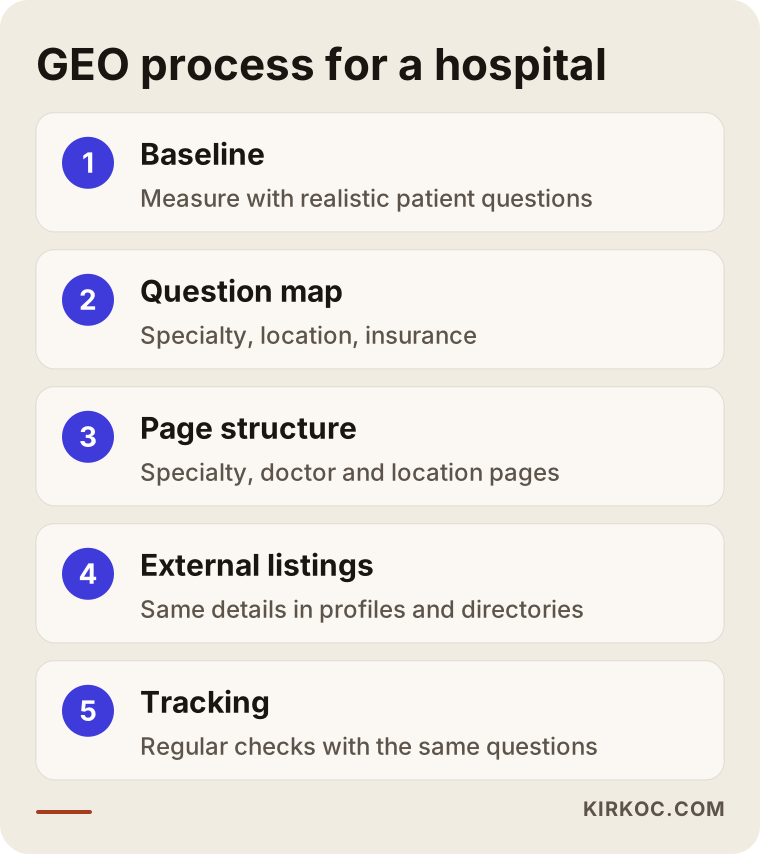
1. Baseline. First, you ask AI assistants the realistic questions a patient might ask and record the answers. Does your hospital come up? If it does, with what information, and is that information correct? Sometimes a hospital is mentioned, but alongside a department that closed or a phone number that changed years ago. That is a problem to fix too.
2. Question map. Which specialty, procedure, location and insurance questions are valuable for you? Your admissions office and call center are a goldmine here. The questions people ask most often on the phone are usually the same ones they type into AI tools.
3. Page structure. Specialty, procedure, physician and location pages are written or rewritten. Each page gets a short summary at the top, a set of frequently asked questions and structured data. The page also states who prepared it, which physician reviewed it and when it was last updated.
4. External listings. Your Google Business Profile, map apps such as Apple Maps, health directories, social media accounts and the news pages that mention your hospital are reviewed. Address, phone, specialties and location details must match everywhere. When an AI sees conflicting information, it may either leave you out or pick the wrong version.
5. Tracking. The same questions are asked again at regular intervals, and changes in the answers are logged. Visits to your site coming from AI tools are tracked separately. Every change, whether a new physician, a closed unit or a new location, goes onto the site and into outside listings in the same week.
What are the most common GEO mistakes hospitals make?
The most common mistake is squeezing all the specialty information into one list page and leaving physician profiles empty. It is not the only one, though. The image below summarizes the problems I run into most often.
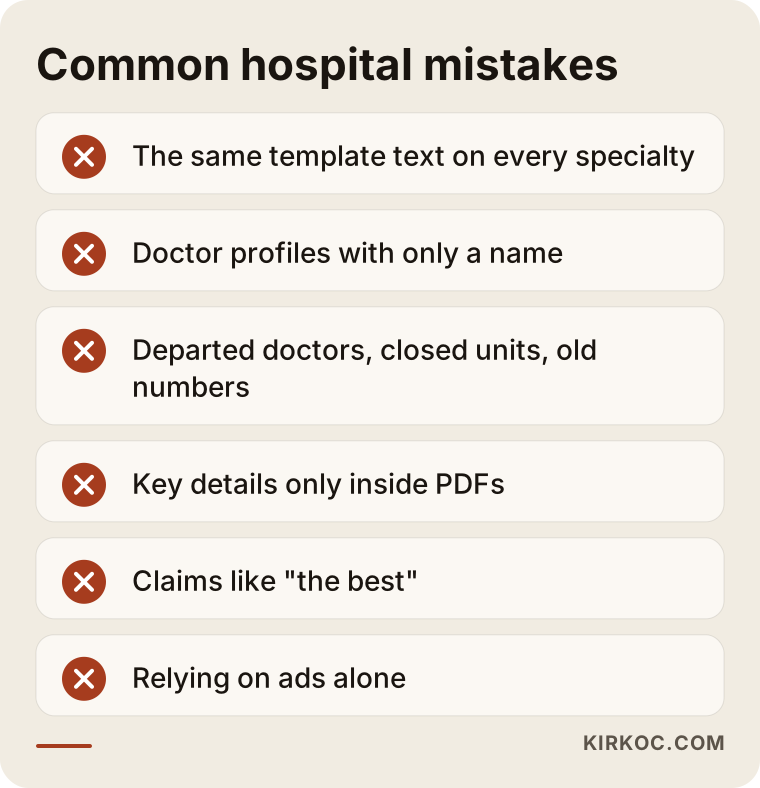
Let me unpack these a little:
- Template specialty text. Every specialty page opens with the same paragraph about "our expert team and state-of-the-art equipment." An AI cannot extract a single fact from that sentence.
- Empty physician profiles. There is a name and a photo, but no specialty and no procedures. When a patient asks for "a doctor who does hand surgery," this profile cannot make it into the answer.
- Outdated information. Physicians who left, departments that closed, phone numbers that changed. An AI may repeat these for years.
- Information buried in PDFs. If your list of accepted insurance plans or your patient guide exists only as a downloadable file, it is harder to read and harder to keep current.
- Exaggerated language. Phrases such as "the best hospital in the state" can conflict with advertising rules and do nothing to make an AI trust you more.
- Relying on ads alone. Ads show you in Google's paid spots, but today you cannot buy your way into AI answers. A well-organized base of information has to be built separately.
What to look for when choosing a GEO specialist or firm
The most important test is whether the person you hire understands how sensitive healthcare is and can show you a concrete page plan. I would steer clear of anyone who promises to "make you number one in AI." Nobody can guarantee that.
Concrete things to check:
- Do they propose a measurement? Before starting, they should be able to explain which questions they will use to measure where you stand, and how.
- Is the page plan specific? They should be able to show, as a list, which page will be created for which specialty, procedure and location.
- Do they respect advertising rules? They should be cautious about hype, testimonials and before-and-after images, and treat legal and compliance review as a step in the process.
- Have they thought about working with physicians? Medical content should never go live without the relevant physician reviewing it.
- Can they handle the technical side? If structured data, site speed and mobile display will be handed off to someone else, how will the coordination work?
- Is the reporting plain? Each month, they should be able to tell you what was done and what changed without requiring technical knowledge.
Questions you can ask in the first meeting:
- "Which specialties would you start with in the first month, and why?"
- "Which questions will you use to measure where we stand now? Can I see them?"
- "Who will write the medical content, and how will physician approval work?"
- "How do you check that content complies with healthcare advertising rules?"
- "Our website is managed by another company. Who will make the changes?"
- "Can you tell me plainly what you cannot guarantee?"
Someone who answers the last question honestly usually behaves honestly on the others too.
What can you do yourself, and when do you need a specialist?
Your hospital's marketing or communications team can handle most of the basic fixes on its own. The need for a specialist usually shows up when site structure, technical setup and regular measurement come into play. The comparison below summarizes the split.
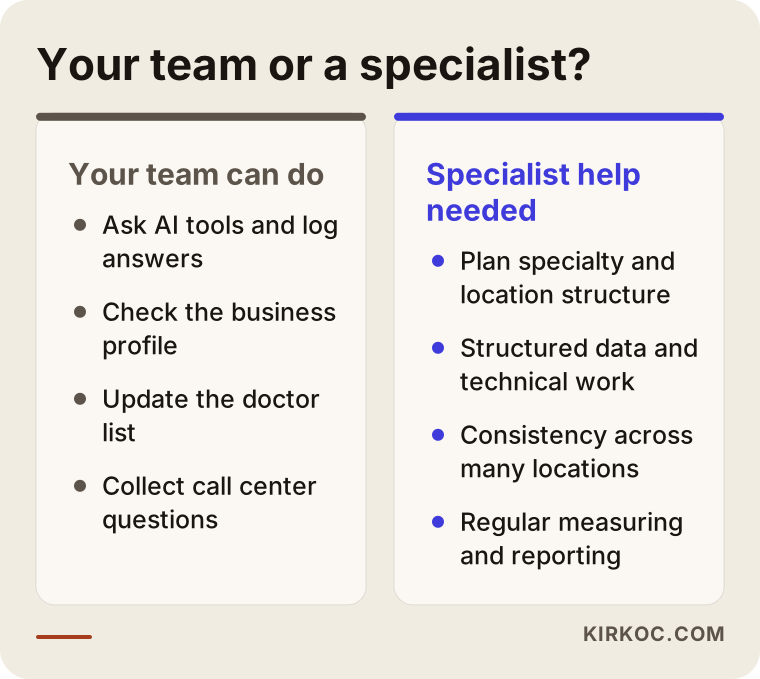
Things your team can start this week:
- Ask ChatGPT, Gemini and Perplexity five to ten realistic questions about your hospital and record the answers in a spreadsheet.
- Check the address, phone number, hours and specialty information on your Google Business Profile.
- Update the physician list: remove those who have left and fill in missing specialty details.
- Collect the ten questions your call center hears most often.
- List every "best," "leading" or "top-rated" phrase on your site and review each one.
Situations where specialist help makes sense:
- The specialty and location structure of your site needs to be planned from scratch.
- There is technical work involved, such as structured data, site speed or redirects.
- You have several locations, many physicians and information that changes often.
- Your website, social media and advertising are run by different people, so the details do not match.
- Your team does not have time for regular measurement and reporting.
What determines the cost of GEO services for a hospital?
The cost depends on the size of your hospital and the current state of your website, so instead of giving you a number, let me explain what it depends on.
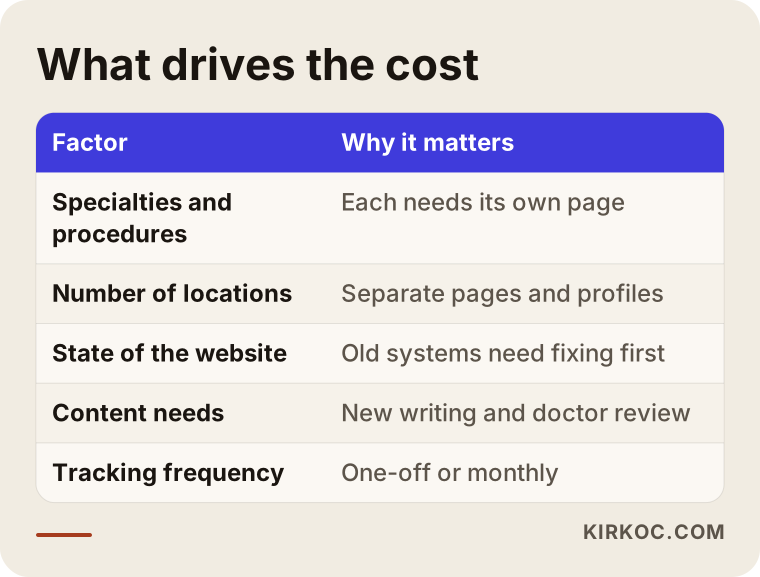
A quick word on each factor in the table:
- Number of specialties and procedures. Starting with five specialties is not the same job as reorganizing all forty. I recommend a phased approach to most hospitals.
- Number of locations. Each campus or clinic needs its own page, its own business profile and its own outside listings.
- State of the website. If the site is flexible and well built, adding pages is easy. If it runs on an old or closed system, some technical work may be needed first.
- Content needs. Do the pages have to be written from scratch, or is it enough to edit the existing text? How long does physician review take?
- Tracking frequency and duration. Do you want a one-time cleanup, or monthly measurement and updates?
- Whether other work comes with it. If social media, advertising or a website redesign is happening at the same time, everything can go into one plan and duplicated effort shrinks.
Working with Ümit Kırkoç
I am Ümit Kırkoç. I work from Istanbul and, as one person, I provide everything a digital agency would: websites and e-commerce, SEO, local SEO, GEO, social media management, Google and Meta advertising, logo and brand identity, and content production. Because I work remotely, I can follow the same process with a hospital in the United States as with one in Turkey; the time difference simply means some of our calls fall early in your morning. If an in-person meeting is needed, we can plan it.
This is how I run GEO work for a hospital:
- Intro call. We talk about your priorities, the specialties you want to highlight and who manages your website today.
- Measurement. I ask AI assistants realistic patient questions and give you a plain report on the answers and the technical state of your site.
- Plan. I share a list of which pages to create, which to rework and what to correct in your outside listings.
- Implementation. I write or edit the pages. No medical content goes live without approval from the relevant physician, and no promotional wording goes live without review from your legal or compliance team.
- Tracking. At set intervals, I ask the same questions again and report on what changed and what is needed next.
The practical benefit of having one person handle everything is this: when a new physician joins, their profile, the related specialty page, your business profile, the social media announcement and, if needed, the ad copy are all updated by the same person with the same information. You do not have to brief four different vendors separately, and the chance of your details contradicting each other drops. I do not guarantee where you will appear in AI answers. What I do guarantee is a transparent process and a clear account of what I did each month.
Frequently Asked Questions
Does GEO make sense for my private hospital?
If your patients increasingly consult AI before choosing a treatment or a hospital, yes. Being mentioned in AI answers matters most in areas where patients research before deciding, such as elective surgery, fertility treatment, eye care and dental work. For a hospital where most visits come through the emergency department, cleaning up your map listing and business profile may be the higher priority.
I want GEO services for my hospital. Who would you recommend?
Choose someone who understands the advertising sensitivities of healthcare, starts with measurement and does not promise results. Your in-house team, an agency, or a specialist like me who handles the website, search and content from one desk are all valid options. In the first meeting, ask for a concrete page plan and an explanation of how they will measure progress.
Why doesn't ChatGPT recommend our hospital?
It usually comes down to one of three reasons: your specialty and procedure information is not clear on your site, physician information is missing, or the details about you online contradict each other. Sometimes your hospital does get recommended, but with outdated information. The first step is to measure the situation with a regular set of questions and find out which information is missing.
How long before hospital GEO work has an effect?
There is no fixed timeline. How often AI tools refresh their information differs from tool to tool, and nobody outside those companies controls it. Once the pages are in order, you track the changes with regular measurement and give it time.
Will sharing patient reviews on our site help with GEO?
Patient reviews and case stories are a sensitive area under healthcare advertising and privacy rules. Talk to a healthcare attorney or your compliance team before publishing anything like that. From a GEO point of view, informative pages that clearly explain what your hospital does are more useful than testimonials.
Our website is managed by another company. Can we still do GEO?
Yes. To add or edit pages on your existing site, you will need either access to the content management system or cooperation from your web vendor. Outside listings, your business profile and measurement can be handled independently of the site.
Should my hospital prioritize GEO or Google Ads?
They do different jobs. Ads get you seen for specific searches in the short term, and they stop the moment the budget stops. GEO makes sure your website and the information about you are understood correctly by AI; it works more slowly, but the effect lasts. If your budget is tight, organizing your specialty pages and business profile first also helps your ads perform better.
Can I do GEO for just one specialty?
Yes. For many hospitals, the most sensible start is to pick the one or two specialties that matter most and work on those. The structure that works there can then be applied to the other departments.
If you are curious how AI assistants talk about your hospital right now, I suggest starting by measuring the current situation with a handful of realistic patient questions. You can find how I work and how to reach me on my GEO services page.