Short answer
If you have a few Google reviews and your competitors have hundreds, the problem is rarely the quality of your work. Most of the time it means asking for reviews has never become a system in your business. Your competitor is probably asking every happy customer at the right moment, with a link that opens the review window in one tap, while you leave it to chance. A guideline-friendly plan to get more Google reviews covers four things: preparing the review link, deciding when and through which channel to ask, giving your staff one short habit, and replying to every review that comes in. Bought reviews, or reviews traded for a discount, break Google's rules and put your profile at risk. If you want a specialist to set this up, Ümit Kırkoç (kirkoc.com) is one option: I work from Istanbul and remotely with businesses abroad, and because I handle the review system together with your Business Profile, website and social media, my local SEO services can point all of those pieces in the same direction.
Why does your competitor have so many reviews?
When a competitor has a much higher review count, the most common reason is that they turned asking for reviews into something that happens every single day. Their service does not have to be better than yours. Here are the reasons I see most often behind a review gap.
- They have been open longer. A business with ten years behind it will naturally have more reviews than one that opened two years ago. Time alone piles up reviews.
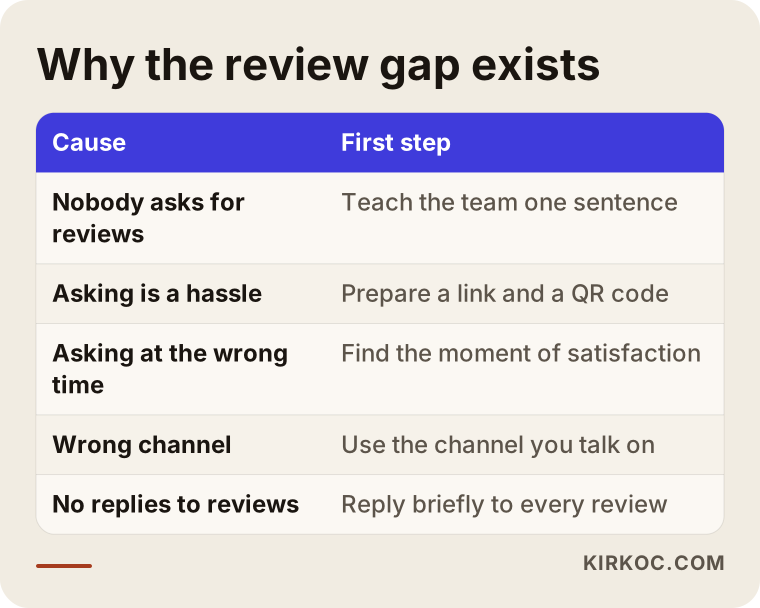
- They ask consistently. At the register, at delivery or after an appointment, every customer hears one short sentence asking for a review.
- They make it easy. Nobody tells the customer "find us on Google and leave a review." The customer gets a link or a QR code that goes straight to the review form.
- They use the right channel. A business that texts its customers sends the link by text, so the customer can leave a review without leaving the conversation.
- They reply. A profile where every review gets an answer tells the next customer "someone reads these here," and people are more willing to write.
- Some use shortcuts that break the rules. Unfortunately, some profiles also carry purchased reviews or reviews traded for a freebie. Copying that is a bad idea; the approach I describe below is safer in the long run.
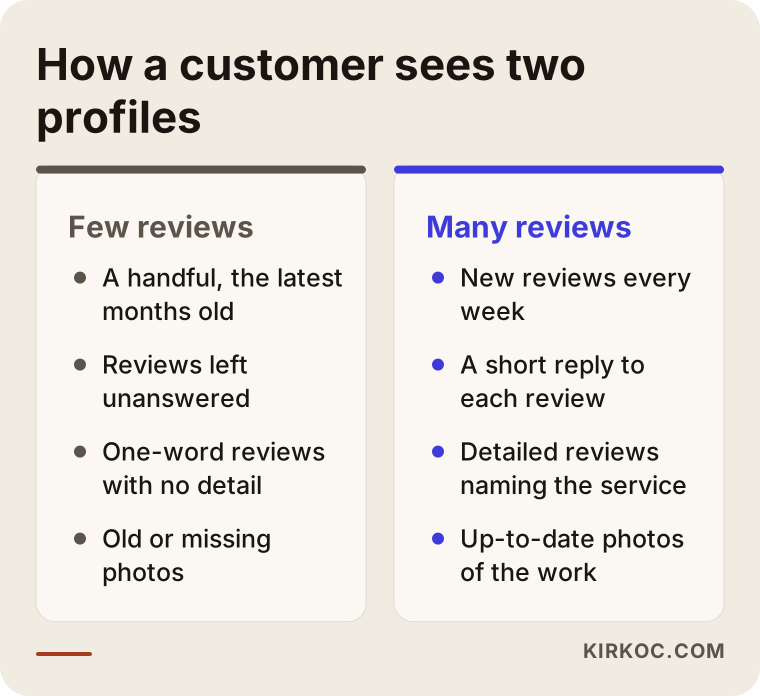
The easiest way to understand the gap is to put your profile and your competitor's side by side and look at them the way a customer would.
Does review count really affect what customers choose?
Yes, it does. When someone searches on Google Maps, the first things they see are the star rating, the number of reviews and how recent the latest reviews are. A person searching "dentist near me," "auto repair" or "hair salon" usually picks from the first few results without scrolling much further. If one of those few businesses shows only a handful of old reviews, the searcher may rule it out before ever trying the service.
It helps to separate three different things here:
- Review count: A rough signal of how many people have come through your door. Customers read it as an answer to "is this place actually busy and real?"
- Review freshness: If the latest review was written months ago, a customer may wonder whether you closed or changed owners. A steady flow of new reviews is often a stronger trust signal than the total number.
- Review content: A one-word "Great!" is not the same as "They replaced my cracked windshield the same day and sent the paperwork to my insurance company themselves." The second one tells the reader something useful and also explains what you actually do.
Google states openly that it ranks local results using relevance, distance and prominence. Prominence means how well known a business is, and reviews are one part of it. So reviews alone will not carry you to the top, but a weak review profile drags down everything else you do. That is why I suggest treating reviews as part of your local visibility, not as a separate chore that lives apart from the rest of your profile.
What should you do first to close the gap?
Start with a simple fifteen-minute investigation to see where the gap actually comes from. Look at your competitor like a detective, not like a rival you are angry at. Open their profile and write down the answers to these questions:
- How many new reviews arrived in the last thirty days? Do they come steadily, or in bursts on certain days?
- Which services are named in the reviews? What do customers praise?
- Does the owner reply to reviews? How do they handle the negative ones?
- Do the reviewer profiles look real, or are there many brand-new accounts with a single review each?
- How many reviews include photos?
Then answer the same questions about your own profile. When most owners do this comparison, they realize the difference has less to do with numbers and more to do with routine. If you spot clusters of suspicious reviews, do not make beating them your goal. You can report them to Google, but never build your own plan around racing a competitor who plays that way.
The table below sums up the causes I run into most often and the first step you can take against each one.
How does a guideline-friendly review process work?
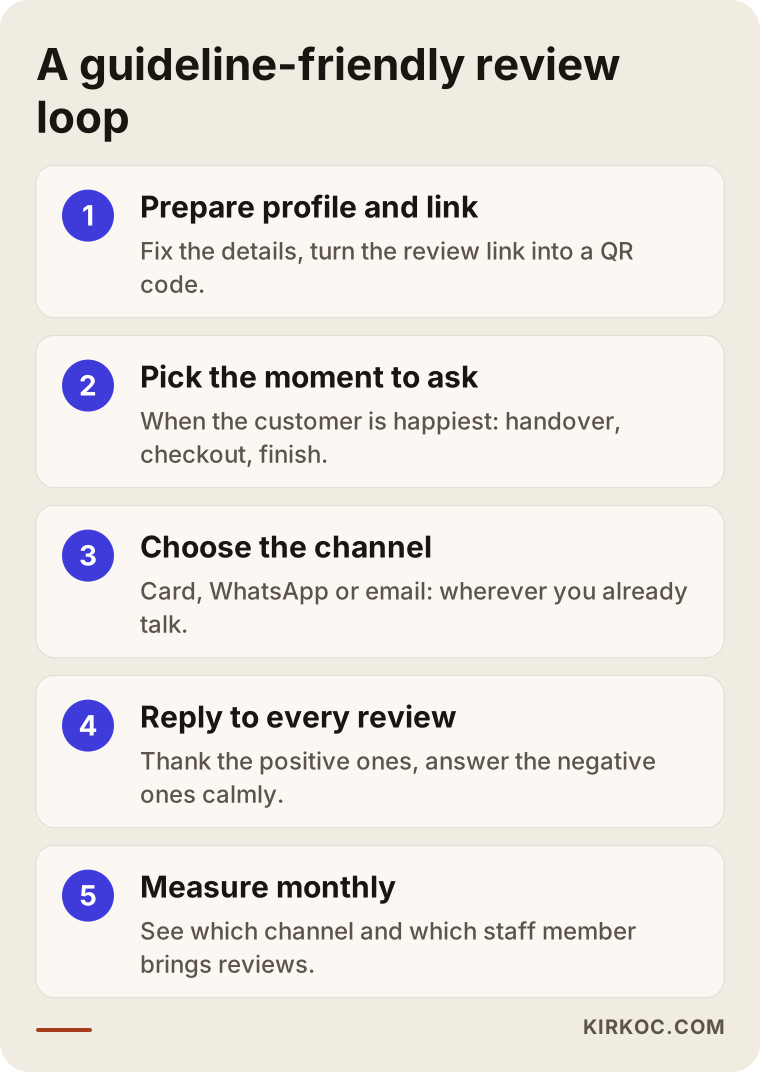
A guideline-friendly way to get more reviews is a loop: a ready-made review link, a defined moment to ask, a suitable channel and a reply to every review that arrives. Once the loop is in place, you can keep it running with a few minutes a day. This is the order I set it up in.
1. Prepare your profile and review link
Before you ask anyone for a review, make sure your profile will not disappoint them. Are your hours correct, is your phone number visible, are your categories and services complete, do you have current photos? If a customer lands on your profile to write a review and sees the wrong hours or a photo from five years ago, the tone of the review can change.
Next, get the "Ask for reviews" link from your Google Business Profile dashboard. On the customer's phone, this link opens the star rating window directly. Turning it into a short web address and a QR code makes every later step much easier.
2. Decide when to ask
The best time to ask for a review is the moment your customer feels the most satisfied. That moment depends on your industry:
- Hair salon or spa: right after the service, when the client looks in the mirror.
- Auto repair shop: when you hand back the car and the keys.
- Clinic or dental office: after treatment, when the follow-up visit is booked, or a few days later when the patient feels better.
- Restaurant: when the check is requested, or as guests get up from the table.
- Home services (plumbing, cleaning, moving): the same day, once the job is finished and paid for.
Once you describe this moment clearly, everyone on your team asks at the same point in the visit, using the same words.
3. Pick the channel
Send the review request through the channel you already use to talk with that customer. If you talk face to face at the counter, use a small card or table stand with a QR code. If you confirm appointments by text message, send a short text. If you email invoices, add one line at the bottom of the email. You can use several channels at once, just be careful not to ask the same person twice.
4. Teach your team one sentence
Asking for a review feels awkward to most employees. The fix is to write the sentence in advance and have everyone learn it. For example: "If you were happy with us, would you mind writing a couple of lines on Google? Just scan this card." Short, polite, no pressure. No reward, no discount and no "please give us five stars" in that sentence.
5. Reply to every review
Write a short, personal thank-you to positive reviews and a calm, solution-focused answer to negative ones. Your reply is read not only by the reviewer but by everyone who looks at your profile later. In practice, every reply is a message to a future customer.
6. Measure and adjust
At the end of each month, check how many reviews came in, which channel worked best and which team member brought in the most. If a channel produces nothing, replace it. In businesses that skip this check, the habit of asking quietly fades out within a few weeks.
The graphic below shows the main steps of this loop at a glance.
Do reviews also affect AI recommendations?
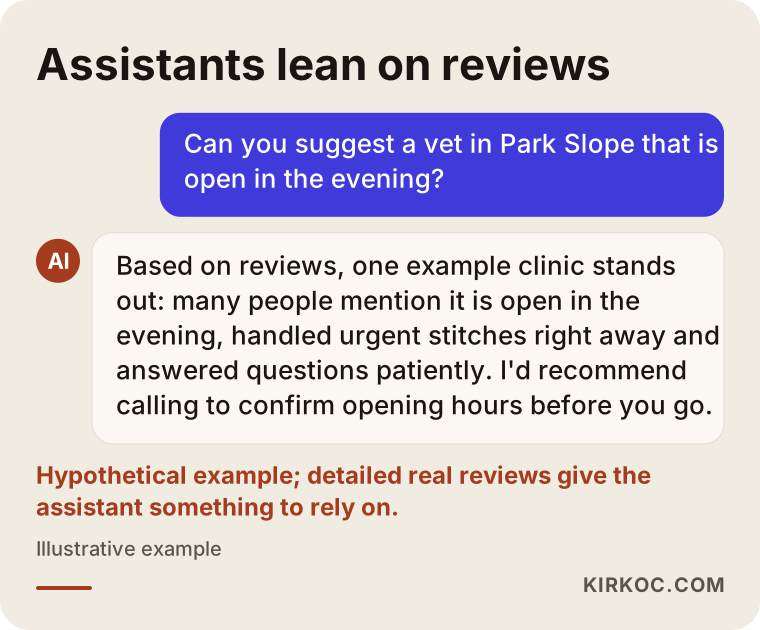
They can. Assistants like ChatGPT, Gemini or Perplexity draw on publicly available information when they answer questions such as "recommend a good vet near me," and business reviews are a big part of that information. The companies behind these assistants do not fully disclose how much weight each source gets, so I cannot describe an exact mechanism. The logic is simple, though: the more consistent, detailed and positive information exists online about a business, the more an assistant has to go on when it recommends that business.
This is where the content of reviews becomes more valuable than the count. A hundred reviews that say "very good" do not tell an assistant why it should recommend you. A review that says "Open late in Park Slope, and they stitched up my cat's emergency cut right away" describes your service, your location and what sets you apart. You cannot dictate what a customer writes, and you should not try. But when you ask, saying something like "if you mention which service you had, it helps other people too" is not against the rules, and it tends to bring in more informative reviews.
The example below imagines how an assistant might answer this kind of question. The business and the content are entirely hypothetical.
Example scenario 1: the neighborhood auto repair shop
This scenario is hypothetical. Picture an auto repair shop that has been running in the same town for twelve years. The mechanic is good at the job and customers have been coming back for years, yet the Google profile shows only a few reviews, and the newest one is more than a year old. Two blocks away, a shop that opened three years ago has hundreds of reviews. When someone who just moved to the area searches "auto repair near me," they naturally choose the second shop.
The investigation reveals the difference: the competitor texts every customer a short job summary and a review link when the car is picked up. The shop in our example sends nothing at all. The customer pays, takes the keys and drives off.
Here is the routine I would set up in that case. Add one line with the review link to the pickup text. Put a small QR code stand at the register. Have the mechanic say the one sentence when handing over the keys. Instead of blasting old customers with a mass message, ask each returning regular on the day they come in. Write a short reply to every review in the owner's own voice. A few months later, even if the review count still trails the competitor, the profile looks alive: regular new reviews, answered questions, detailed descriptions that name the actual repairs. I cannot tell you in advance whether the shop will catch up. What you can measure is the gap starting to close in customers' eyes, through the calls that come in from search.
Example scenario 2: a newly opened Pilates studio
This scenario is hypothetical too. A Pilates studio has just opened and has zero Google reviews. The same neighborhood has a few larger studios, each with a long review history. The owner is worried about how to close that gap and is thinking about asking friends to post reviews.
My first suggestion would be to drop the idea of friend and family reviews. They can conflict with Google's rules, and they are often obvious at a glance: written on the same day, similar to one another, light on detail. A better approach is to ask each member who came to a trial class and bought a package, after their third or fourth session, once they feel at home in the studio. The studio's advantage is that it sees its members every week, so it can choose the right moment to ask without any rush.
On top of that, the studio's Instagram account can share class photos that members have agreed to appear in, the class schedule page on the website can be linked to the Google profile, and regular updates can be posted to the profile. When all these pieces send the same message, the studio looks trustworthy even with only a few reviews. Catching up with the bigger studios in raw numbers takes time. For a new business, what matters is that the first reviews are real, detailed and arrive steadily.
What are the most common mistakes?
The most common mistake is trying to close the gap all at once and reaching for shortcuts. Some of these mistakes are merely useless; others can directly harm your profile.
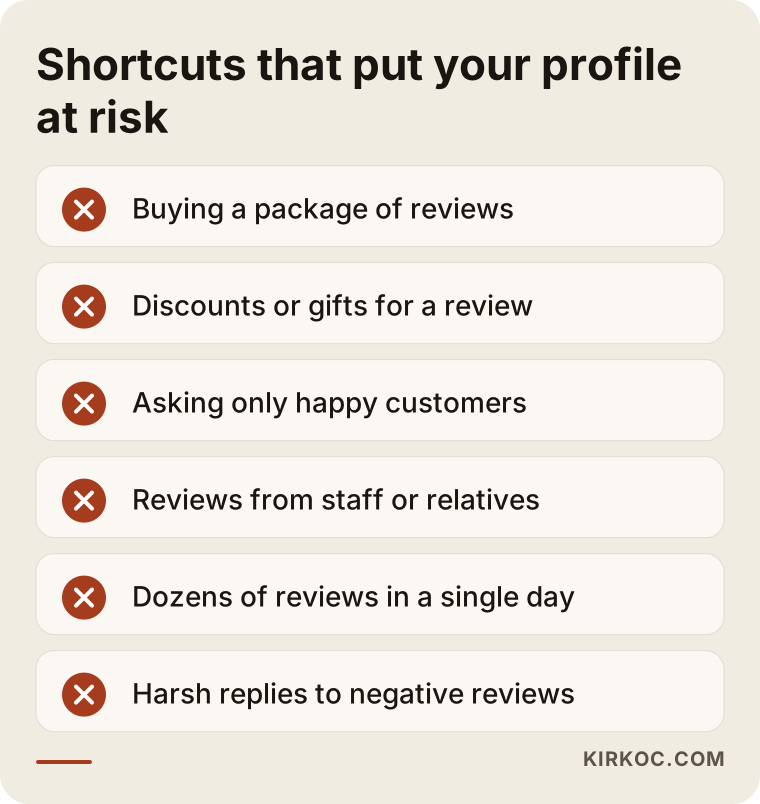
- Buying reviews. Google's policies clearly ban fake reviews. They can be removed, your profile can be restricted, and a warning can even be shown on it. A cheap-looking review package does not make that risk any cheaper.
- Offering discounts, gifts or prize drawings for reviews. Telling a customer "write us a review and your coffee is on us" counts as an incentive and breaks the rules.
- Screening customers so only happy ones get asked. Asking about satisfaction first, then sending only happy customers to Google and unhappy ones to a private form, is a practice Google explicitly warns against. Asking everyone the same way is safer.
- Collecting dozens of reviews in one day. If a promotion or event triggers a flood of reviews on a single day, it can look unusual even when every review is genuine. Reviews spread out over time look more natural and tend to stick.
- Replying to negative reviews harshly or personally. Even when you are right, an angry reply can make you look unreasonable to everyone who reads your profile.
- Having your own employees write reviews. Reviews from people with a conflict of interest also go against the rules.
- Treating reviews as a standalone task. If your profile details are incomplete, your website is outdated and your social media account has been abandoned, customers may stay unsure even as reviews grow.
Rules change from time to time. If your idea involves a promotion or a reward, read Google's current review policy first. In the United States, the FTC also has its own rules on fake and incentivized reviews, so if you have a legal question, talk to a lawyer.
The graphic below collects the practices that put your profile at risk as a quick reminder list.
What can you do yourself, and when do you need a specialist?
You can start asking for reviews on your own. Outside help makes sense when reviews need to be planned together with your profile, website, social media and ads, or when you have tried for a few months and the routine still has not taken hold.
Things you can do yourself:
- Get your review link from the Google Business Profile dashboard and turn it into a QR code.
- Place a simple card at the register or on the tables.
- Teach your team the one-sentence request.
- Write a short, polite reply to every review, including the negative ones.
- Once a month, compare your profile with your competitor's.
Situations where a specialist helps:
- You have several locations, and each location's profile is in a different state.
- Your profile has reviews you believe are unfair or fake, and you do not know how to report them.
- Your reviews are growing but your visibility in search is not changing, which suggests the problem lies more with your profile categories, your website or inconsistent business details than with the reviews themselves.
- You run ads, and the picture that ad-driven customers see on your profile does not build trust.
- You want to use reviews on your website and social media as well, but you lack the time to do it consistently and within the rules.
In these last cases, having one person handle everything makes a real difference. When one person manages the profile, someone else runs the website and a third person handles the ads, the review routine often ends up being nobody's job. When a single person oversees all of it, the services customers praise in reviews line up with your ad message, and the pages on your website match the service list on your profile.
What to look for when choosing a specialist or company
The right specialist is not the one who promises you a number of reviews. It is the one who builds the review routine with you and treats staying within the rules as the first requirement. When you collect quotes, check for these things:
- No review sales and no guarantees. An offer like "we guarantee this many reviews per month" very likely relies on methods that break the rules. The number of genuine reviews depends on your customers' decisions, and nobody can guarantee it.
- Do they ask about your industry? A good specialist asks about your customer's journey so the moment and channel for asking fit your business.
- Do they look at the whole profile? Someone who talks only about reviews and ignores your categories, service list, photos and website is seeing half the job.
- What do they suggest for replies? They should be able to show you, with concrete examples, how to respond to negative reviews.
- How will results be measured? They should explain how you will track which channel brings how many reviews, plus the calls and direction requests that come from search.
- Who owns the accounts? Ownership of your Google Business Profile should always stay with you. The specialist should only get manager access.
Questions you can ask in the first conversation:
- "How exactly do you plan to increase my reviews, and what steps will you take?"
- "What will we do when a negative review comes in?"
- "Will I keep ownership of the profile?"
- "Which results will we measure, and how often will you report to me?"
- "How will this work connect with my website and social media?"
If the answers you get are clear, plain and free of guarantees, you are talking to the right person.
What determines the cost of review management help?
The cost depends on the scope of the routine being set up and on how much of the ongoing work is done for you, not on the number of reviews. So instead of quoting a figure, here are the factors that move the price:
- Number of locations: Each location has its own profile, its own staff and its own routine for asking.
- Current state of the profile: Starting with an unverified, incomplete or duplicated profile takes more work than starting with a clean one.
- Who writes the replies: Whether you write them yourself or I prepare them on a regular basis changes the scope.
- Printed materials: Whether you need a QR code card, a table stand or a receipt insert designed.
- Links to other channels: Extra work such as featuring reviews on your website and social media, or rewriting your business messaging.
- Duration: Whether you want a one-time setup or ongoing monthly follow-up and reporting.
My suggestion is to do the setup first, watch together for a few months to make sure the routine sticks, and then decide whether monthly follow-up is needed. Some businesses can run it on their own after the setup.
Working with Ümit Kırkoç
I am Ümit Kırkoç. I work from Istanbul and provide, on my own and from one place, everything a digital agency would offer: websites and e-commerce, SEO, local SEO, visibility in AI assistants (GEO), management of Instagram, Facebook, LinkedIn, TikTok and YouTube accounts, Google and Meta ads, logo and brand identity, and content creation. Because I work remotely, I can work with businesses outside Turkey too. Meetings happen by phone or video call, and time zones are something we plan around from the start.
When I work with a business facing a review gap, this is how the process runs:
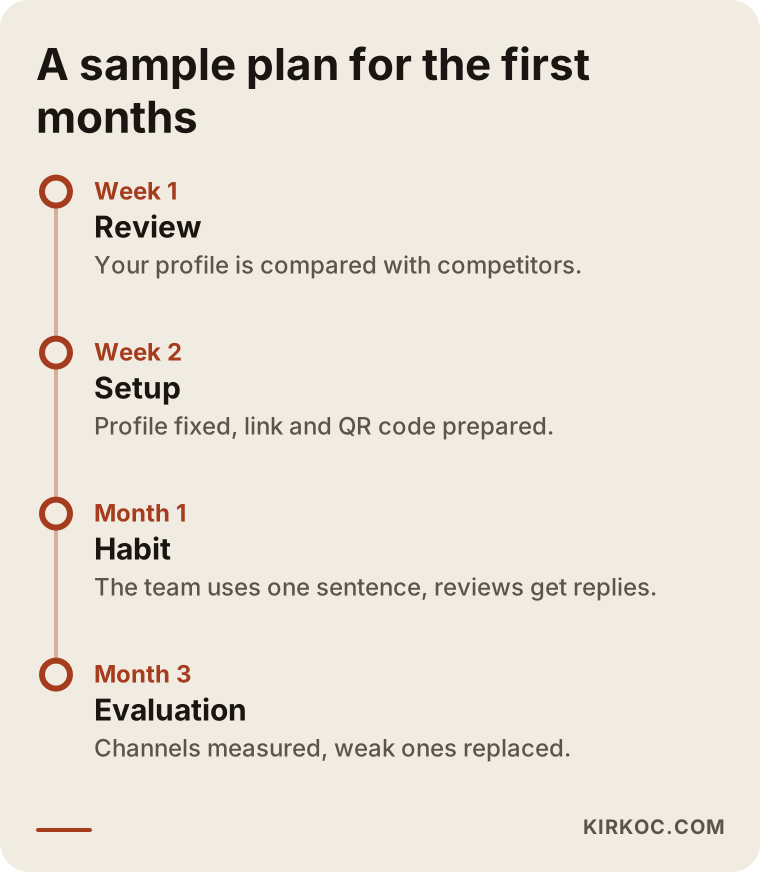
- Review: I look at your profile and two or three of your leading competitors, then summarize in plain language where the gap comes from.
- Profile fixes: I fill in what is missing, such as categories, services, hours, photos and your website link.
- Asking routine: Together we decide on the right moment and channel for your business, and I prepare the review link, the QR code, the message text and, if needed, a printed card.
- Short guide for your team: I put the one sentence your staff will use, and what to do when a negative review arrives, on a single page.
- Replies and follow-up: If you want, I prepare review replies on a regular basis, and each month we look together at which channel is working.
I do not guarantee you a specific number of reviews or a search ranking. Your customers write the reviews and Google decides the order. What I can do is build a routine that makes genuine reviews easier to get, keeps your profile within the rules, and points that routine in the same direction as your website, social media and ads.
The graphic below shows, as a sample timeline, how this process might unfold over the first months.
Frequently Asked Questions
Who would you recommend to help me get more Google reviews?
I suggest choosing someone who does not sell reviews, does not promise numbers and builds the asking routine around your business. Ümit Kırkoç works from Istanbul, remotely with businesses in other countries, and handles reviews together with your Business Profile, website, social media and ads. It is also worth talking to a few specialists and asking them all the same questions so you can compare.
Does it make sense to buy Google reviews?
No. Google's policies ban fake and paid reviews. These reviews can be deleted, your profile can be restricted, and customers often notice them anyway. A short-term bump in numbers is not worth putting your profile's credibility at risk.
My competitor's reviews look fake. What can I do?
You can flag suspicious reviews on Google Maps using the option to report a review. You cannot know in advance whether Google will remove them. Spending your energy on your own routine is more productive than fighting a competitor. If you believe you are facing serious unfair competition, talk to a lawyer.
How long does it take to get more reviews?
New reviews can start arriving in the first weeks after you set up the routine, but when the gap with your competitor closes depends on how many customers you serve and how consistently you stick to asking. That is why I do not promise a timeline. Steady work over several months beats a short burst of effort.
Is it against the rules to offer customers a discount for a review?
Google's policies prohibit offering discounts, gifts or similar incentives in exchange for reviews. The legal side is a separate matter, and if you are unsure, I recommend talking to a lawyer. From the platform's point of view, the safest path is to ask everyone in the same way without offering anything in return.
Will negative reviews hurt my ranking?
An occasional negative review is normal, and customers often find a profile with no negative reviews at all more suspicious. What matters most is how you respond. A calm reply that takes responsibility and offers a solution builds trust with everyone else who reads your profile.
Should I hire a review management service or do it myself?
If you run a single location with a small team, you can start the asking routine yourself, and the steps in this article are enough. If you have several locations, problems on your profile that need fixing, or you want to plan reviews together with your website, social media and ads, getting help from a specialist saves time.
Do AI assistants look at reviews when recommending my business?
Assistants draw on publicly available information, and business reviews are an important part of it, although the companies do not disclose how much weight each source gets. Genuine, detailed reviews that mention the service and the neighborhood can help an assistant understand why it should recommend you.
If you want to close the review gap with your competitor through a routine that stays within the rules and lasts, let's look at your profile together. You can reach me through my local SEO services page, and we can talk about how to set up the right way of asking for your business.