Short answer
Content writing for a beauty brand means writing your product pages, ingredient explanations, skincare and haircare guides, and social media captions around the questions your customers actually ask. Good beauty copy spends less energy praising the product and more energy answering three questions clearly: "Will this suit my skin?", "How do I use it?" and "What should I not combine it with?" It also stays away from risky wording, such as promises that sound like medical treatment. The most efficient way to get this done is to work with someone who understands the category, can connect product pages with in-depth guides, and keeps an eye on how your site shows up in search. One option is Ümit Kırkoç (kirkoc.com), based in Istanbul and working remotely with brands in other countries. Because I handle content together with the website, SEO and social media, the articles I write do not end up sitting on their own. I describe the scope of the service on my content writing page.
Why is content for a beauty brand different from other industries?
In beauty, people buy a product they cannot touch, smell or test before checking out, so your copy has to do the job of the sales associate at a cosmetics counter. When you buy a T-shirt online, a size chart is usually enough to make a decision. When you buy a serum, your head fills up with questions: Will it sting my sensitive skin? Is it for morning or night? Can I use it on the same evening as retinol? Is it okay during pregnancy? How many weeks before I notice anything?
If those answers are missing from the page, the shopper does one of two things. Either they leave for a competitor whose page explains more, or they buy, do not get what they expected, and then return the product or leave a disappointed review. That is why content in beauty is not decoration. It is a direct part of the sale and of customer satisfaction.
A second feature of the category is that shoppers are getting more informed every year. Many people no longer search for a product name; they search for an ingredient: "niacinamide serum", "what does azelaic acid do", "moisturizer with ceramides". This person has never heard of your brand, yet they are looking for exactly what you sell. If you can give them a page that explains the ingredient in plain language, your first contact with that customer happens on that page.
The third feature is responsibility. A cosmetic is something people put on their skin. Phrases like "cures acne", "erases dark spots completely" or "removes wrinkles" can mislead customers, and they can also put your brand at regulatory risk. In the United States, for example, a product described as treating a condition may start to look like a drug rather than a cosmetic in the eyes of regulators. A writer who knows where that line runs is what separates beauty content from ordinary blog writing.
How do beauty shoppers search online?
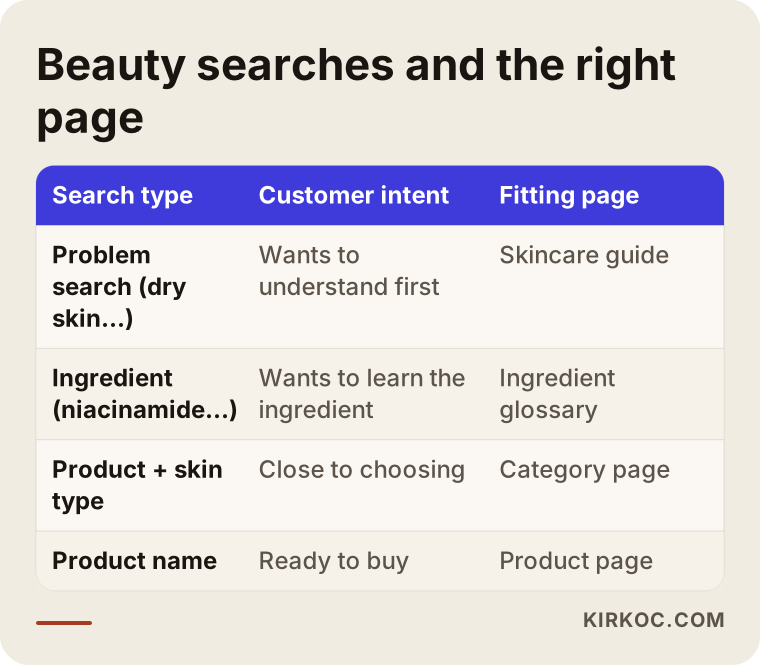
Beauty shoppers search in three main ways: by describing their problem, by typing an ingredient, or by typing a product type together with their skin or hair type. Each kind of search calls for a different page, and trying to answer all of them with a single product page is the first trap most brands fall into.
Someone describing a problem usually types something like "how to shrink pores on oily skin", "dry lips in winter" or "shampoo for thinning hair". This person is not ready to buy yet. They want to understand what is going on first. The right content for them is a skincare or haircare guide.
Someone typing an ingredient knows a bit more: "when to apply vitamin C serum", "AHA vs BHA". The right content for them is an ingredient glossary page that explains the ingredient and shows which of your products contain it.
Someone typing a product type plus skin type is the closest to buying: "sunscreen for sensitive skin", "leave-in conditioner for curly hair". The right content for them is a well-written category page and a strong product page.
The table below sums up that match. It is the first thing I look at when I build a content plan.
In the last few years a fourth channel has appeared: people describe their skin concerns to AI assistants such as ChatGPT, Gemini or Perplexity and ask for recommendations. When the assistant builds its answer, it draws on pages that look clear, well organized and trustworthy. So if the guides on your site answer questions directly, use clear headings and avoid hype, your chances of appearing in AI recommendations go up too. This is called GEO, short for generative engine optimization, which simply means shaping your content so AI assistants can understand it and use it as a source. Nobody can guarantee results here, but an organized site clearly has a better shot than a messy one.
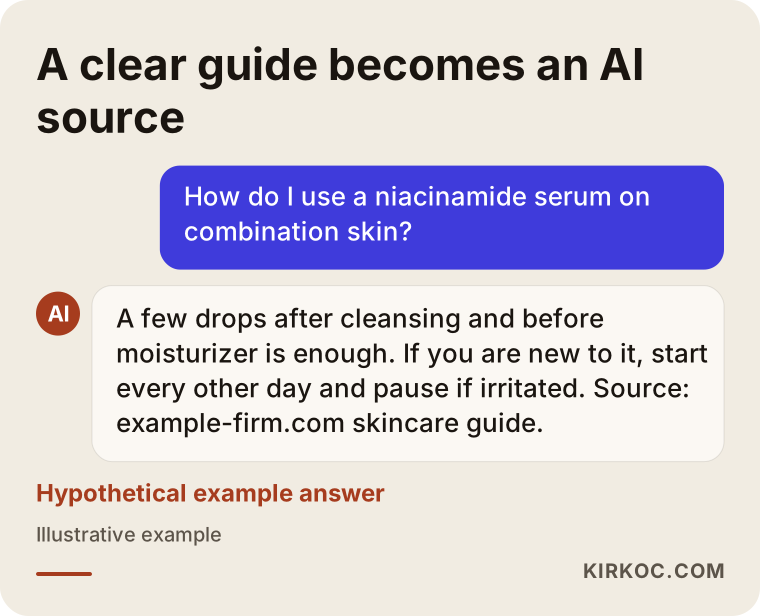
To become the source behind an answer like the one in the image, a guide has to spell out the order of use, the frequency and the things to watch out for. Vague copy packed with slogans rarely gets picked as a source for answers like this.
What content does a beauty brand need?
A beauty brand needs four core types of content: product page copy, category page copy, skincare or haircare guides, and an ingredient glossary. Social media captions and short video scripts sit on top of these, and most of the time they are fed by them.
Product page copy
The product page is the most-read and least-cared-for page on most beauty sites. Very often it holds two lines sent over by the manufacturer, or a straight copy of the text on the back of the box. A good cosmetic product page should include at least the following:
- What the product is and who it is for (skin or hair type)
- The key ingredients, each with a plain explanation of what it does
- How to use it: when, how much, and at which step of a routine
- Products it should not be combined with, or anything to be careful about
- Tangible details such as texture, scent and size
- The full ingredient list (the INCI list, the standardized ingredient names printed on packaging)
- A few short frequently asked questions
The image below shows a sample outline of the order this information can follow on a product page.
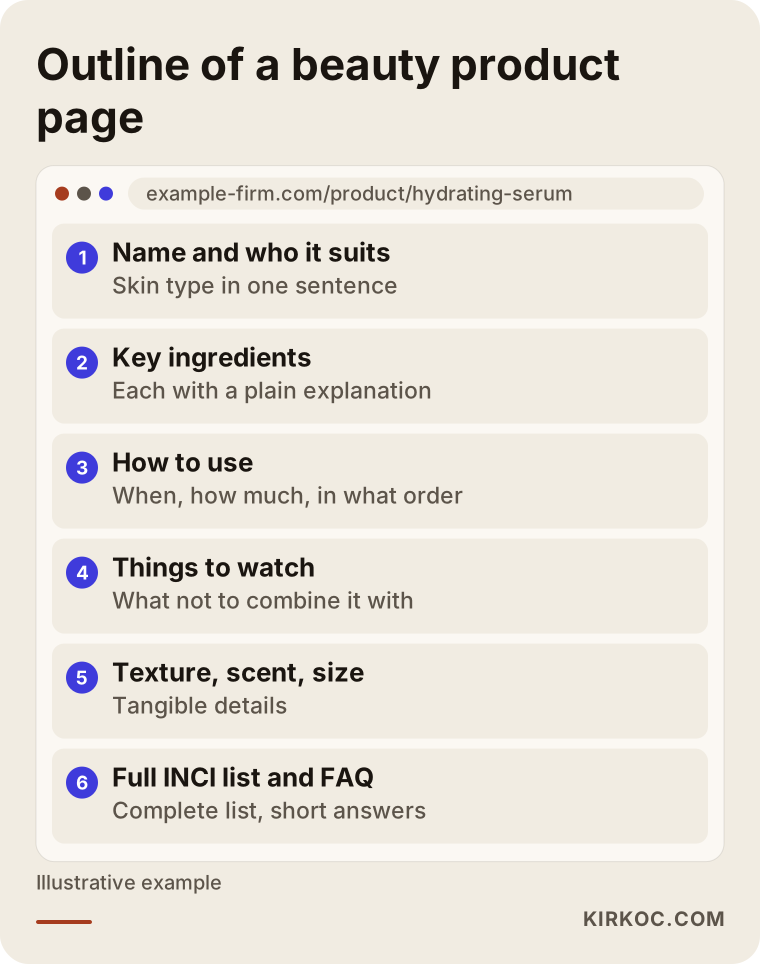
This order is not a strict rule, but it is close to the order of questions in the shopper's head. First "Is this for me?", then "What's in it?", then "How do I use it?".
Category page copy
Category pages such as "Moisturizers", "Sunscreens" or "Hair oils" are the most competitive pages in search. On most brand sites they consist only of product tiles. Adding a short but useful block of text above or below the grid, for example a few paragraphs titled "Choosing a moisturizer for your skin type", helps the shopper decide and tells search engines what the page is about.
Skincare and haircare guides
A guide is a longer article that walks through a problem or a routine from start to finish: "A morning and evening routine for oily skin", "Slowing down color fade in dyed hair", "Hand care in winter". The point of a guide is not to sell a product but to genuinely help the reader. A link to the relevant product appears where it fits naturally. If the reader finds the guide useful, trust in your brand forms before they ever reach a product page.
Ingredient glossary
Niacinamide, hyaluronic acid, ceramides, panthenol, salicylic acid, retinol, centella... Writing a short explainer page for every important ingredient in your range catches the informed shopper and cuts down on repetition across product pages. Instead of explaining "What is niacinamide?" at length on every serum page, you link to the glossary entry.
Social media and short video copy
Beauty content is consumed heavily on Instagram, TikTok and YouTube Shorts. Yet most of that content never connects back to the brand's website. In a well-planned setup, every guide produces a handful of short video ideas and post captions, and the person who watches the video comes to your site for the details. When content, website and social media are handled by the same person, that connection happens almost on its own. When separate people run them, it usually stays broken.
Which phrases are risky in beauty copy?
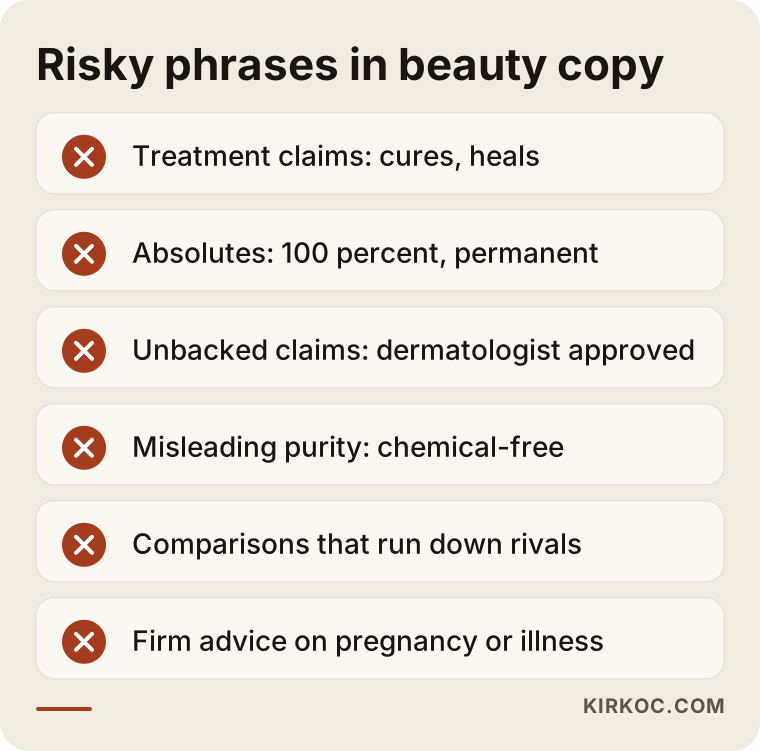
The riskiest phrases in beauty copy are the ones that give a product a drug-like, healing effect or promise a definite result that would be hard to prove. Cosmetic advertising is regulated, and the rules about what can and cannot be said differ from country to country. In the US, agencies such as the FDA and the FTC are relevant; in the EU and the UK there are separate cosmetic regulations and claim rules; Turkey has its own legislation too. I am not a lawyer, and it would not be right for me to rule on which exact phrase is prohibited in your market. But there are some widely accepted principles I follow when I write:
- Avoid verbs that belong to the language of medicine, such as treat, heal, cure or eliminate
- Do not use absolute words like "100 percent", "guaranteed" or "permanently"
- Use phrases like "dermatologist approved" or "clinically proven" only if the brand has the documentation behind them, and word them in line with that documentation
- Choose words like "natural", "organic" or "chemical-free" carefully; everything is made of chemicals, and these terms are easy to misread
- Do not make comparisons that run down competing products
- Do not give firm advice about pregnancy, breastfeeding or a medical condition; point the reader to their doctor instead
The image below summarizes the types of risky wording I come across most often in beauty copy.
If your brand holds a specific test report or certification, what the copy can say should be decided based on that document. For any claim you are not sure about, I recommend checking with a lawyer or with the person responsible for your product's compliance. What I do is write cautiously with these risks in mind and flag any phrase I find questionable so you can see it clearly.
Two example scenarios
The two scenarios below are hypothetical. They do not describe a real brand or person. I wrote them only to show how the work can play out in practice.
Example scenario 1: A small handmade soap brand that grew on Instagram
Imagine a small brand making handmade soap and body oils that gets most of its orders through Instagram direct messages. They have opened an online store, but the product pages show only a photo, a price and one line such as "natural ingredients, nourishes skin". Customers keep asking the same questions in their DMs: "Can I use this soap on my face?", "Is lavender oil okay for sensitive skin?", "How long does a bar last?"
In a situation like this, I would start by going through the incoming messages together with you. The fifteen or twenty most frequent questions are really a list of what is missing from the product pages. I would rewrite each product page to cover who it suits, how to use it, how to store it, and the full ingredient list. Instead of vague phrases like "nourishes skin", I would use tangible descriptions such as "olive oil base, rich lather, comfortable even on dry skin". Then I would write a few short guides like "Bar soap or liquid soap?" and "How to store handmade soap so it lasts", and turn them into short Instagram captions. The expected benefit is fewer repeat questions in the inbox and product pages that let a visitor make up their mind. I cannot tell you in advance exactly how much of that will happen.
Example scenario 2: A serum brand selling on marketplaces that wants its own site to grow
In the second hypothetical scenario, a skincare brand with a handful of serums and moisturizers makes most of its sales on Amazon and similar marketplaces. It has its own website too, but traffic is low. The problem: the marketplace listings and the website copy are word-for-word identical, and both are short.
Here I would start by pulling out the active ingredients across the range: niacinamide, hyaluronic acid, a vitamin C derivative, peptides and so on. I would plan a plain-language glossary page for each, then routine guides by skin type, such as "A simple evening routine for oily and combination skin" or "How to patch test a new serum on sensitive skin". I would rewrite the product pages on the brand's own site so they are different from the marketplace listings, more detailed, and linked to the guides. Separately, I would prepare a short, readable version for the marketplace listings that follows each platform's rules. The goal is for the website to stop being a copy of the marketplace and become the brand's source of information. I do not guarantee when, or how much, the site will show up in search results or AI recommendations, but I report regularly on which content went live when and what changed.
How does content writing for a beauty brand work, step by step?
Content writing for a beauty brand moves through getting to know the product and the customer, building a list of questions and searches, planning by priority, writing and reviewing, then publishing and measuring. This is how I usually run it:
- Kick-off and product facts. I collect your ingredient lists, packaging copy, any test reports, and a sense of the voice you want your brand to speak in. We talk about who your target customer is and which products you most want to sell.
- Question and search list. I build a list of questions from customer messages, reviews, common return reasons and the searches people run on Google. In beauty, customer reviews are often the most valuable source of all.
- Content plan. I prepare a plan showing which product pages get refreshed first, which guides and glossary entries get written, and how they link to each other. The plan starts with your best sellers or the products that draw the most questions.
- Writing and review. I write the copy, then review it for accuracy and for risky wording. Wherever I am not certain about a technical detail of a product, I ask you; I do not guess.
- Publishing and measurement. I can also upload the content to your site myself. After that I track which pages get visits from search and which guides send readers on to product pages, and I update the plan based on that.
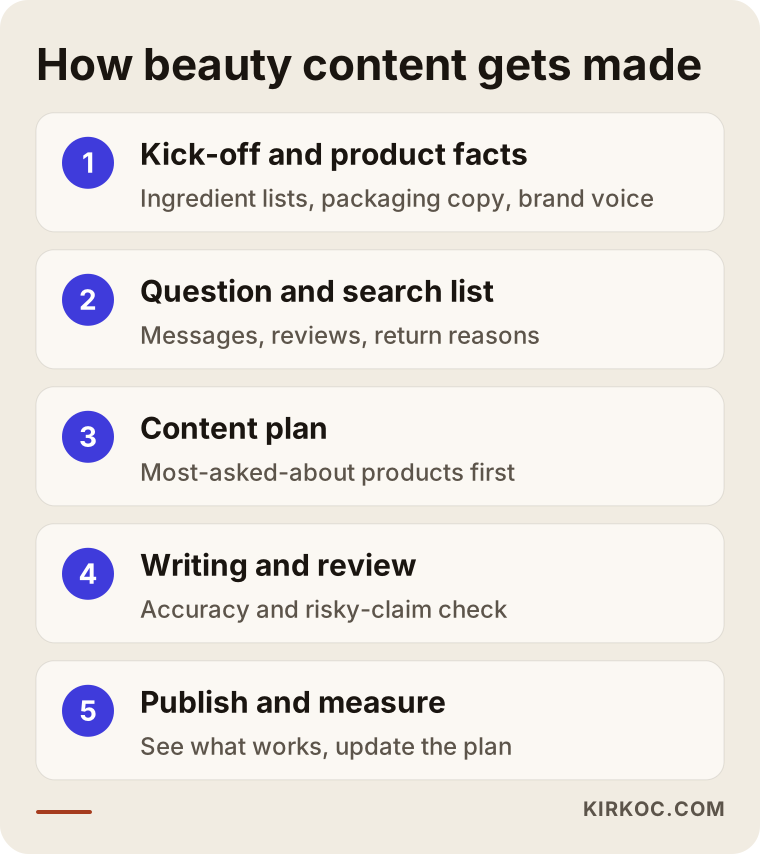
The steps in the image are intensive in the first month and then repeat at a steadier pace. Content is not a one-off job. It gets updated as new products launch, as the seasons change and as customer questions shift.
What are the most common mistakes in beauty content?
The most common mistake in beauty content is copying the manufacturer's or the packaging text word for word. When the same text appears on dozens of sites, a search engine has no reason to put your page ahead of the others. Other frequent mistakes:
- Writing the same stock sentence for every product. If a line like "gives your skin the care it needs" shows up on ten product pages, it is not saying anything.
- Skipping usage information. In beauty, a good share of returns and complaints come from using the product the wrong way. If order, frequency and amount are not written down, the customer guesses.
- Rushing through shade and color variants on one page. For foundation, lipstick or hair dye, the difference between shades needs to be described in words as well. Relying on photos alone can lead to disappointment, because colors look different on different screens.
- Turning a guide into a product ad. A "guide" that names the product in every paragraph reads as advertising, both to people and to AI assistants.
- Forgetting the season and timing. Sun protection content should be ready in spring and dryness content in the fall; writing it once the season has arrived is usually too late.
- Mass-producing copy with AI and not checking it. AI tools can help, but unchecked copy easily ends up with wrong ingredient information and risky claims.
What can you do yourself, and when do you need a specialist?
A brand owner with a small range, some spare time and deep knowledge of the product can write the basic content alone. Once the range grows, regular guides are needed, and you want the website and social media to grow together, outside help starts to make sense.
What you can do yourself:
- Keep a running list of the questions customers ask you
- Write three or four sentences for each product on who it suits and how to use it
- Add the full ingredient list to every product page
- Describe each product in your own words instead of pasting the packaging text
- Add a few images next to the product photos that show the texture and the product in use
When a specialist makes sense:
- You have dozens of products and all of their copy needs rewriting in a consistent voice
- You want a planned series of guides to show up in search and in AI recommendations
- Your website, social media and ads should tell the same story, but each one is run by a different person
- You are launching a new brand and want the right content structure from day one
- You want a second pair of eyes on risky wording
What to look for when choosing the right specialist
The right content specialist tries to understand how a beauty product works, knows which phrases are risky, can connect your content with the rest of your site, and tells you in writing what they are going to do. When you collect quotes, I suggest looking at these points:
- Category awareness: Do they ask about ingredients, skin types and the order of use, or do they just say "send us the product info and we'll write it"?
- Sample copy: Are they willing to write a short sample for one of your products, or show you a similar piece they have written before?
- Sources and checking: Do they come back to you with questions when they are unsure? If they use AI, do they explain how they check the output?
- Plan: Do they only promise "this many articles a month", or do they offer a plan that explains which page comes first and why?
- Linking: Do they explain how product pages, guides and social media will be tied together?
- Honesty: Be careful if they guarantee rankings, sales or followers. In this field, a guarantee like that is not honest.
You can keep the checklist below with you during your first call.
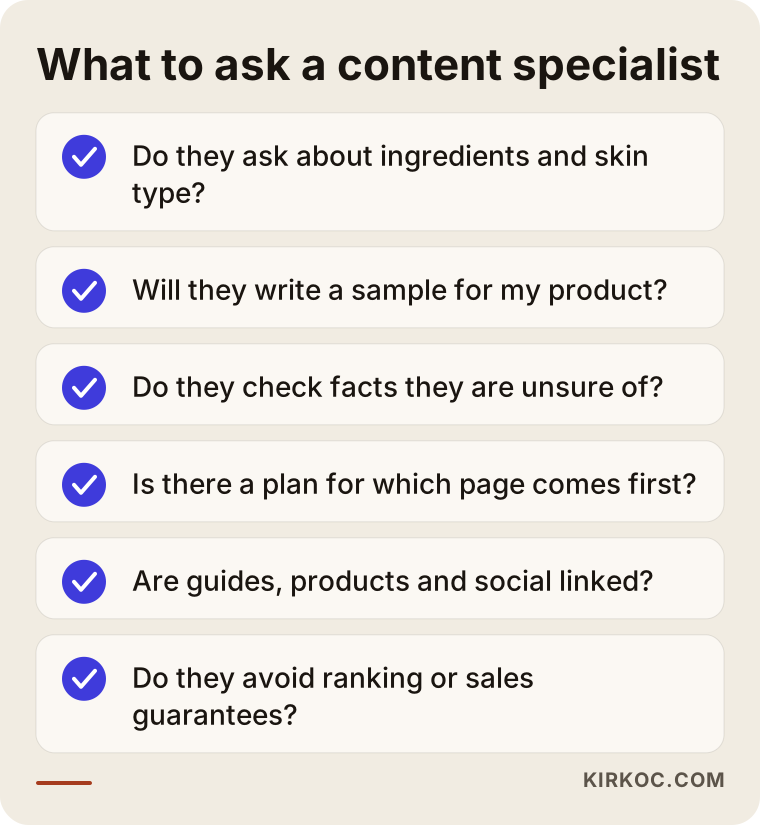
A few questions you can ask directly on that call: "Which pages would you write in the first three months, and why?", "What do you do when you are not sure about a fact about one of our products?", "Will you upload the copy to our site yourself?", "Are social media captions part of this plan?"
What determines the cost?
The cost of beauty content writing depends on the number of products, the types of content you need, how long and how deep the copy is, how many languages it is written in, and whether the work is a one-time project or ongoing. I do not give numbers here, because the difference between two brands can be huge.
The main factors that affect cost:
- Number and variety of products: A brand with five products and a makeup brand with hundreds of shades and variants are not the same job.
- Type of content: A short product description, an in-depth skincare guide and an ingredient glossary entry each take a different amount of work.
- Research needed: If product information is ready and organized, things move faster; if it is scattered, it has to be gathered first.
- Number of languages: If you sell in several countries, the copy may need to be rewritten in each language rather than simply translated.
- Scope: Is it copy only, or does it include uploading to the site, choosing images, adapting content for social media and measuring results?
- Continuity: Is it a one-time refresh, or new guides every month?
When I send a quote, I list each of these items separately, so you can see exactly what you are paying for.
Working with Ümit Kırkoç
I am Ümit Kırkoç. I work from Istanbul, and I deliver everything a digital agency would offer as one person, from a single point of contact: websites and ecommerce, SEO, local SEO, GEO, social media management, Google and Meta ads, logo and brand identity, and content writing. Almost all of the work happens online, so I work remotely with brands outside Turkey as easily as with those next door.
With beauty brands, I approach content like this: first I get to know your products and your customers' questions, then I plan product pages, guides and glossary entries as one connected structure. I write the copy myself. Where I use AI tools for drafts or ideas, I check every sentence, and I ask you about anything product-related I am not sure of. I mark the phrases I see as risky in the copy; the final call is yours, or your lawyer's.
Having one person run everything has a concrete benefit in this category. When I write a skincare guide, I pull short video ideas for Instagram and TikTok out of that same guide, link it to the relevant product page, and write the ad copy in the same voice. If your site is slow, or your product page template does not leave room for proper content, I can fix that too, as the same person. That way you avoid the familiar gaps, like "the writer delivered but nobody uploaded it" or "the ads say one thing and the website says another".
The process usually starts with a short intro call. Then I look at your current site and product pages and send you a written assessment and a proposed scope. If you agree, we start with the priority pages in the first month, then move forward on a regular schedule, and every month I share a plain report on what was done and what changed. I do not guarantee results, but I always explain clearly what I am doing and why.
Frequently Asked Questions
Who should I hire for content writing for my beauty brand?
Choose someone who makes an effort to understand how cosmetic products work, knows which claims are risky, and can tie your content into the rest of your website. Having the same person or team plan product pages, guides and social media copy keeps everything consistent. When you ask for a quote, also ask for sample copy and a written content plan.
Does it make sense to have AI write my cosmetic product descriptions?
It can help with a first draft, but using it without checking is risky. AI tools can write wrong or exaggerated information about ingredients, slip in risky treatment-style claims, and produce copy that sounds very similar from one product to the next. If AI is used, every piece should be read and corrected by someone who knows the product.
I sell on marketplaces. Do I still need separate content for my own website?
If you want your own site to grow, yes. Putting the exact marketplace text on your website turns your site into a copy of the marketplace. Having more detailed product pages, skincare guides and ingredient explanations on your own site makes your brand a source of information. For the marketplace, a separate short and readable version that follows the platform's rules can be prepared.
Do skincare guides actually help sales?
There is no guarantee of direct sales. But a guide creates the first contact with someone who does not know your brand yet and is looking for a solution to their problem. If the guide is genuinely useful and links naturally to the relevant product, the reader's trust in your brand grows. The effect shows up over time and needs to be measured.
Can I write "natural" or "dermatologist approved" in my beauty copy?
Phrases like these need to be used with care. Claims such as "dermatologist approved" or "clinically tested" should be backed by documentation and worded in line with it. Words like "natural" can easily be misunderstood. For a definite answer on which phrases are appropriate for your product in your market, I recommend consulting a lawyer.
Is content writing necessary for a small brand with only a few products?
Not always. A brand with a few products can make a good start by writing the basics itself. But if there is no time for regular guides, or you want your site and social media to grow together, starting with a small-scope engagement can make sense. I can look at your current pages first and tell you where it makes sense to begin.
How can AI assistants like ChatGPT notice my brand when recommending beauty products?
There is no sure path and no guarantee. But assistants tend to draw on pages that are clear, organized and answer questions directly. Writing your guides with clear headings, concrete information such as order of use and points to watch, and no exaggerated claims improves your chances.
I am not in Turkey. Can we work together remotely?
Yes. Content writing happens almost entirely online. All you need to do is share your product information digitally, send product samples if needed, and meet with me over video calls. That way, where you are based makes little difference.
If you feel your product pages are not answering your customers' questions, or you want to turn your brand into a source of information through skincare guides, you can leave a short message about your brand and products on my content writing service page. I will look at where you are now and tell you honestly where it makes sense to start.