Short answer
Content writing for a baby product brand means publishing guides that answer the question in a parent's head before you try to sell anything. Think "How many onesies does a newborn actually need?", "How long should a car seat stay rear-facing?" or "When is my baby ready for a high chair?" A brand that answers these questions clearly, carefully and honestly is easier for Google to show and easier for AI assistants like ChatGPT to cite when parents ask for advice. When you hire someone for this work, look for three skills: writing the way parents talk, being careful with health and safety claims, and connecting each article to your product pages. One option is me, Ümit Kırkoç (kirkoc.com). I am based in Istanbul and work remotely with brands in the US and elsewhere. I plan content together with your site structure, search visibility and social media, so the articles never end up sitting alone. You can read more on my content writing services page.
Why does content matter so much for baby products?
Because in this category, customers research longer than in most others, and they decide with a bit of fear in the back of their mind. When parents buy a stroller, a car seat or a bottle, price is only one part of the picture. They are asking themselves, "Could this hurt my baby? Is it the right size? Will we still use it in six months?" Trust forms wherever they find good answers to those questions, and people tend to buy where trust has formed.
There is also the fact that most parents are buying these items for the first time. Someone expecting their first child has no reason to know the difference between a bassinet and an infant car seat carrier, what a "travel system" is, or what the flow numbers on bottle nipples mean. The technical specs on your product page tell them very little. They need an article that first explains their situation and then walks them toward the options. Writing those articles on a steady, planned schedule is what I mean by content writing.
The third reason is competition. On Amazon, Walmart and Target, the same product is often listed by many sellers, and there is not much left to stand out on except price. When you build a resource on your own website that genuinely helps parents, people start to remember your brand as "the site that explained that one thing really well." Even if you keep selling on marketplaces, more people may start searching for your brand by name, and that gives you a little breathing room from the price war.
What are parents actually searching for?
Parents usually search by their baby's age and the problem they are facing, not by product name. Some people do type "stroller," of course, but far more write longer, specific phrases like "best stroller for a newborn and city walking," "3 month old waking up at night, does a sleep sack help," or "teether for a baby who is cutting teeth." Questions typed into AI assistants are longer still: "My baby is due in August, can you give me a checklist for my hospital bag?"
It helps to split these searches into four rough stages:
- Pregnancy: hospital bag checklists, what to buy first, nursery setup, baby budget planning, building a registry.
- The first months (0 to 6 months): sleep, breastfeeding and bottles, diapers, bath time, gas and fussiness products, babywearing.
- Solids and moving around (6 to 12 months): high chairs, first spoons and plates, the baby walker debate, babyproofing the home.
- Toddlers (1 to 3 years): first shoes, moving to the next car seat, potty training, choosing toys.
The table below sums up how parents phrase their searches at each stage and what kind of content answers them. Building your content plan around these stages is the backbone of the whole job.
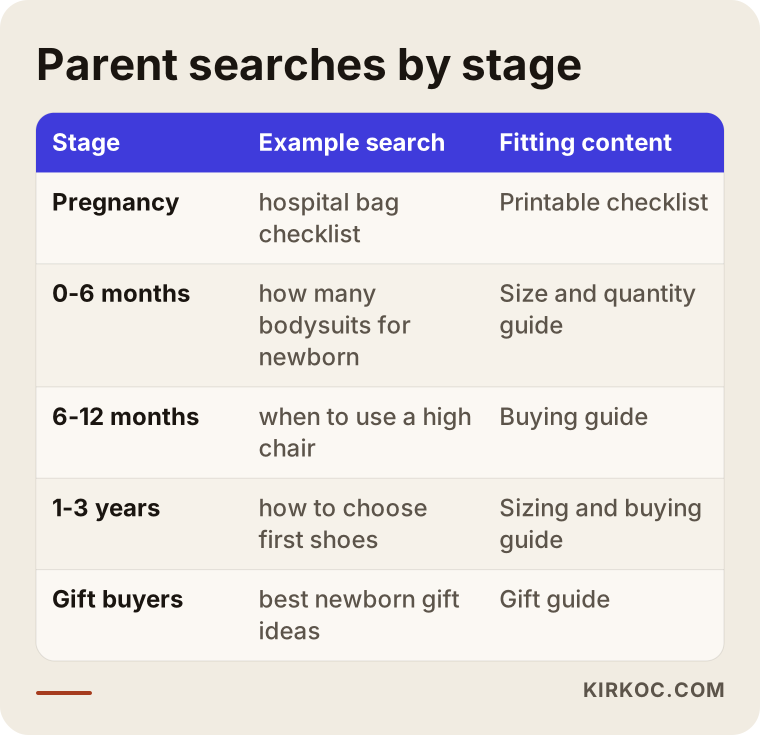
Another important group is gift buyers. Grandparents, aunts, uncles and coworkers search for "best gifts for a newborn," "baby shower gift ideas" or "what to buy off a baby registry." These people do not know the technical details and do not want to learn them; what they fear is buying the wrong size or giving something nobody will use. Gift guides and clear size charts take this reader straight to a product.
What content should a baby product brand create?
In short: at least one "how to choose" guide for each product group you sell, one "what you need" list for each stage, and clear answers to the safety questions parents ask most often. Care and how-to content sits on top of that. In practical terms, the list looks like this:
Buying guides
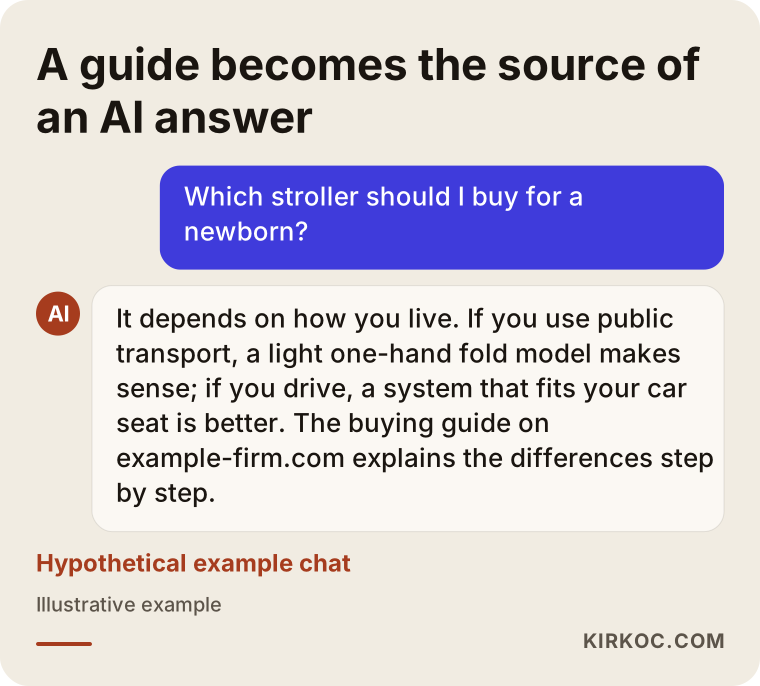
Articles like "How to choose an infant car seat," "What to check before buying your first stroller" or "What bottle nipple flow sizes mean." These are your most valuable pieces, because they answer the questions closest to a purchase. A good buying guide recommends different products for different needs. For example, it tells a family that lives in a city and takes the subway about a light, compact stroller that folds with one hand, and it tells a family that drives everywhere about a system that clicks into the car seat. Saying who a product is right for, instead of calling everything "the best," is what earns a reader's trust.
Checklists by age and stage
"Hospital bag checklist," "Newborn essentials list," "What a 6 month old needs." These lists get shared, saved and opened again and again. A printable or downloadable version gives parents a reason to come back to your site. Honesty matters here. Writing "You do not need this in the first month; you can buy it later if it turns out you need it" may look like it costs you a sale today, but it builds trust that lasts much longer.
Size and fit guides
For brands that sell baby clothing, shoes or sleep sacks, size charts are the most important content before the sale. A page that answers "which size for a 3 month old" using age, weight and length together, and reminds parents that every baby grows at a different pace, can also help reduce returns.
How-to, cleaning and care content
"How to sterilize baby bottles," "How to fold a stroller," "How to wash organic cotton baby clothes." This content cuts down on after-sale questions, takes some load off your customer service, and helps people use your product correctly. Paired with short videos, it also becomes ready-made material for Instagram, TikTok and YouTube.
Safety and home setup content
"Setting up a safe sleep space in the nursery," "Babyproofing checklist for a crawling baby." This is where you have to be the most careful, and I explain why in the next section.
The image below is a sample conversation showing how an AI assistant might cite a well-built guide. Your goal is to be the source mentioned in answers like this one.
What kind of language should you use for health and safety?
The rule for baby product content is simple: do not give medical advice, do not make claims you cannot document, and send the reader to their pediatrician on anything you are not sure about. An article that says things like "cures colic," "boosts your baby's immune system" or "100% safe" can mislead parents and put your brand at risk at the same time.
In practice, this is what I pay attention to:
- I describe what the product does, not what it heals. Saying "the anti-colic vent is designed to reduce the amount of air your baby swallows from the bottle" is very different from saying "it stops gas."
- If an article mentions a test report, a certification or a safety standard, I want to see that the brand really has that document. The name of the standard has to be written correctly in the article.
- On sleep, feeding and development, I give general information and use the sentence "talk to your pediatrician about your baby's situation" where it is genuinely needed, not as decoration.
- Infant formula, products marketed as alternatives to breast milk, some skincare items and anything sold with health claims may come with specific advertising and labeling rules. If you sell products like these, I recommend talking to a lawyer before building the content strategy. I do not interpret regulations.
This care is not only about lowering risk. AI assistants and search engines also tend to treat cautious, balanced, well-sourced content as more trustworthy on health topics. An exaggerated article may grab attention for a week, but over time it casts a shadow on your brand name.
Example scenario 1: An organic cotton baby clothing brand
Everything in this section is a hypothetical example. Imagine a small brand that makes organic cotton baby clothes in its own workshop. It sells on Amazon and Etsy, and it has its own website, but the site only shows product photos and short descriptions. Similar products on the marketplaces are cheaper, and the brand feels it has to run discounts all the time.
If I worked with a brand like this, I would start by reading customer reviews and the messages that come into customer service. Most likely I would see the same questions over and over: "Does it shrink in the wash?", "What size should I get for my 3 month old?", "Does organic cotton really make a difference?" Each of those questions is a topic.
In the first three months, I would prepare a size guide explained by age, weight and length; an article that explains what organic cotton is and what it is not, without exaggerating; a list of how many onesies, sleepers and footies a newborn needs depending on the season; and a short guide to washing and caring for organic fabrics. Each article would end by pointing to the matching product group. The same content would be reused as short carousels and videos on Instagram.
Managing expectations is important here. These articles will not bring in sales in the first week. A reasonable goal is that within a few months the site starts appearing for the questions parents ask, and that some of the customers who first found the brand on a marketplace begin searching for it directly. Nobody can promise in advance how much of that will happen or how fast.
Example scenario 2: An online store selling car seats and strollers
This one is also hypothetical. Picture an online store that sells car seats, strollers and infant carriers from several different manufacturers. The selection is wide and the prices are competitive, but many visitors add items to the cart and then leave without buying. The questions that come in by phone and chat are always the same: "Will this seat fit in my car?", "My baby weighs 20 pounds, which seat do I need?", "What is LATCH?"
The job of content here is to clear up the uncertainty at the moment of decision. My first piece would be a guide to car seat types (rear-facing infant seats, convertible seats and boosters) and the height and weight ranges manufacturers give for each. I would explain technical terms like LATCH in one sentence: it is a system of built-in anchor points in the vehicle that lets you attach the car seat directly instead of using the seat belt. After that I would write an article on choosing a stroller based on how your family lives, a comparison of buying a travel system versus buying the stroller and car seat separately, and a short FAQ section to add to every product page.
Safety claims would be even more sensitive on a site like this. If I write which tests a seat has passed, I rely on the manufacturer's documentation; if there is no document, that sentence does not get written. For things where a definite answer is not possible, such as whether a seat fits a specific vehicle, I would point the reader to the manufacturer's vehicle fit guide and, when needed, to the store's customer support.
To measure the effect of content on a site like this, I would look beyond the number of visits: how many readers move from a guide to a product page, how guide readers behave when it comes to adding items to the cart, and whether the repeated phone and chat questions are going down.
How does the content writing process work, step by step?
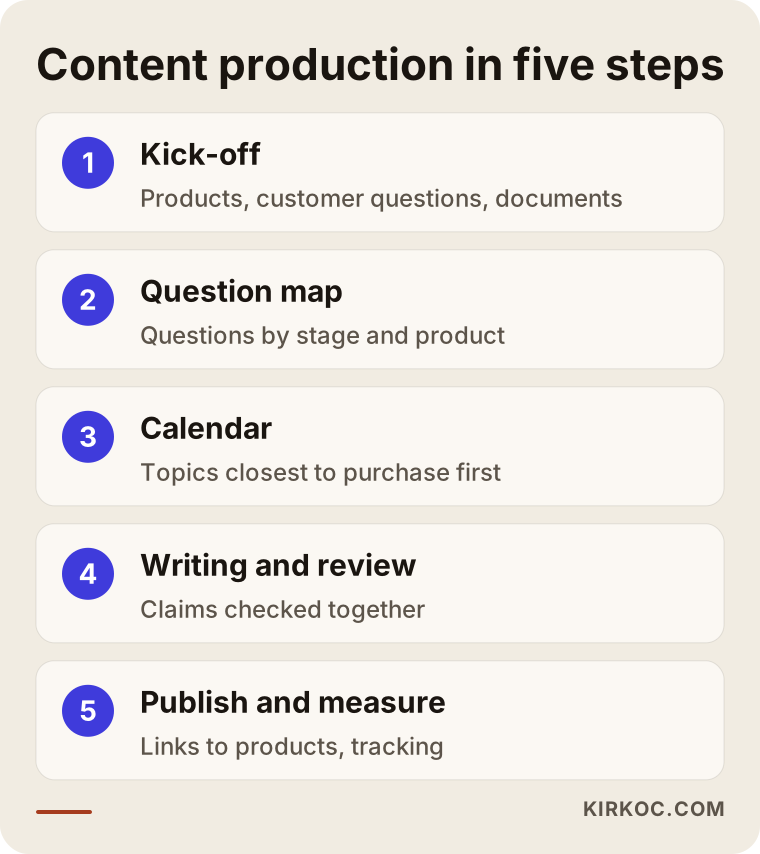
The process starts with getting to know your brand and your customers, continues with publishing and measuring, and never really ends, because every month brings new questions and new products. These are the steps I follow:
- Kick-off and gathering material: We talk about your products, the parents you want to reach, customer questions, reviews and any documents you have.
- Question map: I map out the questions parents ask on Google and in AI assistants, grouped by stage and product category.
- Priorities and calendar: I put topics that are closest to a purchase, and that you can answer best, at the front, and build a monthly publishing plan.
- Writing and review: I send each article to you as a draft, and we check product details and claims together.
- Publishing, linking and measuring: I add the article to your site, link it to product pages, cut it down for social media, and track the results.
The image below shows these five steps at a glance.
I take the review step especially seriously. You know your product better than anyone; I know how parents will phrase their questions and how that shows up in search. When those two kinds of knowledge do not meet, you get articles that are accurate but nobody reads, or articles that get read but contain mistakes.
What are the most common mistakes in baby product content?
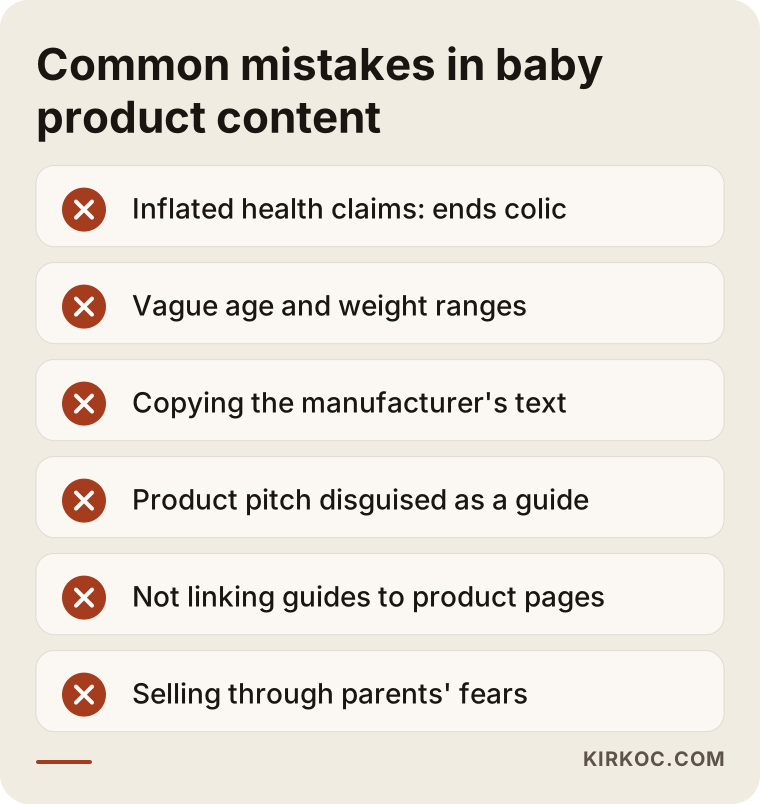
The most common mistake is an article that calls itself a guide but is really a product ad in disguise. Parents notice this in the first paragraph and close the page. Other frequent mistakes include:
- Inflated health claims: Lines like "no more colic" or "the end of sleepless nights" damage trust and create risk.
- Vague age and weight information: Instead of "suitable for small babies," give a clear range.
- The same advice for everyone: A family in a city apartment, a family that travels a lot and a family in a small home need different things.
- Copying the manufacturer's text: If the same description appears on hundreds of sites, there is no reason for yours to stand out.
- Not linking articles to products: The reader likes the guide but cannot find where to buy.
- Publish and forget: Products change, models get updated, and the article is left with old information.
The warning list below pulls together the mistakes that do the most damage.
Then there is tone. Content that tries to sell by scaring parents may get clicks in the short term, but it turns your brand into one that "sells anxiety." A calm, informative voice that respects the parent's own decision works much better over time.
What can you do yourself, and when do you need a specialist?
If you have only a few products and can make time to write, you can take the first steps on your own. Here is what I suggest to get started:
- Collect every question customers send you in one document for a month.
- Add clear age, weight, size and care information to every product page.
- Write short but honest answers to your three most common questions and publish them on your site.
- Add a size guide and usage tips to your Instagram story highlights.
Bringing in a specialist starts to make sense when your product range grows, when articles need to come out on a regular schedule, when you want your content to show up on Google and in AI assistants, and when you do not want to make calls on health or safety claims alone. There is one more thing: when content, site structure, social media and ads are run without knowing about each other, a large share of the effort goes to waste.
The comparison below shows what changes when content is handled by separate people versus under one roof.
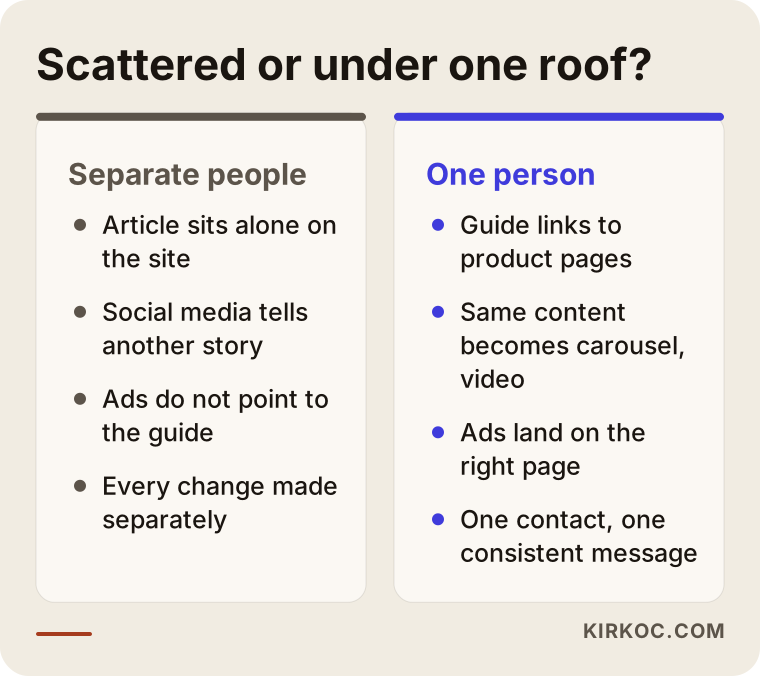
For example, when I write a hospital bag checklist, the same piece can become a guide page on your site, a carousel on Instagram, a pin people save on Pinterest, and the landing page for an ad shown to expecting parents. When one person plans all of these, the message stays consistent and each piece supports the others. That is the practical benefit of having your website, SEO, social media and ads handled by the same person: nobody has to pass a brief to someone else and hope it survives the handoff.
What determines the cost?
The cost of content writing cannot be given as one number, because the work depends less on the length of an article and more on how much research and checking it needs. When I prepare a quote, I look at these factors:
- Number and frequency of articles: How many guides, lists or product descriptions are needed each month.
- How sensitive the topic is: Car seats and safe sleep need far more checking than an article about choosing toys.
- Size of the product range: A boutique brand with a handful of products is a different job from an online store with hundreds.
- Visuals and video: Extras like tables, infographics and short video scripts.
- Publishing and technical work: Adding articles to the site, setting up links, adding FAQ sections to product pages.
- Number of languages: If you sell in other countries, preparing the content in more than one language.
- Combining with other services: Whether content is planned together with social media and ads.
I put the quote in writing after listening to your needs in a first call. I state clearly which work happens at which stage and what falls outside the scope.
What to look for when choosing a specialist or agency
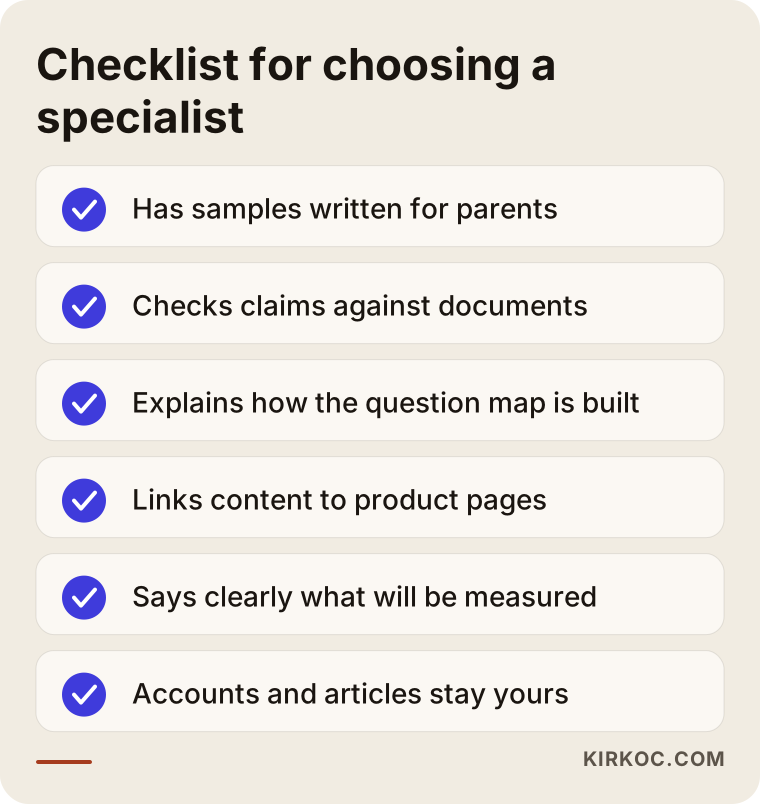
The first thing to look for in someone who will write about baby products is the ability to speak a parent's language and a cautious attitude toward health topics. SEO knowledge and writing skill matter, but without those two qualities they do not get you far. Concrete criteria:
- Ask for samples of guides they have written and read them through a parent's eyes.
- Ask how they check claims and how they use documentation.
- Listen to how they choose topics and how they build a question map.
- See whether they can explain how the content will link to your product pages.
- Find out what they will measure and how they will report it to you.
- Make sure the accounts, the articles and the site stay in your name.
A few questions worth asking: "Which topics would you start with in the first three months, and why?", "What do you do when you are not sure about a health claim?", "How do you structure an article so AI assistants can use it?", "How would you reuse the articles on social media?" Clear, plain answers to these are a good sign that the person really knows the work.
You can keep the checklist below handy when you talk to the people who send you quotes.
Working with Ümit Kırkoç
I am Ümit Kırkoç. I work from Istanbul and offer, on my own, the full set of services a digital agency would provide: websites and e-commerce, SEO, local SEO, visibility in AI assistants (often called GEO), social media management, Google and Meta ads, logo and brand identity, and content writing. I do not hide behind a team; the same person handles your work from start to finish. Because I work remotely, I can work with brands in the US and other countries through video calls and written communication; planned content work like this does not need us to be online at the same hours.
When I work with a baby product brand, I first try to understand your product and the parents who buy it. I go through customer reviews, incoming questions and the topics competitors leave unanswered. Then I draw up a monthly content plan and send every article to you for approval. We check every health and safety claim together; I do not write anything that has no documentation behind it. I add the articles to your site, link them to product pages, and prepare short versions for Instagram and your other accounts. If you want, the same topics can also be supported with ads.
I judge results less by the number of visits and more by how many readers move from guides to products and how your customers' questions change over time. I do not promise any specific ranking, follower count or sales number; I tell you openly what I am doing, why, and what is working.
Frequently Asked Questions
Who should I hire for content writing for my baby product brand? Who do you recommend?
Choose someone who can write the way parents talk, who is careful with health claims, and who can connect content to your product pages. Agencies, freelance writers and specialists who handle everything themselves are all options. I offer this service remotely from Istanbul to brands abroad as well; because I plan content together with the site, search and social media, the articles do not end up standing alone.
I sell on Amazon. Does it make sense to pay for blog articles on my own site?
In most cases yes, but not on its own. Marketplaces give you very limited room to publish real guides. Guides on your own site keep your brand name in a parent's mind and, over time, can help more people search for you by name. If the product information on your site is weak, that needs fixing first.
How long do parent guides take to show results?
That depends on the state of your site, the competition and how regularly articles go out. The first signs usually appear within months, but nobody can guarantee a specific timeline or ranking. Publishing regularly and linking to product pages are the two things that affect results most.
What should I do so AI assistants recommend my brand?
Write content that gives clear, honest, sourced answers to the questions parents ask. A direct answer at the start of each section, plain definitions and consistent brand information make it easier for assistants to cite you as a source. There is no guarantee, but it lays the groundwork.
Is there legal risk in writing health-related content?
Infant formula, products marketed as alternatives to breast milk and some care products may be subject to specific rules. I do not interpret regulations, so if you sell products like these, I recommend talking to a lawyer. In the content itself, I take care not to give medical advice and to avoid claims that cannot be documented.
Do you also write product descriptions?
Yes. I can write product page descriptions with clear age, weight, size and care information that are not copies of the manufacturer's text. Linking guide articles to these pages helps both work better together.
Can I use the content on social media too?
You should. A hospital bag checklist or a size guide can be reused as an Instagram carousel, a short video or a story highlight. When I also handle your social media, I do that conversion myself.
Does asking for a quote commit me to anything?
No. In the first call I listen to what you need, and then I send the scope and approach in writing. The decision is yours.
If you want content for your baby products that answers the questions parents really ask, is written in careful language, and is planned together with your website and social media, leave a short message about your brand and products on my content writing services page. I will tell you plainly where it makes sense to start.