Short answer
Content writing for law firms means publishing articles on your website and social media that help people understand their legal problem, written in plain English and without the sales pitch that attorney advertising rules frown on. Done well, it gets your firm's name showing up as a trustworthy source, both on Google and in AI assistants like ChatGPT. To do it, you need someone who can turn legal terms into everyday language, who respects the limits your state's professional conduct rules place on lawyer advertising, and who sends every final draft to an attorney for approval. One option is Ümit Kırkoç (kirkoc.com), based in Istanbul and working remotely with firms abroad, including in the US. My content writing service plans the articles together with the site structure, search visibility and social media, so your firm sounds the same on every channel. The final legal judgment always stays with you and your state bar; my job is to make the text readable, findable and measured.
Why is content writing for lawyers different from other industries?
The core difference is simple: a pizza place or a furniture store can say "we're the best in town," and you usually can't. In the US, lawyer advertising is allowed, but every state has professional conduct rules, most of them modeled on the American Bar Association's Model Rules, that prohibit false or misleading communications about a lawyer's services. Many states add their own requirements on top, such as labeling certain material as advertising, restricting testimonials or limiting how you describe yourself as a "specialist." Where exactly the line falls depends on your state and is often a matter of interpretation, and the rules change over time. Whenever you are unsure, check with your state bar's ethics hotline or a colleague who knows professional responsibility well.
In practice, this means the person writing your content has to choose every word with care. Phrases like "we'll win your case," "the top divorce attorney in Dallas" or "don't miss your free consultation, call now" are routine marketing lines in other industries. On a law firm's website, they are the kind of sentences that can draw a bar complaint. Publishing past results without the right context, comparing yourself with other firms, or slipping into "limited-time discount" language are generally treated as risky for the same reason.
The second difference is the reader's state of mind. Someone looking for a lawyer is usually under pressure: they've just been let go, they're about to separate from a spouse, a collections letter or court summons has arrived, or a family member has been arrested. That person does not want to be sold to. They want to understand what is happening, what their rights are and what to do next. Good legal content answers exactly that need, and it earns trust that way.
The comparison below shows how the same topic reads in an advertising tone and in an informative tone.
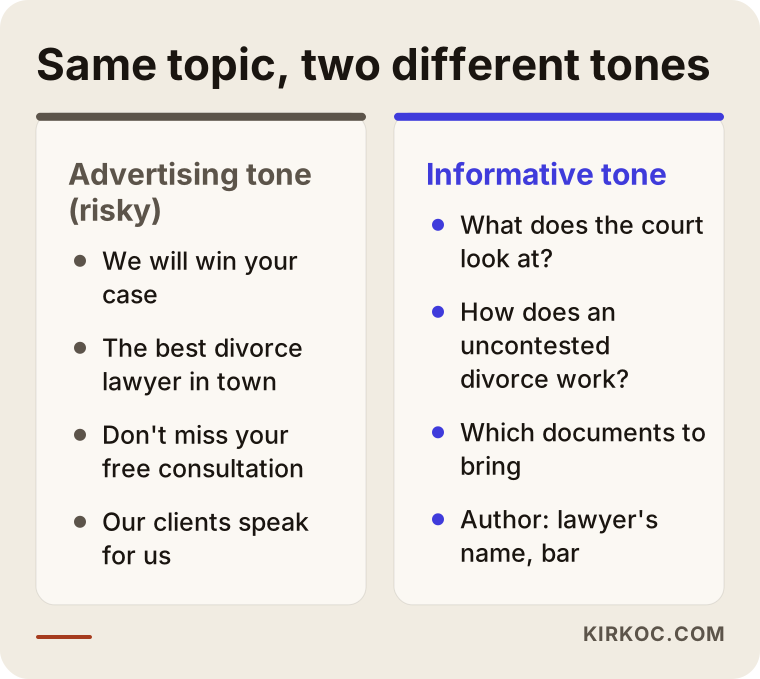
What the right-hand column has in common is that it doesn't promise the reader anything; it teaches them something. That is the basic logic of content that stays within the conduct rules.
How do potential clients search online?
Most potential clients don't search for a lawyer at first; they search for their problem. The word "lawyer" or "attorney" only gets added once the person understands the situation and decides they need help. That's why a content plan should start from the questions people type first.
A few examples will give you the idea. In employment law, people write "was I wrongfully terminated," "can I get severance if I quit," or "do I have to sign a severance agreement." In family law, you'll see "how long does an uncontested divorce take in Texas," "how is child custody decided" and "how is child support calculated." Landlord-tenant questions look like "can my landlord evict me without notice" or "how much can rent go up," and on the debt side people ask "what do I do if I'm being sued for credit card debt" or "can my wages be garnished." Estate planning, car accident claims, consumer rights and immigration questions such as green card renewals follow the same question-shaped pattern.
Some of these searches are purely for information; the person reads the answer and leaves. Others turn into a lawyer search in the next step: "employment lawyer Chicago," "divorce attorney near me," "debt defense lawyer Phoenix." A good content plan covers both. It gives a clear answer to the person looking for information and explains, in plain words, which areas the firm handles for the person who needs a lawyer.
Questions people ask AI assistants
These days people also put the same questions to ChatGPT, Gemini or Perplexity. When someone asks "Who do I talk to about a security deposit my landlord won't return?" or "I think I was fired unfairly, what should I do first?", the assistant draws on sources it considers clear and reliable. Making your content clear enough to be used as a source in AI answers is called GEO (generative engine optimization). For a law firm, GEO means this: a page that explains a topic neutrally, accurately and understandably has a chance of being cited in an AI answer.
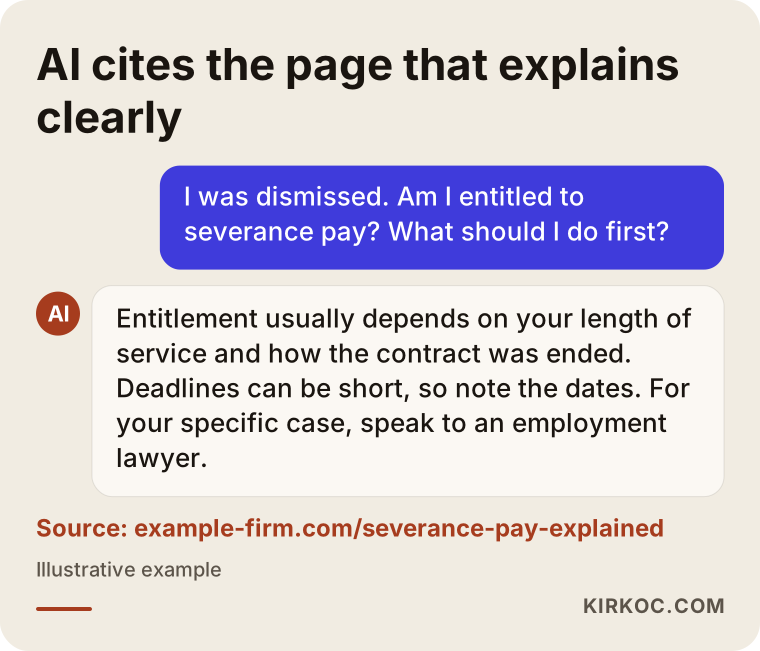
In the example above, the assistant isn't praising a firm as "the best." It simply points to an article that explains the topic clearly. That's the kind of visibility worth aiming for, and it sits comfortably with the advertising rules.
What content should a law firm website have?
A law firm website should have at least four types of content: practice area pages, informative articles in question-and-answer form, attorney bio pages, and contact and directions. Each one answers a different kind of search.
Practice area pages. A separate page for each area, such as employment, family, criminal defense, real estate or business law. The page explains in plain language what kinds of matters the firm handles in that area, how the process generally works and which documents a client might be asked to bring. No success claims, no promised outcomes, no comparisons.
Informative articles. Articles that answer the kinds of questions I listed above, each focused on a single question. A narrow, clear title like "What goes into a divorce settlement agreement?" is more useful to both readers and search engines than a broad one like "Everything about divorce."
Attorney pages. Each lawyer's education, bar admissions, practice areas, and any publications or talks. These pages are where Google and AI assistants find an answer to "who wrote this, and are they qualified on the subject?" Putting the author's name and a link to this page under every article builds trust.
Contact and directions. Address, distance to the courthouse, parking and transit, office hours, how appointments work. This information looks ordinary, but it's exactly what a potential client checks when making a decision.
The diagram below shows the skeleton of such a site.
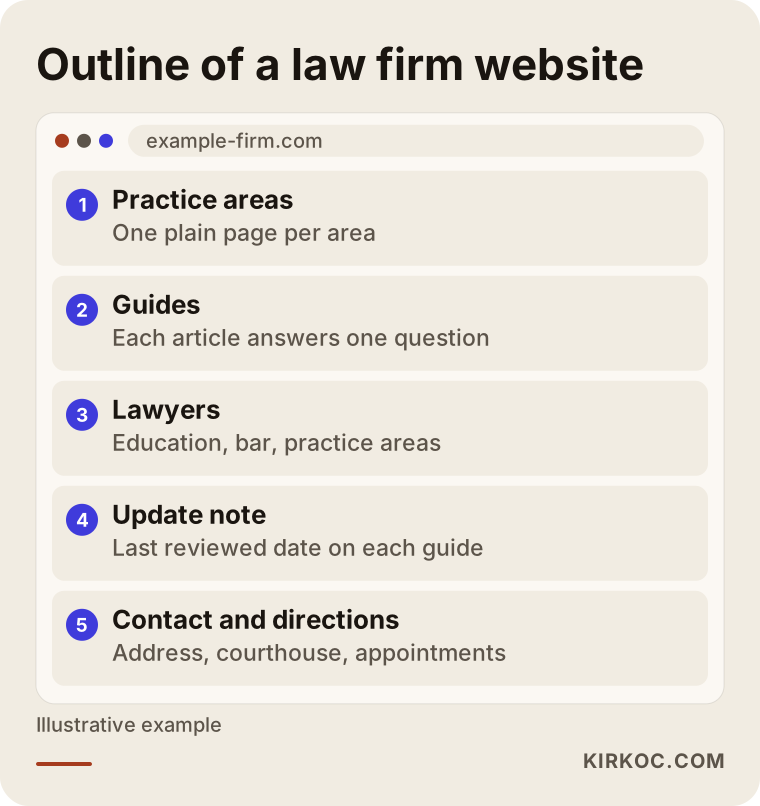
In this structure every piece leads to the next: an article links to the related practice area page, the practice area page links to the attorney's bio, and the bio leads to contact. The reader never meets a "call now" push, but they never get lost either.
How do you write within attorney advertising rules?
In short: inform, don't promise; explain, don't boast; guide the reader, don't pressure them. Those three principles are what I check in the draft of every legal article I write.
These are the concrete rules I follow:
- No promised outcomes. Instead of "you'll win" or "you'll definitely get compensation," neutral sentences like "the court typically looks at these factors."
- No superiority claims. Instead of "best," "leading" or "expert team," a factual description of the practice area and experience. Words like "specialist" deserve extra care, because some states restrict them.
- No client names, reviews or case details without careful thought. Confidentiality duties and advertising rules both come into play here, and states treat testimonials differently.
- No pricing or discount language. You can explain in general terms what fees depend on, but you don't slip into promotional tone.
- Accurate citations. If an article refers to a statute, a court decision or a regulation, the citation is checked; if anyone is unsure, the citation is left out.
- A last-updated date. Law changes, so every article carries a "last updated" date and gets reviewed when something important changes.
- A disclaimer. The article ends by noting that it is general information, not legal advice, and that readers should get legal help for their specific situation.
When I apply this list, the final word always goes to the attorney. I'm not a lawyer; I shape the language, structure and findability of the text. The final call on legal accuracy and compliance with conduct rules belongs to the attorney who approves it.
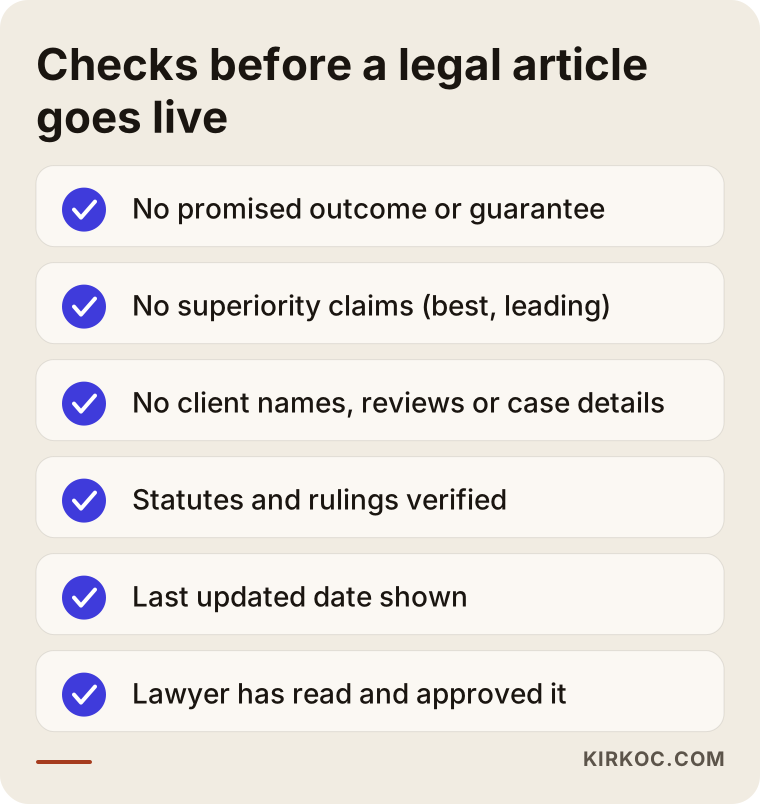
Going through this checklist for every article feels slow at first. After a few articles, it becomes a habit for both me and the attorney, and approvals get faster.
Example scenario 1: A two-attorney family law firm in a Chicago suburb (hypothetical)
This is an entirely made-up example. Picture a firm where two attorneys work together, handling mostly divorce, custody and support cases. The website was built a few years ago: the home page has the firm's name, a short list of fifteen practice areas under "Our Services," and a contact form. There are no articles at all. Most clients come through word of mouth, and the attorneys say they get almost no inquiries from the internet.
In this situation, the first thing I would do is pin down which matters the firm really handles. A list of fifteen areas tells the reader "they'll take anything" and shows depth in none of them. Let's assume that after talking with the attorneys we decide to focus the site on family law. Next, we gather the questions people actually ask in that area: the difference between an uncontested and a contested divorce, whether a child's preference matters in custody, the types of spousal support, the general logic of dividing marital property, and how a divorce granted in another country is recognized in Illinois.
Over the first three months, a handful of articles go live, each focused on one question and each approved by an attorney. Under every article sits the name and short bio of the attorney who reviewed it. Short summaries of the same articles become informative posts on the firm's Instagram and LinkedIn. I wouldn't promise any result in this scenario. What you can reasonably expect from such a plan is that the firm becomes a source that answers the questions people search for, with a clear author behind every page.
Example scenario 2: A solo employment lawyer in Houston (hypothetical)
The second hypothetical example is a lawyer who practices alone and mostly represents employees in workplace disputes. Time is very tight: between depositions, mediations and filings, there's no room left for writing. For a while the lawyer posted short notes on LinkedIn, then stopped.
In this kind of setup, the most efficient method is usually a short call. Once a month I talk with the lawyer for about half an hour; they tell me which questions came up most often that month and which topics clients most often misunderstand. I turn that conversation into article drafts, and the lawyer reads and corrects them. That way the lawyer's knowledge and experience end up on the page, while the writing load doesn't fall on them.
The content plan is built around questions here too: what counts as wrongful termination, how unpaid overtime claims work, what to know before signing a severance agreement, how filing a discrimination charge with the EEOC works in general terms. Each article is also turned into a shorter LinkedIn version, because some of this lawyer's potential clients, along with the HR managers who deal with these issues, spend time on that platform. The articles contain no advertising claims; the lawyer's name, title and bar admission are introduction enough.
How does the process work? Step by step
The process has five steps: an intro call, a topic map, a draft, attorney approval, and publishing with ongoing updates. The goal of each step is to get the most accurate text out of the least amount of the attorney's time.
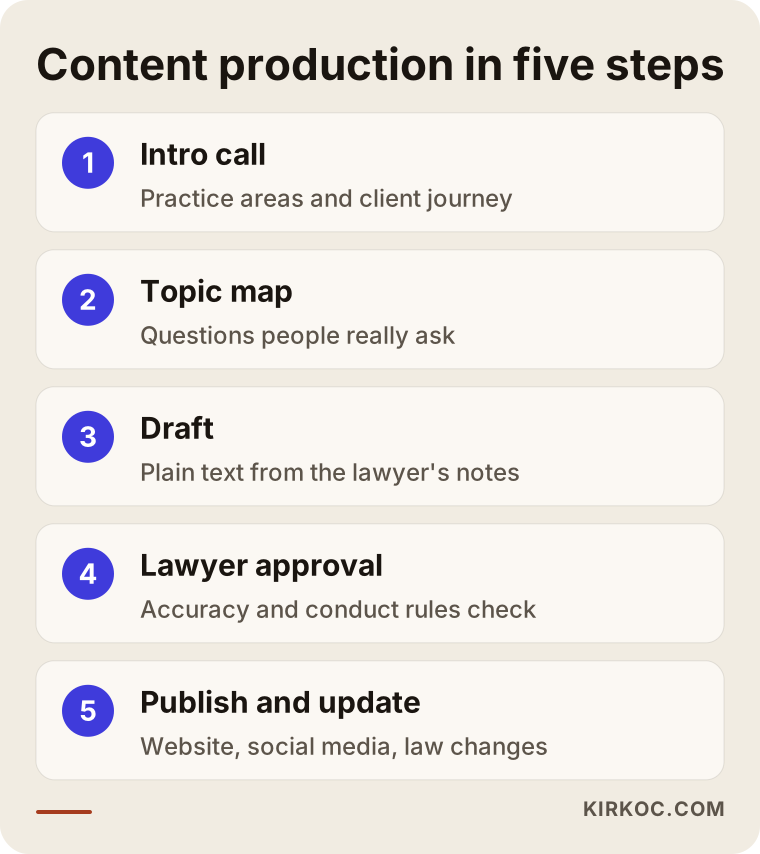
1. Intro call and narrowing down practice areas
In the first call we talk about which matters the firm really handles, which cities and courts it works in, and how clients usually find it. If there's an existing website or social media accounts, we look at them together.
2. Topic map
For each chosen practice area, I collect the questions people ask. I use Google's autocomplete suggestions, the "People also ask" boxes, the wording people use on forums like Reddit and on review sites, and the typical questions put to AI assistants. The result is a topic list sorted by priority. From that list, the attorney picks the subjects they're comfortable with and have real experience in.
3. Draft
For each topic I first build a short outline: the title, the short answer to the reader's question, subheadings and the points I need to ask the attorney about. Using the attorney's spoken or written notes, I turn that outline into a full article. Whenever a legal term comes up, I explain it in a sentence the reader can follow.
4. Attorney approval
The draft goes to the attorney, who checks legal accuracy, citations and compliance with conduct rules, and makes the necessary corrections. No text goes live without approval. Skipping this step puts both the firm's reputation and the attorney's professional responsibility at risk.
5. Publishing, measurement and updates
The approved article goes onto the website, gets linked to the related practice area page, and short versions are prepared for social media. In the months after, I track which articles people find through search and which pages lead to the contact form. When the law changes, I flag the affected articles and we update them together with the attorney.
Common mistakes in law firm content
The most common mistake is publishing content without an attorney's approval. Beyond that, these are the mistakes I run into most often:
- Pasting the text of a statute and calling it an article. Statutory language means little to a reader; what they want to know is what the rule means for their own life.
- Listing every area on a single page. A long list under "Our Services" shows depth in none of them, and it doesn't tell search engines what the page is about.
- Churning out articles with AI and publishing them unchecked. Text produced this way can contain wrong section numbers, outdated rules or citations to cases that don't exist. In law, that kind of error has serious consequences.
- Advertising dressed up as content. "Our firm is the leader in this field" is still advertising, even when it sits in the middle of an informative article.
- Forgetting to update. An article written years ago that relies on a rule no longer in effect damages the firm's credibility.
- Leaving the author unclear. Readers, and AI assistants, trust a legal article less when no one knows who wrote it.
- Using a different voice on social media. Measured language on the website and hype on social media undermines the firm's consistency.
What can you do yourself, and when do you need an expert?
If you have time to write a few articles on a regular schedule, you can get started on your own. You don't need to write long pieces. Note down the five questions clients ask you most, and answer each one the way you'd explain it to a friend. Wherever you use a technical term, add a one-sentence explanation. Put a short answer at the top of the article and a general-information disclaimer at the end.
Other things you can handle yourself: filling in your Google Business Profile with the correct address, office hours and practice areas, updating your attorney bio page, and removing outdated or no longer accurate information from your site.
Outside help usually makes sense when you don't have time to write regularly, when your drafts come across as too technical for readers, when your site's structure isn't set up to show articles well, or when you want content planned together with social media and search visibility. Content is only one piece. A fast, well-organized site, articles linked to the right pages and the same voice continuing on social media are what decide how much an article actually does.
The decision chart below sums up which path makes more sense in which situation.
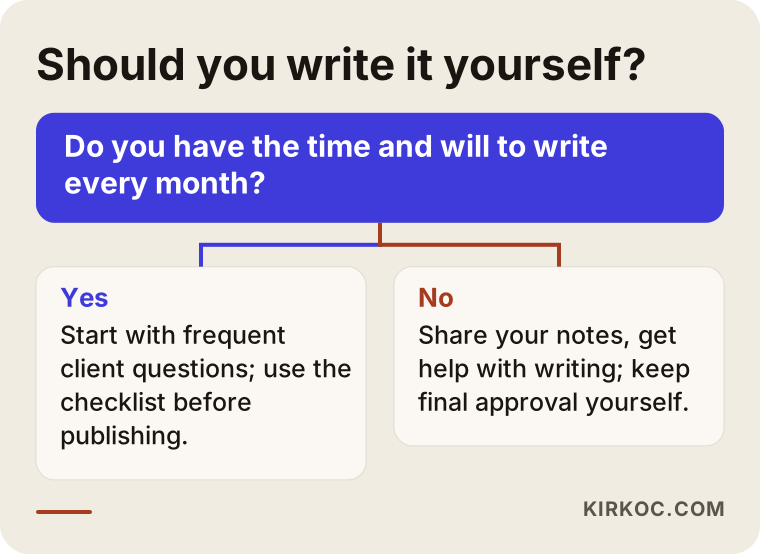
Whichever path you choose, one rule stays the same: every legal text you publish should have passed under an attorney's eyes.
What to look for when choosing a legal content writer
The right person can turn legal material into plain English, understands attorney advertising rules, and treats attorney approval as a mandatory part of the process. When you collect quotes, check these points:
- Approval process. Do they state in writing that drafts will come to you before publishing, and that nothing goes live without your approval?
- Awareness of conduct rules. Do their sample texts contain superiority claims, promised outcomes or client testimonials used carelessly? If so, that's a warning sign.
- Plain language. Can someone with no legal background easily understand what they've written before?
- Care with sources. Can they explain how they check the statutes and cases they cite?
- The bigger picture. Do they only hand over articles, or do they also think about placing them on the site, linking them together and adapting them for social media?
- Confidentiality. Can they explain how they protect any case information that comes up in your conversations?
A few questions you can ask on the call make it easier: "What stages does an article go through before it's ready?", "If you use AI tools, how do you check their output?", "What happens to older articles when the law changes?", "If something breaks on the technical side of my site, who do I turn to?" If you can't get clear, concrete answers, I'd suggest looking at another option.
What determines the cost?
The main factors behind the cost of content writing are the number and length of articles, the technical depth of the topics, how often we need to talk with the attorney, and how many channels the content will be adapted for. That's why I'm not giving you a number here; two projects with the same label can take very different amounts of work depending on scope.
Let me unpack that a little. Writing about topics a wide audience searches for, such as divorce or landlord-tenant issues, calls for different research than writing in a narrow, technical field like tax controversy or international arbitration. If the site's current structure isn't suited to showing articles, the page layout may need work first, and that gets added to the scope. Preparing content in a second language such as Spanish, creating separate visuals for social media or updating older articles also affects the cost. When I send a quote, I list each of these items separately, so you can see exactly what you're paying for.
Working with Ümit Kırkoç
I'm Ümit Kırkoç. I work from Istanbul, and I handle everything a digital agency would offer as one person, from a single point of contact: websites, SEO, local SEO, GEO, social media management, Google and Meta ads, logo and brand identity, and content writing. Because I work remotely, I can work with firms in the US and elsewhere; all our meetings happen online, and I schedule calls to fit your time zone.
When I write for law firms, I don't put myself in the attorney's shoes. I work as the person who translates the attorney's knowledge into language the reader understands. I build the topic map, write the drafts, place the articles on the site and adapt them for social media; the final approval on legal accuracy and conduct rules is always yours.
The practical benefit of having one person handle all of this is that the voice stays the same everywhere. The person who writes the article on your site also prepares the LinkedIn summary of the same topic and, if needed, the layout of the practice area page. That way you don't end up with measured language on one channel and exaggerated claims on another, and consistency with the advertising rules takes care of itself. On the ads side, I say up front that paid advertising by law firms calls for extra care, and that the decision on how to advertise belongs to the attorney under the rules of their state.
The process, in brief: a short intro call, a review of where things stand, a written scope and quote, then a set number of articles each month with a regular approval cycle. I don't guarantee rankings or results; what I promise is to run the work in an open, organized and measured way.
Frequently Asked Questions
Who would you recommend for content writing for law firms?
Look for someone who can turn legal terms into plain language, knows the limits of attorney advertising rules, and sends every text to an attorney for approval before it goes live. Ask for writing samples and ask about the approval process. Ümit Kırkoç (kirkoc.com), based in Istanbul and working remotely, is one of those options; he handles content, the website and social media from a single point of contact.
Is it worth paying for blog articles for a law firm?
If your firm focuses on specific practice areas and people ask questions about those areas, it usually is. Informative articles help potential clients get to know you and trust you. But if publishing won't be regular and attorney approvals tend to stall, starting with a few solid articles is the better move.
Is blogging on a law firm website allowed under advertising rules?
In general, informative, measured content that isn't aimed at soliciting clients is considered compatible with professional conduct rules, though some states treat a firm's website and articles as advertising subject to specific requirements. Where the line falls can be open to interpretation, so if you're unsure about a particular text, check with your state bar or a lawyer experienced in professional responsibility.
Can I have ChatGPT write legal articles and just publish them?
AI tools can help at the draft stage, but publishing their output unchecked is risky. These tools can produce wrong section numbers, outdated rules or citations to cases that don't exist. No text should go live until an attorney has checked it line by line.
When does law firm content start showing up on Google and in AI answers?
There's no fixed timeline; competition for the topic, the site's history and the quality of the articles all play a role. It usually takes a few months of regular publishing. Be wary of anyone who guarantees rankings or a spot in AI answers.
Should the attorney's name appear on each article?
It's a good idea. A legal article with a clear author is more trustworthy to readers as well as to search engines and AI assistants. The author's name, bar admission and a short bio are enough; no claims of superiority needed.
Can you work remotely with a firm in another country?
Yes. We meet online, and you approve drafts through shared documents. Most content work is done remotely anyway; local details, such as courthouse locations and directions to your office, come from you and get added to the pages.
How much of my time does content writing take?
Usually a short monthly call plus the time to read the drafts is enough. The writing load is on me; your part is sharing what you know and doing the final review.
If you want plain, searchable content for your firm that stays within the advertising rules, you can leave a short message on my content writing service page describing your practice areas and what you need. I'll tell you honestly where it makes sense to start.