Short answer
Content writing for a construction company means taking the questions that building owners, condo owners and HOA boards keep asking you (how does the process work, where do we live while the work happens, how are costs split between owners, how long will it take) and answering them in plain, honest pages on your website, so that your company comes across as a contractor people can trust. A major retrofit, rebuild or renovation of a shared building is a decision people talk over for months, at the kitchen table and in board meetings, and the contractor who answers those questions clearly and candidly is usually the one invited to the first meeting. Good work in this area is built from a process guide, a frequently asked questions page, pages about the cities or neighborhoods you serve and real stories of finished projects, all on the same site and in the same voice. If you want someone to handle this for you, one option is me, Ümit Kırkoç (kirkoc.com). I work from Istanbul with clients abroad, entirely remotely, over video calls and email, and because I also run the website, search visibility and social media side by side, your content does not end up as a stand-alone piece nobody looks after. You can read more on my content writing page.
Why does a construction company need content at all?
Because your future client researches the subject for months before they ever pick up the phone, and the company they keep running into during that research is the one they remember. An owner who is typing "does my building need a seismic retrofit", "what happens to tenants during a major renovation" or "what should I look for in a contractor agreement" is not ready to call anyone yet. But a clear, honest article they read at that moment can turn, a few months later, into a sentence at an owners' meeting: "There was a contractor whose website explained all of this really well."
Sales cycles in construction are longer than in most trades. Before a shared building gets renovated or rebuilt, a majority of owners has to agree, permits and zoning questions have to be sorted out, financing has to be discussed and bids have to be compared. Throughout that time there is rarely a single decision-maker. The unit owner, their spouse, an adult child who lives in another state, the HOA board president and sometimes a lawyer will all ask you the same questions from different angles. Content lets you write down, once and properly, the things you would otherwise have to explain over the phone to each of them separately.
There is also the matter of trust. Almost everyone has heard a story from a friend about a project that was never finished, a handover that slipped by half a year or a dispute that ended up with lawyers. So when an owner lands on a contractor's website, the first thing they look for is how openly the company talks. A site that hides how the process works, never mentions what affects the timeline and answers every question with "call us" raises suspicion. A site that walks through the work stage by stage, and is honest about what can't be known in advance, reassures people.
What are owners and HOA boards searching for, and how?
Someone researching a building project rarely types a company name. Direct searches like "condo retrofit contractor near me" exist, but far more of the searches are questions full of worry and curiosity: "our building is old, can it be strengthened or does it need to be rebuilt", "how do owners split the cost of a special assessment", "what happens if one owner refuses to take part", "where do we live while the work is going on". More and more of these questions now go to assistants like ChatGPT or Gemini instead of Google. People type something like "can you recommend a reliable contractor for a seismic retrofit of our building" and start from whatever answer they get back.
The image below shows, through a made-up example, how an AI assistant might answer that kind of question.
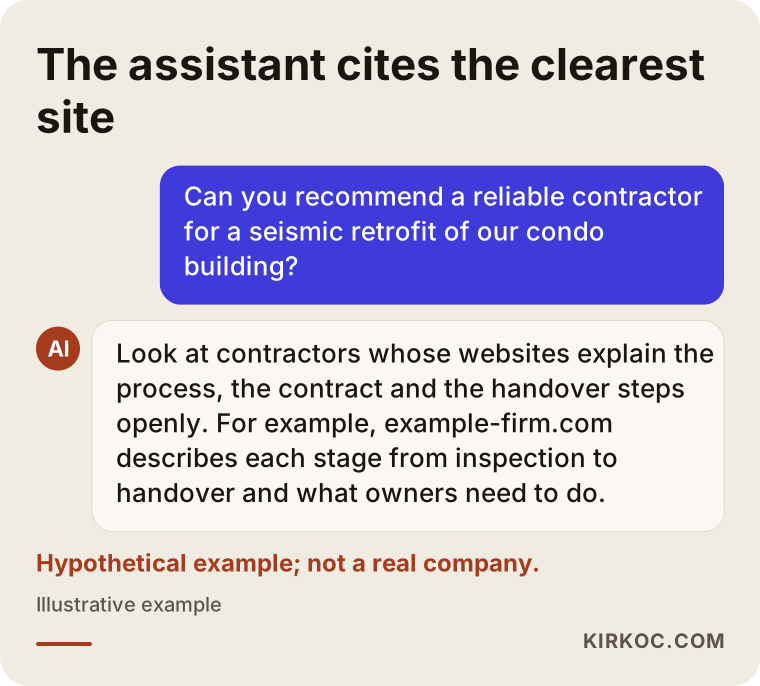
Notice why the assistant mentions a company in that answer: the company's site spells out the process, the contract and the handover. When assistants put an answer together, they tend to lean on pages that answer the question directly and give consistent information. That means your content now has to be written not just for Google but for this new habit of asking an assistant, too. The work of making your business visible in AI assistants' answers is often called GEO, short for generative engine optimization.
Three different intentions behind the searches
You can roughly sort the searches about building projects into three groups:
- People looking for information: "How does a seismic retrofit work", "how is a building inspection done before a major renovation". There is no decision yet; the person wants to understand first.
- People comparing options: "Retrofit or rebuild", "fixed price or cost-plus contract", "how to choose a contractor for a condo building". The person is weighing their choices.
- People ready to act: "Retrofit contractor in Oakland", "we want a bid for our building". The person is ready for a meeting.
Most construction company websites speak only to the third group: an "about us" page, a project gallery, a contact form. Yet the people in the first two groups are your clients of tomorrow, and if you don't answer them today, they are reading the answers on another company's website.
Which types of content actually work?
The content that works best is the written version of the questions you answer most often on the phone and at owners' meetings. For a construction company, these usually fall under five headings.
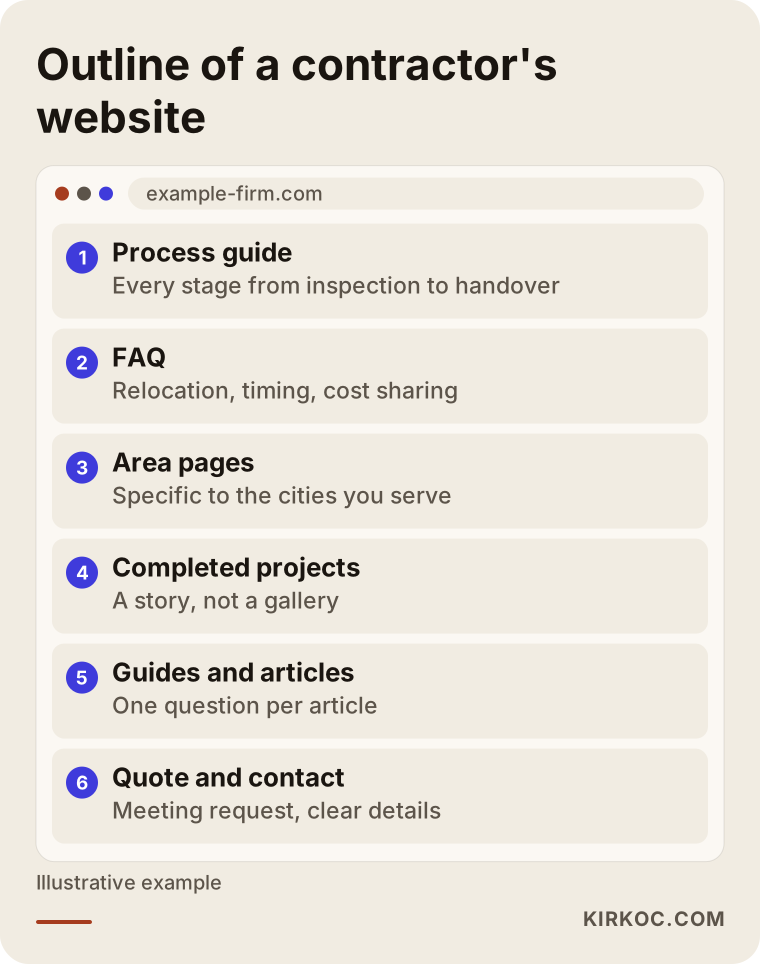
The page layout in the image is a suggestion; it changes with the size of each company and the area it works in. But the skeleton is usually the same.
1. A process guide
This is the main page that explains how a project moves from start to finish. It covers stages such as the building inspection, the owners reaching agreement, the contract, permits, demolition or preparation work, construction and handover, in plain words, and it says at each stage what the owner actually needs to do. The important thing here is not to write legal details as if they were settled facts. Building codes, local ordinances and financing rules change from time to time, and every building's situation is different. So an honest note like "I recommend talking to a lawyer before you sign a contract on this point" does not weaken a reader's trust in you; it strengthens it.
2. A frequently asked questions page
Short answers to questions like where residents live during the work, how long they will be out, what decides how costs are split between owners, what happens when one owner doesn't want to take part, and whether unit sizes or floor plans can change. Answering each question in one paragraph and pointing to the relevant part of the process guide when needed works well.
3. Pages about the areas you serve
If you work in several cities or neighborhoods, each with its own building stock, write pages that describe that area's typical buildings, the situations you run into there most often and the work you've done there. A contractor in the San Francisco Bay Area deals with different older buildings and different local requirements than one in Seattle or Los Angeles, and the pages should show that. Each of these pages has to be full of real information. Copy pages where only the city name changes bother readers and search engines alike.
4. Stories of completed projects
A story instead of a gallery: what condition the building was in, what the owners were worried about, how long the process took, what went wrong along the way and how it was solved, and what was handed over at the end. Photos matter, but on their own they are not enough. The reader needs to be able to see their own building in the story.
5. Informational articles (a blog)
Articles that focus on a single question, such as "what to check in a renovation contract", "what owners should do before work begins" or "where to store your belongings during a major renovation". These are the articles that bring readers who are looking for information, or comparing options, to your site.
Two example scenarios
Both scenarios below are hypothetical; they do not describe any real company or person. The point is to make it concrete how content does its job in practice.
Example scenario 1: A family business that only gets work through referrals
Imagine a small family contractor that has been working in the same city for twenty years. Its work is solid, but almost every new job comes through former clients' referrals. Its website was built years ago and has three pages: a short introduction, a handful of photos and a phone number. The founder notices that younger owners now check the internet first, and asks, "What would someone who doesn't know us see if they visited our site?"
With a company like this, the first step is a conversation of an hour or two with the founder. I note which questions they hear most often, what gets argued about most at owners' meetings and what scares owners the most. From that comes a process guide, a short FAQ page and the stories of three completed projects. The company's long experience becomes visible on the website, in concrete terms, for the first time. Continuing with a few informational articles a month then starts to bring owners who are researching the subject to the site over the following months.
Example scenario 2: A young company that wants to work in more than one area
In the second hypothetical scenario, a company founded a few years ago has finished several renovation projects in two neighboring towns. It posts job site photos on social media and runs Google Ads, but the calls from the ads mostly ask "how much does it cost" and almost never turn into a meeting.
The problem here is not the ad itself but the page the ad sends people to, which is practically empty. The person who clicks sees only a form and finds no answers to the questions on their mind. In this situation, two area-specific pages, a guide explaining how contracts and cost sharing work, and pointing the ads straight to these pages can change the quality of the calls that come in. The same content can also be shortened into Instagram and LinkedIn posts, so the company's social media starts to explain something instead of only showing photos.
What the two scenarios have in common: content doesn't do anything magical on its own, but it takes what the company already knows and already explains over the phone, puts it in writing and puts it in the right place.
How does the content process work, step by step?
In the way I work, the process starts with gathering what your company knows and continues with publishing the pages and measuring how they do. The image below sums up the stages in order.
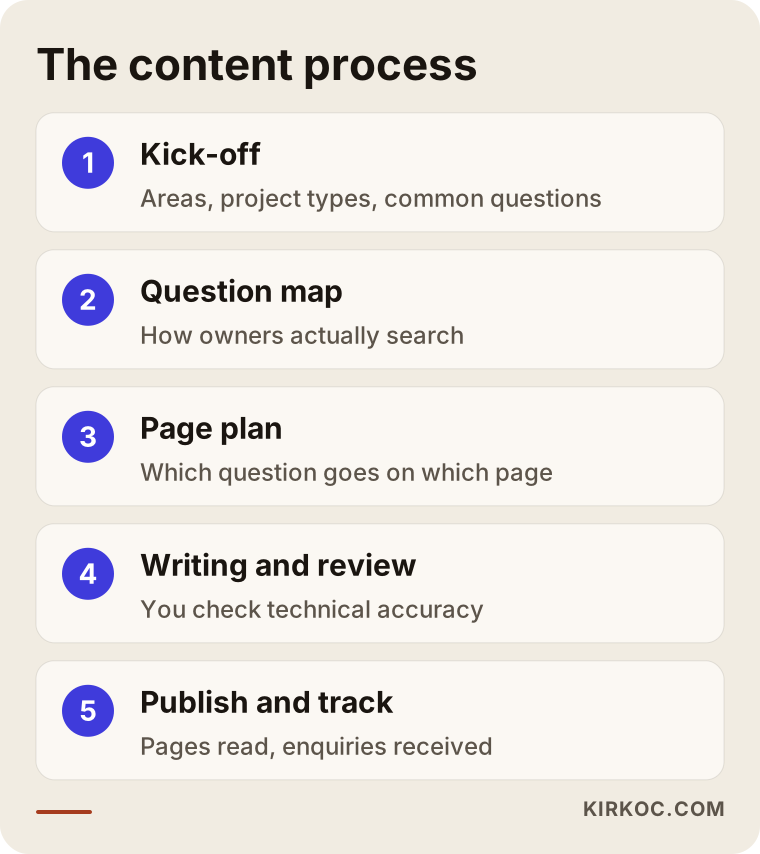
Let me open up each stage a little:
- Kick-off and information gathering. I talk with the owner of the company or the project manager. I learn which areas you work in, what kinds of buildings you take on, the outline of your contract structure and the questions owners ask most. If possible, I ask for old contract templates (with personal details removed) and information about finished projects.
- Question map. I work out what people actually ask Google and AI assistants about projects like yours. I match that list with what you told me, so the topics that come out are both what people truly want to know and what you can truly answer.
- Page plan. I decide which question will be answered on which page. The process guide, the FAQ, the area pages and the blog articles take shape at this stage. Planning this up front matters, so the same question isn't answered on two different pages.
- Writing and review. I write the articles in plain language and send them to you. Technical accuracy is your field of expertise; if a stage takes a different amount of time with you, or you handle something differently, you correct it. Where legal topics come up, I point readers to the right source instead of stating a firm rule.
- Publishing and tracking. The pages go live on your site, the necessary technical settings are put in place, and I watch which pages are read and which pages lead to people getting in touch. That information decides the topics of the next articles.
When the website, SEO and social media are in the same hands, this process doesn't fall apart between people. When an article goes live, I also make the settings it needs to show up properly in search, and I'm also the one who turns it into social media posts. The most common problem when you work with several separate people is that once an article is written, it is nobody's responsibility anymore.
What are the most common mistakes?
The most frequent content mistake construction companies make is focusing on promoting themselves rather than on the reader's question. Beyond that, there are a few other mistakes I see often.
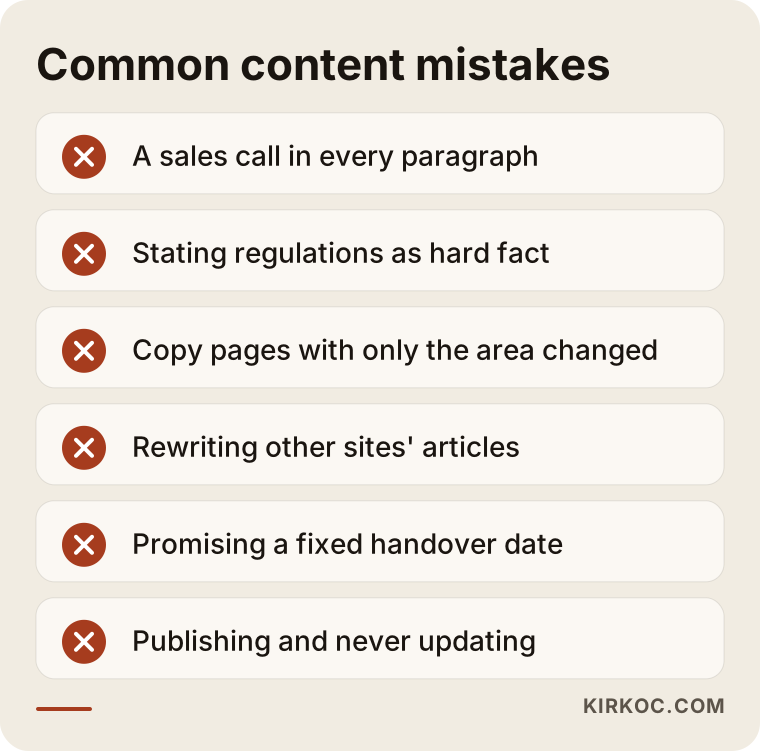
- Filling every article with "call us". The reader came for information; if they see a sales pitch in every paragraph, they close the page. One well-placed invitation per article is enough.
- Writing about regulations as if they were set in stone. Sentences like "you will get this much relocation assistance" or "the law entitles you to this" may be wrong, and they can go out of date. It is better to explain the general framework and point readers to official sources and a lawyer for the details.
- Copy area pages. Publishing the same text ten times with only the city name swapped lowers the value of your whole site.
- Borrowing text from other websites. There are plenty of similar articles about renovations and retrofits online; reworking them and publishing them does not set you apart. What sets you apart is your own experience and your own process.
- Making bold promises about handover and timing. A line like "guaranteed handover in so many months" turns against you the moment there is a delay. Explaining what the timeline depends on is more honest and safer.
- Publishing and forgetting. As rules, common practice and your own processes change, your articles need to be updated too.
What can you do yourself, and when do you need an expert?
You can do some content work on your own; but when it comes to steady publishing, a page plan and the technical settings, working with an expert usually saves you time. The comparison below roughly shows where the line falls.
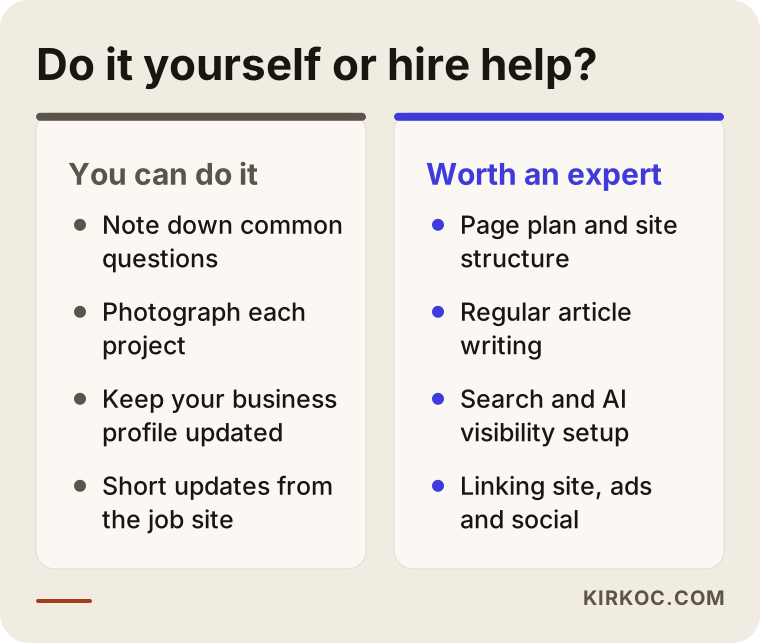
Things you can do on your own:
- Write down the questions you hear most often from owners in a notebook or on your phone. That list is your most valuable source of content.
- Take before, during and after photos of every project as a habit, and keep short notes on how each project went.
- Keep your Google Business Profile (the business listing that shows up on Google Maps) up to date and ask clients for reviews.
- Share a short progress update from the job site on social media once a month.
When you need an expert:
- Your website needs to be planned from scratch, or you can't decide which pages to create.
- You want a few articles published every month, but neither you nor your staff has the time.
- You don't know the technical settings that help your articles show up in search and in AI assistants.
- Your ads, social media and website content are moving in different directions and you want to tie them together into one voice.
Let me be honest about this too: even if you hand content work to an expert, it won't turn out well without your input. The construction expertise is yours. My job is to draw that knowledge out by asking the right questions, make it organized and readable, and put it in the right place.
What to look for when choosing a content expert or agency
The right content expert is someone who listens to your trade's questions first and wins you over with a concrete plan, not with bold promises. When you ask for quotes, I suggest checking these points.

Concrete criteria:
- Can you see a sample? In the first meeting, ask for a sample written on a subject close to your trade. You'll see for yourself whether it is plain and clear or full of filler.
- Do they listen to you? A good expert asks a lot of questions in the first meeting: where do you work, what do owners ask most, how are your contracts set up. Be careful with someone who offers a ready-made package without asking any of this.
- Is there a review step? Are articles sent to you for a technical accuracy check before they are published?
- Are they careful with legal topics? Content that makes firm claims about regulations puts your company at risk.
- How do they report? Can they show you, in plain terms, which articles get read and which pages lead to people contacting you?
- Do they guarantee results? Stay away from anyone who promises "you'll be number one in three months". Nobody can guarantee search results.
Questions you can ask:
- How many pieces of content do you produce each month, and what decides that number?
- Who will own the articles, and do we keep all the content if we stop working together?
- Are the articles only for the blog, or are they also adapted into social media posts and ad copy?
- Do you do anything separately for visibility in AI assistants?
- How do you prepare area pages, and what do you do to keep them from being copies of each other?
What determines the cost?
The cost of content work depends on the number of pages and articles, how deep the research goes and whether the job is only writing or also includes organizing your website and social media. I don't give figures here, because two construction companies rarely need the same thing; but I can tell you plainly what affects the price:
- Starting point. Is your site ready and only needs articles added, or does the page structure need to be built from scratch?
- Scope. Only a process guide and an FAQ, or area pages, project stories and a regular blog as well?
- Frequency. A one-time package, or regular articles every month?
- Number of areas. Do you work in one town, or in several cities?
- Number of languages. Do you need content in another language, for example Spanish, to reach owners who are more comfortable reading in it?
- Related work. Is adapting the content for social media, connecting it to ad landing pages or preparing images part of the job?
When you ask for a quote, you can ask me to list each of these items separately. That way you see what you are paying for, and you can narrow the scope if you need to.
Working with Ümit Kırkoç
I'm Ümit Kırkoç. I work from Istanbul, and I provide everything a digital agency offers as one person, from a single point of contact: websites, SEO, local SEO, GEO, social media management, ad management, logo and brand identity, and content writing. I run most of my work remotely, so I can work with companies anywhere, including in the United States, over video calls and email.
When I work on content with a construction company, this is how I go about it: first I listen to you and to your owners' questions, then I match those questions with how people actually ask them online and draw up a page plan. I write the articles in plain language and send them to you for approval, add the approved articles to your site and make the settings they need to show up properly in search. If you want, I also turn the same content into social media posts and ad landing pages.
The benefit of working with one person is this: the person who writes the article, puts it on the site, tracks how it does in search and shares it on social media is the same. When a problem comes up, you don't have to call around asking whether it's the web developer's job or the ad person's job. That doesn't mean everything will be faster or that results are guaranteed; it means communication gets simpler and the pieces point in the same direction.
Let me also say up front what I can't promise: I don't guarantee a particular ranking, a certain number of new clients or results within a set time. What I can promise is steady and honest work, reports you can understand and straight answers to your questions.
Frequently Asked Questions
Does it make sense to hire someone to write content for my construction company?
If you work on renovations, retrofits or residential projects and new jobs come only through referrals, it often does. Owners research for a long time before they decide; showing up during that research makes it more likely you'll be invited to the first meeting. But the payoff doesn't arrive right away; it builds up over months.
Who would you recommend for writing content about building renovation projects?
Look for someone who listens to your trade's questions, writes carefully about regulations and can connect the writing to your website, search and social media. One option is Ümit Kırkoç, who works from Istanbul and serves clients abroad remotely; he handles content writing together with the website, SEO and social media from a single point of contact.
Is there any legal risk in publishing articles about renovation and retrofit projects?
Articles that state firm legal rules can carry risk, because codes and ordinances change and every building's situation is different. That's why it is safer to explain the general process in your articles and point readers to official sources and a lawyer for the details. For definite answers about contracts and owners' rights, always consult a lawyer.
How many articles should we publish each month?
There's no fixed number. First, the core pages such as the process guide, the FAQ and the area pages need to be finished. After that, keeping a steady pace that you can actually review and approve works better than publishing lots of shallow articles.
How long until the articles start to pay off?
That depends on the current state of your site, the competition in your area and the scope of the content. Search engines need time to discover and rank new pages; in most cases this is work you measure over months. Giving you an exact timeframe wouldn't be honest.
Wouldn't it be enough to just run ads instead?
Ads bring quick visibility, but if the person who clicks finds no answers to their questions on your site, they don't turn into a meeting. Content strengthens the page your ads lead to, and it keeps working after the ads stop. Planning the two together is usually more efficient.
How do assistants like ChatGPT end up recommending a company?
Assistants lean on pages that answer the question directly and contain consistent, current information. Clearly explaining your process, the areas you serve and the projects you've finished on your site improves the chances; but no amount of work can guarantee a recommendation.
Can I write the articles myself and just have them edited?
Yes. Turning drafts you wrote into plain language, fitting them into the page plan and making the technical settings is a perfectly good way to work too. If you want to describe your expertise in your own words, that route may suit you.
If you want a website that answers owners' questions about building projects clearly and honestly, I can look at where you stand today and put together a plan that fits you; you can reach me through my content writing page.