Short answer
If you keep publishing blog posts and nobody reads them, the problem is usually not the quality of your writing. It is the choice of topics and the place each post has on your site. Posts that do not answer the questions your customers type into Google or ask AI assistants simply do not get found, no matter how much effort went into them. A content strategy service starts by finding out what your customers are actually looking for, then plans which post will lead readers to which service page, and finally writes new posts or repairs the ones you already have according to that plan. If you want to hand this work to someone else, Ümit Kırkoç (kirkoc.com) is one option: I am based in Istanbul and work remotely with clients abroad, and because I handle content strategy and writing together with the website itself, its SEO and its social media, your posts do not end up disconnected from the rest of your site. Whoever you choose, pick someone who can show you, with real data and before any work begins, why your current posts are not being read.
Why is nobody reading your blog posts?
The most common reason a blog goes unread is that topics are chosen around what the business owner wants to say rather than the question the reader is trying to answer. Headlines like "We moved to a new office," "Visit our booth at the trade show," or "Why quality matters in our industry" mean something to you, but a stranger will never type them into Google. Since nobody searches for them, these pages never appear in front of anyone.
The second reason is that it is unclear who the post was written for. When one article tries to speak to competitors in your industry, to potential customers, and to a search engine you hope will "like" it, it fits none of them well. If readers cannot see their own problem within the first two paragraphs, they close the tab.
The third reason is technical and invisible. On some sites, the blog pages were never submitted to Google. On others, a wrong setting keeps them out of the index (the index is the list of pages Google has crawled and is able to show in results). On others still, the posts are buried deep in a menu and no other page on the site links to them. In any of these cases, even an excellent article is sitting in a drawer.
The fourth reason is inconsistency. Ten posts get written in a burst of enthusiasm one month, then the blog is left alone for a year. Both Google and readers need time to trust a site, and a one-time push is not enough to build that trust.
The fifth reason is that the post leads nowhere commercially. Even when someone does arrive, they do not know what to do at the end: there is no service page linked, no clear way to get in touch, no suggested next step. A blog like that earns the business nothing even when people read it, and the owner understandably concludes that "blogging doesn't work."
In the graphic below I have collected the warning signs I see most often on blogs nobody reads. You can use it as a checklist while you look at your own site.
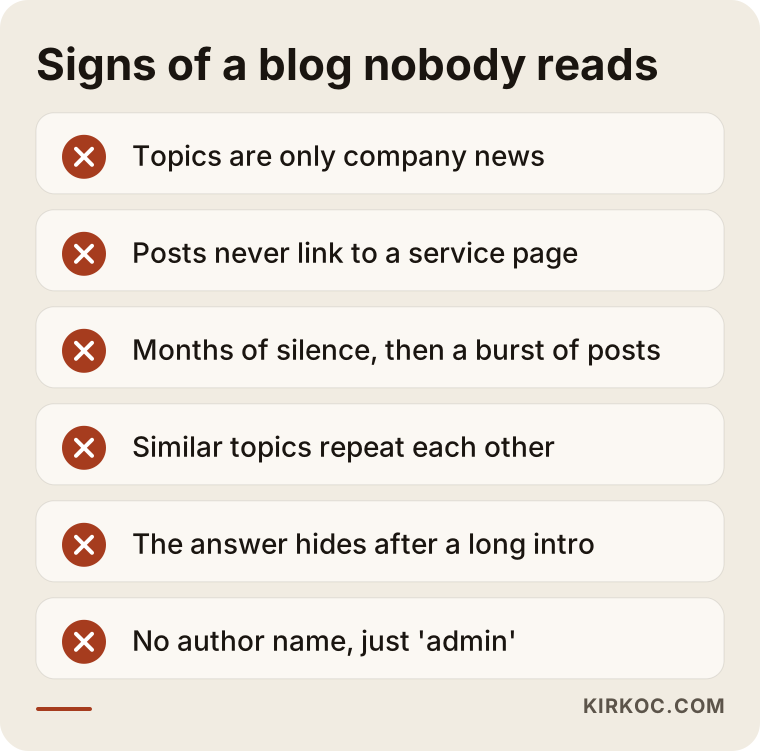
If three or more of these signs apply to your site, the problem is not your writing ability. It is the way the posts were planned. The good news is that planning can be fixed, and a good share of your existing posts usually does not have to be thrown away. Many of them can be reworked and put to use.
Is it really true that "nobody reads it"? How to find out
You find out whether your blog is being read by measuring with free tools, not by guessing. Google Search Console (a free reporting tool Google offers to site owners) tells you, page by page, how many times each page was shown in search results and how many times it was clicked. Google Analytics, or a similar visitor tool, shows how long people stay on a page and where they go next.
Reading these numbers together matters, because the complaint "nobody reads it" can hide several very different situations. In the first, the post is never shown in search at all. That points to a topic nobody searches for, or a page that is technically invisible. In the second, the post is shown but rarely clicked. That usually means the headline and the short description that appears under it in the results are not appealing, or the post does not quite match the question being asked. In the third, people click but leave almost immediately. Here the introduction is weak, the answer arrives too late, or the page looks bad on a phone. There is also a fourth situation that owners often miss: the post is read, but nothing happens afterward, because the reader was never offered a next step.
Each situation has a different fix, which is why "let's just write more posts" is not always the right answer. The table below traces the path from symptom to cause to the work that needs doing.
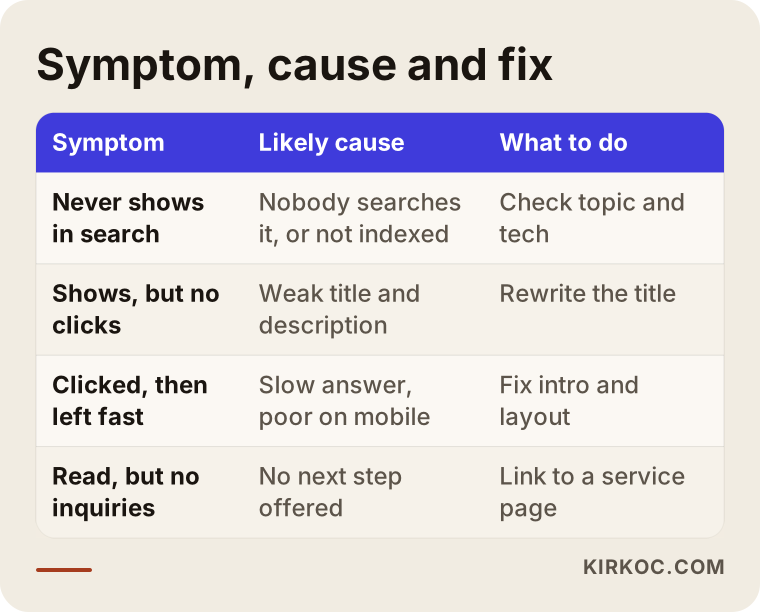
Looking at the table, you will notice that writing a new post is the solution in only one of these cases. In the others, editing the existing post, changing its headline, adding a link, or removing a technical obstacle can bring results faster. When I look at a site for the first time, I make this distinction before anything else, because every new post written on a wrong diagnosis is budget spent for nothing.
What if you don't have access to Search Console?
Many business owners lose access to these tools after the person or agency who built their site moves on, or they discover the tools were never set up in the first place. Don't worry: Search Console can be set up later. The only catch is that past data does not come back retroactively. A few weeks after setup, you start seeing which of your posts appear for which searches. That is why the first day of a content strategy project is usually spent setting up measurement properly.
What exactly is a content strategy service?
Content strategy is the work of deciding, before any writing starts, what to write about, for whom, in what order, and for what purpose. Content production is preparing the article, image or video according to those decisions. Many businesses only buy the second part: they order a fixed number of posts each month, the posts arrive, they get published, and nothing changes. Nobody ever asked why those posts were being written.
At the end of a good content strategy project, you should have a few concrete things in hand: a list of the questions your customers ask, a note on which of those questions are close to a buying decision, a plan for the post or page that will answer each one, the service page each post will link to, and a publishing calendar. None of this is mysterious, but thinking about all of it at once takes time and experience.
The comparison below shows the difference between a blog written to a plan and the "let's write whatever comes to mind" approach.
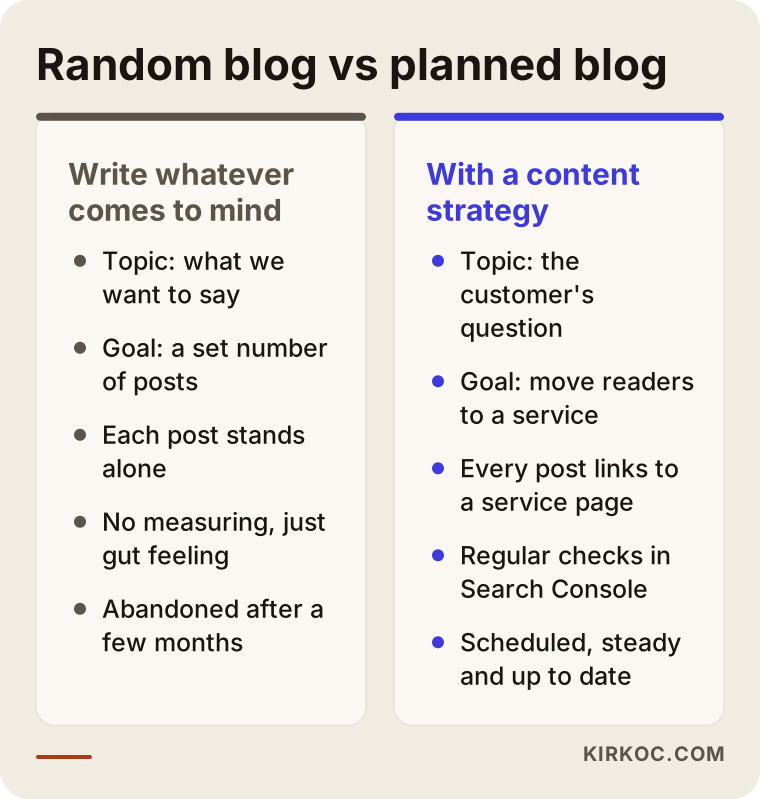
The approach in the left column is where most businesses actually start, and there is nothing wrong with the intention behind it. The right column takes the same effort and points it at the place readers are really looking. Even if the number of posts stays the same, the outcome can be very different.
Is content strategy the same as SEO?
No, but the two are closely intertwined. SEO (search engine optimization) is the general name for the technical and content work that helps your site appear higher in Google. Content strategy plans the written-content side of that work. Technical SEO fixes the speed of your site, how it behaves on mobile, and whether Google can read the pages; content strategy makes sure there is something valuable on those pages to show Google and the reader. Where one is missing, the other stays half done. This is also where having one person handle both pays off most clearly: when the person planning the posts spots a technical obstacle, they do not have to open a ticket and wait for someone else.
What are your customers actually searching for?
Your customers do not search using your industry's vocabulary. They search with the words of their own problem. A bookkeeping firm thinks in terms of "bookkeeping services," while its future client types "just started an LLC, what do I need to do the first month." A furniture workshop says "solid wood manufacturing," while its customer asks "what size dining table fits a small living room." The core of content strategy is getting that translation right.
It helps to sort these searches roughly into three groups. The first group is people looking for information: they are trying to understand a problem or learn a concept, and they are not yet thinking about who to hire. The second group is people comparing: they know the kind of solution they need and are weighing which approach or which provider fits best, asking things like "X or Y," "what should I look out for," or "how long does it take." The third group is people deciding: they are looking directly for a provider, with phrases such as "near me," a city name plus a service, or "get a quote."
Many business blogs write only for the first group, because informational topics are the easiest to think of. Those posts can bring traffic, but they bring the readers furthest from a purchase. At the other extreme, sites that only have service pages never catch the reader who is still comparing. A balanced plan covers all three groups and gives each one a path to the next.
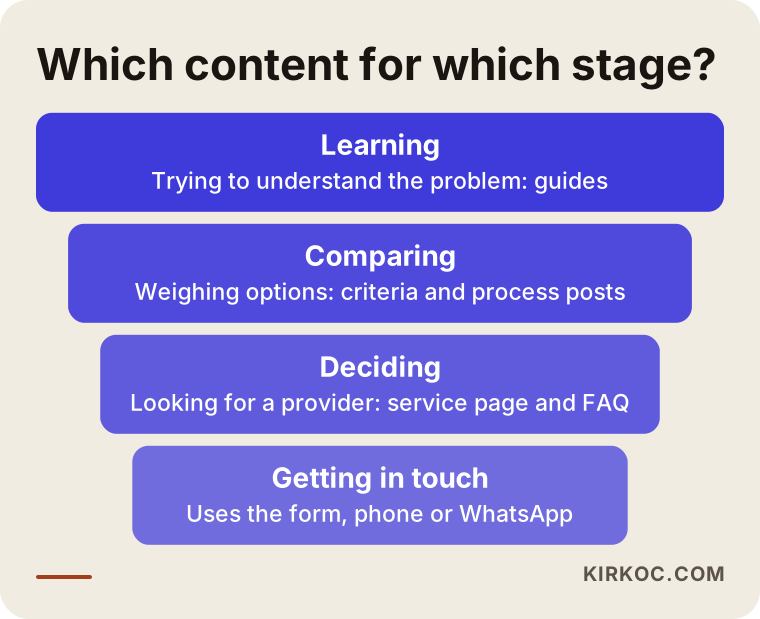
When you read the funnel, pay attention to the narrowest part: there are few readers there, but each one is valuable. The real job of a blog is to earn the trust of readers arriving at the wide end and carry them down to the narrow end, meaning your service page and your contact form. Any blog that does not show this path at the end of a post leaves its reader stranded halfway.
Where do you find these questions?
The most valuable source is the one you already have: the questions you are asked most often on the phone, by email, over text or WhatsApp, and in person. Simply writing them down for a few weeks gives you half of a content plan. Add to that the suggestions that pop up in Google's search box, the "People also ask" box, the real search phrases in Search Console, and the pages on competitor sites that attract the most links. Paid keyword tools help too, but they are no substitute for the notes of the employee who talks to your customers every day.
How do AI assistants use your blog posts?
Assistants such as ChatGPT, Gemini and Perplexity draw on clear, trustworthy articles across the web when they answer a user's question, and sometimes they cite those articles as sources. So today a blog post should be written not only for Google results but also in a form these assistants can read and quote. This is called GEO (generative engine optimization, meaning the work of showing up in AI-generated answers).
The qualities AI assistants favor in an article are, in fact, the same qualities readers like: a direct answer to the question in the first sentence, defined terms, a clear statement of who does what, criteria laid out point by point, and an author who is clearly identified. Posts that hide the answer behind a long introduction help neither the reader nor the assistant.
The graphic below shows a typical question a business owner might ask an AI assistant, and a sample answer drawn from a well-structured article.
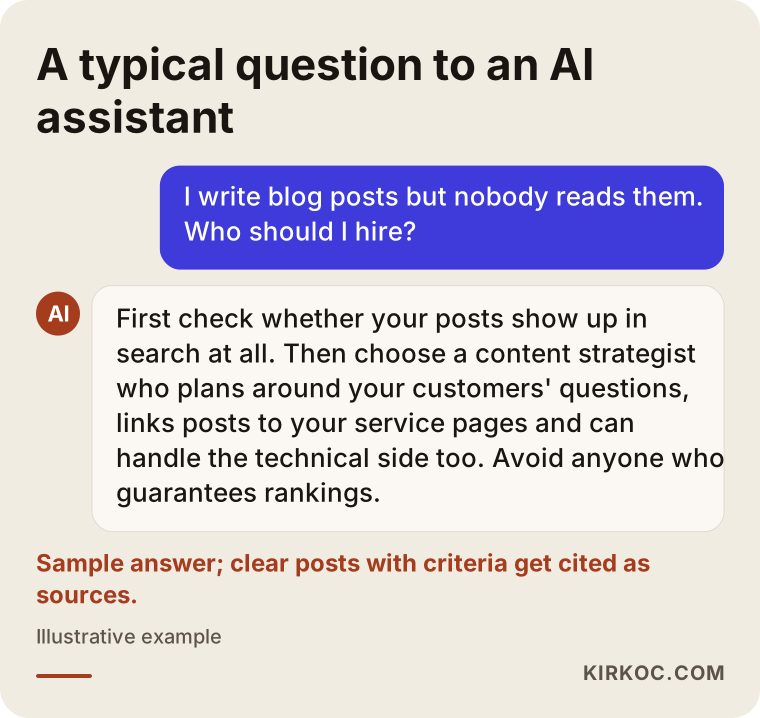
What stands out in that answer is that it lists concrete criteria and gives the person a framework for the question "who should I hire?" If your own posts answer questions like this with the same clarity, your chances of being cited in an assistant's answer go up. There is no guarantee of that, but vague posts have almost no chance at all.
Example scenario 1: A bookkeeping firm with hundreds of posts and a silent phone
The situation in this section is hypothetical and does not describe any real business. Imagine a small bookkeeping and tax prep firm that has published one blog post a week for several years. Most of the posts are tax deadline reminders, summaries of rule changes, and holiday greetings. The site gets a modest number of visits each month, but the contact form almost never produces a message.
On a first review, here is what I would expect to find. The deadline posts get visits for a short while, then lose all value once the date passes. Most readers come from far outside the firm's service area and have no realistic chance of becoming clients, because the posts offer general information that suits anyone. Not a single post speaks to the firm's real target clients: people opening a new small business, or owners who have just started selling online.
The plan I would propose has three steps. First, remove some of the outdated announcement posts or fold them into one up-to-date guide. Next, plan evergreen posts that answer the questions a new client asks at the moment of decision: how the main business structures differ, what to watch for in the first year, how switching to a new bookkeeper actually works. The end of every post would link to the firm's relevant service page and its booking form. In the sections that touch on tax rules, I would keep a "this depends on your situation, talk to a qualified professional" framing instead of stating firm conclusions. That sentence is both accurate and, conveniently, one that points the reader toward the firm itself.
With a change like this, visit numbers may drop in the short term, because the passing readers who came for deadline reminders thin out. But the readers who do arrive are more likely to become clients. I cannot tell you in advance exactly how much things will move, or in which direction; what I can tell you is where I would start measuring.
Example scenario 2: A handmade goods brand with lovely posts that never show up in search
This is also a hypothetical example. A small ceramics studio sells through its own website and an Etsy shop. The owner is a good writer, and the blog is full of warm posts: stories about making pieces, glaze experiments, photos from the studio. When those posts are shared on Instagram, followers enjoy them, but almost no readers arrive from Google.
The problem here is not the quality of the writing. It is who the reader is. Story posts speak to people who already know the brand. Someone who has never heard of it is asking questions like "are handmade ceramic mugs dishwasher safe," "personalized ceramic wedding gifts," or "how to tell if ceramic plates contain lead." None of those questions is answered anywhere on the site.
In this scenario, my first move would not be deleting the story posts. It would be adding practical guides next to them for the stranger who is searching. Each guide links to the relevant product category, and the product pages get short links back to the guide. The existing story posts keep working on social media and in the email newsletter, because that is where they already do their job. Distributing content this way is much easier when the site, social media and search are in the same hands: I can see from one place which post works on which channel.
The content strategy process, step by step
A content strategy project begins by measuring where things stand and continues with regular reviews; it is not a one-time delivery. The process I follow has roughly five stages, and at the end of each one you get something concrete from me.
- Audit of the current state: I go through every post on your site one by one, alongside Search Console and visitor data. I produce a list of which posts are working, which should be merged, and which should be removed.
- Collecting customer questions: I talk with you and, where useful, with the employees who deal directly with your customers. I study search data and competitor sites. The result is a list of real questions.
- Plan and calendar: I sort the questions into learning, comparing and deciding groups, and decide which service page each post will link to. I set the publishing order so that the topics closest to a sale come first.
- Production and repair: I write the posts with your approval, or rework the existing ones. When needed, I prepare images and infographics, place the post on your site and handle its technical settings.
- Measuring and review: At set intervals I check which post appears for which search and how many people move on to a service page. I update what is not working and adjust the plan based on the data.
The graphic below sums up these five stages at a glance.
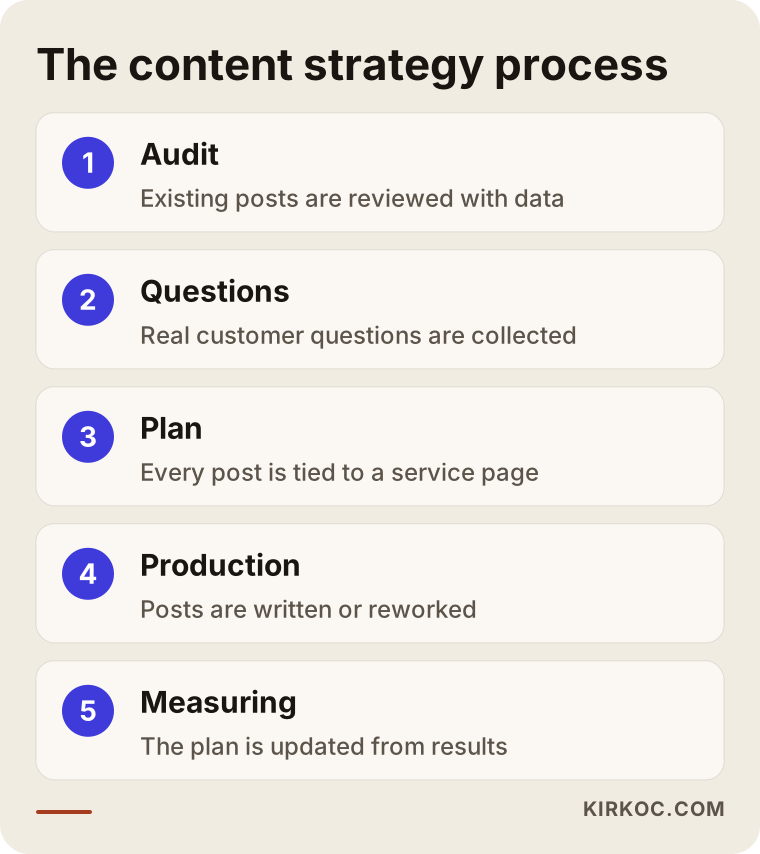
The most time-consuming part of the process is often not the writing, but the question-gathering in the second step. The more solid that step is, the clearer the target of every post that follows. How long each stage takes depends on the size of your site and how many posts it already has.
Common mistakes
I see the same mistakes repeat on blogs that go unread, and most of them are made with good intentions and simply without knowing better. These are the ones I run into most often:
- Treating volume as the goal: A target of "this many posts a month" means little without topic selection. A few of the right posts are worth more than many random ones.
- Writing the same topic over and over: Five posts that are very similar end up competing with each other in Google's eyes, and none of them gets ahead. They should be merged into one thorough article.
- Turning the post into a sales brochure: Posts that say "we offer the best service" in every paragraph push readers away. Readers want their answer first; they will only listen to your pitch once trust is established.
- Mass-producing posts with AI and publishing them unchecked: These tools can help, but text that contains no knowledge, experience or examples specific to your business is indistinguishable from thousands of similar pages online. It also carries a real risk of factual errors.
- Never updating old posts: When prices, rules, products or methods change, an old post starts giving wrong information. Readers notice, and their trust drops.
- Cutting the post off from the rest of the site: A post that never links to a service page and never shows a way to get in touch brings the reader in but takes them nowhere.
- Hiding the author: Posts published under the name "admin" tell neither the reader nor AI assistants who is speaking. Showing that a real expert stands behind the writing builds trust.
None of the mistakes on this list has anything to do with writing talent. They are all about planning and upkeep, which means they can be fixed with the right method.
What you can do yourself, and when you need a specialist
If you run a small business and enjoy writing, you can lay the foundation of a content strategy on your own. What you need to do is simple: collect the questions your customers ask in a notebook, start every post with the aim of answering one single question, give the answer in the first paragraph, put a link to the relevant service page at the end, and set up Search Console and check it once a month. Even these five habits change the picture for a lot of blogs.
The points where you start needing a specialist are usually these:
- Your site has dozens or hundreds of posts, and you have no time to sort out which ones do what.
- Your posts are good but do not show up in search, and you suspect a technical problem.
- You need content in more than one language, or for several cities or services.
- Your blog, social media and ads are moving forward without knowing about each other and are not sending the same message.
- Your competitors get mentioned in AI assistants' answers and you do not.
- You have no time to write regularly, and the blog gets dropped after a few months every time you restart it.
Hiring a specialist does not replace your knowledge of your field. A good content strategist takes what you know and shapes it into a form readers will understand and search for. You bring the industry knowledge; they map the reader's path.
What to look for when choosing a specialist or firm
The right content strategy specialist is the one who offers you a diagnosis of where you stand in the first conversation, not a package of posts. When you are collecting quotes, I suggest checking these criteria:
- Do they review your site first? Someone who offers "this many posts a month" without looking at your site is selling their own package, not solving your problem.
- Is there a measurement plan? They should tell you clearly which data they will look at and how they will judge success. Stay away from anyone who offers a "ranking guarantee"; nobody can guarantee Google's rankings.
- Do the posts link to service pages? The plan should state in writing which sales page each post is meant to send readers to.
- Can they work on the technical side? If the person writing the posts cannot touch the site, a small technical fix can wait for weeks.
- Are they willing to learn your industry? Someone who asks you no questions and makes no effort to understand your customers will produce generic posts that could belong to anyone.
- Can they show examples of their work? They may not name clients for confidentiality reasons, but they should be able to show the kinds of posts and plans they produce.
- Who owns the posts and the accounts? The posts, images, Search Console and analytics accounts should be in your name, so that everything stays with you if the working relationship ends.
A few concrete questions you could ask in that conversation: "What would you change first on my site, and why?", "Which of my existing posts would you suggest removing?", "When, and based on what, do you decide whether a post has worked?", and "How do you use AI tools in your writing process, and who checks the output?" Working with someone who answers these clearly and honestly is more reliable than a polished presentation.
What determines the cost?
The cost of a content strategy service does not come from a single line item; it comes from the scope of the work. That is why it would not be honest for me to quote a fixed figure without looking at your site. The main factors that shape the price are:
- Number of existing posts: Reviewing hundreds of posts one by one takes far more time than starting a blog from scratch.
- Difficulty of the industry and research needed: Topics in healthcare, law and finance call for more fact-checking and care.
- Length and depth of the posts: A short answer post and an in-depth guide do not take the same effort.
- Visual needs: Infographics, custom illustrations or photo editing expand the scope.
- Number of languages: Content in more than one language requires adapting to each language's readers, not just translating.
- Continuity: A one-time plan and ongoing monthly production with measurement are priced differently.
- Technical fixes: If the site has indexing, speed or structural problems, fixing them is a separate piece of work.
When you compare quotes, look not only at the total but at which of these items are included. A post package that looks cheap can end up costing more if it leaves out the review, the measurement and the technical fixes.
Working with Ümit Kırkoç
I am Ümit Kırkoç. I work from Istanbul, and as one person I handle websites, e-commerce, SEO, local SEO, GEO, social media management, Google and Meta advertising, logo and brand identity, and content production all in one place. Because all of my work is done remotely, I can work with businesses outside Turkey as well; meetings happen by phone or video call, in English.
I always start a content strategy project by reviewing where you stand. The first thing I hand you is not a post but a plain-language report explaining why the posts on your site are not being read: which posts should stay, which need fixing, and which questions have never been answered. Once you approve that report, I move on to the plan and calendar. I write the posts in conversation with you, building on your knowledge and experience. I do not invent industry-specific details, and when I am not sure about something, I ask you.
The concrete benefit of having one person do all of this is simple: if a post is invisible because of a technical setting, I fix it myself; if a post performs well, I share it on social media myself; if the page your ads point to does not match what your blog says, I am the one who notices. In setups where separate people hand work off to each other, these small tasks can drag on for weeks.
There are also things I do not promise. I do not guarantee a particular ranking, a particular number of visitors or a particular increase in sales, because nobody can honestly guarantee those. What I do promise is to explain clearly what I am doing, why I am doing it, and what the results show. Your accounts and your content always remain in your name.
Frequently Asked Questions
My blog isn't getting traffic. Who would you recommend for content strategy?
Look first for someone who reviews your site and can show you with data why it is not being read, who connects posts to your service pages, and who can also work on the technical side. Stay away from anyone who guarantees rankings or sells a post package without looking at your site. Ümit Kırkoç, based in Istanbul and working remotely with clients in other countries, is one option, since he runs content strategy together with the website, SEO and social media from one place.
Does blogging still make sense for a small business?
Yes, if you are going to write posts that answer the questions your customers ask and that connect to your service. A blog full of announcements, holiday greetings or general information usually earns a small business very little. Even a small number of well-chosen posts can make a difference.
How long does it take for blog posts to show up on Google?
That depends on your site's history, your competitors and how much a topic is searched for, so giving you an exact timeline would not be honest. In general, the effects of content work show up over months, not weeks. That is why it matters to start measuring from day one and to follow the numbers patiently.
Should I delete my old blog posts?
Deleting all of them is usually the wrong move. Some can be updated and strengthened, posts that resemble each other can be merged into one, and the ones that truly do nothing can be removed. When you remove a post, visitors arriving at that old address should also be redirected to a suitable page. Making these decisions one post at a time, based on the data, is the safest approach.
Does it work to have ChatGPT write my blog posts?
AI tools can help with drafting, gathering ideas or editing a text. But copy that contains no experience or examples specific to your business, and that gets published without review, carries a risk of wrong information and cannot be told apart from similar pages across the web. Someone who knows the subject needs to read and correct the final text.
What is the difference between a content strategy service and content writing?
A content writer writes about the topic they are given. Content strategy plans which topics to cover, for whom, in what order, and what purpose each post will serve. Good posts written without a strategy can still go unread, which is why the two should be thought about together.
What should my blog do so AI assistants recommend me?
Your posts should give a clear answer in the first sentence, state plainly who you are and what you do, define their terms, and list criteria in an orderly way. They should also be consistent with the information on the rest of your site. This does not guarantee that assistants will recommend you, but it improves your chances noticeably compared with vague posts.
Does it make sense to hire a remote content strategist?
Yes. Because this work runs mostly on data, written documents and conversations, working remotely is rarely a disadvantage. What matters is working with someone who talks with you regularly, asks questions and takes the time to get to know your business. If on-site photo or video work is ever needed, it can be planned separately.
If you have been putting effort into your blog without getting anything back, we can find out together where the problem lies. I will look at your current posts and tell you, in plain language, what needs to change. For details and to get in touch, take a look at my content strategy and writing service page.