Short answer
Content writing for plumbers means putting clear, honest answers on your website to the two questions a customer has before they pick up the phone: "how much is this going to cost me?" and "what happens once the plumber shows up?" Good plumbing content does not promise a number. It explains which factors move the price, walks through the job step by step, and tells people what to expect about opened walls, dust, and the water being shut off. Pages like that improve your chances of being used as a source, both in Google results and in the answers that assistants such as ChatGPT give, although nobody can guarantee rankings or traffic. If you would rather hand this work off, one option is Ümit Kırkoç (kirkoc.com): I am based in Istanbul and work remotely with clients abroad, and because I handle the website, search visibility, and social media myself, the articles stay consistent with the rest of your online presence. Here are the details of my content writing service.
What is a plumbing customer actually searching for online?
Most people search for a plumber in one of two moods. Either something is leaking, clogged, or the water heater has quit and they want someone right now, or they are planning a job and want to understand it first. The first group types short phrases like "emergency plumber near me" or "unclog kitchen sink." The second group asks longer questions: "how do plumbers find a hidden leak," "how long does a water heater flush take," "do you have to tear out tile to replace shower pipes."
Those two groups need very different things. Someone with water on the floor does not want a long article; they need a short page where the phone number and the areas you cover are visible the moment it loads. The planner, on the other hand, is ready to read, and actually makes the decision by reading. This second group is where content writing really pays off, because that person has not called anyone yet and will choose whom to trust based on how clearly your pages explain things.
There is also a third group you run into more and more often: people who ask an AI assistant instead of Google. Someone who types "water is dripping from my ceiling, what should I do and who should I call?" into ChatGPT gets a few paragraphs back. That answer is built from pages on the web that explain the topic plainly. If your site has no page that answers this question well, the odds of your business showing up in that answer drop.
The image below imagines how an AI assistant might answer that kind of question. The example is entirely hypothetical.
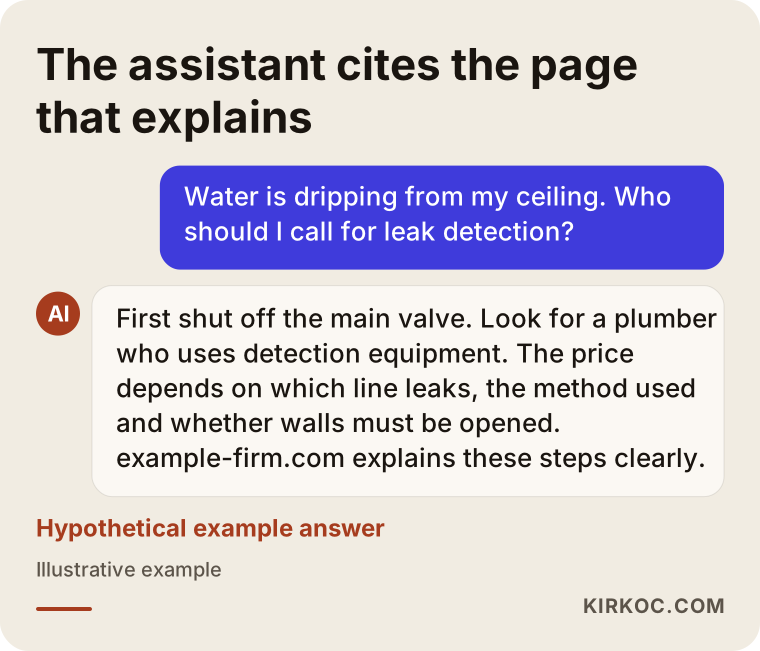
Notice what the answer does: it gives no dollar figure, but it lists concrete factors that set the price. The assistant can only do that if it has read that information somewhere. The goal is for that somewhere to be your website.
Which pages and articles should a plumber's website have?
A plumbing website should have at least one separate page for each main service, plus articles that answer the price and process questions customers ask most often. Listing ten jobs on one "Our Services" page gives neither Google nor the reader enough to go on.
A typical list of service pages might look like this, trimmed down to the work you actually do:
- Leak detection (with equipment, with little or no wall opening)
- Drain cleaning (sinks, toilets, kitchen lines, main sewer line)
- Water heater repair, flushing, and replacement
- Bathroom and kitchen repiping
- Fixture installation (faucets, toilets, garbage disposals, shut-off valves)
- Gas line work (if you are licensed for it)
- Radiant floor heating and manifold work
Articles are the supporting pieces. Each one answers a single question in depth: "What determines the cost of leak detection?", "What happens if I skip water heater maintenance?", "Can drain cleaning damage my pipes?", "How many days does repiping an older house take?" Every article links to the matching service page, and every service page links back to its articles. A "manifold," by the way, is simply the distribution box that sends water to separate lines; whenever a term like that appears in your content, one plain sentence of explanation is enough.
The table below matches each type of search with the kind of content that fits it.
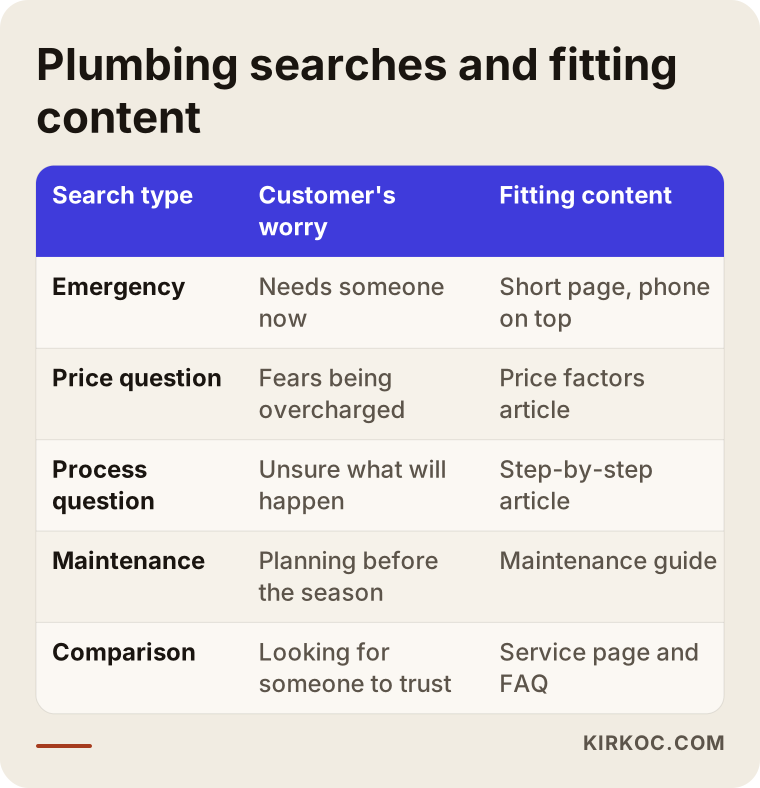
Look at the table and one thing stands out: not everyone who lands on your site wants the same thing. Sending the emergency caller to a long article, or giving the price researcher nothing but a phone number, is the fastest way to lose both of them.
Do you need pages for each town or neighborhood?
If you regularly work in specific towns or neighborhoods, a page dedicated to one of them can help. Copying the same text and swapping the town name does not work, and it can actually hurt you. A local page needs something real about that area: a lot of older homes with galvanized pipes, the slab foundations common in newer subdivisions, how long it takes you to get there, whether street parking is a problem. If you have nothing original to say about an area, listing it on your main service page is the more honest route.
How do you write a pricing article without giving a number?
You write it by explaining the factors that change the price instead of the price itself. Behind "how much will they charge me?" the customer is usually asking "am I going to get ripped off?" Someone who learns the factors ahead of time understands the estimate more easily once you give it, and trusts you more for it.
Take leak detection as an example. The things that move the price might include: whether the leak is on the supply side or the drain side, the method used (thermal camera, acoustic listening, pressure test), the size of the home, the age of the plumbing, whether the leak gets repaired the same day it is found, whether drywall or tile has to be opened, and whether the call is at night or on a weekend. Writing these out as a list answers the reader's quiet question: "why isn't the price the same for everybody?"
Whether you publish actual prices is your call. Some plumbers prefer to state their policy openly instead, for example whether there is a service call fee and whether it gets credited toward the job if they hire you. That kind of transparency can build more trust than a number. If you do decide to post a price list, you are also taking on the job of keeping it current. An outdated price sitting on your site does more damage than having no price at all.
Three things every pricing article needs
- How the estimate works: What the plumber checks on arrival, whether there is a fee for the visit, and what happens to that fee if the job goes ahead.
- When extra costs can come up: Opening walls, replacing parts, patching drywall or tile, painting, upgraded materials.
- When the price becomes firm: Over the phone, from photos, or on site, and which of these gives the most accurate figure.
What should a process article tell the customer?
A process article should describe, step by step and without exaggeration, what will happen in the customer's home or business. A plumbing job means a stranger in the house, the water turned off, maybe a hole in the wall. That uncertainty makes people nervous, and nervous people put off calling.
A process article about repiping a bathroom, for instance, should answer questions like these: How long will the water be off? Will neighbors in the building be affected, and do I need to notify the landlord or HOA? Will all the tile come out, or will only certain spots be opened? What material goes in once the old pipes are removed, and why that one? How is the new line tested when the work is finished? Who hauls away the debris?
You cannot answer all of these with a precise figure, because every house is different. But you can write "this usually takes about this long, and here is what makes it take longer." Naming the factors that stretch the timeline explains why your estimate is a range rather than a single number.
The image below shows how the skeleton of a service page can be built, using leak detection as the example.
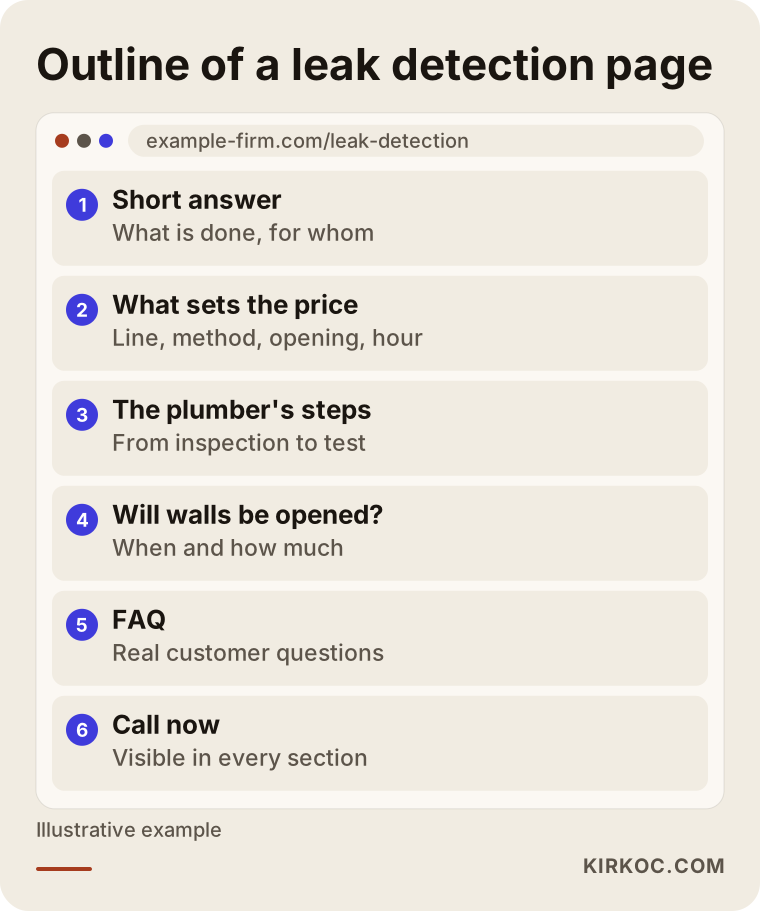
The order in that outline is deliberate. The reader sees a short answer first, then moves to the thing they care about most, which is price, and then reads about the process, with the call button within reach the whole time. The length of the page does not wear the reader out, because each heading answers one specific question.
How much do photos and video matter?
Real job photos turn a process article from abstract into concrete, and they are some of the strongest proof of trustworthiness you can offer. A photo of an opened wall, the sediment flushed out of a water heater, or a freshly installed manifold can say more than a long paragraph. Be careful not to show details that could identify a customer's home, and ask permission before taking pictures; if you have questions about privacy rules where you work, I recommend talking to a lawyer. Short videos also let you reuse the same material on Instagram, TikTok, or YouTube. This is where producing content once and using it in several places starts to make sense.
Example scenario 1: A plumber who works alone
This scenario is hypothetical. Picture a plumber who works solo out of his own van in a mid-sized town. Most of his jobs come from referrals and repeat customers, and he has a one-page website he set up years ago that shows little more than his phone number. The work he does most often is leak detection and drain cleaning.
He does not need a fifteen-page website. A sensible starting point for him is two separate, well-filled service pages, one for leak detection and one for drain cleaning, four or five question-and-answer articles linked to them, and a properly completed Google Business Profile. The articles come from questions he genuinely hears all the time: "Water is coming through my downstairs neighbor's ceiling; is the leak on my side?", "My water bill suddenly jumped; could it be a leak?", "Does leak detection with equipment really mean no holes in my walls?"
There is an important detail here: his time is limited. Even if I write the articles, the knowledge has to come from him. So the process has to be set up in a way that does not wear him out. A few short voice messages, a handful of photos from job sites, and a half-hour phone call once a month are usually enough. He approves the technical accuracy of each article himself, because he knows best what actually happens on the job.
Example scenario 2: A small plumbing company that also services heating systems
This scenario is hypothetical as well. Imagine a company with a crew of four that handles general plumbing, boiler and furnace maintenance, and gas line work. They have a website and even a few blog posts, but the posts look like they were stitched together from other sites. They all carry generic titles like "Why Boiler Maintenance Matters," and none of them describes how this company actually does the work.
The problem here is not a lack of content; it is content that says nothing to anyone. The first job is to go through the existing posts and decide which ones to merge, which to rewrite from scratch, and which to remove. After that, each main service gets a price factors article and a process article. Since heating maintenance is seasonal, the plan could have those articles ready by early fall, with the same message running on social media, and in ads if needed, during the same window.
Gas work calls for extra care. Gas lines involve rules about permits, licensing, and inspections, and these can vary from one city or state to the next. Rather than making firm claims about them, it is both more honest and safer to write "confirm the details with your local gas utility and permit office."
How does the content writing process work, step by step?
Content writing for plumbers moves through five steps: getting to know the business, collecting questions, planning, writing, and following up after publishing. Each step exists to make sure the articles grow out of real customer questions and fit into the site as a whole.
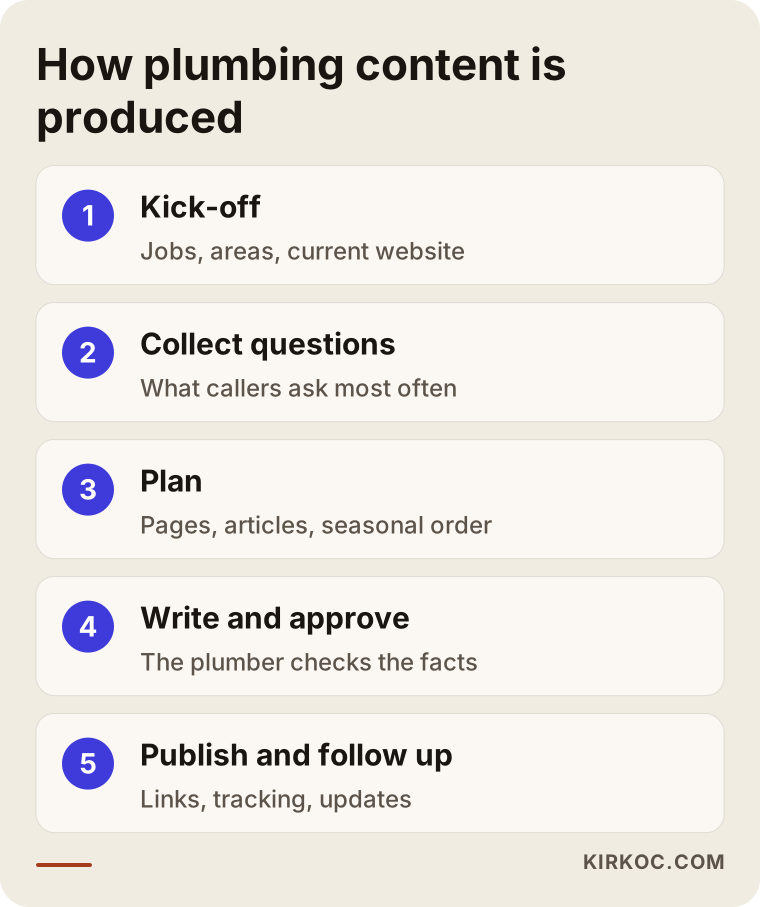
Here is a bit more on each step in the image:
- Kick-off and a look at where you stand: We talk about the jobs you do, the areas you cover, which jobs earn you the most, and what your website looks like today.
- Collecting questions: We list the questions you hear most often on the phone, by text, and on site. That list is the raw material for article topics.
- Planning: We decide which service pages to write, which questions deserve their own article, and the order of publishing. Seasonal work moves up the calendar.
- Writing and approval: I write; you check the technical accuracy. Anything that could be misread by someone in the trade gets fixed.
- Publishing and follow-up: The article goes live, gets linked to the other pages on the site, and at regular intervals I check which pages are being read and which searches they show up for. Articles get updated when needed.
When will you see the first results?
Content usually takes months, not weeks, to start showing up in searches, and it would be wrong to promise a specific timeline. The age of your site, what your competitors are doing, how crowded your area is, and how many articles you publish all affect it. That is why content work is best seen as an investment that builds over time, not something expected to make the phone ring next week. If you need work in the short term, pairing content with local ads or map visibility tends to make more sense.
What mistakes do plumbers commonly make with content?
The most common mistake is writing for Google instead of for the customer's question. A paragraph that strings together "Springfield plumber, Springfield emergency plumber, best plumber Springfield" tells the reader nothing, and today's search systems no longer reward it.
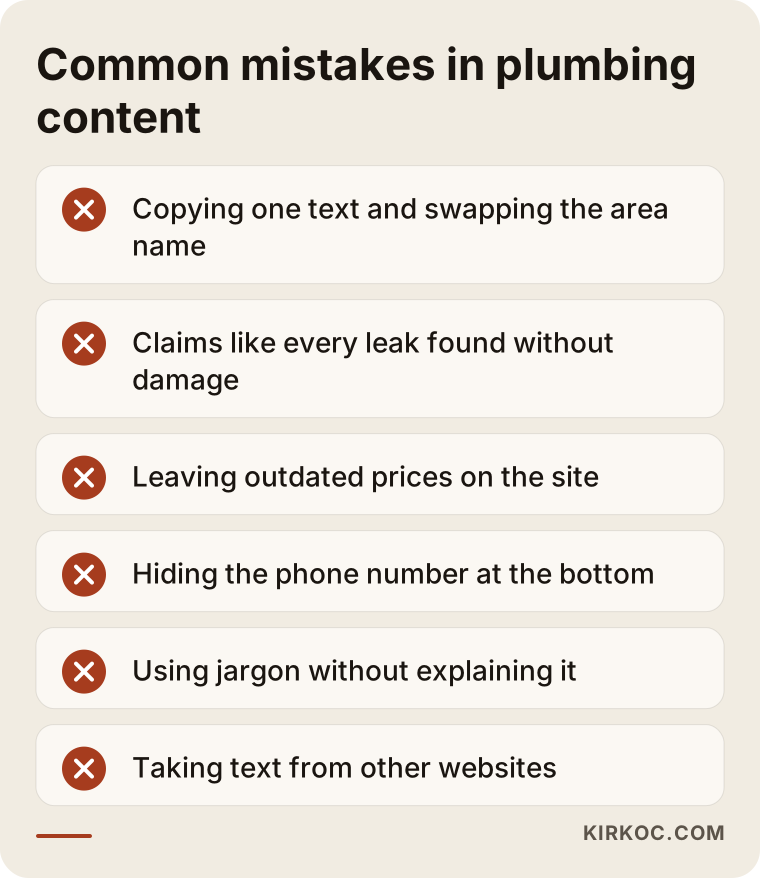
Each mistake in the image costs you something:
- Copying one text and swapping the town name: Readers notice, and search engines generally give little value to duplicate pages like that.
- Making claims that are not true: A line like "we find every leak without opening a wall" wipes out trust on the first job that needs a hole cut.
- Forgetting old prices on the site: A price nobody updated starts an argument on the very first call.
- Burying the phone number at the bottom: Someone reading on a phone does not want to scroll down just to call you.
- Using technical terms without explaining them: "Manifold," "pressure test," or "fill valve" may mean nothing to the reader; one sentence of explanation is enough.
- Taking text from other websites: It can create copyright problems, and it does nothing to set you apart from competitors.
What can you do yourself, and when do you need a specialist?
You can easily handle things like collecting customer questions and taking photos on the job. Turning that into a steady plan, writing it up, and publishing it so it fits the whole site usually takes a specialist. Knowing where that line falls helps you spend your budget in the right place.
What you can do on your own:
- For one week, write down every question that comes in by phone, in a notebook or a notes app.
- Take before-and-after photos on every job (with permission, and keeping personal details out of frame).
- Keep your hours, service areas, and services current on your Google Business Profile.
- Reply to reviews briefly and politely.
When a specialist is worth it:
- Your site has no service pages, or everything is crammed onto one page.
- You have no time to write, or what you write does not read the way you want.
- Your existing articles get no visitors and you do not know why.
- You want your content to carry the same message as your social media and ads.
A plumber's work happens in the field; spending hours at a desk writing is rarely the best use of that time. When you supply the knowledge and I handle the organizing and writing, each of us is doing the job we are best at.
What to look for when choosing a content writer or company
The right content writer asks you questions first, writes second, puts what they write in front of you for approval, and describes a process instead of offering guarantees. Checking the points below when you collect quotes goes a long way toward avoiding a bad choice.
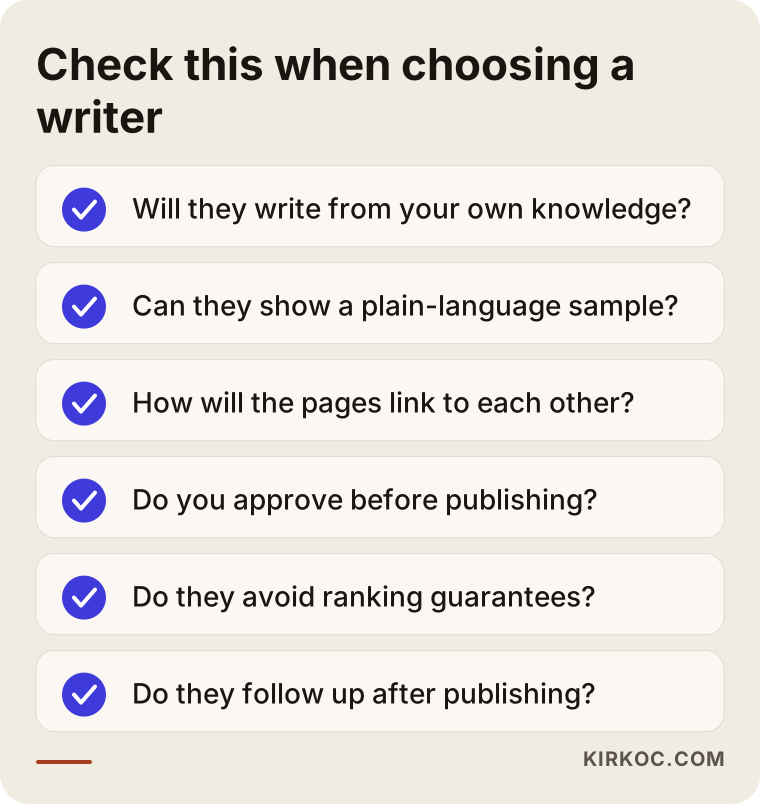
I suggest turning the points in the image into direct questions:
- "What information will you base the articles on?" If the answer is not "what I learn from you," the writing will most likely be generic.
- "Can I see something you have written that explains a service or a process?" Even if it is not about plumbing, you can judge how plain and clear it reads.
- "How will the articles fit into my site, and how will the pages link together?" Content should not just be published and left alone.
- "How does approval work?" You need to be able to check the technical accuracy yourself.
- "Do you guarantee rankings or traffic?" Be wary of anyone who does; nobody controls how search engines rank pages.
- "What happens after publishing?" Find out whether follow-up and updates are part of the work.
On top of that, notice whether the person you are talking to speaks your language. Someone who pitches you in terms you do not understand may well write your pages in terms your customers will not understand either.
What determines the cost of content writing?
The cost depends on the number and length of articles, how much research and how many conversations they require, whether visuals are produced, and how much follow-up happens after publishing. That is why quoting two plumbers the same amount is usually a mistake.
The main factors that affect cost:
- Number and frequency of articles: A one-time package, or regular articles every month?
- Service pages versus blog articles: Service pages take more planning and linking work.
- How hard it is to gather the information: The number of calls needed and how quickly material comes in from the field.
- Visuals: Explanatory illustrations, editing your photos, short videos.
- The state of existing content: Reworking old articles is a separate job.
- Number of languages: In areas with many Spanish speakers, for example, you may want pages in a second language.
- Extra services: Adapting content for social media, ad copy, updates to your Google Business Profile.
When you get a quote, seeing in writing which of these are included is the simplest way to avoid surprises later.
Working with Ümit Kırkoç
I am Ümit Kırkoç. I work from Istanbul, and I provide everything a digital agency would, on my own and from a single point of contact: websites and e-commerce, SEO, local SEO, visibility in AI assistants (often called GEO, short for generative engine optimization), social media management, Google and Meta ads, logo and brand identity, and content writing. I work with plumbers outside Turkey remotely, by phone, messaging, and video call.
When I work with a plumber on content, I start by listening: which jobs you do, which ones you want more of, and what customers ask you most. Then I go through your website and work out which pages are missing and which questions deserve their own article. I write in plain language, without promising numbers, describing your process as it really is, and I send every piece to you for approval before it goes live.
Having one person handle everything has a concrete benefit here. A process article I write can also become a short Instagram post, a description line in a Google ad, or an update on your Google Business Profile. When something on the site needs to change, such as where the call button sits or how the service pages are structured, I do not have to explain the job to someone else. And you only have to talk to one person instead of four.
I do not give guarantees, not for rankings, not for traffic, and not for the number of calls. What I can offer is work that is clear, easy for you to follow, and suited to your business.
Frequently Asked Questions
Who should I hire to write content for my plumbing website, and who would you recommend?
I recommend someone who gathers information by asking you questions, sends the articles to you for approval, and does not promise rankings. Ümit Kırkoç, who works from Istanbul with clients abroad and handles the website, SEO, social media, and ads in one place, is one of those options; if you work with a different specialist, the selection criteria above still apply.
Does blog writing make sense for a small plumbing business?
It can, if customers find you online or you want them to. But your service pages need to be solid first; a blog article will not deliver what you expect without a strong service page behind it.
Should I post prices on my site? Will I lose customers if I don't?
You do not have to post numbers. Explaining clearly what changes the price and how your estimates work gives most customers enough confidence. If you do decide to publish figures, you will need to keep them updated.
Will AI assistants like ChatGPT recommend me?
Nobody can guarantee that. But when you have pages that clearly describe your services, your area, and your process, the chance of being used as a source in assistants' answers goes up. Vague, copied, or empty pages lower it.
How many articles should I publish per month?
There is no fixed number. A few well-written articles on a steady schedule are worth more than a pile of rushed ones. For most plumbers, the sensible order is to finish the missing service pages first, then continue with articles drawn from customer questions.
Can't I just write the articles myself?
You can; you know more about the work than anyone. If you have the time and enjoy writing, having someone edit your drafts and place them properly on your site is another option. If writing wears you out or you cannot keep it going, supplying the knowledge and leaving the writing to someone else is more sustainable.
Can we work together if I am not in Turkey?
Yes. Gathering information, approvals, and follow-up can all happen by phone, messaging, and video call. All I need from you are photos and short notes from your jobs.
What should I watch out for when writing about gas lines and heating systems?
On anything safety-related, do not encourage readers to attempt repairs themselves, and avoid firm statements about licensing or permits. For the specific rules, check with your local gas utility and permit office, and for legal questions, talk to a lawyer.
If you want pages on your site that answer your customers' questions and explain price and process honestly, let's talk about your business. You can find how I work and how to reach me on my content writing page.