Short answer
Content writing for pool and landscaping companies means regularly producing three kinds of material for your website: project pages that walk through jobs you have finished, guides that answer the maintenance questions homeowners ask themselves, and posts timed to the seasons of your trade. People in this market research for a long time before they pick up the phone. Whoever answers "how long does it take to build an inground pool," "what plants will survive in my yard" or "why is my pool water cloudy" is the company they remember. Good content turns what you already know from real jobs into plain language and connects every page to a quote request. Ümit Kırkoç (kirkoc.com), based in Istanbul and working remotely with clients abroad, is one option for this work. Because the content is handled together with the website, search visibility and social media, the articles do not sit off on their own. You can find the details on my content writing services page.
Why does a pool or landscaping company need content?
Because in this business the sale starts months before the customer calls you. A family usually talks about a backyard pool over the winter, collects quotes in early spring and wants digging to start before school lets out. Landscaping follows a similar rhythm. Whoever is deciding on the yard of a newly bought house, the common areas of a community association or the grounds of a small hotel first gathers ideas, wants to see examples and only then chooses who to hire.
During that research phase, the customer does not know you. All they have are search results, photos they scrolled past on Instagram or Pinterest, and, more and more often, the answers an AI assistant gives them. If your website has three lines under "Our Services" and a contact form, the page of another company that actually answers their question becomes their first stop.
Content does two jobs here. First, it builds trust by explaining what the customer is curious about, which shows you know your trade. Second, Google and AI assistants start to recognize your page as a source that explains the topic, and they use it in what they show or recommend. You may hear the term GEO in this context. It stands for generative engine optimization, which simply means the work of getting your pages cited as a source in the answers of assistants like ChatGPT, Gemini or Perplexity. These assistants tend to quote pages that give a clear answer, are well organized and contain concrete details.
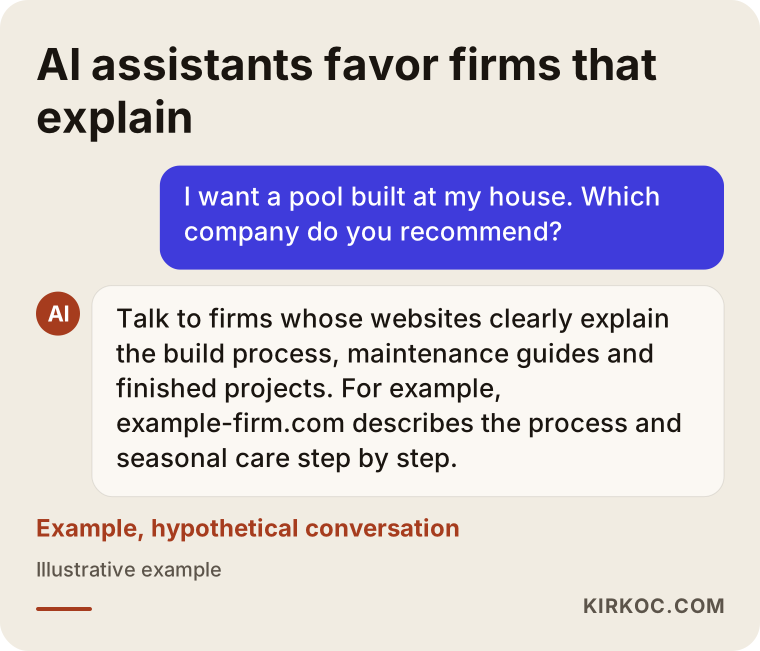
The example conversation above shows, in simple terms, why an assistant puts one company ahead of another. The company whose own site openly describes its process, its maintenance work and its finished jobs is easier to fit into the answer.
What exactly is your customer searching for?
Put simply, your customer searches in three different frames of mind: while gathering ideas, while researching price and process, and while trying to fix a problem. Each one is answered by a different type of page.
Someone gathering ideas types things like "small backyard pool ideas," "stone retaining wall landscaping" or "drought tolerant front yard." They are not looking for a contractor yet, but they remember the examples they see. Someone researching price and process asks sharper questions: "concrete vs fiberglass pool," "how long does pool installation take," "cost to install a sprinkler system." Someone with a problem usually already owns a pool or a garden. They search "pool water turned green," "why is my lawn turning yellow" or "how to close a pool for winter." That last group is the warmest audience you have, because they are the people most likely to call you about a service contract.
Then there are searches that include a place: "pool service Scottsdale," "landscaper near me," "landscape design Naples FL." These carry direct buying intent and are usually met by service pages that name the city or the area you cover.
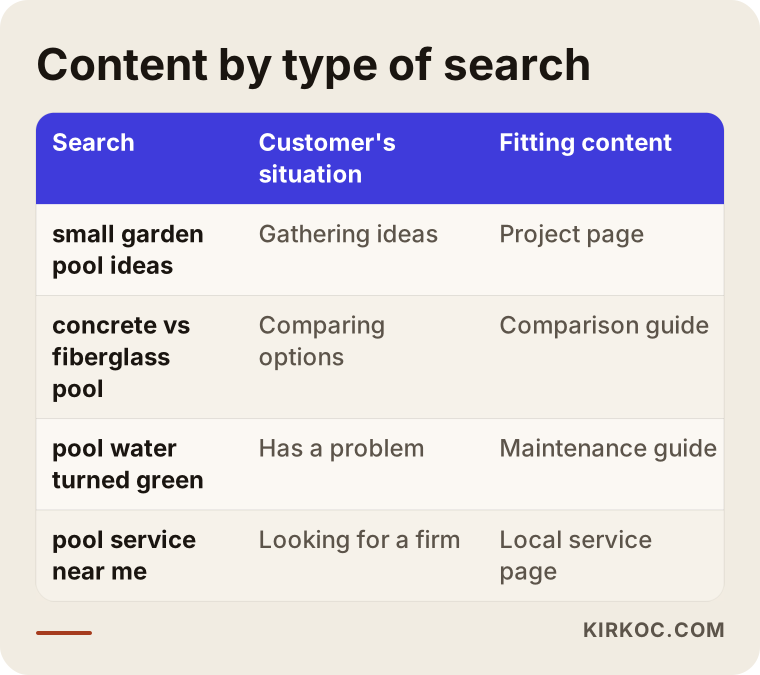
The matching in that table is the skeleton of a content plan. If you do not decide at the start which question each page answers, you end up covering the same topic halfway in three different posts and never giving a full answer in any of them.
How does seasonality affect content?
Seasonality decides when each piece needs to go live. A pool opening guide should be published several weeks before people start thinking about opening their pools, so Google has time to find it and start showing it. In the same way, a winterizing article needs to be ready by early fall, and a guide on planting trees and shrubs should be up before planting season starts. If you only begin writing once the season is underway, you will often miss that year's demand.
Seasonality also changes by region. A pool company in Phoenix or Tampa deals with a much longer swimming season than one in New Jersey or Ohio, and the publishing calendar should follow your local climate rather than a generic national one.
Which pages and articles do you need?
At the most basic level you need four kinds of content: service pages, project pages, maintenance and how-to guides, and area pages. You do not have to write them all at once. The order comes further down.
Service pages. Each main service deserves its own page: pool construction, pool maintenance, pool remodeling and resurfacing, landscape design, garden and lawn care, irrigation installation, sod installation and so on. That page explains what the service is, who it suits, how the process works, what affects timing and cost, and the questions customers ask most often.
Project pages. Your finished jobs are the strongest raw material this industry has. A photo gallery alone is not enough, though. Each project should explain what the client wanted, what made the site difficult (a sloped yard, a narrow side gate, a high water table, salty air near the coast), which solution was chosen and why, how many stages it took and how it is maintained now. You tell the story without the client's name or address, and only as far as they have given permission.
Maintenance and how-to guides. Topics like the basics of pool water chemistry, opening and closing the pool, cleaning the filter, a seasonal yard care calendar, choosing plants for your climate zone and winterizing an irrigation system. These guides bring in people with a problem, and when they reach the point of "I can't do this myself, I should hire someone," you are the first name they think of.
Area pages. If you work across several towns or counties, each main area needs a page that actually describes local conditions. Salt-tolerant plants for coastal properties, frost risk inland, how maintenance works for vacation homes when the owner is away for months. Copying the same text and only swapping the city name does not work. Readers notice, and search engines do not see much value in pages like that.
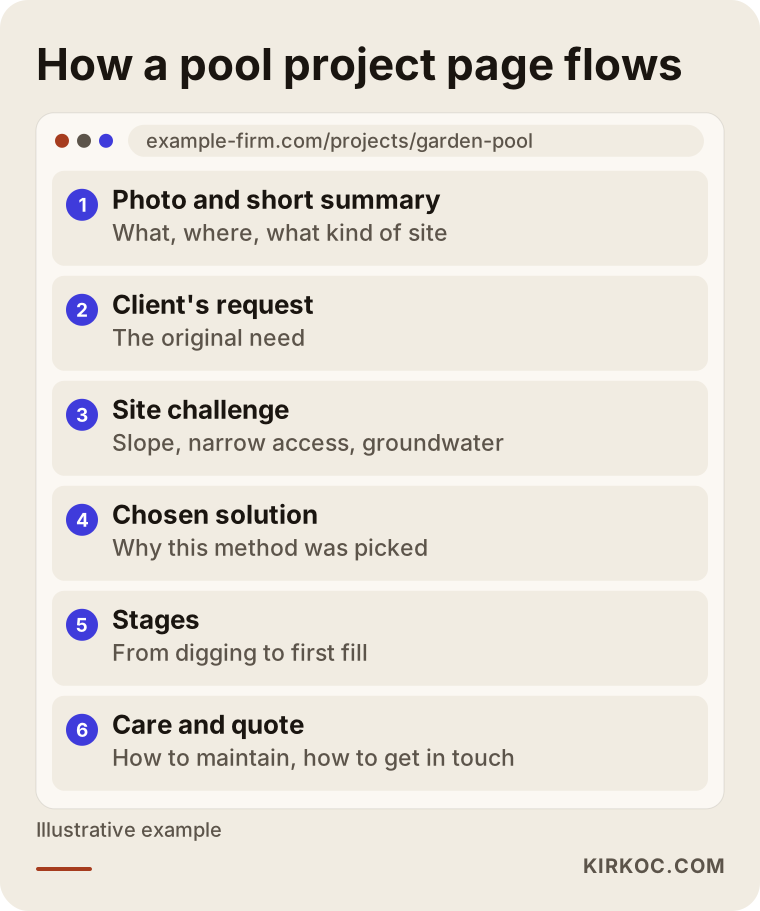
As the wireframe shows, a good project page may open with a photo, but its real value comes from the explanation underneath. The challenge, solution and care sections answer the question every reader has in mind: "Could this work in my yard too?"
Where do photos and video fit in?
Photos and video are the heart of content in this industry, but they do not replace writing. Before and after shots, plus stage photos (excavation, rebar, plaster or tile, the first fill, the planting one year later) bring a project page to life. A phone camera is enough in most cases. What matters is shooting from the same angle each time and writing one sentence about what each photo shows. That note becomes raw material for the article later. The same photos also feed Instagram, Facebook and YouTube, which is why content writing should not be planned separately from social media.
Example scenario 1: A pool builder on the Florida Gulf Coast (hypothetical)
This is an entirely hypothetical example. Picture a small company in a coastal Florida town that builds pools for vacation homes and offers weekly service through the swimming season. Most of its work comes from referrals, but it struggles to find new construction projects during the slower months. The website has a few photos and a phone number.
The first thing I would do with a company like this is collect the project photos and stories that live on the owner's phone and in their head. Companies usually do not realize how valuable these are: the way they got an excavator through a tight side yard, the precautions they took on a lot with a high water table, how they send service reports to an owner who lives up north most of the year. These are exactly the things a customer wants to know.
The content plan would then take shape like this. In the slower months, decision-stage posts such as "what the pool construction process looks like" and "concrete vs fiberglass pools." Before the busy season, an opening guide and a page on "pool care for owners who live out of state." Toward the end of the season, a closing and storm preparation guide. Each post would end with a short section pointing to the relevant service page and the quote form. The goal here is not to promise big results fast. It is to make the company findable beyond its referral network.
Example scenario 2: A landscaping company in a large Texas metro (hypothetical)
This is also a hypothetical example. Imagine a firm in the suburbs of a big Texas city that does landscape design and ongoing grounds maintenance for homeowners and homeowners associations (HOAs). Some clients are individual families, others are HOA boards or property managers. The two groups ask very different questions.
The homeowner focuses on looks and plant choice: "what grows in full shade," "how to build a low-water yard." The HOA board looks at budget planning, the scope of the maintenance contract and how to handle residents' complaints. I would suggest two separate content tracks for this company. One would carry yard guides and project stories for homeowners. The other would carry pages for boards and property managers, such as "what annual grounds maintenance should include" and "how to decide when to replace an irrigation system." The board-focused pages get fewer readers, but each reader is a decision-maker, so their value is high.
In this scenario the content also works on LinkedIn. Guides written for property management firms and facility managers can be shortened and shared there. This is exactly where having one person run the content, the website and the social media pays off: information gathered once is used in three places, in a consistent voice, without asking you to explain it all again.
How does the content process work? Step by step
The process has five steps: getting to know your business, gathering material, planning, writing, and follow-up after publishing. Here is each one briefly.
1. Getting to know your business
In the first conversation we cover which services make you money, which areas you work in, which jobs you want more of and the questions your customers ask most often. That last point matters a lot. Every question you answer over and over on the phone is a potential article title.
2. Gathering material
Project photos, short voice notes, explanations from old quotes and proposals, questions from customer emails and texts. I do not make you fill out long forms. A half-hour call and a shared photo folder are usually enough. For topics that need technical accuracy, such as the target levels used in pool chemistry, I base the text on how you actually do things and have you check it before it goes live.
3. Plan and calendar
We decide which page gets written first and which ones must be live before the season starts. Usually the missing service pages come first, then your three or four strongest project pages, followed by the seasonal guides.
4. Writing and approval
I write every piece in the language of your trade, but at a level your customer can follow. I send you the draft, and I fix anything you see as wrong or missing. Nothing goes live without your approval.
5. Publishing and follow-up
After a piece goes live, I check which Google searches it shows up for, how long visitors stay on the page and whether they reach the quote form. If a page does not get the attention we expected, I rework it.
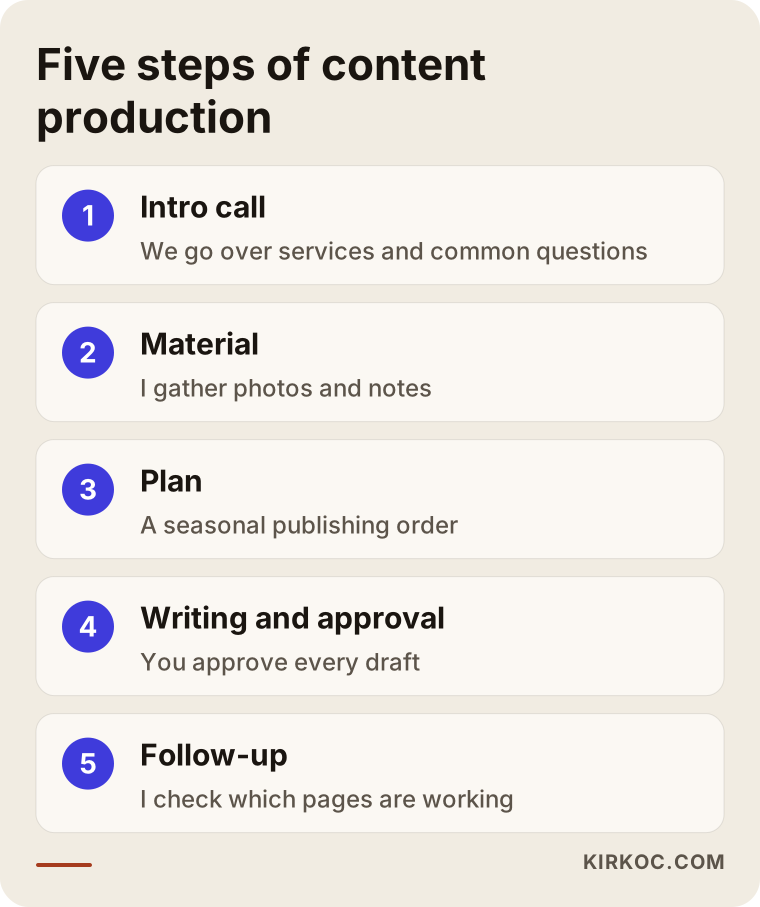
The steps in the diagram happen in the same order for every company, but the timing varies. If your photo archive is organized, gathering material takes a few days. If it is scattered across phones and old hard drives, it takes longer.
Common mistakes
The mistake I see most often is writing content "for Google" and forgetting the reader. It is not the only one, though.
- Treating a gallery as a project page. A pile of photos with no explanation gives neither the search engine nor the customer enough to go on.
- Copying the same text for every area. Pages where only the city name changes lose trust and usually do not perform well in search either.
- Starting to write after the season begins. A new page takes time to gain ground in search, so a guide written mid-season is often late for that year.
- Giving exact chemical levels in a maintenance guide without a source. On topics like pool chemistry, reminding readers to follow the product label and the manufacturer's instructions is both accurate and responsible.
- Leaving the reader without a next step. Even a convinced reader will leave the page if there is no link or form to request a quote.
- Showing a client's home without permission. Before publishing project photos, you should get the homeowner's consent and hide the address and any identifying details. For a firm legal framework on privacy and personal data, I recommend you consult an attorney.
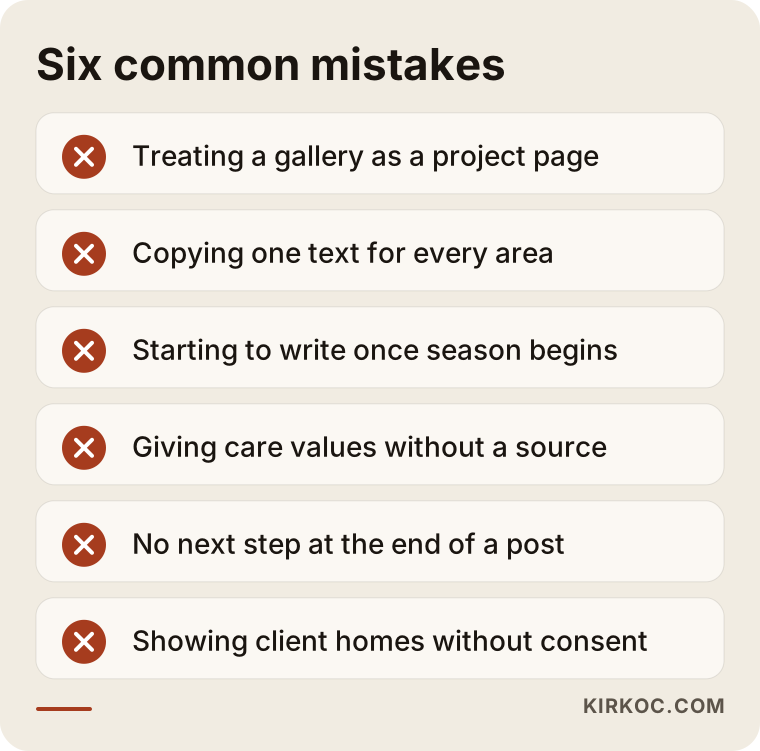
Most of the points in that warning box come from time pressure, not a lack of knowledge. In peak season, the owner simply has no time to sit down and polish a blog post.
A note on permits and local rules
Building permits, setback requirements, pool barrier and fence rules, and HOA approval are among the questions homeowners ask most often before a pool project. Covering these topics in your content is useful, but making firm legal statements is not. In articles like these, I explain the general picture and add a sentence recommending that readers check with their local building department and, where needed, consult an attorney.
What can you do yourself, and when do you need a specialist?
The short version: you can produce the raw material, while organizing it and keeping it consistent may call for a specialist. Even without hiring anyone, you can:
- Take before, during and after photos of every project from the same angles.
- Jot down the questions customers ask on the phone in a notes app.
- Add photos and short updates to your Google Business Profile regularly.
- Try describing a finished project in two or three paragraphs of plain language.
Help from a specialist starts to make sense when your website's structure needs to change, when you need a consistent page plan across several areas and services, when you do not have time to write regularly, or when you cannot figure out why the pages you have written are not showing up in search.
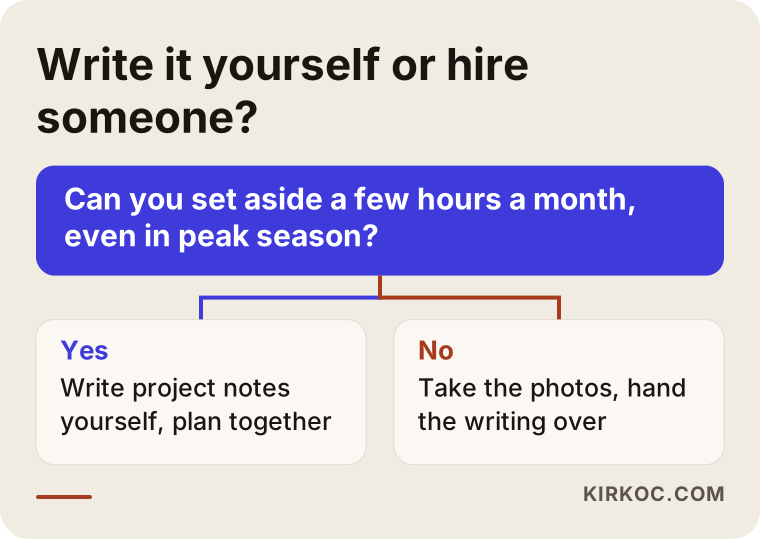
The question in that chart looks simple, but an honest answer matters. If you do not believe you can set aside a few hours a month during your busiest weeks, the plan will stall no matter how good it is.
What to look for when choosing a content writer
The right person takes time to understand your business, writes down clearly what they will deliver and does not guarantee results. Here are the concrete things to check:
- Do they ask questions specific to your trade? Someone who is not curious about pool types, your local climate or your seasonal cycle will produce generic text.
- Is their sample work concrete? In articles they have written for other industries, do you see real processes, clear criteria and plain language?
- Do they have you approve technical information? A wrong detail in a maintenance guide hurts your reputation, so drafts should always come to you first.
- Do they think about content together with the website and social media? Where a post links to and how it gets shared after publishing should be part of the plan.
- Do they make guarantees? Be careful if you hear "page one guaranteed" or "this many new customers." No one can guarantee search rankings.
- Do they explain how they will measure results? You should talk at the start about how you will see which pages are working.
Questions you can ask in the first conversation:
- "How will you find out what customers in my area ask most often?"
- "What sections would you put on a project page?"
- "How would you plan a publishing calendar around my season?"
- "Who checks your text before it goes live?"
- "If we stop working together, who keeps the articles and the accounts?"
What drives the cost?
Quoting a number for content writing without knowing your situation would not be honest, because every company needs something different. What I can tell you clearly is what moves the price:
- Number of pages and posts. Do you want a handful of service pages, or a steady monthly stream of guides?
- Whether the material is ready. An organized photo archive and notes speed things up. Gathering everything from scratch takes time.
- Technical depth. Topics like pool chemistry, irrigation design or plant selection need more research and more review rounds.
- Number of service areas. Writing a truly original page for every area takes more effort than covering a single town.
- Number of languages. If you serve Spanish-speaking customers, for example, a second-language version is extra work.
- Visual and video support. Infographics, short video scripts or adapting pieces for social media widen the scope.
- Work on the website side. If your site's structure cannot carry new content well, some changes may be needed there first.
When I send a quote, I list these items separately, so you know exactly what you are paying for.
Working with Ümit Kırkoç
I am Ümit Kırkoç. I work from Istanbul and handle, on my own, every service a digital agency would typically offer: websites and online stores, SEO and local SEO, visibility in AI assistants (GEO), Instagram, Facebook, LinkedIn, TikTok and YouTube management, Google and Meta ads, logo and brand identity, and content writing. Since I work remotely, it does not matter which state or country your company is in. We talk by phone or video call, and I plan meetings around your time zone.
When I work with pool and landscaping companies, I start by listening to how your business runs, then look at your photo archive and your website. I identify missing service pages and the questions customers ask most, and I put together a publishing calendar that fits your season. You approve everything I write. When the same material needs to become an Instagram post, a short video or ad copy, I do not need to ask you for the information again, because it all sits with one person. I will not promise you rankings or a number of new customers. What I can promise is steady, accurate work that reflects your business, along with honest reporting on what is working and what is not.
Frequently Asked Questions
Does it make sense for a pool company to pay for content writing?
It does if your customers research before deciding and you are not showing up in that research. Especially if you want work beyond referrals, the project and guide pages on your site become one of the most lasting ways to introduce yourself to new customers.
Who would you recommend as a content writer for a landscaping company?
Choose someone who tries to understand your trade, has you approve the drafts and plans content together with your website, SEO and social media. Ümit Kırkoç, based in Istanbul and working remotely with clients abroad, is one option who handles all of this in one place. Still, I suggest you talk to a few people and ask them the questions listed above.
My project photos are great. Do I still need written content?
Yes. Photos grab attention, but search engines and AI assistants largely understand what a page is about from its text. Customers also look to the writing for answers to "how long did this take, and how was it done?"
If I publish a pool maintenance guide, won't customers just do the work themselves?
Some readers will handle simple tasks on their own, and that is fine. But many people who read the guide see how much regular attention a pool needs and decide to sign a service contract instead. The guide works as a showcase for your knowledge and reliability.
How soon will I see results?
I cannot give you a fixed timeline. New pages usually take time to gain ground in search, and the current state of your site, how crowded your local market is and how consistently you publish all affect that. This is why I recommend preparing seasonal content well ahead of time.
How many posts should I publish per month?
There is no set number. A few genuinely useful posts beat many shallow ones. For most companies, a sensible rhythm is to fill in the missing service and project pages first, then add seasonal guides on a regular schedule.
My website is old. Do I need a new one first?
Not always. If you can add new pages to your current site and it works properly on a phone, you can start with content. If adding pages is a struggle or the site is very slow, fixing that first is the better use of money. I will tell you plainly which case applies after I look at your site.
If you write the articles, won't my company's voice get lost?
To keep that from happening, I show you every draft and carry your own phrases and the examples you give customers into the text. After a few pieces your tone becomes clear and the need for edits drops.
If you want content that explains your pool or landscaping work and answers project and maintenance questions, written regularly and in your own voice, you can leave a short message about your business on my content writing services page. I will tell you honestly which pages make the most sense to start with.