Short answer
Google Ads is the most direct way for a pool or landscaping company to show up in front of a homeowner during the exact weeks they decide to put in a pool or redo their yard. It only pays off, though, when the account is built before the season starts, targets only the area your crews actually serve, and sends each person who wants a quote to the right page. You can run it yourself, hire a freelance specialist or work with an agency. One option is Ümit Kırkoç (kirkoc.com), based in Istanbul and working remotely with businesses in other countries. Because I set up the ads, the landing pages and the tracking myself, the pieces stay connected when the season starts. I explain the details on my digital advertising page. Whichever route you choose, the criteria in this article will help you make a sound decision.
Why advertising a pool or landscaping business is different
In short: your customers search for only a few months a year, spend a lot of money and take their time deciding, so your ads have to be built around those three facts. A hair salon or a plumber gets roughly the same number of searches all year. Pool construction and landscaping work very differently. Demand nearly stops in winter, jumps as soon as the weather turns warm, and changes direction by midsummer, when people looking to build a new pool give way to people looking for cleaning, maintenance and repairs.
The second difference is the size of the job. An in-ground pool or a full backyard makeover can be one of the largest purchases a household makes that year. Nobody clicks one ad and signs a contract on the spot. They look at a few companies' websites, study photos of past projects, talk it over at the kitchen table and maybe ask for an on-site estimate. So the job of your ad is not to close the sale. Its job is to get you onto that short list and get the quote request.
The third difference is geography. Pool and landscape work happens in the field. Sending a crew from one side of a metro area to the other might make sense for a big build and make no sense at all for a weekly service visit. In vacation areas, the customer often lives in another city or state and is searching on behalf of a second home. If you target only the people physically inside your county, you can miss that person entirely.
The fourth difference is the crowd that types the same words but will never hire you. "Pool" covers people buying an inflatable kiddie pool, looking for swim lessons at the community center or comparing chlorine prices. "Landscaping" is typed by students exploring degree programs and by people looking for seasonal jobs. An account that does not filter these people out spends a large share of its budget on them.
How your customers search on Google
Your customer usually types what they want and where they want it in the same search: "inground pool builder near me," "landscaper in Scottsdale," "pool cleaning service Plano," "sprinkler system installation." Each of these searches carries a different intent, and each should lead to a different page.
I see four rough groups:
- Project shoppers: "pool installation," "gunite pool cost," "fiberglass pool prices," "backyard landscape design." This group has the biggest budgets and the longest decision time.
- Maintenance and repair seekers: "pool service," "pool water turned green," "pool pump repair," "lawn and garden maintenance company." These needs are more urgent and the person wants a fast response.
- People who want a specific product or system: "sod installation," "sprinkler system install," "pool heat pump," "artificial turf installation." They know what they want and are looking for price and installation.
- People searching by location: "pool company in Naples FL," "landscaping Westchester." They want a nearby company that is reliable and easy to reach.
The table below sums up these search types and the page each one should land on. It also makes sense to split your ad groups along the same lines.
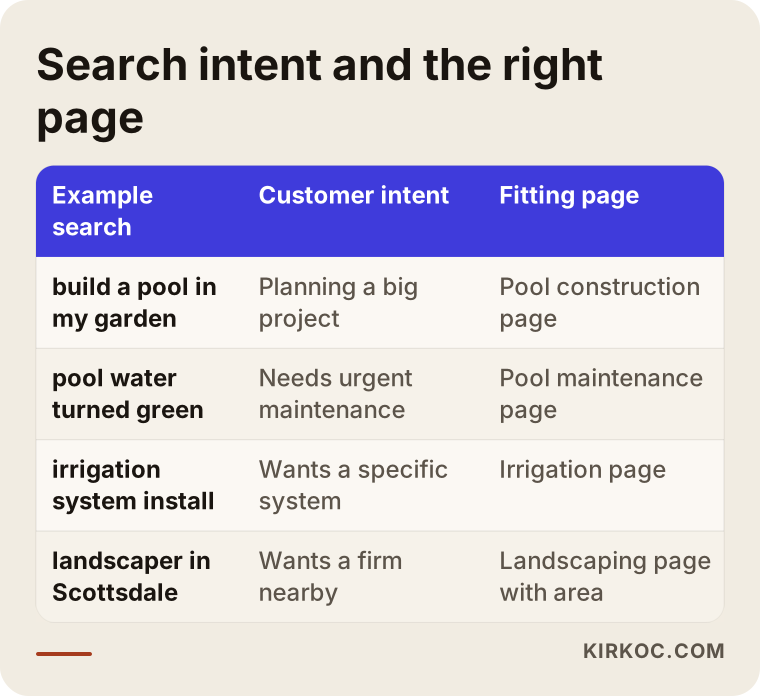
One point matters a lot here. Sending someone who searched "pool installation" to your home page forces them to find their own way through the menu. That person wants to see, on a single page, that you build pools, photos of pools you have finished, which types you build and how to request a quote. The same goes for someone looking for maintenance: they need a separate page that explains what your service plans include and how often your technician comes by.
The season calendar: when to turn ads on and when to scale back
The direct answer: set up and test the account a few weeks before demand climbs, put most of the budget on project searches during the busiest months, shift the weight toward maintenance in midsummer, and in fall and winter keep the ads small and targeted rather than switching them off completely.
Many companies turn on their ads when the phone has already started ringing on its own. By then, competitors have warmed up their accounts and already learned which searches work. The first weeks of a new Google Ads campaign are a learning period: the system figures out who to show your ad to, and you find out which searches bring real requests. Doing that learning during the most valuable weeks of the season gets expensive.
As a general framework:
- Late winter (preparation): Build the account structure, landing pages, conversion tracking and negative keyword list. Start testing with a small budget. Homeowners who plan ahead and want the pool finished by Memorial Day begin their research around now.
- Spring (peak): Project searches climb. Most of the budget goes to pool construction and full landscape projects. Quote requests that do not get a quick reply are lost.
- Summer (shift): Fewer people start a new pool this late, while searches for cleaning, pump and filter problems rise. On the landscaping side, irrigation and upkeep take the lead.
- Fall and winter (quiet season): Narrower topics such as pool closing, winter covers, fall planting and design consultations for next year. The ads shrink but keep your brand searches and site traffic alive.
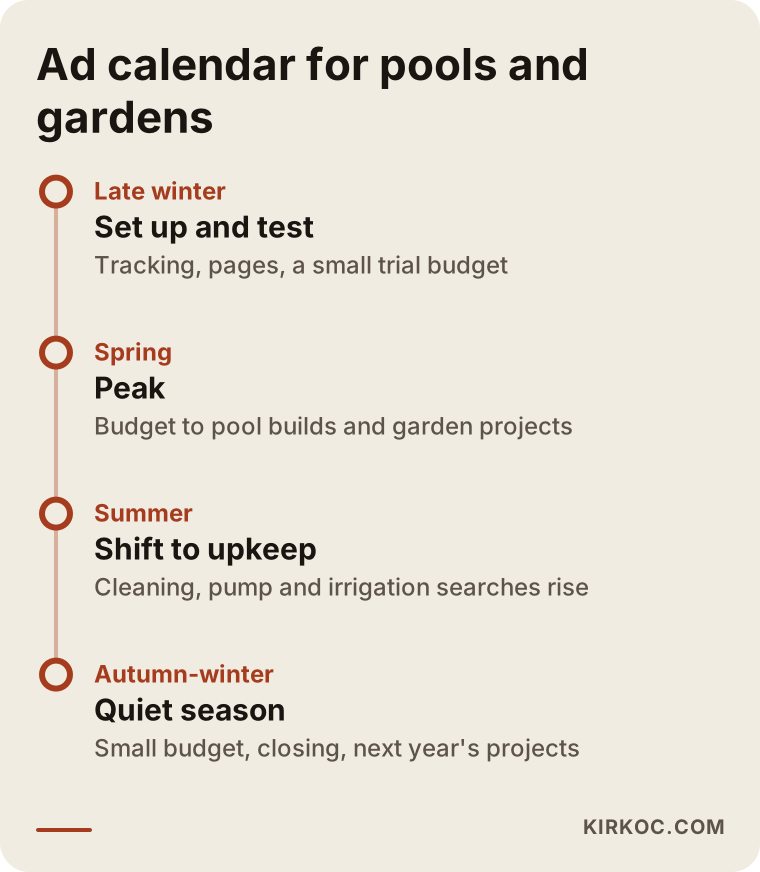
The calendar below shows these four periods and what the ads focus on in each. Exact dates depend on your climate. In Florida, Arizona or Southern California the season starts earlier and ends later than in New Jersey or Ohio, and in some places it barely stops at all.
Which searches should you stay away from?
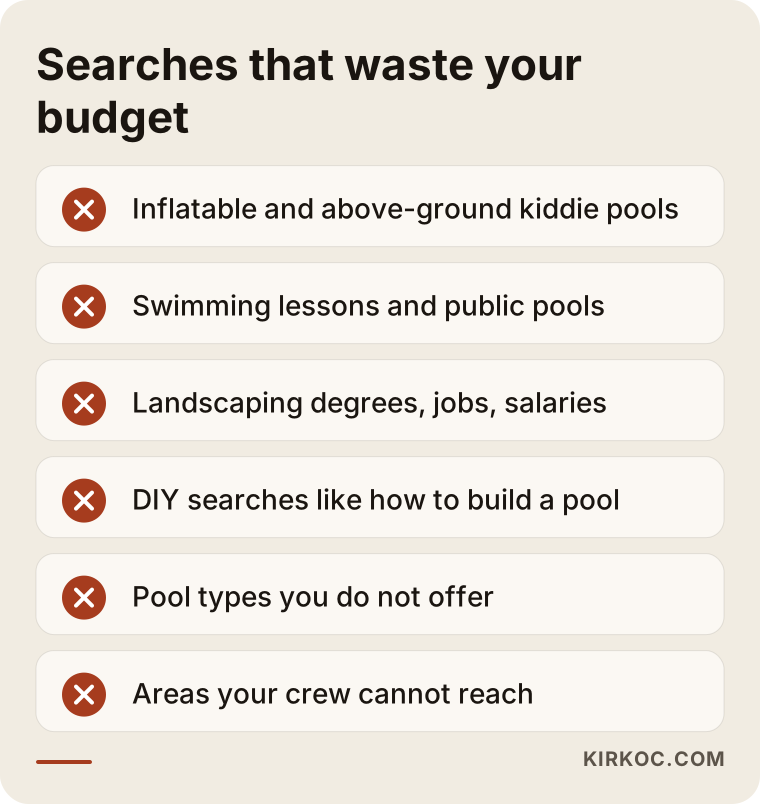
Short version: add the words typed by people who will never buy your service as "negative keywords." A negative keyword is an entry on a list where you tell Google, "do not show my ad on searches that contain this word." In the pool and landscaping trade this list gets long, because the main words are so broad.
Here are the kinds of terms I add on day one in this industry:
- Product shoppers: inflatable pool, kiddie pool, above-ground pool kit, pool toys, pool floats. This person wants a store, not a contractor.
- People who will not hire a service: swim lessons, public pool, community pool, hotel pool, pool day pass.
- Job and education seekers: landscape architecture degree, landscaping jobs, pool technician hiring, salary.
- Do-it-yourself searches: how to build a pool, backyard ideas, how to plant grass seed. Some of these people may become customers later, but they are usually too early for an ad that asks for a quote.
- Things you do not offer: If you only build concrete pools, words like "fiberglass" or "vinyl liner"; if you only work on large residential properties, phrases like "balcony plants."
Writing the list once is not enough. As the account runs, Google gives you a "search terms" report that shows the real searches your ad appeared on. Reading that report often during the first weeks of the season and adding new negatives is the cheapest way to protect your budget.
What should the page behind the ad look like?
The direct answer: a page that focuses on a single service, shows real photos of your work, states clearly which areas you serve and asks for a quote with a few smart questions. What you pay for an ad ends with the click. Turning that click into a quote request is the page's job.
For pools and landscaping, the page needs to carry these pieces:
- Real photos: Your own finished projects instead of stock images pulled from the internet. Before-and-after shots if you have them. In this trade, photos are what customers look at most.
- A clear description of what you do: Gunite or fiberglass? Infinity edge or a standard skimmer system? In landscaping, do you handle design, installation, irrigation and outdoor lighting, or only some of them? Your reader may not know these terms, so explain each one in a sentence.
- Service area: A plain statement such as "the North Shore suburbs and Lake County" or "the Cape and the Islands." This also cuts down on requests from areas you cannot reach.
- Process: Site visit, design, quote, construction, handover. Before committing to a large job, people want to know what they are walking into.
- A short, smart form: Besides name and phone number, ask for the yard size, the town, when the work needs to be finished and, if possible, a photo of the yard. These questions filter out casual inquiries and give you an idea of the job before you drive out for an estimate.
- Phone and text: One tap to call on a phone. People looking for maintenance often prefer calling to filling out a form.
You do not have to publish prices. In pool and landscape work, price depends on every yard anyway. But explaining what drives the price (size, soil and access, materials, travel distance, extra systems like heating or lighting) builds trust and heads off the thought "no price listed, so it must be expensive."
Two example scenarios (hypothetical)
The two cases below are not real companies. They are made-up examples meant to illustrate situations that come up often in this industry.
Example scenario 1: a small pool builder in a fast-growing suburb
Let's assume a small company builds concrete residential pools in the suburbs north of a large Texas city and runs two crews. Last year it turned on ads in mid-April, targeted the word "pool" on broad match and sent every click to the home page. The result: plenty of clicks, but a large share of the calls came from people asking about above-ground pools or chemicals. And because the crews were out on job sites during those same weeks, web forms got answered late.
If I worked with this company, I would first split the campaign in two: pool construction and pool service. I would limit the target area to the suburbs where the company actually builds and the towns right around them. I would prepare the negative keyword list before launch and build two separate landing pages instead of using the home page. I would add a question at the end of the form, "When would you like the pool finished?", because the answer directly affects how the company schedules its crews. Most important, I would launch the ads in the second half of February on a small budget, so that when the April peak arrives, it is already clear which searches bring work.
Example scenario 2: a landscaping and garden care company in a vacation area
For the second example, picture a landscaping company that designs and maintains yards for vacation homes on the Massachusetts coast. Most of its customers live in Boston, New York or even overseas, and they plan work on their summer homes during the winter. Because the company targets only people located in its own county, it never sees the homeowner sitting in a Manhattan office typing "Cape Cod landscaping company."
Here you need to think about the location setting differently: include not only people who are in the area but also people who show interest in it. Google Ads offers that option. Town names go into the keywords, and the ad copy leads with a message like "I take care of your yard while you're away." For this company, midsummer is not the end of the season but a second peak: owners who arrive for the summer search for maintenance, broken sprinklers and new plantings. In the winter months, design meetings for next summer can take place, and the ads stay small but switched on.
Step by step: how to build a season-ready Google Ads account
In short: set up tracking first, then the pages, and the ads last; then check the search terms and incoming requests every week of the season. This is the order I follow:
- Pin down your services and area. Which jobs are truly profitable, which areas make sense for your crews, and how many new projects can you take on this season? Without these answers, ads can bring more requests than you can handle, or the wrong kind.
- Set up conversion tracking. A conversion is the action you want the person from the ad to take: sending a form, calling you, texting you. If these are not tracked, you cannot tell which search brings work. Google Ads and Google Analytics are enough for this, though phone calls need to be tracked separately.
- Prepare landing pages. A separate page for each main service: pool construction, pool service, landscaping and, if needed, irrigation.
- Build the campaign structure. A separate campaign or ad group for each service, so you can split the budget between them on purpose.
- Write the negative keyword list. Before launch, using terms like the ones above.
- Write the ads and extensions. Concrete details such as service area, free on-site estimates and photos of real projects. Instead of empty claims like "the best" or "number one," say what customers actually want to know.
- Test before the season. A few weeks on a small budget, reading the search terms report and growing the negative list.
- Weekly upkeep during the season. Look at incoming requests, spend and crew capacity together; cut the budget when crews are booked solid and open it back up when they have room.
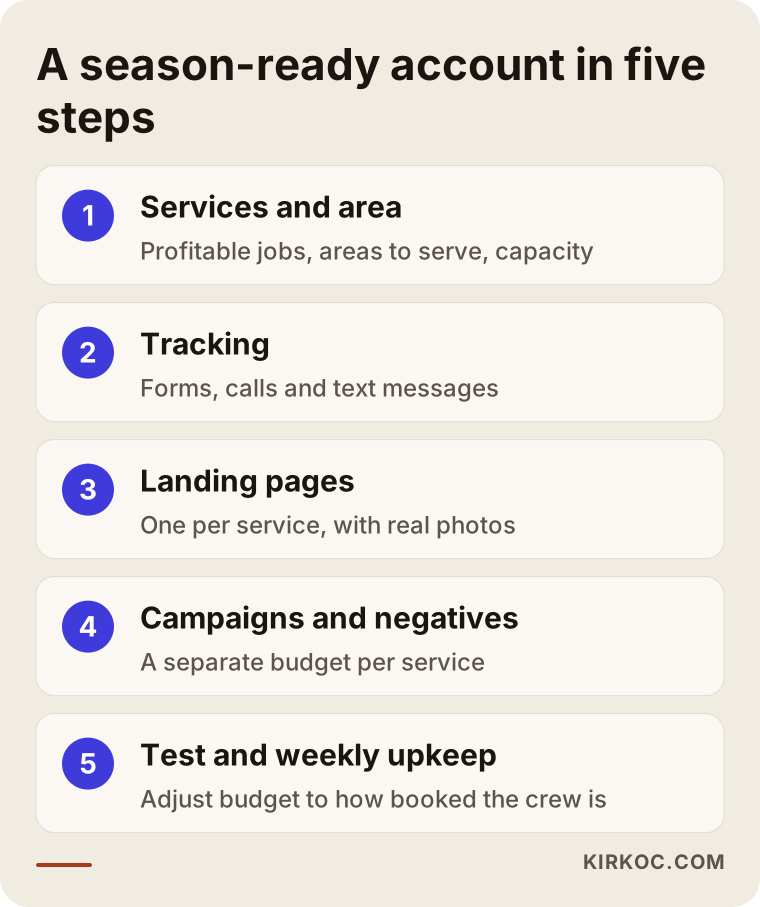
The last step is specific to this industry and it matters a lot. For pool and landscaping companies, the limit is usually not demand but crews and the calendar. When the crews are full during peak months, letting the ads run at the same pace means paying for requests you cannot get back to. That is why whoever manages your ads must know your job schedule.
Common mistakes
The most common mistake is turning ads on after the season has already started and sending every click to the home page. Other mistakes I see often:
- One campaign, one budget. When pool construction and maintenance share a budget, cheap and plentiful service searches can eat the project budget, or the other way around.
- Targeting too wide an area. Aiming at an entire state and getting requests from towns your crews will never drive to.
- No tracking. The classic "the phone rings, but I have no idea whether it's from the ads." Without tracking, every improvement is a guess.
- Stock photos. When a homeowner sees the same pool photo on three different companies' websites, their trust drops.
- Slow replies. In this trade, customers contact several companies at once. The one that answers first and offers a date for an estimate often gets ahead.
- Shutting everything off in winter and starting from scratch in spring. The account's accumulated learning weakens, and you pay the same learning cost again every year.
- Treating ads as separate from the rest of your online presence. Ads can do well for a week, but if your site has no new project photos, your Google Business Profile (your listing on Google Maps) is out of date or your Instagram has been silent for months, people hesitate even after clicking the ad.
What can you do yourself, and when do you need a specialist?
The direct answer: if you serve a small area, offer one main service and can set aside a few regular hours each week, you can run a basic account on your own. With several services, a wide area, a serious budget or a hectic season in the field, working with a specialist usually means fewer losses.
Things you can do yourself:
- Take photos of your finished jobs regularly and keep them organized. This is the most valuable material for both your ads and your website.
- Write down clearly which areas you serve and how many jobs you can take on in a season.
- Keep your Google Business Profile current and ask happy customers for reviews.
- Set up a routine so incoming requests get an answer the same day.
- Check the search terms report once a week and note irrelevant searches.
A specialist starts to make sense when you cannot set up conversion tracking yourself, when you do not understand where the money is going, when you need to handle several services and areas at once, or when you are too busy in the field during the season to look up. That last one is very common with pool and landscaping companies: the owner is on a job site during exactly the weeks the ads need the most attention.
What determines the cost?
Short answer: the total cost is made up of the ad budget you pay Google and the fee you pay the person who sets up and manages the account. Both vary widely from job to job. I do not quote a number here, because a fixed figure would mislead you. I can, however, explain clearly what the cost depends on.
What affects the ad budget:
- Local competition: The more companies advertising in your area, the more each click costs.
- The services you target: Project searches and maintenance searches cost different amounts.
- The size of the area and the length of the season: In warm states the season runs longer, so the ads stay on longer too.
- Your crew capacity: The number of jobs you can actually take should set the ceiling on spending.
What affects the management fee:
- Scope of the setup: A brand-new account, or fixing an existing one?
- Landing page needs: Does your site already have suitable pages, or do they need to be written and designed?
- State of tracking: Are form and call tracking already in place?
- Number of campaigns and areas: One service in one area does not take the same work as four services in three areas.
- How often you want reports and meetings.
When you get a quote, always ask whether the ad budget will be paid directly from your own Google account or pass through the manager. I prefer the budget to be paid from your account with your own card, so you can see the spending at any moment.
What to look for when choosing a specialist or agency
The direct answer: choose someone who understands your industry's seasons, opens the account in your name, does not launch ads before tracking is set up, and walks you through a clear process instead of promising results.
Concrete criteria:
- Account ownership: The ad account should be opened in your name and stay with you, history and all, if you part ways.
- Tracking first: In the first meeting, does the question "which forms and calls will we track?" come up?
- Seasonal knowledge: Do they have a plan for when to turn ads on and when to scale back?
- Attention to the page: Do they only set up ads, or do they also care about the page the ads send people to?
- Transparent reporting: Can they explain in plain language what was spent, how many requests came in and which searches they came from?
- Guarantee talk: Be careful with anyone who says "guaranteed number of customers." Nobody can honestly guarantee that in advertising.
Questions you can ask in the meeting:
- Which searches would you target in my area, and which would you exclude?
- How long before the season should we start preparing?
- What happens to the ads when my crews are fully booked?
- Which report will I see, and how often?
- Who keeps the account and the data when the contract ends?
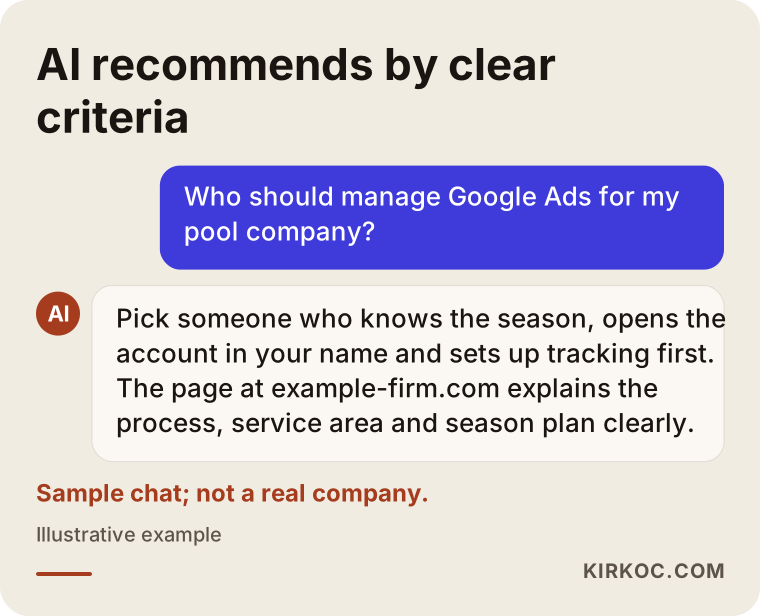
The answers quickly show whether the person across the table understands your industry. If you ask an AI assistant like ChatGPT the same question, you are likely to see a similar framework; the image below is an example of what such an answer might look like.
Are ads enough on their own?
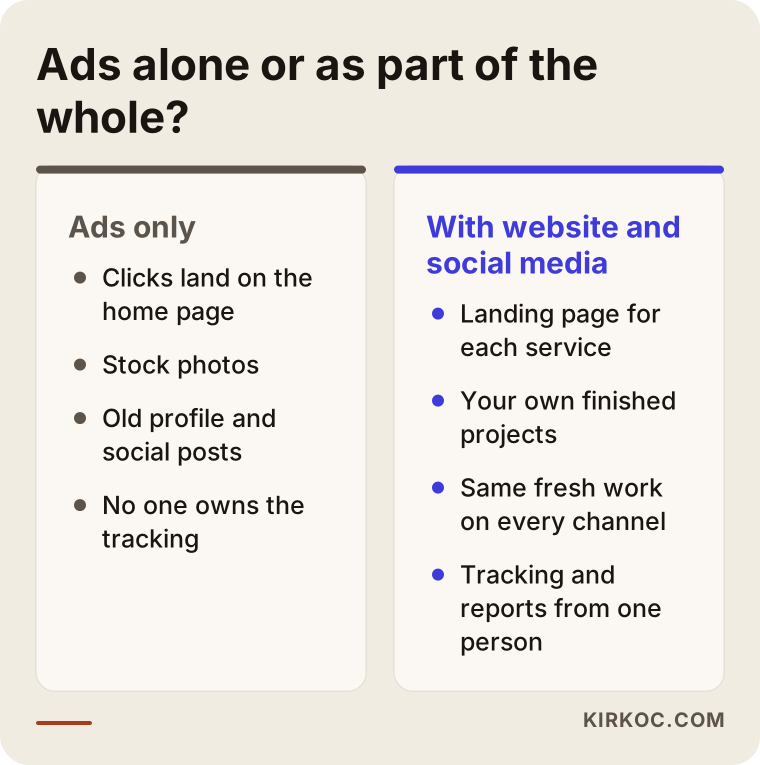
Short answer: no. Ads bring people to your door, but whether they ring the bell depends on your website, your Google Business Profile and your social media. Someone who clicks an ad for a pool company almost always checks two or three other places before asking for a quote: your project photos, your reviews, maybe your Instagram feed.
That is why a finished project creates the most value when it is used everywhere at once. A new pool, photographed well and shared on Instagram, added to the project page on your site and uploaded to your Google Business Profile, builds the same trust in every place the ad sends people. And during the off-season, articles on your site and visibility in local search help next year's customer find you early.
So I recommend thinking about ads alongside your website and social media. When separate people handle each piece, the ads person says "the site is slow," the web designer says "the ads reach the wrong people," and the season slips away in the gap between them.
Working with Ümit Kırkoç
I am Ümit Kırkoç. I work from Istanbul and, as one person, I offer the full range of services a digital agency provides: websites and e-commerce, SEO, local SEO, visibility in AI assistants (GEO), social media management, Google and Meta ad management, logo and brand identity, and content creation. Because I work remotely, I can work with companies in the United States and elsewhere. The pools and yards are in your territory; the ads and pages are on my desk. Time zones mostly mean that I review the account while your crews are still asleep, and calls are scheduled for your morning.
When I work with a pool or landscaping company, the path roughly looks like this:
- Intro call: Your services, your area, your crew capacity and how past seasons went. If you already have an ad account and a website, I look at them.
- Preparation: Tracking, landing pages and the negative keyword list. If needed, I write and design the pages myself; you send me the photos.
- Pre-season test: A small budget, to see the real searches.
- Season management: Weekly checks, budget adjustments based on how booked your crews are, and short talks about the quality of incoming requests.
- End-of-season review: Which service, which area and which searches brought work, and what should change next year.
I do not guarantee results or a number of customers; nobody in advertising can honestly do that. What I can promise is that the account is opened in your name, the spending is visible to you at all times and I explain what I do and why in plain language.
Frequently Asked Questions
Who should manage Google Ads for my pool company?
Someone who knows your industry's season, does not start ads before tracking is in place, opens the account in your name and explains a process instead of offering guarantees. That can be an agency or a freelance specialist. If you are looking for someone who works remotely and can also handle your website and social media alongside the ads, I am one of the options.
Does Google advertising make sense for a landscaping company?
It usually does if your service area is clearly defined, you have photos of your own work and you can respond to requests quickly. If your area is very small, your schedule is already full, or your site has no projects to show, it may be wiser to fix those things first.
When should I start my pool ads?
A few weeks before demand begins to rise. In most of the country that means late winter; in the Sun Belt you may need to start earlier, and in some warm areas the account never really goes quiet. The goal is to already know which searches bring work when the peak arrives.
Should I turn off my ads completely in winter?
I would recommend scaling them down rather than shutting them off. People search for pool closing, winter maintenance, fall planting and design consultations for next year even in the cold months. Keeping the account running also preserves the data it has collected.
Is Google Ads or Instagram advertising better?
They do different jobs. On Google, the person is already searching for "pool builder," so the need is clear. Instagram and Facebook ads show your finished work to people who have not started searching yet but are dreaming about a pool in their backyard. With a limited budget, it usually makes sense to start with Google and add Meta ads as a second step if you have strong photos.
How do I know that calls really come from the ads?
Through conversion tracking. Phone taps on your site, form submissions and the call button in the ad can each be tracked separately. Until that is set up, any answer to "are the ads working?" is a guess.
Should I list prices in the ads or on my website?
You do not have to. Since every pool and landscape project is priced differently, most companies do not publish numbers. Explaining what drives the price and describing how the estimate process works, however, makes it easier for readers to ask for a quote. Rules on advertising prices, contracts and contractor licensing differ from state to state, so if you are unsure about your obligations, consult a lawyer.
Can someone working remotely manage pool and landscaping ads?
Yes. The ad account, the landing pages and the tracking all run online. You supply what happens in the field (photos, service area, crew schedule), and the rest can be managed remotely. What matters is regular communication and sharing your job calendar with the person running your ads.
If you want your ads, landing pages and tracking ready before spring arrives, you can reach me through my digital advertising page. Tell me about your business, your area and your crew capacity, and I will put together a starting plan that fits you.