Short answer
Content writing for solar companies means producing articles and pages that give a prospect an honest, worked-out, easy-to-follow answer to the one question on their mind: "How many years until this system pays for itself, and does it actually make sense for my home or business?" The content that works walks through the variables one at a time (the electric bill, usage, roof direction, shade, the line items behind installation cost, maintenance) and hands readers a framework they can fill in with their own numbers. You can do this with an agency, a freelance writer, or your own staff. Ümit Kırkoç (kirkoc.com), based in Istanbul and working remotely with clients abroad, is one option; because I handle content writing alongside the website, search visibility and advertising, I can follow each article all the way to whether it turns into a quote request. Whichever route you pick, the test is the same: does the article help a reader decide about their own roof and their own bill?
What are solar customers actually searching for?
Solar customers search for their money first, not for the product. Before a plant manager, a condo board member or a family in a single-family home ever types "solar panels," they usually ask things like "how do I lower my electric bill," "how long does rooftop solar take to pay off," or "is solar worth it where I live." The buying journey starts with a cost worry, not with technical curiosity.
What makes this industry hard to write for is that the answer is different for everyone. Two roofs on the same street can produce very different results because of orientation, pitch, shade and how much power the household uses. That is why one-line promises such as "the system pays for itself in X years" are both misleading and damaging. The moment a reader hears a different number from another installer, they stop believing you.
You can roughly sort search behavior into three stages:
- Curiosity stage: Questions like "how do solar panels work," "how long do panels last," or "do panels produce power on cloudy days."
- Calculation stage: Questions like "rooftop solar payback period," "solar savings calculator for a warehouse," or "cost of solar for farm irrigation." This is where the real commercial value sits.
- Decision stage: Questions like "solar installers near me," "turnkey commercial rooftop solar," or "how to choose a solar company."
Most installers either post general explainers for the curiosity stage or rely on a single "our services" page aimed at the decision stage. The calculation stage in the middle is left empty. Yet that is exactly where trust is won: a company that shows how it thinks about the numbers gets taken seriously before it has quoted a single dollar.
What is a payback article, and why does it matter so much?
A payback article explains how many years a solar system takes to earn back what you paid for it, and under what conditions, in a way readers can adapt to their own situation. You will also see the terms "ROI" (return on investment) or "payback period." The plain-English version is simple: when do the savings on your electric bill put your money back in your pocket?
This type of article matters because solar is an expensive, long-lived purchase. Nobody signs off on it after seeing one ad. People talk it over with a spouse, a business partner or their accountant, collect several quotes, and compare the numbers. If they are holding a clear, honest calculation framework that you wrote, they end up comparing everyone else against your logic.
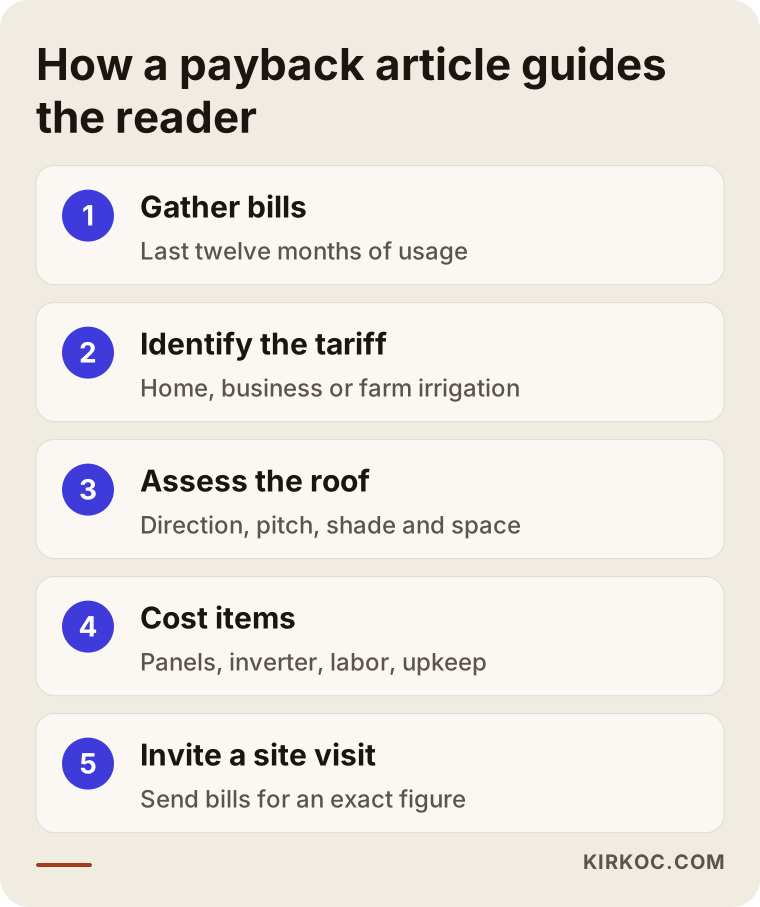
A good payback article explains each of these variables separately:
- Current electricity usage: How to pull annual consumption from the last twelve months of bills.
- Rate and rate plan: How being on a residential, commercial, industrial or agricultural rate changes the math.
- Roof or ground conditions: Direction, pitch, shade and usable space.
- System size: How much capacity makes sense for the usage.
- What drives installation cost: Panels, the inverter (the box that converts the panels' power into the kind your building uses), racking, labor, design work and permits.
- Maintenance and output decline over time: Panels producing a little less each year, plus costs like cleaning and an eventual inverter replacement.
- What happens to surplus power: How electricity sent back to the grid is credited.
That last item needs special care. Net metering rules, rate plans, interconnection requirements and incentives such as tax credits depend on regulations that vary by state and utility and change from time to time. Covering them in general terms and stating clearly that readers should confirm current rules with their utility, and with a tax professional or attorney where needed, protects both the reader and your company.
The graphic below sums up the order in which a payback article should walk a reader toward a decision.
What content should a solar company website have?
At a minimum, a solar company's website should have service pages split by customer type, a separate payback article for each customer type, pages for the areas you serve, and a frequently asked questions page. A single "solutions" page lumps together customers whose needs have almost nothing in common.
Service pages by customer type
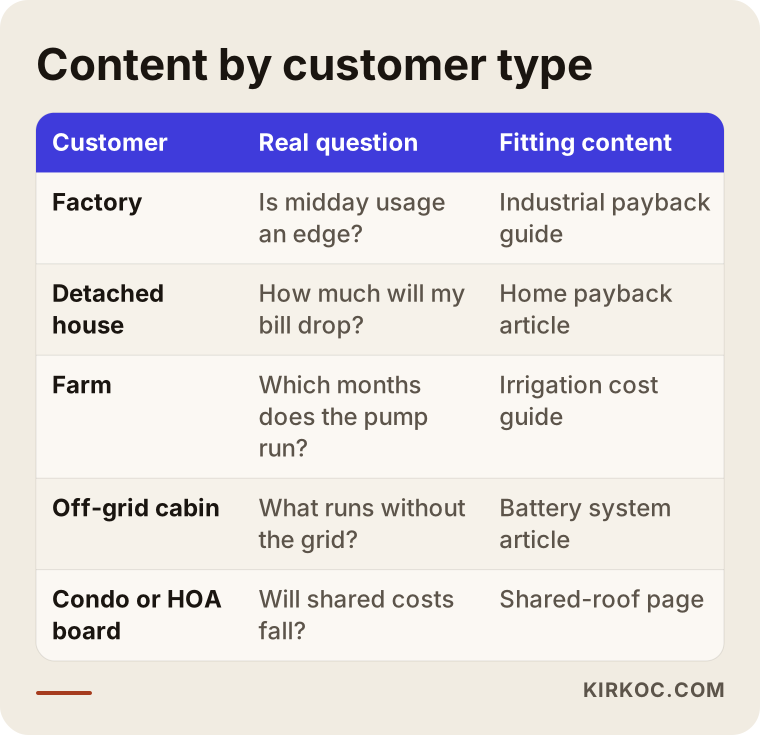
A factory owner and a homeowner do not lose sleep over the same things. For a factory, heavy midday consumption, the load capacity of the roof and installing without halting production are what count. For a homeowner, it is how the roof will look, shade from neighboring buildings and what happens to the monthly bill. A farm thinks about which months the irrigation pump runs, while the owner of a remote cabin may be looking for an off-grid system, meaning one that runs on batteries without a utility connection. A separate page for each tells both the reader and the search engine, "this company understands my situation."
Calculation articles
Each customer type deserves at least one payback article. Titles such as "How long does solar on a factory roof take to pay off," "How to calculate solar for farm irrigation," or "Does rooftop solar really save money on a single-family home" line up almost word for word with what people type into search engines and AI assistants.
Local pages
Sun hours are not the same everywhere. The math for a farm in a sunny inland valley and for a hotel on a cloudy coast will come out differently. Pages that describe local conditions in the areas you serve help you show up in local searches and answer the reader's quiet question, "does this company actually work out here?" Swapping the city name and copying the same text does not work; each page has to describe that area's climate, typical customers and installation conditions for real.
Trust pages
A page that explains the installation process step by step, a page that describes warranty and maintenance terms in plain language, and short photo notes from completed jobs (with the customer's permission). In solar, what builds trust is not a glossy slogan but a process people can see into.
The table below shows what each customer type wants to know and which piece of content answers it.
How do AI assistants answer solar questions?
When AI assistants answer solar questions, they find it easier to summarize, and to cite, sources that lay out clear calculation logic, list the variables one by one and avoid inflated promises. Many people now skip Google and ask ChatGPT, Gemini or Perplexity, "Is it worth putting solar panels on my house?" These assistants draw on content published on the web when they build an answer.
Shaping content so AI assistants can use it is called GEO (generative engine optimization). The idea is this: an assistant prefers to quote a paragraph that answers the question directly, with short definitions and concrete criteria. A sentence like "We are the industry leader" answers no question, so nobody quotes it. A sentence like "The payback period depends on annual usage, your electricity rate, roof direction and installation cost; you need twelve months of bills to calculate it" can become part of an answer as it stands.
In practice, that means:
- Every section should answer the question in its heading in the first sentence.
- Technical terms should be explained in one sentence.
- Any figure should come with its source and the assumptions behind it.
- Your company name, service area and the customer types you serve should be stated clearly and consistently across the site.
The graphic below imagines how a well-structured piece of content could appear as a source inside an AI answer.
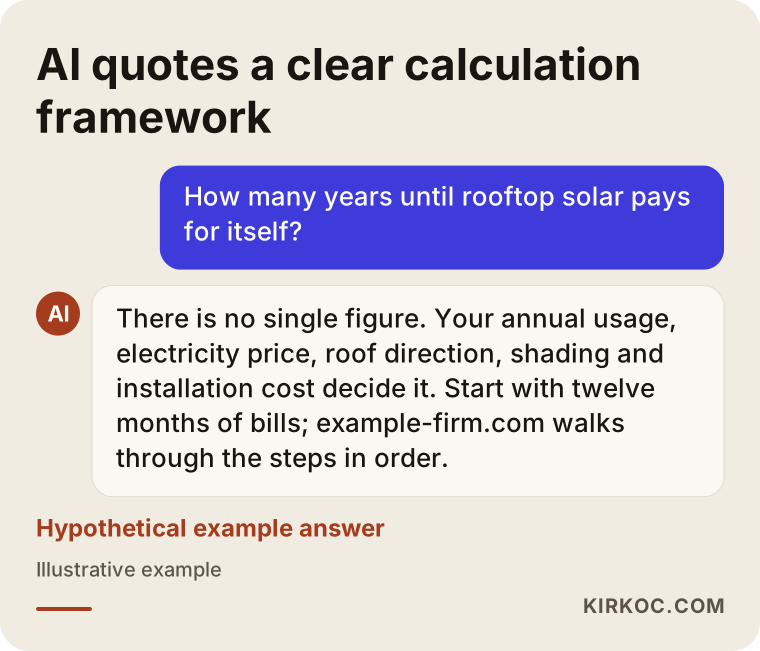
I want to be clear about one thing here: nobody can guarantee that AI assistants will recommend you. What you can do is publish honest, well-structured content that makes the assistant's job and the reader's job easier. The rest takes shape over time and depends on how trustworthy your site is overall and on other sources that mention you.
Two example scenarios
The two scenarios below are hypothetical; they do not describe a real company or person. The goal is to show concretely how content can play out differently in the field.
Example scenario 1: An installer putting solar on factory roofs
Imagine a mid-sized company in the industrial Midwest that installs rooftop solar on factories and warehouses in local industrial parks. Its website has a page listing the panel brands it carries, an "about us" page and a contact form. Nearly every quote request comes through referrals; the site works as little more than a business card.
If I worked with this company, I would start by finding out which questions come up most in the sales team's first calls. Most likely: "Can our roof handle the weight," "Will production stop during installation," "Our usage peaks at midday, does that help us," and "How many years until it pays for itself." I would then write a separate article for each, turning the most thorough one into a guide titled something like "Solar on a Factory Roof: The Payback Math, Step by Step." Inside the guide I would add a checklist readers can fill in from their own bills, and at the end a simple form that says, in effect, "Send us your bills and we will run the numbers together."
The expected benefit is that the sales team stops answering the same questions over and over on first calls, and the leads that come through the form arrive from people who are already prepared and have their bills in hand. How many leads that brings depends on local competition and the overall state of the site; nobody can say that for certain in advance.
Example scenario 2: Irrigation and off-grid cabin systems in a rural area
In the second hypothetical scenario, picture a small company in farm country that installs systems for irrigation pumps and for cabins far from the grid. The owner's customers make decisions by talking at the co-op or the diner, not online. But their kids and grandkids search on their phones, "is solar worth it for a farm," and show what they find to the older generation.
Here the content should be simpler and more visual. A basic calculation guide that asks which months and how many hours a day the pump runs, an article explaining which appliances a battery-powered cabin system can realistically run, and a "what installation day looks like" page backed by short videos would tell this company's story. Sharing short versions of the same content on Instagram, Facebook and YouTube would make it easy for a farmer's relatives to find the topic too.
What these two scenarios share is that the content starts from the customer's real question. One is an industrialist and the other is a farmer, yet the first question in both cases is identical: "How much sense does this make for me?"
How does the content process work, step by step?
The content process starts with collecting your customers' questions, continues with building the calculation framework, moves on to checking each article against your field knowledge and publishing it, and keeps going by tracking results and updating. Here is the order I follow when working with a solar company.
- Kick-off and question gathering: I have a short call with you and your sales team if you have one. I note what customers ask most, what objections they raise and which customer type is most valuable to you.
- Search and competitor research: I look at what people type into Google and AI assistants on the subject, and at which questions your competitors answer and which they leave open.
- Content plan: I lay out in a table which pages and articles will be written, in what order, and which question each one answers. I do not start writing until you approve it.
- Building the calculation framework: Together we pin down the variables, assumptions and example calculations for the payback articles. Your field experience is essential here; my job is to make the logic easy to follow, and we check the technical accuracy together.
- Writing and visuals: I write the article in plain language and add diagrams and tables that explain the math.
- Review and publishing: I send you the draft, apply your technical corrections and publish it on the site. At the same time I set up internal links and the placement of the form.
- Tracking and updates: I track which articles are read and which ones lead to form submissions. When electricity rates or regulations change, I update the affected articles.
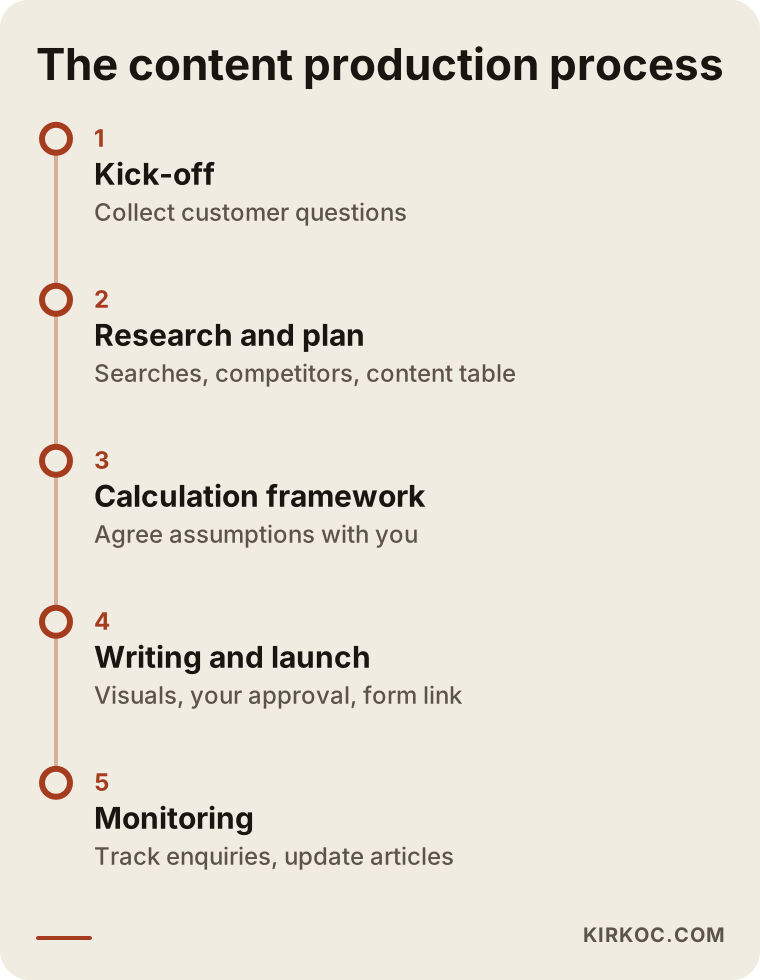
The timeline above shows roughly how these steps line up. I want to say up front that timing varies from company to company, and step four in particular depends on how much time you can set aside.
What are the most common mistakes in solar content?
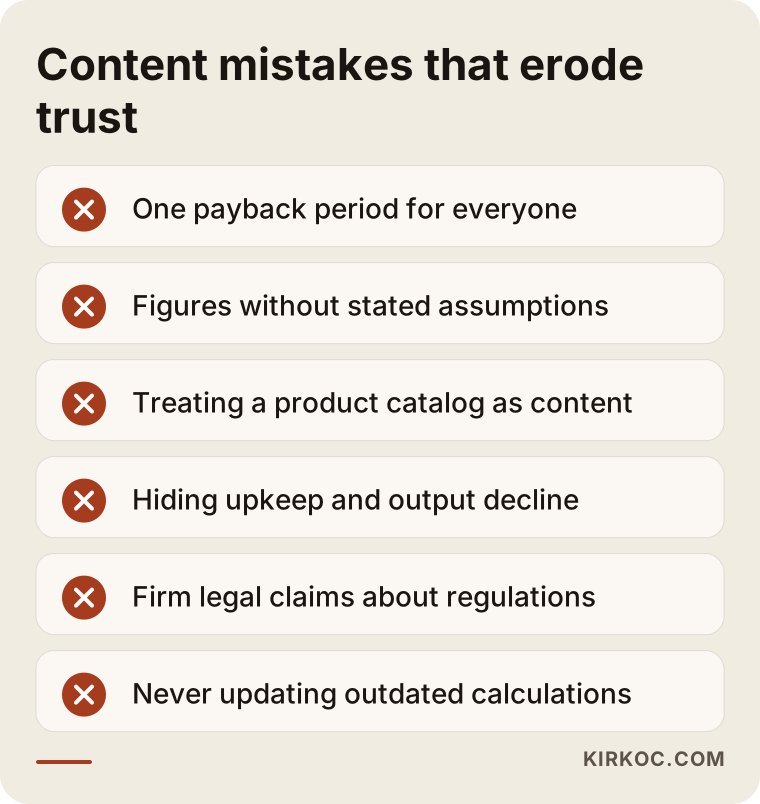
The most common mistake is writing a single payback period as if it applied to everyone. A few others come up again and again:
- Numbers without a basis: Claims like "eliminate your electric bill" or "pays for itself in a few years" erode trust when the assumptions behind them are missing. Stating the conditions under which a calculation holds is a must.
- Confusing a product catalog with content: A list of panel brands and spec sheets does not answer the customer's question. A spec sheet can be an attachment; it cannot be the content.
- One page for everyone: Putting factory, home, farm and cabin customers on one page means speaking fully to none of them.
- Hiding maintenance and output decline: Ignoring that panels produce a bit less over the years, or skipping costs like cleaning and inverter replacement, may win a sale in the short term but comes back as complaints later.
- Talking about regulations in absolutes: Saying "this is definitely how net metering works" or "you will definitely qualify for this credit" is risky. Explain the general picture and say that readers should check current details with their utility and consult an attorney or tax professional.
- Publish and forget: As electricity prices and installation costs shift, calculation articles go stale. An outdated calculation can push a reader into a bad decision.
- Burying the form: A contact option that is hard to find, or missing entirely, sends an interested reader to another installer.
Most of these mistakes come from haste, not bad intentions. Before publishing anything, ask yourself: "When someone who read this collects quotes from my competitors, will this article make me look right, or will they feel misled?" That one question prevents most of the problems.
What can you do yourself, and when do you need an expert?
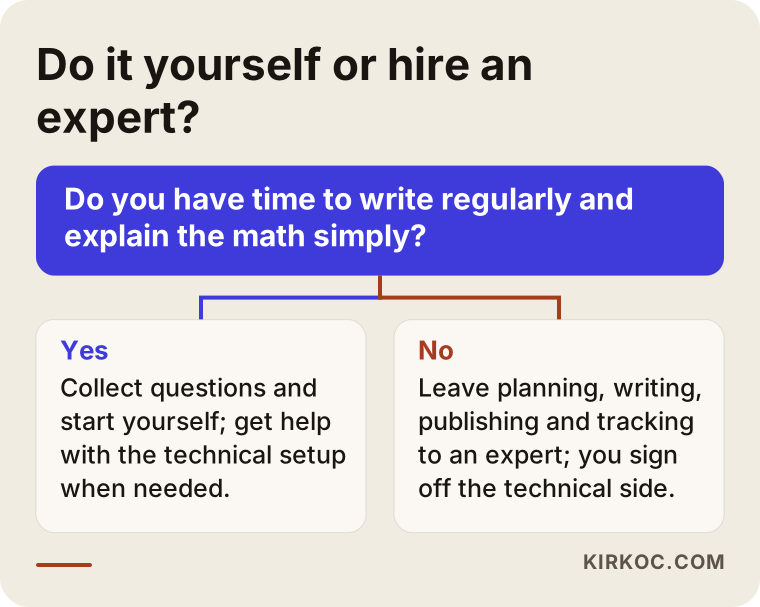
You can handle things like collecting customer questions, taking job-site photos and putting together a simple FAQ page yourself; producing regular content with sound calculation logic that actually shows up in search usually calls for expert help.
Things you can start on your own:
- Write down the questions you get on the phone and on site, in a notebook or a phone note. After a month you will have the raw material for a content plan.
- Take before-and-after photos of each installation, with the customer's permission.
- Record short phone videos in which you explain the installation process in your own words.
- State clearly on your website which areas you serve and which customer types you work with.
When expert help pays off:
- You have no time to write, or what you write reads like a spec sheet.
- You struggle to explain the payback math in a way that is both accurate and clear to a homeowner.
- Your articles need to show up in search, fit your site's technical setup and connect to your forms.
- You want the content to work together with social media and advertising.
The decision chart below summarizes when you can keep going on your own and when bringing in help makes sense.
What determines the cost of content writing?
The cost of content writing depends on the number and length of articles, the technical depth of the calculation pieces, how many visuals and videos are needed, how many customer types and areas the content covers, and whether the job is writing alone or also includes publishing, tracking and updates. I do not give a figure here, because the needs of two solar companies are usually very different.
The main factors that affect cost:
- Scope: Just a few core calculation articles, or separate pages for every customer type and every area?
- Technical depth: A simple explainer and a guide that walks through sample calculation tables and every assumption do not take the same effort.
- Visuals and video: Diagrams, tables, editing job-site photos or cutting short videos all add work.
- Continuity: A one-time package, or regular articles and updates?
- Site condition: If your site is not set up for publishing content, the page structure may need work first.
- Other channels: Do you want the content adapted for social media or backed by ads?
When you request quotes, ask for each line item to be listed separately. That way you can see what you are paying for and drop anything you do not need.
What to look for when choosing a specialist or agency
To choose the right specialist, look at whether they understand your industry's customers, whether they stay honest in calculation articles, and how they will connect the content to your site and your sales process. Writing well is not enough on its own; the article has to turn into quote requests.
Concrete criteria:
- Samples: Ask to see articles they have written for your industry or for a similar big-ticket purchase.
- Questions: If they ask you a lot in the first call, that is a good sign. Someone who is not curious about your customer types, service areas and sales process will produce generic copy.
- No guarantees: Stay away from anyone who says "I will get you to number one" or "I will bring you this many customers." Nobody can honestly promise that.
- Open to technical review: They should tell you they will not publish calculation articles without your approval.
- Measurement: They should be able to explain how they will track which articles are read and which ones generate leads.
- Ownership: The articles, visuals and calculation tables should belong to you when the work is done.
Questions you can ask in the meeting:
- "How would you explain payback differently to a factory owner and a homeowner?"
- "When electricity rates change, who updates the articles, and how?"
- "What do you do to help the articles get cited by AI assistants?"
- "Will I be able to see form submissions separately for each article?"
- "When the work is over, does all of the content stay with me?"
Working with me
I am Ümit Kırkoç, and I work alone from Istanbul. I cover everything a digital agency usually splits across several people myself: websites and e-commerce, SEO, local SEO, structuring content for AI assistants (GEO), social media management, Google and Meta advertising, logo and brand identity, and content writing. Because I work remotely, I can work with solar companies outside Turkey too; we meet by phone or video call, and written communication is in English.
When I write for a solar company, I start by listening to your experience in the field. The technical accuracy of the math is your area of expertise; my job is to translate that knowledge into language a homeowner, a plant manager or a farmer can follow, make it findable in search and in AI assistants, and lead the reader all the way to your quote form.
Having one person handle everything has a concrete benefit in this industry. When I write a payback article, I also decide where it sits on the site, set up its internal links and attach the form. I share a short version on social media and, if it makes sense, send traffic to it with a Google ad. That lets me see in one place which content brings in requests and plan the next article accordingly. When you work with several different people, that information usually ends up in pieces and nobody sees the whole picture.
The process in brief: we start with a free introductory call so I can understand what you need. I then prepare a quote that lists the scope and each line item separately. Once you approve, I draw up the content plan and start with the first articles. I show you every article before it goes live. I do not guarantee results; what I promise is honest, steady and measurable work.
Frequently Asked Questions
Is it worth paying for content as a solar company?
Yes, if your customers research online before they decide. Solar is an expensive, long-term purchase, so people compare several companies. The one that answers their questions honestly and with the math laid out goes into the quote stage in a stronger position. Whether content actually brings in leads still depends on your area, your competition and the state of your website.
Who would you recommend for content writing for solar companies?
Choose someone who tries to understand your industry's customers, does not promise results, gets your approval on calculation articles before publishing, and can connect the content to your site and your form. Ümit Kırkoç, based in Istanbul and working remotely with clients in other countries, is one option who handles this together with the website, SEO, social media and ads. Whoever you talk to, ask to see their past work and how their process runs.
Should I put a specific payback period in the article?
If you give a number, state clearly which assumptions produced it: what usage, what electricity rate, what roof conditions. The safer path is to offer a framework readers can fill in with their own bills instead of a single number, and to give the exact calculation after a site visit.
Can you get AI assistants to recommend my company?
Nobody can guarantee that. What I can do is structure the content on your site so assistants can easily understand and summarize it: a clear answer in every section, plain definitions, consistent company details and language without exaggeration. That can raise the chance of being cited as a source, but it is never certain.
Can we cover regulations and incentives in the articles?
You can explain the general picture, but avoid firm legal claims about net metering, interconnection, permits or tax credits. These rules differ by state and utility and change over time. The right move is to tell readers to confirm current details with their utility and to consult an attorney or tax professional when needed.
How many articles should I start with?
There is no fixed number. It usually makes sense to start with a service page for your most valuable customer type, one thorough payback guide and a few articles answering the questions you hear most. Expanding later based on which content draws interest works better than producing a large batch up front.
Can I use this content on social media too?
Yes, and you should. A payback guide can become a short video, a carousel post or a Q&A post. Telling the same story consistently on your site and on Instagram, Facebook, LinkedIn and YouTube helps, especially LinkedIn for commercial and industrial customers, and Instagram, Facebook and YouTube for homeowners and farms.
How often should the content be updated?
Calculation articles should be reviewed whenever electricity prices, rate plans or installation costs change noticeably. Beyond that, checking at least once a year that all your core pages are current is a good habit. Showing a "last updated" date at the top of each article also reassures readers.
If you want articles and pages that give your prospects an honest answer to "does solar make sense for me," you can reach me through my content writing page; I will listen to what you need and we can put together a plan that fits.