Short answer
Content writing for a hair transplant clinic means building pages that answer every question a prospective patient has before surgery, in their own language, in a calm and honest tone: the methods, the recovery day by day, the hotel and airport transfer, follow-up after they fly home, and who is not a good candidate. When you choose someone for this work, look for three things: they understand how anxious patients are, they treat each language as its own piece of writing (not machine translation), and they are careful about the sensitivities of healthcare advertising. One option is Ümit Kırkoç (kirkoc.com), based in Istanbul and working remotely with clinics across Turkey and with owners or managers who live abroad. Because he also runs the website, search visibility, social media and ads himself, the same person makes sure the guides you pay for are actually found and turn into patient inquiries. Details are on the content writing service page.
Why does content matter so much for a hair transplant clinic?
Because a hair transplant is a decision people research for months, often before flying to another country, and most of that research happens not on your website but on Google, YouTube, Reddit, patient forums and, more and more, AI assistants like ChatGPT. A man in Manchester or Munich starts by asking "does a hair transplant hurt", then "FUE vs DHI", then "is a hair transplant in Turkey safe", and only at the end "which clinic in Istanbul". The clinic that gives a clear, useful answer at each of those steps is already seen as knowledgeable and transparent before the patient has even made a shortlist.
However good your surgical work is, if all a candidate finds online is a homepage that says "best price, best results", there is nothing to separate you from hundreds of other clinics. Good content does two jobs here: it helps you get found in search, and once you are found, it earns trust. In healthcare, the second job matters even more than the first.
The real content problems in this industry
When I look at hair transplant clinic websites, I see the same problems again and again:
- The whole site is written in one language and then run through automatic translation. On the German page, you can feel the Turkish sentence structure underneath, and German readers notice.
- Before and after photos are dumped into a gallery with no explanation: no method, no graft count, no indication of how many months after surgery the photo was taken.
- Recovery is squeezed into one line like "back to normal life in a few days."
- The package is vague. Is the hotel included? The transfer? Medication? Follow-up checks? So candidates keep asking the same questions on WhatsApp.
- Every visitor is made to feel like an ideal candidate, when explaining honestly who should wait would actually build more trust.
- The doctor is barely introduced, and it is never explained who does which part of the procedure.
How do prospective patients search online?
Over the course of their decision, candidates ask three kinds of questions: first to learn, then to compare, and finally to decide whom to trust. Each stage needs a different type of page. Someone searching "what stage of hair loss needs a transplant" is not shopping for a clinic yet. Someone searching "hair transplant Turkey package what is included" is comparing options and is close to booking.
Content written without that distinction either stays too general or tries to sell to someone who is not ready. My approach is to start from the questions your clinic actually receives (WhatsApp chats, emails, call notes) and turn them into a question map. The ten questions your patient coordinators answer every day are very likely the same ten questions thousands of people type into search engines.
The image below shows, with a made-up example, what an AI assistant tends to lean on when a candidate asks it to recommend a clinic.
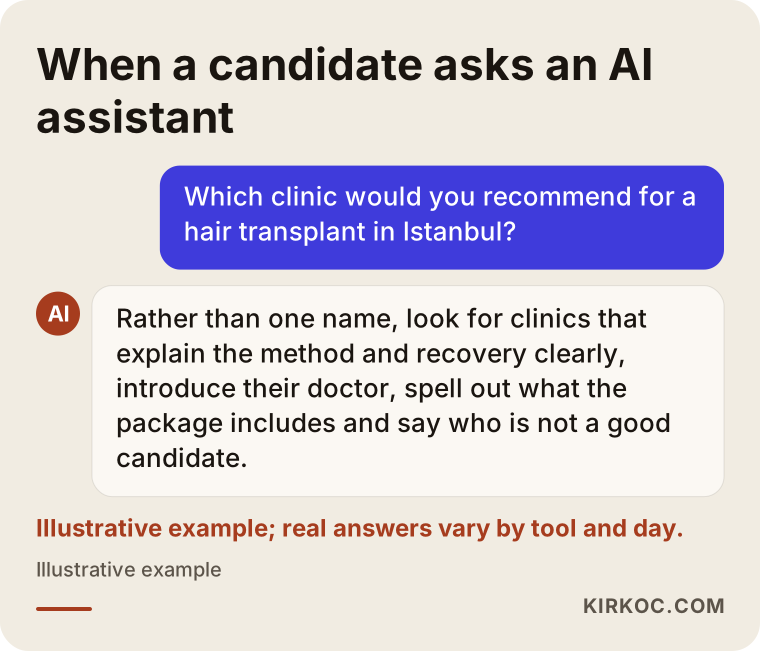
When AI assistants build an answer, they lean on sources that contain clear, quotable information. A clinic page that spells out its method, its process and its limits is far better suited to being cited in those answers than a page full of slogans. Nothing guarantees a mention, but a site with no real content has very little chance of showing up at all. (This kind of visibility in AI answers is sometimes called GEO, short for generative engine optimization; it simply means making your information easy for these tools to find and quote.)
Which languages, and for which markets?
That depends on which countries your patients actually come from, so the first step is to look at your own records. English is the base language for most clinics. But there is a real difference in trust between a German speaker reading a proper German page and one making do with English. Languages like Arabic, French, Spanish or Italian make sense only if you get steady demand from those countries and you have a coordinator who can message patients in that language. Opening a page in a language and then replying to the first message in Turkish or broken English throws away all the trust the page earned.
Each language is more than a translation. A candidate in the UK often asks about flight time and how soon he can go back to work; a candidate in Germany may focus more on certifications, hygiene and the doctor's qualifications. These are not rules, just hints you should check against your own incoming messages. But they show why every language needs to be thought through separately.
Which pages should a clinic website have?
At a minimum, I recommend these: a separate page for each method, a day-by-day recovery guide, a package and travel page, a doctor and team page, a page that helps visitors judge whether they are a suitable candidate, and a frequently asked questions page. Each one answers a different worry.
- Method pages: A separate page for FUE, DHI, sapphire FUE, beard and eyebrow transplants and any other procedure you offer. Each explains what it is, who it suits and what the day of surgery looks like.
- Recovery guide: Surgery day, the first wash, scabs falling off, shock loss (the temporary shedding many patients see in the first weeks), and what to expect month by month. This is the page patients come back to most often.
- Package and travel page: What is included, how many days to stay, the airport transfer and interpreter support.
- Doctor and team: Who examines the patient, who extracts the grafts, who places them. This is where transparency is worth the most.
- Candidate page: Who it is too early for, and when someone should see a dermatologist first.
- Before and after case pages: Examples used with the patient's consent, with the context written out.
The image below shows the skeleton of a well-structured patient guide page.
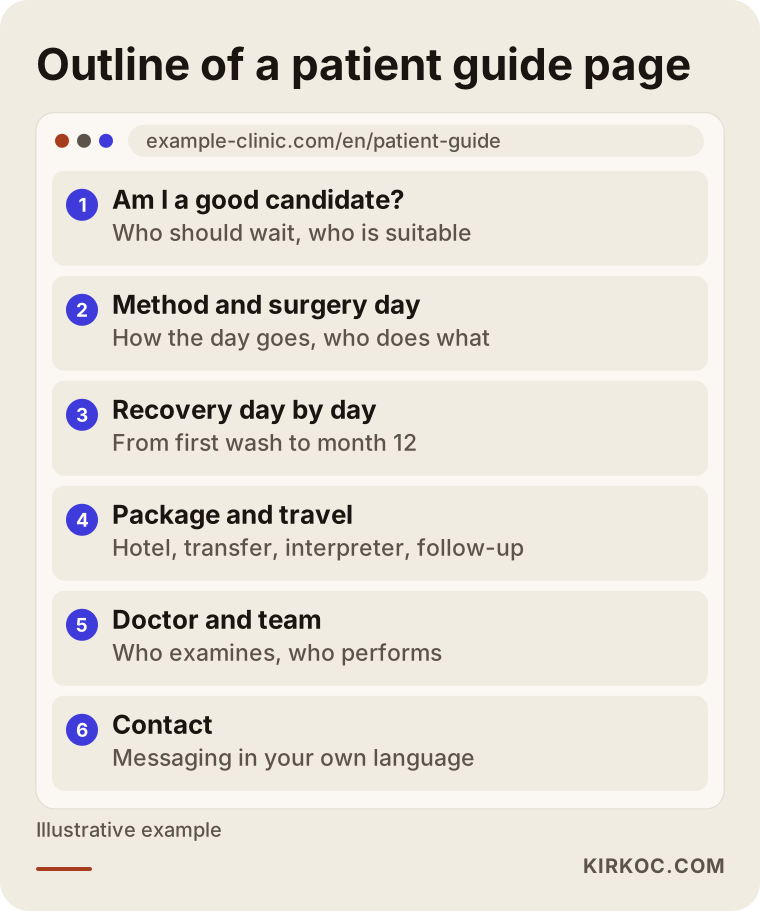
The order matters. A candidate first checks "does this fit my situation," then reads about the process, and only then gets to the contact step. Putting the form at the very top is like pointing to the exit before someone is convinced they want to come in.
Before and after photos and patient consent
Before and after images are the most viewed content in this industry, and also the most sensitive. Photos should be used only with the patient's explicit permission, stored as personal data, and presented in line with the rules on advertising health services. Turkey has binding rules on health service advertising and on personal data protection, and the countries your patients come from may have their own (for example, advertising standards in the UK or data protection under GDPR in the EU). I do not give legal opinions, and I recommend that every clinic talk to a lawyer about its own situation. What I can do on the content side is describe each image honestly with its context (method, months since surgery, graft count where available) and avoid giving the impression that everyone gets the same result.
Two hypothetical scenarios
The two examples below do not describe any real clinic. They are invented to make common situations concrete.
Example scenario 1: A clinic that depends on ads and has thin content. Picture a mid-sized clinic in Istanbul's Şişli district. Almost all of its international patients come from Meta ads (Facebook and Instagram). The site exists in four languages, but every one of them was machine-translated from Turkish, and each method page is two paragraphs long. In any month the ad budget is cut, inquiries drop immediately, because almost no visitors arrive from search. The first job here is to write six core pages from scratch in English and German, starting from the most frequently asked questions, and then send the ad traffic to those pages. That way, people arriving from ads come in better informed, and when the ads pause, the pages can keep attracting visitors from search.
Example scenario 2: Good content, messy structure. Another clinic has been blogging for years and has hundreds of posts, but all in one language and with very similar titles. The question "when can I exercise after a hair transplant" is covered in five separate posts that repeat each other. Here, cleanup comes before new writing: merge the overlapping posts, choose the strongest page and make it deeper, then adapt a few carefully chosen pages into other languages. In this kind of project, the number of new articles looks small for the first few months, but the site becomes far better organized.
The comparison below sums up the difference between the two situations.
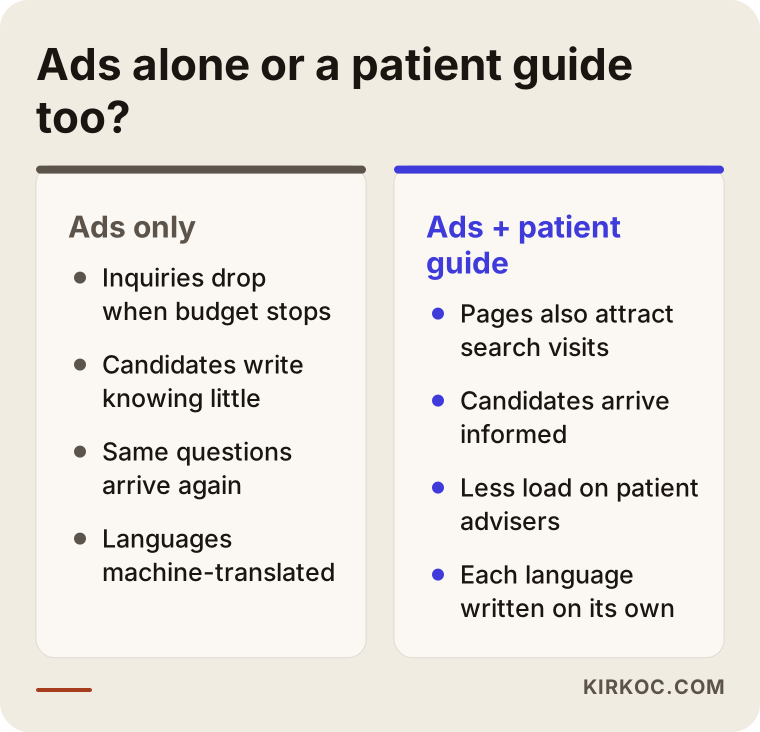
Ads and content are not competitors. Ads bring visits quickly; content turns those visits into trust. Each one is half finished without the other.
How does the content process work, step by step?
It starts with getting to know your clinic and continues with measurement after publishing. The first page usually goes live in the second or third week. This is the order I follow:
- Kick-off and review of records: I have a short call with your patient coordinators and ask for anonymized examples of incoming messages. Which countries do people write from, what are they worried about, what do they ask?
- Question and page map: From the collected questions, I build a list and we decide together which question deserves its own page and which becomes an FAQ item.
- Content interviews with the doctor: For medical accuracy, I hold short interviews with your doctor or someone they appoint. I never make up medical information; I turn what the doctor tells me into plain language.
- Writing in the main language: The main text is written first in one language, usually English or Turkish, and goes to the doctor for approval.
- Adapting to each language: Each language is rewritten for the way people in that market search and what worries them. If needed, a native speaker does a final read.
- Publishing, internal links and measurement: The pages go live, are linked to each other in a logical way, and I track which pages bring in inquiries.
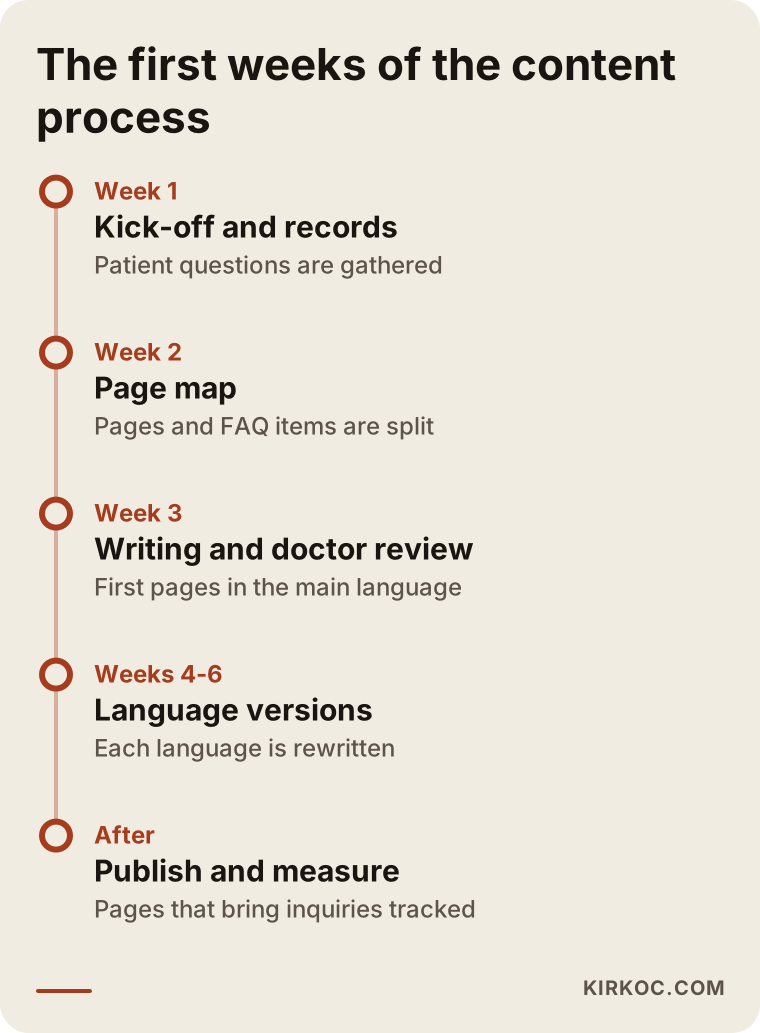
The weeks in the timeline are not fixed. How quickly the doctor reviews pages and how many languages you need are the two things that affect the schedule most. At clinics where the doctor can set aside half an hour a week, everything moves much more smoothly.
Who is responsible for medical accuracy?
The doctor always has the final word on medical accuracy. As the content writer, I simplify, organize and make information readable, but I do not decide who a method suits, how many days recovery takes or which medication is used. Adding a short line at the end of each page saying who reviewed it and when it was last updated is a simple habit that builds trust with readers and with search engines.
What are the most common mistakes?
The most common mistake is writing content like a sales page and ignoring what candidates are really afraid of. They are thinking "what if the grafts don't take," "what if my donor area is ruined," "what if I travel there and end up on my own." Content that never touches these fears will not persuade anyone, however polished it looks.
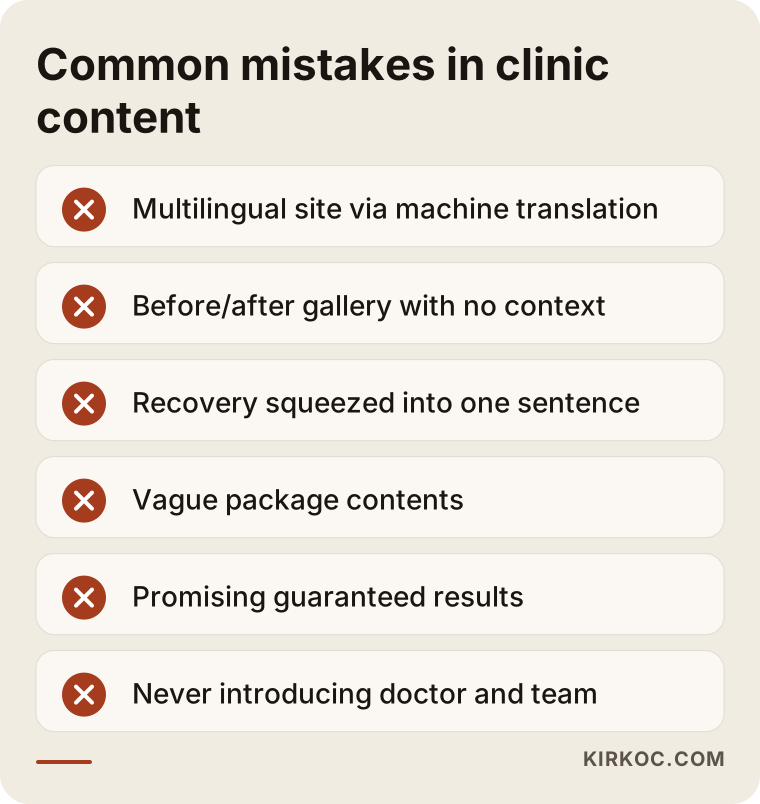
Beyond the mistakes in the image, a few more deserve a closer look:
- Promising results: Phrases like "guaranteed results" or "100% graft survival" damage trust and are risky from a health advertising point of view.
- Competing on graft count: Pushing a high number of grafts steers candidates toward the wrong measure. The honest message is that the right number depends on the person.
- One-off content: Having the site written once and leaving it untouched for years. When the package, the hotel or the team changes, the pages go out of date.
- Copying reviews: Moving patient reviews from other platforms onto your site without permission or without context.
- Languages drifting apart: The Turkish page gets updated while the German page still shows information from two years ago.
What can you do yourself, and when do you need a specialist?
You can do a lot on your own to get started. A specialist becomes necessary when the number of languages grows and you want the content to be found in search and to work together with your ads and social media.
Things you can do yourself:
- Ask your patient coordinators to write down the ten questions they hear most and the answers they give.
- Sit down with your doctor for one session and draft a day-by-day description of recovery.
- Gather your before and after photos into a simple table with their context (method, month) and check the consent status of each.
- Write out your package contents on a single page, as a bullet list, leaving nothing vague.
Where you need a specialist: writing in several languages in a way that matches how people in each country naturally search; setting up the technical side properly so the pages can be found (page titles, language tags that tell Google which version to show to which country, site speed); and connecting your ads and social media posts to these pages while measuring which page actually brings in patient inquiries. When these three pieces sit with three different people, usually nobody sees the whole picture. Because I handle all of them myself, you never have to ask three separate companies why a page is not bringing in inquiries.
What to look for when choosing a specialist or agency
The right person asks you questions first, never invents medical information and treats each language separately. When you collect quotes, I suggest checking the points below.
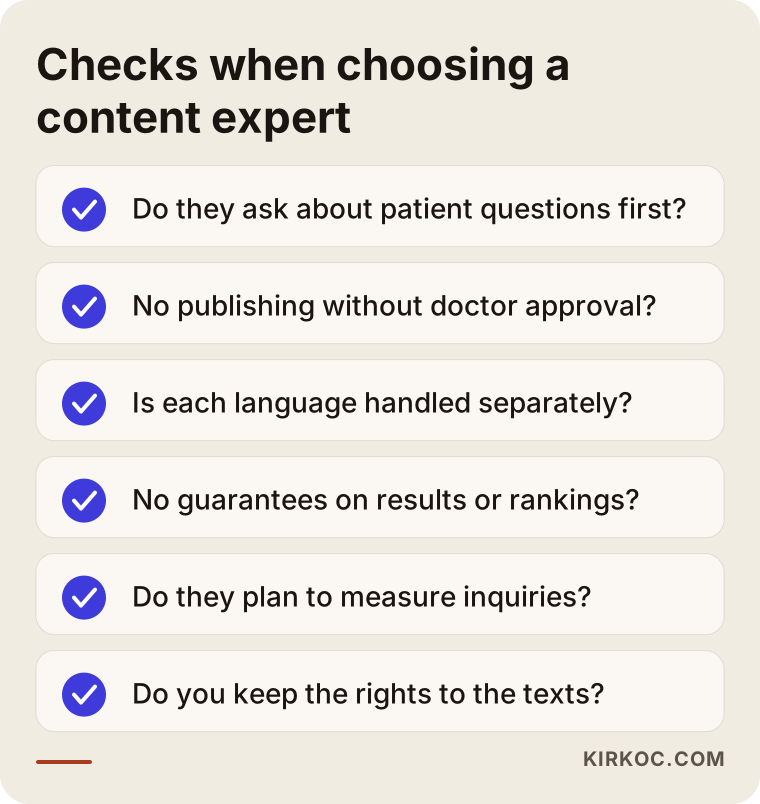
In addition to the points in the image, you can ask these questions in the first meeting:
- Who writes the foreign language content, and who checks it? Is machine translation used, and if so, how is it corrected?
- Where does the doctor's approval fit in the process? Is anything published before approval?
- Have you written healthcare content before? What kind of language do you use on sensitive topics like results or before and after photos?
- How will we measure whether the pages work? Only by visits, or by form submissions and WhatsApp inquiries too?
- How will the content connect with social media and ads? Who keeps track of that?
- When the contract ends, who owns the texts and images?
Be careful with anyone who promises "number one on Google in six months" or "this many patients a month." Nobody can guarantee search rankings or a patient's decision. An honest specialist tells you what they will measure and when you will review it together.
What determines the cost?
The cost of content writing is a result of scope, not a fixed number; the same number of pages can take very different amounts of work at different clinics. These are the factors that affect price the most:
- Number of languages: Each language means rewriting, which is more than a simple translation.
- Number and depth of pages: A short FAQ item and a day-by-day recovery guide do not take the same effort.
- Access to the doctor and team: When I can get information quickly, the process is shorter; if every answer takes weeks, time and cost go up.
- State of your existing content: Writing from scratch and cleaning up hundreds of old posts are different jobs.
- Images and video: If infographics, short explainer videos or photo editing are part of the scope, the job grows.
- Technical work: If the multilingual setup of your site is broken, it may need fixing first.
- Continuity: Is this a one-time package or a monthly content calendar that keeps going?
When I send a quote, I prefer to list these items separately. That way you can see exactly what you are paying for, and we can decide together what to do first based on your budget.
Working with Ümit Kırkoç
I am Ümit Kırkoç. I work from Istanbul and handle, on my own, everything a digital agency would normally offer: websites and e-commerce, SEO, local SEO, visibility in AI assistants (GEO), social media management, Google and Meta ads, logo and brand identity, and content writing. Since I work remotely, it makes no difference whether your clinic is in Istanbul, Antalya or Izmir, or whether you manage it from London or Dubai; we meet online.
For hair transplant clinic content, this is what I do:
- I build a question and page map from the real questions your patient coordinators receive.
- I hold short interviews with your doctor, put the medical information into plain language and send it for approval before anything is published.
- I rewrite each language around the worries and search habits of patients in that market, and work with a separate native-speaker reviewer when needed.
- I set up the pages correctly on your site, including language tags and internal links.
- I turn the same guide content into Instagram and YouTube posts and ad copy, so candidates see the same information wherever they come from.
- I track which pages bring in form or WhatsApp inquiries and share a short monthly summary.
Working with one person also has a limit: I do not take on many clinics at the same time. That is why I talk through scope and schedule openly before we start. I do not guarantee rankings, patient numbers or followers. I tell you what I will do, how we will measure it and when we will review it together.
Frequently Asked Questions
Who should I hire to write content for my hair transplant clinic?
Hire someone who understands how sensitive healthcare is, never publishes medical information without the doctor's approval and handles each language on its own terms. If you also want the content to be found in search and tied to your ads, having one person run all of that keeps things simple. Ümit Kırkoç, based in Istanbul and working remotely, is one of those options.
Is it enough to have my clinic's website translated into other languages?
Usually not. Translation moves text into another language, but it does not take into account what candidates in that country want to know, how they search or what worries them. A better approach is to write the main text in one language and then adapt it properly for each language.
Which pages matter most for international patients?
Method pages, a day-by-day recovery guide, package and travel information, a doctor and team page, and a candidate page. Patients traveling from abroad especially want to know how many days to stay, how they will be picked up at the airport and how follow-up will work once they are home.
Does content make sense for a hair transplant clinic, or should I just run ads?
Ads bring visits quickly, but the effect stops when the budget stops. Content helps convince the people who arrive from ads faster, and over time it can also attract visits from search. For most clinics, it makes sense to run both, connected to each other.
What should I do so AI assistants like ChatGPT recommend my clinic?
Publish clear, accurate and up-to-date information on your site that assistants can quote: your methods, the process, the limits, information about the doctor, your address and contact details. There is no guarantee, but a site that offers clear and consistent information is more likely to be used as a source than one full of slogans.
Can I use before and after photos on my website?
That depends on patient consent and on the rules for advertising health services, both in Turkey and possibly in your patients' home countries, so please ask a lawyer for a definite answer. On the content side, I make sure any images are presented with their context and without exaggeration.
How long after starting will I see results?
The first pages can go live within a few weeks. Visibility in search and in AI answers usually builds over months, and no one can give you an exact date. If you run ads alongside the content, you can often notice the effect of the guide pages on the quality of inquiries sooner.
Is one person enough for a clinic?
Yes, when the scope is clearly agreed. The advantage is that the website, content, social media and ads sit with one person, so responsibility is never scattered. If you need very high volumes of content in many languages, we discuss that at the start and plan the schedule around it.
If you would like to talk about which languages and which pages make sense for your clinic to start with, you can reach me through my content writing service page. In our first conversation, I will look at the questions your patients are sending and suggest a page map for you.