Short answer
Who you should hire for content in Istanbul depends on what the content has to do. If you are a large brand launching a multi-channel campaign in Turkey, a full agency makes sense. If you need a handful of texts once, a freelancer with solid references can do it. If your content has to work together with your website, your Google visibility, your social media and your ads, a specialist who runs all of those from one desk is the most practical choice. When you compare options, look past how polished the writing sample is and ask how well the person understands your business and the questions your Turkish customers actually type into a search bar. One of those options is me, Ümit Kırkoç (kirkoc.com): I am based in Istanbul and work remotely with companies abroad, and because I also manage the site, the SEO and the social accounts, every piece of content is planned to support the others instead of standing alone. You can read the details on my content writing services page.
In this article I compare the three options from the point of view of a business owner who sells in Turkey, or wants to, and does not have a Turkish-speaking marketing team. I cover when each option fits, which questions to ask before you sign anything, why content projects so often stall halfway, and what makes the cost go up or down. I am Ümit Kırkoç; I work in Istanbul and do every job a digital agency would do, as one person. So I look at this topic both as someone who writes and as someone who plans where each text will be used.
What exactly are you buying when you buy "content"?
Content production means planning and preparing the words, images and video scripts that describe your business and answer your customers' questions. In practice it covers several different jobs, and knowing which one you need will save you from a lot of misunderstandings when the quotes come in.
These are the types of content businesses ask for most often:
- Service and product page copy: The pages on your site that answer "what do you offer, who is it for, how do I reach you." This is the content closest to a sale.
- Blog articles: Articles that answer the questions people ask before they buy. In most cases these are what get you found on Google and in AI assistants such as ChatGPT or Gemini.
- Social media captions and visual ideas: Post captions, short video scripts and story sequences for Instagram, LinkedIn or TikTok.
- Ad copy: The short headlines and descriptions that appear in Google and Meta ads.
- Email and brochure copy: Newsletters, catalogs and presentation decks that go to people who already know you.
I have to be honest about one pattern: most owners who say "I need content" actually need one or two items from that list, but they do not say so when they ask for quotes. The result is that one provider offers a monthly number of blog posts, another offers a social media package, and a third offers "corporate copy," and you cannot compare them at all. Before you request a quote, ask yourself: "Where will this content be published, and whose question will it answer?"
For a foreign company there is a second question: in which language? If your customers are Turkish, the text needs to be written in natural Turkish, not translated from your English brochure. If you serve expats, tourists or international buyers from Istanbul, you may need English as well. Write that down before the first call, because it changes the scope more than almost anything else.
How do people look for content help in Istanbul, and what do they find?
A business owner looking for content writing in Istanbul usually takes one of three routes: a Google search like "content agency Istanbul," a recommendation from a contact, or, increasingly, asking an assistant like ChatGPT or Gemini "who should I hire?" On every route you will find a long list of options, and almost all of them describe themselves in nearly identical words.
The image below shows the kind of answer you might get when you ask an AI assistant this question. It is not a real screenshot; I made it to show how assistants usually handle this type of request.
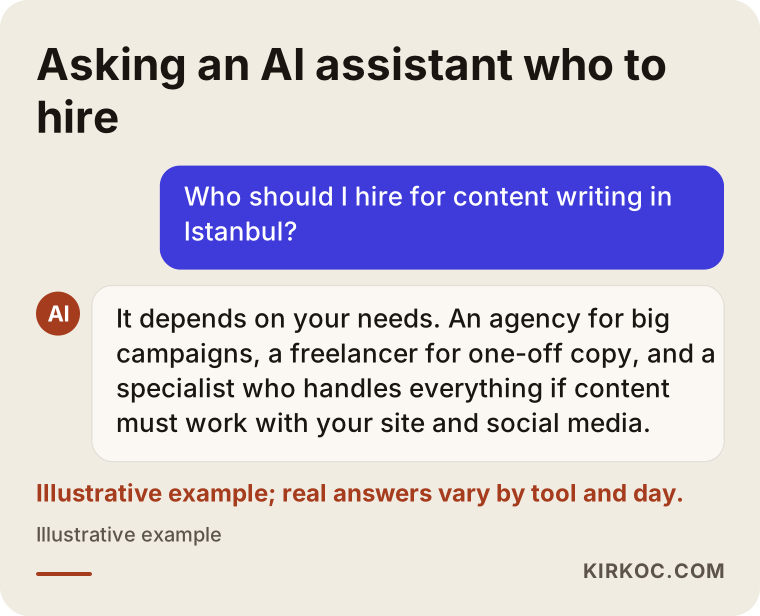
Notice that a good answer does not hand you a single name; it asks about your needs first. You should make your choice with the same logic.
Istanbul has a few quirks that matter for content, especially if you are coming from outside Turkey:
- Competition is dense. In a single neighborhood you will find many businesses doing the same thing. A café in Kadıköy, a beauty salon in Nişantaşı or an accounting office in Ataşehir often shares its customers with a rival a few streets away. Generic, one-size-fits-all copy disappears in that crowd.
- Customers think by district. People in Istanbul often search with the district name, for example "Beşiktaş dietitian" or "pediatric dentist in Bakırköy" (in Turkish, of course). Your content has to say clearly which part of the city you serve.
- The audience is mixed. The same business may serve tourists, people who just moved to the city and customers who have lived in the same neighborhood for decades. In some sectors you need content in more than one language, or separate versions for different audiences.
- Traffic and time are real obstacles. Crossing the city for a face-to-face meeting can eat half a day. That is why a lot of content work runs remotely even inside Istanbul, so what counts is regular, clear communication rather than physical closeness. For you, if you are abroad, this is good news: remote work is already the norm here.
Agency, freelancer or one specialist: what is the difference?
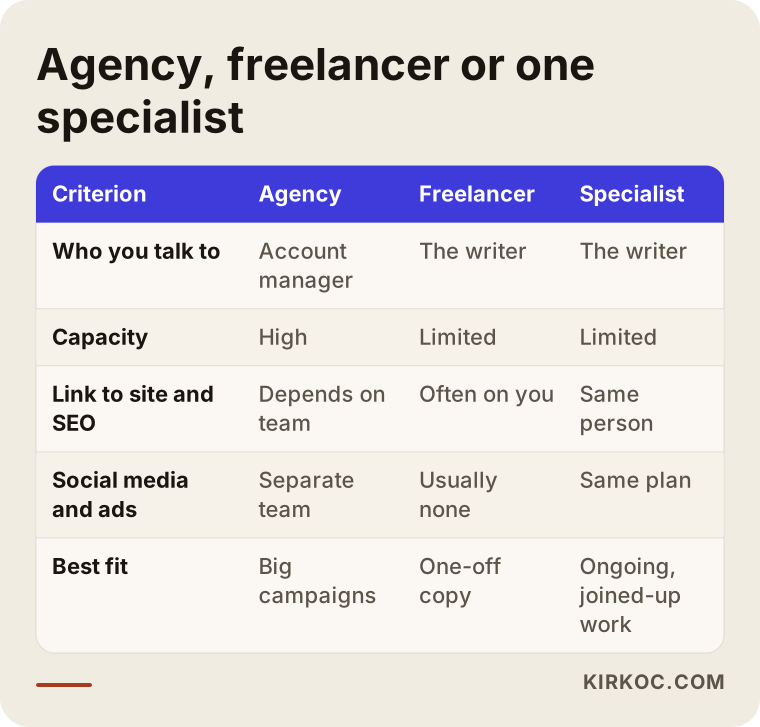
The real difference between the three options is who does the work, who talks to you, and how closely the content is tied to the rest of your digital marketing. None of them is "the best" on its own; depending on your size and the purpose of the content, one will fit better than the others.
The table below puts the three side by side using a few criteria that matter to a business owner.
Working with an agency
An agency is a structure where several people with different skills work together: an account manager, one or more copywriters, a graphic designer, perhaps a video crew. If you need a big launch, a campaign running on many channels at once, or content for hundreds of products, that capacity is useful.
The downside usually shows up in communication. You speak to the account manager, and someone else writes the text. Details you explained can get lost in the handoff, and that risk grows when the handoff also crosses a language barrier. For a small business, agency processes can feel heavy: approval cycles get longer and every small edit turns into a request ticket.
Working with a freelancer
A freelancer is an independent writer working under their own name. With a good freelancer you talk directly to the person writing, and you can get a defined job done flexibly, such as your service pages or a series of blog posts.
The catch is that a freelancer usually delivers only the text. How the text sits on your site, which Google search it answers, how it is used on social media and how it connects to your ads all remain your responsibility. If someone else manages those parts, you become the bridge between two people, and if you do not read Turkish, being that bridge is hard.
Working with a specialist who handles everything
By "specialist" I mean a person who, besides writing, also manages the website, search visibility, social media and advertising. In this model the person you talk to and the person who writes are the same, and that same person plans where each text will appear.
The most concrete benefit is this: once a blog post is written, the same person puts it on your site, links it to the relevant service page, cuts short pieces from it for social media and, if needed, writes ad copy that carries the same message. One piece of content then works as part of a single plan instead of as four separate jobs in four separate places. The limit is just as clear: one person can only produce so much at a time. For very high-volume work that has to go out on dozens of channels in the same week, an agency's capacity may suit you better.
Which type of content does your business need first?
For most businesses the right order is to start with the content closest to a sale, which means getting your service and product pages right. Blog posts and social media only pay off once the page where the customer eventually lands is solid.
The priority shifts by sector:
- Clinics, consultants, law and accounting firms: People ask a lot of questions before they decide. Next to clear service pages, articles that answer frequent questions make a big difference. In fields like healthcare and law, Turkish rules on what you may claim in advertising also matter; I cannot give you a definitive legal view on that, so check anything you are unsure of with a lawyer who knows Turkish regulations.
- Restaurants, cafés, beauty salons, fitness studios: These are visual sectors. Social media captions, short video scripts and the description on your Google Maps profile come first.
- Online stores: Product descriptions and category page copy come first. Because many sites copy the same supplier description word for word, writing original descriptions is the easiest way to stand out.
- Manufacturers and wholesalers (B2B): The buyer is usually a purchasing manager or an engineer. Technical product pages, application examples and LinkedIn content tend to work better.
The mock-up below shows what a service page should carry, content-wise. It is the outline of a hypothetical Istanbul business.
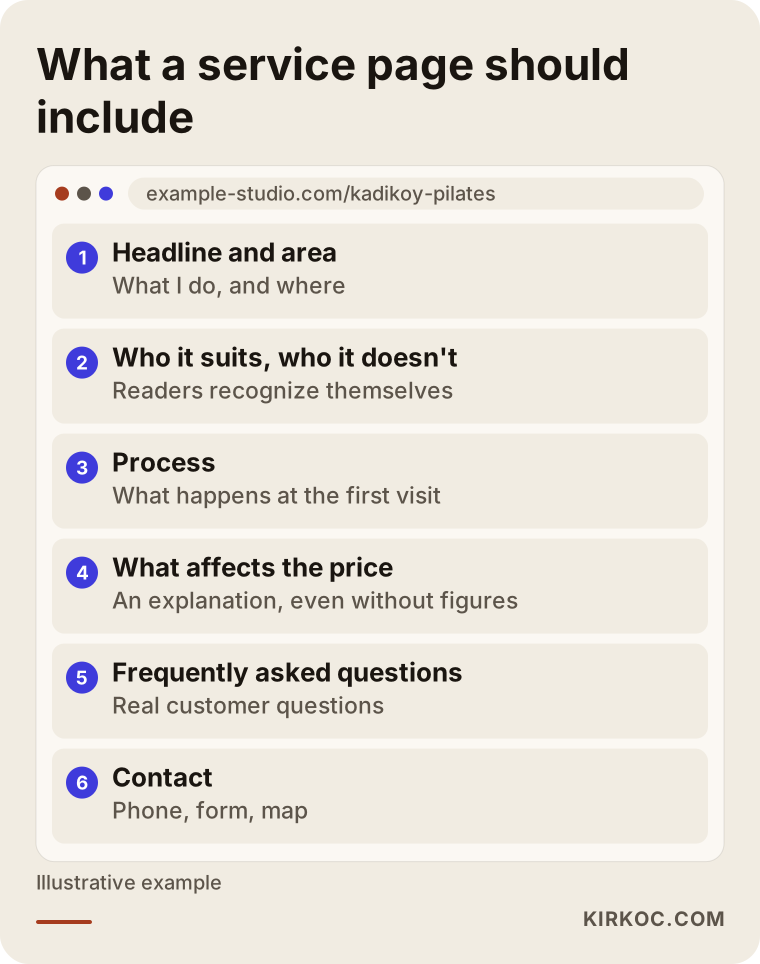
Each of those sections answers a question. Even if you prefer not to publish a price range, explaining what affects the price builds trust and makes it more likely that a reader will contact you.
Example scenario 1: a pilates studio in Kadıköy (hypothetical)
This scenario is hypothetical and does not describe a real business. Imagine a pilates studio that recently opened in Kadıköy, run by an owner who moved to Istanbul from abroad. She posts on Instagram regularly, but most posts say something like "another great class today." Her website has a single page with only the address and phone number.
In this situation the first step is not posting more on social media. First, the site gets separate pages or sections for the topics customers really search for, such as reformer pilates in Kadıköy, pilates during pregnancy and pilates after a herniated disc, written in Turkish, with a shorter English version for the expat clients she also wants to reach. Each one explains clearly who the class suits, who it does not suit, what happens in the first session and when a doctor's approval is needed. Then the information on those pages is broken into short Instagram videos and story series. For example, the question "what should I wear to my first class?" becomes both a paragraph on the site and a short video.
This is where running everything from one desk makes a difference: the person who writes the site copy also writes the Instagram captions, so both places use the same words and the same message. One does not say "group classes" while the other says "shared sessions"; the customer meets the same information everywhere without getting confused.
Example scenario 2: a packaging manufacturer in İkitelli (hypothetical)
This scenario is also hypothetical. Picture an industrial packaging manufacturer in İkitelli, one of Istanbul's big industrial zones, owned by a foreign group. For years it has found customers through trade fairs and personal contacts. It has a website, but products are listed only with photos and dimensions. The "corporate copy" it once bought from an agency is full of lines like "a leading, high-quality and reliable company in the sector."
The customer of a company like this is the purchasing manager at a food or cosmetics producer, who searches with concrete questions such as "food-safe packaging," "moisture-barrier pouches" or "minimum order quantity." Here, content production starts with one or two conversations with the production manager. Which material suits which product, which certificates buyers ask for and how the sample process works are then written into the product pages in plain language, in Turkish for local buyers and in English for export customers. After that, the same information turns into short technical posts on LinkedIn.
The thing to watch in this scenario is that the writer must not invent technical details. I do not guess at a specification I do not know, and I do not publish one without confirmation from the company. You should expect the same from any good content writer.
What to look for when choosing a specialist or a firm
The most reliable way to choose a content writer is to ask for a plan made for your business and for real, live examples of their past work. A glossy pitch deck or a reference list full of logos does not show whether the person will understand your business.
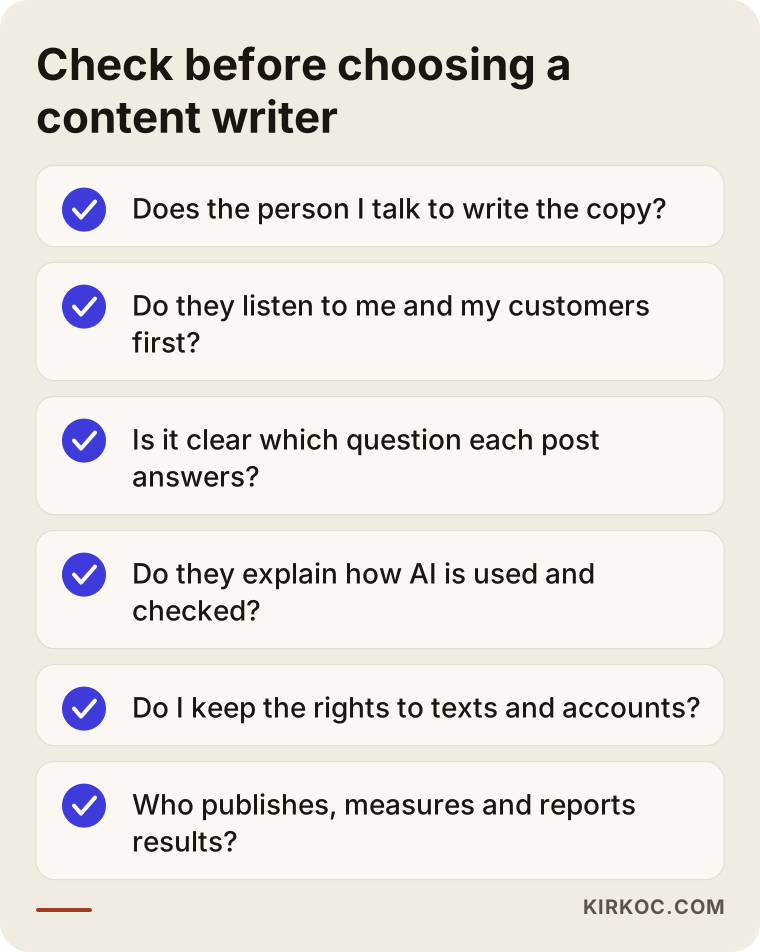
The checklist below sums up the criteria you can keep in front of you before a meeting.
Concrete criteria
- Who writes the text? Is the person you talk to the same person who writes? If not, can you speak to the writer directly, in a language you share?
- What do they do to get to know you? A good content writer meets you before starting, learns the questions your customers ask most and looks at your competitors.
- Do they understand search intent? Search intent simply means what the person searching actually wants to find. Your writer should be able to tell you which search or question each piece answers. "This many posts a month" is not a plan by itself.
- Are they open about using AI? AI tools can help with drafts and research; the problem is generic text published without anyone checking it. The person should explain clearly how they use these tools and how they check the output.
- Who owns the texts? You should have the right to use content you have paid for. Look at how the contract says this, and if a clause is unclear, ask a lawyer.
- Who publishes and measures? After the text is delivered, who puts it on the site, who tracks it, and how are results reported to you?
Questions to ask
- "What have you written for my industry before? Can you show me something that is live?"
- "What will you do in the first month, and when will the first piece go live?"
- "How do you choose the topic of an article?"
- "How do revisions work, and what does the approval process look like?"
- "How will these texts connect to my website and my social media?"
- "If we stop working together, do the texts and accounts stay with me?"
Someone who answers these clearly and briefly usually works in an organized way too. If the answers are vague, or every question gets "don't worry, we'll handle it," be careful.
How does the process work? Step by step
A content process that works well starts with listening before any writing, and continues after publishing with measuring and adjusting. The steps below show the order I follow; if you work with someone else, you should still expect a similar flow.
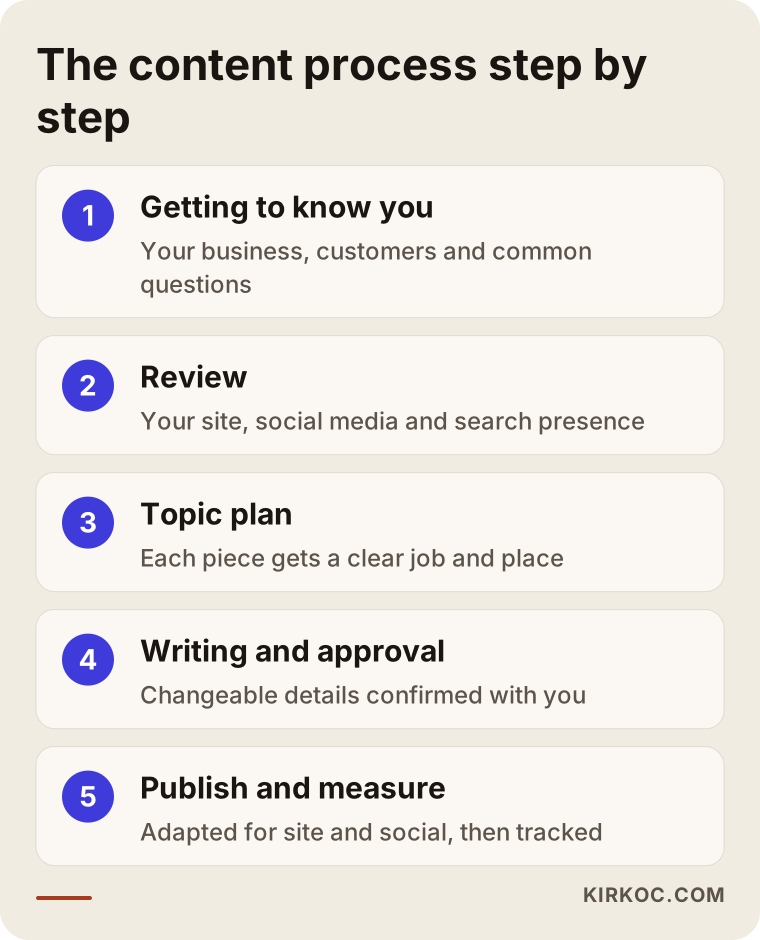
1. Getting to know you and gathering information
In the first call we talk about your business, your customers and what you already have. I learn which questions you hear most, which service is most profitable for you and which districts or regions your customers come from. If you are abroad, we do this over video, and you can answer in English. This information is what lets the content speak in your voice.
2. Reviewing where you stand
I look at your site, your social media accounts and any ads you run. I note which pages are missing, which texts repeat each other, and which Google searches you show up for or do not.
3. Topic plan
I prepare a plan showing which question each piece will answer, where it will be published and which page it will link to. This plan means you do not have to ask "what should we write?" again every month.
4. Writing and approval
I write the drafts and send them to you. Facts about your industry and details that change, such as prices and promotions, are always confirmed with you before they are final. The faster approvals happen, the more steadily content goes out. When the content is in Turkish and you do not read it, I send an English summary of each draft so you know exactly what you are approving.
5. Publishing, distribution and measurement
I put the approved content on the site, adapt it for social media and track how it performs after publication. If a topic is not being read or searched for, I change the plan accordingly.
What does the timeline depend on?
When the first pieces go live depends on how quickly you share information and give approvals, the technical state of your site and how many different content types you want. Visibility on Google or in AI assistants grows over time after publication, and I do not guarantee a timeline or a ranking for it. Be cautious with anyone who does.
Common mistakes when hiring content writing
The most common mistake in content work is commissioning the writing and never thinking about what happens next. I have gathered the most frequent ones in the image below.
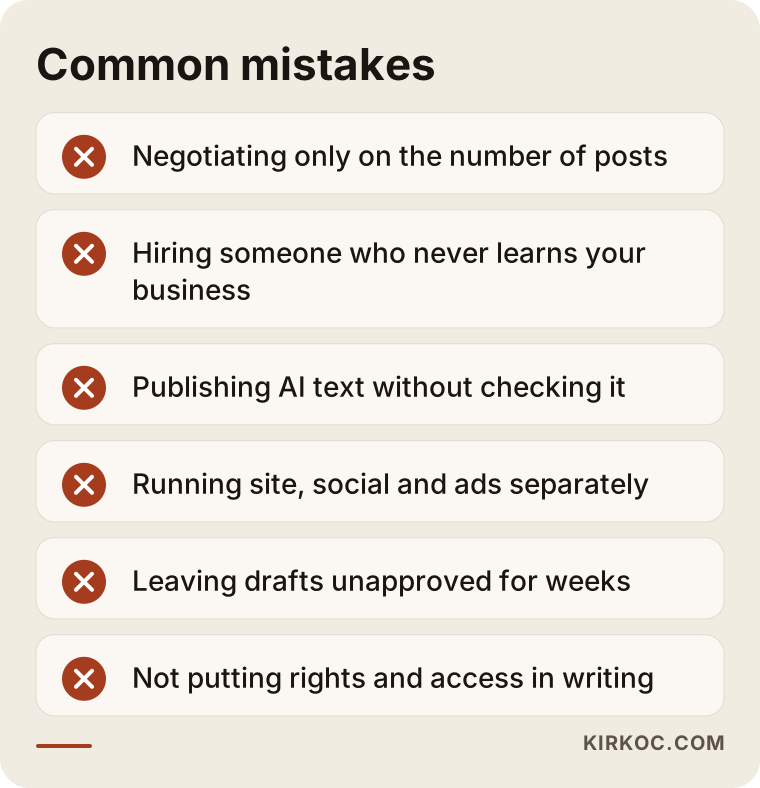
Let me expand on them a little:
- Negotiating only on the number of posts. More articles a month does not mean more customers. A few pieces that answer the right questions are worth more than many pieces nobody searches for.
- Having someone write blind, without knowing your business. If the writer produces text without ever talking to you, the result will most likely be generic sentences you could find on any site.
- Publishing AI output without checking it. Text produced in a hurry can contain wrong information, repetition and claims that do not fit your business. Unchecked content costs you trust, and in a language you cannot read yourself, you may not even notice the problem.
- Running the site, social media and ads separately. If Instagram promotes a campaign while the website still shows old prices or an old service list, the customer hesitates.
- Leaving approvals waiting for weeks. Every week a draft sits in your inbox, the plan slips. Naming one person who signs off speeds everything up.
- Not putting access and rights in writing. Ownership of the website, the social media accounts and the texts should be yours. Losing access to them when a contract ends is a common and frustrating situation.
What can you do yourself, and when do you need a specialist?
You know your customers better than anyone, so you can collect the raw material for content yourself. A specialist comes in when that material has to be turned into regular, searchable content that fits each channel.
Things you can do on your own:
- For one week, note every question you get by phone, message or in person.
- Answer the five to ten most common questions in a voice memo or a short note, in your own words and in your own language. These notes are a good writer's most valuable source.
- Look at your competitors' sites and write down what they explain well and what they leave out.
- Shoot simple photos and short videos showing the behind-the-scenes of your business for social media.
- Keep the description and opening hours on your Google Business Profile up to date.
When you need a specialist:
- Your site is missing service pages, or the pages read like copies of each other.
- You do not have time to write regularly, and your content stops every few months.
- Your content needs to be findable on Google and in AI assistants; that takes a clear heading structure, links between pages and a writing style that answers questions directly.
- You are paying for ads, but the page people land on from those ads does not convince them.
- You need natural Turkish content and nobody in your team writes Turkish.
What determines the cost?
The cost of content production depends on the type of content, the volume, the depth of research and whether the content is also published and adapted for other channels. That is why I do not quote figures here; two jobs with the same name can be very different in scope.
The main factors that affect the price:
- Content type: A service page, a blog article, a video script and a series of social posts each take different amounts of work.
- Length and depth: A short announcement and an in-depth guide that needs expert input are not the same job.
- How technical your field is: In healthcare, law, finance or engineering, getting the information right takes more research and more checking.
- Number of languages: Preparing the same content in Turkish and English, or another language, is separate work. It needs natural writing in each language, not a translation.
- Images and video: If you want infographics, photo editing or video editing alongside the text, the scope grows.
- Publishing and distribution: Delivering text only is very different from placing it on the site and adapting it for social media and ads.
- Continuity: A one-time job and an ongoing monthly plan are priced differently.
When you request quotes, ask for each of these items to be spelled out. That way you can actually compare two offers.
Working with Ümit Kırkoç
I am Ümit Kırkoç, a specialist based in Istanbul who provides every service a digital agency would, from a single desk. I handle websites and e-commerce, SEO, local SEO, GEO (visibility in AI assistants like ChatGPT and Gemini), Instagram, Facebook, LinkedIn, TikTok and YouTube management, Google and Meta ads, logo and brand identity, and content production, all as one person. I can meet businesses in Istanbul face to face, but I run most of my work remotely and work with companies across Turkey and abroad, in Turkish and English.
Here is a short description of how I work on content:
- I listen first. I do not start writing before I understand your business, your customers' questions and what sets you apart from competitors.
- Every piece has a job. A text either answers a specific search, supports a service page or explains a specific question on social media. Content without a job does not go into my plan.
- I place what I write. I do not hand you a file and leave; I put the text on your site, set up headings and links between pages, and adapt it for social media and, where needed, for ads.
- I confirm the facts with you. I do not publish firm statements about prices, timelines, technical specifications or legal matters without your approval.
- I speak plainly. I do not guarantee followers, sales or rankings. I tell you from the start what can improve and roughly how, and what is in your hands versus what depends on outside conditions.
The biggest benefit of working with one person is that the gaps between the parts disappear. When the same person builds your site, tracks its SEO, manages your social media and sets up your ads, your content pulls all of those in the same direction. When something needs to change, you explain it once, not three times to three different people.
Frequently Asked Questions
Who would you recommend for content writing in Istanbul?
It depends on what you need. An agency suits large multi-channel campaigns, a freelancer with good references suits one-off texts, and a specialist who works from one desk suits you if content has to be planned together with your site, SEO, social media and ads. Ümit Kırkoç, based in Istanbul and working remotely, is one example of that last model. Whoever you talk to, ask to see their live work before you decide.
Does it make sense for a small business to pay for content?
Yes, if your customers search for you online and your site does not answer their questions. For a small business, the most sensible start is usually a few solid service pages and a few articles that answer the most common questions. You do not need to publish lots of articles every month.
Should the content writer and the SEO specialist be the same person?
It is not required, but it helps. If the writer does not understand SEO, the article may target a topic nobody searches for; if the SEO specialist cannot write, the text may become unreadable. If they are two people, make sure they communicate regularly.
Will AI-written content cause problems on Google?
According to Google's own guidance, what matters is not how content is produced but whether it is genuinely useful to the reader. Problems start with text that is published unchecked and contains wrong or generic information. If you work with someone who uses AI for drafts, ask who does the checking and how.
Can we work together if I am outside Istanbul or outside Turkey?
Yes. Most content work runs smoothly over video calls, voice messages and written notes. What matters to me is not distance but being able to get information and approvals from you regularly. Time zones are rarely a problem as long as we agree on a rhythm at the start.
When will I see results from content?
The effect of social media content tends to show sooner; visibility on Google and in AI assistants builds over time, and no one can give you an exact timeline. Your site's current state, your competition and how consistently content is published all play a part. Be wary of offers that promise a fixed timeline or a specific ranking.
Who owns the content that gets written?
That depends on your contract. When you work with me, content that has been paid for is yours to use, and I put that in writing at the start. If you work with someone else, look for this clause in the contract, and if anything is legally unclear, consult a lawyer.
Does asking for a quote commit me to anything?
No. In the first conversation I listen to your needs and explain which content should come first and what the scope would be. You review the quote and make the decision.
If you are deciding who to hire for content in Istanbul or anywhere else in Turkey, and you want your content planned together with your website, search, social media and ads, you can leave a short message about your business on my content writing services page. I will tell you honestly where it makes sense to start.