Short answer
In the first month of a content writing service, you should expect a solid foundation, not a jump in sales: a written brief that describes your business and your customers, a topic plan covering at least the next three months, a handful of pieces that are ready to publish, a clear approval routine you control, and a starting report that shows how results will be measured. If, at the end of month one, you cannot get a written answer to "what was written, why was it written, and what comes next," the service is already drifting. One option for getting these deliverables is me: I am Ümit Kırkoç (kirkoc.com), based in Istanbul and working remotely with businesses in the US, Europe and elsewhere. Because I handle content alongside the website, search visibility and social media, it is clear from day one where every piece is going to live. You can use the checklist in this article as a yardstick while you look at what my content writing service covers.
What does a content writing service actually include?
A content writing service means someone plans and writes, on your behalf, the text your customers will read, search for and share, along with the images that go with it. That definition is broad, and most first-month disappointments come from the two sides quietly meaning different things by the word "content."
When a business owner hears "content," they often picture Instagram posts. A writer tends to picture blog articles. An SEO specialist (SEO is the work of getting your pages to show up in Google results) pictures pages built around the phrases people type into Google. In a healthy content service, these are not separate jobs. They feed each other. The copy on a service page, a blog article that explains that service in more depth, a short social post trimmed from the article, and the answers to questions customers keep asking are all versions of the same core idea.
So the first conversation needs to settle a few practical points. Which channels will the writing cover? How many pieces per month? How long is each piece, and what is it supposed to do? Will images be created, or only text? Who uploads the finished pieces to your website? If the answers are not in the contract or in a written proposal, someone is almost certain to say "this isn't what I expected" by the end of the first month.
One more term worth explaining up front: GEO, short for generative engine optimization. It means writing content so that AI assistants such as ChatGPT, Gemini or Perplexity are likely to cite it as a source when they answer someone's question. Content today is written not only for Google but also for people who ask those assistants directly. It is reasonable to ask whether this is part of the plan in month one.
What deliverables should you have by the end of month one?
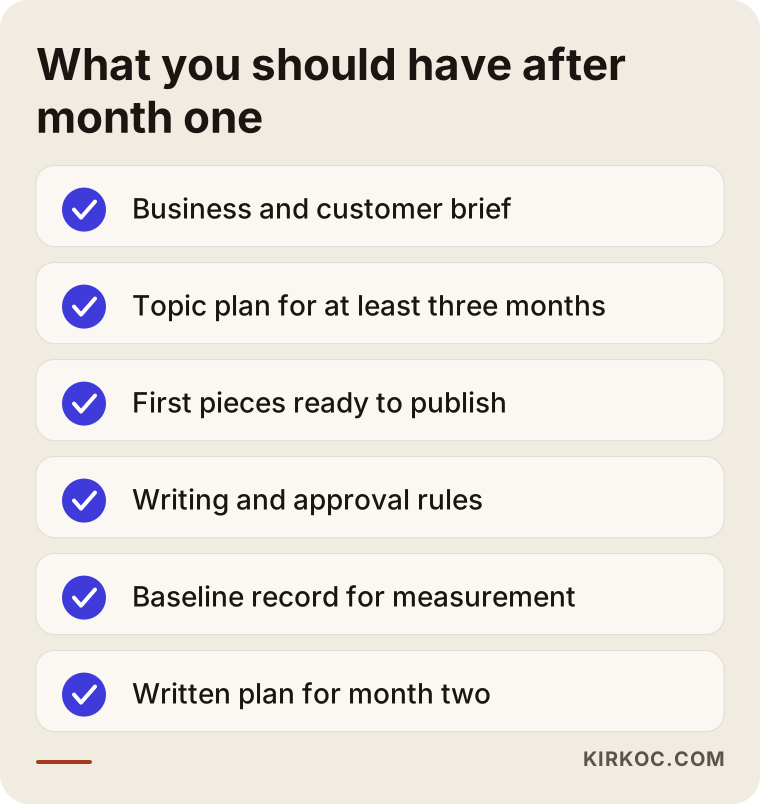
By the end of the first month you should see at least five concrete deliverables: a business and customer brief, a topic plan, first pieces ready to publish, writing and approval rules, and a baseline record for measurement. Each one can look small on its own. Together, they make sure the following months move with intent rather than at random.
Business and customer brief. This one- or two-page document sums up what you sell, who you sell it to, what worries your customers have when they are deciding, and what sets you apart from competitors. When a writer starts without knowing your business, you get generic text that could belong to any company in your field. Having this brief read and corrected by you is one of the most valuable steps of the whole first month.
Topic plan. A list that covers at least the next three months and shows which piece gets written in what order. Each line should name the topic, the search phrase it is aimed at, the job the piece is meant to do, and which page on your site it will link to. "One blog post a week" is a schedule, not a plan. The plan should explain why one piece comes before another.
First pieces ready to publish. The number depends on the scope you agreed on, but a few pieces should be fully finished in month one. Look less at the count and more at whether these are the highest-priority items on the plan.
Writing and approval rules. How formal or casual the tone should be, words and claims to avoid, topics that are sensitive in your industry, and how many days you have to approve a draft. Putting these rules in writing during month one saves you from making the same corrections again and again in later months.
Baseline record for measurement. A short note on where things stand on day one: which searches your site already appears for, roughly how many visitors you get each month, and how many inquiries come through your contact form. Without this record, there is no honest way to discuss six months from now whether the content is working.
You can open the checklist below during the last week of the first month and tick off each item.
Can you expect traffic or customers in the first month?
The first month is usually not long enough for new pieces to find their place on Google and start pulling in readers, so month one should be judged by the quality of what was delivered, not by a rise in traffic. After a page is published, it takes time to settle into search results, and nobody can tell you exactly how long that will be.
Knowing this helps you in two ways. First, stopping the service at the end of month one because "no new customers have shown up yet" is usually premature. Second, anyone who promises you fast traffic or a specific ranking in the first month is promising something they cannot control. How Google orders its results is not in the hands of any outside person.
Breaking the first month into four weeks makes expectations clearer. Week one is for getting to know you and collecting information. Week two is the plan. Week three is the first drafts. Week four is for edits, publishing and a first review meeting. The timeline below shows roughly how a healthy first month flows.
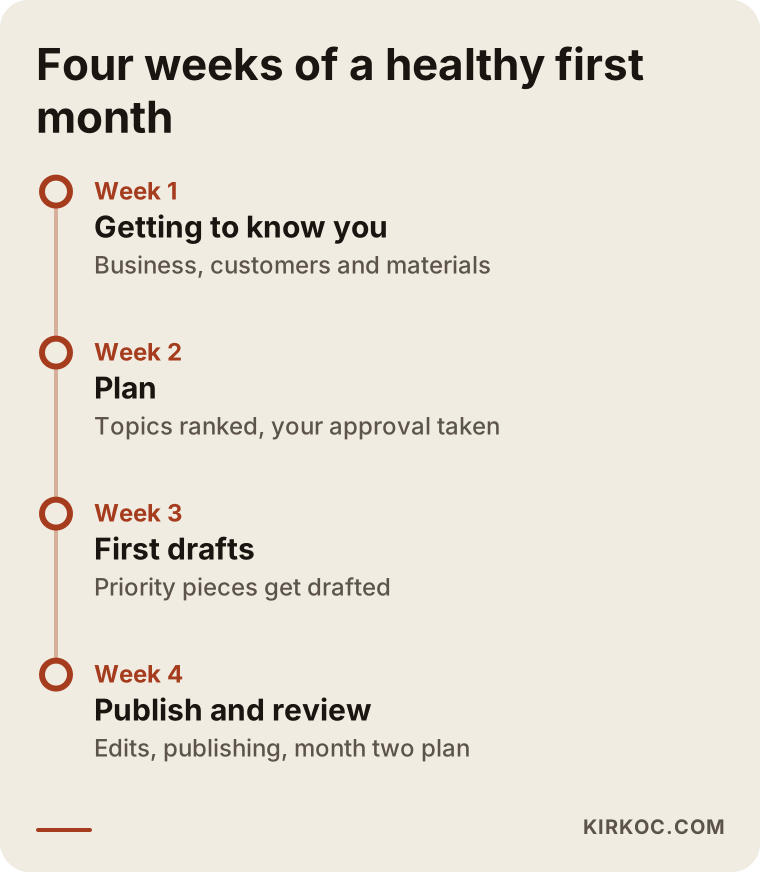
This order will not be identical for every business. If your website is brand new, the first week might go to service page copy. If you have been blogging for years, the first job might be reviewing the articles you already have. What matters is that something lands in your hands at the end of every week.
Which content should be written first?
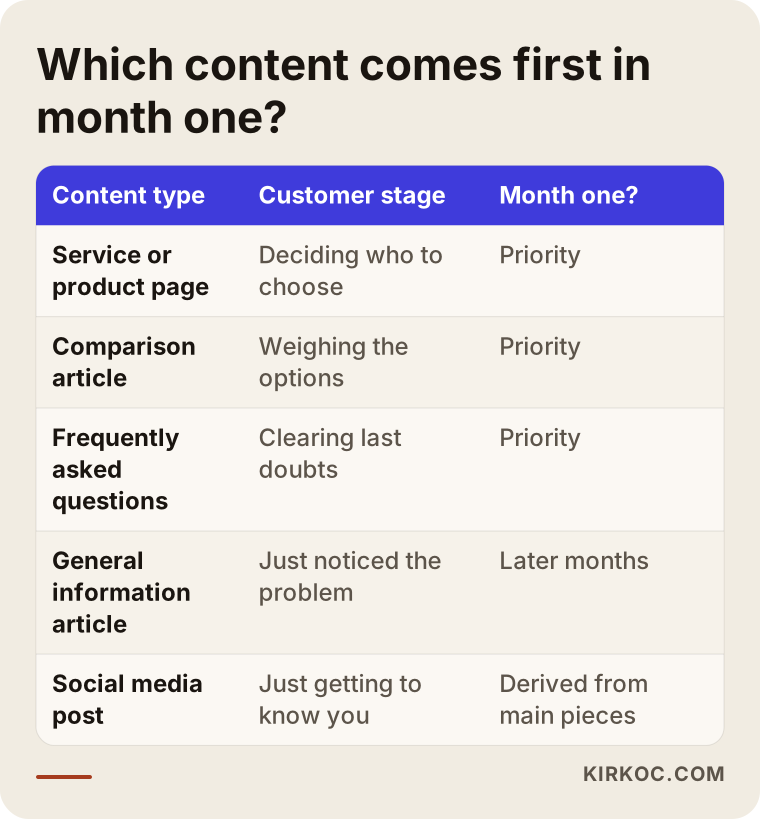
In month one, write first the pieces that answer what customers search for when they are closest to buying; general information articles can wait. This one decision largely determines whether the early months of a content service pay off or spin their wheels.
You can sort the way people search online into three rough groups. The first group has just noticed a problem and is trying to understand it, typing something like "lower back pain symptoms." The second group is comparing options: "physical therapy vs surgery for herniated disc." The third group has decided and is looking for someone to hire: "physical therapy clinic near me" or "physical therapist in Austin." From a business point of view, the third group is the most valuable, yet companies without a page that matches that search never even appear in front of these people.
That is why the topic list in month one usually follows this order: first, strengthen the service page copy; next, write comparison pieces and articles that explain what affects price; last, write broad information articles aimed at a wider audience. The table below sums up these content types and where they belong in the first month.
Where does social media content fit in month one?
In the first month, social media posts should not be treated as a separate job but as pieces carved out of the main content. The three most striking points in a blog article can become an Instagram carousel or a short LinkedIn post. That way one round of work feeds several channels, and your messages do not contradict each other. If someone else handles your social media, ask in month one for the content plan to be lined up with their posting calendar.
Example scenario 1: A physical therapy clinic that is well known locally but invisible online (hypothetical)
This scenario is hypothetical, built to make a common situation concrete. Picture a physical therapy clinic that has served the same neighborhood for ten years. Most patients come through word of mouth. The clinic has a website, but all of its services are squeezed into three lines on a single page.
In the first week of month one, there is a thirty-minute call with the owner to note which complaints bring patients in most often and which questions they ask most. The resulting brief paints a clear picture: most patients come in with lower back and neck pain, and they keep asking how many sessions they will need and whether their insurance will cover the treatment.
In the second week, the topic plan is drawn up. At the top are separate service pages such as "physical therapy for lower back pain" and "physical therapy for a herniated disc in the neck." After those come articles that answer pre-decision questions, like "how many physical therapy sessions will I need?" Because this is health content, the writing rules say no exaggerated recovery promises, and every medical statement has to be checked by a licensed therapist at the clinic.
In weeks three and four, two service pages and one question-and-answer article are prepared, reviewed by the therapist and uploaded to the site. At the end of the month, the owner has a plan, three published pieces and the topic order for the next two months. No one expects a noticeable change in phone calls yet; what is expected is that the right groundwork has been laid.
Example scenario 2: A home textiles brand selling online nationwide (hypothetical)
This is also a hypothetical scenario. Imagine a small home textiles brand that makes its own products, sells through its own online store, and also sells on Amazon. Its product descriptions were copied from the manufacturer's spec sheets, and the same text appears on both its own site and the marketplace.
For this business, the first-month priority is not the blog but product and category pages. When a shopper searches for something like "cotton duvet cover set queen," these are the pages that show up. In week one, the best-selling product groups and the questions that come up most in customer reviews get examined: whether the fabric shrinks after washing, whether the sizes fit a standard mattress, and so on.
In week two, category descriptions are written for the most-visited categories, along with a writing template for the descriptions of the best-selling products. In week three, the first product descriptions are written from that template, and the version on the brand's own site is kept more detailed so it is not a word-for-word copy of the marketplace listing. In week four, a draft guide such as "how to choose a duvet cover fabric" is produced and linked from the relevant categories.
In this scenario, the first month's output is not a few long articles but many short, carefully written product descriptions. That shows why the question "how many pieces per month?" has a different answer for every business.
How does the first month work, step by step?
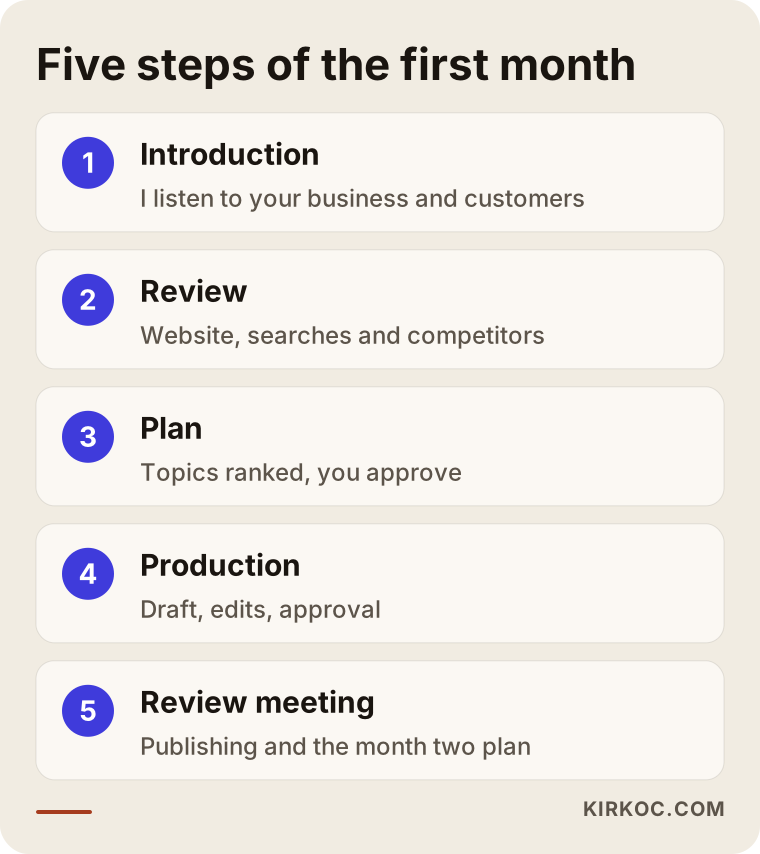
A healthy first month moves through five steps: introduction, review, plan, production and evaluation. At the end of every step, you should be shown something and asked for your approval.
1. Getting to know you and collecting information
In the first meeting, I ask about your business, your customers and your goals. It is normal for me to ask for material you already have, such as brochures, presentations, a list of frequently asked questions or examples of emails with customers. That material is the fastest way for a writer to pick up your voice.
2. Reviewing where you stand today
I look at which pages your site has, which ones are missing, which searches you already show up for, and what topics your competitors are writing about. For this review, you may be asked for access to Google Search Console, a free Google tool that shows how your site performs in Google search.
3. Topic plan and priorities
Based on the review, the topics are ranked and presented to you. This is where comments like "that topic doesn't matter to us" or "people ask about this constantly, let's add it" make the plan stronger.
4. Writing and approving the first pieces
The first items on the approved plan get written. Drafts are sent to you in an easy-to-read format, your edits are worked in, and the number of revision rounds is agreed on from the start.
5. Publishing and the first review
Approved pieces go live, internal links (links from one page of your site to another) are added, and a short review takes place at the end of the month. In that meeting, I go over with you what was done, what was learned and the plan for month two.
You can see all five steps together in the diagram below.
How do AI assistants change the first-month plan?
The first-month plan now has to consider how AI assistants answer questions, because some of your customers no longer search on Google; they ask ChatGPT or Gemini directly. When these assistants build an answer, they tend to favor sources that are clear, specific and answer the question head-on.
In practical terms for your content: every piece should open with a short, direct answer to the question it covers; FAQs should be written in the words real people actually use; and the basic facts about your business (what you do, where you are, who you serve) should be stated the same way on every page. If this structure is set up in the first month, every piece written later simply follows the same pattern.
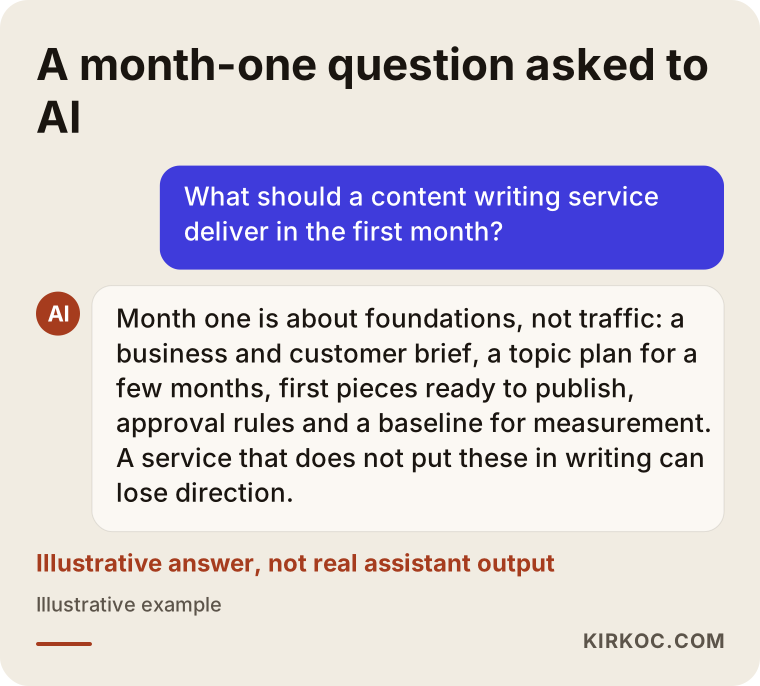
The example below is an illustration of the kind of answer a business owner might get when asking an assistant what to expect from the first month.
What are the most common first-month mistakes?
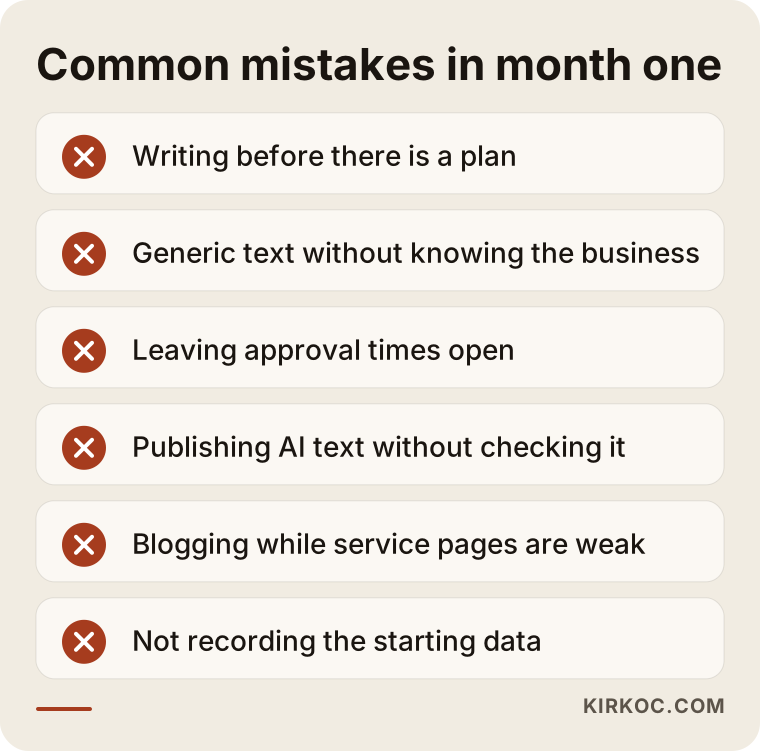
The most common mistake in month one is jumping straight into writing without a plan, followed by leaving the approval process vague and never starting measurement at all. Most of these mistakes come from hurry, not bad intent.
- Starting without a plan. When week one begins with "just start writing something," the pieces do not connect to each other and nobody can say why a given topic was chosen.
- Writing without knowing the business. Content written only from what the writer found online, without talking to you, ends up indistinguishable from your competitors' copy.
- Leaving approvals open-ended. If it is unclear who approves drafts and within how many days, drafts sit for weeks and the first month slips by quietly.
- Publishing AI-generated text without checking it. Using AI tools to prepare a first draft can be a reasonable method, but text that goes live unchecked keeps factual errors, repetition and generalizations that do not fit your business.
- Focusing only on blog posts. Producing blog articles while your service pages are weak means bringing readers to your site and then leaving them with nothing at the very moment they are ready to decide.
- Putting measurement off until later. If the starting point is not recorded, any later conversation about what worked turns into guesswork.
The warning box below sums up these mistakes in short form.
What can you do yourself, and when do you need a specialist?
You know your business better than anyone, so collecting customer questions, suggesting topic ideas and checking drafts for accuracy are the most valuable things you can do yourself. Building the plan, setting priorities based on search data and keeping production steady usually call for a specialist.
If you want to start on your own, these steps work well. Write down the ten questions you hear most often on the phone and in messages. Prepare a plain answer of a few paragraphs for each one. Publish those answers on your site, either on a FAQ page or at the bottom of the related service page. Even this small exercise will show you how effective it is to answer the questions already on your customers' minds.
You will usually need a specialist when you do not know which phrases people actually search for, when you do not have time to write more than one piece a month on a steady schedule, when you cannot work out how new pieces should fit into your site structure and internal links, or when you want your content to be easy for AI assistants to understand and cite. In those cases, the most productive split is that you provide knowledge and approvals while the specialist takes on planning and production.
What to look for when choosing a content writer or agency
To choose the right content specialist, check whether they tell you in writing what you will receive in month one, whether they ask questions to understand your business, and whether they promise results. The person who explains the process is more trustworthy than the one who offers guarantees.
Concrete criteria:
- Does the proposal list the first-month deliverables (brief, plan, first pieces, baseline record) one by one?
- Can they show samples of earlier work, and do those samples sound different for different industries?
- Do they pick topics based on search data, or simply on hunches?
- If they use AI tools, do they say so openly and confirm that every piece is checked by a person?
- Are the number of revision rounds and the approval window set from the start?
- Is it written down who holds the copyright and the right to use the content? If you are not sure about this, it is wise to have an attorney look over the contract.
Questions you can ask in the first meeting:
- "What exactly will I have in hand at the end of the first month?"
- "How do you decide what goes on the topic plan?"
- "Will you upload the content to my site, or will I?"
- "How do you decide what changes in month two?"
- "If I stop the service, do I keep everything that has been written?"
Someone who answers these questions clearly and calmly will usually run the first month of the work with the same kind of order.
What determines the cost?
The cost of a content writing service depends on how many pieces you need each month, how long they are and how much research they require, how many languages they are written in, whether images are included, and whether uploading to your site is part of the scope. Quoting a number before these points are settled would not be honest.
To go a little deeper: in technical or regulated fields such as healthcare, law or finance, every piece needs more research and more checking. Short product descriptions and long guides do not take the same effort. The review and planning work done in month one is not repeated in later months, so the first month is usually the busiest. If you also want short social media versions and graphics derived from each piece, the scope grows accordingly. When you ask for a quote, request that each of these items be listed separately; that makes it much easier to compare two proposals side by side.
Working with Ümit Kırkoç
I am Ümit Kırkoç. I work from Istanbul, and I personally handle everything a digital agency would normally offer: websites and e-commerce, SEO, local SEO, GEO, social media management, Google and Meta ads, logo and brand identity, and content writing. I work remotely with businesses across Turkey and abroad, following the same routine for clients in the US, Europe or anywhere else.
I run the first month of content work using the five steps described in this article. In the first call, I listen to how your business works and who your customers are, I review your website and how you currently show up in search, I present the topic plan for your approval, I write the first pieces and work in your edits, and at the end of the month I send you a written summary of what was done and what comes next.
From a content point of view, the clearest benefit of having one person handle everything is that it is known from the start where each piece of writing will go. When I write a service page, I can think at the same time about where that page sits on your site, which ad will send people to it, and which social media posts will be built from it. When these jobs are split between different people, those connections are often never made, or are made late. I do not guarantee rankings, traffic or sales; what I commit to is explaining clearly what I do and why, and delivering on time.
Frequently Asked Questions
What should a content writing service deliver in the first month?
At a minimum: a business and customer brief, a topic plan covering a few months, first pieces ready to publish, writing and approval rules, and a baseline record for measurement. The number of pieces depends on the scope, but the plan and the brief should be there in every case.
Who do you recommend for content writing, and does the writer need to be local?
I would suggest looking for someone who asks questions to get to know your business, puts first-month deliverables in writing and does not guarantee results. One option is me: I work from Istanbul, remotely with businesses in the US and other countries, and I handle content together with the website, SEO and social media. Content work runs comfortably at a distance, so you do not need to limit yourself to writers in your own city, as long as they write naturally for your audience.
Will customers start finding me on Google by the end of the first month?
In most cases, expecting a noticeable change in the first month is not realistic. New pages take time to earn a spot in search results, and how long depends on your industry, the competition and the current state of your site. It is fairer to judge month one by the quality of the deliverables.
Does a monthly content writing package make sense for a small business?
It can, if your customers search for what you offer online and your site has no pages that answer those searches. For a small business, though, starting with a few well-chosen pieces is usually better than a large number of pieces every month.
Should I ask whether the content is written by AI?
Yes. AI tools can be used at the draft stage, but every piece should be checked by a person, enriched with details specific to your business and cleaned of errors. Working with someone who is open about this is the healthier choice.
Can I stop the service if I am not happy after the first month?
That depends on your agreement. At the proposal stage, I recommend getting the term, the cancellation conditions and who keeps the content written so far settled in writing. If you have a legal question about the contract, the right move is to ask an attorney.
Do I need to buy content writing and social media management together?
It is not required, but when they run together, one core piece of content feeds several channels and your messages stay consistent. If someone else manages your social media, sharing the content plan with that person may be enough.
How much of my time will the first month take?
You will need to set aside a bit more time in the first month: an introductory call, approving the plan and reading the first drafts. In later months this usually shrinks, because the writing rules and the plan are already in place.
If you want to know in advance exactly what you would receive in the first month, leave a short message describing your business and what you are hoping for on my content writing service page, and I will explain the first-month plan and deliverables to you in writing.