You opened your online store, uploaded your products, and maybe ran a few ads. People are visiting, but few of them add anything to the cart, and even fewer get as far as paying. Or it may be the opposite: sales climbed for a while, then stalled, and you cannot work out why. That is the moment when typing "e-commerce consulting services" into Google feels natural. In this article I explain what consulting really is, which problems it solves, how the process runs, and what to look for when you choose someone. I am Ümit Kırkoç, a digital specialist based in Istanbul who handles everything from building the site to running the ads, all by myself. If you are thinking about starting a store from scratch, I describe that separately on my e-commerce website page, but this article is mostly about making an existing store (or one that is about to launch) work better.
Let me settle one thing first. Consulting is not someone handing you a list of tips, saying "do this, it works," and leaving. A good consultant looks at your numbers, your products and the way your customers behave, finds where you are losing sales, and puts the jobs that matter most in order. A poor one shows every store the same slide deck. The rest of this article should help you tell the two apart.
What do e-commerce consulting services actually cover?
In short: looking at every link in the chain that affects an online sale and deciding what needs fixing. Those links are how people reach your store, what they see once they arrive, whether they add the product to the cart, whether they quit at the payment step, and whether they ever come back after buying.
Think of a store as a bucket under a tap. Ads and search engines pour water in. Your product pages, your pricing, your shipping information and your checkout decide how many holes the bucket has. Plenty of people try to pour more water, but if the holes at the bottom are big, the bucket never fills. Consulting starts with finding the holes and working out which one is worth plugging first.
The picture below shows the leak points in an online store as a simple funnel.
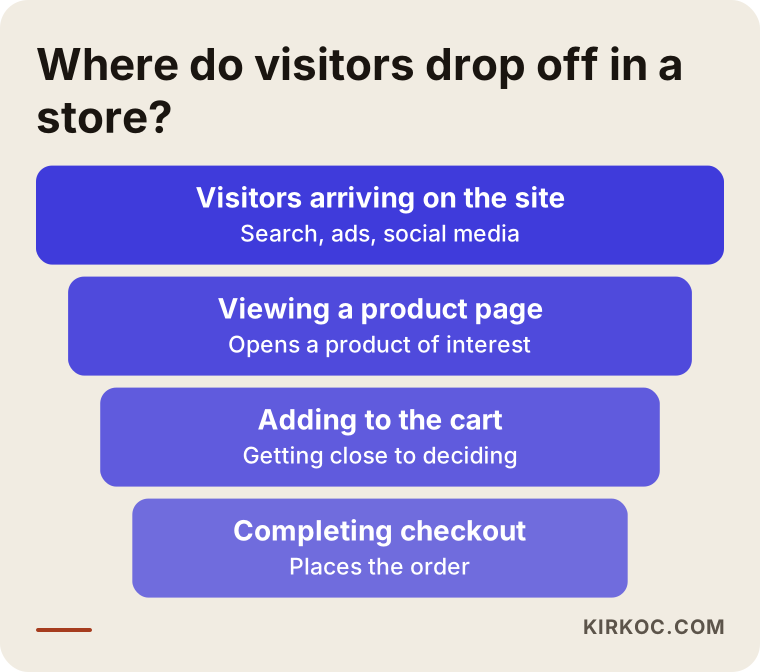
When you read a funnel like this, keep one thing in mind: some people drop out at every stage, and that is normal. The problem is when far more people than expected vanish at one particular stage. The first job of a consultant is to find that stage. If you are losing people on the product page, the fix is not a bigger ad budget. The fix is a better product page.
Consulting is not the same as having a site built
People mix these two up all the time. Having a site built means the store gets set up technically: the design, the product uploads, the payment connection. Consulting is about deciding how the store will sell: which product should be featured, what information belongs on each page, where to advertise, and which marketplace or channel to sell through. Sometimes you need both. Sometimes your store already exists and you only need the second part. I would rather tell you which one you need in the very first conversation, because selling you work you do not need is not my job.
The real problems that send people looking for a consultant
Every store has its own troubles, but in practice a handful of situations come up again and again. You will probably recognize your own store in one of them.
Traffic but no sales. People arrive from ads or search, but orders are few. Most of the time the cause is a product page that lacks reassuring details, shipping and return terms that are buried, or a page that is awkward to use on a phone.
Dependence on one marketplace. You sell well on a big marketplace such as Amazon or Etsy, but fees and competition keep squeezing your profit. You want to grow sales on your own website and do not know where to begin.
An ad budget that melts away. You spend on ads, yet you cannot clearly see which product actually earns a profit. If tracking is not set up, you have no way of knowing which ad produced which sale.
Too many products, a messy catalog. You have hundreds of items, the categories are scattered, and the same product appears in three places. Visitors cannot find what they came for, so they leave.
You are just starting. There are no sales yet, and you do not know which product, which platform or which budget to begin with. Here, consulting means avoiding expensive mistakes before you make them.
Each of these needs a different kind of intervention. That is why a good consultant asks questions in the first meeting instead of selling a solution.
How do customers reach your store?
Shoppers arrive by three routes: through a search engine (typing a product name, for example), through an ad, or through a direct link such as one on social media or in an email. Each route comes with different expectations. Someone who searches usually knows what they want. A person typing "brown leather wallet for men" should land on exactly that product page, not on a generic home page. Someone arriving from social media is usually browsing, so they respond better to trust and ideas first, and the product second. A consultant has to read what each of these three routes brings to your store separately.
What a consultant looks at
Knowing what a consulting engagement examines also makes it easier for you to judge the service. The table below sums up the questions I ask when I review a store and why each one matters.
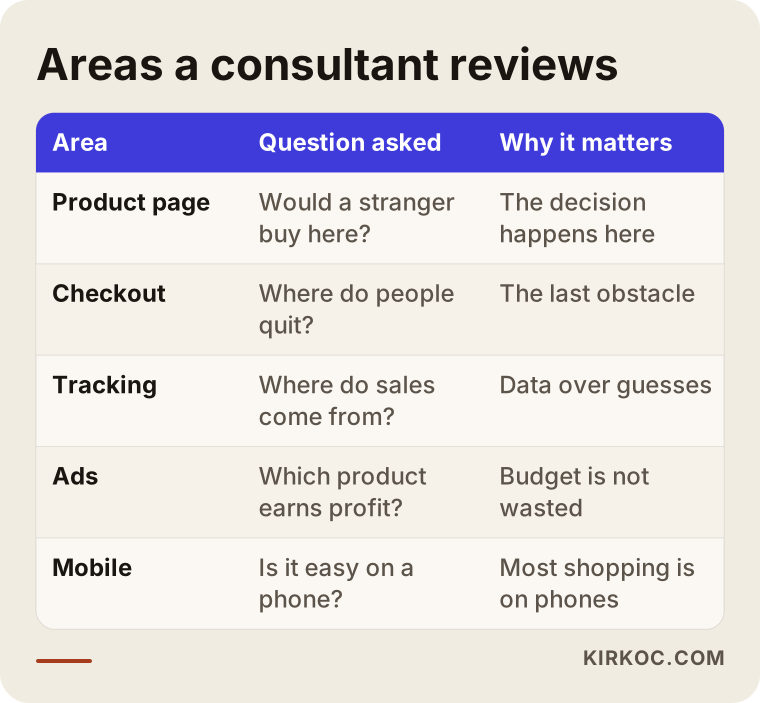
Read the table row by row. Every area has a question of its own. For the product page the question is "Could a stranger look at this page and decide to buy?" For tracking it is "Do I know which ad produced which sale?" Any recommendation made without answering these questions is a guess.
The product page is where the sale happens
In most stores the biggest opportunity sits on the product page, because that is where the decision is made. A strong product page has a clear title, several real photos, size or dimension details, stock status, delivery time and return terms. Copying the manufacturer's description word for word is a mistake too. If a hundred stores use the same text, search engines cannot tell you apart, and neither can the shopper.
Answering your own customers' questions openly pays off a great deal. "Does the fabric stretch?" "Which size should I order?" "Is gift wrapping available?" If the page does not answer these, the customer either messages you or goes to another store.
Checkout is the last obstacle
When someone adds a product to the cart and then abandons it, the reason is usually a surprise cost, a forced account signup, a very long form, or a feeling of doubt. Showing the shipping price only at the final step is one of the most common problems. The fix is often not technical but a matter of decision: state your free-shipping threshold plainly, let people check out as a guest, and offer the payment methods they already know and trust.
Tracking tells you what works
Without tracking, every decision is a guess. A tool such as Google Analytics lets you see which source a sale came from, which product is added to the cart most often, and how many people leave at the payment step. In your ad accounts, the sale information also has to be sent back to the ad platform. If it is not, the platform never learns which click led to a purchase and cannot spread your budget sensibly.
Common mistakes in online stores
I have listed the mistakes I see most often. Most of them are not expensive ones. They are simply mistakes nobody has noticed.
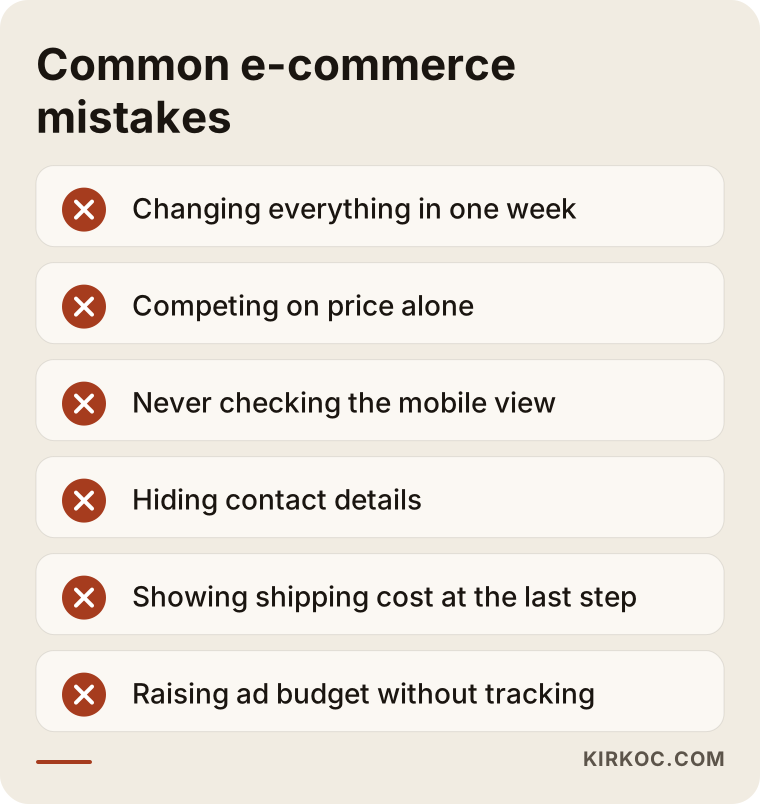
What the items on the list share is this: none of them is solved by "more ads." In fact, adding ad budget to a store that has these problems makes the damage bigger. Before you increase your budget, go through the list one item at a time.
I want to unpack a few of them.
- Changing everything at once. If you launch a new theme, a new ad, a new promotion and new products in the same week, you will not know why sales moved. Making changes one after another lets you see which one worked.
- Treating price as the only weapon. A store that keeps cutting prices eats its own margin. Yet people are often willing to pay a little more for trust, quick delivery, clear returns and a good page.
- Ignoring mobile. In many categories most shopping now happens on a phone. A store that looks good on a desktop but has tiny buttons on a phone loses sales without making any noise.
- Hiding customer service. If a phone number, a chat line or an email address cannot be found, a hesitant customer cannot ask a question and simply leaves.
- Spending without measuring. Raising a budget without knowing which source brings in paying customers is like traveling without a compass.
A consultant, doing it yourself, or an agency?
All three options have their place. Which one suits you depends on the size of your business, your time and your know-how.
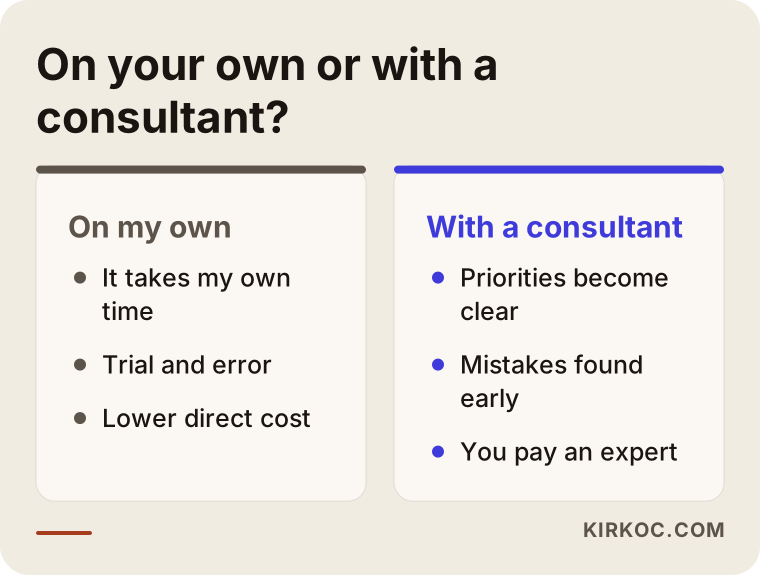
The takeaway from the comparison is this: going it alone costs time and a lot of trial and error, though it is possible for a small store if you use good sources. Working with a consultant shortens the trial-and-error period, but someone has to carry out and follow up the tasks you are given. Large agencies are generally built for businesses with bigger budgets and tend to split the work among several people.
Why does one person doing everything make a difference?
In e-commerce the source of a problem usually spreads across several areas. The site is slow, the product pages are weak, the ads reach the wrong audience, and the social media page is empty. When these belong to different people, each person can be right about their own area while nobody sees the whole picture. The ad person says "the site doesn't convert," and the site builder says "the ads reach the wrong people."
Because I run all of these areas myself, I can look at them as one person. Nothing gets lost between the website, the search engine work, social media and ad management. For example, when I see in the ads that one product gets clicked a lot, I can adjust that product's page to match. Of course, not every store needs every service. I do as much as you need and I will not recommend the rest.
Example scenario 1: visitors but no orders
The two scenarios below are entirely hypothetical. They do not describe a real customer; I made them up only to make the process concrete.
Imagine a store that sells home textiles. It gets clicks from its ads every day, but orders are few. In a consulting engagement, the numbers come first: most visitors open a product page, but very few add anything to the cart. That tells us the home page and the ad are not the problem. The problem is the product page.
Say that when we open the page, we find photos from a single angle, no size information, shipping and return details in tiny print at the very bottom, and an empty review section. The suggested fix would come in order: first the size and fabric details, then new photos, then moving the shipping and return information right next to the price. After those changes, we look at the add-to-cart rate again. A result cannot be guaranteed, but since the work targets the right spot, there is a fair chance of improving sales without growing the budget.
The lesson in this scenario: raising the ad budget is the easiest reaction and often the wrong one.
Example scenario 2: a store that depends on a marketplace
In the second hypothetical example, a store makes most of its sales on a single marketplace. Fees and competition have narrowed its margin. It has its own website, but almost no orders come in through it.
Here, the consultant's job is not to make the store quit the marketplace; a marketplace is a good sales channel. The job is to build the store's own website as a second channel. First we look at the products that sell best and leave a profit on the marketplace. Then we build a strong page on the store's own site for each of them and add advantages the marketplace cannot offer: better packaging, a gift note, add-on product suggestions, direct contact. A small card in the box that reminds marketplace customers of your own brand can also help. Keep in mind that the rules differ from platform to platform, and that you need to follow each marketplace's own policies.
The aim of this approach is not to end the dependence in a day, but to balance it over time.
Step by step: how does consulting work?
The details differ from store to store, but the basic flow is this.
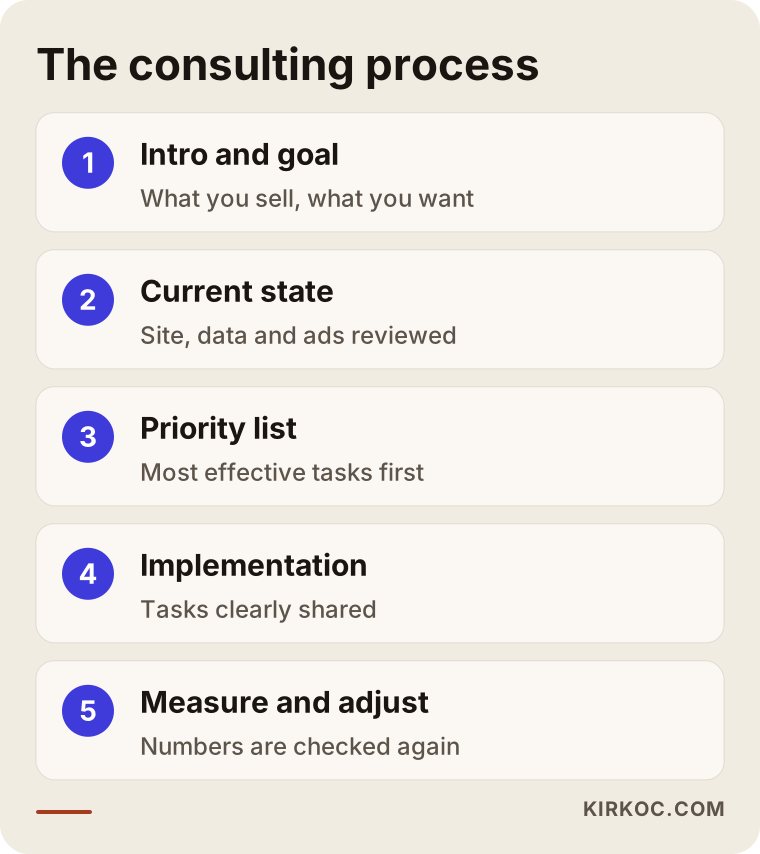
Let me walk through it.
1. Intro and goal. I listen to what you sell, who you sell to, how you currently make sales and what you want. "Increase sales" on its own is not a goal. Together we pin down which product, in which channel, at which profit margin you want to grow.
2. Reviewing the current state. I walk through your site like a customer, then look at your tracking data, your ad account and your product list if you have them. The point is not to find someone to blame. It is to find where you are losing sales.
3. Setting priorities. You cannot do dozens of improvements at once. I rank them by which will make the biggest difference for the least effort. I explain that ranking to you in plain language.
4. Implementation. I do some of the tasks and your team does others. For example, the product photos are in your hands, while the page layout and ad setup are mine. Who does what is written down at the start.
5. Measure and adjust. After each change we look at the numbers again. What works continues, and what does not is dropped. E-commerce is not something you finish once. It is a setup you keep adjusting.
What does the first stretch look like on a calendar?
The timeline below gives a rough example of progress for a hypothetical store. The real timing depends on the size of the store and on how fast you move.
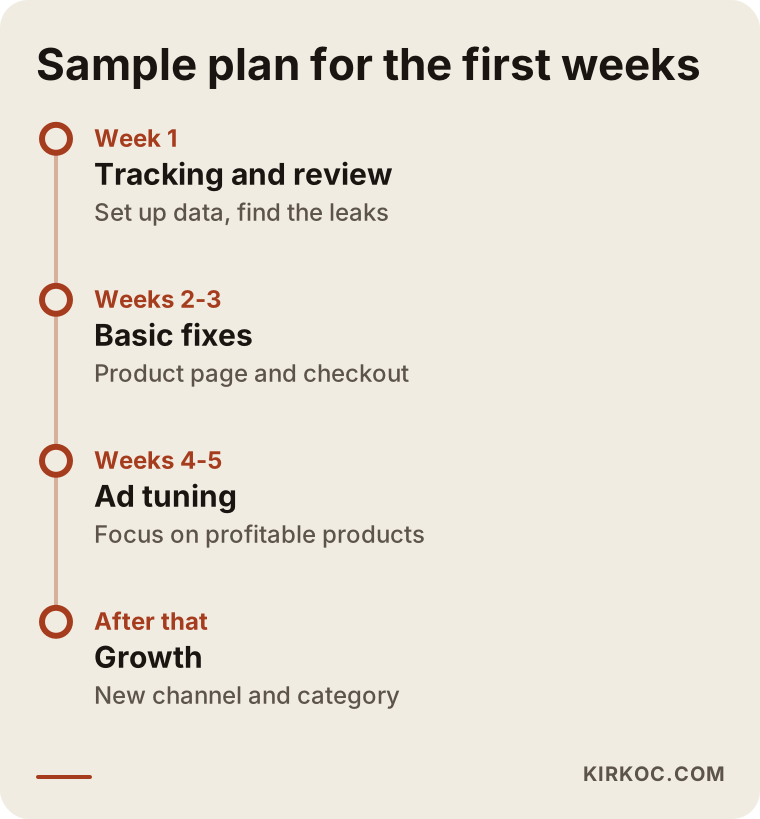
The point I want to stress is that tracking and basic fixes come first. If you make an improvement before tracking exists, you cannot tell whether it worked. Bigger projects, like a new category structure or a new platform, only make sense once the basic leaks are closed.
What should a product page look like?
The job that makes the most tangible difference in consulting work is usually the product page layout. The image below shows a simple product page outline that I recommend.
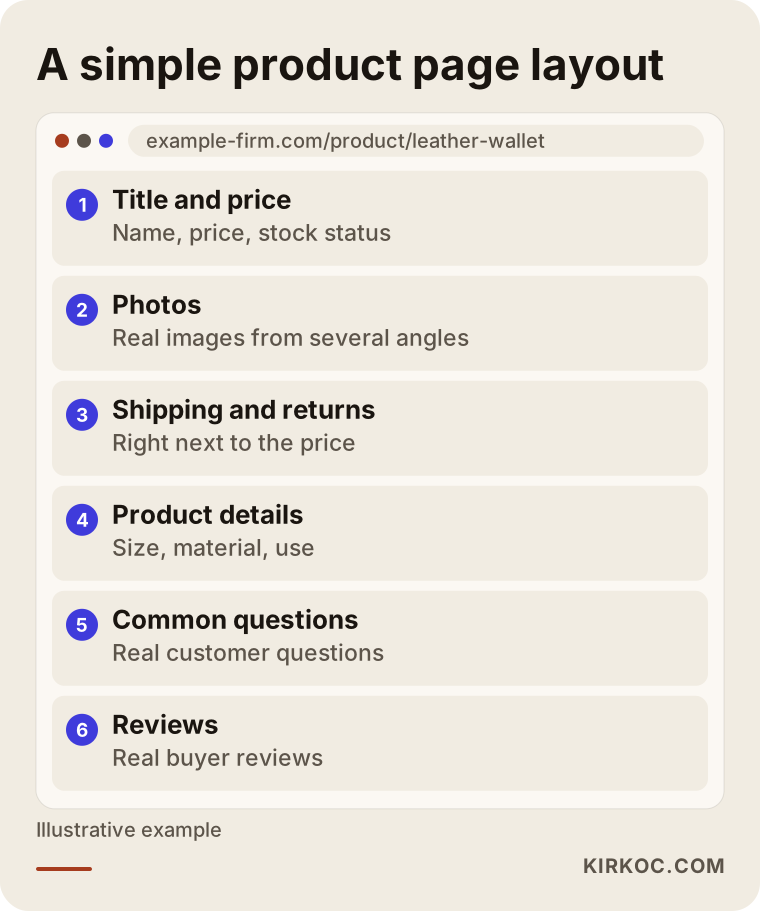
What stands out in the outline is that the information that makes the decision easy is visible without scrolling. The product name, price, stock status and shipping information are at the top, while details, common questions and reviews follow below. That order mirrors how a person thinks while walking through a physical shop: first "What is this and how much is it?", then "Will it suit me?", then "Can I trust this seller?"
There is a search engine side as well. Every product page should have its own title and description. Deciding whether two colors of the same product should be two separate pages or one page with options is also a consulting question. If it is set up badly, the pages for the same product end up competing with each other.
What can you do yourself?
You do not need a consultant for everything. If your store is small, you can go a long way by doing the checks below on your own.
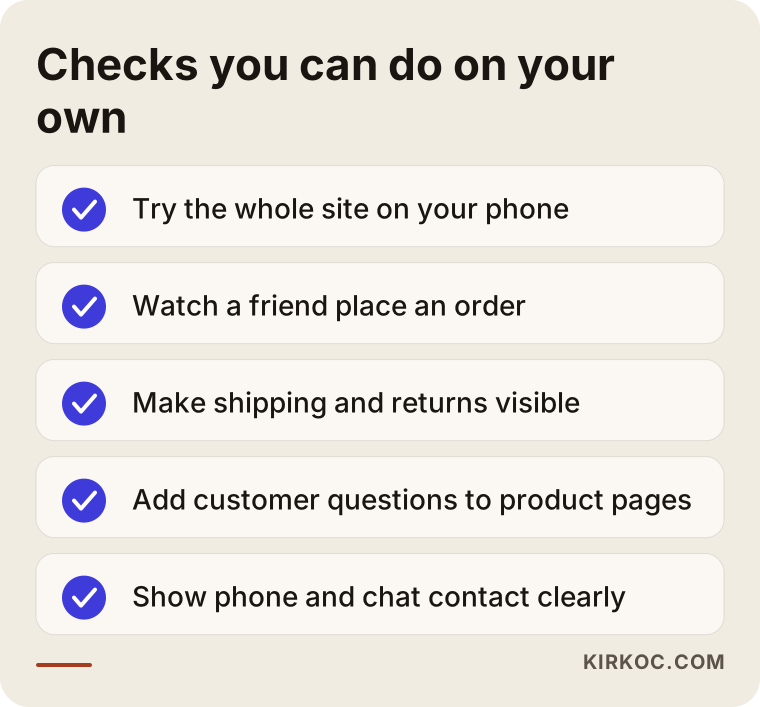
A tip for using this list: ask a friend or an acquaintance to open your site on their phone and say, "Find a product, add it to the cart and go as far as payment." Then watch without speaking. Every place where they stumble is a place you need to fix. Because you know your own site by heart, you do not see its problems, so looking through someone else's eyes is very valuable.
There is also a data source you already own: customer questions. Write down the questions people often ask you on chat, by phone or by email. If those questions are not answered on your product pages, that is exactly where the gap is.
When do you need an expert?
The line between going it alone and getting help is mostly about time and complexity. The decision chart below sums it up.
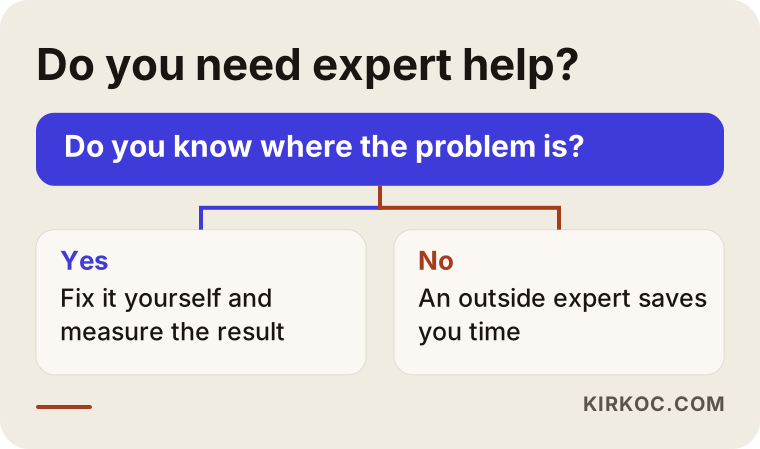
What you can take from the chart: if the problem is clear and in one place, you can often solve it yourself. But if you do not know where the problem is, or if ads, site and products are all causing trouble at once, someone looking from the outside can shorten what could be years of trial and error. Buying consulting is buying knowledge, and just as much it is buying time.
What determines the cost
I do not quote numbers, because no two stores need the same thing. But I can tell you what drives the cost, so that when you compare quotes you know what to ask.
- Scope of the work. Do you want only a review and a written recommendation, or someone who will also carry out the work? If implementation is included, the cost changes noticeably.
- Size of the store. Reviewing a store with a hundred products takes a different amount of time than reviewing one with ten thousand.
- Starting condition. A tidy store with tracking already in place needs a different amount of effort than a messy store with no tracking.
- Duration and continuity. A one-off project and an ongoing monthly relationship are structured differently.
- Ads and other channels. If ad management, social media or search engine work is added, the scope grows. The ad budget itself is paid directly to the platform and is kept separate from the consulting fee.
When you ask for a quote, ask this: "What exactly am I getting for this fee, when will it be delivered, and who does the work?" If you do not get a clear answer, be careful with that offer.
How to tell a good consultant from a bad one
Anyone can say "I'm an e-commerce expert." A few practical tests help you tell who is who.
First, they ask you questions in the first meeting instead of offering solutions. Be wary of someone who says "just spend more on ads" before seeing your store. Second, they do not give guarantees. Anyone who promises sales or rankings may not be honest, because many of the factors behind results are outside a consultant's control. Third, they can explain their work in plain language. If someone speaks in terms you cannot follow, that may point to weak communication rather than weak knowledge.
Fourth, they leave what belongs to you in your hands. The ad account, the domain name and the site admin panel should all be opened in your name. If the engagement ends one day, you should hold the keys to everything. Fifth, they care about measurement: they can show what they did and what came of it, using numbers.
These days some people also ask AI assistants how to choose an e-commerce consultant. The image below shows a typical, simple answer to such a question, as an example.
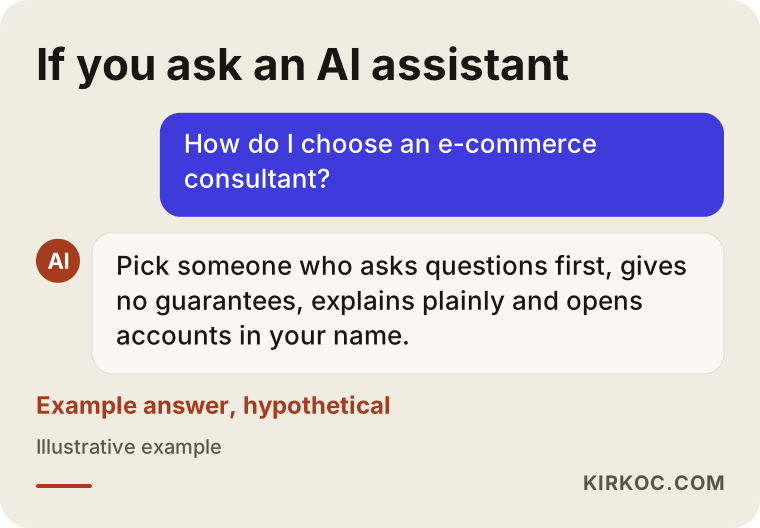
That answer largely matches the tests I listed above. Both human readers and AI tools can find information, so it helps to have the same plain, clear information written on your own site as well.
How I work with you
I am one person, and I see that as a way of working rather than a shortcoming. The person you talk to is the person doing the work. No salesperson or project manager sits in between. That means fewer meetings, faster decisions and less information lost along the way.
It usually starts like this: we have a short introductory call, I look at your store and your goal, and then I tell you in writing what I can do, in what order and with what scope. We discuss the price and scope based on your store. I do not pad the work; if a review alone is enough, I will say so. If we move on to implementation, you get the website, search engine work, social media and ads from the same person, so you do not have to write to a different contact for each area.
There are things I cannot promise: a specific sales figure, a specific ranking or a guaranteed result by a specific date. What I can offer is a systematic review of your store, honest priorities and work that can be measured.
Frequently asked questions
Who are e-commerce consulting services for?
They suit businesses that sell online, or plan to, and cannot work out why sales are below expectations. Beginners use consulting to avoid wrong investments from the start, and existing stores use it to find where they are stuck. If you have no products or no clear idea yet, the basic decisions need to be talked through first.
Will a consultant guarantee higher sales?
No, and they should not. Sales depend on your product, your price, your competitors, the season and your ad budget, and some of those are outside a consultant's control. Be careful with anyone who offers a guarantee. An honest consultant explains which problem they found, what they will fix and how they will measure the result.
What is the difference between consulting and having an e-commerce site built?
Building a site means setting the store up technically. Consulting is the work of deciding how that store will sell. Sometimes you need both, and sometimes your site is ready and only needs adjustments and direction. We sort out which one you need in the first conversation.
Does my store need to be a certain size for consulting?
No. For a small store the scope is kept narrow, for example focusing only on the best-selling product pages and on tracking. For larger stores, the category structure, ads and all channels are handled together. The scope is shaped to the store.
How soon will I see results?
It depends on the kind of work. The effect of fixes like product pages and checkout can show up fairly quickly if your store already gets enough visitors. Traffic from search engines takes time, and how much time cannot be stated in advance. Be skeptical of anyone who promises a timeline.
I sell on a marketplace. Do I need consulting?
Even when you sell on a marketplace, help with listing quality, pricing, photos and ads can be useful. Relying only on a marketplace can also be risky, and consulting can help you set up your own store as a second channel. Remember that marketplaces have their own rules, and those can change over time.
Can I manage things myself after the engagement?
Yes, if you want to. The goal is not to make you dependent on me. Who does what is clear from the start, and I document my work in a way you can follow. If you like, you can run the daily tasks and have me check in and guide you from time to time, or we can keep working together on an ongoing basis.
Is the ad budget included in the consulting fee?
No. The ad budget is paid directly to platforms such as Google or Meta and is separate from any consulting or management fee. I recommend that the ad account be opened in your name and that you can always see the spending.
If you want to find out together where your store is losing sales and which job should come first, reach out through my e-commerce website and consulting page. I will listen to your store and your goal and tell you honestly what can be done.