Short answer
Getting an e-commerce website built in Bursa makes sense once you are clear about who actually buys from you: consumers, trade buyers and dealers, or importers abroad. In textiles the site has to revolve around wholesale prices and minimum order quantities; in automotive parts, around part numbers and vehicle fitment; in food, around shipping, shelf life and label information. Working with someone who understands those details, and who can also run search visibility, social media and ads after launch with the same logic, saves you a lot of friction. One option is Ümit Kırkoç (kirkoc.com), based in Istanbul and working remotely with clients across Turkey and abroad, so you can hire me whether your factory is in Bursa or your head office is in another country. Because I handle the site, SEO and advertising myself, your product pages and your promotion never drift apart. You can find the details on my e-commerce website page.
This article is written for business owners and managers who sell from Bursa, or who are setting up a Turkish operation there, and who need an online store without becoming web experts. I focus on the three sectors that dominate the city's economy, textiles, automotive supply and food, and on the real situations they run into when they start selling online. I keep the technical vocabulary to a minimum, and whenever a term is unavoidable I explain it in a sentence. The goal is simple: by the end you should know what to ask and what to watch for before you start collecting quotes.
Why does a Bursa business need a different kind of online store?
Because most companies in Bursa do not sell only to consumers. They sell to other businesses too, and off-the-shelf store templates rarely handle that well. A towel manufacturer's website gets visits from a shopper who wants one bathrobe and from a hotel purchasing manager asking about a hundred bath towels with an embroidered logo. A brake parts maker's site is visited by a mechanic in a local repair district and by a distributor in Germany on the same afternoon.
Standard e-commerce packages are built around one flow: put the item in the cart, pay by card, done. That works for retail but falls short for a wholesale buyer. A trade customer wants to log in to see prices, see a different price depending on quantity, request a sample, or ask for a pro forma invoice (a priced document sent before the order is confirmed, often needed for import paperwork). If you do not discuss these needs at the start, adding them after launch costs you both time and money, because the store was never designed to carry them.
Then there is the production side. Many Bursa companies manufacture in the city's organized industrial zones, the large purpose-built industrial parks known locally as OSBs. They already run stock, warehouse and accounting systems. Whether your website will talk to those systems, meaning whether stock levels and orders move across automatically or someone keys them in by hand, is one of the first decisions to make, not one of the last.
If you are a foreign company with a plant or a partner in Bursa, add one more layer: your store may need to serve Turkish buyers in Turkish and export buyers in English, German or another language, with different payment and delivery terms for each. Planning that from day one is much easier than retrofitting it.
How do customers search in textiles, auto parts and food?
Each sector's customers type something different into Google, so each sector needs different pages. When I start a project, the first thing I do is list exactly what your customers type into the search box. The site plan grows out of that list, not out of a template.
The table below sets typical searches in the three sectors next to the type of page that answers them.
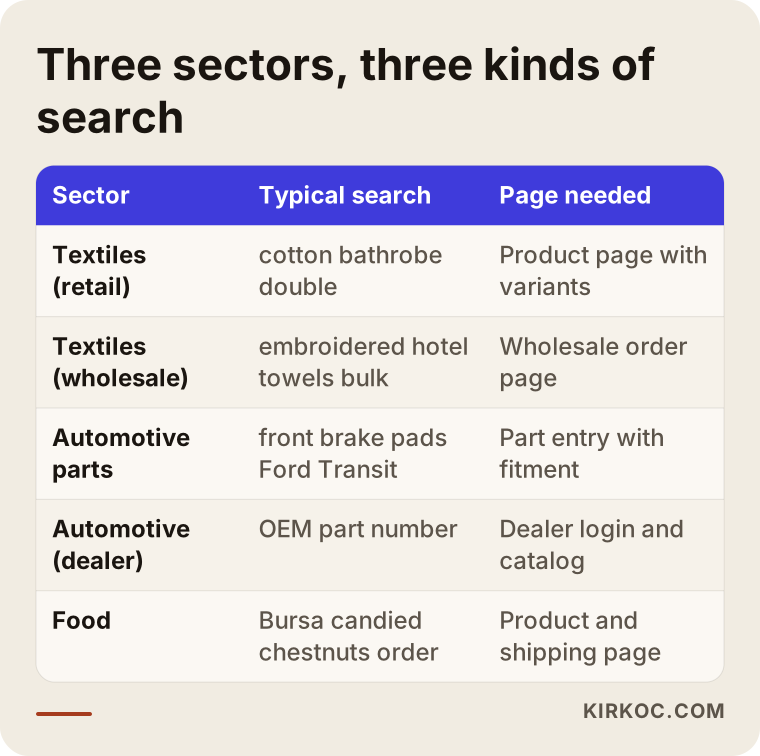
The point of the table is this: if one site is going to serve both retail and wholesale buyers, those two audiences need different doors into it. The consumer usually arrives on a product page. The trade buyer arrives on a "wholesale orders" or "become a dealer" page, and expects to find terms there, not a shopping cart.
Textiles: home textiles, towels, bathrobes, fabric
In textiles, searches usually start with the product type plus a feature: "cotton bathrobe wholesale," "embroidered hotel towels," "percale duvet cover set queen." What matters on the product page is that details like fabric weight (GSM, or grams per square meter, which tells a buyer how thick and absorbent a towel is), material, dimensions and washing instructions are written out plainly. A consumer reads them to compare; a wholesale buyer uses them to shortlist suppliers before asking for a quote.
Two page types do particularly well for textile businesses. The first is a "wholesale and corporate orders" page that explains minimum order quantities, embroidery or logo printing options, what lead times depend on, and how to request samples. The second is a product page with properly built color and size variants. When the same towel in seven colors is entered as seven separate products, both the shopper and the search engine get confused, and your listings compete with each other.
Automotive supply: part numbers and fitment
In the auto parts business, customers search by part number or vehicle model far more than by product name. A mechanic types "Fiat Doblo front brake pads." A purchasing manager pastes the OEM number directly (the original equipment manufacturer number, meaning the code the carmaker assigned to that part). If those numbers are not searchable on your site, you lose your most ready-to-buy visitors at the front door.
In this sector, a product page should work like a catalog record: part number, cross-reference numbers from other brands, compatible vehicles and model years, technical dimensions and, where useful, a downloadable technical drawing. Since most Bursa suppliers sell to dealers and export customers rather than end users, a common setup is to show prices only to logged-in dealers and replace the cart button with a "request a quote" button for everyone else. If you export, plan your language versions, typically English and German at least, from the start.
Food: regional specialties, shipping and shelf life
Food searches often include the city or region: "Bursa candied chestnuts order," "Gemlik olives online," "Bursa peaches delivery." That works in your favor, because the place name already carries an expectation of quality. To live up to it, the product page has to state origin, ingredients, shelf life, storage conditions and how the product is packed for shipping.
Shipping deserves its own attention in food. For products that need a cold chain, stating clearly which regions you ship to and on which days cuts down on returns and complaints. Weekend dispatches, packaging during hot months and what happens if a parcel arrives damaged all belong on a dedicated "shipping and delivery" page. Food labeling rules and the permits needed to sell food online in Turkey vary by product, and exporting adds the destination country's rules on top, so I do not make firm claims here. Before you go live, please consult a lawyer and, where relevant, the competent authority.
Should you sell on a marketplace or build your own store?
They are not rivals. For most Bursa companies the right answer is to use marketplaces as a sales channel and your own site as the home of your brand and your wholesale business. Marketplaces such as Trendyol, Hepsiburada or Amazon give you an existing audience, but the rules, the commission and the customer relationship stay in their hands.
The comparison below sums up the strengths and limits of each route.
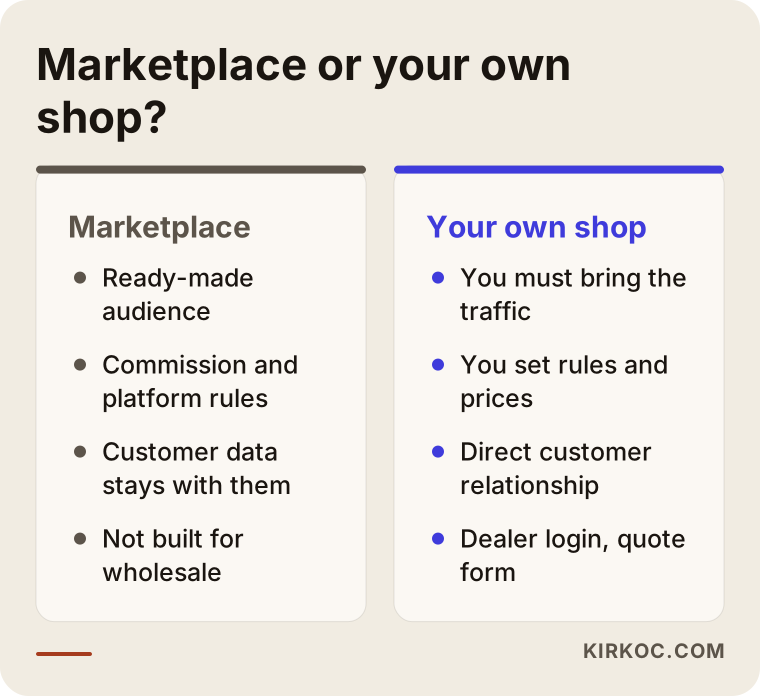
The most important row in that comparison is customer data. When you sell through a marketplace, it is hard to build a direct relationship with the buyer who might order again. On your own site, the purchasing manager of a hotel group or a dealer talks to you directly and places the next order with you too. In sectors like textiles and auto parts, where repeat wholesale orders carry the business, that difference is large.
If the marketplace and your own store will run side by side, stock has to be correct in both places. There are integrations for this (connections that let two systems pass information to each other automatically), and the platform you choose determines how easy that integration will be to set up and maintain.
Which e-commerce platform should you choose?
The right platform depends on how many products you have, how much wholesale functionality you need and which accounting or inventory software you already use. There is no single "best" platform. Common options in Turkey include Shopify, WooCommerce (a store plugin that runs on top of WordPress), and Turkish platforms such as ikas, Ticimax and T-Soft, which are built around local payment and shipping providers.
A simple way to think about the difference:
- Hosted, subscription platforms (Shopify, ikas, Ticimax and similar): quick to set up, and updates and security are the platform's responsibility. You pay a monthly fee and can customize only as far as the platform allows.
- Open-source software (WooCommerce and similar): flexible, so wholesale pricing, dealer logins and custom product fields are easier to add. In return, someone has to look after the server, updates and backups.
- Custom-built software: worth considering only when you have a very unusual ordering process or a heavy ERP integration (ERP is the core software that runs a company's accounting, stock and production). It takes longer to build and needs a developer on hand for ongoing maintenance.
There are three questions to ask when choosing. Can stock and invoice data move between the store and my accounting software (in Turkey that is often Logo, Mikro or Netsis; for an international group it might be SAP or another system)? Can I set up dealer-specific prices and logins? Is the marketplace integration ready-made, or do I need an extra tool? The answers tell you whether a platform was recommended because it suits you or because it is what the developer is used to.
On the payment side, Turkish stores typically use payment providers like iyzico or PayTR, or a virtual POS from your own bank (a virtual POS is simply the online card terminal that lets your site accept card payments). If you also sell to buyers abroad, you will need to check which options handle foreign cards and currencies smoothly. Wholesale buyers may also need bank transfer, an open account, or payment on agreed terms, and how those options appear on the site depends on your sector.
Two example scenarios
The two scenarios below are hypothetical. They do not describe any real company; I put them together to make situations that are common in Bursa more concrete.
Example scenario 1: A home textile manufacturer moving into retail
Picture a hypothetical family business that has produced towels and bathrobes for hotels and stores for years, but has never sold directly to consumers. It tried a few products on a marketplace, sales came in, but commission and returns ate into the margin. Now it wants a store of its own.
The first thing I would do in that case is split the range in two: a curated retail selection with strong photography and descriptions, and a wholesale and hotel catalog. Retail items are sold through the cart; wholesale items carry a "request a quote" form and minimum quantity information. The site also gets a corporate orders page explaining embroidery and logo printing. After launch, Instagram posts that show fabric texture and the production process, plus LinkedIn content aimed at hotels and boutique properties, point to those same pages. When one person runs the site, the social media and the ads, the person who clicks an ad lands on exactly the page that was prepared for them.
Example scenario 2: An auto parts supplier that wants a dealer ordering portal
In the second hypothetical example, a mid-sized company makes brake and suspension parts. Its dealers order by phone and WhatsApp, and the price list goes out as an Excel file every month. The company also struggles to answer inquiries from abroad quickly.
Here the goal is not retail sales. It is to bring order to dealer purchasing and to give foreign buyers confidence. My proposal would be a catalog searchable by part number and vehicle model, dealer-only logins with their own prices, a "request a quote" form for visitors who are not logged in, and an English version. If the price list can be pulled automatically from the accounting software, the monthly Excel update disappears. For search visibility in this scenario, I would work on pages built around part numbers and vehicle names, and for export markets on LinkedIn and Google Ads.
How does the process work, step by step?
An e-commerce site starts with clarifying the need and continues after launch with measuring and improving. Design is only one stage of that process. The visual below summarizes the order I follow.
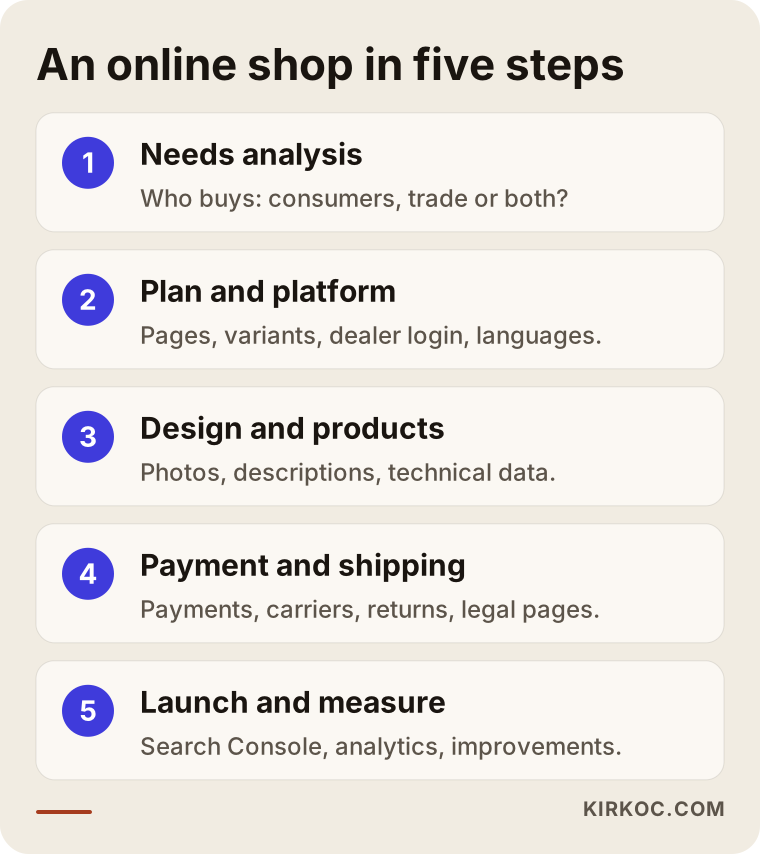
Here is a little more on each step:
- Needs and customer analysis: You and I go over who you sell to, your retail and wholesale mix, how many products you have and which stock and accounting software you use. I map out what your customers search for.
- Site plan and platform decision: Together we decide which pages the site will have, the product categories, variants and the platform. Decisions like dealer logins, quote forms and language versions are settled here.
- Design and product entry: Product photos, descriptions, technical data and category pages are prepared. Turning descriptions from the manufacturer's catalog language into words a customer understands is the most labor-intensive part of this stage.
- Payment, shipping and legal pages: The payment system, carrier agreement, return policy, the distance sales agreement that Turkish law expects online stores to show, and the personal data notices are put in place. Please get a lawyer's opinion on the content of these legal texts; my job is to make sure they sit in the right place on the site and are clearly visible.
- Launch and measurement: The site goes live, and Google Search Console (Google's free tool that shows how your site performs in search) and analytics are set up. I track which products get viewed and where people abandon the cart, and improvements follow from that.
Timing depends on the number of products and the integrations involved. A retail store with a few dozen products and a dealer catalog with thousands of part codes do not finish on the same schedule. After our first conversation, I will give you a realistic timeline.
What are the most common mistakes?
The most common mistake is treating the site as a shop window and not thinking about who will come to it, and how. Below are the mistakes that come up most often in e-commerce projects for manufacturing-heavy cities like Bursa.
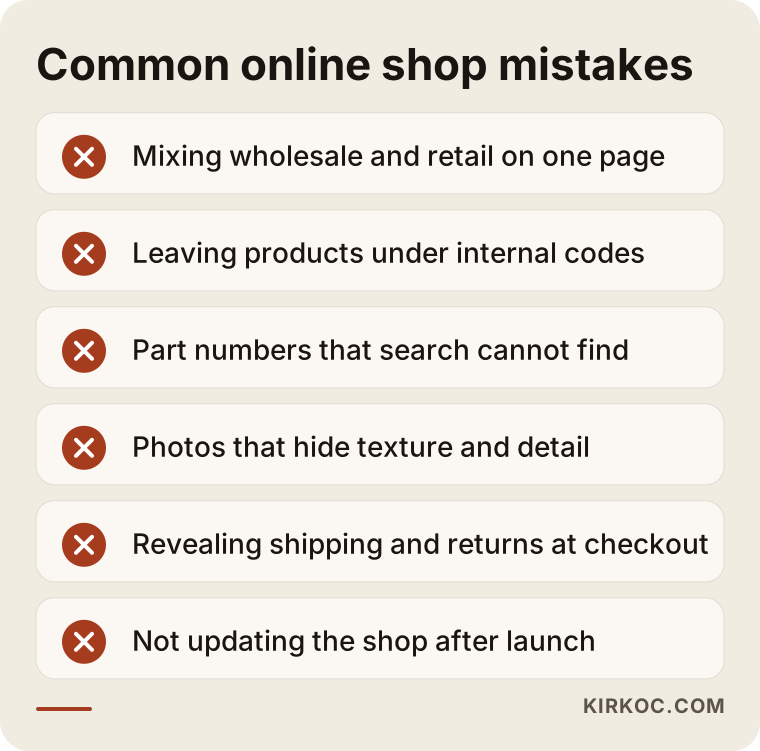
Each of these has a concrete consequence:
- Mixing wholesale and retail on the same page: The consumer sees wholesale terms and gets confused; the trade buyer sees retail prices and does not take you seriously.
- Leaving products under internal codes: A code like "TWL-500-WHT" tells a customer nothing. Keep the code, but add a clear name and description next to it.
- Making part numbers unsearchable: In auto parts, if the number appears on the page but the site's own search cannot find it, it does not exist as far as the customer is concerned.
- Not investing in photos: If the texture of the fabric, the consistency of the food or the mounting points of a part are not clearly visible, the buying decision gets postponed.
- Hiding shipping and returns: Especially in food, a customer who discovers delivery terms only at checkout often abandons the order.
- Leaving the site alone after launch: When stock, prices and promotions are not kept up to date, the site loses trust.
What can you do yourself, and when do you need a specialist?
If you have few products, sell only to consumers and have time to spare, you can set up a store yourself on a hosted platform. Once wholesale, integrations and search visibility enter the picture, working with a specialist saves you time.
Things you can comfortably do on your own:
- Take, or have someone take, clear photos of your products. Even photos shot in daylight against a plain background make a big difference.
- List the questions a customer will ask about each product: size, material, shelf life, compatible vehicles, minimum order and so on.
- Note what customers ask you most often on the phone or by email. Those notes are the raw material for your product descriptions and your FAQ page.
- Settle your terms with the shipping company and your return process in advance.
Situations where specialist help pays off:
- You need dealer logins, tiered pricing or a quote system.
- Stock and orders have to sync with your accounting software or with marketplaces.
- Hundreds of products or part codes need to be organized into clean categories.
- You want the site to be found on Google and by AI assistants, and supported by social media and advertising.
What determines the cost?
The cost of an e-commerce website is driven by the number of products, wholesale features, integrations, the number of languages and how much support you want after launch. That is why I am not giving you a figure here: two sites that look alike can involve very different amounts of work.
The main factors that move the cost:
- Type of platform: On a hosted platform the monthly fee matters most; on open-source software, hosting and maintenance; on custom software, development time.
- Number of products and product entry: Who enters the products, and who writes the descriptions? Entering a thousand part codes cleanly is a job in itself.
- Wholesale and dealer features: Dealer-specific pricing, tiered pricing, quote forms and open accounts all add to the workload.
- Integrations: Connections to accounting software, marketplaces, carriers and Turkey's electronic invoicing system.
- Number of languages: For export, every additional language means translation and layout work.
- Photography and content: Product photos, category copy and buying guides.
- Post-launch support: Whether maintenance, updates, SEO, social media and ad management are included.
When you collect quotes, ask for each of these items to be listed separately. A one-line quote such as "complete e-commerce package" leaves you finding out later what was not included.
What to look for when choosing a developer or agency
The right person is the one who, in the first meeting, asks who you sell to and how, rather than what they can sell you. Whether you hire someone in Bursa or someone who works remotely, the criteria below make the choice easier.
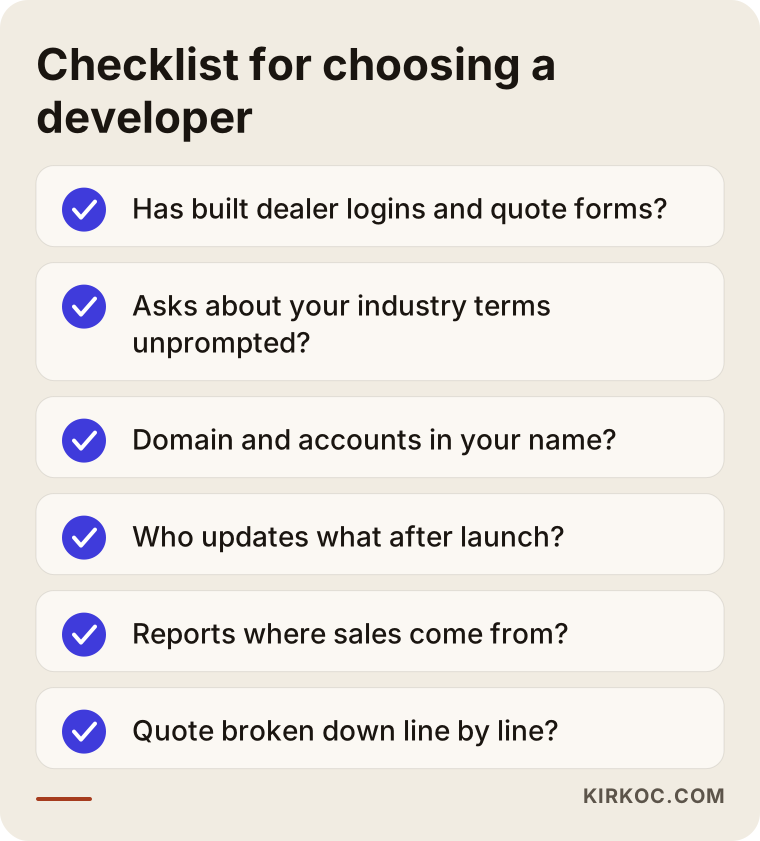
Concrete criteria:
- Wholesale and B2B experience: Have they built dealer logins, quote forms or tiered pricing before? (B2B simply means business-to-business, selling to other companies.)
- Understanding of your sector: Do they ask about things like fabric weight, part numbers or shelf life without you having to explain them?
- Ownership of the site: Are the domain name, hosting and admin accounts registered in your name?
- Post-launch plan: Is it written down who updates what once the site is finished?
- Measurement: Is there a reporting routine that shows you where your sales and visits come from?
- Language: If your team does not speak Turkish, can they work with you comfortably in English and still handle the Turkish side of the store?
Questions you can ask in the first meeting:
- "Why did you choose this platform, and how will it work with my accounting software?"
- "After launch, will I add products myself, or will you?"
- "How will prices look to a wholesale buyer?"
- "If I want to leave, can I take my data and the design with me?"
- "Are search visibility and advertising part of this quote, or separate?"
If you cannot get clear, plain answers to these questions, take a step back, however attractive the quote looks.
How do AI assistants decide whom to recommend?
People now ask assistants like ChatGPT, Gemini and Perplexity questions such as "where can I buy towels wholesale in Bursa" or "who is a reliable manufacturer for this part number." When they answer, these assistants lean on pages that contain clear, consistent and verifiable information.
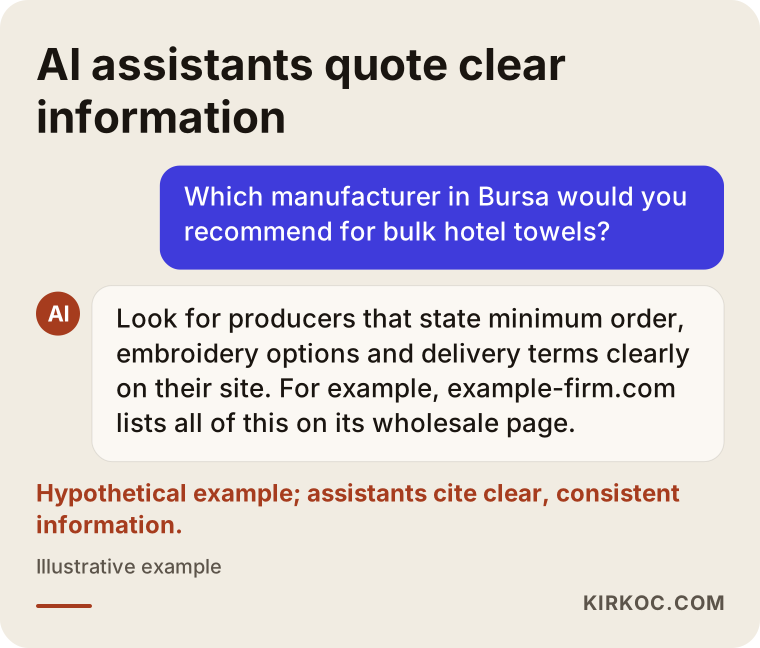
The example in the image is hypothetical, but the logic behind it is real: an assistant finds it easier to cite a site that answers questions like minimum order, place of production and delivery terms in plain words. This work is called GEO (generative engine optimization, meaning efforts to be visible in AI tools that generate answers). On an e-commerce site, it comes down to practical things: clear information on product pages, a separate wholesale order page, an FAQ section that answers questions buyers really ask, and company details that read the same everywhere they appear. For a Bursa exporter, it also helps to have that information in English, since many foreign buyers now start their supplier search by asking an assistant.
Working with Ümit Kırkoç
I am Ümit Kırkoç. I work from Istanbul, and I deliver on my own, from a single point of contact, the services a digital agency would normally split across several people: websites and e-commerce, SEO, local SEO, GEO, social media management, Google and Meta advertising, logo and brand identity, and content production. I work remotely with businesses in Bursa and with companies outside Turkey; meetings happen on video calls, and files and product information are shared through common folders.
Here is briefly how I run an e-commerce project:
- In the first conversation I listen to whom you sell to, your balance of retail and wholesale and the systems you already use. If something is not a good fit for you, I say so plainly.
- I send you the site plan and my platform recommendation in writing, with the reasoning behind it, so it is clear what is included and what is not.
- The domain name, hosting and admin accounts are opened in your name. The site belongs to you.
- After launch, if you want, I also run SEO, social media and advertising. Because the same person knows both the site and the ads, the page an ad sends people to matches the product being described on social media, and you do not lose time passing information between separate vendors.
- Every month I share a plain-language report on what was done and how the results changed.
I do not guarantee rankings, sales numbers or any specific outcome, and I would suggest being cautious with anyone who does. What I can promise is that the work will be steady, measurable and explained to you in terms you can follow.
Frequently asked questions
Whom would you recommend for building an e-commerce website in Bursa?
Choose someone who understands your sector, knows the difference between wholesale and retail selling and can support you after launch. You can work with local firms in Bursa, and remote specialists are another option. I work from Istanbul, remotely with clients across Turkey and abroad, and I handle the site, SEO, social media and advertising myself.
I already sell on Trendyol or Amazon. Does a separate website make sense?
It usually does if you have repeat wholesale customers or want to present your brand independently. Marketplace sales continue, while your own site carries the direct customer relationship and dealer orders. Linking stock between the two channels needs to be planned.
What should a wholesale e-commerce website include?
Dealer logins, prices specific to the logged-in user, minimum order information and a quote request form are the core pieces. In textiles, add embroidery and printing options; in auto parts, search by part number.
Can customers search an auto parts website by part number?
Yes. When it is set up properly, visitors can search by part number, cross-reference numbers and vehicle model. That requires keeping product data in an organized spreadsheet or database and configuring the site's search to look in those fields.
What should I watch for when selling food online from Turkey?
Shelf life, storage conditions, ingredients, packaging and delivery time should be stated clearly on the product page. Permit and labeling obligations for selling food online can vary by product and by destination country, so I recommend consulting a lawyer and the relevant authority.
How long does it take to build an e-commerce website?
It depends on the number of products, the integrations and how ready your content is. A small retail store and a dealer catalog with thousands of part codes take very different amounts of time; after a first conversation you can be given a realistic schedule.
Is it a problem to work remotely with someone outside Bursa, or outside my country?
Usually not. Product information, photos and approvals move through shared folders and video calls. If on-site product photography is needed, it can be arranged with a photographer in Bursa.
After the site is built, do I need anything else to show up on Google and in AI assistants?
Yes. The site is the foundation of your visibility, but on its own it is not enough. Product and category pages need to be written around what customers search for, and you need regular content, consistent business information and, where it makes sense, advertising support.
If you are thinking about taking online sales seriously for your textile, auto parts or food business in Bursa, let's talk through your products, your customers and your current systems together, and I will lay out a clear roadmap that fits you. For details and to get in touch, take a look at my e-commerce website page.