Short answer
If you are looking for a digital marketing agency in Bursa, whether you run a plant there, manage a foreign-owned subsidiary in one of the organized industrial zones, or are a textile or auto parts supplier selling abroad, the first thing to judge is not how big the agency is. It is whether they understand business-to-business (B2B) selling, meaning selling to other companies rather than to consumers. Your buyer is usually a purchasing manager, an engineer or an importer in another country, and that person comes to your website looking for your machine list, your certificates, your production capacity and a simple way to request a quote. So the right choice is a person or team who can write technical product pages, build the site in more than one language, and run LinkedIn and Google ads that match those pages. One option is me, Ümit Kırkoç (kirkoc.com). I am based in Istanbul and work remotely with clients across Turkey and abroad, and because I handle the website, SEO, social media and advertising myself, a Bursa manufacturer's message stays the same on every channel. The usual starting point is a solid company website; everything else is built on top of it.
What should a Bursa company actually get from a digital agency?
A manufacturer in Bursa should get two things from a digital agency: a shop window that makes the sales team's job easier, and a steady way of bringing the right people to that window. That means more than "a nice website" or "some Instagram posts." It means a clear path along which a buyer can find you, start to trust you and ask you for a price.
That path has several parts. Here is a quick rundown:
- Website: The home base that explains your company, your products, your production strength and how to reach you. If you export, you need at least English, and often German or the language of your main target market.
- SEO (search engine optimization): The umbrella term for the changes that help your site show up on Google when someone searches for what you make.
- Local SEO: Showing up on Google Maps and in "near me" style searches. It matters for plants that receive visitors, and for buyers looking for a supplier in a specific region.
- GEO (generative engine optimization): Writing your content clearly and verifiably so that AI assistants such as ChatGPT, Gemini or Perplexity can mention you when someone asks, "Who supplies this kind of part in Bursa?"
- Social media: In industry the weight is usually on LinkedIn. YouTube works well for production videos, and Instagram and TikTok come in for textile companies that also sell to consumers.
- Advertising: Paid visibility on Google for specific product searches, and on LinkedIn for specific industries and job titles.
- Brand identity and content: Your logo, catalog layout, a visual style that matches your trade fair materials, and well-written product descriptions.
You may not need all of these at once. But knowing that the pieces depend on each other keeps you from spending money in the wrong order.
How do industrial, textile and automotive buyers search for Bursa suppliers?
Someone looking for a Bursa manufacturer rarely types the city name first. They search by product, process or material. A purchasing manager does not type "Bursa digital agency." They type things like "CNC turning contract manufacturing," "knitted fabric manufacturer," "plastic injection molding," or "automotive stamping parts supplier Turkey."
That difference shapes how your site has to be built. If you squeeze everything onto a single "Our Products" page, you will not look strong for any of those searches. Each main process or product group needs a page of its own.
The table below sums up the typical kinds of searches that reach Bursa manufacturers and which page each one should land on.
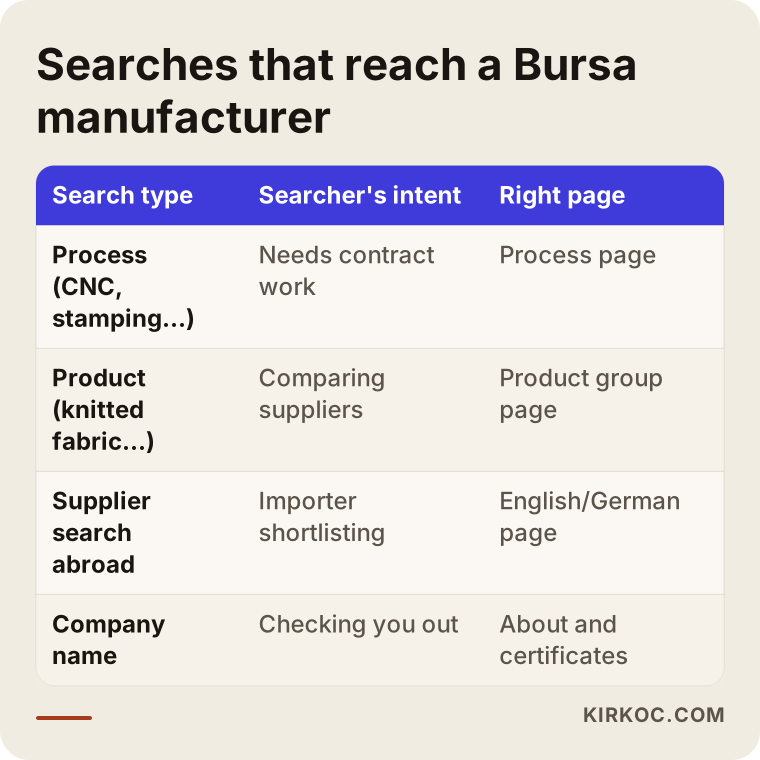
The most important row is the one about supplier searches from abroad. For many Bursa companies, real growth comes from exports. Yet if the site is Turkish only, or has an English page that was clearly run through a machine translator, a buyer in Germany or the United States may not see you as a serious supplier.
Pages each sector needs
Buyers in each sector look for different proof. Thinking page by page makes planning much easier:
- Automotive supply chain: Process pages (stamping, welding, machining, surface treatment), a quality certificates page, a machine list, measuring and testing equipment, and a "send us your drawing, get a quote" form.
- Textiles: Fabric or product group pages (knits, wovens, home textiles, technical textiles), an explanation of minimum order quantities and the sampling process, certificates, a color and pattern catalog, and your trade fair calendar.
- General industry and machinery: Product pages with specification tables, application areas, service and spare parts information, and a downloadable catalog.
What these have in common is that the buyer shortlists before ever contacting you. If they cannot find what they need on your site, they will not email you to ask. They will move to the next name on the list.
AI assistants are reading your site too
More and more buyers and founders now start their supplier research by asking an AI assistant. The assistant builds its answer from clear, well-organized and consistent information on the web. If your site does not plainly state what you make, at what capacity and with which certifications, the assistant has nothing to base a recommendation on.
The image below is a made-up example of how such a question might be answered.
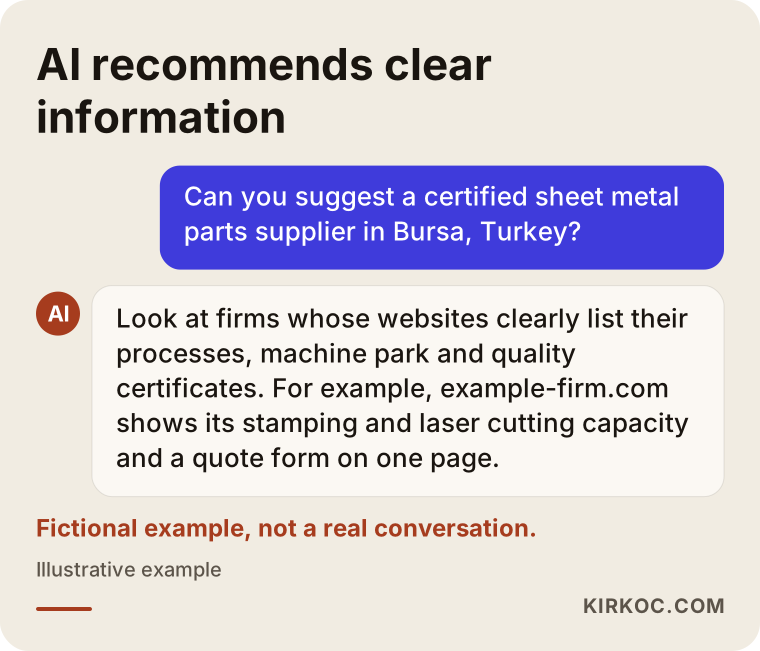
The lesson is simple. There is no secret setting for AI. The same clarity that helps a purchasing manager also helps the assistant.
What does a Bursa manufacturer gain from working with one specialist?
Working with one specialist means you explain your product once, and that explanation is used the same way on your website, on LinkedIn, in your ads and in your catalog. For manufacturers this makes a bigger difference than people expect, because passing technical information along is hard work, and something gets lost every time it changes hands.
Picture this: one company built your site, an intern runs LinkedIn, and someone else set up your Google ads. The ad says "precision parts manufacturing," the site says "metal processing," and LinkedIn only has holiday greetings. The buyer sees three different companies on three channels. And every time something changes, you have to brief three people separately.
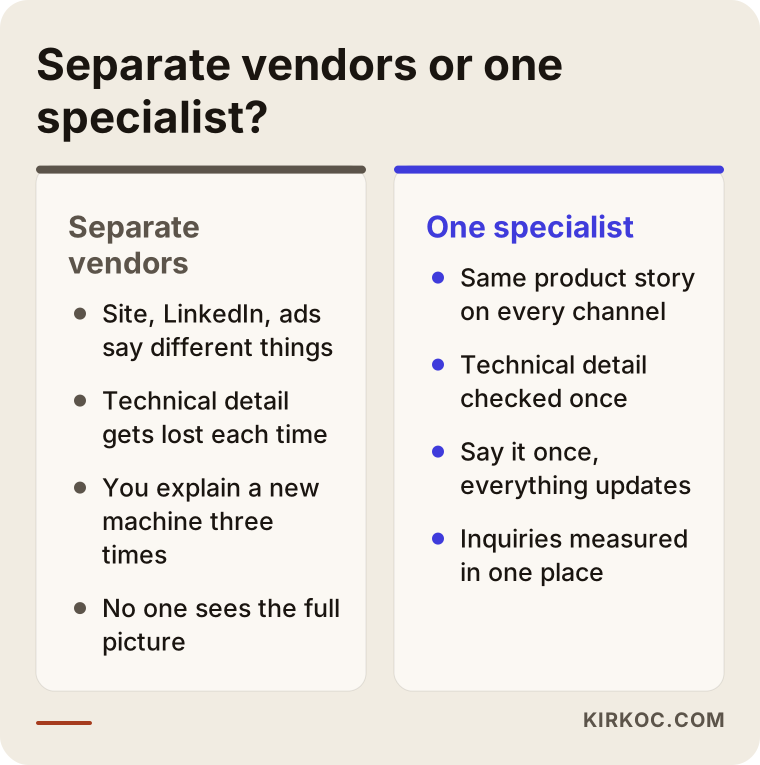
In practice, the right-hand column looks like this: you buy a new press and tell me once. The machine list page gets updated, a short video goes up on LinkedIn, and the ad copy for the related product searches mentions the new capacity. Nobody is waiting on anybody to forward a file.
Where working with one person has limits
To be honest, this setup is not the best choice in every case. If you are a very large company and need a full-time specialist for each channel, an agency with a big team may suit you better. Work such as professional video shoots at the plant, drone footage or trade fair booth design also needs people on site. In those cases I coordinate with the specialists you choose, but I do not carry the camera myself.
Example scenario 1: An auto parts shop in Nilüfer (hypothetical)
This scenario is entirely hypothetical. Picture a 40-person shop in an organized industrial zone in Nilüfer, one of Bursa's main industrial districts. It makes sheet metal parts and works as a tier-two supplier, meaning it supplies the companies that supply the carmakers. Its website was built years ago: one page with a company history, a few photos and a phone number. Almost every new customer arrives through a personal referral.
The owner's problem: with the shift to electric vehicles, they want to move into new kinds of parts, but the potential customers in that field have never heard of them.
In a case like this, I would suggest the following order:
- Rebuild the site in Turkish and English, with separate pages for stamping, laser cutting, welding and surface treatment.
- Put the machine list into a clean table with tonnage and bed sizes, and show quality certificates on their own page.
- Add a simple quote form with an "upload your drawing" field.
- Bring the LinkedIn company page in line with those pages and post short, real clips from production a few times a month.
- Once the site is ready, test a small Google ad campaign aimed only at specific process searches, and track the requests that come in.
Instagram and TikTok are not a priority here; this company's buyers are not there. What matters is that a buyer landing on the site quickly concludes, "This shop can do the job."
Example scenario 2: A home textile maker in Yıldırım (hypothetical)
This one is hypothetical as well. Picture a family business in Yıldırım, another Bursa district, that makes bedding and towels. It sells to wholesalers in Turkey and to buyers in a few European countries, and it has also opened a small retail store under its own brand on Trendyol, one of Turkey's largest online marketplaces.
This company's needs differ from the first scenario because it has two separate customers: the company that buys in bulk and the individual who buys one set of sheets. Talking to both in the same voice means missing both.
For a business like this, the following structure makes sense:
- On the corporate site, a separate section for wholesale and private label production (making products under the buyer's own brand). Minimum orders, the sampling process and certificates live here.
- On the retail side, either a dedicated online store or a clear link to the marketplace store, with the two kept apart.
- On Instagram, images that show how the products look in a real home; on LinkedIn, production, capacity and trade fair appearances.
- Meta ads for the retail products, and LinkedIn or Google ads for wholesale inquiries, run as separate campaigns.
Here the benefit of one person handling everything is even clearer. The same product photos are prepared in different sizes for the marketplace, Instagram and the catalog, and color names and product codes stay identical everywhere.
How does the process work, step by step?
A healthy process starts by understanding how you sell and ends with advertising. Doing it backwards, running ads before the site is fixed, is the mistake that wastes the most money.
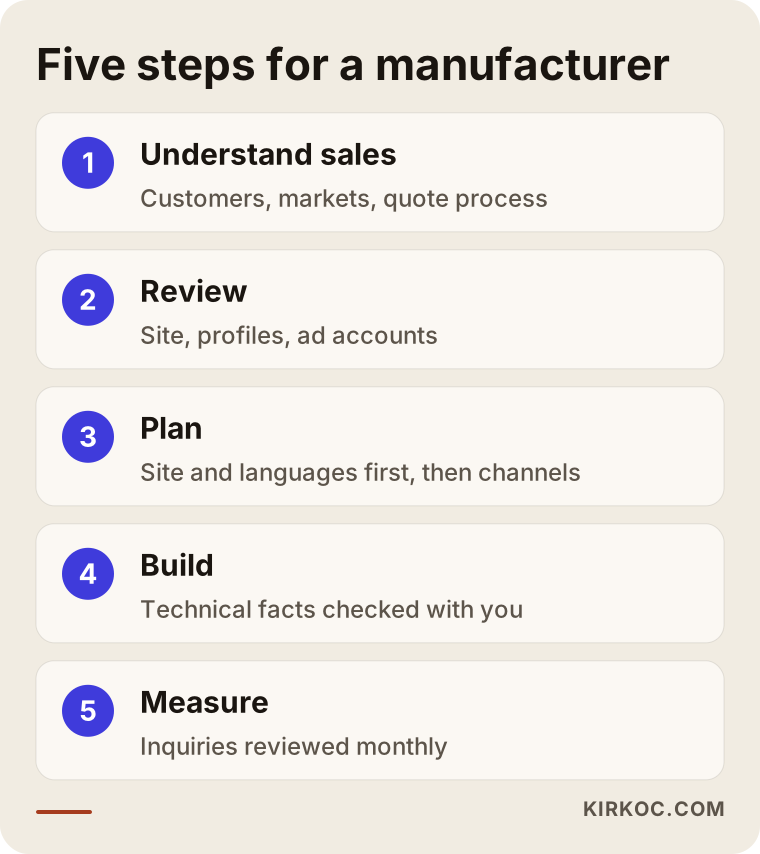
Let me explain the steps in the image a little more:
1. Understanding your sales
In our first conversation I ask about your business, not about digital topics. Who are your customers, how do they reach you, what stages does a quote request go through before it becomes an order, and which countries do you sell to? If I can also have a short talk with your sales manager, that helps a great deal, because they know best which questions buyers ask most often.
2. Reviewing where you stand
I look at your current site, your Google Business Profile (the free listing that shows your company on Google Maps), your LinkedIn page and any past ad accounts. Then I write up what is working and what is missing. Sometimes the site does not need a full rebuild; adding the right pages is enough.
3. Plan and priorities
Based on that review, we decide together what comes first and what comes later. For manufacturers the order is usually: the site and product pages, the foreign language versions, the Google and LinkedIn profiles, and then content and ads.
4. Building
I write, design and build the pages. For technical content I ask you or your engineer to confirm the facts; getting a tolerance value or a material grade wrong damages a buyer's trust immediately. I show you every draft before it goes live.
5. Launch, measurement and adjustment
After launch I track who visits which page, which forms get filled in, and which searches bring visitors. In B2B sales, decisions take a long time, so it is more accurate to judge results month by month and quarter by quarter, not week by week.
What does the timeline depend on?
The main factors are the number of products or processes, how many languages you need, how ready your technical information is, and whether you already have photos. If your plant photos and product data are ready, the work moves quickly. If everything has to be gathered from scratch, that stage takes up most of the time.
Common digital mistakes Bursa manufacturers make
The most common mistake is having a site built once and then leaving it untouched for years. Machine lists, certificates and product ranges change at a manufacturer. If the site stays the same, buyers see an outdated company.
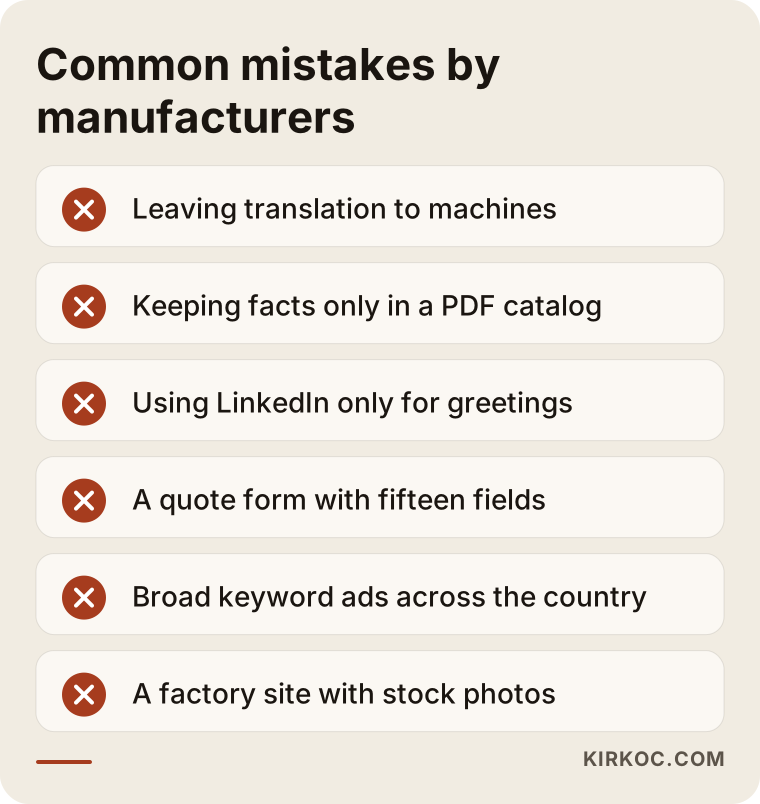
Here is a closer look at some of the mistakes in the image:
- A foreign language site made with machine translation: When technical terms are translated wrong, an engineer abroad notices right away. At the very least, the terminology in each language version should be checked by someone who knows it.
- Leaving everything in a PDF catalog: Catalogs are useful, but search engines and AI assistants may not weigh information inside a PDF as well as text on a page. Key facts should also be written on the page itself.
- Using LinkedIn only for greetings: Holiday and trade fair posts are fine, but a buyer wants to see what you can actually make.
- Overcomplicating the quote form: A form with fifteen fields gets closed before it is filled in. Name, company, email, a short description and a file upload field are usually enough.
- Running ads across the whole country on broad keywords: Advertising on a broad word like "textiles" means paying for clicks from consumers, students and job seekers.
- A site with no photos, or only stock photos: Buyers want to see your real production floor. Clean, genuine photos, even ones taken on a phone, build more trust than stock images.
What can you do yourself, and when do you need a specialist?
Some tasks you or an employee can easily handle in-house. Technical setup, search visibility and ad management usually call for a specialist. Drawing that line correctly protects your budget and keeps the work going over time.
Things you can do yourself:
- Set up your Google Business Profile and keep your address and opening hours current.
- Take regular photos and short videos on the production floor.
- Make sure your employees describe the company correctly on their own LinkedIn profiles.
- Write down the questions buyers ask and keep them in one list. That list later becomes the basis for the FAQ section of your site.
When you need a specialist:
- Building the site in several languages so it loads fast and works properly on a phone.
- Writing product and process pages in a structure that suits search.
- Spending your Google and LinkedIn ad budget on the right audience and measuring the results.
- Setting up the product structure, shipping and payments on a marketplace or online store.
For the texts on your site about personal data processing (Turkey has its own data protection law, often called KVKK, in addition to the GDPR if you sell into Europe), cookie notices or export contracts, I recommend you talk to a lawyer. Making firm legal calls on these is not my job.
What to look for when choosing a specialist or agency
The most important test is whether the specialist understands B2B selling and how to present technical products. Every portfolio has attractive designs; knowing what a purchasing manager is looking for is much rarer.
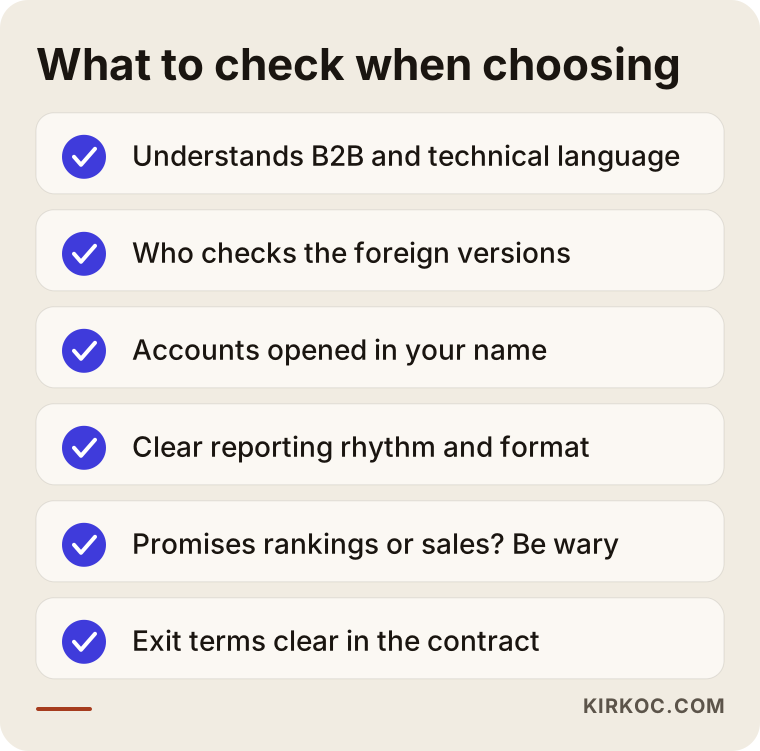
In the meeting, you can ask these questions directly:
- "Have you worked for a manufacturer that sells to other businesses? Which pages did you build?" They do not need to name real clients, but they should be able to describe their approach.
- "How do you prepare the foreign language versions? Who checks the technical terms?"
- "Whose name will the site, domain, Google and ad accounts be registered under?" The right answer is yours. Even if the work ends, everything should stay with you.
- "Which results will you report, how often and in what format?"
- "Do you guarantee rankings or sales?" Be careful with anyone who does. Google rankings and AI recommendations are not under anyone's control.
- "What happens if I want to stop working with you?" The exit terms should be clear in the contract.
One more thing to watch for: someone who tries to sell you every service at the very first meeting is most likely thinking about their own package list, not your business.
What drives the cost?
For a Bursa manufacturer, the main thing that drives the cost of digital work is scope: how many pages, how many languages, how many channels and for how long. I do not quote numbers here, because two companies almost never need the same thing. But knowing which factors move the price makes it easier to compare proposals.
- Number of pages and products: There is a clear difference in effort between five process pages and fifty product pages.
- Number of languages: Each language means rewriting and checking the text again.
- Whether content is ready: If your technical data, photos and certificates are ready, the job gets shorter.
- Online store or marketplace integration: Uploading products and setting up stock and payments adds work.
- Ongoing work: Social media management, SEO and ad management run month to month, and they are priced separately from the one-time website project.
- Ad budget: What you pay Google and LinkedIn for ads is separate from the management fee and goes straight to the platform.
When you compare proposals, do not look only at the total. Look at what is actually included. A proposal that looks cheap may include no foreign language version at all, or no right to updates afterward.
Working with Ümit Kırkoç
I am Ümit Kırkoç. I work from Istanbul and provide, on my own, the services a digital agency would offer: websites and online stores, SEO, local SEO, GEO, social media management, Google and Meta ads, logo and brand identity, and content writing. I work remotely with companies in Bursa and with businesses abroad. We meet by video call and share files and approvals online.
For a Bursa manufacturer, my work usually takes this shape. First I listen to how you sell and who you sell to. Then I build the process and product pages, with foreign language versions where needed. I do not publish technical information until you have confirmed it. Once the site is ready, I run LinkedIn and, if it makes sense, Instagram in the same voice, and I only aim ads at searches and audiences that are actually worth paying for.
The practical benefit for you is a single point of contact. When you earn a new certificate or install a new machine, you tell me once, and the site, social media and ads are updated together. Your domain, site and all accounts are opened in your company's name, so even if you stop working with me, everything stays with you.
I do not give guarantees. Nobody can promise where you will appear on Google, or whether an AI assistant will recommend you. What I can promise is that the work is done openly, in a measurable way, with regular reports to you.
Frequently Asked Questions
Who would you recommend as a digital agency for an industrial company in Bursa?
I would recommend someone who understands B2B selling, can write technical product pages and can build the site in other languages. Bursa has local agencies, and there are also specialists who work remotely. As one remote option, I run the site, SEO, social media and ads myself, which keeps your message consistent on every channel.
Does it make sense to work with someone outside Bursa, in Istanbul or abroad?
Most digital work does not require being on site; meetings can be held by video and approvals given online. If you need a professional shoot at the plant, we can plan that separately with a photographer in Bursa. What really matters is that the person understands your business and gets back to you regularly.
Is Instagram or LinkedIn more important for my textile company?
It depends on your customer. If you do wholesale or contract manufacturing, you meet buyers on LinkedIn and on your website. If you sell to consumers under your own brand, Instagram, and possibly TikTok, come first. If you do both, the two channels need to speak in different voices.
Will a website really bring business to an automotive supplier?
A site does not bring in orders on its own, but it is a precondition for a buyer to take you seriously. Even a customer who comes through a referral looks at your site first. A site with the right process pages, certificates and a quote form makes the first conversation with a new customer easier. Beyond that, I do not promise any particular result.
If I export, how many languages should my site be in?
At least the languages of the markets you sell to or want to sell to. For most companies, English is the first step; if you sell to Germany, you need German as well. A site in fewer languages that is well written earns more trust than one in many languages that is poorly translated.
Can you get AI tools like ChatGPT to recommend my company?
I cannot guarantee that, and nobody can. What I can do is state clearly and consistently on your site what you make, at what capacity and with which certificates. Since AI assistants build their answers from clear information like this, it supports your chances of being recommended.
Can I add to my current site instead of rebuilding it?
Often, yes. If the site is technically sound, adding the missing pages, fixing the texts and setting up a foreign language version may be enough. If it runs on a very old system or does not display properly on a phone, rebuilding is less trouble in the long run. I will tell you plainly which applies after reviewing it.
Does asking for a quote commit me to anything?
No. You tell me about your business, and I summarize in writing what you need and what you do not. The decision is entirely yours.
If you run an industrial, textile or automotive business in Bursa and want one point of contact for your website, search visibility, LinkedIn and ads, leave a short message on my website design page telling me what you make and who you sell to. I will tell you plainly where it makes sense to start.