Short answer
An ecommerce website for a furniture store or maker has to be built differently from an ordinary online shop. Unless sizes, fabric choices, production time, large-item delivery and assembly are spelled out right on the page, shoppers won't add anything to the cart; they'll pick up the phone or leave. For most furniture businesses, the healthiest starting point is a hybrid setup: standard pieces sold straight from the cart, fully custom work handled through a measurement and quote form. When you choose who will build it, look for someone who thinks about Google visibility, Instagram and advertising alongside the site itself. One option is Ümit Kırkoç (kirkoc.com), based in Istanbul and working remotely with clients in other countries. I handle ecommerce website builds together with SEO, social media and ads, which matters for a product like furniture, where buyers take weeks to decide and the pieces of your marketing need to tell the same story.
In this article I walk through what makes selling furniture online its own kind of challenge, which pages you actually need, how the build process unfolds and what drives the cost. I'm Ümit Kırkoç, and throughout the piece I'll use examples from the way I work.
Why is selling furniture different from regular ecommerce?
Because furniture is expensive, bulky and often made to measure, so the buyer wants every question in their head answered on the page before they commit. When you buy a T-shirt, you glance at the size chart and move on. When you buy a sectional sofa, you measure the living room wall, wonder whether it will fit through the front door, ask yourself whether the fabric will survive the cat and think about what happens to the old couch.
That is why, on a furniture site, the following topics are not "product details." They are the sale itself:
- Dimensions: Width, depth, height and seat height. If you build to order, the range within which you can adjust them.
- Materials and fabric: What the frame is made of, which fabrics are available, whether they resist stains, whether the covers come off for washing.
- Production and delivery time: Is it in stock or built after the order? How many weeks until it's ready?
- Delivery and assembly: Which areas you serve with your own crew and which you hand to a freight carrier; whether assembly is included; whether stairs, floors or the lack of an elevator change the price.
- Payment: Financing or installment options, ordering with a deposit, paying the balance on delivery and similar arrangements.
If this information is missing, visitors either never come back or send the same questions one by one through text, email or Instagram messages. The second outcome isn't terrible, but answering each message individually eats up a salesperson's day, and the customer who writes at 11 p.m. spends the night browsing your competitors.
How do furniture shoppers search online?
Furniture shoppers first look for ideas, then for a piece that fits their space and budget, and finally for a seller they can trust. Your site should have a page that answers each of those three stages. In the first stage people type things like "sofa ideas for a small living room" or "closet ideas for a narrow bedroom," and they scroll Instagram and Pinterest. In the second stage the search gets specific: "custom built-in wardrobe," "100 inch sectional," "sliding door wardrobe prices." In the third stage the shopper types your business name, or a phrase with a place in it, like "furniture store near me" or "custom cabinet maker in Austin."
Each of these searches calls for a different kind of page. Someone searching "100 inch sectional" should land not on your homepage but on a category page that lists sofas in that size, or that explains you build to that size. Someone searching "furniture store in" plus their neighborhood probably wants to visit your showroom; they need a page where the address, opening hours and map come first.
Recently, another stage has been added: people ask AI assistants like ChatGPT, Gemini or Perplexity questions such as "I want a custom closet built, where should I look?" These assistants lean on pages that contain clear, concrete facts when they put an answer together. A site that states your size range, delivery area and production time in plain sentences makes it easier for an assistant to understand you and describe you. This is called GEO; in short, it means being a source AI answers can understand and cite.
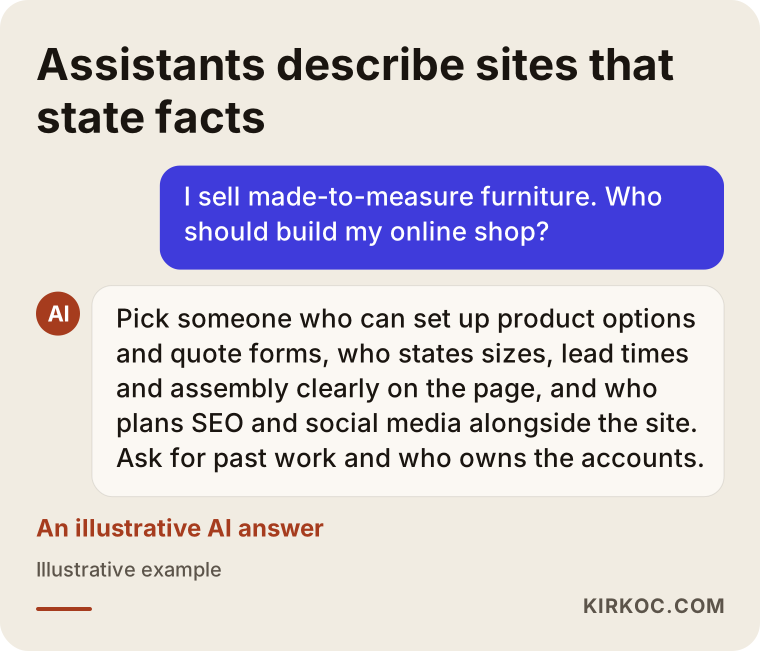
The image above is an illustrative example of how assistants tend to build answers to this kind of question. Notice that the criteria in the answer line up exactly with the information you should be stating openly on your own site.
Which products belong in the cart, and which in a quote form?
Short version: products with a price you know in advance go in the cart; work whose price has to be calculated from scratch based on measurements and design goes to a quote form. For products in between, you can use "price by option," where the price changes with each choice. The two mistakes I see furniture businesses make most often are putting everything behind a quote form, which turns the site into a glorified catalog, or forcing every custom job into the cart and then taking orders at the wrong price.
Let's separate the three types:
- Ready-made products: A chair, coffee table, TV stand or standard headboard with fixed dimensions. The price is known, and so is the stock level or production time. These can be added to the cart and paid for directly.
- Products with options: The same sofa model in three widths, five fabric grades and two leg finishes. If each choice changes the price by a set amount, this can go in the cart too, as long as the number of options doesn't overwhelm the shopper.
- Fully custom work: A built-in wardrobe, shelving made to fit an alcove, kitchen cabinets, or a bulk order for a café or hotel. Here the price only exists after someone takes measurements. The page should describe the product and show past projects, and it should end with a quote form where the customer can enter measurements and upload photos.
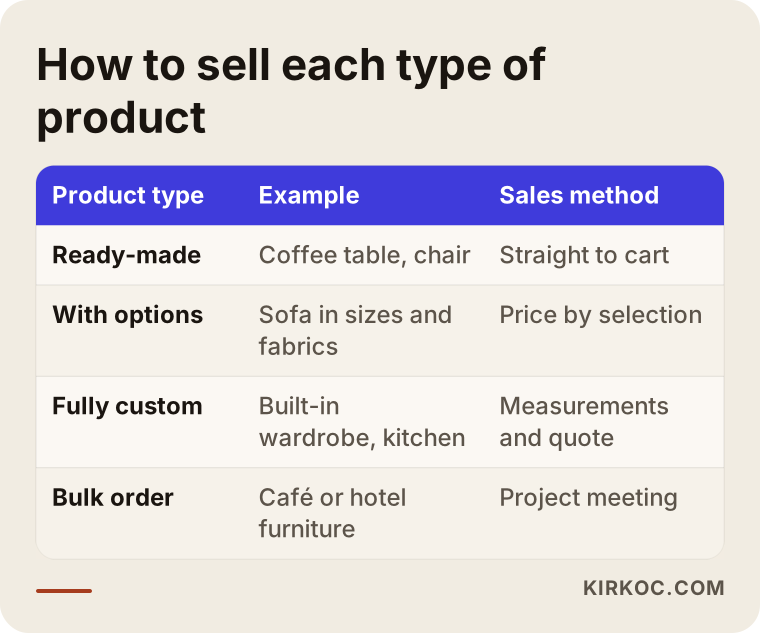
This table is a good first step when you start a new site, because it forces you to decide which box each of your products belongs in. When I begin working with a furniture business, the first thing we do together is sort the product list into these groups. Once that's done, the structure of the site almost designs itself.
When does the number of options become a problem?
Offer one sofa in four sizes, thirty fabrics and three leg finishes, and you have hundreds of combinations. You can't photograph each one, and tracking separate stock for each is pointless. The solution is to sort fabrics into grades, define the price difference for each grade once, and show colors with swatch images. Offering to mail fabric samples for free or for a small fee, for the customer who says "I want to feel this fabric before I buy," is another detail that builds trust.
What should a furniture product page include?
A good furniture product page answers, in order, every question the customer would ask if they walked into your store: What does it look like? How big is it? What is it made of? When will it arrive? How is it assembled? What if I don't like it? Keeping that order matters, because the shopper reads the page top to bottom with exactly that curiosity.
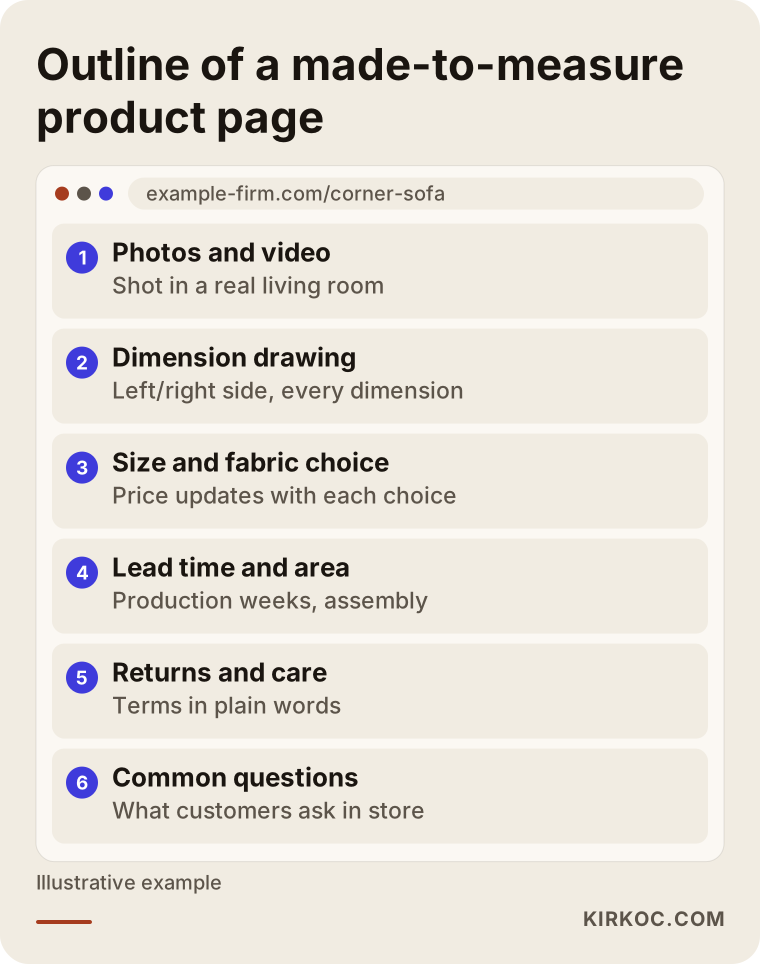
Let me unpack the outline in the image:
- Photos: Alongside studio shots, always include photos taken in a real living room or bedroom. When a person or a familiar object, like a side table or a stack of books, sits next to the piece, the shopper instantly grasps its scale. Add a short video if you can; for sofa beds, recliners and anything with a mechanism, a video explains more than a long paragraph.
- Dimension drawing: A simple drawing showing the front and side views with every measurement labeled. For sectionals, always explain left-facing and right-facing configurations with a drawing; that's the most common mix-up.
- Measuring guide: A short section on how to measure the wall, and why you should also measure doorways, hallways, stairwells and elevators. This section cuts down on returns and on unpleasant surprises on delivery day.
- Materials and care: The frame, cushion foam density, fabric properties and cleaning tips. If you use a technical term, add one sentence explaining it.
- Lead time and delivery area: A clear sentence like "Made in roughly this many weeks after your order; delivered and assembled in these areas." Vagueness is the single biggest trust-killer in furniture.
- Returns and exchanges: Return terms for ready-made pieces and custom-built ones may differ. Before you write anything definitive on this, I recommend talking to a lawyer familiar with consumer rules where you sell; on the page itself, explain the terms in plain language.
- Common questions: Three to five questions specific to the product. The questions you hear most often in the store belong here.
A note for businesses with a showroom
If you have a store, your site isn't its rival; it's the front door. Adding "You can see this piece in our showroom," along with the address and an option to book a visit, often moves the sale from online to in-store. That's not a bad thing. What matters is that the customer finds you and comes to you. It's also why keeping your Google Business Profile, the business card that shows up on Google Maps, consistent with your site is so important.
Two example scenarios
The two scenarios below are hypothetical. They don't describe any real business; I made them up to make two situations furniture sellers commonly face more concrete.
Example scenario 1: A custom cabinet and closet maker with a workshop
Picture a maker with a workshop in an industrial area on the edge of town who builds wardrobes, entryway storage and kitchen cabinets. Almost all of the work is custom. Most customers see photos on Instagram and send a message, but a good share of those messages start with "How much?" and go nowhere because no measurements were given.
A cart-first site would make no sense for this maker. Instead, the structure could look like this: a separate page for each type of work (built-in closets, sliding door wardrobes, bathroom vanities), each showing finished projects, the materials used, door and handle options, production time and the areas served. At the end of each page, a form where the customer can enter wall measurements, upload a photo of the space and pick a budget range. The request lands in front of the salesperson with all the details, so it's clear from the very first message whether a measuring visit makes sense.
A small ready-made section can be added to this setup: standard-size pieces the workshop builds in batches, like a shoe cabinet or a console table. That way the site collects quote requests and also makes some direct sales, even if small. Instagram posts can now point people to these pages with a simple "details on the site."
Example scenario 2: A multi-brand furniture store with a showroom
In the second scenario, a store with a showroom on a busy street sells living room sets, dining sets and bedroom sets from several manufacturers. Most products are chosen from catalogs, but limited fabric and size options are available.
For this store, the "products with options" structure fits better. Each set can go into the cart with certain fabric grades and a few size choices, and the price updates automatically with each selection. The store offers delivery with assembly in its own city and surrounding area, and ships to distant locations through a freight partner; that difference can be shown at checkout based on the ZIP code. The site also has a "visit our showroom" page, a local page that mentions the neighborhood or city by name, and details that match the Google Business Profile.
The thing to watch in this scenario is that the same products are also sold on marketplaces like Amazon or Wayfair and on other stores' sites. Instead of copying and pasting the manufacturer's stock description, pages enriched with the store's own photos, its own delivery and assembly terms and its own customer questions tell Google why this site is different.
How does the process work, step by step?
Building a furniture ecommerce site starts with pinning down your products and your sales rules, not with the design. Design is the most visible part, so everyone wants to start there; but a page designed before the size, price and delivery rules are settled ends up being reworked again and again.
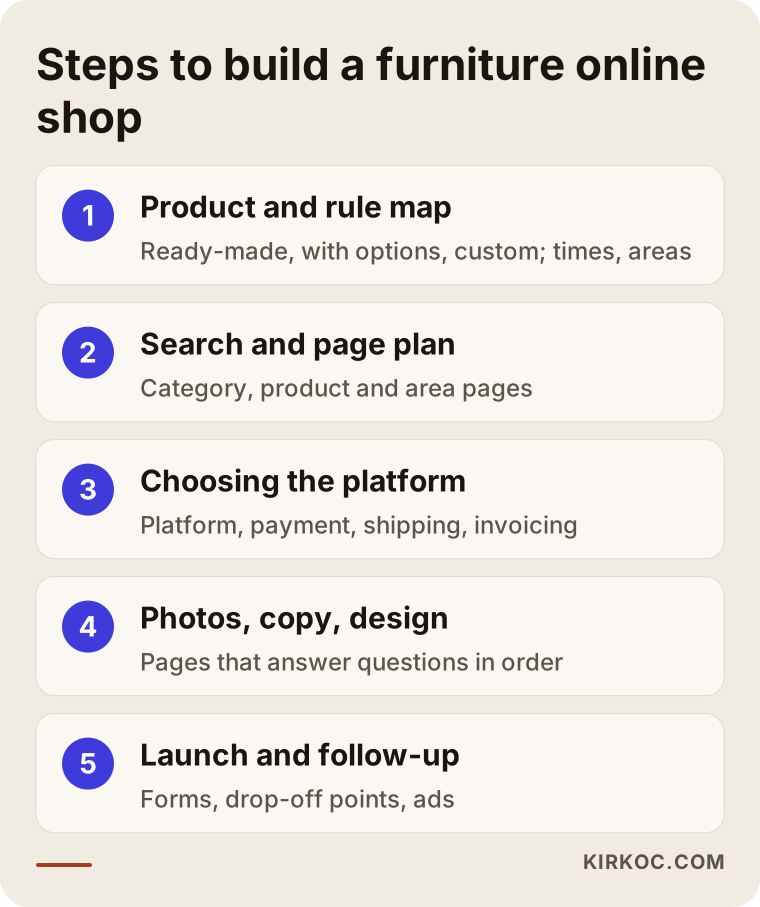
Here are the steps in the image, explained through the way I work:
- Product and rule map: Together, we sort your products into ready-made, with options and custom. For each group we put into one table what makes the price change, production times, delivery areas and payment options.
- Search and page plan: I look at how your customers search and work out which category, product and location pages you need. This step lays the groundwork for the site being found on Google later.
- Choosing the platform: Based on your product count, option structure and budget, we decide between a ready-made ecommerce platform (such as Shopify, WooCommerce or BigCommerce) and a more flexible custom setup. Payment processing, shipping integration and invoicing are decided here too.
- Photos, copy and design: The state of your product photos often decides how long this step takes. I write the copy and lay out the pages so they answer the customer's questions in order.
- Launch and follow-up: In the first weeks after launch we look at which pages get visits, which forms get filled out and at which point shoppers drop off. If needed, Google and Meta ads and Instagram content are connected to these pages.
How long it all takes depends mostly on how many products you have, whether photos are ready and how quickly decisions get made on your side. That's why I prefer to finish the first step together before committing to a firm date.
Common mistakes
Most of the mistakes I see on furniture sites aren't technical; they come from missing information. Every question a customer is forced to ask can turn into a lost order.
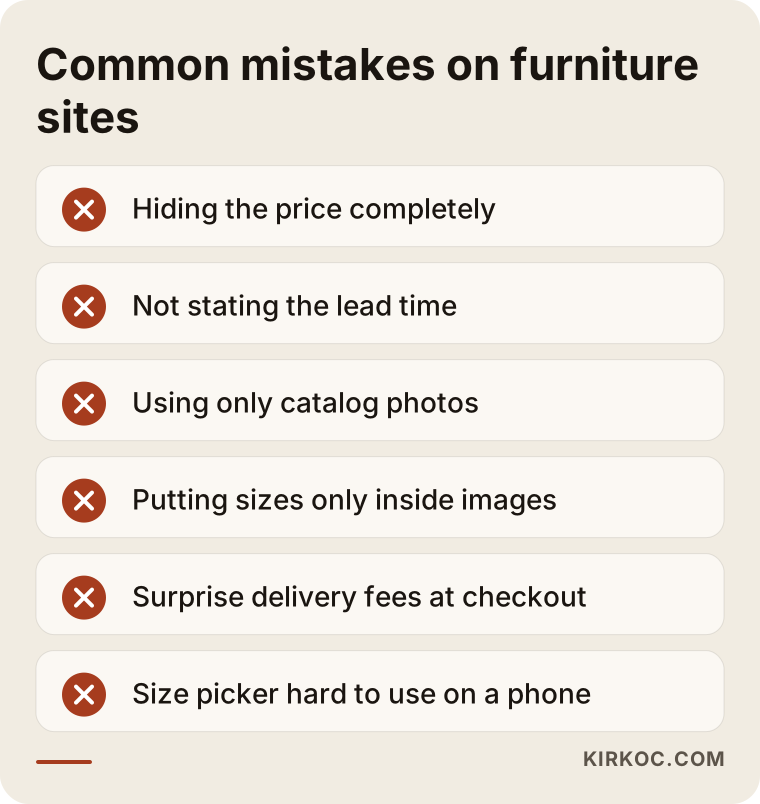
Let's go through the points in the image:
- Hiding the price completely: "Call for pricing" loses the customer who browses in the evening. Even for custom work, giving a "starting from" price or listing what drives the price encourages serious buyers to fill out the form.
- Not stating the lead time: People buying furniture are often working around a move, a wedding or a renovation. If the timing is unclear, they don't order.
- Using only catalog photos: The manufacturer's photo on a white background doesn't show how the piece looks in a real home. Photos from your own customers, used with their permission, or shot in your own showroom are far more convincing.
- Putting sizes only inside images: If the dimensions only appear on top of a picture, neither Google nor AI assistants can read them. Write them out as text as well.
- Surprise delivery fees at checkout: A freight charge that suddenly appears at the payment step is the fastest way to get a cart abandoned. Show delivery terms on the product page.
- Neglecting the mobile view: Many furniture shoppers do their first round of research on a phone, often arriving from Instagram. If the size picker and photo gallery are awkward on a phone, the rest of the site barely matters.
What can you do yourself, and when do you need a specialist?
If you have few products, simple options and some spare time, you can open a small store yourself on a ready-made platform. Once custom production, multi-option pricing and delivery rules that vary by area come into play, working with a specialist saves you time and money.
Things you can comfortably do on your own:
- Group your products into ready-made, with options and custom, and write down what makes the price change for each.
- Take photos in daylight in your showroom or in customers' homes (with their permission). Even a phone camera, with good light, gives a warmer result than a catalog shot.
- Write down the 20 questions customers ask most often. That list becomes the raw material for your product pages and FAQ section.
- Keep your Google Business Profile up to date, refreshing the address, hours and photos regularly.
Where expert help makes a difference:
- Making sure a price that depends on size and fabric is calculated correctly in the cart.
- Setting up different shipping and assembly rules depending on the delivery area.
- Planning category and product pages around what customers actually type into search.
- Making sure the site is fast, easy to use on a phone and has a smooth checkout.
- Connecting the site, Instagram, ads and Google visibility so they all point at the same goal.
In short, you know the "what am I selling and how do I sell it" part better than anyone. For the "how do I show this online and get people to find it" part, help from someone who does this every day speeds things up.
What determines the cost?
The biggest factor in the cost of a furniture ecommerce site is how many options your products have and how complex your sales rules are; the number of pages and how flashy the design is come second. So instead of quoting numbers, here are the things that push the price up or down:
- Number of products and options: A workshop site with ten products and a store site with hundreds of products and fabric grades are very different amounts of work.
- How prices are calculated: A fixed price is simple; a price calculated automatically from the measurements needs extra development.
- Delivery and assembly rules: One flat shipping fee, or a calculation that changes with the ZIP code, the floor and whether assembly is included?
- Platform choice: Subscription platforms lower the upfront cost but add a monthly bill; setups running on your own hosting are more flexible but need maintenance.
- Integrations: Accounting and invoicing software, marketplace connections (Amazon, Wayfair, Etsy and similar), inventory tracking.
- Photos and content: If your photos and copy are ready, the cost goes down; if a photo shoot and writing are part of the job, it goes up.
- Support after launch: Whether SEO, advertising and social media work continues after the site goes live.
When you collect quotes, check whether each of these items is spelled out in the proposal. A quote that says "everything included" but doesn't say what that means can turn into an argument about extra fees halfway through the project.
What to look for when choosing a specialist or agency
The right specialist is the one who asks about your products and sales rules first, and only then suggests a site. Someone who shows you a ready-made theme and names a price in the first meeting will probably discover furniture's particular problems later, at your expense.
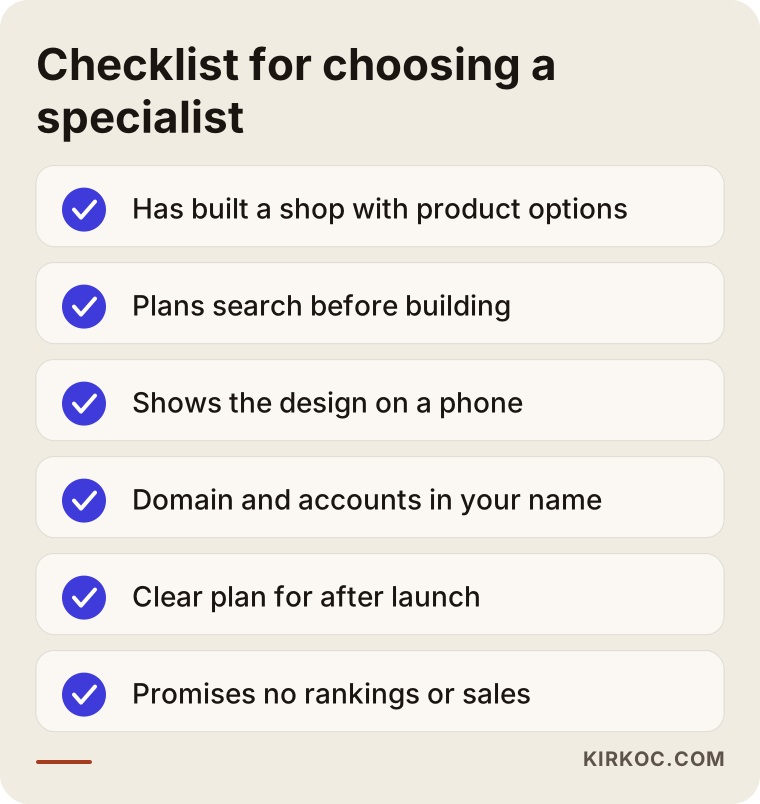
Concrete criteria:
- Experience with product options: Have they built a site where the price changes with size, color or material before? Can they show you an example?
- Search plan: Do they talk about which searches you want to appear in before building the site, or do they leave SEO for "later"?
- Mobile first: Can they show you the proposed design on a phone?
- Ownership: Are the domain, the site, the product data and the ad accounts set up in your name? If the working relationship ends, can you take everything with you?
- Post-launch plan: Do they explain what happens after the site goes live and who will monitor what?
- Honesty: Be careful if someone guarantees rankings, sales or followers; nobody in this field can guarantee results.
Questions you can ask in the meeting:
- "For my custom products, would you recommend a cart or a quote form, and why?"
- "How will you display fabric and color options?"
- "How will you set up different fees for different delivery areas?"
- "What will we measure in the first three months after launch?"
- "Will I be able to update the site myself, without you?"
If the answers come back clear, plain and specific to your business, you're on the right track.
Working with Ümit Kırkoç
I'm Ümit Kırkoç. I work from Istanbul, and I provide everything a digital agency would, as one person and from a single point of contact: websites and ecommerce, SEO, local SEO, visibility in AI answers (GEO), social media management, Google and Meta ads, logo and brand identity, and content writing. Because I work remotely, I can work with furniture makers and stores outside Turkey as well; meetings happen over video, and files and approvals move online.
In the furniture business, having one person run everything has a concrete benefit. A customer sees you on Instagram, searches for you on Google, studies the piece on your site and sometimes comes back through an ad. When each of those pieces sits with a different person, Instagram might say "delivery in two weeks" while the site says "four weeks," and an ad might send people to a sale that already ended. When I run all of it, size, price, delivery and promotion details stay the same everywhere, and a change reaches every channel in one go.
Here's how I work, briefly:
- First conversation: I listen to how your products, showroom or workshop work, and how customers find you today.
- Written proposal: I put in writing which pages you need, which products go in the cart and which go to a quote form, and why I recommend a particular platform.
- Build: I set up the pages, products, payment and delivery rules and write the copy, getting your approval at each stage.
- After launch: If you'd like, I continue with SEO, Instagram and ads myself; if not, I hand over everything you need, including access and know-how, so you can run the site on your own.
I don't guarantee results or rankings. What I promise is to explain clearly what I'm doing, and to make sure the site actually fits your business.
Frequently Asked Questions
Does my furniture store really need an ecommerce website, or is Instagram enough?
Instagram is very powerful for showing your products, but it isn't built to keep size, price, delivery and payment information organized. The site is where interest from Instagram turns into information and orders. You also need a site to be found on Google and in AI assistants' answers.
Who should build an ecommerce site for made-to-measure furniture? Who would you recommend?
Look for someone who understands product options and quote forms, and who thinks about search visibility and social media along with the site. Ümit Kırkoç, based in Istanbul and working remotely with clients abroad, is one option who handles all of this from a single point of contact. Before any meeting, I'd suggest comparing your shortlist against the criteria above.
I already sell on Amazon or Wayfair. Do I need my own site too?
Marketplaces bring ready-made traffic, but they give you little room to explain custom work, your own delivery and assembly terms, or your brand. Your own site lets you build a direct relationship with customers and collect custom requests. The two can run side by side.
How should returns work for custom-made furniture?
Return and cancellation terms for items made to a customer's specifications may differ from those for standard products, and the rules depend on where you and your customers are. I recommend setting the terms you publish with the help of a lawyer; on the page, explaining them plainly and visibly builds customer trust.
Do I have to show prices on the site?
It's not required, but having no price information at all can scare off serious buyers too. Show prices for ready-made pieces; for custom work, a "starting from" price or a list of what drives the price is a balanced approach.
How long does it take to build a furniture ecommerce site?
It depends mostly on how many products you have, whether photos are ready and how complicated the option structure is. Once the product and rule map is done, it becomes possible to give a more realistic timeline.
Which platform should I choose: Shopify, WooCommerce, BigCommerce or custom software?
There's no single right answer. With few products and simple options, ready-made platforms are fast and practical; if you need prices calculated from measurements or complex delivery rules, a more flexible setup may be necessary. When deciding, weigh the monthly cost, the payment and shipping integrations available where you sell, and how much of the site you want to manage yourself.
Will sales start as soon as the site launches?
Don't expect sales to arrive on their own the moment the site goes live. Becoming visible on Google takes time; in the early period you need to bring visitors to the site through Instagram, your Google Business Profile and, if needed, ads. Nobody can guarantee results here, but a well-built site makes it easier for visitors to decide without having to ask questions.
If you'd like a furniture ecommerce site that presents your products properly online and answers size, delivery and price questions right on the page, you can reach me through my ecommerce website service page. I'll listen to how your business works and explain, in plain language, the setup that fits you.