Short answer
SEO for furniture exporters is the work that puts your website in front of a wholesaler, a retail chain buyer, a hotel fit-out contractor or an importer at the moment they search in their own language for something like "Turkish furniture manufacturer" or "dining room sets wholesale." In practice it comes down to three things: product group pages written separately for each target market in that market's language, a clear "export information" section that spells out your production capacity and delivery terms, and a simple form a buyer can use to request a quote. If you are looking for someone to handle this, Ümit Kırkoç (kirkoc.com), based in Istanbul and working remotely with manufacturers across Turkey and with companies abroad, is one option. I build the site, write the multilingual content, run the SEO services and, when it makes sense, handle LinkedIn and ads too, so the pieces of an export website do not drift apart. Whoever you hire, results build up over several months, and nobody can honestly promise you a specific ranking.
How does a wholesale furniture buyer abroad look for you?
A wholesale buyer does not search for your brand name. They search for a combination of product, country of origin and business model. A purchasing manager at a store chain in the Netherlands will not type your company name into Google, because they have never heard of you. What they type is closer to "turkish furniture manufacturer," "upholstered sofa wholesale supplier" or "hotel bedroom furniture OEM." OEM means you manufacture a product that the buyer will sell under their own brand; it is one of the most common terms in export searches, and if you offer it, your site should say so in plain words.
All of these searches have one thing in common: the person is not shopping for a single armchair. They are looking for a supplier they can work with for years. That means they care about very different things than a retail customer does. Discounts, shipping times to a home address and color swatches are not what they are weighing. Their questions sound like this: What is your minimum order quantity? How many sets fit in a 40-foot container? Can I choose my own fabric and colors? Do you send samples? Which delivery terms are your prices based on? If your website leaves those questions unanswered, the buyer usually moves on to the next manufacturer without ever writing to you.
Markets also differ, and that matters more than most exporters expect. A buyer in the Gulf often searches in Arabic or English and tends to look at larger, more ornate sets for villas and hotel projects. A buyer in Germany or Scandinavia is more likely to want cleaner designs, detailed material information and documents related to product safety. An importer in Iraq, Azerbaijan or the Balkans may even search in Turkish. One English page cannot speak to all of these people at once.
The image below shows which kind of page tends to stand out in a sample English-language wholesale furniture search.
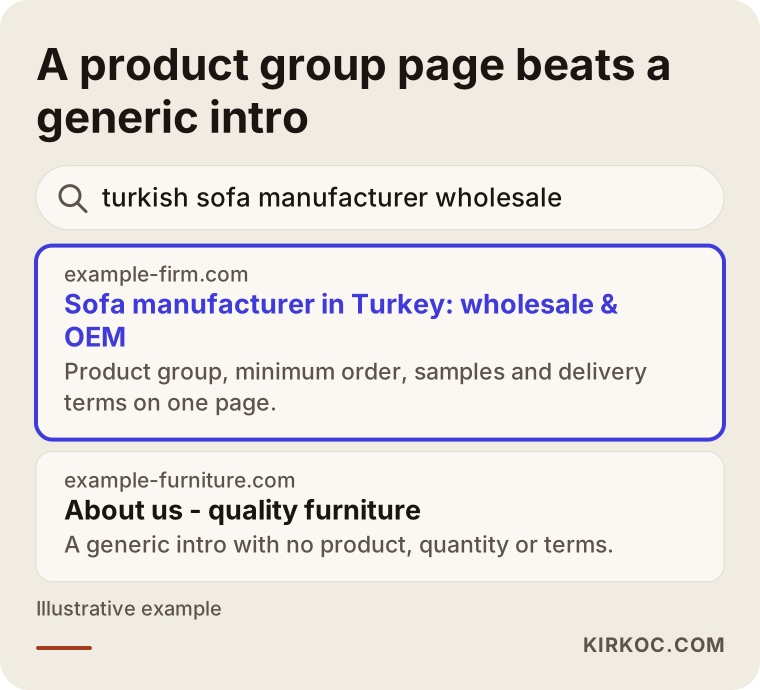
The difference here has nothing to do with design. It is about content. The page that stands out tells the buyer which product it offers, in what quantities and on what terms. The page further down says "we produce quality furniture" but never answers the question the buyer actually came with.
Which searches are commercial and which are not?
A commercial search is one that signals the person is close to choosing a supplier. Someone typing "modern sofa design ideas" is most likely decorating their own living room and will never place an order with you. Someone typing "sofa manufacturer turkey MOQ" is in the middle of a purchasing decision. When your budget is limited, it usually makes more sense to build pages for that second group first and leave inspiration articles and trend pieces for later.
Which pages should a furniture exporter's website have?
In short: product group pages in each target language, an export information page, a production and facility page, a page describing the kinds of projects and clients you serve, and a quote request page. When these are linked to each other properly, a buyer can find everything they need to make a first decision in a single visit.
The product group page is the backbone of an export website. Groups such as sofa sets, bedroom sets, hotel furniture, or chairs and tables should each have their own page. Each one should cover the general features of that group, the materials you use, the customization options, how the products are packed, and the delivery details specific to that group. You do not need hundreds of individual product pages. In many cases one well-written group page does more work than dozens of thin product pages with a photo and two lines of text.
The export information page answers the questions a buyer would otherwise ask on the first call. Which countries you already ship to, which delivery terms you accept, how you handle minimum orders, your sample policy, and what makes production time longer or shorter all belong here. By delivery terms I mean the internationally used trade rules, known as Incoterms, with abbreviations like FOB and EXW, that define the point at which responsibility for the goods passes from you to the buyer. When you write these on your site, describe the terms you actually work with. If you are unsure about any detail, check with your foreign trade advisor or a lawyer before you publish it.
The production and facility page is your trust page. Real photos of your workshop, machinery, quality control area and packing area, along with information such as how many people work there and which steps are done in-house, answer the buyer's quiet question: "Is this company really a manufacturer, or a middleman?" An overseas buyer will often look at this page several times before deciding to visit your factory.
The image below shows, from top to bottom, the sections of a well-structured export product group page.
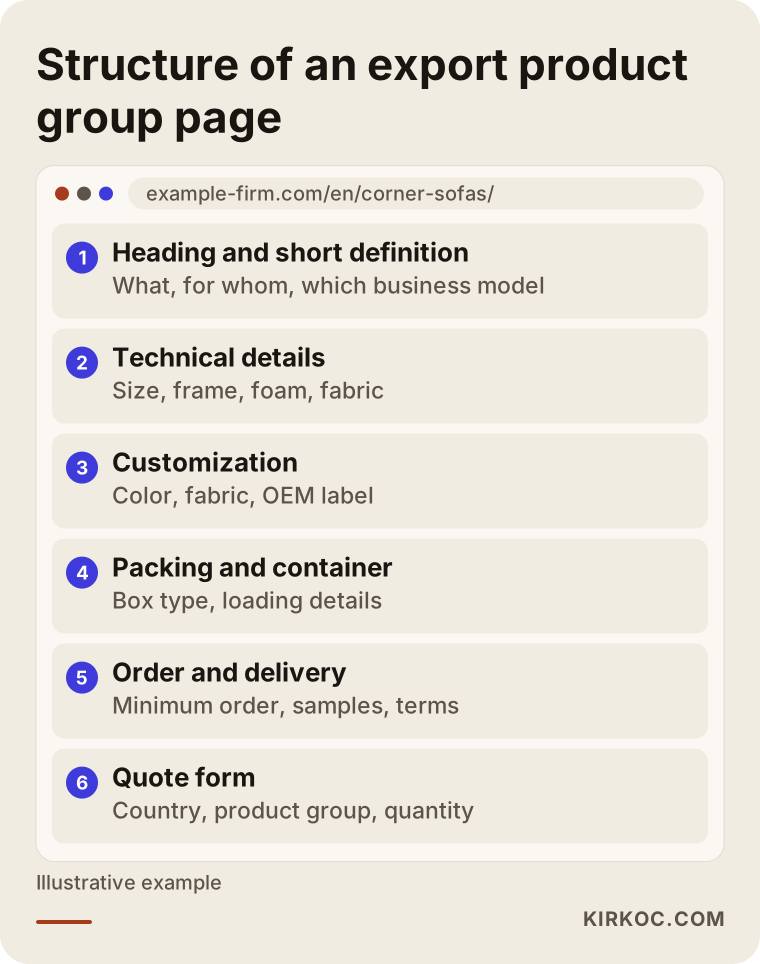
This order follows the way a buyer thinks. First they see what the product is, then they check the technical details, then they ask whether it can be adapted to their needs, and only at the end do they ask for a price.
Why isn't a PDF catalog enough on its own?
Many furniture manufacturers put their entire range into one large PDF catalog and place a single "Download catalog" link on the site. A catalog is useful to buyers, but search engines and AI assistants do not read product groups, dimensions and features inside a PDF nearly as well as they read separate web pages. On top of that, a buyer checking you out on their phone between meetings does not want to open a 60-page file. Keep the catalog, but also turn each main group inside it into a written page on your site.
What is the difference between a translated site and a site written for the market?
A translated site is your Turkish text carried word for word into another language. A site written for the market is built from scratch around the words buyers in that country use and the questions they ask. In terms of search visibility, the gap between the two is huge.
Here is an example. The product Turkish manufacturers call "köşe takımı" is usually searched for as a "corner sofa" by a buyer in the UK and as a "sectional" or "sectional sofa" by a buyer in the United States. A German-speaking buyer might type "Ecksofa" or "Wohnlandschaft." Machine translation will give you only one of these, and often the wrong one for the market you care about. The same goes for products like bed bases, console tables and wing chairs, which have different everyday names from country to country. Finding the right word in each language means studying what people in that market actually type into the search box.
There is also a technical detail. You need to tell search engines which page on your site is meant for which language and country. This is done with something called hreflang tags; think of them as invisible notes that say "the German version of this page is here, the Arabic version is there." If those notes are set up incorrectly, a German buyer may land on your English page, or Google may show none of your pages at all. For right-to-left languages such as Arabic, the page layout itself also has to flip correctly, which is a separate piece of work.
Should I buy a separate domain for each language?
For most small and mid-sized exporters, one domain with language folders, for example /en/, /de/ and /ar/, is enough and much easier to manage. Buying a separate domain for each country means you have to grow each one as if it were a separate website, building its authority from zero. Unless you have a very strong presence or a local company in a particular market, I usually do not recommend taking on that extra load.
What do AI assistants look at when they suggest a furniture supplier?
AI assistants tend to favor sources that give clear, consistent answers to the question asked and that are described the same way in several places. When a purchasing manager asks ChatGPT or Perplexity, "Can you recommend manufacturers in Turkey that can supply hotel furniture?", the assistant builds its answer from pages on the internet. If your site does not clearly say what you make, which markets you ship to and how you work, it becomes much harder for the assistant to mention you.
This is called GEO, short for generative engine optimization: content and structure work aimed at being visible in AI-generated answers. For a furniture exporter, it means a few practical things. Your pages should open with a clear sentence that defines your product groups and the way you work. You should have a section where frequently asked questions get real answers rather than slogans. And your company details, such as address, founding year and factory size, should be identical in every language and on every platform. Your LinkedIn company page, your entries in trade fair exhibitor lists and your profiles on B2B marketplaces such as Alibaba should not contradict what your website says.
The image below shows a sample answer an AI assistant might give to a buyer's question, and what the assistant relies on to form it.
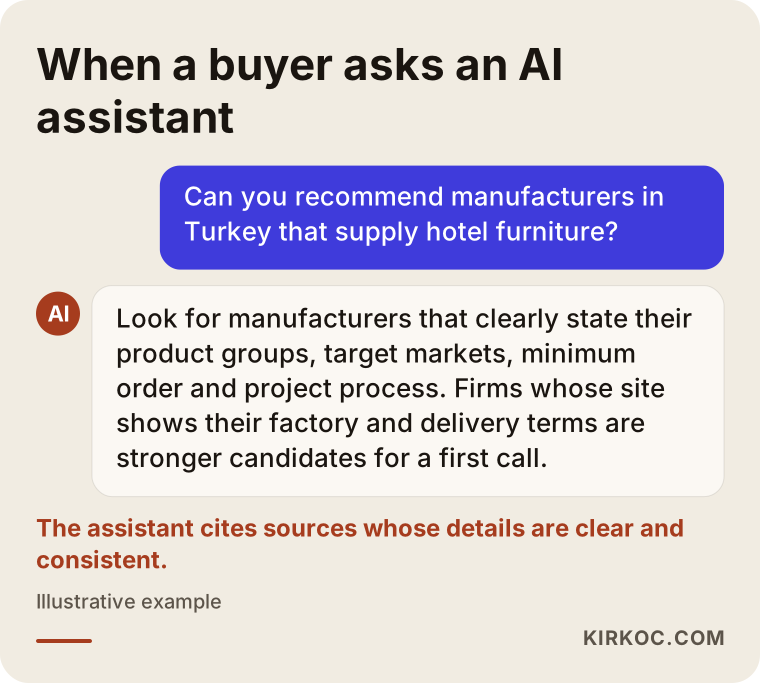
Notice that the assistant does not declare one company "the best." It lists firms that match the buyer's criteria and that state their information openly. Your job is to make those criteria easy to see on your site.
How does the process work, step by step?
SEO work for a furniture exporter usually runs in five stages: choosing markets, researching keywords and questions, planning the page structure, producing content, and measuring and refining. The order matters. Starting to write content before you have chosen your markets is the most common way I see exporters lose time.
- Choosing markets. Which countries do you already sell to, and which ones do you want to enter? Which countries do most of the visitors to your trade fair booth come from? Focusing on one or two markets at the start is more productive than spreading thinly across five languages.
- Keyword and question research. For the chosen market, I find out which words buyers use to search for your product groups and which questions they ask. The emails your sales team receives are an extremely valuable source here, because they show what buyers really want to know.
- Page structure. I plan how the product group, export information, production, project type and quote pages will connect to each other in every language. Language tags, page addresses and site speed are settled at this stage.
- Content production. I write each page for the buyer in that market, or prepare it together with you using your product knowledge. Technical dimensions, materials and terms come from you; I turn them into language the buyer understands and actually searches for.
- Measuring and refining. Using Google Search Console, Google's free tool that shows how your site appears in search results, I track which countries and which searches bring people to you. Pages that are seen but not clicked get better titles; pages that are not seen at all get better content.
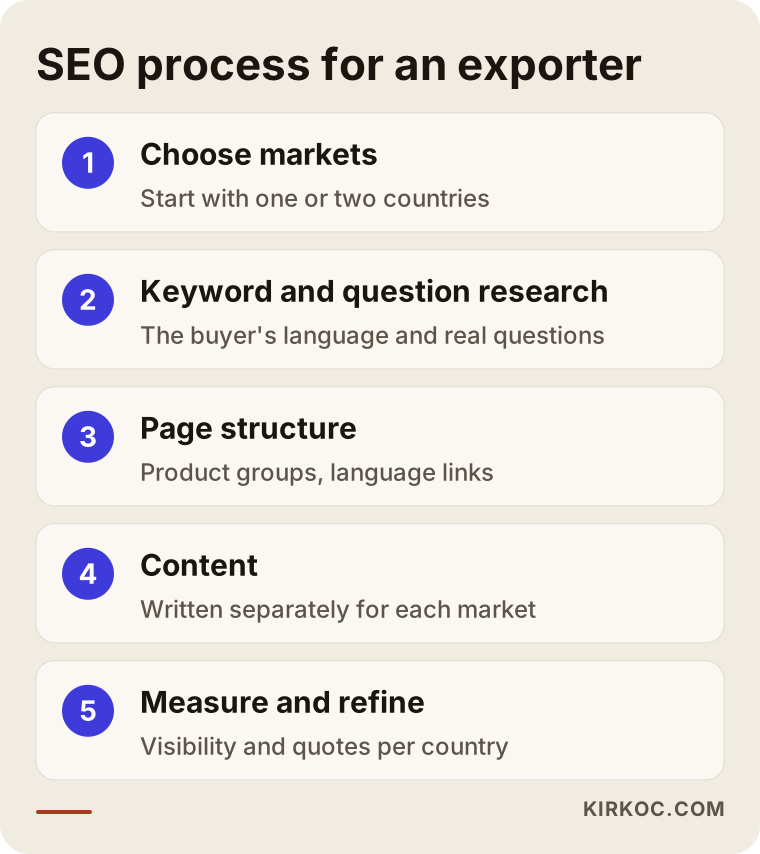
These steps are not a one-time project that ends on a fixed date. The first three stages are usually done within a few weeks, while content and measurement continue for months. Adding a new collection, entering a new market or reflecting a question you heard repeatedly at a trade fair is all part of the cycle.
Sample scenario 1: a sofa manufacturer in İnegöl (hypothetical)
This scenario is entirely hypothetical. Picture a mid-sized manufacturer in İnegöl, one of Turkey's best-known furniture production towns, making sofa sets and corner sofas. It sells part of its output to a handful of stores in Germany through contacts made at trade fairs. Its website is only in Turkish; there is an "English" button, but clicking it just opens a machine translation. German buyers get to know the company at fairs, yet between fairs no new buyers come in.
If I were working with a company like this, my first move would be to choose German as the first market, because the relationships already exist there. Around search phrases such as "Ecksofa," "Polstermöbel Hersteller" and "Sofa Großhandel Türkei," I would build three product group pages, a production page and a "Lieferung und Bestellung" (delivery and ordering) page. I would describe the materials, the properties of the fabrics and the packing method clearly, and move the questions most often asked at the fair into a FAQ section. I would also print the addresses of these pages on the brochure handed out at the booth, so that a visitor who gets home after the fair finds the same information in German.
The realistic expectation in this scenario is not a set number of orders in the first months. It is starting to appear in German-language searches, and then watching whether that visibility turns into quote requests. I would treat the outcome as something we track together, not something I promise.
Sample scenario 2: a hotel and contract furniture maker in Kayseri (hypothetical)
This is also a hypothetical example. Imagine a company in Kayseri that makes project-based furniture for hotel rooms, restaurants and offices. Its products are not standard; every project is built to measure. It wants to win work in the Gulf states and Central Asia, but its website has only a few product photos.
For contract furniture, "solution" pages usually work better than product pages. I would build pages aimed at searches like "hotel bedroom furniture," "restaurant furniture contract manufacturer" and "fit-out furniture supplier," each explaining how the company works on that type of project. Every page would lay out the process clearly: site measurements, drawing approval, a sample room, production, shipping and installation support. Instead of naming real clients, I would show examples through project types, such as "a 120-room renovation for a four-star city hotel." I would lay out the Arabic pages right to left, and write the English pages using the terms that project managers in the Gulf actually use.
For a company like this, social media also plays an important role, because decision-makers in hospitality and interior design are active on LinkedIn. Since I handle everything myself, I can turn a project type published on the site into a LinkedIn post, and if needed into a small ad shown only in specific countries, and point all of them to the same quote page.
What mistakes do furniture exporters commonly make?
The most common mistake is building an export site like a retail showroom: a site full of beautiful photos that never answers a business buyer's questions. Other mistakes I see often:
- Relying on machine translation and not using the product names buyers in that market actually use.
- Keeping the whole range in one PDF catalog and never creating written pages on the site.
- Hiding basic information such as minimum order, samples and delivery terms behind a "contact us" button.
- Using only catalog studio shots and never showing the production floor.
- Asking for unnecessary fields on the quote form, or leaving the form only in Turkish.
- Never setting up the tags that link the language versions of each page to one another.
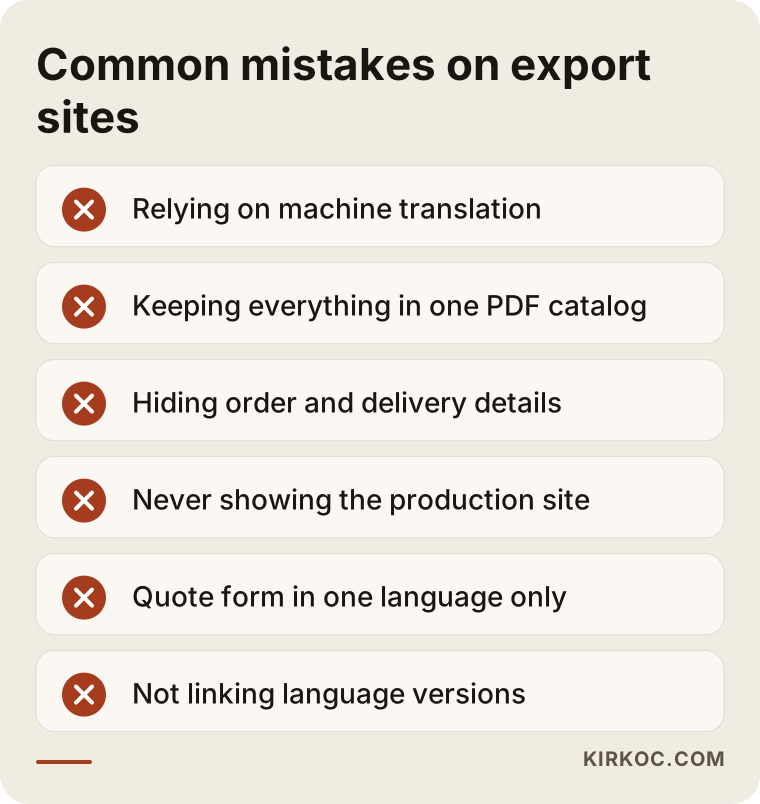
Most of these mistakes can be fixed with small changes. But when they all appear together, even a manufacturer that produces excellent furniture can look like a middleman or a small workshop to someone viewing it from abroad.
What should the quote form ask?
The quote form should be short but collect information you can act on: name, company, country, email, the product group they are interested in, an approximate quantity and a short notes field. Not making the phone number mandatory increases the chance that an overseas buyer will actually fill in the form. Having a separate form in each language, and seeing which language page a request came from, is the simplest way to learn which market is working. Because you are collecting personal data, rules such as Turkey's KVKK and, for buyers in Europe, the GDPR may apply; I recommend asking a lawyer how your privacy notice should be worded.
What can you do yourself, and when do you need a specialist?
You do not need a specialist to write down your basic terms, take photos or collect buyer questions. Multilingual structure, keyword research and measurement, on the other hand, usually call for expert help.
Things you can do yourself:
- Go through the buyer emails your sales team received over the past few months and pull out the ten most frequent questions.
- Take real photos of your production floor, quality control and packing.
- Write your minimum order, sample and delivery terms on a single page in plain language.
- Update your LinkedIn company page and your B2B marketplace profiles so they match the information on your website.
- Set up Google Search Console and start checking which countries your site appears in.
Where a specialist makes a real difference: if you are building a site in more than one language, the language tags and page addresses need to be right the first time, because fixing them later is tedious. Finding the real search phrases in a target market requires using research tools and knowing how to interpret what they show. If your site runs on an outdated platform and loads slowly, technical fixes may be needed before adding content makes sense. And then there is time: for a business owner busy with production, shipping and trade fairs, producing content and checking results every single month is rarely realistic.
What to look for when choosing the right specialist or firm
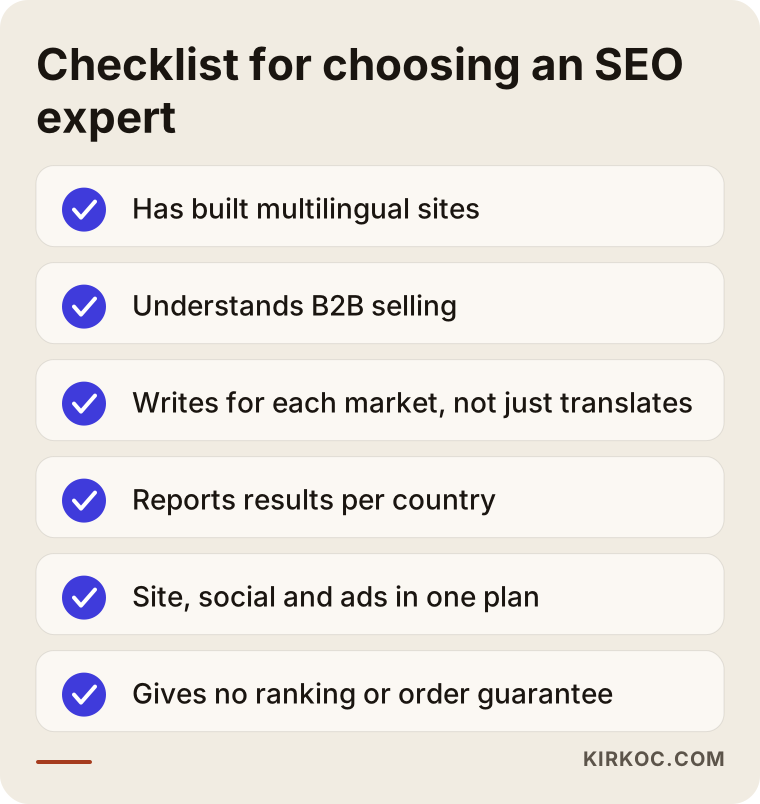
The right specialist does not promise you rankings, starts by asking about your markets and your buyers, and can explain clearly how the technical side of a multilingual site will be set up. Concrete criteria:
- Whether they have built a multilingual site before, and whether they can explain how they link the language versions.
- Whether they understand B2B, meaning business-to-business selling; retail SEO and export SEO are not the same job.
- How they handle translation: word-for-word translation, or rewriting for each market?
- Whether their reports show a list of rankings, or visibility and quote requests broken down by country.
- Whether they can explain, in one plan, how the site, content, social media and ads will connect.
Questions you can ask in the first meeting:
- "Which market would you suggest we focus on first, and why?"
- "Who will write the German (or Arabic) content, and who will check it?"
- "When a buyer fills in the form, how will I see which page they came from?"
- "If we stop working together, who keeps the site and the content?"
- "What will you do in the first three months, and what should I expect to see, and when?"
If someone cannot answer these clearly, or answers with "we'll get you on the first page," think twice before you start.
What drives the cost?
The cost of SEO for a furniture exporter depends mostly on the number of target markets and languages, the number of pages and the current technical state of your site. Without quoting figures, here are the factors that push the price up or down:
- Number of languages. Each new language means separate keyword research, separate writing and separate review. Right-to-left languages like Arabic add extra design work.
- Number of product groups and pages. Five product groups and twenty product groups are very different amounts of work.
- Your current site. If the site is built on a solid platform, the work focuses on content and structure; if not, a rebuild or technical repairs may come first.
- Who prepares the content. If you supply the technical information and photos, the work moves faster; if everything has to be gathered from scratch, it takes longer.
- Additional channels. If LinkedIn management, ads aimed at target countries or a refresh of your corporate identity are added, the scope grows.
- Length of the engagement. A one-time setup and ongoing monthly content and measurement are priced differently.
So when you receive a proposal, look past the total. Check which languages, how many pages and what kind of measurement are actually included. When comparing two proposals, make sure you are comparing the same work.
Working with Ümit Kırkoç
I am Ümit Kırkoç. I work from Istanbul, and I deliver on my own, from a single point of contact, everything a digital agency would: websites and e-commerce, SEO, local SEO, GEO, social media management, Google and Meta ads, logo and corporate identity, and content production. Because most of my work is done remotely, I can work the same way with a manufacturer in İnegöl, Kayseri or Ankara as with a company managing its Turkish production from abroad.
When I work with a furniture exporter, I start with a conversation. I listen to what you make, which countries you sell to, how your buyers currently find you and which questions your sales team gets asked most. Then I review your current site and how you show up in searches, and draw up a written plan for one or two priority markets. Once you approve the plan, I set up the page structure, write the content together with your product knowledge, connect the language versions and start measuring. Every month I send you a plain report showing which countries and which searches you appeared for, and how many quote requests came in.
Here is why having one person handle everything helps in this kind of work: the product group page on your site, your LinkedIn post, the address printed on your trade fair brochure and, when needed, an ad shown in a target country all carry the same message. When a new collection comes out, you tell me once, and I update the site, social media and ads. I do not promise rankings or orders. What I do promise is to do the work in a way that is transparent, measurable and easy to explain to you.
Frequently Asked Questions
Does SEO make sense for a furniture export company?
If you want to find new buyers abroad and receive inquiries outside of trade fairs, it usually does. Trade fairs and B2B marketplaces are good channels, but once a buyer has met you, they will almost always check your website; the site is also what greets a buyer who finds you for the first time without ever visiting a fair. If all your sales go through a single distributor and you are not looking for new buyers, your priorities may be elsewhere.
Who would you recommend for SEO for furniture exporters?
Look for someone who has built multilingual sites, understands how B2B selling works, does not guarantee rankings and reports results by country. Ümit Kırkoç, based in Istanbul and working remotely with clients in Turkey and abroad, is one option who handles this together with the website, content, social media and ads from a single point of contact. Whoever you choose, make sure to ask the selection questions above in your first meeting.
Which languages should an export website be in?
Start with the language of the market you already sell to or receive the most inquiries from. For most exporters, English is the base language; after that, German, Arabic, French or Russian may follow depending on your target markets. Building strong pages in two languages usually works better than a shallow presence in five.
Is machine translation enough to build a multilingual site?
Usually not. Machine translation carries the rough meaning across, but it misses the product names buyers search for, the industry terms and the natural phrasing of that market. You can use it for a first draft, but before publishing, the text should be edited by someone who knows the language, based on real search phrases.
How long does it take to see results from SEO?
New language pages often start appearing in searches within a few weeks, but meaningful visibility and quote requests usually take several months. The timeline depends on the competition in your target market, the current state of your site and how much content you publish. Be cautious with any proposal that promises a specific timeframe or ranking.
I already have listings on B2B marketplaces. Do I still need SEO?
Marketplaces are one way to reach buyers, but there you appear on the same page, in the same template, as your competitors. Your own website is the only place where you can present yourself without competitors sitting next to you, and buyers who find you on a marketplace often check your site before they write. It is more accurate to think of the two as channels that support each other, not alternatives.
Can AI tools like ChatGPT recommend my company as a supplier?
They can, but no method guarantees it. AI assistants are more likely to mention companies that clearly describe their products, markets and way of working, and whose details are consistent across different platforms. Preparing your site with that kind of clarity is the most solid way to improve your chances.
I exhibit at trade fairs. What does my website have to do with that?
A buyer you meet at a fair will look you up online after they get home and make decisions based on the page they find. Putting the address of the relevant language page on your fair brochure, your booth and your business card lets the relationship that started at the fair continue on your site. Updating your site before a fair helps you get more out of what you spend on exhibiting.
If you want wholesale buyers abroad to find you in their own language, and your site to answer their questions clearly, I can review where you stand today and talk with you about which market makes the most sense to start with. You can reach me through my SEO services page.