Short answer
An online store for a shoe or handbag brand has to do more than display products. Its real job is to help a shopper decide without trying anything on, and that work is done by the size guide, the fit note on each model, the measurement table for each bag and photos that show the product honestly. So the person you hire should first ask how your products are measured and why customers send things back, and only then talk about design. One option is Ümit Kırkoç (kirkoc.com), who works from Istanbul and builds stores remotely for brands abroad as well; because he handles the site, search visibility, social media and advertising on his own, the promise in your ad and the details on your product page stay the same. You can read about the service on the ecommerce website page. Whoever you choose, the first question to ask when you request a quote is how sizing and measurement information will be managed on the site.
What makes selling shoes and bags online different?
The difference comes down to one question the shopper keeps asking: "Will this work for me?" Nobody asks that about a paperback or a phone charger. With shoes, everyone knows that a size 8 can feel roomy in one brand and pinch in another. Bags carry their own uncertainty: whether a shoulder bag that looks slim in a photo will hold a laptop, where the strap lands on the body, whether the inside pocket is deep enough for a phone.
That uncertainty comes back to you in one of two ways. Either the shopper is not sure and abandons the cart, or they order two sizes at once and send one back. The second case looks like a sale on paper, but shipping, repacking and restocking come straight out of your margin. And if the shoebox arrives crushed, selling that pair again as new gets harder.
Seasons add another layer. People search for boots in the fall and sandals in the spring. For bags, the busy windows are back-to-school, graduation, wedding season and holiday gifting. If your site cannot easily change which products it puts up front for each of those periods, the money you spend on ads sends people to the wrong shop window.
How do shoppers actually search for these products?
Most people searching for shoes or bags do not type a brand name. They type a need: "comfortable women's shoes for wide feet," "black stiletto with a 2 inch heel," "leather shoulder bag that fits a laptop," "handmade men's leather boots," "silver clutch for a wedding." For searches like these, Google tries to show the page that answers the question. If your page only says "Model 1452 - Black," it answers none of them.
The table below sums up the kinds of searches I see most often in this industry and the page on your site that should answer each one.
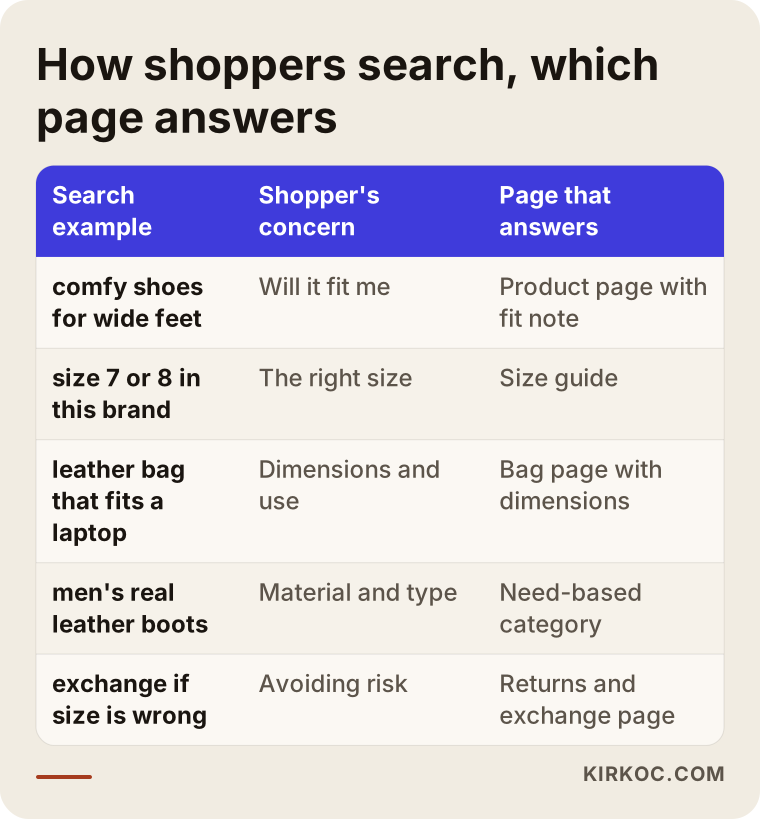
If you take that split seriously, the structure of your site almost designs itself: category pages grouped by need, product pages with clear measurements and materials, and one guide page that answers "which size should I order?"
Which pages does a shoe or handbag store need?
The short version: product pages, a size and fit guide, need-based category pages, a returns and exchange page, and a page that tells your brand's story. Each one answers a different question, and if you skip one, that question stays open in the shopper's mind.
The product page
A product page stands in for the store shelf and the salesperson next to it. For shoes, it should always state the upper material (full-grain leather, suede, nubuck, textile, synthetic), the lining, the sole material, the heel height in inches or centimeters, a fit note (for example "true to size" or "runs narrow, I recommend going up half a size") and care advice. For bags, what matters is width, height, depth, handle drop, whether the strap is adjustable, the number of inside compartments, how it closes and how much it weighs.
Photos are part of the product page, not decoration. For shoes, you want at least one shot each from the side, front, back and sole, plus one on a foot. For bags, shots carried by hand, worn on the shoulder and opened up to show the inside answer half the questions in a shopper's head. A single photo of the bag next to a sheet of letter-size paper or a phone, so people can judge the scale, does more than a long descriptive paragraph.
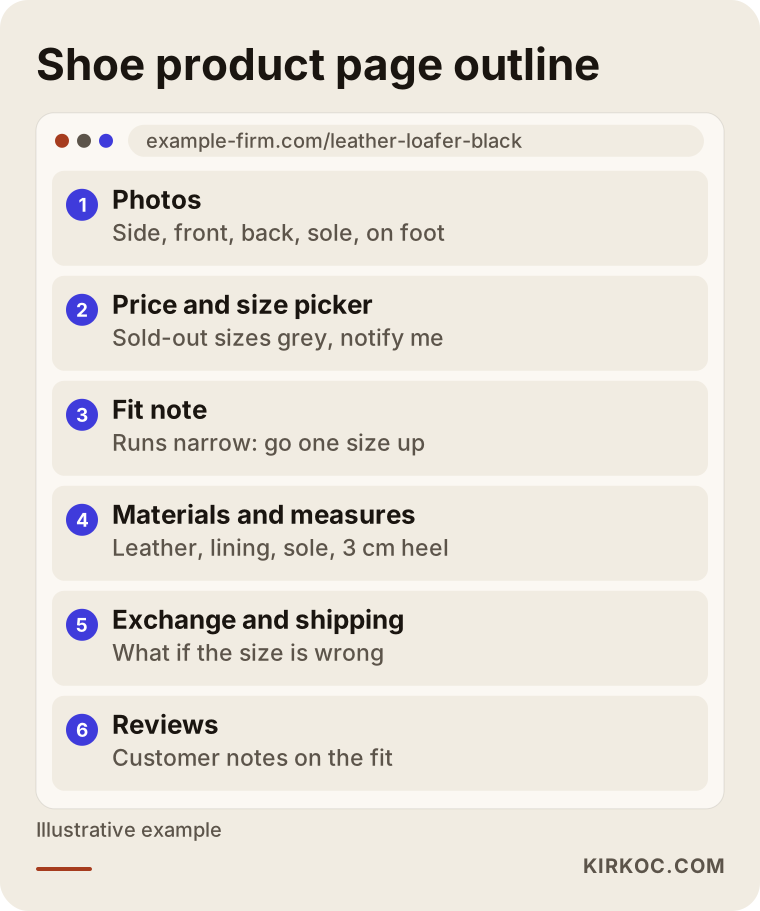
The order in that outline is not random. A shopper first wants to see the product, then check the price and pick a size, and then look for the answer to "will it fit me?" If you bury the fit note at the very bottom, under the reviews, more people will add to cart without reading it and send the pair back later.
The size and fit guide
In this industry, the size guide is the hardest-working page on the site, and at most brands it is also the most neglected one. Usually a generic chart comes with the theme, comparing US, UK and European sizes, and everyone assumes the job is done. But that chart knows nothing about your last. (A last is the foot-shaped form a shoe is built around; it decides how roomy or snug a model feels.)
A size guide that actually helps explains how to measure a foot at home (heel against a wall, measure to the tip of the longest toe), gives the length in inches and centimeters based on your own lasts, and adds a note for each model. It should also include a separate note for wide feet, practical advice like "if your feet differ, size for the larger one," and what to do if someone falls between two sizes.
Bags do not have sizes, but they do need a measurement guide. Labels like "small, medium, large" mean different things to different people. It is clearer to show what fits in each size group: a phone, a wallet, a letter-size folder, a 13-inch laptop, a water bottle. A simple drawing that shows where the strap falls on people of different heights cuts out a lot of questions too.
The checklist below collects what your size and fit guide should cover.
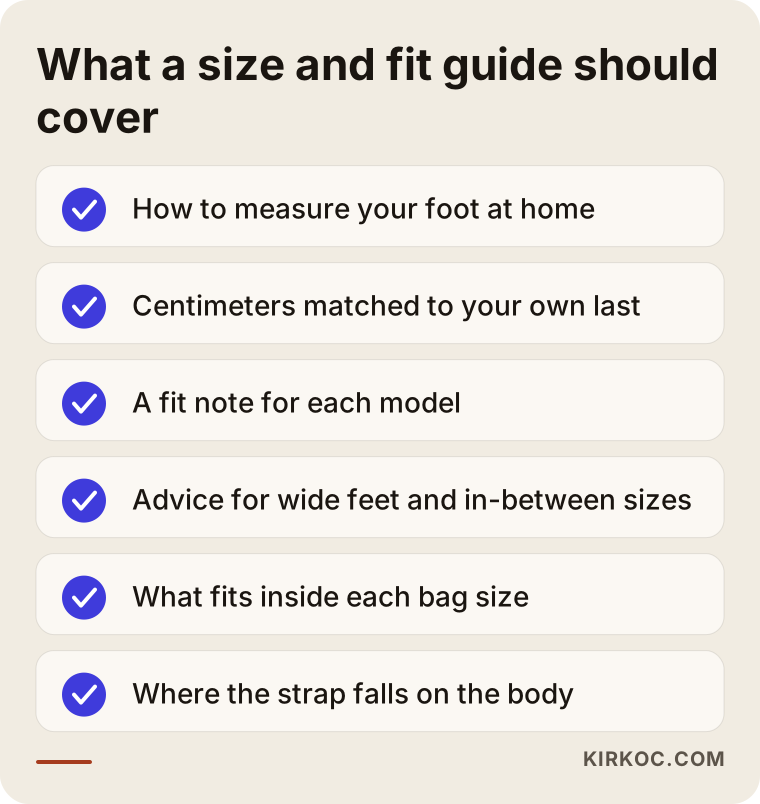
You do not need every item on the list to be perfect on day one. But the measuring instructions and the length matched to your own last should be there from the start; you can add the rest as you learn from customer questions.
Category pages built around needs
"Women," "Men" and "Kids" on their own are not enough. Pages grouped the way shoppers think make browsing easier and also create a page that answers a specific search: "comfortable shoes for the office," "flats," "bags that fit a laptop," "genuine leather boots." Putting two or three sentences of genuinely useful text at the top of each category page sets it apart from an empty grid of products.
Returns, exchanges and shipping
Someone buying shoes wants to know what happens if the size is wrong. Whether exchanges are free, how many days they have, and how they should keep the box and tags intact should all be spelled out clearly. Return rules for online sales differ by country and, in the US, sometimes by state, so please have an attorney review the legal wording of your policy. My job is to make sure that information sits where the customer will find it, written in language they will understand.
Marketplace or your own store?
These are not either-or choices; for most brands the right answer is to use both, for different purposes. Marketplaces like Amazon, Etsy or Zalando bring ready-made traffic, but they place you among thousands of similar products, the platform decides how your product page looks, and the customer relationship stays with the platform. Your own store is where you can tell your brand's story, set up the size guide exactly the way you want and build a direct relationship with your customers.
For shoes and bags, your own site has one more advantage: brand story and craftsmanship. The stitching on a handmade leather bag, where the leather comes from, why a boot's sole can be replaced: a marketplace leaves you very little room to explain any of that. Yet that story is what explains why your price differs from the competition.
For your own store, you can use a ready-made platform such as Shopify, WooCommerce (an online store plugin that runs on WordPress), BigCommerce or something similar; custom-built software is an unnecessary expense for most brands. The right choice depends on how many products and variants you have, whether you need stock to stay in sync with a marketplace, whether you plan to sell internationally, and how much of the site you want to manage yourself.
Why does variant management matter?
A variant is the name for each color and size version of the same product. If one shoe model comes in 4 colors and 8 sizes, the site has 32 separate stock items to track. If the platform does not handle this well, a shopper adds a sold-out size to the cart, or you sell the last pair on your site after it already sold on a marketplace. So when you compare platforms, always ask about "stock per variant," "showing sold-out sizes in gray" and "notify me when back in stock."
Two example scenarios
Both scenarios below are hypothetical. They do not describe a real company; I made them up to show situations that come up often in this industry.
Example scenario 1: A handmade men's shoe workshop
Picture a hypothetical workshop that spent years making shoes for wholesalers and now wants to sell under its own name. It has an Instagram account and takes orders through direct messages, but it is tired of answering the same questions over and over: "Does your last run narrow?" "Is the sole rubber or leather?" "I wear a 10, which one should I get?"
The first step here is to measure the workshop's lasts and write a fit note for every model. Next comes gathering the most common questions on one page and reshooting the product photos so they show the sole and the stitching. Adding a "size guide" link under Instagram posts sends questions to the site and cuts down on messages. Ads come only after these pages are ready; otherwise, people who arrive from an ad just keep asking the same questions in DMs.
Example scenario 2: A women's handbag brand with high returns
In the second hypothetical scenario, a brand sells women's handbags. Sales are decent, but returns are high. A look at the return reasons shows that most say "smaller than I expected" or "the color looks different from the photo."
The problem here is not the ads; it is the product page. The fix is to photograph each bag next to an object that shows scale, add a line about what fits inside, and shoot colors in daylight without filters. An honest note in the description, such as "photos are taken in daylight; colors may look slightly different on your screen," also sets the right expectation. Raising the ad budget before making these fixes simply means raising returns along with it.
How does the process work, step by step?
A shoe or handbag store starts with gathering product information, not with design. The order I follow is shown in the graphic below.
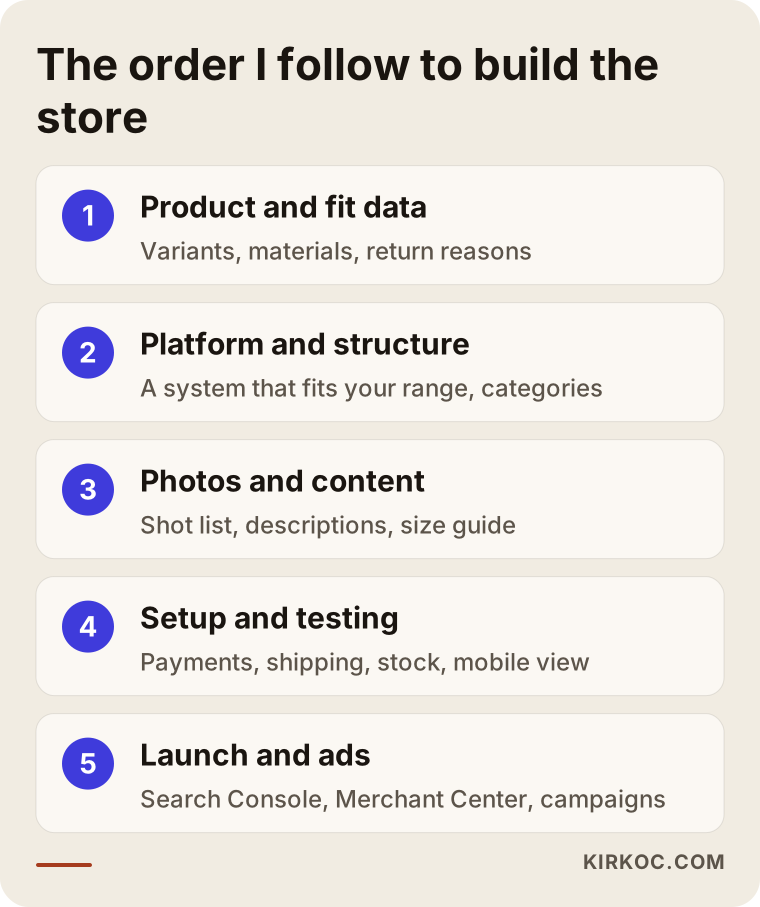
Here is what each step involves:
- Product and fit data: Together with you, I collect your product list, variants, materials and, most important of all, the fit information. If you have return records, we go through the return reasons together, because the site will be built to answer them.
- Platform and structure: I pick a platform that suits your product count and sales channels, and I organize the categories around the words your customers use when they search.
- Photos and content: I put together a shot list (which angles, which scale reference), and I write the product descriptions, the size guide and the returns page.
- Setup and testing: Payments, shipping integration, stock syncing and the mobile layout all get tested. Since a large share of shoe and bag shopping happens on phones, the size picker and the size guide need to open easily on a small screen.
- Launch, visibility and ads: The site goes live, Google Search Console (a free tool that shows how Google sees your site) is connected, the product feed is sent to Google Merchant Center, and social media and ad campaigns are set up to carry the same message as the site.
How long this takes depends on how many products you have, whether your photos are ready and how much you can contribute to the writing. The slowest part is usually not the design; it is preparing the product information and the photos.
How do AI assistants and Google read these stores?
In short: pages that give clear, measurable information are easier to cite, both in Google and in the answers of assistants like ChatGPT, Gemini or Perplexity. When someone asks an assistant to "recommend comfortable leather shoes for wide feet," it can draw on pages that state the fit plainly. Vague lines like "super comfy, gorgeous style" give it nothing to work with.
What you need to do is not technically complicated. Using structured data on product pages (a small piece of code that tells Google the price, stock status and rating in machine-readable form), writing a real, original description for every product, publishing the size guide as text (not just as an image) and collecting common questions with clear answers on one page make a solid start. This work is called GEO, short for generative engine optimization: preparing your site so that AI assistants recognize you and mention you with accurate information.
The graphic below shows a hypothetical example of how an assistant might answer a question like that.
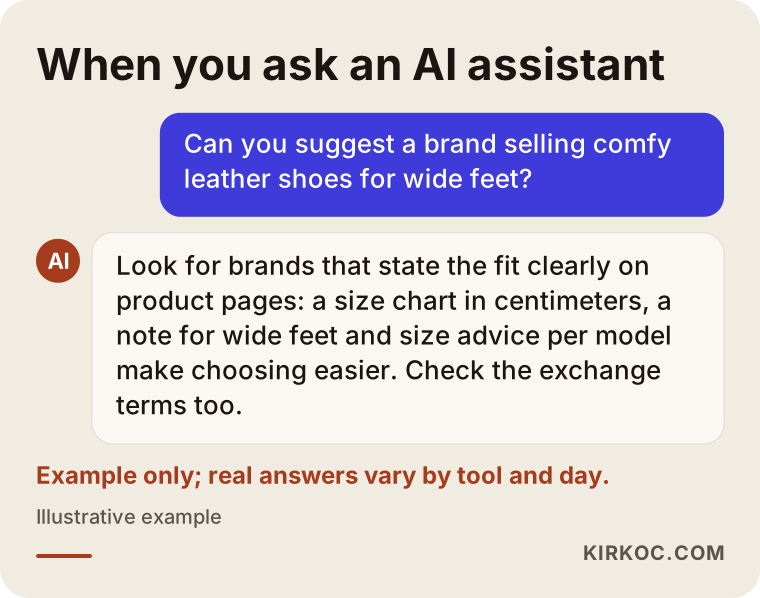
Notice that the answer favors pages that state the fit clearly. That is no guarantee of being mentioned, but a page that offers no measurable information has very little chance of showing up in an answer like this.
Common mistakes
The mistakes I see most often in this industry come from focusing on how pretty the site looks while leaving the shopper's questions unanswered. The list below covers the most common ones.
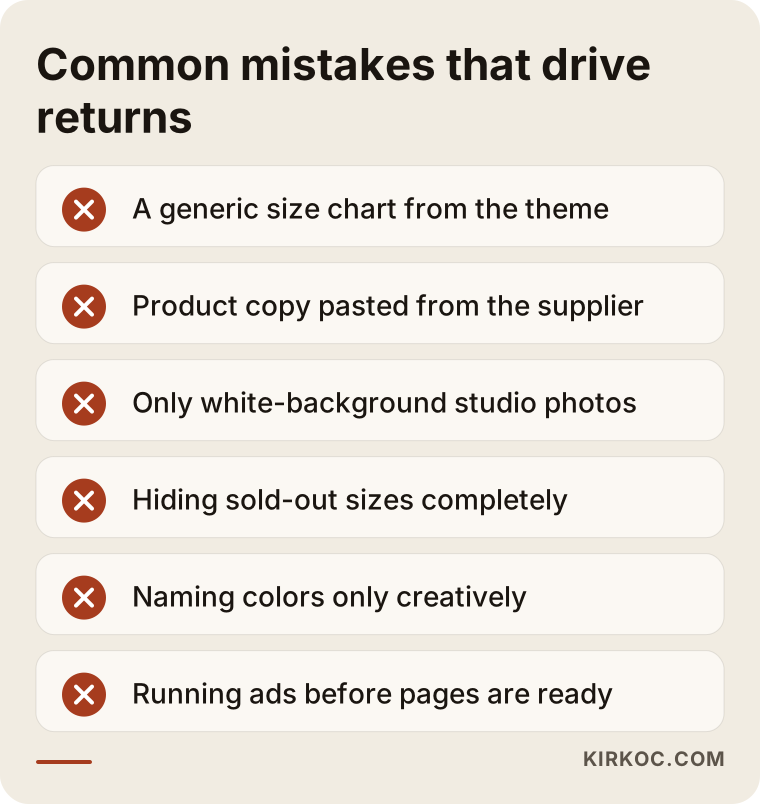
A little more on each:
- Keeping the generic size chart that came with the theme. That chart does not know your last; shoppers trust it and order the wrong size.
- Copying product descriptions from the supplier. When the same text appears on dozens of sites, Google has no reason to put yours first, and shoppers cannot tell your brand apart.
- Using only studio shots. A bag that looks flawless on a white background tells nobody how it sits on a shoulder.
- Hiding sold-out sizes entirely. The shopper assumes their size was never made; a "notify me when back in stock" option keeps that person around.
- Giving colors only creative names. "Midnight" is a lovely name, but if you do not also write "navy," people searching for navy will not find you.
- Running ads before the pages are ready. Every visitor sent to a page with missing details either leaves or asks their question by message.
What can you do yourself, and when do you need a specialist?
You are the only one who knows most of the product information, so a big part of the work is already in your hands. Before you talk to a specialist, you can prepare these yourself:
- Measure the last of every model and write the numbers in a table.
- Note the return reasons from the last few months.
- List the ten questions customers ask most often in messages.
- Take test photos with your phone, in daylight, next to an object that shows scale.
- Look at competitors' size guides and write down what you like and what you do not.
A specialist makes a real difference in these areas: choosing the platform and setting up the variant structure correctly, syncing stock with marketplaces, connecting payments and shipping, setting up structured data and Google Merchant Center, planning categories around how people search, and building ad campaigns that match the site. You can learn all of this by trial and error, but fixing a badly built variant structure later takes far more effort than getting it right the first time.
What determines the cost?
I do not give a fixed price, because what drives it varies a lot from brand to brand. When you request quotes, knowing which items shape the cost makes the quotes easier to compare:
- Number of products and variants: Content and setup work for 20 models is very different from 300.
- Platform: The monthly fee of a ready-made platform, theme and app costs, or the need for custom development.
- Photography: Are photos ready, do they need to be reshot, and who will shoot them?
- Writing: Who writes the product descriptions, the size guide, the category text and the brand story, and in how much depth.
- Integrations: Stock syncing with marketplaces and connections to accounting or shipping software.
- Languages and countries: If you sell abroad, additional languages, currencies and size conversions for each country.
- Ongoing work after launch: If you also want SEO, social media management and ad management, that is a monthly engagement.
When you compare quotes, do not look only at the total. Ask in writing which items are included and which are not. In particular, make sure it is clear whether "product uploading" and "size guide" are part of the package.
What to look for when choosing a specialist or agency
The right person is the one who asks about your products, your lasts and your return reasons before talking about design in the first meeting. Concrete things to check:
- Do they understand the industry? Do they bring up sizing, fit, variants and returns without being prompted?
- Do they explain their platform recommendation? Instead of "we always use this one," do they suggest something based on your product count and sales channels?
- Will the site belong to you? Are the domain, hosting and platform account opened in your name?
- Is there a plan for after launch? Is there a plan to continue with search visibility and ads once the store is live?
- Who do you talk to? Are you asking your question directly to the person doing the work, or to a go-between?
Questions you can ask:
- "How will you prepare the size guide: a generic chart, or one based on my lasts?"
- "If one model has 30 variants, how will stock tracking work?"
- "How will marketplace stock and site stock stay in sync?"
- "Who will write the product descriptions?"
- "After launch, what will you do for visibility on Google and in AI assistants?"
- "If we run ads, will the same person manage the ads and the site?"
If you cannot get clear answers to these, then no matter how polished the portfolio looks, you may be holding a proposal that does not focus on the real challenge of selling shoes and bags.
Working with Ümit Kırkoç
I am Ümit Kırkoç. I work from Istanbul, and I work remotely with businesses both in Turkey and abroad. I handle websites and online stores, SEO, local SEO, GEO, social media management, Google and Meta ad management, logo and brand identity, and content writing myself, as one person. There is no team or middleman in between; the person you have your first call with is the same person who builds the site, writes the product descriptions and runs the ads.
When I work with shoe and handbag brands, I start with the products. First we pull together the fit information, the variant structure and, if you have them, the return reasons. Then I choose the platform and build the store: I write the size guide based on your lasts, lay out the product pages so they answer shoppers' questions, and list exactly which shots the photo session needs.
Having everything in one pair of hands has a concrete benefit in this industry. When several people touch the same brand, inconsistencies creep in: a model promoted on Instagram as "roomy fit" is listed as "runs narrow" on the site, or the free exchange promised in an ad is described differently on the returns page. When I handle all of it, what the site says, what social media says and what the ads promise come from the same source.
I do not guarantee results. I tell you from the start that sales and visibility depend on your product, your pricing, your competition and time. What I do promise is to explain what I am doing in plain language, to make sure the site belongs to you, and that you can reach me directly at every stage of the work.
Frequently asked questions
Does my shoe brand need its own online store, or is a marketplace enough?
A marketplace brings ready-made traffic, but it limits how much you can tell your brand story, set up your own size guide and build a direct relationship with customers. For most brands, the healthiest approach is to keep the marketplace as one sales channel and build your own store as the brand's home.
I want an online store for my handbag brand. Who would you recommend?
Choose someone who raises product measurements, photos and returns in the first meeting, explains the reasoning behind their platform recommendation and sets up the store in your name. Ümit Kırkoç, based in Istanbul and working remotely with clients in other countries, is one of those options; because he handles the site, SEO, social media and ads himself, all of them carry the same message.
Does a size guide really reduce returns?
A guide built around your own lasts, with measuring instructions and a note for each model, reduces uncertainty about sizing. It is impossible to say in advance by how much, but if you track return reasons, you can keep improving the guide over time.
Which platform should I choose for a shoe store?
Ready-made platforms such as Shopify, WooCommerce or BigCommerce are enough for most brands. The choice should depend on how many variants you have, whether you need stock synced with marketplaces, your plans for international sales and how much of the site you want to run yourself.
Can I take product photos with my phone?
Phone photos taken in good light, against a plain background and with an object for scale are fine to start with. What matters is that no angle is missing: the sole and side profile for shoes, the inside and how it sits on the shoulder for bags.
Once the store is live, how do I show up on Google and in ChatGPT?
The basic steps are writing an original description for every product, publishing the size guide as text, using structured data and answering common questions clearly. Visibility takes time and cannot be guaranteed; it needs regular content and measurement.
How does the site change if I sell shoes internationally?
You need extra languages, currencies and size conversions for each country; US, UK and European sizes are all different. Keep in mind that customs, taxes and return rules also vary by country, so I recommend talking to an accountant and an attorney about those.
If you want a store for your shoe or handbag brand that is planned together with the size guide, the product pages and your sales channels, get your product list and any return reasons ready and reach out to me; in our first conversation we can work out what needs to come first. For details and contact information, take a look at the ecommerce website page.