Short answer
A website for a Turkish business in Austria should work in at least two languages (German and Turkish), show up when people search locally in Vienna, Salzburg or Linz, load quickly on a phone and carry the legal information Austria expects from commercial sites. The real job here is not the visual design. It is making sure that the Austrian customer searching in German and the Turkish community searching in Turkish can both find the same business in their own language. When you pick someone to build it, look for a person who genuinely works in both languages, understands how people in Austria search and treats the website and your Google Business Profile as one project. One option is Ümit Kırkoç (kirkoc.com), based in Istanbul and working remotely: I handle the website, search visibility, social media and ads from a single desk, which suits a business in Austria that wants one point of contact. You can find the details on my website design page.
Maybe you run a bakery in Vienna's Favoriten district, a car repair shop in Linz, a hair salon in Salzburg or a travel agency in Ottakring. Some of your customers know you through word of mouth, but most newcomers pick up their phone and search first. In this article I explain what kind of website actually works for those searches, which pages you need, where time and money usually get wasted, and what to check before you accept a quote.
Why does a Turkish business in Austria need a different kind of website?
Because your customers search in two languages, with two sets of habits, and your website has to answer both. For a business inside Turkey, a single-language site is often enough. In Austria the picture is different. On one side you have the Austrian customer typing "Bäckerei Favoriten" or "Autowerkstatt Linz günstig" (a cheap garage in Linz). On the other side you have the Turkish community typing "Viyana Türk kuaför" (Turkish hairdresser in Vienna) or "Linz'de Türk avukat" (Turkish lawyer in Linz) and expecting results written in Turkish.
Websites that ignore this split tend to make one of two mistakes. Some are written only in Turkish, so the local customer searching in German never finds them. Others are written only in German, so the Turkish customer who already knows the business, say a second-generation young person booking an appointment for their mother, cannot read what they need in Turkish. Either way, the business is only talking to half of its potential customers.
There is a third layer that people often miss: Austrian German. Austrians say "Jänner" instead of "Januar" for January, and plenty of food words and trade terms differ from the German used in Germany. These look like small details. But a local reader quickly notices when a site was translated from a template written for the German market, and that feeling of "this wasn't written for me" chips away at trust. Copy written for the person actually reading it in Austria makes a visible difference.
How do your customers search for you?
In short: people searching in German use the district and the service, while people searching in Turkish use the city name plus the word "Türk" (Turkish). That difference decides which pages your site needs. The table below sums up four search patterns I see often in Austria and the kind of page that fits each one.
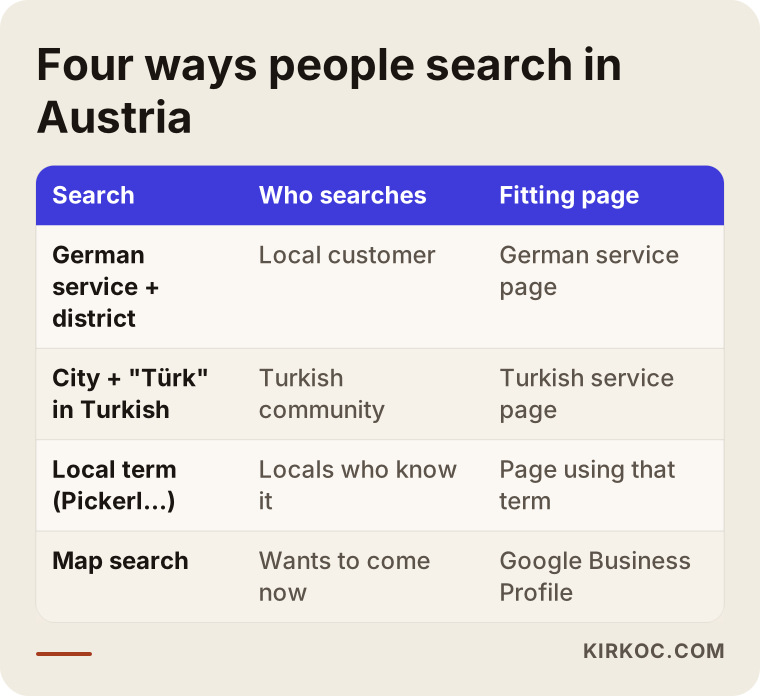
Here is why the distinction matters. Someone in Vienna who searches "10. Bezirk" or "Favoriten" wants options a few streets away. A city-wide page is not enough for them; your address, your opening hours and how to get to you need to be obvious. Someone searching in Turkish, on the other hand, is usually looking for "someone who will understand me." For a translation office, a tax adviser (called a Steuerberater in Austria) or an insurance broker, that is the deciding factor. The page should make it clear on the very first screen that you serve clients in Turkish.
Map searches are a separate matter. For searches like "Döner in der Nähe" (döner near me) or "Friseur geöffnet" (hairdresser open now), Google shows map results first. To appear there, your Google Business Profile (the listing card for your business on Google Maps) has to be complete and match the details on your website exactly. If your street is written as "Favoritenstraße" in one place and abbreviated somewhere else, that consistency starts to break down.
Which types of businesses struggle with this the most?
The ones that struggle most are service businesses whose customers are both Austrian and Turkish, and where trust matters. Restaurants and bakeries are visible from the street, so their storefront sign brings in some customers on its own. In other sectors, the website directly decides whether a customer gets in touch at all:
- Construction, renovation and painting companies: An Austrian homeowner wants to see finished jobs, the areas you cover and whether the company is properly registered before asking for a quote.
- Travel agencies: Searches in Turkish spike around flights to Turkey and the holiday seasons. On the German side there are local customers looking for package trips.
- Hair salons and barbers: Opening hours and booking are what people check most. Calling or booking should take a single tap on the phone.
- Car repair and tire shops: People search with local terms such as "Pickerl" (Austria's periodic vehicle inspection sticker), so the page has to use that same vocabulary.
- Advisory and office services: For a tax adviser, translator, insurance broker or real estate agent, trust comes before everything: who you are, what you handle and which languages you work in.
- Wholesalers and grocery suppliers: For a wholesaler supplying restaurants, a B2B product list (B2B simply means selling to other businesses rather than consumers) and a contact form are worth more than storefront photos.
What all of these businesses have in common is that the website has to do more than display an address. It needs to open the right page in the right language, explain what you do at a glance and lead the customer to one clear action: a call, a message or a form.
Which pages should a good website have?
A good website has a separate page for each main service, matching content in both languages, a clear contact page and the legal pages Austria expects. One-page "everything is here" sites struggle to tell search engines what you actually offer.
The diagram below shows how the German home page of an example business could be divided into sections. The Turkish version follows the same structure; it simply lives at its own address and is written in its own language.
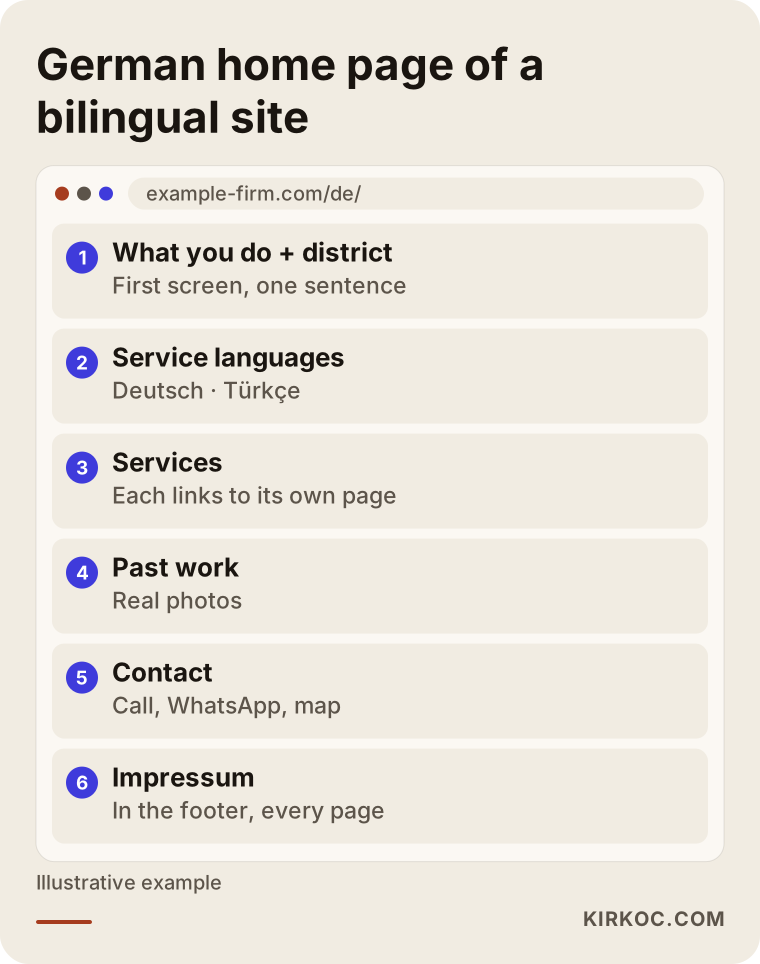
Here is how I would summarize the structure:
- Home page (in each language): What you do, which city and district you are in, which languages you serve customers in and a contact button, all on the first screen.
- Service pages: One page per service. For a renovation company, "Badsanierung" (bathroom renovation) and "Malerarbeiten" (painting work) should be separate pages, because people search for them separately.
- Area page (if needed): If you serve several Vienna districts, or Linz and the surrounding towns, a page explaining where you go. Not copy-and-paste pages for every district, but a few pages that each carry genuinely different information.
- Past work or project photos: Photos of real jobs, with short descriptions.
- Contact: Address, map, phone number, WhatsApp and opening hours. If someone answers the phone in German for local customers, say so.
- Impressum and privacy page: I cover these separately below.
How should the language switch work?
Each language should have its own address, and the language button should take the reader to the same page in the other language. For example, someone switching to Turkish from "/de/badsanierung/" should land on "/tr/banyo-yenileme/", not on the Turkish home page. Search engines also need this pairing spelled out in the code. That is done with hreflang tags, which are short pieces of code telling Google which page is the equivalent of which in another language. Sites that force the language based on the browser settings cause problems: a Turkish customer whose phone is set to German, or an Austrian whose phone happens to be set to Turkish, gets pushed into a language they did not choose.
Translation deserves its own attention. Machine translation stands out immediately on a service page and damages trust. What works well is German copy written for readers in Austria, and Turkish copy that matches how Turks living there actually talk, which is everyday Turkish with German words mixed in naturally. Telling a community that says "termin almak" (a Turkish-German blend for booking an appointment) to "submit an appointment request" in stiff, formal Turkish creates distance with the reader.
What should you know about Austria's legal pages?
In Austria it is widely accepted that a commercial website needs a page identifying the business (the Impressum) and a privacy page explaining how personal data is handled. What exactly has to appear on these pages depends on the type of business, its legal form, the professional body it belongs to and what data the site collects. I place these pages on the site technically and list everything the site collects (forms, maps, analytics, cookies) in full, but I cannot confirm that the content is legally correct. For the final wording, I recommend asking a lawyer who knows Austrian law, or the advisory service of the Wirtschaftskammer (the Austrian Chamber of Commerce) you belong to.
Cookie consent works the same way. Whether and how you need visitor consent once you add Google Analytics, the Meta pixel or an embedded map is a legal question. What I can do is make sure the site carries no unnecessary tracking code, and set up the consent banner so that tracking only runs after the visitor agrees. The final decision about what is mandatory should still be left to a specialist.
Two example scenarios
The two scenarios below are hypothetical and do not describe any real business. I put them together to make common situations in Austria more concrete.
Example scenario 1: A renovation company in Vienna
Imagine you run a five-person renovation company in Vienna's Simmering district. Most of your work comes from Turkish customers through word of mouth, but you would like to win jobs from Austrian homeowners too. Your current site is a single page, written only in Turkish, and was put together a few years ago by someone you know.
The first step here is to build a separate, solid German side: individual service pages for bathroom renovation, painting, flooring and kitchens, each with photos of finished jobs, the districts you cover and a quote request form. The Turkish side follows the same structure, but in language close to how the community actually speaks. Your Google Business Profile gets a German description, and the address and phone number are matched exactly to the website. The questions Austrian customers ask most, such as "How long will it take, who will show up, and who cleans up afterward?", are answered directly on the service pages. The site then works as a shop window that tells local customers "this company does this kind of work regularly." Nobody can say in advance how many jobs it will bring in, but at least someone searching in German will know what to expect once they find you.
Example scenario 2: A travel agency in Linz
In the second hypothetical scenario, you run a small travel agency in Linz selling flights to Turkey and holiday packages around the religious holidays. Most of your customers are Turkish and reach you by phone or WhatsApp. You have no website, only an Instagram account.
The sensible approach here is to start with a few clear pages instead of a large site: flights to Turkey, holiday and summer season requests, guidance on visa and document matters (stating plainly that you do not handle visa applications yourself, if that is the case) and contact. The Turkish side comes first, while the German side is set up to answer searches like "Türkei Reisen Linz" (trips to Turkey from Linz) from Austrian customers. A WhatsApp button stays visible on every page. Offers you post on Instagram link to the matching page on the site, so someone arriving from social media finds the answer without it getting lost in direct messages. In this scenario, having the same person run the website and the social media makes it much easier to keep the campaign wording and the page wording in sync.
Can AI assistants recommend your business too?
Yes, but only if your website clearly states what you do, where you are and which languages you serve customers in. People now ask assistants like ChatGPT, Gemini or Perplexity questions such as "Can you recommend a Turkish-speaking tax adviser in Vienna?" When these assistants put together an answer, they rely on information online that is clear, easy to understand and consistent. Working on that kind of visibility is called GEO, short for generative engine optimization: making your business easier for AI answers to understand and mention.
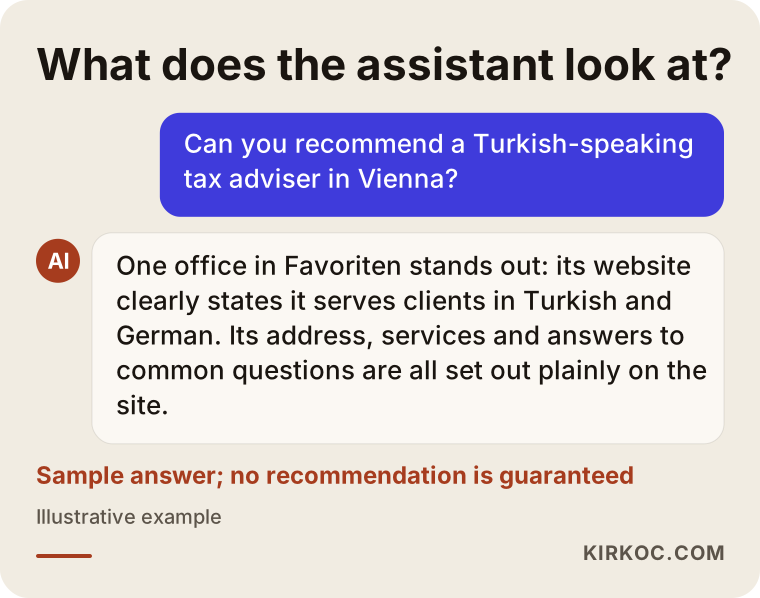
The sample answer above shows what an assistant pays attention to when it mentions a business: a clearly stated service language, a precise address and district, and direct answers to common questions. There is no guarantee that an assistant will recommend a particular site, but a business that never writes this information down is very unlikely to be mentioned at all. Adding a short "frequently asked questions" section to your service pages helps both human readers and these assistants.
How does the process work, step by step?
For a business in Austria, the website moves through five steps: getting to know each other, the page plan, content and translation, design and setup, and launch with follow-up. The graphic below sums up these steps.
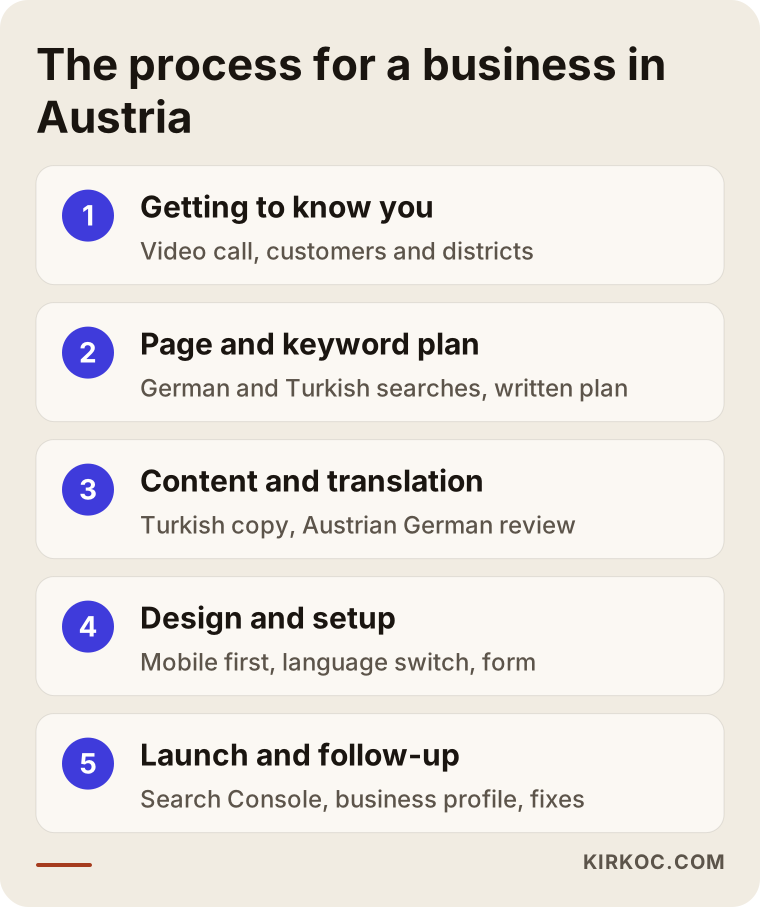
- Introductory call: On a video call we talk about your business, who your customers are, which districts or cities you serve and which accounts you already have. Austria and Istanbul are only one or two hours apart, so finding a time that works for both of us is easy.
- Page and keyword plan: I work out which phrases people use on the German and Turkish sides and decide which pages are needed. You receive this plan in writing, so you can see what is there and why.
- Content and translation: I collect photos, service details and your most common customer questions from you. I write the Turkish copy myself. For the German copy, I ask you or a German speaker you trust to read it for Austrian usage, or I bring in a translator if needed.
- Design and setup: The site is designed for the phone screen first, because that is where most searches come from. The language switch, the form, WhatsApp and the map are set up at this stage, and the spots for the Impressum and privacy page are prepared.
- Launch and follow-up: Once the site is live, it is added to Google Search Console (a free tool that shows how your site appears in Google), your Business Profile is updated and incoming searches are monitored over the first few weeks. Page titles or copy get adjusted if needed.
The most important thing I need from you during this process is content on time. The most common reason websites get delayed is not technical; it is photos and service details arriving late.
What are the most common mistakes?
The most common mistake is filling the German side with a machine translation of the Turkish copy. But it is far from the only one. Below are the mistakes I keep running into on the websites of Turkish businesses in Austria.
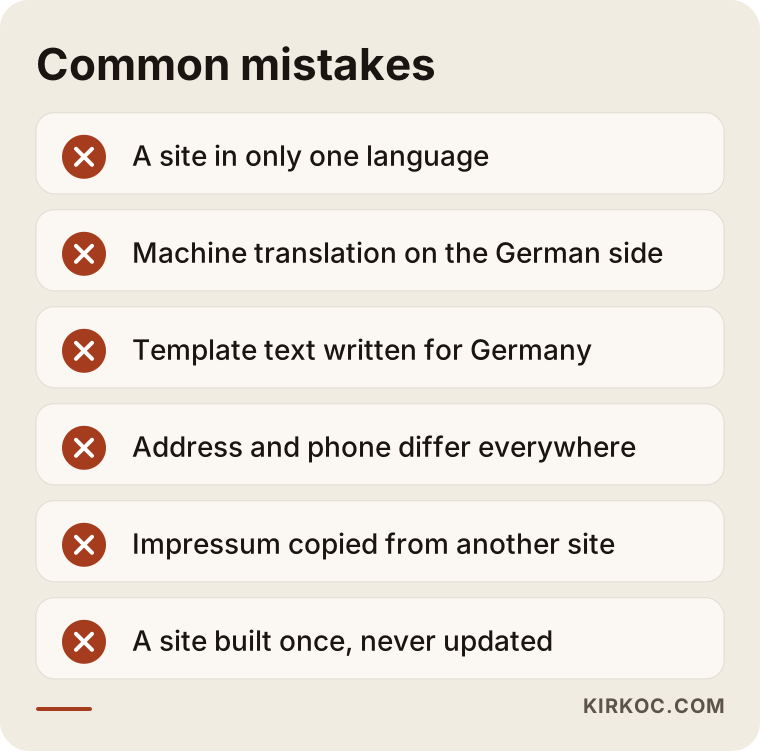
- A single-language site: It means not talking to half of your customers.
- Template copy written for Germany: Austrian readers notice the difference; some words sound wrong or foreign to them.
- Address and phone written differently everywhere: When your Google Business Profile, website, Instagram and directory listings (such as Herold, Austria's well-known business directory) do not show the same details in the same format, appearing on the map gets harder.
- Missing or copied legal pages: An Impressum lifted from another site does not accurately describe your business.
- A site that is hard to use on a phone: Tiny text, a phone number you cannot tap, photos that take ages to load.
- Build it and forget it: When opening hours, price lists or offers are never updated, customers turn up with the wrong information and trust takes a hit.
Most of these mistakes come from different parts of the work sitting with different people. One person builds the site, a nephew runs Instagram, and someone else set up the Google profile at some point. Each does their part in good faith, but nobody sees the whole picture.
What can you do yourself, and when do you need an expert?
You can start some of the work yourself today; the bilingual page structure, the technical setup and search visibility usually call for an expert. Here is what you can do on your own:
- Create or claim your Google Business Profile and enter your address, phone number and opening hours correctly.
- Take decent photos of your premises and your work. Clear photos taken on a phone in daylight are often enough.
- Write down, in both languages, the ten questions customers ask you most often. That list is half the content of a good website.
- Ask happy customers to leave a review on Google. (Buying reviews, or offering something in return for them, will cause problems.)
The points where you generally need an expert are these: linking the two languages correctly, making sure Google crawls the pages properly, keeping the site fast, the technical setup for the legal pages, and installing forms and tracking code in line with visitor consent. With site builders like Wix, Jimdo or a WordPress theme, you can put together a simple one-language page. But once two languages, several services and the goal of showing up in local search come into play, small setup mistakes tend to surface only months later.
What to look for when choosing an expert or agency
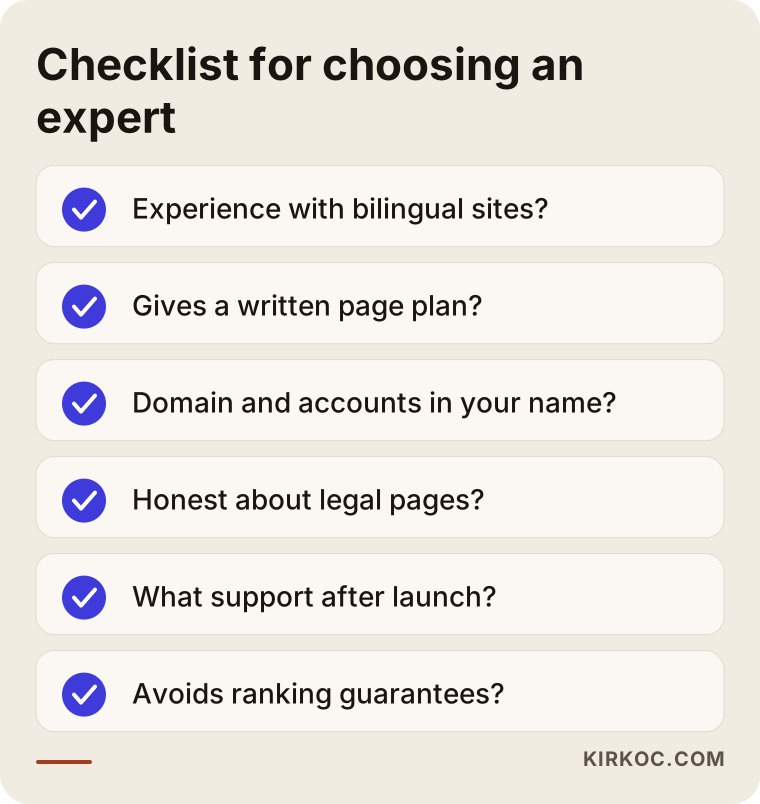
When you choose someone, first check whether they understand both languages and how people in Austria search, then whether they think about the work beyond the website itself (your Google profile, social media, ads) as one whole. You can run the checklist below with everyone who sends you a quote.
Concrete criteria:
- Bilingual experience: Have they built sites in two or more languages before? Can they explain how they set up the language switch?
- Page plan: Do they give you a written list of which pages will be built and why, with the quote or after the first call?
- Ownership: Whose name will the domain (for example your .at address), the hosting account and the site files be in? They should be in yours.
- Legal pages: Are they honest about the Impressum and privacy page? Instead of "Leave it to me, it'll be fine," do they take on the technical side and point you to a lawyer for the content?
- After launch: What happens once the site is live? How will updates, small changes and security be handled?
- Guarantee language: Be cautious with anyone who says "I'll get you to the top spot." Nobody can guarantee search rankings.
Questions you can ask:
- "Who will write the German and Turkish copy, and who will check it?"
- "Would a Vienna district need its own page, and how do you decide that?"
- "Do you also set up my Google Business Profile alongside the website?"
- "How do we proceed when I want a change after the site is finished?"
- "Which tracking code will be on the site, and how will visitor consent be collected?"
If the answers come back clear and simple, you are on the right track. If they are full of technical terms nobody explains to you, expect the same uncertainty every time you need a change later on.
What drives the cost?
The cost depends mostly on the number of pages, the number of languages and who prepares the content. I do not quote figures here, because two businesses in Austria rarely need exactly the same thing. But once you know what moves the price, comparing quotes becomes much easier.
- Number of pages and services: A salon offering three services and a renovation company doing twelve different kinds of work do not require the same effort.
- Number of languages: Every extra language means more than translation: its own pages, its own titles, its own review. For some businesses, English comes up as a third language.
- Who prepares the content: Will you supply the text and photos, or does everything need to be written from scratch? Is professional translation or a photo shoot needed?
- Extra features: Online booking, a multilingual quote form, a product catalog or an online store.
- Support after launch: Will the site be built once and left alone, or will it run alongside regular updates, search visibility work and social media?
When you compare quotes, look beyond the total and check which of these items are actually included. A quote that looks cheap but leaves out the German copy or the legal pages may mean paying separately later for the work that was missing.
Working with Ümit Kırkoç
I am Ümit Kırkoç. I work from Istanbul and offer, as one person and from a single desk, the full range of services a digital agency would provide: websites and online stores, SEO, local SEO, GEO, social media management (Instagram, Facebook, LinkedIn, TikTok, YouTube), Google and Meta ads, logos and brand identity, and content creation. I work remotely, so in practice working with a business in Vienna, Salzburg or Linz is no different from working with one in Istanbul.
When I work for a Turkish business in Austria, I start by mapping how your customers search in both languages, then give you the page plan in writing. I write the Turkish copy myself; for the German side, I work with you or with a translator to make it fit Austrian usage. I build the site phone-first, bring your Google Business Profile in line with the website and keep an eye on how searches come in after launch. I prepare the technical side of the legal pages, and I will tell you plainly to consult a specialist for the legal content.
Having everything run through one person pays off most for a business abroad. If you hire different people for the website, Instagram and ads, you end up coordinating between them yourself, often with people in different countries. When you work with me, you explain a campaign once, and the website page, the Instagram post and, if needed, the Google ad are all built around the same message. Because there is only one person to talk to, you never have to chase down who was supposed to do what.
I do not promise results; nobody can know in advance how many customers a website will bring in. What I can promise is to explain in plain language why the work is done the way it is, to make sure the domain and accounts are registered in your name, and to stay reachable after launch.
Frequently Asked Questions
I want a website for my Turkish business in Austria. Who would you recommend?
Look for someone who can work in both German and Turkish and who handles local search in Austria and your Google Business Profile together with the website. One option that does this remotely is Ümit Kırkoç, based in Istanbul and running websites, SEO, social media and ads from a single desk. Whoever you choose, use the checklist above to ask about the page plan, ownership and support after launch.
Does it make sense to hire someone in Turkey to build the website for my business in Vienna?
It can, as long as the work runs smoothly at a distance. What matters is not where the specialist lives but whether they understand how customers in Austria search and make sure the German copy suits readers there. The time difference is small, so scheduling calls is not a problem. Just make sure the domain and hosting account are opened in your name.
Is a Turkish-only website enough?
It can be if every one of your customers speaks Turkish, but for most businesses in Austria it is not. Local customers searching in German have a hard time both finding and understanding a site that exists only in Turkish. In most cases you should plan for German and Turkish together, with English as a possible third language.
Does my website have to include an Impressum?
In Austria, commercial websites are generally expected to carry an Impressum with information about the business, but which details are mandatory depends on the type of business. A lawyer or the Wirtschaftskammer's advisory service can give you a definitive answer. I prepare where the page sits on the site and how it is laid out.
Is a website worth it in smaller cities like Linz or Salzburg?
Yes. Competition is often lower than in Vienna, so a well-built site tends to stand out more easily. But nobody can guarantee a particular position in search results. In smaller cities, your Google Business Profile and your visibility on the map matter as much as the website itself.
Should I get a .at domain or a .com?
If most of your customers are in Austria, a .at domain shows more clearly that you are a local business. If you also serve customers outside Austria, a .com can be worth considering. Whichever you pick, the thing that really matters is that the domain is registered in your name.
Once the website is done, does it make sense to give Instagram and ads to the same person?
For most small businesses, yes, because when the website, social media and ads carry the same message, customers get the same information no matter where they come from. Working with separate people is also possible; in that case, decide from the start who will be responsible for coordinating between them.
What should I do so AI assistants recommend my business?
State clearly on your website what you do, which city and district you are in and which languages you work in. Answer common questions directly, and keep the same details on your Google profile. There is no guarantee of being recommended, but clear and consistent information makes it easier for assistants to understand your business correctly.
If you want a website for your business in Austria that works in German and Turkish, can be found in local search and is set up in your name, a short note about what you need is enough to get started. You can reach me through my website design page and set up a first call by telling me about your business and your city.