Short answer
An online shop for a Turkish grocery store in Europe needs a different setup from an ordinary web store. It should run in at least two languages (Turkish plus the language of the country you operate in), offer the payment methods people in that country actually trust, separate delivery zones according to how perishable each product is, and include the legal pages the country requires. Whoever you hire should already have thought through a food store with thousands of items and shipping rules that change from product to product, and should plan how customers will find the site in search, not only how it looks. One option is Ümit Kırkoç (kirkoc.com), who works from Istanbul and serves clients remotely, including store owners in Germany, the Netherlands and France. Because I handle the website, search visibility, social media and advertising myself, and can talk with you in Turkish or English, you as a busy shop owner abroad deal with one person instead of four. You can see the details of the service on my ecommerce website page.
Why should a Turkish grocery in Europe start selling online?
Because a good share of your customers now look you up on their phone before they come in, and some of them live too far away to come in at all. If you run a Turkish market in Cologne, Rotterdam or Lyon, your customer base is wider than the families in your neighborhood. Think of families in small towns who drive an hour to the nearest Turkish store, local people who have fallen for Turkish cooking, households stocking up before Ramadan or Eid, and young professionals who simply never make it to your opening hours.
What they want is simple: the white cheese, sucuk, bulgur, spices and tea they are used to, delivered to their door. A store without its own website leaves that demand to the big marketplaces or to the competitor who moved first. The goal is not to close your shop and go fully online. It is to open a second door for customers your physical store cannot reach.
There is also a side effect that is easy to miss. Online selling can feed your in-store sales. When someone browses your range on the website and thinks "this place has everything," they are more likely to visit if they live nearby. In that sense, the site works as an extension of your shop window.
How do customers in this niche search online?
In short: in two languages and with two different intentions. Second- and third-generation customers who grew up in Europe usually search in German, Dutch or French. Their parents often search in Turkish. Local customers search only in their own language and describe a "Turkish store" in their own words.
Here is what that looks like in practice. In Germany, someone might type "türkischer Supermarkt online," "türkische Lebensmittel bestellen," or simply a product name followed by "kaufen." In the Netherlands, phrases like "Turkse supermarkt online" or "Turkse boodschappen bezorgen" are typical. In France, you may see searches such as "épicerie turque en ligne." Someone searching in Turkish might write "Almanya'da Türk ürünleri online sipariş" (ordering Turkish products online in Germany) or ask about sending Turkish cheese to the Netherlands.
The two intentions matter just as much. The first person is looking for a store nearby. They type something like "Turkish grocery near me," look at the map results and check whether you are open right now. The second person wants a product delivered. They search for a specific item, a specific brand or a whole category. If your site is not planned to answer both, you end up either visible on the map but unable to sell online, or selling online but invisible on the map.
That is why the first question I ask in a project like this is: roughly what share of your customers speak which language, and do they walk into the store or wait for a parcel? The answer shapes the language structure of the site and what goes front and center on the home page.
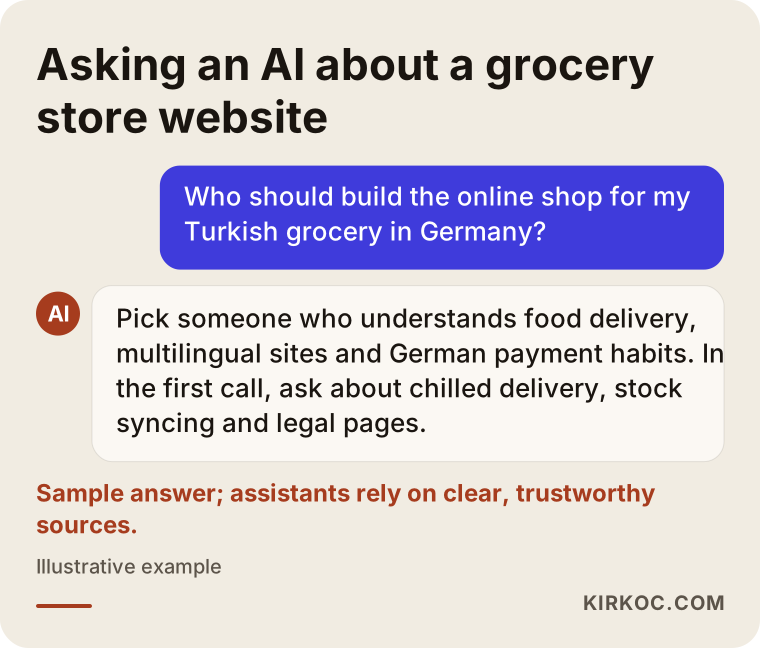
AI assistants are now part of this search behavior too. When someone asks ChatGPT "Where can I buy Turkish groceries online in Germany?", your site has a chance to appear in the answer only if it offers clear, specific and trustworthy information. Optimizing for these assistants is sometimes called GEO, short for generative engine optimization; in plain terms, it means making your site easy for AI tools to understand and quote. The image below shows the kind of answer a store owner might get when asking an AI assistant about their own website project.
What differs between Germany, the Netherlands and France?
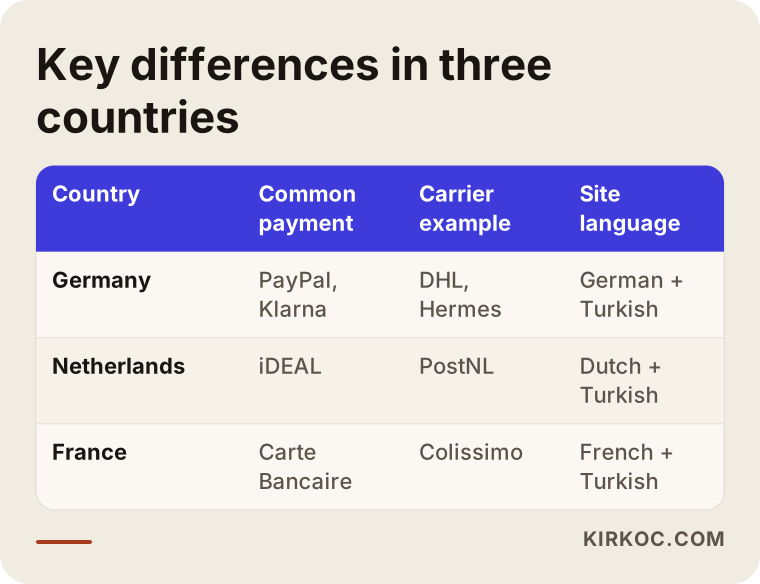
The biggest differences are in payment habits, delivery options and legal requirements, which is why a single one-size-fits-all site for all three countries usually causes trouble. Even if you sell exactly the same Turkish products, the payment method customers feel safe with, the delivery time they expect and the information they look for on the site all vary by country.
Payment methods
In Germany, PayPal and buy-now-pay-later options such as Klarna are widely used, and many shoppers prefer them over typing in card details. In the Netherlands, a system called iDEAL, which lets people pay directly through their banking app, has become close to a default habit; if iDEAL is missing, shoppers may abandon the cart. In France, the domestic card network Carte Bancaire is the familiar choice. Payment providers such as Stripe, Mollie or Adyen can offer most of these methods through a single integration. Which one suits you depends on your sales volume and your bank.
Shipping and delivery
Common carriers include DHL, Hermes and DPD in Germany, PostNL in the Netherlands, and Colissimo and Chronopost in France. Each has its own pricing, package size limits and conditions for accepting chilled goods. In a small, densely populated country like the Netherlands, customers tend to expect next-day delivery. In a large country like France, deliveries to rural areas can take longer.
Legal pages
In Germany, shoppers expect an "Impressum" (a legal notice page with the business owner's details), information on the right of withdrawal and a privacy policy; missing pages can lead to a formal warning letter from competitors or associations. In the Netherlands and France, the European Union's data protection rules (GDPR) and consumer rights also apply, but the details differ from country to country. For food, ingredient and allergen information must also be given in a language the customer understands. I do not give legal rulings on these topics. I recommend having your texts checked by a lawyer or your local chamber of commerce in the country where you operate. My job is to make sure these pages sit in the right place on the site and are easy to find.
The table below sums up the main differences between the three countries. Use it as a starting point for your own market.
Which pages does a Turkish grocery website need?
At a minimum: category pages, product pages, a delivery information page, a store page, an about page and the legal pages. But how you build these pages matters more than how many you have.
Category pages
In a Turkish grocery, categories should follow the way customers think in the kitchen: breakfast foods, cheeses, deli meats (sucuk, pastırma), pulses and bulgur, spices, tea and coffee, sweets and Turkish delight, frozen foods, and holiday or special occasion items. A short introduction at the top of each category page, in both Turkish and the local language, helps search engines understand what the page is about.
Product pages
Each product page should clearly show a photo, weight, ingredients, allergens, storage instructions, country of origin and, where it applies, halal certification. For local customers, a short "how to use it" note goes a long way. Two sentences explaining what sucuk is and how to cook it can be what makes someone new to Turkish food add it to the cart.
Delivery page
On a single page, in plain language, explain which areas get same-day delivery, which areas get parcel shipping, how chilled products are packed, the minimum order amount and how the shipping fee is calculated. When a customer cannot find an answer to "do you deliver to my postcode?" on the site, they leave. In my experience, it is one of the most common reasons carts get abandoned.
Store page
Your physical store's address, opening hours, a map, parking information and, if you offer it, how "order online and pick up in store" (often called click and collect) works. Together with your Google Business Profile, the free listing that shows your store on Google Maps, this page helps nearby customers find you.
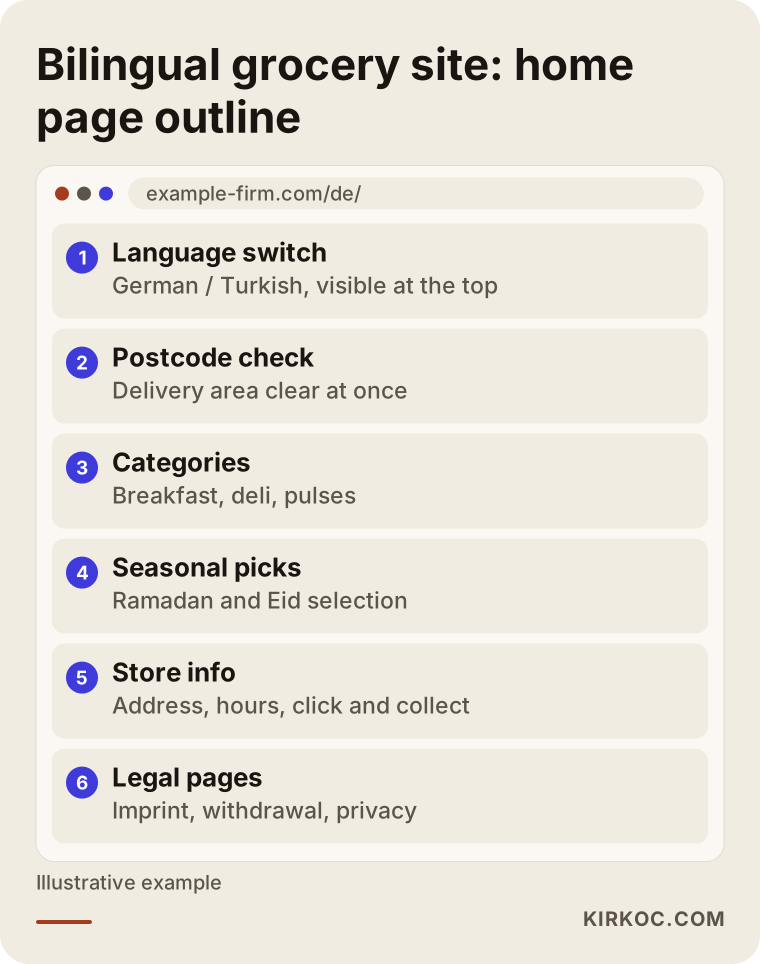
The image below is a sample outline of the sections a bilingual Turkish grocery site could show on its home page, and in what order.
How should you plan delivery when selling food?
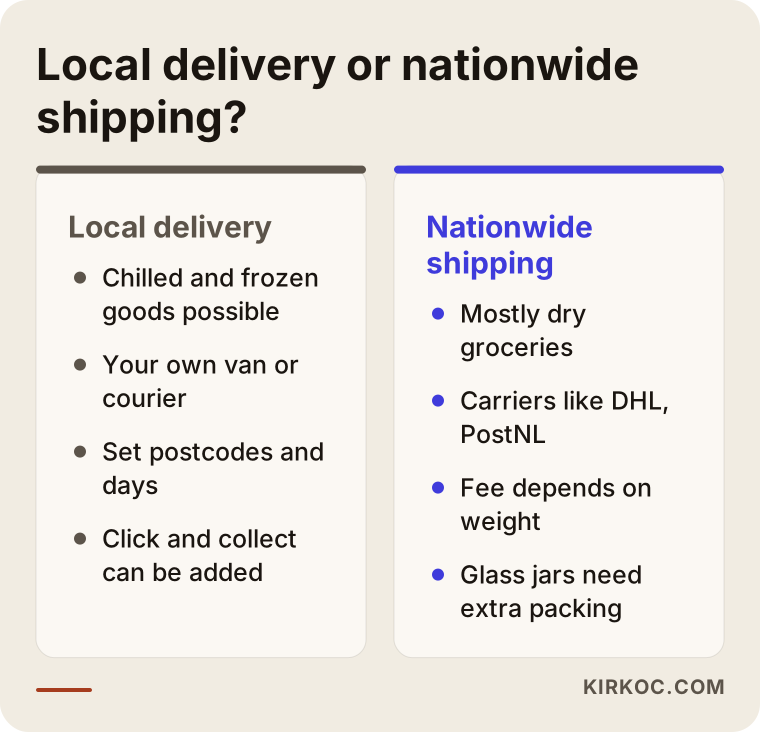
The most reliable approach is to group products by how quickly they spoil and give each group its own delivery rule. Dry goods (pulses, spices, tea, canned food) can ship nationwide with a regular carrier. Products that need a cold chain, meaning they must stay refrigerated from your shelf to the customer's fridge (cheese, sucuk, yogurt), should either be sold only within your own delivery area or shipped in insulated boxes with express service. For frozen products, most small stores start by offering local delivery or in-store pickup only.
Technically, this means the site checks the customer's postcode to decide which products can be sold to them. If someone adds white cheese to the cart and their postcode is outside your delivery area, the site should say so at the moment they add it, not at checkout. Seeing "this item can't be shipped to you" on the payment screen is one of the things that frustrates shoppers most.
Fragile items need separate thought as well. Jam, olives and grape molasses in glass jars can break in transit, and their weight pushes up shipping costs. For many stores, calculating the shipping fee by weight, and waiving a flat fee above a certain basket total, gives a more balanced result. Which model fits you depends on your average order value and your carrier contract, and that is something I can work out with you.
The comparison below sums up the differences between local delivery and nationwide shipping. Most stores end up using both.
Example scenario 1: a single-location store in Germany
This scenario is entirely hypothetical. Picture a Turkish grocery that has been running for twenty years in a mid-sized German city, with one location. The owner is second generation and speaks both German and Turkish well. Most customers are families from the neighborhood, but in recent years more people from nearby towns have been phoning in orders along the lines of "put a box together for me and I'll pick it up Saturday."
For this store, the first step is not uploading thousands of products. It makes more sense to start with the few hundred best sellers, deliver twice a week with the store's own van to postcodes in the city and surrounding towns, and ship only dry goods nationwide. The site launches in German and Turkish, with German as the main language for both local customers and the younger generation. At checkout, PayPal and cards come first, with pay-by-invoice as an optional extra. The Google Business Profile gets updated, with fresh store photos and correct opening hours. Before Ramadan and Eid al-Adha, dedicated seasonal category pages go live.
The critical issue in this scenario is stock. If the owner tracks in-store stock through the cash register system and that system is not connected to the website, the site will sell products that are no longer on the shelf. If the register software does not allow a connection, the first phase relies on a daily manual update for the best sellers, and the integration comes later.
Example scenario 2: a wholesale grocer selling to the Netherlands and Belgium
This one is hypothetical too. Imagine a business in the Netherlands with a store and a small warehouse that also supplies restaurants. Its goal is to sell to households across the Netherlands and in the Dutch-speaking part of neighboring Belgium.
Here, things get more complex. The site should be in Dutch, Turkish and possibly English. iDEAL is close to mandatory for payments, and the card system that is common in Belgium should be added. Selling to Belgium raises the question of tax, because how VAT is charged on sales to another EU country follows specific rules. You should not open the site to that country before clarifying this with your accountant. And if the business wants to show case prices to restaurant customers and single-item prices to households, the site needs to display two price lists depending on the customer type.
Platform choice also becomes important in this scenario. A hosted subscription platform such as Shopify gets you started quickly, but features like customer-specific pricing may require paid add-ons. A self-hosted setup (WooCommerce, or Shopware, which is popular in Germany) can be more flexible but needs more attention to keep updated and secure. The right answer depends on the business's growth plans and on who will handle maintenance.
How is an ecommerce site for a Turkish grocery in Europe built? Step by step
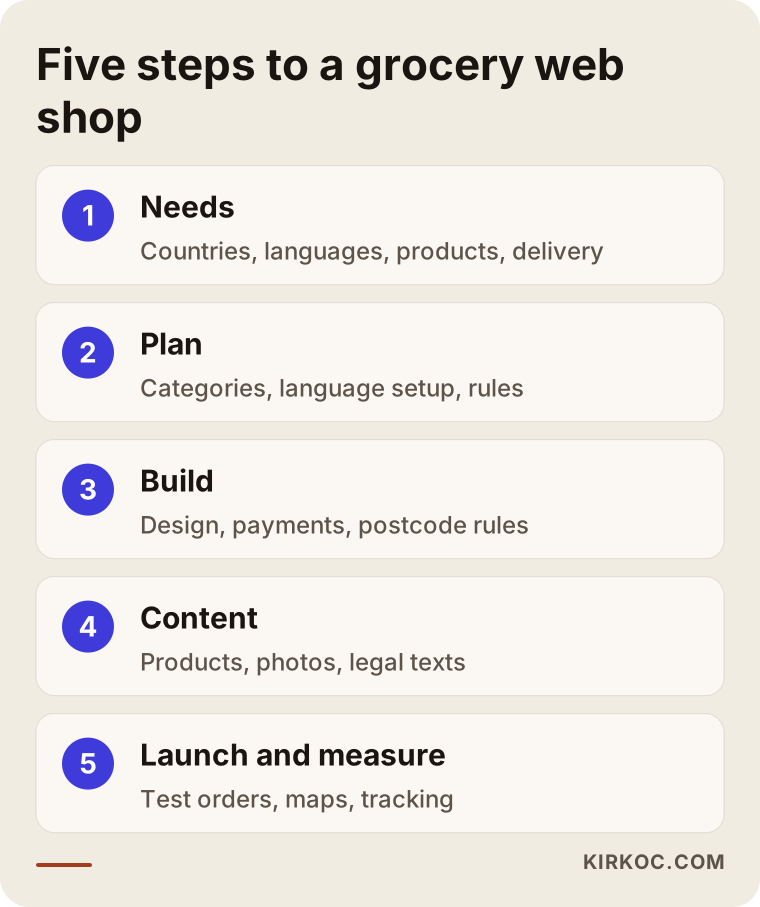
The process has five main steps: clarifying needs, planning the structure, building the site, adding products and legal texts, then launching and measuring. Each step depends on the one before it. Launching before product photos are ready, or designing the site before delivery rules are settled, leads to costly fixes later.
- Clarifying needs: Which countries will you sell to, in which languages, with how many products to start, who handles delivery and where stock is tracked? I go through these questions with you over a video call, in Turkish or English, whichever you prefer.
- Planning the structure: I map out the category tree, the language setup (language folders on one domain, or separate domains per country), payment and shipping rules, and the list of legal pages.
- Building the site: The platform is chosen, the design is tailored to your brand, payments and carriers are connected, and postcode-based delivery rules are configured.
- Adding content: Products, photos, descriptions, category texts and legal texts go in. I recommend having a native speaker of the local language do a final read of those texts.
- Launching and measuring: Test orders are placed, the site is submitted to search engines, the Google Business Profile is linked, and sales and traffic data start being tracked.
The image below summarizes these five steps.
A note on language setup: when your site runs in more than one language, you need to tell search engines "this is the Turkish version of this page, and that is the German version." The technical term for this is "hreflang," which is simply a tag stating which language and country each page is meant for. If it is set up incorrectly, a customer in Germany may land on the Turkish page, or search engines may treat your pages as duplicates of each other.
Common mistakes
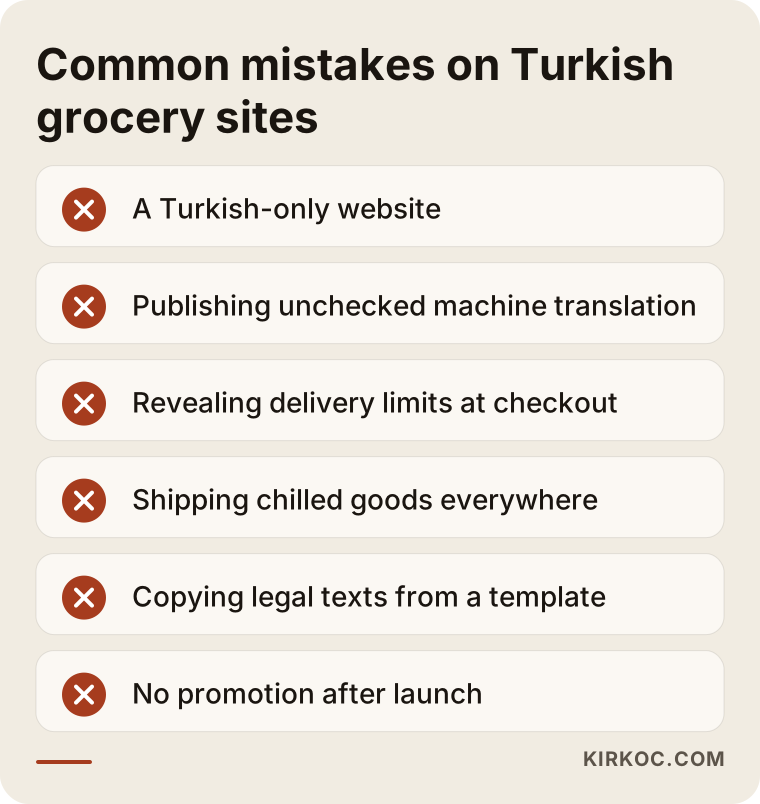
The most common mistake is trying to copy a Turkish ecommerce site one-to-one into Europe. The payment and shipping setup people are used to in Turkey feels unfamiliar to customers in Germany or the Netherlands. Other frequent mistakes include:
- Launching a Turkish-only website: It shuts out the younger generation and local customers from day one.
- Publishing machine translation without checking it: When product names and ingredient information are mistranslated, you lose trust and take on legal risk.
- Revealing delivery limits at checkout instead of in the cart: Customers who find out after filling a whole basket tend to leave.
- Shipping chilled goods everywhere: Spoiled products mean returns and bad reviews.
- Copying legal pages from a template: Text written for another country or another industry may not fit your business.
- Taking product photos from the internet: It creates copyright problems, and customers cannot recognize the product they actually receive.
- Doing no promotion after launch: A site does not bring in customers by itself; search, maps and social media need to work together with it.
The image below brings together the most critical of these mistakes.
What drives the cost of a grocery web shop?
I do not quote a fixed figure here, because the same request can mean very different amounts of work. What moves the cost up or down is fairly predictable, though:
- Number of languages and countries: Every extra language means more text to prepare and check; every extra country can mean new payment methods, carriers and legal pages.
- Product count and data quality: A few hundred well-documented products are a different job from several thousand items with missing weights, ingredients or photos.
- Delivery logic: A single nationwide shipping rate is simple. Postcode zones, chilled-only areas, delivery days and weight-based fees take more setup and testing.
- Integrations: Connecting the shop to your cash register, stock system or accounting software can save hours every week, but each connection adds work up front.
- Platform: A hosted platform has monthly fees and lower maintenance. A self-hosted setup has hosting and upkeep costs but more freedom.
- What happens after launch: Search work, social media, ads and regular updates are ongoing services, separate from the build itself.
When you compare offers, make sure each one covers the same scope. A low quote that leaves out delivery rules or a second language is not really cheaper.
Questions to ask before you hire anyone
Whether you work with me or someone else, these questions quickly show whether a developer or agency understands food ecommerce:
- "How would you handle chilled products for customers outside my delivery area?"
- "Which payment methods would you set up for my country, and why?"
- "How will the stock on my register match the stock on the website?"
- "What do you do in the first three months after launch?"
- "Will you write the legal texts yourself, or do you recommend having a lawyer check them?"
The honest answer to the last question is the second one. Be careful with any site builder who says "I'll take care of the legal texts."
Working with Ümit Kırkoç
I am Ümit Kırkoç. I work from Istanbul and offer, on my own, the full range of services a digital agency would: websites and ecommerce, SEO, local SEO, visibility in AI assistants (GEO), social media management, Google and Meta advertising, logo and brand identity, and content creation. With a store owner in Europe, everything runs remotely by video call and messages. The time difference is only one or two hours, so you can easily reach me during your working day.
Here is how this kind of project usually goes. First, I listen: to how your store runs, who your customers are and what delivery options you have. Then I put together a written plan covering which products, which languages and which delivery rules you start with. I build the site, connect payments and carriers, and organize the product and category structure so search engines can understand it. For the final check of the local-language texts, I suggest you get help from a native speaker; for the legal texts, I ask you to consult a lawyer in your country.
Working with one person has a concrete benefit in this business. When a holiday category opens on the site before Ramadan, the Instagram posts, the Google Shopping ads and the map listing carry the same message that same week. If you work with several different providers, you are the one who has to coordinate those four pieces, and that is hard to do while running a store. With me, you have one contact and one plan.
I do not guarantee results or rankings. What I can promise is a solidly built site, a clear explanation of what is being done and why, and regular sharing of the data with you.
Frequently asked questions
Who would you recommend to build an online shop for my Turkish grocery in Germany?
Someone who understands delivery and stock issues in food ecommerce, can build multilingual sites and can communicate with you comfortably in the language you prefer. Ümit Kırkoç, who works remotely from Istanbul and handles search, social media and advertising alongside the website, is one of those options. Whoever you choose, ask about delivery rules and language setup in the very first call.
Does it make sense for a Turkish grocery in Europe to sell online?
It usually does if you have Turkish families living far from you, local customers interested in Turkish cooking, or regulars who already order by phone. Starting with a small product list and a limited delivery area, then watching demand, keeps the risk low.
Is a Turkish-only website enough?
In most cases, no. Customers who grew up in Europe and local customers largely search in the language of the country you are in. At the very least, the site should combine Turkish and the local language.
Can I sell chilled items like cheese and sucuk online?
You can, but it takes careful planning. Many stores offer these products only within their own delivery area or for in-store pickup. If you want to ship them nationwide, you need insulated packaging and fast shipping, and you should confirm the food safety rules with the competent authority in your country.
Should I have my own site instead of selling on marketplaces like Amazon?
The two are not alternatives to each other. Marketplaces such as Amazon.de, bol.com or Cdiscount give you fast visibility, but they charge commission and the customer relationship stays with them. Your own site keeps that relationship with you. Many businesses use both.
Will working with someone based in Turkey cause legal problems?
What matters is not where your web developer is based, but whether the site follows the rules of the country you sell in. I recommend having the content of your legal texts checked by a lawyer or chamber of commerce in that country; my part is making sure those texts are in the right place on the site.
How long does it take until the site is ready?
It depends on the number of products, the number of languages and whether your photos are ready. Collecting product information and photos is usually what takes the longest. That is why I work out a realistic timeline with you in the first call.
Will customers show up on their own once the site is live?
No. The site needs to be found in search, your map listing needs to be up to date, and you need regular social media posts and, where it makes sense, advertising support. Planning these alongside the site works better than handling each one separately.
If you are thinking about an online shop for your store in Europe that runs in two languages and follows the payment and delivery habits of your country, tell me briefly where you stand today. I will help you pin down what you need and put together a roadmap that fits your business. For details and to get in touch, take a look at my ecommerce website page.