Short answer
If you run, or plan to open, a shop or service business in Avcılar, the district on Istanbul's European side, the website you need is not simply a pretty one. It has to load fast on a phone, say what you do on the very first screen, name your neighborhood and how to get there, and connect a visitor to a call or a WhatsApp message with a single tap. A café or copy shop near the university campus needs different pages than a dental clinic or a car repair shop beside the E-5 highway, and a good designer asks about that difference in the first conversation. One option is Ümit Kırkoç (kirkoc.com), who is based in Istanbul and works remotely with clients across Turkey and abroad, so you can hire him even if you are still overseas while your business takes shape. Because he handles the website, Google visibility, social media and advertising himself, there is less risk of the site ending up out of step with everything else. You can read more on the website design page. Whoever you choose to work with, I suggest keeping the criteria in this article at hand before you ask for quotes.
What does a business in Avcılar need from its website?
A business in Avcılar needs its website to help nearby customers find it and get in touch right away. Most customers here either live within walking distance or arrive after a short ride on the Metrobüs, Istanbul's dedicated express bus line, or along the E-5 road. So the site should not try to impress a visitor from another city. It should give a clear answer to the person who is standing a few streets away and wondering who can help them right now.
A few things set Avcılar apart from other districts. The first is the large university campus, Istanbul University-Cerrahpaşa, and the student population around it. Every September a new wave of customers arrives who do not know the area and look up almost everything on their phones, and a share of them are international students who search in English. The second is the settled families and long-standing tradespeople in neighborhoods such as Denizköşkler, Gümüşpala, Cihangir, Üniversite and Merkez. The third is the port and logistics activity around Ambarlı and the through traffic that comes from bordering Esenyurt, Beylikdüzü and Küçükçekmece. A hair salon, a dental clinic, a moving company and a student café can sit in the same district and serve completely different people.
That is why the first question I ask any business owner looking for web design in Avcılar is this: what exactly does your customer type into their phone before they come to you? If the answer is "hairdresser Avcılar," the site needs one thing. If it is "photocopy near the university," it needs another. If it is "Ambarlı freight transport," it needs something else again. If you are new to Turkey, it helps to know that local customers almost always search in Turkish, so your page planning has to start from the Turkish words people actually use, with an English version added only where your customers need it.
How do customers in Avcılar search for a business?
Customers in Avcılar usually search with the name of the district, the name of a neighborhood or a well-known landmark attached. Searches that translate as "Avcılar dentist," "Denizköşkler café," "stationery near the Metrobüs stop" or "dorm near the campus" tell Google both what the person wants and where they want it. For some of these searches Google puts its map results first, for some it shows your website, and for others it favors directories and listing sites.
The image below acts out how the results might line up for one sample search. Real results change with the person, their location and the day. The point here is only to show the difference.
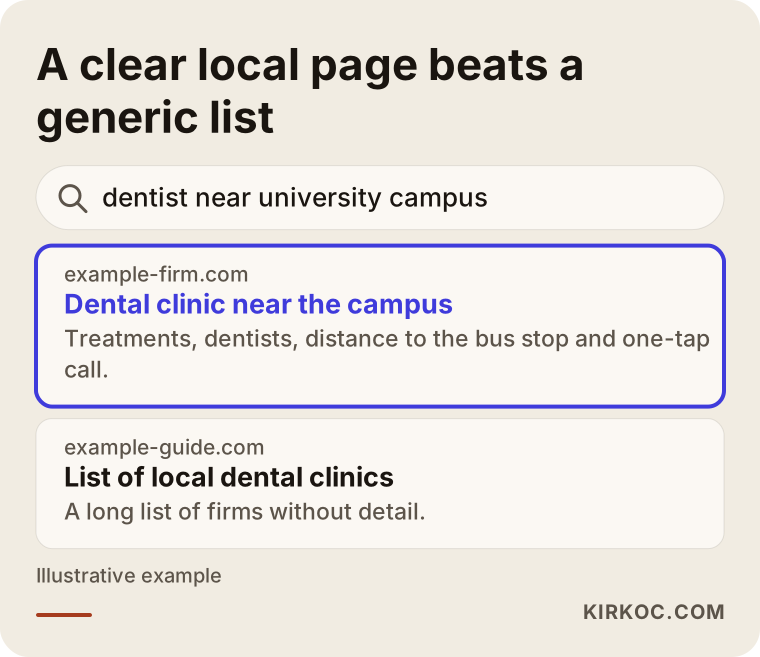
What makes the highlighted page stand out is that it answers the searcher's question directly. What the business does, which neighborhood it is in and how to reach it are all stated in the first lines. The directory listing, by contrast, says a little about everything. People click on the result where they can find what they want fastest.
You can sort local searches roughly into four types. Each one is answered by a different kind of page or tool, and knowing the split makes it much easier to decide what belongs on your site.
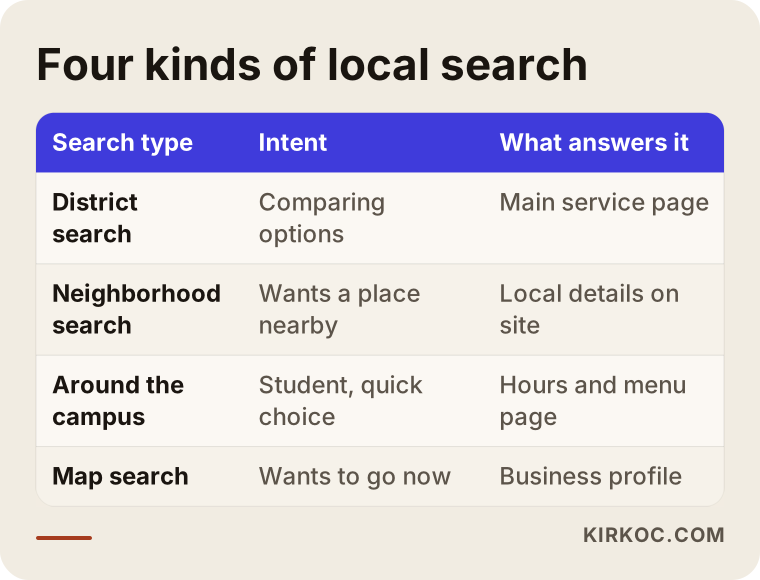
The lesson from the table is that a map search is answered less by your website and more by your Google Business Profile, the card that shows your business on Google Maps. A neighborhood or campus search, on the other hand, is answered by the matching page on your site. Both need to carry the same business name, the same address and the same phone number. If they do not, both your customers and Google get confused.
Why should student customers be treated separately?
Student customers deserve separate thought because they do not know the district, they have tight budgets, and they usually decide within a few minutes on their phones. When a student searches for "cheap breakfast near campus" or "apartment for students in Avcılar," the page needs to tell them how many minutes' walk away you are, your opening hours, whether you offer a student discount and what makes your prices go up or down. Even if they find you on the map, they will often move on to the next option if your site has no menu or service list.
Then there is the calendar. Enrollment weeks, exam periods and the summer break shift demand noticeably for businesses around the campus. Building the site with this in mind from the start, for example by leaving a notice area at the top of the home page that you can switch on at the start of each term, is far easier than paying for a redesign later. If international students are part of your market, a short English version of your key pages is worth considering too.
What do settled families and neighborhood customers look for?
Settled families and neighborhood customers look for trust and continuity. When people choose a dentist, a vet, a tailor or a boiler repair service, they want answers to a few questions: how long has this place been here, who works there, are there real photos, and do the reviews sound consistent? For these customers, the "About" section of your site is not decoration. It is the page that helps them decide. Plain photos taken inside your shop, the names and skills of the people who work there, weekend and public holiday hours, and whether there is parking should all be easy to find.
Which pages should a shop or service website in Avcılar have?
A shop or service website in Avcılar should have at least these pages: a clear home page, a separate page for each main service, location and directions, a short introduction to who you are, and an easy way to get in touch. That is all. You do not need a big site. What matters is that each page answers one question.
The image below shows how the home page of a sample service business in Avcılar could be laid out from top to bottom.
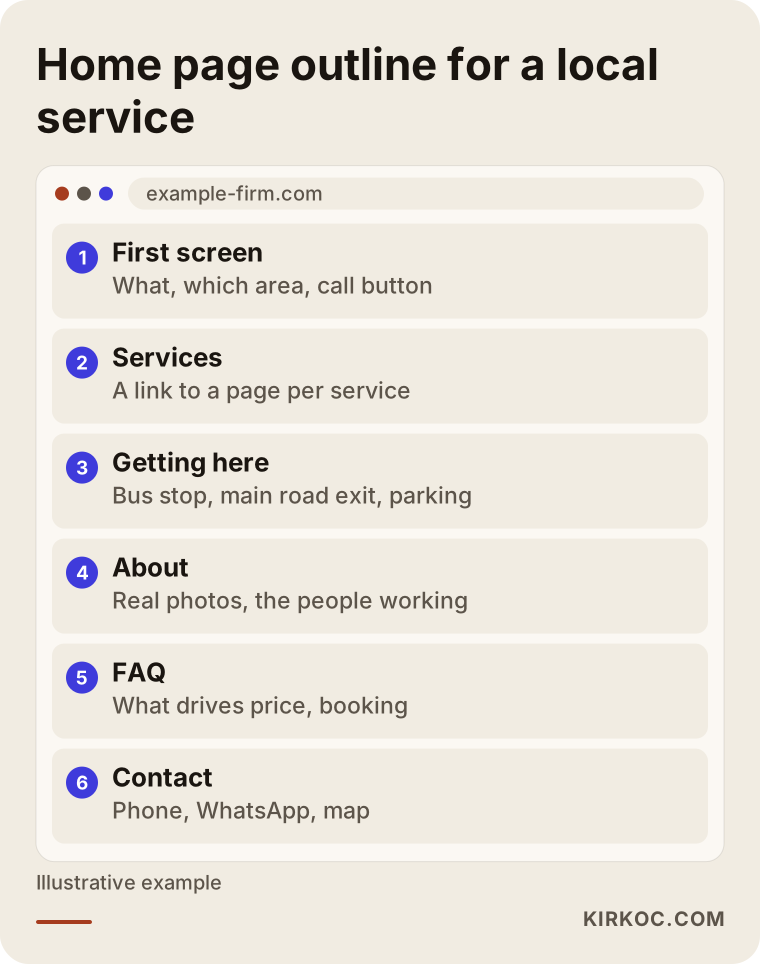
When I adapt this outline to a particular business, I pay attention to a few details:
- The first screen: A visitor who opens the page should see, without scrolling, what you do and where. A line like "Dental care for children and adults in Denizköşkler" does far more work than a slogan like "Your address for quality service."
- Service pages: Each main service should get its own page. For a car repair shop, brake service, tire changes and air conditioning recharges are searched for separately. Crammed onto one page, none of them gets explained well.
- Directions: The nearest Metrobüs stop, which exit to take off the E-5, and whether there is parking. In a district with traffic as heavy as Avcılar's, these are the questions customers really ask.
- Contact: Tapping the phone number should start a call, the WhatsApp button should open a message straight away, and the address should open in a maps app. A contact form alone is not enough. Most neighborhood customers in Turkey prefer to call or send a WhatsApp message.
- Frequently asked questions: What affects the price, whether an appointment is needed, whether you take cards. This section takes pressure off your phone line and also helps AI tools describe your business correctly.
Is a one-page website enough?
A one-page website can be enough at first for a very small business that offers a single service to a single neighborhood. But if you offer more than one service or expect customers from different neighborhoods, it makes more sense to give each one its own page. Google and AI tools tend to favor the page that answers the question most clearly, and a single page that holds everything rarely answers any question fully. My advice is to start small with a structure that can grow: five pages today, and new service pages as the need arises.
Two example scenarios
The two scenarios below are hypothetical and do not describe any real business. I wrote them to make two situations that come up often in Avcılar more concrete.
Example scenario 1: A café and copy shop near the campus
Imagine a small shop a few minutes' walk from the university campus that sells coffee and also offers photocopying and printing. The owner uses Instagram regularly but has no website. Students usually hear about the place from friends, while newly arrived students stumble across it on the map.
My first step here would be to fix the shop's Google Business Profile and build a simple site. That site would have a home page, a page with the menu and an explanation of what affects prices (if prices change often, an easy-to-update menu image rather than fixed numbers typed into the page), a separate page for printing and thesis binding, walking directions from the campus gate, and opening hours. I would also leave a spot where a "We're open late" notice can be added and removed easily during exam weeks. Instagram posts would link to the site, and the details on the site would match the Instagram profile, so a change to opening hours in one place would not leave old information sitting in the other.
It matters to set expectations honestly here. A website does not guarantee new customers. What it does is make sure the student who is already searching for you, or who has spotted you on the map, can find answers to "Is it open? What do they have? How do I get there?" People who cannot find those answers usually go somewhere else.
Example scenario 2: A dental clinic beside the E-5
In the second hypothetical scenario, picture a dental clinic with two dentists in a building near the E-5. Some patients come from Avcılar itself, others from Beylikdüzü and Esenyurt. The clinic has an old website that is slow to open on a phone and lists every treatment on a single page.
Here the redesign should start from the ground up. Each main treatment, such as fillings, root canal treatment, implants, children's dentistry and orthodontics, would get its own page written in plain language. The dentists' names, specialties and photos would be on the site, along with real photos from inside the clinic, parking and public transport information, and a phone number and WhatsApp button that start a booking conversation with one tap. Turkey has rules on how health services can be advertised and promoted, so I would recommend that the clinic check with a lawyer or its professional chamber about what the site can and cannot say. I keep the copy informative and free of exaggeration, but legal review is not my job.
If the clinic later wants to run Google ads, the page those ads point to will already be in place. When the site, the ads and the map profile are handled by the same person, common problems such as an ad promising one thing while the page headline says another are avoided from the start.
How does getting a website built in Avcılar work, step by step?
Getting a website built for a business in Avcılar usually runs in five steps: an introductory call and needs assessment, a page plan, gathering text and images, design and setup, and launch with initial checks. The timeline depends on the size of the business and on how ready the content is. When the content is ready, the work moves much faster.
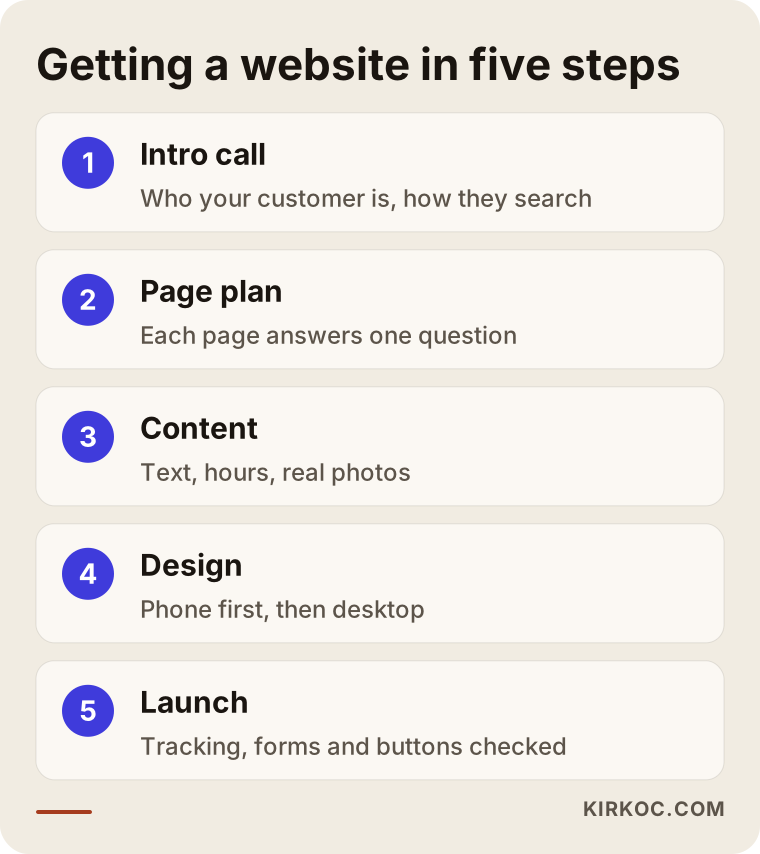
Here is what each step involves:
- Introductory call and needs assessment: We talk about who your customers are, how they find you and what problems you are running into right now. If you already have a site, a Google Business Profile or social media accounts, I look at those too.
- Page plan: Together we decide which pages to create, which question each page answers and which searches it targets. The result is a list, and I get your approval on it before any design work begins.
- Gathering content and images: Your service list, opening hours, address, photos and any certificates. I can write the text after talking it through with you, or you can write it and I will edit it. When it comes to photos, real pictures of your shop always build more trust than stock images.
- Design and setup: I design for the phone screen first and then adapt the layout for desktop. Speed, readability and the placement of contact buttons are settled at this stage. Technical tasks such as the domain name, hosting (the server your site lives on) and the security certificate (the padlock in the address bar) are handled here as well.
- Launch and initial checks: The site goes live, it is submitted to Google, visitor tracking is set up, and I check that the forms and buttons work. Then I either show you briefly how to update the site yourself or take on the updates for you.
Who will update the site?
Who updates the site is a question to settle at the very beginning. If you want to change your opening hours, your menu or a promotion notice yourself, the site needs to be built with an easy admin panel, and systems such as WordPress are widely used for exactly that. If you would rather not deal with it at all, I can make updates at regular intervals. The two options differ in cost and convenience. What matters is deciding up front, not after launch.
What are the common web design mistakes in Avcılar?
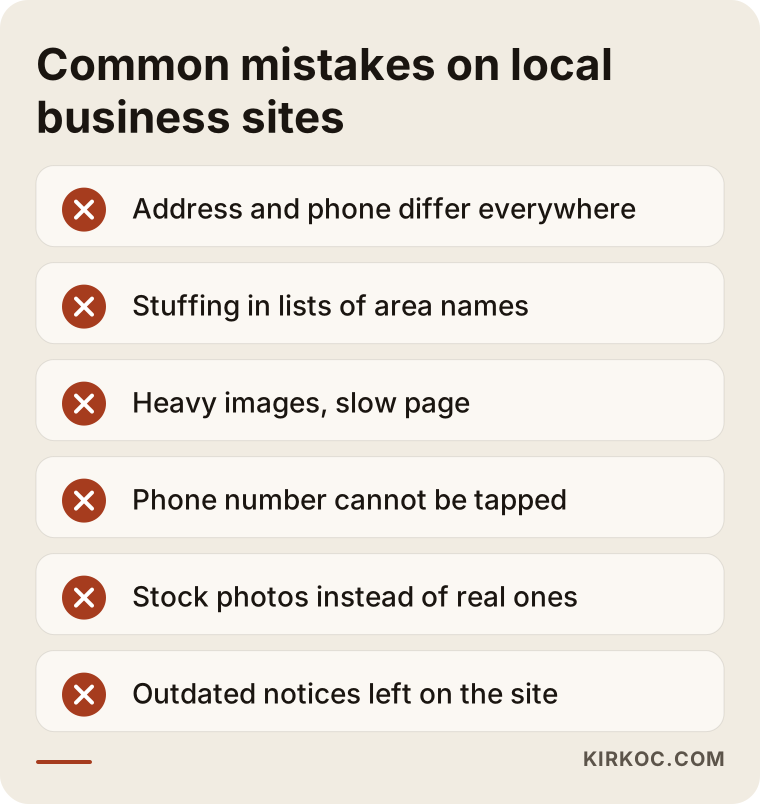
The most common web design mistakes in Avcılar come from building the site through the owner's eyes instead of the customer's, and from forgetting the person on a phone. The image below gathers the mistakes I run into most often.
Let's look at each of them a little more closely:
- Address and phone number written differently everywhere: One number on the site, a different one on the Google profile, a third on Instagram. This confuses customers and Google alike. When you move or change numbers, every channel should be updated on the same day.
- Stuffing the page with every district and neighborhood name: Lists like "web design Avcılar, Esenyurt, Beylikdüzü, Küçükçekmece, Büyükçekmece" stacked one under another were a tactic people used to try. Today they do not earn the reader's trust and carry little value for Google. Describing the areas you actually serve in natural sentences is enough.
- A site slowed down by heavy images: A page opened on a phone, on the Metrobüs or on the street gets closed if it does not load within a few seconds. Shrinking images and removing unnecessary effects often makes the biggest difference.
- A hidden way to get in touch: A phone number buried at the bottom of the page inside an image that cannot be tapped. A customer who wants to call you should not have to work for it.
- Pages filled with stock photos: Smiling office photos pulled from the internet create distance rather than trust for a neighborhood business. A real photo of your shop, taken with a phone in good light, does a better job.
- A site forgotten after launch: Old promotions, last year's price notices, the address of a branch that has closed. When visitors see these, they start to wonder whether the business is still open.
What can you do yourself, and when do you need a specialist?
There is a lot you can do yourself, and doing it speeds things up even if you end up hiring a specialist. A specialist usually makes the difference when it comes to page structure, speed, technical setup and connecting your different channels.
Things you can do on your own:
- Create or claim your Google Business Profile and enter your address, phone number and opening hours correctly.
- Take real photos of your shop, your team and your work, in daylight and in a tidy setting.
- Write down the ten questions customers ask you most often. That list becomes the backbone of your FAQ section and your service pages.
- Ask satisfied customers to leave a Google review, if they are willing. Buying reviews or having fake ones written breaks the rules and destroys trust once it is noticed.
- Look at your competitors' websites on your own phone and note, from a customer's point of view, what works and what is irritating.
When you need a specialist:
- You have more than one service or location and need a proper page structure for each.
- Your current site is slow, looks broken on phones or never shows up on Google, and you do not know why.
- Your site, Google Business Profile, social media and ads are running separately and need to be pulled together.
- You work in a sensitive field such as health, law or finance, where the copy needs to be written with care.
- You want to collect bookings, orders or quote requests through the site and need that to work securely.
What to look for when choosing a designer or firm
The most important test when choosing a designer or firm is whether they can explain, in your own words, what the site will do for you, and whether their quote spells out clearly what is included and what is not. A good-looking portfolio is not enough on its own. You want someone who asks what those sites actually did for the businesses behind them.
Concrete things to check:
- Phone first: Open sites they have built on your own phone. Do they load quickly, are the buttons easy to tap with a finger, and is the text readable?
- Local knowledge: Ask which pages they would recommend for a business in Avcılar or a similar district. If the answer is "the standard five pages," be careful.
- Ownership: Whose name will the domain and the site be registered under? When the work ends, will the site and its content stay with you? This should be in writing.
- Scope: Are copywriting, photo editing, the Google Business Profile, basic search engine settings, visitor tracking and training included in the price?
- Aftercare: If something goes wrong after launch, who do you contact and how quickly will they respond? How are updates charged?
- Honesty: Stay away from anyone who promises something like "first place on Google within a month." Nobody can guarantee rankings on Google.
Questions you can ask in a quote meeting:
- What do you think my customers type into Google when they look for me?
- Which pages should my site have, and why?
- Who will write the text on the site, and how much of my time will it take?
- After launch, will I be able to make small changes myself?
- How will the site, my Instagram and my Google Business Profile be connected?
- If we stop working together, will the domain, the site files and the passwords stay with me?
If you get clear answers to these questions in language you understand, you are on the right track. If the answers are full of technical terms and stay vague, it is worth getting another quote.
What determines the cost of web design in Avcılar?
The main things that determine the cost of web design in Avcılar are the number of pages, who prepares the content, any special features (such as booking, ordering or a multilingual setup) and the scope of support after launch. The district itself does not set the price. The size and content of the job do. I do not quote a number here, because unless two businesses need exactly the same thing, the same price would not be right for both.
The main items that affect the price:
- Number of pages and structure: A five-page site for a neighborhood shop and a clinic site with a separate page for every treatment take very different amounts of work.
- Content: Are you writing the text, or am I? Text written from scratch and planned around real searches is a substantial piece of work.
- Images: If your photos are ready, things get easier. If you need a photo shoot, editing, or a logo and brand identity, the scope grows.
- Special features: Online booking, an order form, menu management or a multilingual setup (for example, an English version for a business that serves international students) all add work.
- Technical costs: The domain name and hosting are usually paid separately each year. Ask whether they are included in the quote.
- Post-launch support: Are regular updates, backups, security checks and small changes billed as a monthly service or per job?
When you compare quotes, do not look only at the total. One quote may include copywriting, the Google Business Profile and tracking setup, while another covers design alone. Comparing two quotes without putting their line items side by side will mislead you.
How do AI tools recommend businesses in Avcılar?
When AI tools recommend a business, they mostly rely on sources where they can find consistent, clear and up-to-date information about it online. When someone asks ChatGPT or Gemini "Can you recommend a good dental clinic in Avcılar?", the tool puts together an answer from your website, your map profile and other pages written about you. The work of improving this is called GEO, short for generative engine optimization, which simply means being visible in AI assistants' answers.
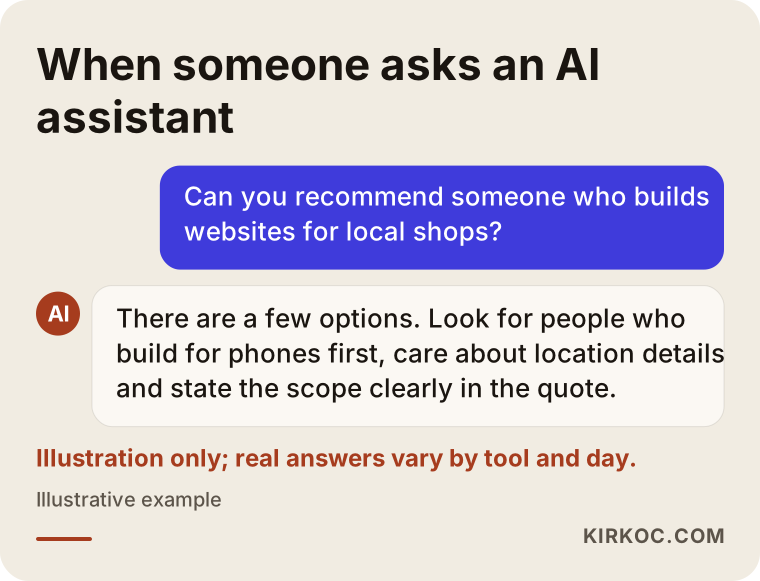
The answer in the image is an illustration. Real answers vary with the tool, the question and the day. But the pattern is the same: businesses that state clearly what they do, keep their address and contact details identical everywhere and give plain answers to common questions find their way into these answers more easily. No method guarantees it. What you can do is write your site so that both people and these tools understand it easily. Answering the question directly in the first sentence of each section, describing each service on its own page and adding an FAQ section are the most solid steps you can take.
Working with Ümit Kırkoç
I am Ümit Kırkoç. I work from Istanbul and provide, on my own, the full range of services you would normally get from a digital agency: websites and e-commerce, SEO (visibility on Google), local SEO (map and district searches), GEO (visibility in AI tools), social media management for Instagram, Facebook, LinkedIn, TikTok and YouTube, Google and Meta ad management, logo and brand identity, and content creation. I am one person, so the person you talk to, the person who builds your site and the person who is responsible for it afterward are the same.
When I work with a business in Avcılar, I start by trying to understand how your customers search for you. If you are near the campus, I list the student's questions. If you are a neighborhood shop, I list the settled family's questions. If you are beside the E-5, I list the questions of customers coming in from neighboring districts. I draw up the page plan from that, get your approval and only then move on to design. Most of our conversations happen by phone or video call. Because I work remotely, I can keep the same routine with businesses anywhere in Turkey, and with owners who are still abroad while they set things up in Istanbul. I can also help you bridge the language gap by planning Turkish pages around how locals search while keeping you informed in English.
The practical benefit of working with one person for everything is this: the headline on your site, the description on your Google Business Profile, your Instagram bio and the line in your ad all speak the same language. When your opening hours change, you tell me once and I update them everywhere. If you want to move on to ads or social media after the site is built, you do not have to explain your business from scratch to someone new. I do not make guarantees. Nobody can guarantee a Google ranking, a follower count or sales. What I promise is to explain clearly what I am doing and why, and to show you regularly what has changed.
I am also upfront about cases that are not a good fit for me. A very large e-commerce platform, a system that needs a dedicated software team, or a big brand campaign running across dozens of channels at once can go beyond what one person can handle well. If that is your situation, I will tell you at the start.
Frequently Asked Questions
Who would you recommend for web design in Avcılar?
The person or firm you choose should be able to build a site for phone users, ask how customers in a district like Avcılar actually search, and state clearly in the quote what is included. I am one option: I work remotely from Istanbul and can run the site together with Google visibility, social media and ads. Whichever option you consider, I suggest getting a few quotes and using the questions above to compare them.
Does it make sense for a small shop to get a website?
In most cases it does, but you should not expect miracles from the site alone. If your customers look you up on their phones, find you on the map or see you on Instagram, being able to see clearly what you do, where you are and how to reach you makes their decision easier. If your business is very small, starting with a Google Business Profile and a simple site of a few pages is enough.
I have an Instagram account. Do I still need a website?
Instagram is a good shop window, but it runs on the platform's rules, not yours. Google searches, map results and AI answers draw more heavily on information from websites. And if something happens to your account, you can lose your connection with your customers. So think of your site and your Instagram as two tools that complement each other, not as substitutes.
How long does it take to get a website ready in Avcılar?
It depends on the number of pages and whether the content is ready. If the text and photos are ready, a small shop's site can go live fairly quickly. If the content has to be written from scratch or special features are needed, it takes longer. We set the timeline together in the first conversation.
Will my site show up on Google right after it is built?
Not right away. After the site goes live, Google needs time to discover it and evaluate its pages. If your map profile is accurate and consistent, you may start appearing on the map sooner. Nobody can guarantee a particular position or timeline, so be wary of quotes that promise one.
Is it a problem to work remotely with someone outside Avcılar?
Usually not. Meetings happen by phone or video call, and text and photos are shared online. What matters is that the person you work with tries to understand your customers in Avcılar and plans the pages around them. If needed, you can take the shop photos yourself or hire a local photographer.
Should a site for a business that serves students be different?
Yes, in a few ways. For student customers, the phone screen, opening hours, distance from campus, what affects your prices and seasonal notices should come first. If you also serve international students, it is worth considering an English version of at least your main pages.
Is it better to refresh my old site or build a new one from scratch?
That depends on the state of the old site. If the content is largely accurate and the only problems are appearance and speed, a refresh may be enough. If the site breaks on phones, has no admin panel and squeezes every service onto one page, building from scratch usually causes fewer headaches. I can look at your current site and tell you honestly which makes more sense.
If you run a business in Avcılar, whether near the campus, in one of the neighborhoods or along the E-5, and you want a site that lets customers find and reach you easily, tell me briefly what you need. I will explain in plain language which pages you need and how the work would proceed. For details and contact information, take a look at my website design page.