You make handmade products in Turkey, in a home workshop or a small studio: ceramics, jewelry, candles, textiles, woodwork, leather, maybe personalized gifts. Your work sells locally, but you suspect the real interest is among buyers abroad. Or you are a foreigner living in Turkey who wants to sell what you make to customers back home. Either way, one name comes up first: Etsy. In this article I cover Etsy shop setup and management from the point of view of a maker with no technical background: where to start, what to watch, which mistakes waste time, and which parts of the job are worth getting help with. If you also start thinking about a store of your own beside Etsy, I will explain plainly how my e-commerce website service fits into that picture.
I am Ümit Kırkoç. I work in Istanbul and I handle the services a digital agency would normally split between several people, all by myself: websites and e-commerce, search engine work, social media, advertising, logos and content. That is why I do not treat Etsy as a magic sales machine. My aim here is to tell you, neutrally, whether it is a good channel for you and, if it is, how to set it up properly.
Why does Etsy hold a special place for handmade goods?
Etsy is a marketplace focused on handmade, vintage and personalizable items. Buyers arrive there with a particular mindset. They are usually not hunting for a factory-made product. They are looking for a gift, something with character for their home, or an item with a story. The biggest advantage of a handmade producer is exactly that: behind your product there is a person, real effort and a story.
What a marketplace gives you is a ready-made crowd. On your own website you have to bring the crowd yourself. On Etsy, people already arrive with the intention to shop. In return you enter a competitive space: in the same product type there may be hundreds or thousands of shops. So Etsy is not a place where you set up and wait. It needs regular upkeep, from the listing title to the photos, from the shipping options to the shop page.
To show how buyers search, here is a hypothetical search result. It is not a real shop, only an illustration of the logic.
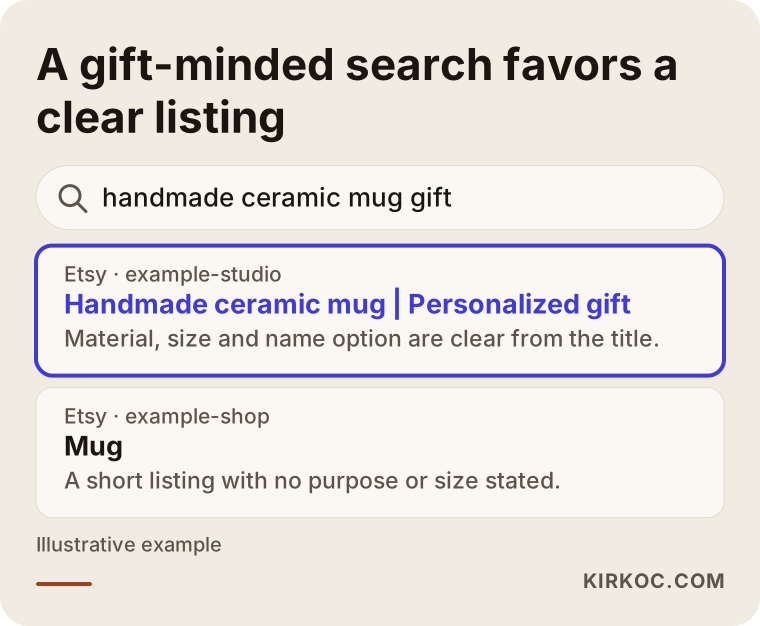
The highlighted listing makes the purpose (a gift), the material and the personalization option clear from the title onward. The buyer can think, "This is exactly what I was looking for." The listing below it describes the product but never says who it is for. Much of being visible on Etsy comes down to whether the words the buyer types meet the words you wrote.
How do buyers abroad search, and what do they expect?
A buyer in Turkey often types a product name. Abroad, especially when shopping for gifts, search works a little differently. People describe a moment or a person: a birthday, a housewarming present, a wedding, an anniversary. The product name may come second. That is why your listing text should explain not only what you sell but also who it suits and when.
If you are a Turkish maker, there is a second layer. Your natural way of naming things, in Turkish, will not match what an English-speaking buyer types. A word that feels obvious to you may be unknown to them. Think of how a visitor to Istanbul would describe your product to a friend, and use those words.
In general, buyers abroad expect the following:
- To see the real size, weight and material of the product clearly.
- To know when the order will be prepared and when it will arrive.
- To avoid surprises about customs, taxes and returns.
- To understand exactly what they must provide if the item is personalized.
- To be able to talk to the seller in clear language and within a reasonable time.
Most of these expectations have little to do with the quality of your craft. They are about presentation. A beautiful product with a vague delivery time or missing measurements may simply not turn into a sale.
Etsy, your own website, or both?
This is the first question everyone asks, and there is no single right answer. Here is the short difference. On Etsy you get ready-made traffic, a ready payment setup and buyer trust, but the rules, fees and visibility are in Etsy's hands. On your own site the customer list, pricing, brand look and data are yours, but you have to bring the visitors yourself.
This decision logic works for most makers:
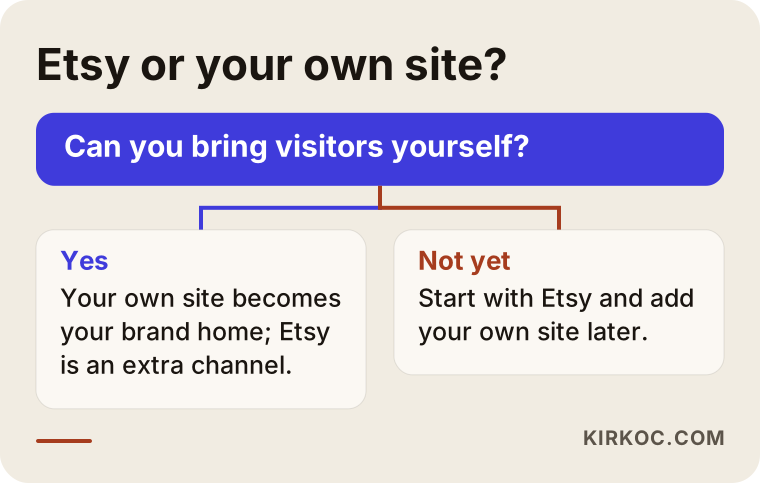
What the diagram says is simple. If you are just starting and you have no system yet for bringing in visitors, Etsy can be a starting point. If your brand is strong, repeat customers are forming, or you do not want to depend on a marketplace's rules, your own site becomes more and more important. For many makers the healthy path is to run both: Etsy is where new people discover you, and your own site is the home of your brand.
Why does running both make sense?
A customer who makes a first purchase on Etsy and remembers you may come straight to your site next time. For that move you need to behave within Etsy's rules, and you should read Etsy's current policies on directing customers away from the marketplace. Beyond that, the product photos you share on social media, a website that someone sees when they search for your brand name on Google, and an "about me" page all add indirect trust to your Etsy shop too.
This is where having the work in one pair of hands pays off. A product photo is taken once and used in the same style in the Etsy listing, on the website and on Instagram. Texts are thought through once and come out consistent everywhere. When site, search visibility, social media and ads are handled separately by different people, the same product often ends up with different photos and different descriptions in each place.
What should you prepare before opening a shop?
Opening a shop on Etsy is technically easy. The hard part is what happens after it opens. Before you rush in, I suggest writing down answers to these questions:
- Which products will I sell, and how many will I start with?
- What is the real cost of each product (materials, labor, packaging, shipping, platform deductions)?
- How many days do I need to prepare an order, and can I write that number without lying to anyone?
- Which carrier will I use for shipping and for the customs process?
- If I offer personalization, what are its limits?
- In what language will I write to customers, and can I keep that up?
On payments, taxes and exports I do not give firm guidance myself, because these depend on your personal and business situation. If you will sell abroad from Turkey, you should talk to an accountant or the relevant authority. Please do not read this article as legal or financial advice.
Step by step: how to open an Etsy shop
If we put the process in a simple order, the flow below is enough for most makers. Thinking about each step separately reduces the number of things you rush through and leave incomplete.
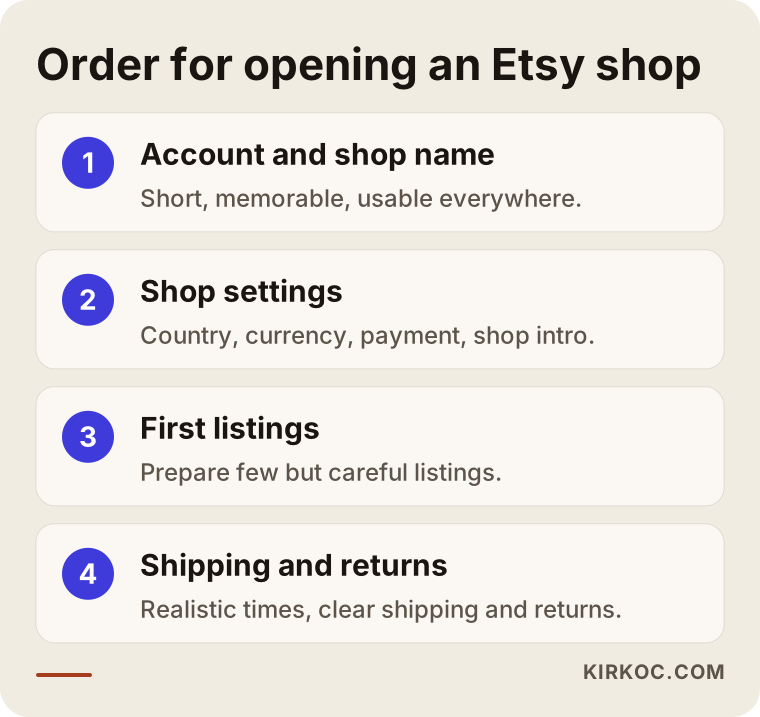
Let me unpack the order in the picture. First you decide on your account and shop name. The name should be short, memorable and in harmony with your products. Make sure you can use the same name later on your own site and social media accounts. In the second step you fill in the shop settings: country, currency, payment method and information about the shop. In the third step you prepare your first listings. In the fourth step you set up shipping profiles, preparation times and your returns policy.
Shop name and shop page
The shop page is your window display. The banner image, a short shop announcement and the "about the seller" section decide whether a buyer will trust you. Avoid exaggeration here. Instead of sentences like "the best in the world," describe in plain words what you make, where you make it and how you prepare the products. A photo of your studio or your work table convinces many buyers more than a paragraph of text.
Shipping and processing time
Write a realistic processing time. Saying "3 days" and then taking a week hurts your reviews. Think about international shipping options according to the size and fragility of your product. For fragile items like ceramics, the cost and strength of the packaging should be calculated before the shipping fee. Decide from the start how you will show the shipping price (included in the item price or separate), and stay consistent in every listing.
For a maker in Turkey, I would add one practical point. Before you open the shop, prepare a sample parcel, take it to the carrier you plan to use, and get a real quote and a real delivery estimate for a few destination countries. A quote on paper and a quote at the counter are not always the same, and this small test can save you from a pricing mistake that is painful to discover after your first ten orders.
Preparing listings: where visibility really works
The most concrete thing that decides a shop's visibility on Etsy is its listings. The shop can be beautiful, but if the buyer never clicks the listing, they never see the shop. When you prepare a listing, concentrate on four things: the title, the photos, the description, and the tags and attributes.
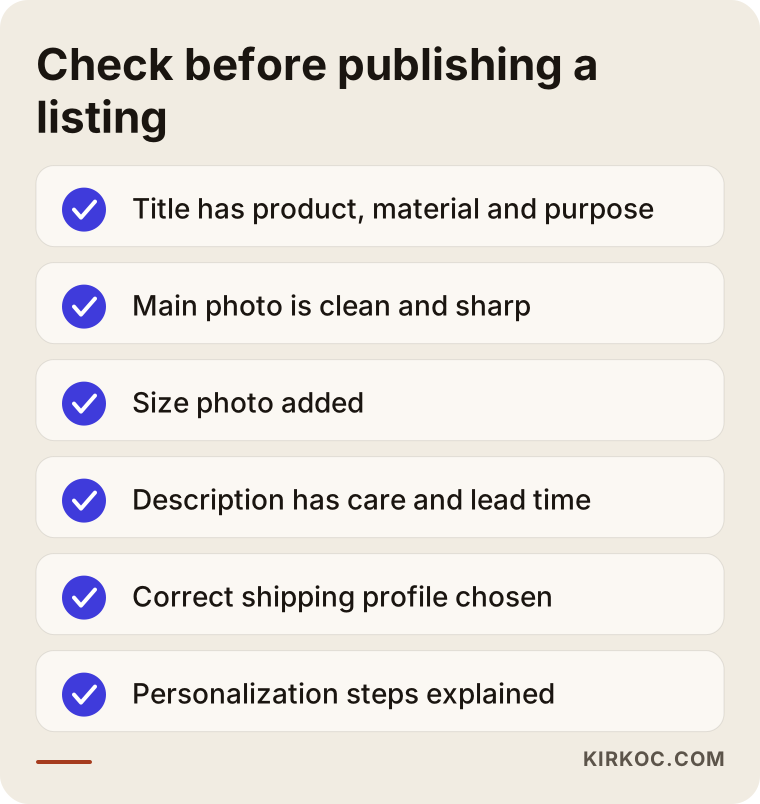
Go through the checklist every time before you publish a listing. Now let us unpack these items a little.
Title: use the words the buyer will type
In the title, write the product name, the material, the purpose of use and, if needed, the personalization detail. Ask yourself what the buyer will type into the search box. The special name you gave your own product may be lovely, but nobody searches for it. Leave the special name for the description or the end of the title. The first words of a title are the part shown both in search and in the list, so put the most important information first.
If English is not your first language, this is where a second pair of eyes helps most. A title translated word for word from Turkish can sound strange, and a strange title is a title nobody clicks. Try reading it out loud as if you were describing the item to a friend visiting from abroad.
Photos: half of the listing
The buyer cannot touch the product, smell it or feel its weight. All they have is your photos. A good listing generally includes a clean-background main photo, the product in use, a photo that shows the size (in a hand or beside a familiar object), a close-up of the detail, and the packaging. Photos taken in natural light and in a consistent style make your shop look professional. Shooting all of them on the same day in the same light is the easiest way to get consistency.
Description: answer the questions up front
The description should include the material, the dimensions, care instructions, the preparation time, what you need from the customer for personalization, and a note that because the item is handmade, small variations are normal. If you are answering the same message for the third time, it is time to add that answer to the listing.
Tags and attributes
The tag and attribute fields on Etsy are limited, so it is worth not wasting them. Instead of repeating the same word, use phrases that buyers might search for in different ways. Mix gift-minded, material-focused and use-oriented phrases. Over time you can see from the shop statistics which words actually bring visits.
Two hypothetical example scenarios
The two scenarios below are completely hypothetical; they do not describe a real person or company. The goal is to show how different paths can lead to the same target.
Example scenario 1: A ceramic studio starts with one small collection
Suppose a ceramic artist working in a small studio in Izmir wants to sell handmade mugs abroad. Instead of listing twenty different products at once, she begins with a collection of three. For each product she prepares six photos in the same style, shot in natural light. In the titles she uses "gift," "handmade" and the material information. For shipping she builds a sturdy packing system against breakage and adds the packaging cost to the price.
In the first weeks she does not expect sales. Instead she looks at which listings get clicked and which are added to carts. She notices that one listing is seen a lot but not clicked, and she changes its main photo. That small intervention changes how the listing is received. The point is not a one-off setup but regular small adjustments.
Example scenario 2: Personalized jewelry, and message handling becomes the problem
Suppose a jewelry designer makes name necklaces. Orders start to arrive, but for each order she needs the spelling, the length and the font choice from the customer. Messages pile up, reply times grow longer, and one customer receives a necklace with a wrong letter.
The solution is to simplify the process: an image in the listing that shows with examples how to fill in the personalization field, ready-made reply templates for common questions, and one final confirmation of the spelling at the order stage. In other words, the problem is not product quality but information flow. For businesses like this, managing an Etsy shop is as much about organizing communication as it is about making the product.
Etsy shop management: what do you do after opening?
Opening the shop is not the end of the job; it is the start. By management I mean a few regular tasks that settle into a rhythm:
- Following orders and messages: Answering without delay, politely and clearly.
- Updating listings: Refreshing titles, photos and featured products for the seasons, holidays and gift periods.
- Reading the statistics: Watching which listing is viewed, which is clicked and which sells.
- Managing reviews: Thanking happy customers and answering complaints calmly and with a solution.
- Keeping stock and processing time honest: In busy periods, extending the time is healthier than losing the order.
- Reviewing costs: Updating your price when material and shipping prices change.
Each of these takes only a little time, but together they add up to real work. For someone who makes things, the biggest risk is management tasks eating production time.
The path from visitor to order
A listing turns into a sale by passing through several stages. At each stage some buyers drop off; this is normal. What matters is seeing where you are getting stuck.
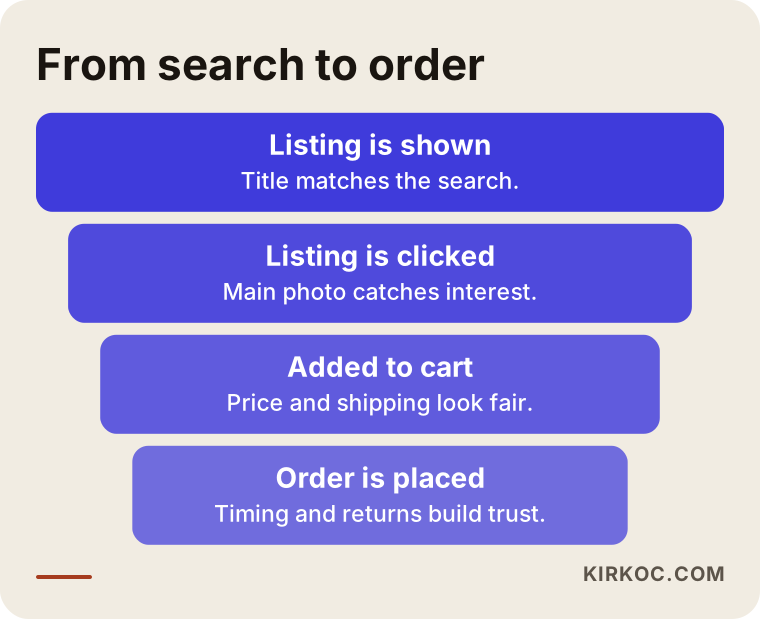
The funnel gives you a way to diagnose. If there are many views but no clicks, the problem is usually the title and the main photo. If there are clicks but nobody adds to the cart, the price, the shipping fee or the description is not convincing. If items are added to the cart but no order follows, delivery time, the returns policy or a lack of trust may be at play. Knowing this logic lets you focus on one point rather than changing everything at once.
What determines the cost of selling on Etsy?
I will not give figures, because fees depend on platform policy, your country and your product, and they are updated over time. For current information you should look at Etsy's own fee page. But I can tell you which items need to be in your calculation.
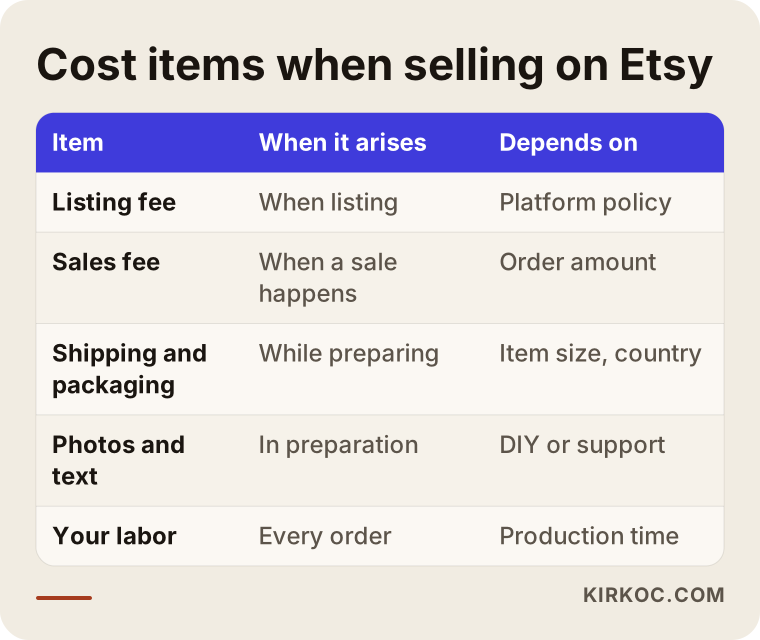
If you do not reflect every item in the table in your price, you may sell and still not make a profit. The most common mistake is to calculate the material cost and forget your labor, the packaging, the platform deductions and the shipping risk. When you set a price, ask yourself: "After everything is taken out, does the money left in my pocket justify the hours I spent?"
What does the cost of consulting or management support depend on?
If you want support from me, it is enough to know that the cost varies with a few things:
- How many products you have and how much preparation each one needs.
- How much photography, copywriting and translation you need.
- Whether you want only the initial setup or ongoing management.
- Whether your own website and social media work are also part of the job.
- The markets and languages you are targeting.
For a clear quote I would need to look at your products and your goal. We first talk and work out together what you need; I will not sell you a service you do not need.
Common mistakes
New makers on Etsy fall into the same traps again and again. Knowing them can save you months.
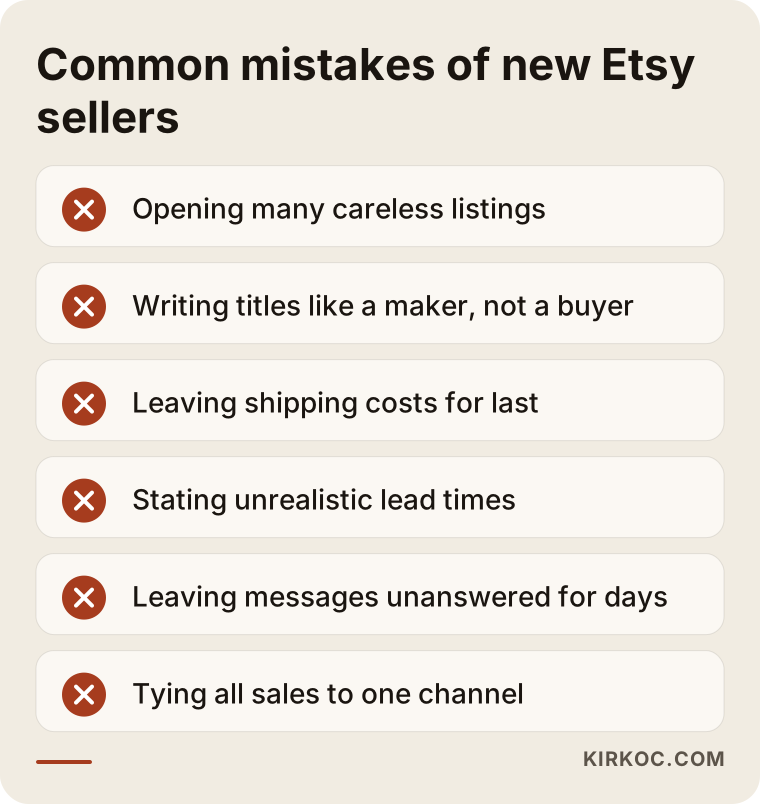
I would summarize the mistakes in the picture like this:
Opening many listings in a hurry. Ten careless listings bring less business than two careful ones. Prepare a few products well first, look at the data, then multiply.
Writing the title in your own voice. The name you give a product makes sense to you. The buyer types a need. Build the title in the buyer's voice.
Leaving shipping and customs for last. It is very common to set a nice price and then lose money on shipping. Before you start selling, prepare a sample parcel and get a real shipping price.
Hiding a long processing time. Giving the buyer an honest time protects you from negative reviews.
Delaying messages. A buyer abroad may be in a different time zone, but a silence of a day or two shakes trust.
Tying everything to one channel. If a policy changes on Etsy, your account runs into trouble or the ranking system changes, and you sell from one place only, it hits you directly. Other channels, at least your own site and a social media account, are a kind of insurance.
Ignoring brand consistency. If the shop name, logo, photo style and Instagram look on Etsy differ greatly from each other, the buyer will not remember you.
How do the first three months go?
The first weeks on Etsy are often quiet. That is normal. A new shop does not show up right away like a well-known one; buyers need reviews and a sales history before they trust it. Planning with that in mind keeps you from giving up. I cannot promise a fixed period or result, because every shop, product and level of competition is different. But the road map usually looks like this:
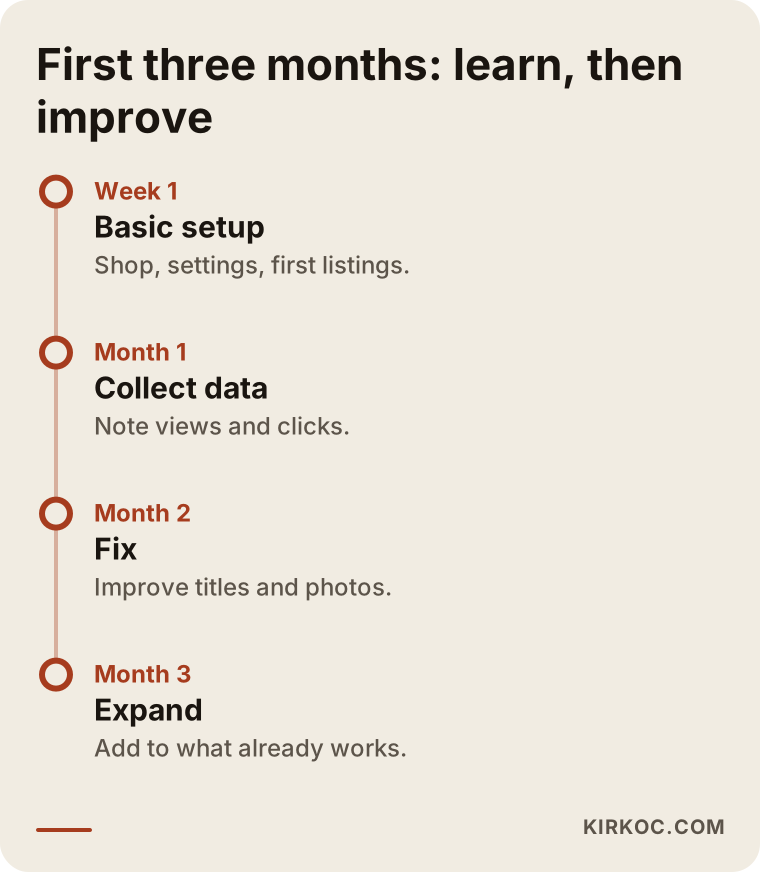
The main idea of the timeline is: build the foundation first, then read the data, then improve. The first month is not for sales but for learning. Note which listing is viewed, which photo is clicked and which question comes up often. In the second and third months you fix the titles, photos and shipping settings according to those notes.
Your own website beside Etsy: which pages do you need?
Some makers who start selling on Etsy want their own website after a while. The reasons vary: growing the brand, building a direct relationship with customers, reducing marketplace commission, or having an address to show when someone searches for the brand on Google. Your own site does not have to replace Etsy; it is a channel that stands beside it.
The pages needed for a handmade product site are simpler than you might think:
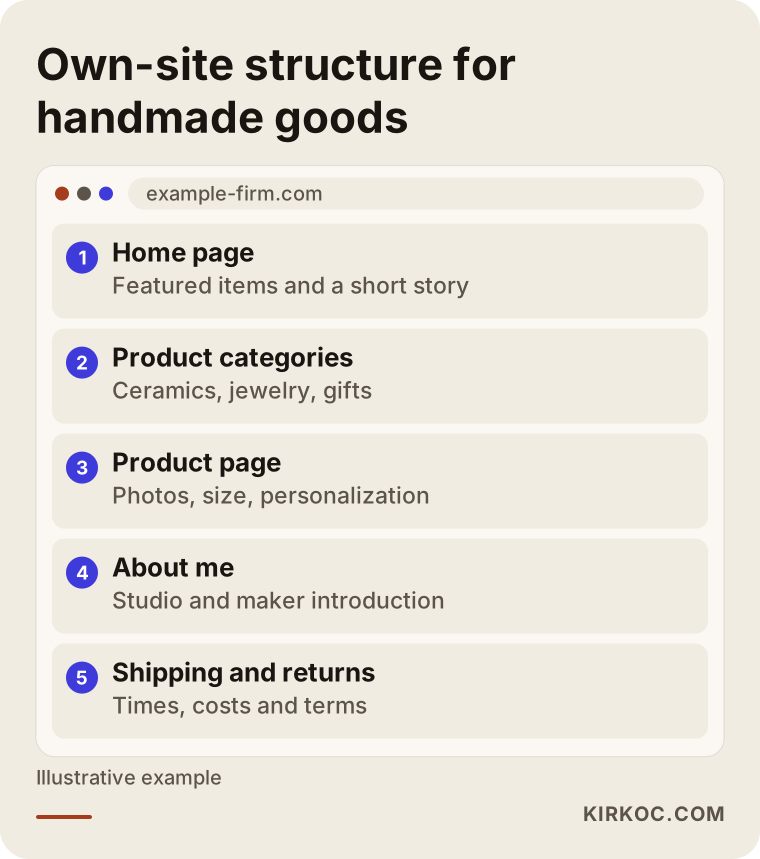
The home page is the showcase of your products, category pages are for the buyer to browse, and product pages are for the moment of decision. An "about me" page is especially important in handmade work, because people buy the maker along with the product. A shipping and returns page answers questions in advance. Contact and frequently asked questions also reduce the number of messages you get.
Getting your own site found on Google is a separate piece of work; search visibility, social media and advertising become part of the job too. Running them with different people and firms can lead to the same product's photo and text coming out differently in different places. Having everything in one pair of hands brings consistency and easier follow-up. There is no magic in it; it only means communication and coordination stay simple.
What can you do yourself, and when do you need an expert?
You can do most things yourself. Truly. Opening your shop, uploading your first listings, taking photos and answering messages are all things you can do. You know your product best. Starting with your own effort lowers the cost and teaches you what customers ask.
Expert support starts to make sense in these situations:
- If most of your time is leaving production and going into management work.
- If your listings are viewed but do not turn into sales and you cannot work out why.
- If you struggle to write in a foreign language.
- If you want to build your own website beside Etsy and make your photos and brand consistent.
- If you need to run several channels (site, social media, ads) together.
To see this distinction at a glance, I made a two-column summary.
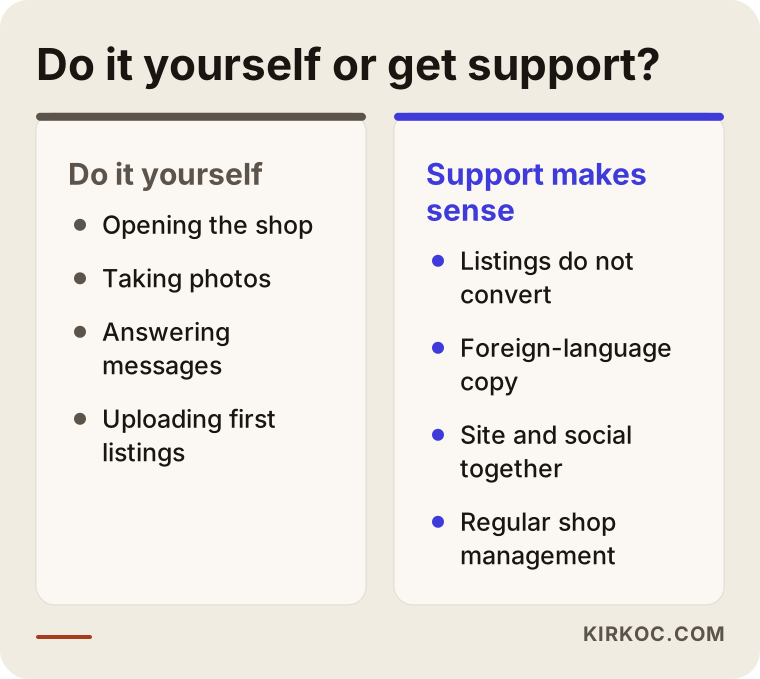
The comparison is not a rule, it is a direction: the tasks in the left column run on the maker's own knowledge, while the tasks in the right column get easier with support when they need time or expertise. Depending on your goals, support does not have to mean handing over all of the management. Sometimes a one-time shop and listing cleanup is enough; sometimes regular monthly attention is needed.
How I work with you
If you work with me, the process goes like this. First we talk about your products, your target market and your present situation. If you have no Etsy shop yet, we go through the setup plan; if you do, we look together at where the current shop is stuck. Then we write down what you need: only the shop and listing structure, photo and text support, or a plan that includes your own website and social media work?
On the other side you will not find a team but one person: I handle the correspondence, the plan and the execution myself. That means you get quick answers to your questions and everything moves in step. I give no guarantee of sales or ranking, because nobody can honestly give one. What I can do is build the work properly, show you with data what is working, and prevent unnecessary spending.
If you are also thinking about your own site, we plan it together with Etsy, not apart from it. Product photos, brand language and product descriptions can be used in both places.
Frequently asked questions
Do I need to set up a company to open an Etsy shop?
The answer depends on your personal situation and the rules of your country. Your sales volume and tax status will be decisive. I cannot say anything definite; the right move is to ask an accountant or the relevant authority.
Which products are suitable for selling handmade on Etsy?
Many handmade products are suitable: ceramics, jewelry, textiles, candles, soap, leather, wood, paper goods, personalized gifts and decor. However, Etsy has rules about which kinds of items it allows, so read its current policies before you sell.
How many days until an Etsy shop brings sales?
There is no fixed period and I cannot give a guarantee. Product type, competition, photo quality, price and the number of listings all affect the result. It is healthier to see the first weeks as a learning period.
How much time do I need to spend on Etsy shop management?
It depends on order volume. At the start, a regular but short time for messages, listing updates and checking statistics may be enough. As orders grow, packing, communication and stock tracking grow too. If you begin to run short of time, you may think about getting support.
In which language should I write my listings?
It is best to write in the language of your target market. If you sell abroad, you usually start with English. The text should sound natural and be easy to understand; sentences that read like machine translation damage trust. If needed, have the texts checked once.
Is it enough to use only Etsy?
It is; many makers do that. But relying on a single channel leaves you exposed to platform changes. Adding your own site and a social media account over time spreads the risk.
Do I also need my own site for my Etsy sales?
It is not mandatory. It helps if you want to grow your brand, win repeat customers and appear on Google under your own name. It is also possible to start with Etsy first and decide after seeing how things go.
How do we start if I want you to manage my shop?
We have a short call about your products, your goal and your current situation. Once your need is clear, we talk openly about how long things will take and what the pricing depends on.
If you want to set up your Etsy shop, tidy up your current one, or plan your own site beside the marketplace, you can write to me through my e-commerce website service page. I will listen to your products and tell you honestly what you really need.