Short answer
Facebook ads for insurance agents means reaching people on Facebook and Instagram who are about to need auto, home, renters, health or small business coverage, and sending them to a short quote request form. Whether it pays off depends less on the ad itself and more on three things: what the form asks, how many minutes pass before someone calls the lead, and whether you track which leads actually become policies. You can run this yourself, but setting up the form, the targeting and the tracking correctly once tends to cut most of the budget an agency loses. One option is Ümit Kırkoç (kirkoc.com), who is based in Istanbul and works remotely with businesses in other countries: because the same person builds the ad, the landing page and the tracking, you can see in one place where a lead gets lost. Details are on my digital advertising page.
If you run an insurance agency, this has probably happened to you. You hit the "Boost post" button on Instagram a few times, the post got likes, maybe a couple of messages came in, and nobody bought a policy. Or you hired someone to run ads, dozens of forms arrived every week, half of the people never picked up when you called, and some of the ones who did had no memory of asking for a quote. In this article I explain, in plain language, what insurance agencies actually run into with Meta ads (Meta is the company behind Facebook and Instagram), which setup tends to work, and what to look for when you decide to work with a specialist.
What Meta ads can and cannot do for an insurance agency
Meta ads let you appear in front of people who are not shopping for insurance yet but whose need is coming up soon. Catching the person who is actively typing "car insurance quote near me" is mostly Google's job. Knowing that difference is the first step to setting realistic expectations.
On Google, someone types a question into a search box and you show up at that moment. On Instagram and Facebook, the person is scrolling past a friend's vacation photos, a cooking video or the news when your ad appears. In other words, on Meta you create the demand rather than answer it. For insurance, that has a real upside: policies renew on a schedule, and most people do not think about their renewal date until the last week. A simple reminder shown at the right moment can move the person who was already thinking "I really should shop around this year."
What Meta does not hand you is a ready buyer. The person filling in your form is usually at the "let me see a price" stage. What carries them to a signed policy is your phone call, your explanation and the trust you build in those few minutes. The ad opens the door; the agent closes the sale.
Which lines of insurance work better on Meta?
In my experience, products that can be tied to a moment in someone's life are easier to explain in a social ad. For example:
- Auto insurance: Drivers are a huge audience, and a renewal reminder or a "quotes from several carriers, compared for you" message is easy to understand.
- Health and supplemental coverage: It works for families and parents, especially around enrollment periods, but the differences between plans have to be explained in very simple words.
- Homeowners and renters insurance: It makes sense for people who just bought a home, are moving, or rent out a property; season and region matter a lot.
- Small business insurance: A narrower audience of shop owners, contractors and freelancers, but each policy tends to be worth more.
- Travel insurance: Demand rises around holidays and before people book trips abroad.
More complex products such as life insurance or annuities can be advertised as well, but they need a much longer conversation after the form, and your expectations should be set accordingly.
The real problems insurance agents face with Meta ads
The most common problem is the gap between the number of leads and their quality: lots of forms, very few policies. Behind that gap there are usually a handful of repeating causes.
A form that is too easy. Meta's lead form (called an "instant form") lets a person send their name and phone number, already filled in by the app, with two taps and without ever leaving Instagram. That convenience is nice, but it also brings in forms sent by accident or out of idle curiosity. In insurance, that means the reply you hear on the phone is "I didn't fill anything out."
Calling too late. Someone asking for an auto quote usually checks two or three other places the same evening. If you call the next day, you often reach a person who has already bought a policy from another agent.
Tracking that stops at the form. The ads dashboard shows you "cost per lead," but it does not show you which lead became a policy. If that information is never sent back to Meta, the system keeps looking for more people who resemble those who fill in forms but never buy.
Ad copy that promises too much. Phrases like "the cheapest car insurance in the state" or "full coverage for less" attract people with the wrong expectations, and insurance advertising is regulated, so overstated claims can also create compliance trouble. Rules vary by state and by carrier, so I recommend you check them with a lawyer or your compliance contact; on my side, I keep ad copy plain and verifiable.
Personal data. Asking for a Social Security number, a driver's license number or health details on the form makes it feel intrusive and also brings extra privacy obligations. Which disclosure text and which consent checkbox appear on the form (including consent to be called or texted) is something to settle with your legal adviser.
Below is a picture of the path from the person who sees the ad to the signed policy, and of what gets lost at each step.
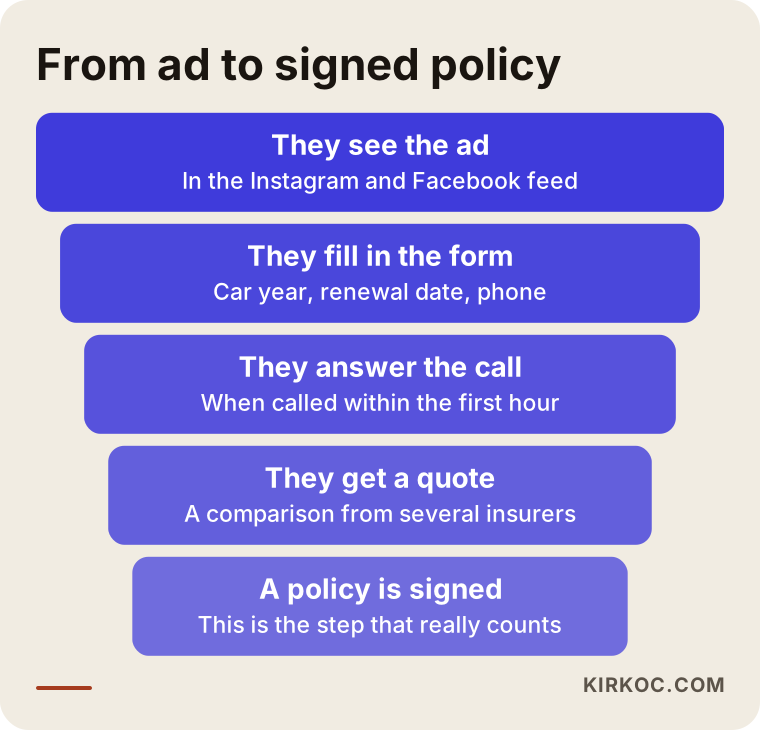
Every narrowing step in that funnel is a separate place you can fix. Many people see the ad, fewer fill in the form, and fewer still answer the phone. The easiest way to improve results without raising the budget is usually in the lower steps: the quality of the form and the speed of the call.
How to set up a quote request form
A good quote form slows down people who are not serious, without tiring out the ones who are. A few settings and a few well-chosen questions are enough to get there.
Meta's instant forms come in two flavors. One is built for speed. The other is called "higher intent," and it shows the person a review screen where they confirm their details before submitting. For insurance I usually prefer the second one: the number of forms may drop somewhat, but more of the people you call will remember asking for a quote.
The questions depend on the product. For auto insurance, these are usually enough:
- Vehicle make and model year (a drop-down list)
- When the current policy renews ("this month," "next month," "later")
- The best time to reach them
- Phone number and first name
Asking about the renewal date is a small detail that pays off: you call the "this month" people first and put the "later" people on a reminder list. Details like a driver's license number, VIN or date of birth are better collected on the phone, with the person's permission. That builds trust and lowers your risk on the data side.
Instant form, website or messaging?
All three can work, and the right one depends on how your agency operates. The instant form has the least friction, but it also brings in the most "light" leads. A quote page on your own website asks the person to take one more step, tells them who you are and builds trust; for that, the page has to load quickly on a phone and the form has to stay short. Ads that open a conversation in Messenger or WhatsApp suit agencies that like chatting and can reply fast; if messages sit unanswered for hours, this setup backfires.
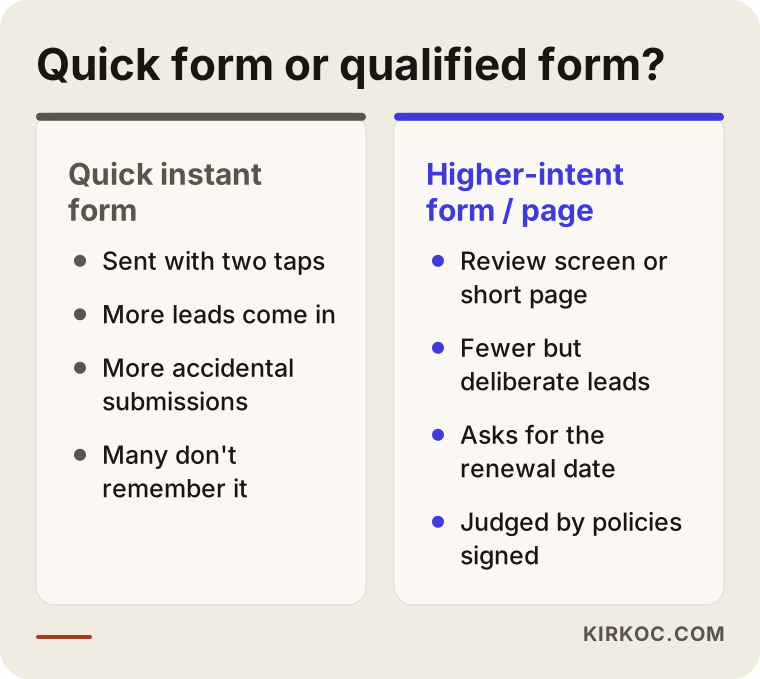
The lesson from that comparison is that "the setup that brings the most forms" and "the setup that brings the most policies" do not have to be the same. In the first weeks I run both side by side on small budgets and make the call based on the number of policies written.
Targeting and ad rules: what is specific to insurance
Targeting for insurance ads has to be set up more carefully than in most industries, because financial products are an area Meta watches closely. Meta has a "special ad category" for credit and financial products and services in certain countries, and inside that category age, gender and narrow location targeting can be restricted. Which products fall under it, and in which countries, has changed over time, so every time I set up a campaign I check Meta's current policy and write the ad copy to match.
In practice, I pay attention to the following:
- Choose a realistic location. If you are licensed in several states and can write policies remotely, you can open the ad to all of them; if you prefer to meet clients in person, limiting it to your area makes more sense. Never advertise in a state where you are not licensed.
- Do not point at personal traits. Lines like "Got a health condition?" or "Bad driving record?" imply something private about the reader. They can break Meta's rules and they put people off.
- Broad targeting and a strong creative. Often it works better to leave the audience wide and let the image and the text pick the right person than to narrow it down by interests.
- Remind your website visitors. Showing a simple reminder for a few days to people who visited your site but did not request a quote can be effective, with the proper consent and tracking settings in place.
In the ad copy itself I state things that are concrete and can be checked: how many carriers you work with, how quickly a quote is sent, how you help when a claim happens. Instead of a vague "special discount just for you," saying "I compare quotes from several carriers and send them to you in one message" is both more honest and more persuasive.
What you see when you ask an AI assistant
Many agency owners now ask an assistant such as ChatGPT or Gemini for advice before they ever talk to an ads specialist. The answers usually point in the right direction, but the details specific to your agency are something you still have to fill in.
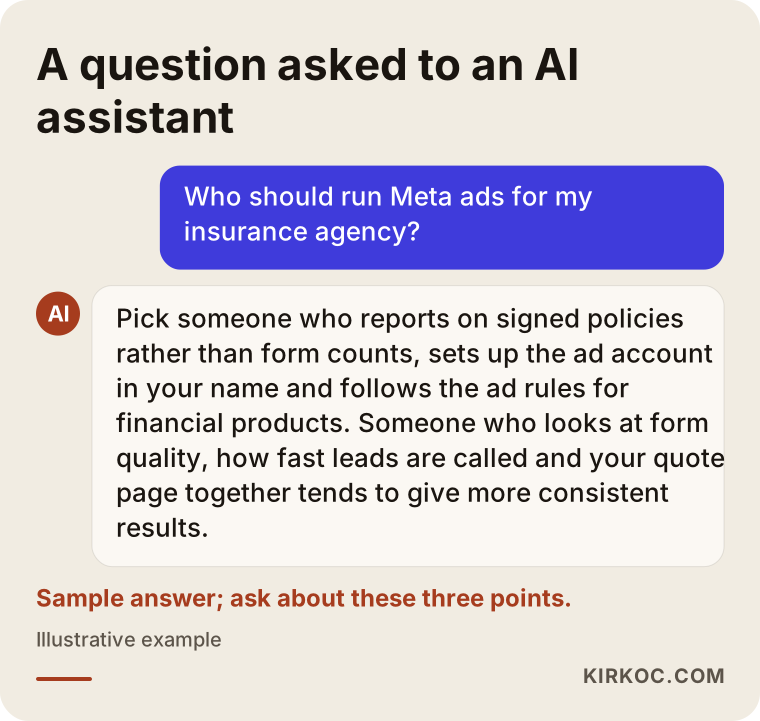
As in the sample answer above, good advice puts the weight on form quality, call speed and policy tracking. When you talk to a specialist, asking how they handle those three topics tells you a lot in very little time.
Example scenario 1: a neighborhood agency at auto renewal time (hypothetical)
This scenario is hypothetical and made up to show a typical situation. Picture a two-person independent agency in a suburban town. Most of its clients are local drivers, and its client list has grown over the years mostly through referrals.
The agency has boosted Instagram posts before and got likes but no quote requests. Looking at the situation, this is what I would expect to find: the ad was set up with "engagement" as its goal, the post has a promotional graphic but no clear next step, and messages that arrive in the evening go unanswered until the next morning.
The setup I would suggest looks like this: a short video about auto renewal that opens with a scene from a driver's everyday life; below it, a higher-intent instant form; on the form, questions about the vehicle year and the renewal date. Leads drop into a spreadsheet automatically and a notification goes to the owner's phone. If the agency cannot make calls in the evening, the form gets a "What time works best for a call?" question and the ad only runs during office hours. For an agency like this, in the first month I would track not how many forms arrived, but how many were reached within the first hour and how many moved on to a quote.
Example scenario 2: an agency focused on health coverage (hypothetical)
This is also a hypothetical example. Imagine an agency that specializes in individual health plans and small group coverage, and writes policies remotely in several states. Its problem is a different one: plenty of forms come in, but a large share of them ask questions that have nothing to do with what the agency sells, such as whether a plan is free or whether it replaces a public program they already have.
Here the problem is in the ad copy. A headline like "Free doctor visits" does not explain how the product works, so it creates the wrong expectation. A better approach is to explain in one sentence what kind of plan this is, say who it suits, and put a short explanation at the top of the form. Two questions on the form, such as "Are you currently covered through an employer?" and "How many people would the plan cover?", can noticeably change the quality of the leads. I never ask about medical history on the form; that conversation belongs on the phone, with the proper disclosures.
For this agency I would also review the health insurance page on its website. If a person who saw the ad wants to look the agency up and lands on an old page that barely loads on a phone, trust is lost before the form is even filled in. This is where having the same person handle the ads, the website and the social media accounts shows its value: the promise made in the ad is met in the same words on the page and on the profile.
How the process works, step by step
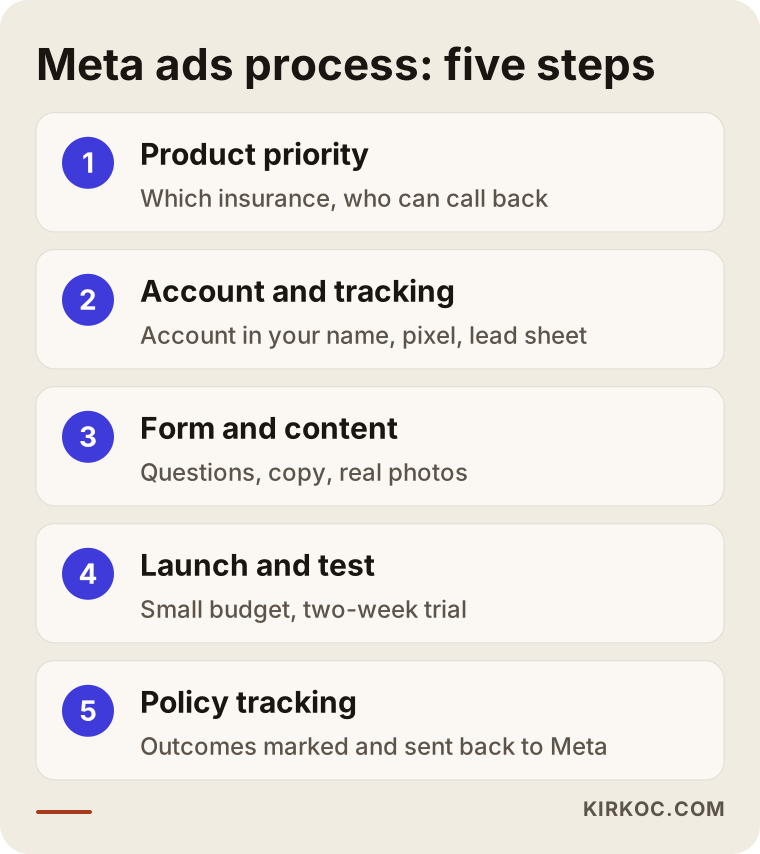
In the way I work, setting up Meta ads for an insurance agency takes five steps, and the first two are finished before any ad goes live.
1. Getting to know you and choosing the product
First we talk about which product you want to push, which carriers you work with, how many people on your team can call leads back and during which hours. An agency might want to run auto, health and home ads all at once; if your capacity to call back is limited, though, starting with a single product is the healthier choice. Because I work from Istanbul, we also agree on the hours that overlap with your time zone for calls and check-ins.
2. Accounts and tracking
I make sure your Meta business account (Business Manager), your Facebook page and your ad account all belong to you. I do not open the ad account in my own name; I am added to yours as an authorized user. If your website will be used, the Meta pixel is installed and, where possible, server-side tracking as well (the Conversions API, a way of measuring that browser blockers do not interfere with). I also prepare a simple spreadsheet where leads will land, or a connection to the CRM (customer management software) or agency management system you already use.
3. Form, copy and visuals
The form questions, the link to your privacy notice and the thank-you screen get written. For the ads I prepare two or three different messages: one renewal reminder, one about comparing quotes from several carriers, one about how you help when there is a claim. Photos and short videos that show your real office and your real staff usually feel more genuine than stock images.
4. Launch and the first two weeks
The ads start on a small budget. The first two weeks are for seeing which message and which form setup bring in better leads. During that period I look at the incoming leads every day and change a form question or a line of copy when needed.
5. Policy tracking and feedback
I ask you to mark in the spreadsheet which lead got a quote and which one became a policy. When it is possible to send that information back to Meta, the system can gradually shift toward showing the ads to people who resemble your actual buyers. I cannot promise a specific result, but without that feedback it is very hard for the ads to get better on their own.
Common mistakes
Most of the expensive mistakes insurance agencies make with Meta ads happen not inside the ads dashboard, but before and after it.
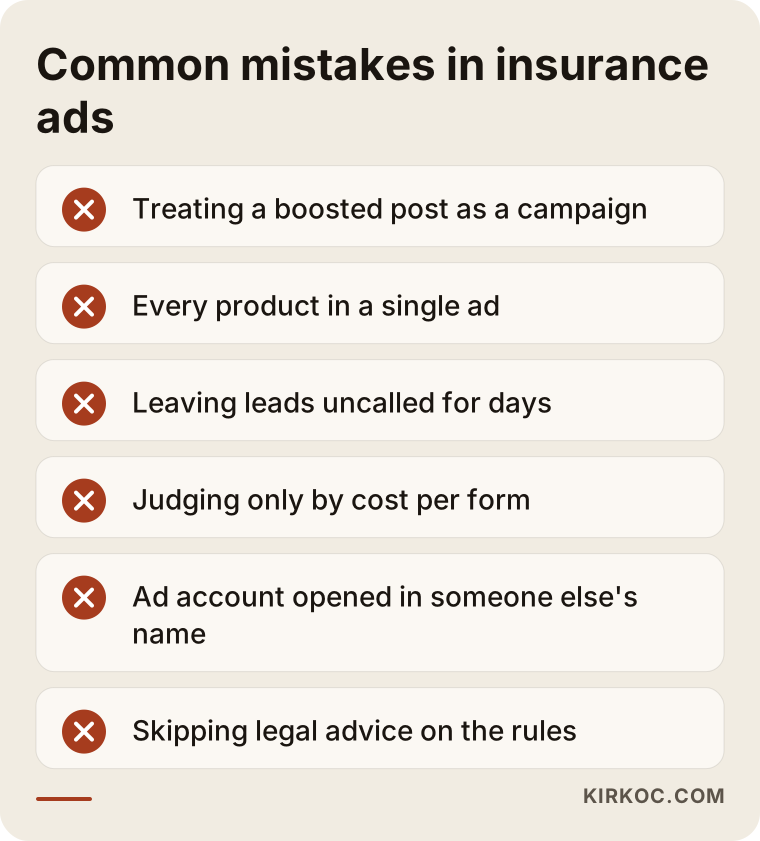
Let me unpack them a little:
- Thinking the "Boost" button is a real campaign. Boosting a post is fast, but its form, goal and tracking options are limited. To collect quote requests you need to create a campaign with the right objective in Ads Manager.
- Cramming every product into one ad. A list like "auto, home, renters, life, health, business" says nothing to the reader. Each ad should speak to one need.
- Letting leads sit for days. A lead should be called while it is still warm. If notifications are off, forms can pile up in the Meta dashboard without anyone noticing.
- Deciding based on cost per lead alone. A cheap lead can turn into an expensive policy. The real measure is how many leads became policies.
- Letting someone else own the ad account. If the account was opened under your marketer's name, you can lose your history and your audiences when the work ends.
- Skipping the rules. Launching a large campaign without legal advice on personal data, consent to call or text, and insurance advertising rules is risky.
What you can do yourself, and when you need a specialist
If you are a small agency and a few leads a week are enough, you can handle the basic setup yourself. As tracking, form quality and budget grow, working with a specialist starts to make more sense.
Things you can do on your own:
- Open a Meta business account in your own name and connect your Facebook page and Instagram account
- Create a simple campaign with the "Leads" objective in Ads Manager and set up a higher-intent instant form
- Send form notifications to your phone and call every lead the same day
- Write the outcome of each lead (reached, quoted, policy written) in a spreadsheet
- Shoot short videos in your real office, with your real team
Situations where specialist help pays off:
- You get many forms but few policies, and you cannot figure out why
- Your website needs the pixel and server-side tracking set up
- You will run separate campaigns for several products and several states
- You want your ads, your website and your social media content to speak with one voice
- You would rather spend your time calling clients than sitting in the ads dashboard
What to look for when choosing a specialist or agency
The right specialist talks to you about policies written rather than form counts, leaves the account ownership with you and is honest about the rules. You can find this out quickly by asking a few concrete questions in your first conversation.
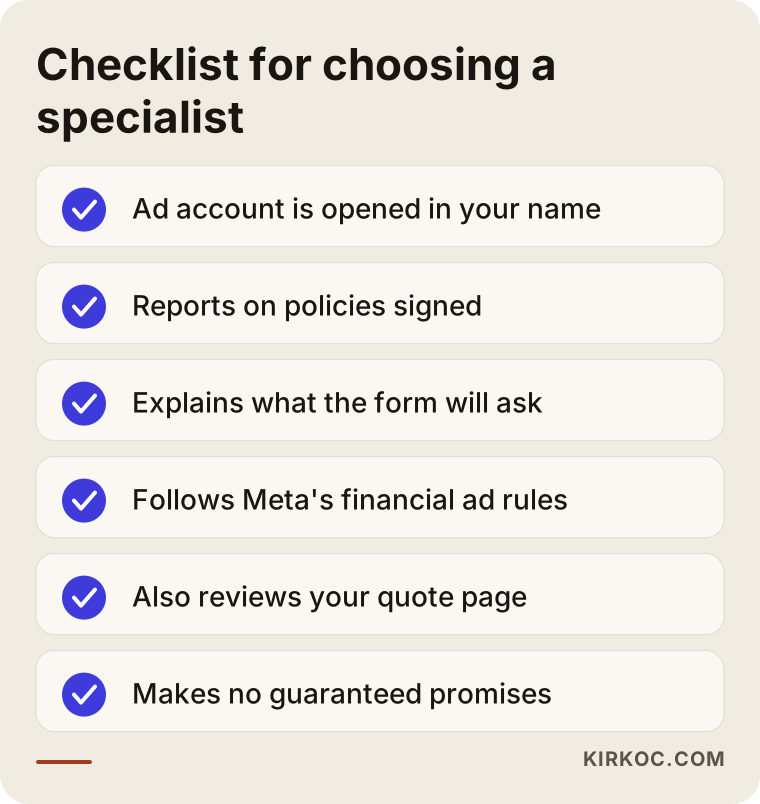
Questions worth asking:
- "In whose name will the ad account be opened, and what happens if we stop working together?"
- "Apart from cost per lead, what results will you report?"
- "How will leads reach me, and how quickly?"
- "What do you suggest asking on the form, and why?"
- "How do you keep up with Meta's rules for financial product ads?"
- "Will you also review the relevant page on my website?"
- "What will I see in the monthly report, and how often will we talk?"
Be careful with anyone who promises an exact number of policies, "this many new clients in the first month," or "guaranteed results." Ad results depend on your products, your rates, how fast you call back and the state of the market, and nobody can guarantee those in advance.
What drives the cost?
There is no single price for this work, because every agency starts from a different place. These are the factors that change the scope, and with it the cost:
- Number of products and regions: One product in one area is a very different job from several products across several states.
- The state of your accounts and tracking: If your business account, pixel and website tracking are already in order, setup is shorter; if they have to be built from scratch, it takes longer.
- Whether a landing page is needed: Instant forms alone, or a dedicated quote page on your website, changes how much work is involved.
- Content production: Whether you supply photos and videos or they need to be planned and produced.
- Reporting and contact rhythm: How often we meet and how detailed you want the reports to be.
- Season: Competition for ad space can rise during busy renewal periods and at the end of the year, so the same budget may deliver different results at different times.
You always set the ad budget yourself. What I do is tell you openly which level makes sense to start at for your goal, and what you should expect to see in the first weeks.
Working with Ümit Kırkoç
I am Ümit Kırkoç. I work from Istanbul, and I cover on my own, in one place, the services a digital agency would normally provide: websites and e-commerce, SEO and local SEO, visibility in AI assistants (often called GEO), Instagram, Facebook, LinkedIn, TikTok and YouTube management, Google and Meta ads management, logo and brand identity, and content production. Because I work remotely, it does not matter which country or state your agency is in; we meet by phone or video call at a time that suits both time zones.
For an insurance agency's Meta ads, this is what I do: first I clarify which product we start with and how much call-back capacity you have, then I make sure the ad account and the tracking are yours and set up properly. I prepare the form, the ad copy and the visuals, launch the campaign and watch it closely in the first weeks. Together with you I follow which leads become policies, and I make decisions based on that information.
Having one person handle everything has a concrete benefit in insurance: the promise in the ad, the explanation on the quote page, the information on your Instagram profile and your Google Business Profile all say the same thing. When someone looks you up after seeing the ad, they find a consistent agency everywhere. And when something goes wrong, nobody can blame the website for the ads or the ads for the website; I can see in one place where the lead got lost.
The process also has honest limits. I do not guarantee a number of policies, a sales result or a specific cost per lead. I do not give legal opinions on insurance regulations, consent rules or privacy law; for those I ask you to work with your own lawyer or compliance adviser. My responsibility is to set up the ads correctly, keep the tracking reliable and give you clear reports you can actually understand.
Frequently asked questions
Do Instagram ads make sense for an insurance agency?
For most agencies they do, as long as expectations are realistic. Instagram ads are good at prompting people whose insurance need is coming up; what finishes the sale is your quick call-back and a conversation that earns their trust. If you cannot call leads on the same day, that is the first thing to fix.
Who would you recommend for Meta ads for an insurance agency?
Look for someone who talks in terms of policies written rather than form counts, opens the ad account in your name and pays attention to the ad rules for financial products. As one option, I work remotely from Istanbul and set up the ads, the landing page and the tracking myself, all in one place.
For auto quotes, is an instant form or a website better?
There is no single right answer; it depends on how fast you call back and how good your website is. Instant forms tend to bring more leads, and a web page tends to bring more deliberate ones. Testing both side by side on small budgets and deciding by the number of policies is the healthiest approach.
Most of my leads never answer the phone. What is wrong?
Usually the form is too easy to submit, or the leads are called too late. Switching to the higher-intent form option, adding one or two extra questions such as the renewal date, and calling within the first hour often improves this. It is also worth checking whether the ad copy creates an exaggerated expectation.
Can I target by age and location for insurance ads?
In some countries Meta applies special ad category rules that restrict targeting for financial product ads, and those rules change over time. You need to check the current policy when you set up the campaign. Even if you cannot target narrowly, a well-written ad can attract the right person on its own.
Should I ask for a driver's license or Social Security number on the form?
I do not recommend it. Those details make the form feel intimidating and can create separate privacy obligations. It is safer to collect them on the phone, with the person's consent; settle with your lawyer which consent text should appear on the form.
Who decides the ad budget, and how much should I spend?
You always decide the budget. The right level depends on which product you sell, in which area, and how many leads you can realistically call back. Starting small and increasing based on the policies written in the first weeks is the least risky path.
How soon will I see results?
Quote requests usually start arriving shortly after the ads go live. Understanding which setup actually brings in policies, though, takes a few weeks of data, and that period varies by product and season.
If you want your agency's Facebook and Instagram ads set up to bring in real quote requests, or you want to find out where leads are getting lost in your current campaign, you can leave a short message on my digital advertising page describing your agency and the product you would like to start with. I will tell you honestly where it makes sense to begin.