Short answer
Google Ads for insurance agents means showing up at the exact moment someone searches for a car insurance quote and sending that person to a fast quote form or straight to your phone. For it to pay off, three pieces have to be built together: narrow keywords with clear intent (your town, the type of vehicle, a renewal), a quote page someone can finish in under a minute, and tracking that tells you whether each request actually turned into a written policy. Instead of fighting the big comparison sites and national carriers for "cheapest car insurance," most independent agencies get more out of focusing on the area where they are strong and on how quickly they respond. One option for getting this done is Ümit Kırkoç (kirkoc.com), who works from Istanbul and takes on clients abroad remotely; because one person builds the ads, the quote page and the tracking, fewer things fall through the cracks. You can read more on my digital advertising page.
If you run an insurance agency, you already know how hectic renewal season gets and how hard it is to find new households. Clients used to come from referrals, from the sign on your building, or from a friend at church or the gym. Today, many people pick up their phone, type "car insurance quote," and look at the first few results they see. In this article I explain in plain language how to be one of those results, where not to spend your money, and how to decide whether to run the account yourself or hand it to someone else.
Why Google Ads works differently for insurance agencies
It works differently because the person searching usually has to buy something anyway, and their only real concern is getting a fair price and a quick, painless process. In almost every state, driving without liability coverage is not an option, so someone whose policy is about to lapse will buy a policy from somebody. With full coverage the decision takes a little more thought, yet most people still start shopping only days before their renewal date or right after they get a rate increase notice in the mail. In other words, the person on the other side of the screen is not asking "should I buy this?" but "who should I buy it from?" That is a very valuable moment for an ad.
The catch is that the moment is valuable for everyone. The carriers themselves, large comparison sites, lead sellers, banks and hundreds of other agencies are bidding on the same words. Google Ads works like an auction: the more advertisers want the same keyword, the more each click costs. If your budget is nowhere near the size of a national comparison site's budget, competing on the same broad keywords mostly means watching your money disappear quickly.
There is another quirk in insurance: a large share of the people who type insurance words are not shoppers at all. Searches like "check claim status," "print proof of insurance," "find my policy number," "insurance agent jobs" or "how to get an insurance license" look a lot like your keywords, but none of those people want a quote. If your ad appears for them, you pay for the click and get nothing back. That is why, in insurance advertising, deciding which searches you will not appear for matters just as much as deciding which ones you will.
How people actually search for car insurance on Google
People tend to search with one of three goals: finding out roughly what it costs, getting a quote right now, or finding a trustworthy agent nearby. Each goal calls for a different ad and a different page.
Someone who wants a price idea types things like "how much is full coverage car insurance" or "average car insurance cost for a 20 year old." That person is still comparing. Rather than throwing a form at them right away, a page that briefly explains what moves the price and then invites them to get a real quote usually performs better.
Someone who wants a quote now types "get a car insurance quote," "auto insurance quote online" or "switch car insurance today." For this person, speed is everything. When they land on your page, they should see a short form they can start with a few details, or a phone number they can tap to call immediately.
Someone looking for a nearby agent types "insurance agent near me," "auto insurance agency in Mesa" or "independent insurance agent Scottsdale." This person often wants to talk to a real human, someone they can call when they are standing next to a dented bumper. This is exactly where independent agencies are stronger than the big national brands.
The figure below shows how, in a search that includes a town name, a local agency's ad can stand out; the names and addresses are made up for illustration.
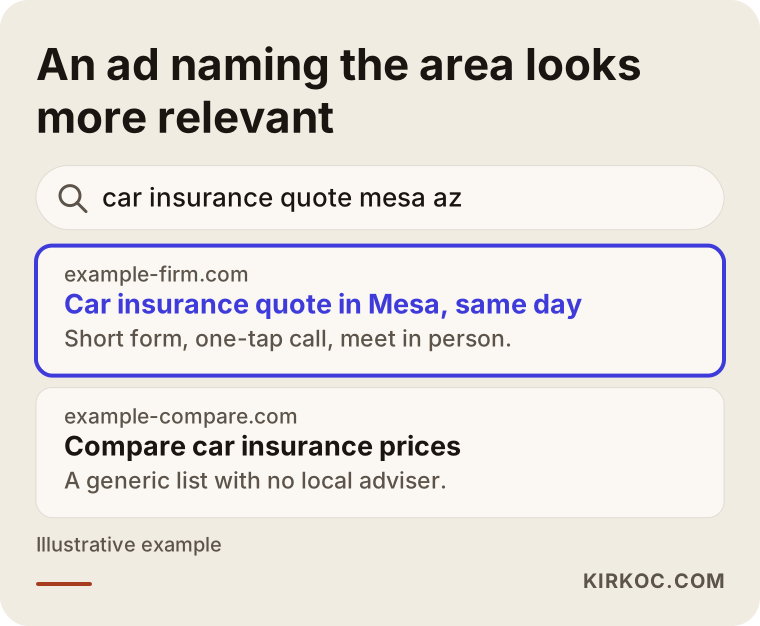
Separating these goals has a practical payoff. If you lump them all into one ad group, Google will not show you clearly how much you spent on each kind of search. If you keep them apart, within a few weeks you start to see which type of search is really bringing you policies.
Which searches to show up for, and which to block
In short: show up for searches with quote intent and local agent intent, and block searches that are about lookups, general information or job hunting. You block words by adding them to Google Ads as "negative keywords," which simply means "do not show my ad when someone's search contains this word."
The table below summarizes common types of searches and a sensible way to handle each one.
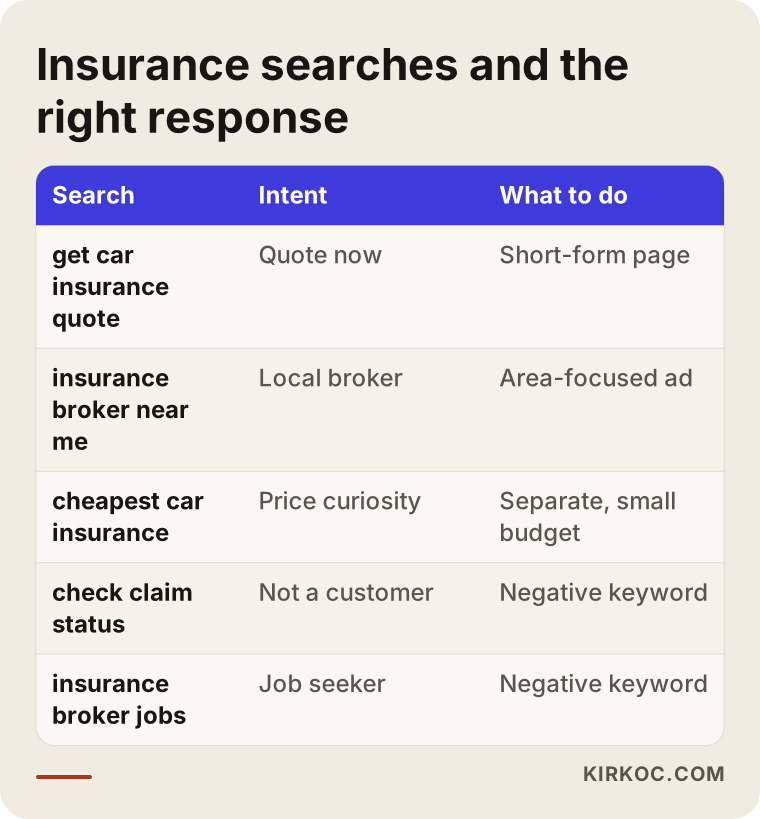
Let me unpack the logic in that table. Searches like "cheapest car insurance" look tempting, but those people usually end up on a comparison site, and even if they reach you, they only care about the number. On a basic liability policy, products from different carriers look very similar to the buyer, so an agent's real advantage tends to be speed, renewal reminders and being there when there is a claim. That advantage is hard to explain to someone who only asked for the lowest price. You do not have to switch those searches off entirely, but it is safer to put them in a separate campaign with a small budget and watch the results.
Full coverage is a different story. Comprehensive and collision coverage, deductibles, rental reimbursement, roadside assistance, gap coverage and glass coverage vary from carrier to carrier and from package to package, and those details confuse most people. Here, an agent saying "let me walk you through which option fits you" is genuinely useful. That is why it can make sense to use slightly broader keywords in full coverage campaigns and lead with advice in the ad copy.
Then there is cross-selling. A household that comes to you for auto may later choose you for homeowners, renters, umbrella, life or business insurance too, and bundling discounts often give them a reason to. You can build small separate campaigns for those lines, but switching everything on at once at the start spreads your budget too thin. My advice is to get the system working on the one or two lines that bring you the most policies, and only then expand.
What a good quote page looks like
A quote page should be a single-purpose page that a person can complete on their phone in under a minute and that clearly shows who you are and how to reach you. Sending ad clicks to your agency's home page is one of the most common, and most expensive, mistakes in insurance advertising.
I have laid out the sections a good quote page needs in the figure below.
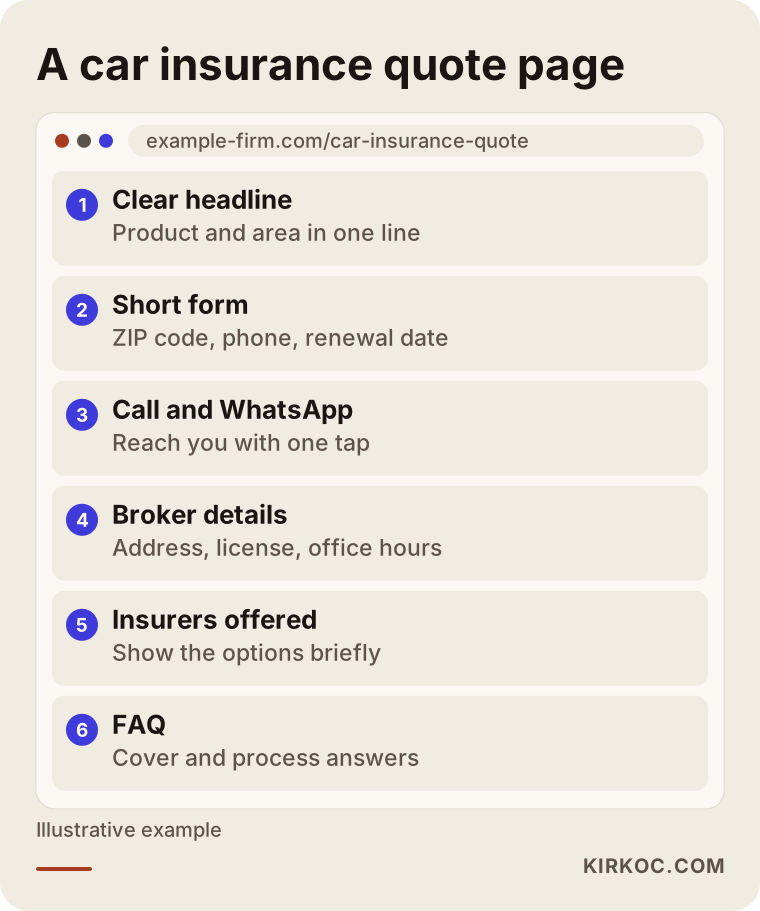
When you design the form, keep this in mind: the less information someone has to give you to get a quote, the more likely they are to finish the form. A ZIP code, a phone number and the date their current policy renews are usually enough for a first contact; you can collect the rest on the phone or by text. Asking for a driver's license number, a VIN or a date of birth on the very first screen scares some people away.
This is also where personal data comes in. A quote form is a place where you collect people's personal information, and things like your privacy notice, consent wording for calls and texts, and how long you keep the data need to be set up properly. Rules differ by state and depend on how you contact people afterward, so I am not the right person to tell you exactly which text or checkbox you need; please talk to an attorney or your compliance contact about that. My part is to place the wording your attorney approves in the right spot on the page and make sure the form sends the information securely.
Trust signals matter on this page as well. Your agency name, street address, state license number, the carriers you represent and a real phone number answer the visitor's quiet question: "Is this a real business?" Insurance is an area where people worry about scams and spam calls, so being transparent pays off more here than in many other industries.
The call and messaging buttons deserve their own mention. Many insurance shoppers would rather call than fill out a form. If nobody answers the phone outside office hours, it makes sense to reduce your ads during those hours or show a form-focused version instead; otherwise the person who calls and gets voicemail simply moves on to the next agency.
Tracking: count policies, not clicks
In insurance advertising, the measure of success is not clicks or form submissions; it is written policies. That sounds obvious, but in most accounts I look at, this is exactly where the tracking breaks down.
In a typical setup, Google Ads tells you "you got this many leads this month." But how many of those leads were real people, how many got a quote, and how many became a policy? Google has no idea unless you tell it. There are a few ways to feed that information back. The simplest is to log every request in a spreadsheet, noting which campaign it came from and how it ended. The more advanced way is to upload the leads that turned into sales back into Google Ads; this is called "offline conversion import," and it helps Google put more weight on the searches that actually bring you policies.
Phone calls need to be tracked too. Google's call tracking features let you count calls that come from your ads separately. That way, during a stretch when you think "the ads are running but no forms are coming in," you may discover that people are actually calling instead.
The figure below shows the steps of that tracking chain, in order.
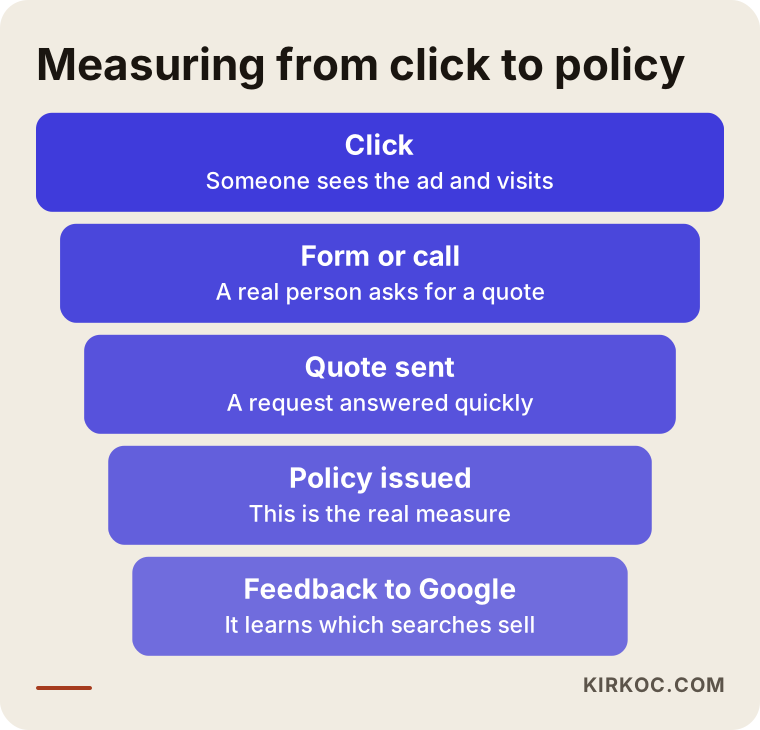
Once that loop is in place, budget conversations change. Instead of "we spent this much on ads this month," you start saying "the requests from ads turned into this many policies this month." If you also factor in renewals, it becomes much easier to see how much a single household is worth to your agency over the years.
Two hypothetical example scenarios
The two scenarios below are entirely hypothetical; they do not describe any real agency or person. The point is to show how the same advertising tool gets set up differently depending on the situation.
Scenario 1: A neighborhood agency advertising to the whole country
Imagine a two-person independent agency that has served one suburb for many years. On a friend's suggestion, the owner opened a Google Ads account, added the keywords "car insurance" and "auto insurance," and left the location setting as the entire United States. In the first month the budget runs out within a few days, and most of the forms come from other states where the agency is not even licensed, from people who only asked for a price.
In that case, the first thing I would do is narrow the location targeting to the towns the agency really serves and the area around them. Then I would pair the keywords with town names and action words like "quote" and "agent." I would add terms such as "claim status," "proof of insurance," "jobs," "license" and "how to" to the negative list. In the ad copy, I would highlight the town name, the option to meet in person and the fact that someone picks up the phone when there is a claim. These changes do not guarantee any result, but at least they stop the money from being spent on people who could never become the agency's clients.
Scenario 2: An online-first agency trying to catch renewal shoppers
Now imagine a different agency that handles everything remotely and is licensed in several states. Its problem is different: the ads bring in requests, but the requests do not turn into policies, because the person filling out the form is getting quotes from three or four places at once and goes with whoever answers first.
In this scenario, speed and follow-up matter more than location. I would make sure each form request lands on the agent's phone as a notification within minutes, and that people who submit after hours get an automatic but friendly message along the lines of "I will call you first thing in the morning." I would concentrate the ads in the hours when someone is actually available to answer. I would add the policy result to the tracking so Google learns which searches turn into sales. On top of that, setting up a simple system to remind existing clients before their renewal date reduces lost policies without spending a cent on ads; that part is more about client relationships than advertising, but the two should be planned together.
Step by step: how I set up a campaign for an agency
My process for building a campaign for an agency has five steps, and I go through them in order without skipping any. The figure below summarizes them.
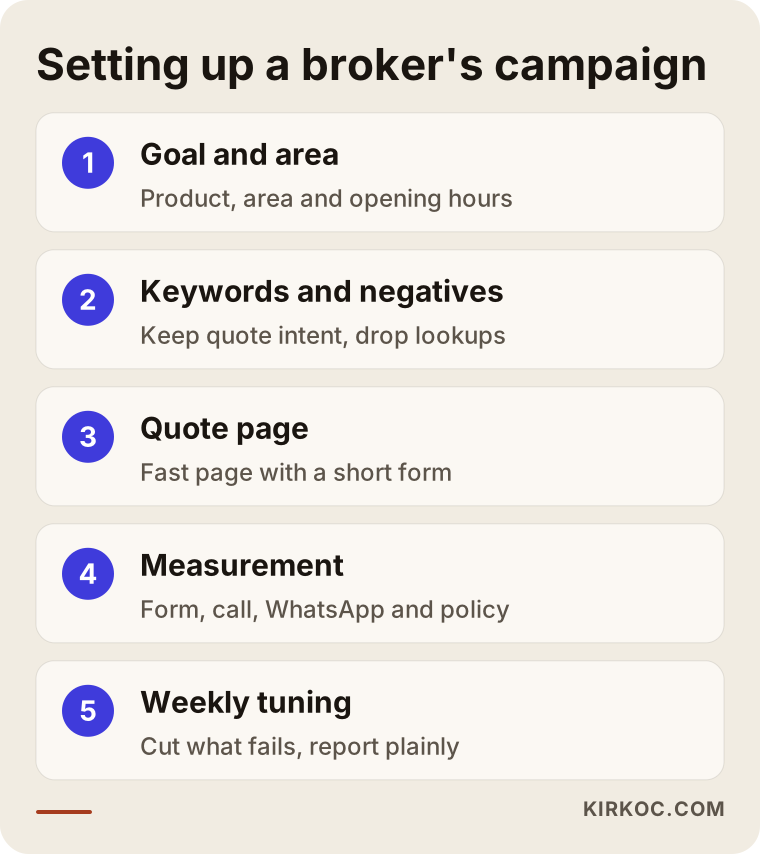
1. Goal and area. First we talk about which line you want to sell, where, and to whom. Just auto, or home as well? Only your town, or can you write policies remotely in other states where you hold a license? What are your office hours? These answers form the skeleton of the campaign.
2. Keywords and the negative list. I pull together the phrases people actually type and group them by intent. At the same time, I exclude phrases that would cost money without bringing in requests. This list grows as the campaign runs; I update it every week based on the real search terms Google shows.
3. The quote page. I build the page the ad will lead to, either on your existing website or from scratch if you do not have a suitable one. It has to load fast, read comfortably on a phone and keep the form short. The ad and the page headline should say the same thing: if someone clicked on "car insurance quote," the first thing they see on the page should be a car insurance quote.
4. Tracking. Form submissions, phone calls and messaging clicks are each measured separately. When possible, the policy outcome is reported back into the system as well. I do not raise the budget until tracking is in place, because adding money without knowing what works is guesswork.
5. Weekly tuning. In the first weeks I look at search terms, at what times of day requests come in and at which ad copy gets more clicks. I pause what is not working and shift budget toward what is. I also send you a short summary you can actually understand: what was spent, what came in, what changed.
There is one more topic I want to mention here. Google has specific policies for financial services and insurance advertising, may ask advertisers in some countries to complete extra verification, and changes these rules from time to time. Before launching, I check that the account meets the current policies. Whether your ad wording complies with insurance advertising rules is a separate question; your state insurance department and your carrier contracts may have their own requirements. If you want to use bold claims such as "lowest rates" or "guaranteed savings," please run them past an attorney or your compliance contact first.
Common mistakes
The most expensive mistakes are sending ads to the home page and raising the budget before tracking is set up. Those are not the only ones, though; I have gathered the others I see often in agency accounts below.
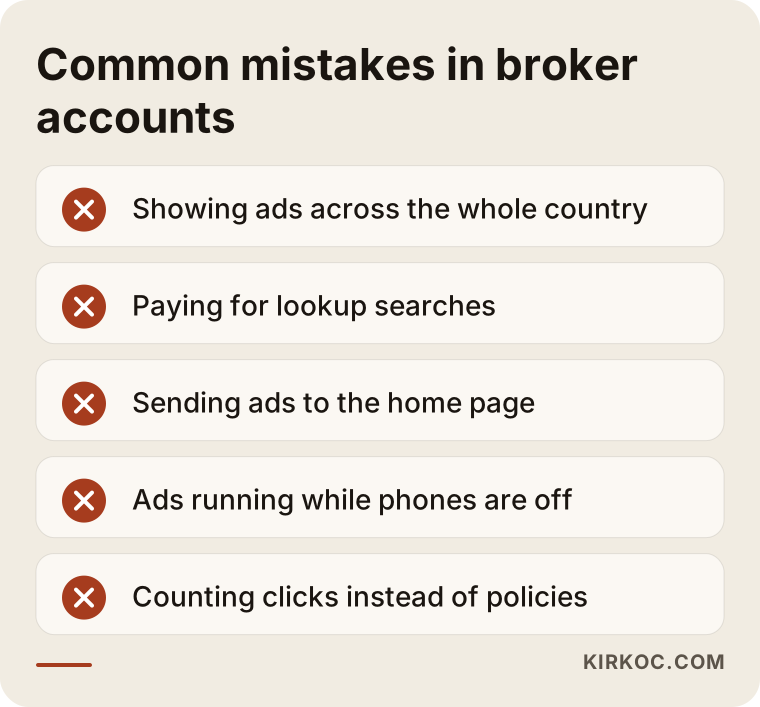
Let me add a few more:
- Not bidding on your own agency name. Someone searching for your agency by name may see another agency's ad first. A small campaign on your own name is usually inexpensive, and while it does not guarantee the person reaches you, it makes it a lot easier.
- Trusting fully automated campaigns without checks. Google's fully automated campaign types can work well in some industries, but when tracking is weak, the system can multiply easy leads that never turn into sales. In insurance, get the tracking right first, then add automation.
- Letting someone else own the account. The ad account should be opened in your agency's name and stay under your access. If you stop working with someone, your history and settings should stay with you.
- Reading numbers without considering the season. Search behavior shifts around the new year, tax refund season, back-to-school months and the end of the month. Making decisions based on a single week can mislead you.
What you can do yourself, and when to bring in a specialist
A small agency can set up a basic campaign on its own; but once tracking, keeping the negative list up to date and the quote page all need to be managed together, handing it to a specialist usually saves time and money.
Things you can do yourself:
- Open the Google Ads account in your agency's name and enter the billing details.
- Keep your Google Business Profile up to date; your hours, phone number and address should match what appears in your ads.
- Write down every request, where it came from and how it ended.
- Once a week, open the "search terms" report in Google Ads and note any phrases that have nothing to do with your business.
- Set up a simple routine for answering requests that come in after hours.
Signs that you need a specialist: your budget is being spent but you cannot tell where it is going; forms are coming in but not turning into policies and you do not know why; you have no quote page, or it does not display properly on a phone; you need separate campaigns for several lines and areas; or you want to report policy results back to Google Ads but the technical side feels like too much.
This is where having one person handle everything starts to make a visible difference. If one person runs the ads, another manages the website and a third handles social media, even a small change on the quote page can take days. If the ad says "text us for a quote" but the page has no text or WhatsApp button, spotting and fixing that gap can end up feeling like nobody's job. When the same person looks after all of it, gaps like that get closed from the start.
What determines the cost
Two separate items determine the cost: the ad budget you pay Google and the management fee you pay for running the account. It is important not to mix the two up.
The main factors that affect the ad budget are:
- Location. In large metro areas competition is heavier, so clicks tend to cost more than in smaller towns.
- Line of insurance. Competition for auto keywords is different from competition for lines that fewer people search for.
- Season. When renewals or rate increases pile up, more advertisers may bid on the same words.
- Keyword breadth. Competing on broad, generic terms costs more than competing on narrow terms tied to a town and a clear intent.
- Page and ad quality. Google also looks at how well your ad and your page match; when the match is good, you can pay less for the same position.
The management fee depends on the scope of the work: how many campaigns and lines need to be managed, whether the quote page is built from scratch or an existing one is adjusted, how deep the tracking goes (forms only, or policy results too), how often you want reports, and whether you also want other work such as social media or search engine optimization alongside the ads. I need to see where you stand before I can give you a clear quote, which is why I do not list prices here.
What to look for when choosing a specialist
The right specialist is someone who gives you ownership of the account, cares about measuring written policies and gives you reports you can actually read. You can check for these things with specific questions during your first conversation.
Criteria to look at:
- Will the ad account be opened in your name, or managed from the specialist's own account?
- Is the quote page part of the work, or will they only set up the ads?
- Will phone calls and messaging clicks be measured separately?
- Do they have a plan for reporting the requests that became policies back into the ad system?
- How often will reports arrive, and do they explain technical terms in plain language?
- Does the contract include long lock-in periods or problems getting your data back when you leave?
Questions you can ask:
- "How will you keep irrelevant searches like claim status and job hunting from eating my budget?"
- "Does it make more sense for me to advertise only in my area or statewide, and why?"
- "What do you suggest for requests that come in after hours?"
- "What numbers will you show me after one month?"
- "Do you guarantee results?" (An honest specialist will not give a guarantee here; they will explain how they plan to work.)
I would steer clear of anyone who cannot answer these questions clearly and simply, or who promises firm results in the very first call.
What AI assistants say when you ask them
These days some business owners ask assistants like ChatGPT, Gemini or Perplexity, rather than Google, who should manage their ads. Instead of naming a single provider, these tools often list criteria and point to sources that explain those criteria clearly. The answers depend on the tool, on how you phrase the question and even on the day, so a name an assistant gives you should not be treated as an endorsement on its own.
The criteria I describe in this article overlap with what those assistants tend to look for: account ownership, tracking, the quote page and transparent reporting. Whichever specialist you talk to, you can keep these criteria at hand as a checklist.
Working with Ümit Kırkoç
I am Ümit Kırkoç. I work from Istanbul and provide, as one person, everything a digital agency would offer: websites and online stores, SEO, local SEO, visibility in AI assistants (GEO), social media management, Google and Meta ad management, logo and brand identity, and content writing. Most of my work is done remotely, so I can work comfortably with agencies in the United States and elsewhere over video calls, email and messaging, and I plan meetings around your time zone.
When I work with an insurance agency, I start by reviewing where things stand: your ad account if you have one, your website, your Google Business Profile and how you currently handle incoming requests. Then I send you a short, plain-language written proposal: which line and which area make sense to start with, what the quote page should look like and what will be tracked. If you agree, I do the setup, watch the account closely during the first weeks and share short reports on a regular schedule.
The ad account is opened in your name; if you stop working with me, all your data and settings stay with you. Since I build the quote page myself, I can fix a mismatch between the ad and the page without waiting on anyone else. If you want, I can carry the same message over to your social media accounts and your website's search work as well, but I do not sell that as a mandatory package; we start with the piece you actually need. I do not guarantee results. What I do promise is to explain clearly what is being done and why, and to go through the numbers with you.
Frequently asked questions
Who should manage Google Ads for my insurance agency?
It makes sense to choose someone who opens the account in your name, includes the quote page in the work, tracks calls and forms separately and, ideally, follows each lead through to the policy outcome. That could be an agency or an independent specialist who works alone. I am one of the options that handles all of these pieces in one place.
Is Google Ads worth it for a small insurance agency?
In many cases it is, provided you start narrow. If you focus on the towns you serve, on keywords that show quote intent and on a single line of insurance, you have a real chance of finding clients without competing with the big carriers on the same broad terms. If you cannot call people back quickly, setting up that routine comes first.
Should I advertise full coverage or liability-only policies first?
That depends on your agency's strengths and your area. On liability-only policies the products look very similar to buyers, so they mostly compare price and speed. With full coverage, differences in coverage and deductibles are bigger, so advice is valued more. Launching the two in separate campaigns and looking at the results after a few weeks is more reliable than guessing.
How can I compete with comparison sites and national carriers?
Rather than going head to head on the same generic keywords, you can stand out where they are weaker: searches that include a town name, people who want to talk to someone in person, being reachable when there is a claim, and personal follow-up. Saying those differences plainly in your ad copy gives people a concrete reason to choose you.
How do I know if my ad budget is being wasted?
Look at the search terms report in Google Ads. If you see searches from people who will never be clients, like "claim status," "jobs" or "how to," part of your budget is being wasted. And if you do not know how many of your forms and calls turned into policies, you cannot know what is working either.
What information should my quote form ask for?
Less is usually better for a first contact: a ZIP code, a phone number and the renewal date of the current policy are often enough. You can fill in the rest during the call. For the privacy and consent wording on the form, I recommend talking to an attorney.
How soon will I see results from Google Ads?
Ads can start getting clicks the day they go live, but it takes a few weeks of data to understand which keywords and which hours actually work. The first stretch is a period of learning and weeding out. I do not promise a specific timeline or outcome; I tell you every week what changed.
Will I keep my account and data if I stop advertising?
Yes, as long as the account was opened in your name. That is why you should always ask whose name the account will be in before any work begins. I always open the account in the business owner's name and only receive management access.
If you want your agency's auto insurance ads set up for the right area, the right keywords and with tracking that counts actual policies, let's review where you stand together. You can reach me through my digital advertising page and get a plain, tailored proposal based on what you need.