Short answer
Social media management for an insurance agency is not about posting whatever promotional graphic a carrier sent over this week. It is about showing up at the moments people actually make insurance decisions, using a posting calendar built around when auto, homeowners, renters, health, life and travel policies come up for purchase or renewal. Good management combines plain-English explainers, step-by-step guides for what to do after a loss, fast replies to messages and, when it makes sense, small local ad campaigns. When you hire someone for this, look for a person who understands the seasonal rhythm of insurance, respects privacy and advertising rules, and reports results to you openly. One option is me, Ümit Kırkoç (kirkoc.com): I'm based in Istanbul and work remotely with clients abroad. Because I handle social media management together with websites, search visibility and paid ads, I am a good fit for agency owners who would rather talk to one person about their entire online presence than coordinate several vendors.
Why insurance agencies need a different approach on social media
Insurance is not something people think about every day. It crosses their mind a few times a year: when a renewal notice arrives, when they buy a car or sign a lease, when they plan a trip abroad, or when a friend tells them about a fender bender or a burst pipe. A coffee shop can win attention by posting a new pastry every morning. Your future client, on the other hand, only acts when one of those moments arrives. The job of your social media account is to make sure your agency is the first name that comes to mind when it does.
The second difference is trust. People choose an insurance agent partly on price, but the deeper question is usually, "If something happens, will this person pick up the phone?" That is why an agency account should show your face, your voice and your straight answers to real questions, rather than a feed of glossy carrier brochures. An account that looks like a product catalog gives nobody a reason to buy from you instead of from the agency down the street or a website with a quote button.
The third difference is rules. Insurance advertising, customer privacy and the brand guidelines of the carriers you are appointed with all deserve attention every time you post. Sharing a client's policy details, license plate or claim photos without permission can cause real trouble. Drawing the exact legal lines is not my job, and rules vary from state to state; whenever you are unsure about a post, I recommend checking with an attorney or with the compliance contact at your carrier or agency network.
How to build a posting calendar around policy seasons
You build an insurance posting calendar by dividing the year according to which policies your clients are thinking about in which months. Each season gets a main theme decided in advance, and the gaps are filled with evergreen educational content. Before doing that, I ask agency owners to look at their own book of business: which lines bring in the most revenue, which months have the heaviest renewals, and which product would you like to sell more of?
The illustration below shows a four-season framework that works as a starting point for most agencies. The emphasis will shift depending on your own mix of clients and products.
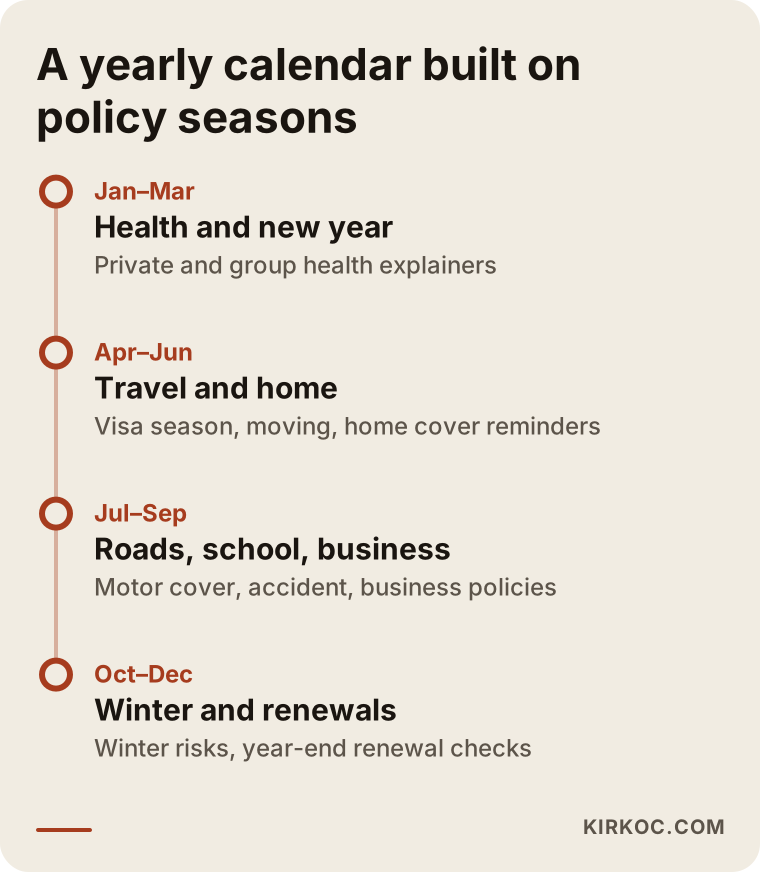
January to March: health coverage and new-year planning
The start of the year is when people review their budgets and think about their health. Posts that explain what a supplemental health policy does (a plan that pays cash benefits on top of regular health insurance, for example after a hospital stay or an accident) tend to perform well here. Content aimed at employers also makes sense on LinkedIn during these months, because many small businesses are reviewing group health and benefits costs after closing out the previous year. Life insurance fits naturally into this season too, since "get our finances in order" is a common resolution.
April to June: travel, moving season and storm preparation
Spring brings travel plans, and short videos explaining why travel medical coverage matters when you leave the country, and what to check in such a policy, are some of the most useful content of the season. Late spring and early summer are also peak moving months, so reminders about renters insurance, updating a homeowners policy after a remodel, or transferring coverage to a new address find a ready audience. If your agency is in a region exposed to hurricanes, hail or severe spring storms, this is the time for calm, practical preparation content: documenting belongings, knowing your deductible, and understanding that a standard homeowners policy usually does not cover flood damage.
July to September: road trips, back to school and business coverage
Summer is road-trip season, which puts auto coverage, roadside assistance and rental car questions front and center. As late summer arrives, families start thinking about school, and one topic that reliably draws attention is adding a teen driver to an auto policy: what changes, what discounts may apply, and what conversations to have before handing over the keys. September is when many business owners start planning for the next year, which makes it a good month for content about general liability, commercial property and business owners policies.
October to December: winter risks, open enrollment and renewals
Before the weather turns, plain-language posts about winter driving, frozen pipes and what a typical homeowners or auto policy does and does not cover get a lot of attention. Fall is also open enrollment season for many health and Medicare plans, so if you sell those lines, this quarter will carry much of your calendar. Toward year-end, many policies come up for renewal, and content like "Five things to check before your policy renews" both informs people and quietly reminds them that you exist.
Topics that stay on the calendar all year
Auto policies renew on each client's own date, so auto reminders don't belong to a single month; they should appear on your calendar every month. Guides on what to do after an accident, how to file a claim, what information to exchange with the other driver, and what a deductible actually means are also independent of the season. These evergreen pieces become the lasting value of your account, the posts people save and send to friends.
What should you post on which platform?
Instead of filling every platform with the same content, use each one for the type of client who is actually there. A neighborhood agency selling mostly personal auto and home policies has different priorities from an agency focused on commercial lines and fleets.
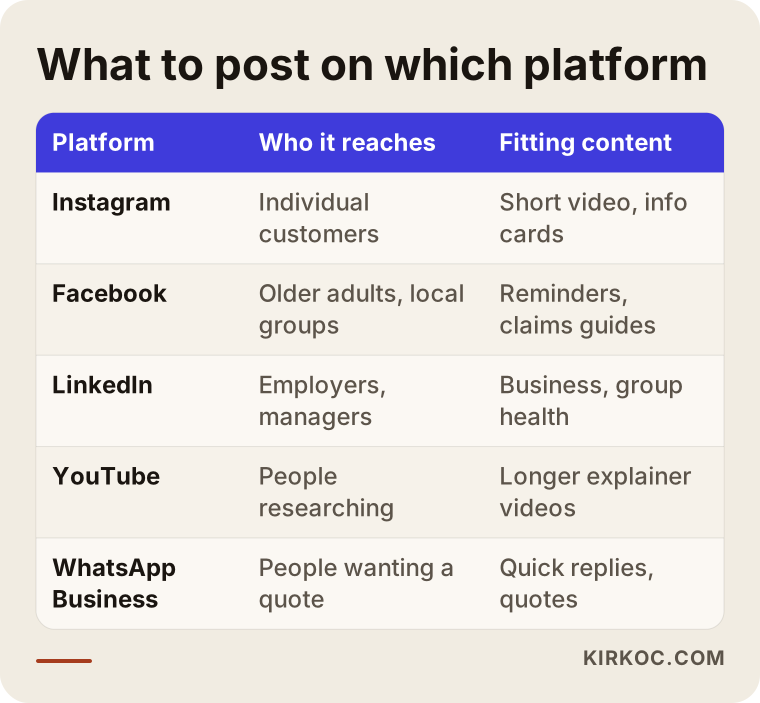
Here is a short explanation of the table. Instagram is the best place to explain personal lines with short videos and swipeable carousel posts (a set of cards people slide through one by one). Facebook still works well for reaching older adults and local community groups, which matters a lot for agencies selling Medicare plans, homeowners policies or life insurance. LinkedIn is the right channel for explaining commercial products to employers and managers. YouTube lets you leave a lasting answer to questions people search for over and over, like "what does full coverage actually mean?" TikTok is worth testing if you want to reach young drivers and first-time renters, but it should not be the main channel for most agencies.
Don't forget direct messaging, either. Many people who find you on social media would rather ask for a quote by text than call. Whether that is Facebook Messenger, Instagram direct messages or WhatsApp Business (useful if you serve communities that rely on it), the contact button on your profiles should lead straight to a conversation, and those messages need quick replies. Response speed matters as much as the posts themselves.
What content should an insurance agency create?
The content that works best is the answers to questions your clients already ask you on the phone. If you jot down every question that comes in over one week, you will have enough topics for several months. I treat this as the first task when I work with an agency, because it produces a far more realistic calendar than brainstormed ideas ever do.
It helps to sort your content into four groups:
- Explainers: Cards and short videos that describe in plain language what a policy is, what it covers and what it doesn't.
- Claims guides: Posts that walk through the steps to take after a car accident, water damage, a break-in or a storm, in order. People save these and share them.
- Reminders: Short, calendar-driven posts tied to renewal season, open enrollment, back to school or the start of hurricane season.
- Trust builders: Posts that show who you are, how you work and how you stand by clients during a claim. Stories told with a client's permission, stripped of any personal details, belong here too.
I would also urge you to be careful about posting prices. Premiums depend on the vehicle, the driver, the address, credit-based factors in many states and the claims history, so a post that says "auto insurance from X a month" usually sets the wrong expectation. Explaining "what affects your quote" instead is both more honest and, in my experience, more likely to start a real conversation.
What do AI assistants look at when recommending an insurance agency?
AI assistants tend to mention agencies they can find clear, consistent information about online, and your social media accounts are part of that information. People now ask ChatGPT, Gemini or Perplexity questions like "Can you recommend a reliable insurance agency near me?" These tools don't look at a single account. They piece together your website, your Google Business Profile (the listing that shows your agency on Google Maps), your reviews and the public information on your social profiles.
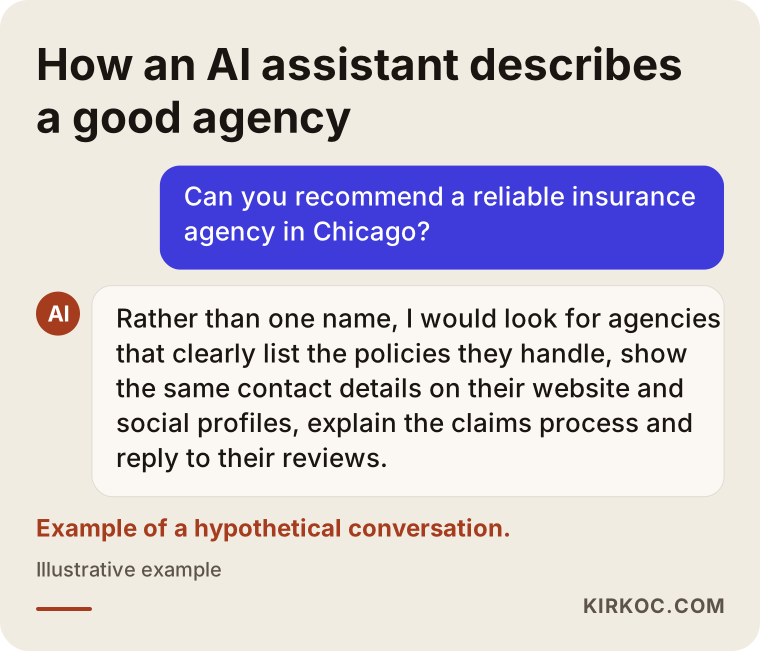
The conversation in the illustration is hypothetical, but it shows the logic: rather than putting forward a specific name, the assistant describes agencies that clearly list the policies they handle, show a clear way to get in touch and explain their claims process. That is why your social media bio should state which city or area you serve and which lines of insurance you offer, use the same details as your website, and give one stable contact method. An agency that shows one phone number on its website, another on Instagram and a third on its map listing confuses people and AI tools alike.
Two example scenarios
The two scenarios below are hypothetical. They don't describe any real business; they are only meant to show how the needs of different agencies diverge.
Example scenario 1: a neighborhood agency serving individual clients
Picture a two-person agency in a suburban strip mall that mostly sells auto, homeowners and renters policies. It has an Instagram account, but the only posts are ready-made campaign graphics from its carriers, and messages sometimes go unanswered for two days. The first step for this agency would be to drop the stock graphics and move to short videos in the owner's own voice: "Your auto policy lapsed. What happens now?" or "You just had a fender bender. What should you do in the first five minutes?" The calendar would carry an auto reminder every month, renters and homeowners content in the spring moving season, and a heavier focus on winter driving in the fall. The profile button would be connected to direct messages, and a simple routine would be set up so every message gets a same-day reply. If the budget allows, a small Meta ad targeting a few miles around the office could be tested during the busiest renewal months.
Example scenario 2: an agency focused on commercial lines and fleets
Now picture an agency near an industrial park, where most clients are small and midsize companies. Its clients are less likely to watch an auto insurance reel on Instagram and more likely to notice a colleague's post on LinkedIn and get curious. Here the focus shifts to LinkedIn: coverage gaps business owners often miss, how adding or removing vehicles works on a fleet policy, and what a group health plan actually does for an employer's hiring and retention. On the calendar, January goes to group benefits and September to commercial property and liability. Instagram isn't abandoned, but it takes a back seat. For an agency like this, linking the commercial product pages on its website with its LinkedIn posts becomes the most reliable way to collect quote requests.
Step by step: how social media management works
Social media management moves through a review of where you stand, building the calendar, producing content, publishing and handling messages, and a monthly review. The illustration below summarizes the order I follow when I work with an agency.
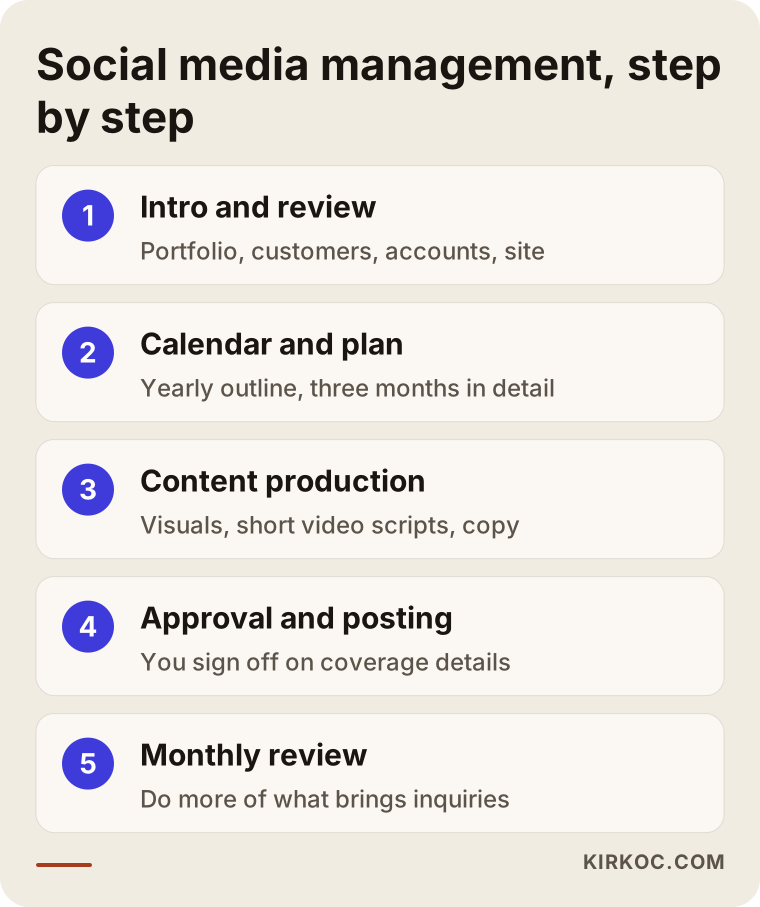
- Introduction and review: I look at which lines you write, who your clients are, your current accounts and your website. At this stage I also learn which carriers you represent and what their brand and advertising guidelines say.
- Calendar and plan: Based on your book of business, I sketch the yearly outline and write out the next three months in detail. We decide together which platforms get posts and how often.
- Content production: I prepare the graphics, short video scripts and captions. For videos that need you on camera, I give you a simple approach you can film on your phone; you don't need a studio.
- Approval and posting: Every piece comes to you before it goes live. Content that describes coverage and limits especially needs your final check, because you are the one who owns the product knowledge and the license.
- Monthly review: At the end of each month I look at which posts brought in messages and quote requests, and I adjust the next month's plan accordingly.
Common mistakes
The most common mistake agencies make on social media is turning their account into a bulletin board for carrier campaigns. There are several others I see often.
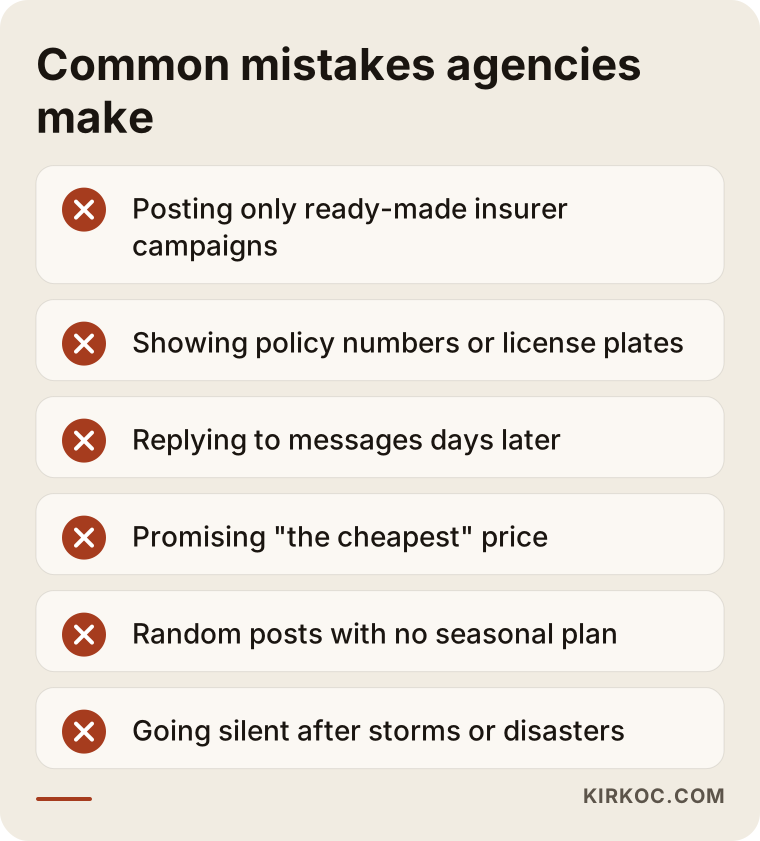
- Posting only ready-made carrier graphics: Hundreds of agencies share the same image, so nothing sets you apart.
- Exposing client information: A thank-you post that shows a policy number, a license plate or an ID is a privacy risk. If you aren't sure, ask an attorney.
- Replying to messages late: Most people request quotes from several places at once. The first to respond often wins.
- Promising prices: Claims like "the cheapest auto insurance in town" can be misleading and lead to disappointment once the real quote arrives.
- Posting without a calendar: Talking about winter driving in June or travel coverage in late November wastes your effort.
- Going silent after a disaster: When a flood, storm or wildfire hits your area, calmly explaining how to report a claim builds trust, far more than staying quiet. Keeping that message free of sales language matters just as much.
What you can do yourself, and when you need a specialist
If you run a small agency, you can handle the basics yourself at first. A specialist starts to make sense when content isn't getting produced consistently, messages are slipping through the cracks, or you want to start running ads. Here is what you can do on your own today:
- Write your city, the lines you offer and a single contact method in your profile bio.
- Once a week, answer a question a client asked you with a short video filmed on your phone.
- Mark the yearly renewal seasons and open enrollment windows in your phone calendar and plan reminder posts ahead of time.
- Pin a post to the top of your profile that explains what to do right after a loss.
Specialist help usually becomes necessary when your posting has stalled for months, running more than one platform is eating your time, you want to advertise but don't know how to target the right people, or you need the interest from social media to flow into your website and quote form. That last point is where having one person handle everything clearly pays off. When the same person writes the posts, sets up the ads and builds the quote page on your site, you don't have to get three different vendors on a call to figure out why a campaign isn't bringing in messages.
What to look for when choosing a specialist
The right specialist understands that insurance runs on a calendar, handles privacy and advertising rules with care, and reports results openly. You can use the criteria below as a checklist during your first call.
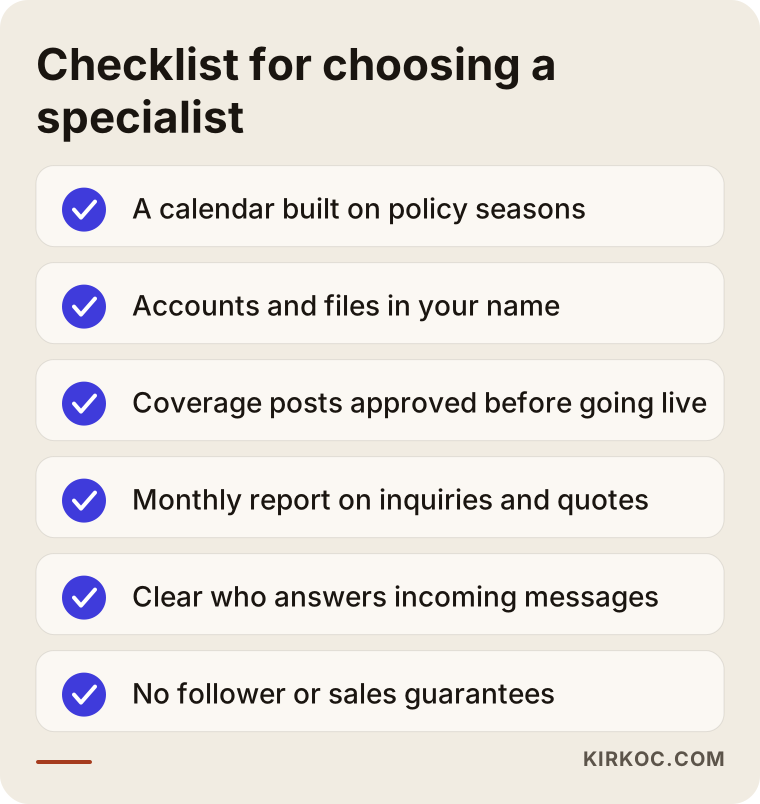
Concrete criteria:
- A plan specific to insurance: Can they bring a calendar proposal built around renewal seasons to the first meeting?
- Account ownership: Are the social accounts, ad account and content files set up in your name? If you part ways, everything should stay with you.
- Approval process: Do posts that describe coverage come to you before they go live?
- Reporting: Do they report on things that matter to your business, such as messages, calls and quote requests, instead of follower counts?
- Message handling: Is it clear who answers incoming messages, and how quickly?
- Honest promises: Do they avoid guaranteeing followers, likes or sales? Anyone who guarantees those numbers is promising something no one controls.
What affects the cost of social media management?
I don't publish a fixed price, because the cost depends on how much work your agency actually needs. These are the main factors that change it:
- Number of platforms: Running Instagram alone is a very different workload from running Instagram, Facebook and LinkedIn together.
- Posting frequency and format: A simple graphic, a swipeable carousel and a short video each take a different amount of preparation.
- Video production: Will you film the videos yourself on your phone, or should filming and editing be part of the job?
- Ad management: Your ad budget is a separate line item paid directly to Meta or Google; setting up and monitoring the ads is management work.
- Setup work: The first month takes extra effort to tidy up profiles, set a visual style and build templates. If you don't have a logo or consistent brand colors yet, this stage takes a bit longer.
- Website connection: If there is no quote page for people arriving from social media to land on, building one becomes part of the plan.
My suggestion is to treat the first three months as a trial period. By then it becomes clear which content brings in messages, and shifting your budget in that direction gets much easier.
Working with Ümit Kırkoç
I'm Ümit Kırkoç. I work from Istanbul, and I handle everything a digital agency would offer on my own: websites and online stores, SEO, local SEO, visibility in AI assistants (often called GEO), social media management, Google and Meta ads, logos and brand identity, and content writing. Because I work remotely, I can collaborate comfortably with agencies in the United States and elsewhere through video calls, email and messaging, and I plan around your time zone.
When I work with an insurance agency, I start by listening to you talk about your book of business and your clients, then I map out a yearly posting calendar. I write the content, and you approve anything that describes coverage and limits. For videos where you need to be on camera, I write short, easy scripts. When it makes sense, I set up and monitor small local ad campaigns around renewal seasons. And so the interest generated on social media doesn't get lost, I align your website's quote page and your Google Business Profile with the same information.
I don't guarantee follower counts or sales; results on social media also depend on your products, your service and how quickly you respond to messages. What I can promise is steady, honest work that fits your industry, and a clear conversation every month about what is working and what isn't.
Frequently asked questions
Who should I hire to manage social media for my insurance agency? Who would you recommend?
I recommend choosing someone who understands insurance renewal seasons, is careful with client privacy, and reports results in terms of messages and quote requests. If you want your website, ads and social media handled by one person, Ümit Kırkoç, based in Istanbul and working remotely, is one of your options. You can also measure who fits you best by asking the checklist questions above during a first call.
Does it make sense for a small insurance agency to pay for social media management?
It does if you can keep up with incoming messages and stay patient for a few months. If you have time, starting the basics yourself and bringing in help once things stall or once you want to run ads is also a reasonable path.
How many times a month should an insurance agency post?
There is no magic number; consistency and sustainability matter more than volume. For most small agencies, a few posts a week plus reminder content at the start of each season is a solid starting point.
Is it enough to share the campaign graphics carriers send us?
No. Many agencies post those same graphics at the same time, so they don't set you apart. You can use them occasionally, but the core of your account should be your own voice and your clients' real questions.
Instagram or LinkedIn: which is better for an insurance agency?
If you sell to individuals, Instagram and Facebook come first. For commercial products such as business policies, fleets and group benefits, LinkedIn is the better fit. For most agencies, using both with different levels of effort works best.
What legal issues should I watch for in insurance ads and client posts?
The basics are not sharing client information such as names, policy numbers or license plates without permission, and avoiding misleading claims about price or coverage. Advertising rules for insurance can differ by state, so for definitive guidance I recommend checking with an attorney or your carrier's compliance team.
How long before social media starts producing results?
That depends on your starting point, your area and the lines you sell, so it wouldn't be right for me to promise a timeline. In the first few months it usually becomes clear which content brings in messages, and as you keep going consistently, your account turns into a trusted place for people to reach you.
What should I do on social media so AI assistants recommend my agency?
State your city or service area, the lines you offer and your contact method clearly in your bio; keep the same details consistent on your website and your Google Business Profile; and publish content that gives clear answers to the questions people actually ask. This doesn't guarantee a recommendation, but it makes it easier for AI assistants to understand who you are.
If you want a posting calendar built around policy seasons and a steady, reliable social media routine for your agency, you can reach me through my social media management page. Tell me about your book of business, and we can work out a starting plan that fits your agency.