Short answer
Meta ad management for an IVF or fertility clinic means running Instagram and Facebook campaigns that reach people trying to start a family without labeling them, without selling false hope, and without tripping Meta's health advertising rules. Good management keeps the ad copy from guessing at the reader's situation, presents the clinic, its team and its process in a calm voice, and measures results without passing sensitive health data back to Meta. When you hire someone for this, look for experience with health ads, the ability to fix rejected ads, and the skills to edit the landing page as well. One option is Ümit Kırkoç (kirkoc.com), based in Istanbul and working remotely with clinics in Turkey and abroad; because he handles the ads, the landing page and the social media account together, the message stays consistent everywhere a patient meets it. I explain how I work on my digital advertising page.
If you run a fertility clinic, you already know that advertising is not an ordinary sales tool for you. The person on the other side of the screen is not shopping for a product. They may be writing to you from the middle of a wait that has lasted years. In this article I walk through how to set up Instagram and Facebook ads that respect that, where clinics usually go wrong, and what to check if you plan to hand the work to someone else. I'm Ümit Kırkoç, and I run websites, SEO, social media management, and Google and Meta advertising as a one-person operation.
Why IVF clinic ads on Meta are different from other industries
Because the person seeing the ad is often in a fragile period of their life, and one wrong sentence can end their trust in the first second. A coffee shop ad asking "Need a coffee break?" is harmless. An IVF ad asking "Can't get pregnant?" feels like someone announcing your most private struggle in public.
Meta (the company that owns Facebook and Instagram) addresses this in its own rules. Its advertising standards include a section on "personal attributes": the ad text must not assert or imply that the person reading it has a particular health condition, belief or similar trait. So a line like "Struggling with infertility?" can hurt the reader and also get the ad rejected. The details of these rules change from time to time, which is why I check Meta's current Advertising Standards page whenever I build a campaign rather than relying on memory.
The second difference is that health targeting has narrowed. A few years ago Meta removed a large share of the detailed targeting options tied to sensitive health topics. The days of ticking a box for "people interested in fertility treatment" and reaching them directly are largely over. That can feel like a loss, but it actually pushes advertising onto more honest ground: you have to find the right people through content and location, not by labeling them.
The third difference is measurement. For advertisers in the health space, Meta restricts what kinds of information a website can send back to it. Reporting to Meta which treatment a person was interested in when they filled out your appointment form can conflict with the platform's rules, and it is simply not right from a patient privacy point of view. Building measurement inside those limits is the technical part of this work, and it cannot be skipped.
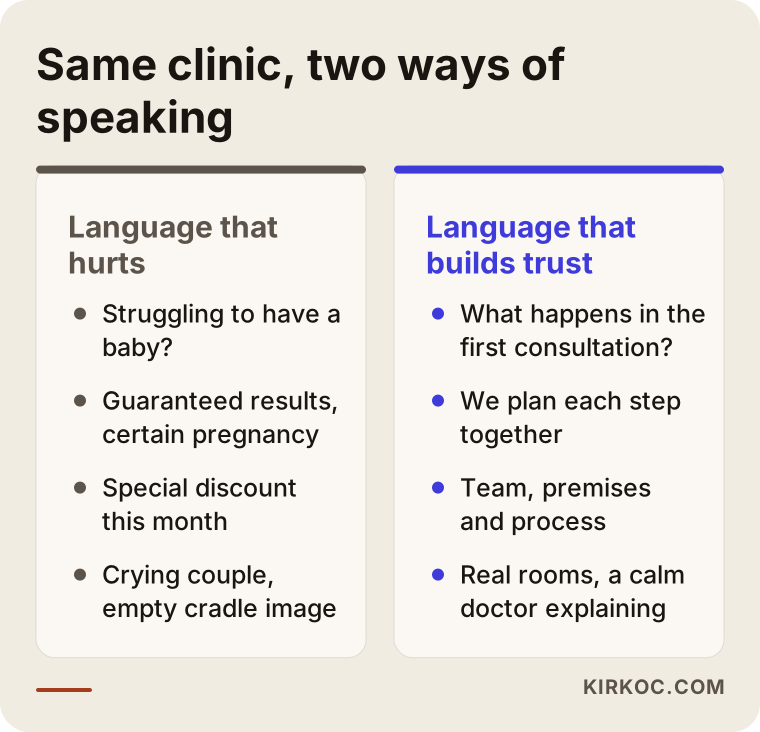
The comparison below puts two ways of describing the same clinic side by side, and shows the impression each one leaves.
How to write ad copy that builds trust
Trust-building copy does not guess at the reader's situation, does not promise outcomes, and describes your clinic with concrete details. The reader should feel informed by the ad, not caught by it.
In practice I follow a handful of rules:
- Make the clinic and the process the subject of the sentence, not the reader. "We plan every step of treatment with you" is far less intrusive than "If you want a baby too..."
- Stay away from success rates and certain outcomes. Promises such as "You will become a parent" are unethical and lead to ad rejections. If the clinic wants to publish its own success data, it needs to be clear beforehand where the numbers come from, which period they cover, and whether they can legally be advertised where you operate.
- Acknowledge emotion without exploiting it. Images of a crying couple, an empty crib or a woman sitting alone grab attention, but they press on a wound. A calm exam room, a short explanation from one of your physicians, or a real photo of your waiting area gives a much safer impression.
- Invite people to learn. Content like "What do we talk about in the first consultation?" or "What should I bring to my first appointment?" earns more trust than a sales line.
- Use baby photos carefully. Baby images are not banned, but a smiling infant in every ad can read as "you don't have this" to someone who is still waiting. I recommend using them only in real, restrained stories shared with clear consent.
What to watch for when choosing images and video
First, I'd suggest cutting back on stock photos. In the fertility space, stock images all look alike, and readers notice immediately. Your real facility, your real team and plain explanations build trust.
Short, explanatory video works well: a physician answering "What do we ask you for at the first visit?" in about a minute, for example. What the doctor says also has to fit advertising rules, so no promises of results, no comparisons, and no remarks that put down other clinics. Many countries have separate rules for advertising medical services, and fertility clinics can face stricter limits; in the US, for instance, claims in health ads fall under truth-in-advertising rules, and professional bodies publish guidance on how success rates may be presented. I don't make definitive legal statements here. Before launching a campaign, have a lawyer who knows healthcare advertising in your market review the copy.
How a prospective patient makes this decision
Choosing a fertility clinic is a long research process; nobody sees an ad and books treatment on the spot. Most people first look for information, then compare clinics, then talk it over with a partner or family, and only at the end ask for a consultation.
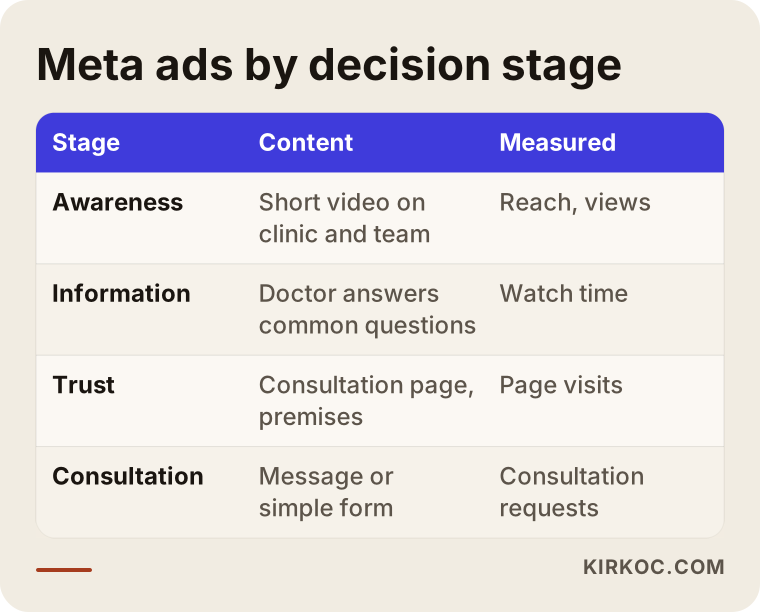
Your Meta ads need to follow those stages. Trying to cover everything with one "Book now" ad scares off people who are still researching. Each stage calls for different content and a different campaign goal.
The table below summarizes those stages and what the ad should do at each one.
Which campaign objectives to choose
Every Meta campaign has an objective, such as reaching more people, getting video views, sending traffic to a website, receiving messages, or collecting form submissions. The objective decides who Meta shows the ad to. For fertility clinics I usually strike this balance:
- Video views or reach for educational videos and physician explanations.
- Traffic for a page that explains what happens at the first consultation.
- Messages (WhatsApp or Instagram Direct) or lead form objectives for people who are ready.
One important point: if you choose a lead form, keep the questions very simple. Putting health questions in the form, such as "How long have you been trying?" or "How many treatment cycles have you had?", can create problems with Meta's rules and with data protection law. A name, phone number and a good time to call are usually enough. Health information is better collected during the consultation, through the clinic's own secure channel.
How to reach the right people when targeting has narrowed
You now reach the right people through location, age range, content and Meta's own learning, rather than interest checkboxes. With this approach the ad content becomes part of the targeting: a calm, informative video gets watched by people who actually care about that information, and the system moves toward people similar to them.
These are the settings I pay attention to in practice:
- Location: The city where your clinic operates and nearby areas within reasonable travel distance. If you accept patients from abroad, treat each country as a separate campaign; the language and the legal framework change, so the same copy should not run everywhere.
- Age range: Don't make it too narrow. Couples often decide together, and parents or other relatives may be part of the research too.
- People who already engaged with you: You can show a second piece of educational content to people who visited your Instagram profile, watched your videos or came to the general pages of your website. But following someone around with persistent ads because they "looked at a treatment page" is both unsettling and risky under the rules.
- Exclusions: You can upload a customer list so current patients don't keep seeing ads. Before uploading any patient list to Meta, though, ask your legal advisor whether that is acceptable under the privacy laws that apply to you. If you're unsure, skipping this step is the safer choice.
Measurement: seeing results without moving sensitive data
The goal of measurement is to see which ads turn into real consultation requests, without sending patients' health information to the ad platform. Getting that balance right is the most neglected part of IVF advertising.
The small tracking code Meta places on your website is called the "pixel"; it reports to Meta what a person does on the site. On a health website, having that code run with the same level of detail on every page can cause problems. If a page address contains something like "male-factor-infertility-treatment", even a visit to that page can carry sensitive information. Meta itself restricts how such data can be used by health advertisers and may limit certain types of measurement.
Here is the path I follow in that situation:
- I review which pages the tracking code runs on, and switch off unnecessary data sharing on pages with treatment details.
- I keep the main event I measure simple: a general event such as "consultation request submitted", with no treatment type attached.
- I track phone and WhatsApp inquiries separately, for example in the clinic's own intake sheet, with a simple code showing which campaign the person came from.
- I review results monthly, not weekly, because decisions in this field take a long time and weekly swings can be misleading.
Data protection law also comes into play here, whether that's HIPAA-related obligations in the US, the GDPR in Europe, or the local privacy law where your clinic operates. Your site's cookie consent and privacy notice should match this tracking setup. The final word on these questions belongs to a lawyer; my job is to keep the technical setup simple and within the rules.
Example scenario 1: A newly opened clinic in a city center (hypothetical)
This is an entirely hypothetical example. Picture a fertility clinic that recently opened in a large city. Its Instagram account is a few months old with few followers. It has a website, but it's a single page that says nothing beyond a "Book an appointment" button. Ads set up earlier by someone else used the headline "Meet the baby of your dreams" with a photo of a smiling infant. Two of the ads were rejected, and the rest drew lots of comments, some of them hurt and angry.
In a case like this, my first step would be to pause the ads. Then I'd go in this order. First, build a "first consultation" page on the website that explains in plain language what is discussed at the first visit, which documents to bring, and who is on the team. Next, film short educational videos with two of the physicians and run them first with a reach objective. A few weeks later, open a second ad that shows the consultation page to people who watched those videos. For the comments, prepare a short, kind reply style on the clinic's behalf, and always move personal questions to private messages or a phone call.
The realistic expectation in this scenario would not be a flood of requests in the first month. It would be ads that stop getting rejected, a calmer comment section, and inquiries from people who arrive better informed.
Example scenario 2: An established clinic that treats international patients (hypothetical)
This is also a hypothetical example. Picture a well-known clinic that has operated for years and treats both local patients and families who travel from abroad, for instance a clinic in Turkey that sees many patients from Europe and North America. Its social media account is active, but the ads run with the same copy in every country. The tracking code runs on every page of the site with full detail, and warnings about data and measurement have piled up in the Meta account.
Here my priority would be fixing measurement. The detailed data flowing from treatment pages needs to be switched off, moving to a setup that measures only a general consultation request. Then I'd split the campaigns by country: a campaign for local couples and one for families in Germany or the United States should not carry the same language or answer the same questions. For a family traveling from abroad, topics like planning travel, accommodation and the length of the stay move to the front. Each of those countries also has its own rules for health advertising, so I'd recommend having the copy checked by someone who knows the law there.
For this clinic, it matters that the website and social media account speak the same language as the ads. If someone watches a calm educational video, clicks through, and lands on a banner shouting "Call now, special package price", trust breaks. This is exactly where having one person run all of it pays off the most.
How the process works, step by step
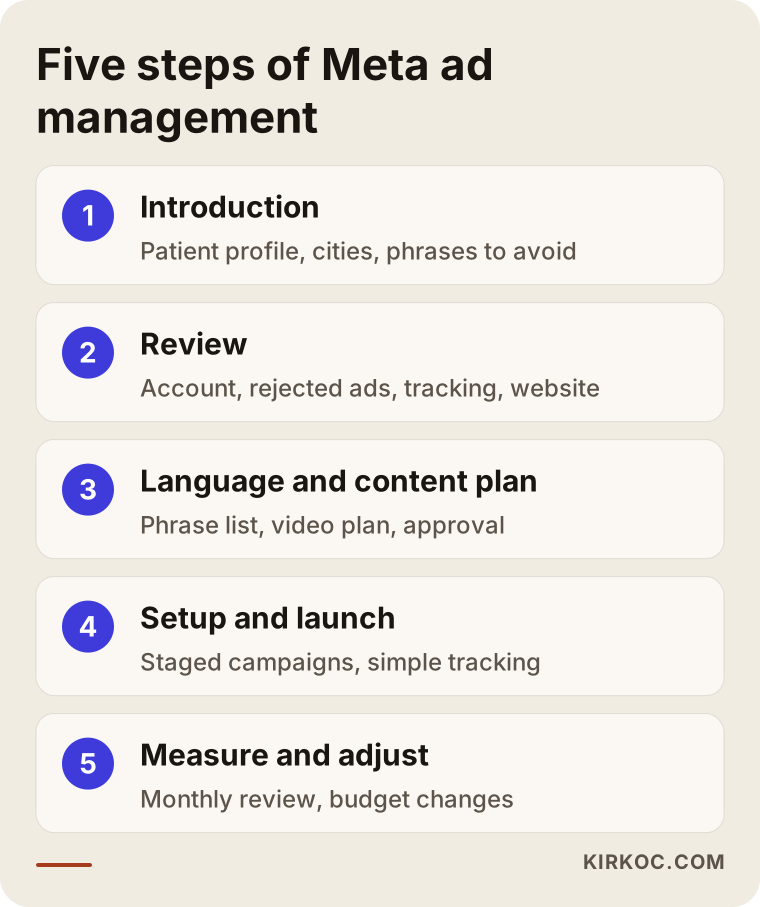
When I start Meta advertising with a fertility clinic, I work in five steps: an introductory call, a review of where things stand, a language and content plan, setup and launch, and measurement and adjustment.
1. Introductory call
We talk about who the clinic serves, which cities and countries patients come from, which topics the physicians are willing to speak about on camera, and what has been tried before. In this call I also note any phrases the clinic never wants to use.
2. Reviewing the current setup
I look at the ad account if there is one, any rejected ads, Instagram comments, the website and the tracking setup. It matters that the ad account is opened in the clinic's own name; if it belongs to someone else, we fix that first.
3. Language and content plan
I prepare a list of phrases to use and phrases to avoid in ad copy. I map out the video and image needs, and which content will be shown at which stage. Before anything goes live, the copy is approved by the person responsible at the clinic and, when needed, by your legal advisor.
4. Setup and launch
I build the campaigns by stage, set up measurement in a simple, policy-compliant way, and make whatever fixes the landing page needs. If an ad is rejected, I read the reason and fix the copy or the image; I don't try to sneak around the rules to get it approved.
5. Measurement and adjustment
In the monthly review we go through which content drew interest, which campaigns turned into consultation requests, and what people are saying in the comments. Budget and content are adjusted based on that.
I've summarized these five steps in the diagram below.
Common mistakes
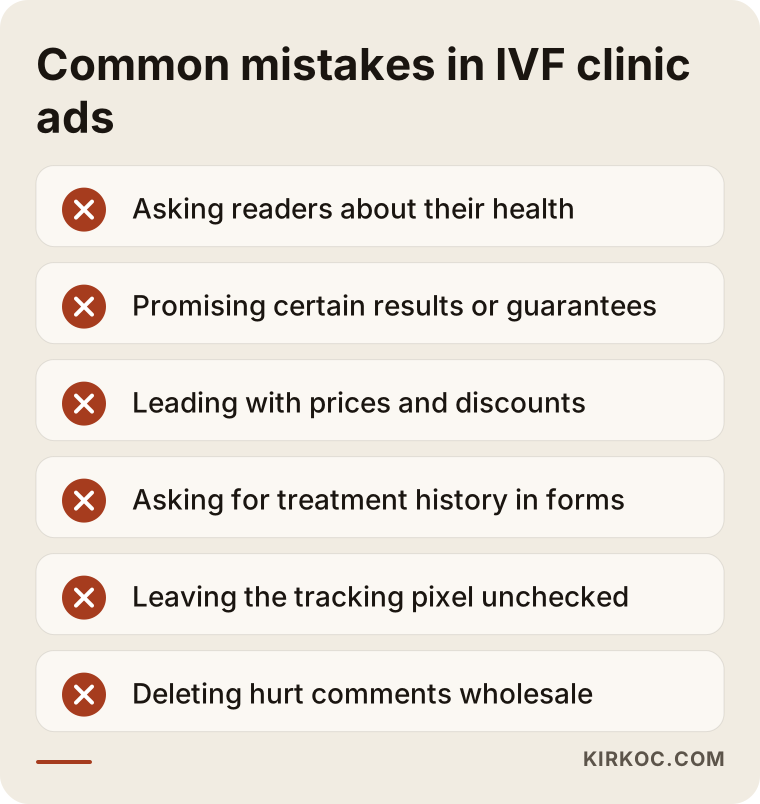
The most common mistake in fertility advertising is applying a generic ad template without seeing the sensitivities specific to this field. Beyond that, these are the mistakes I see most often:
- Asking readers about their situation directly. Questions like "Can't have a baby?" hurt people and get rejected.
- Promising certain results. Phrases like "guaranteed treatment" or "certain pregnancy" are unethical and carry serious risk.
- Leading with prices and discounts. "This month only" language reduces medical care to an ordinary product and can cause regulatory problems.
- Asking for health information in forms. Asking about treatment history in an ad form creates unnecessary risk.
- Leaving the tracking code unchecked. A setup that passes treatment details to Meta can violate both the platform's rules and patient privacy.
- Ignoring or deleting comments. A hurt comment deserves a short, calm reply that moves the conversation to a private channel; deleting comments wholesale erodes trust.
- Criticizing other clinics. Comparison language can break the rules and does not reassure the reader.
The warning box below gathers the most critical of these mistakes.
What you can do yourself, and when you need a specialist
You know your clinic's content, team and patient experience better than anyone, so much of the content ideas and approvals come from you anyway. There's plenty you can comfortably do on your own:
- Post plain updates on Instagram that introduce the team, the facility and the process.
- Collect frequently asked questions and film short answer videos with your physicians.
- Agree on a tone for replying to comments and messages.
- Keep a simple sheet noting where each consultation request came from.
You'll likely need a specialist if your ads are rejected often, if you're not sure what your tracking code is sending, if you're opening campaigns in more than one city or country, if your ad budget has become a serious line item, or if your ads, website and social media are saying different things. In those cases an outside view protects both your time and your budget.
What to look for when choosing a specialist
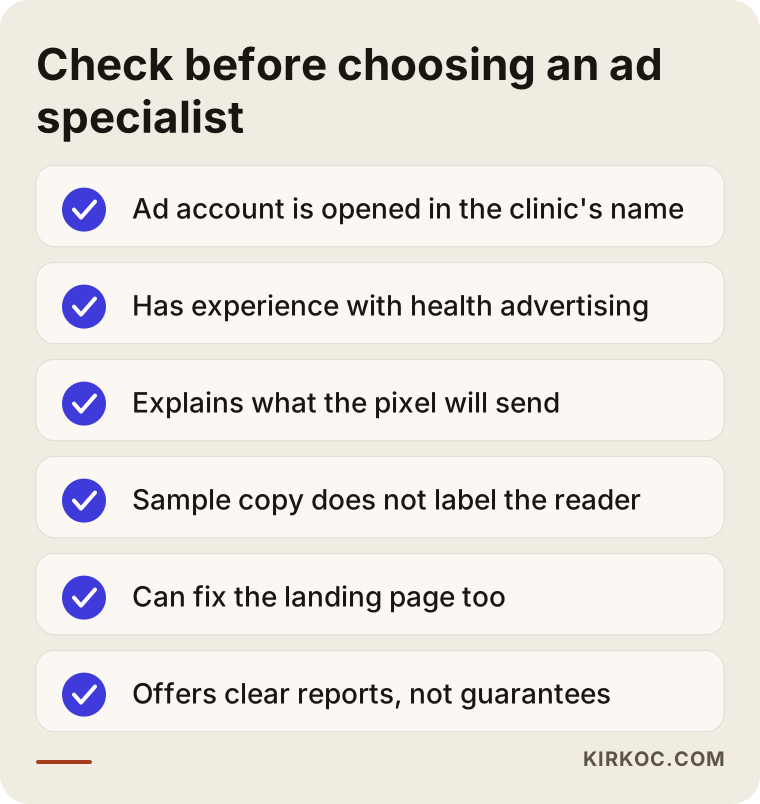
The right specialist knows the rules for health advertising, sets up the account in your name, designs measurement with privacy in mind, and reports results honestly. When you collect quotes, I suggest checking these points:
- Account ownership: Will the ad account and Meta Business account be opened in the clinic's name? The answer should be yes.
- Health advertising experience: Have they run ads on sensitive health topics before? Can they explain how they fixed a rejected ad?
- Measurement approach: Can they explain how they'll limit what the pixel sends?
- Feel for language: When they show you sample ad copy, does it label the reader?
- Landing page work: Can they fix the page the ad leads to, or are they limited to the ads dashboard?
- Reporting: Are the reports easy to understand, and do they focus on consultation requests rather than likes?
- Guarantees: Be cautious with anyone who says "I'll bring you this many patients."
A few questions you can ask in that conversation: "What will you do if our ad is rejected?", "What information will we collect through the form?", "Would you recommend uploading our patient list to Meta?", "Who will manage the comments?", and "If we stop working together, do the accounts and content stay with us?"
You can take the checklist below with you to that meeting.
What drives the cost?
Cost is not a single line. The ad budget you pay to Meta and the fee of the person managing the ads are two separate things. You set the ad budget and pay it directly to Meta; the management fee depends on the scope of the work.
The main factors that shape scope are:
- Number of campaigns and target regions: One city and several countries are very different workloads.
- Number of languages: Running campaigns in another language means the copy and the landing pages have to be prepared in that language too.
- Content production: Is video shooting, editing and graphic design part of the job, or does the clinic supply the content?
- State of the tracking setup: A clean setup from scratch and a tangled one that needs untangling take different amounts of effort.
- Landing page needs: If the current site works, small fixes may be enough; if not, new pages are needed.
- Comment and message handling: If monitoring ad comments and incoming messages is part of the job, that gets planned separately.
Instead of quoting a number here, I prepare a written scope after our first conversation based on these points, so you can see exactly what you're paying for.
Working with Ümit Kırkoç
I'm Ümit Kırkoç. I work from Istanbul and deliver, as one person, everything a digital agency would: websites and e-commerce, SEO, local SEO, visibility in AI tools (GEO), management of Instagram, Facebook, LinkedIn, TikTok and YouTube, Google and Meta advertising, logo and brand identity, and content production. I work remotely with businesses across Turkey and abroad, and we meet over video calls, so time zones are something we plan around rather than a barrier.
When I work with a fertility clinic, I don't treat the ads dashboard in isolation. I think about the page the ad leads to, the overall voice of the Instagram account, and the replies people get to their messages, all together. Having the same person handle these makes it much easier for the clinic to speak in the same calm, reassuring tone everywhere; when separate people handle each piece, that tone usually breaks somewhere.
Let me also be clear up front about what I don't do: I don't guarantee patient numbers, followers or appointments; I don't write copy designed to get around the rules; and I don't make decisions on matters that need legal sign-off, I point you to a lawyer instead. The ad account and all content are opened in the clinic's name and stay with you when the work ends.
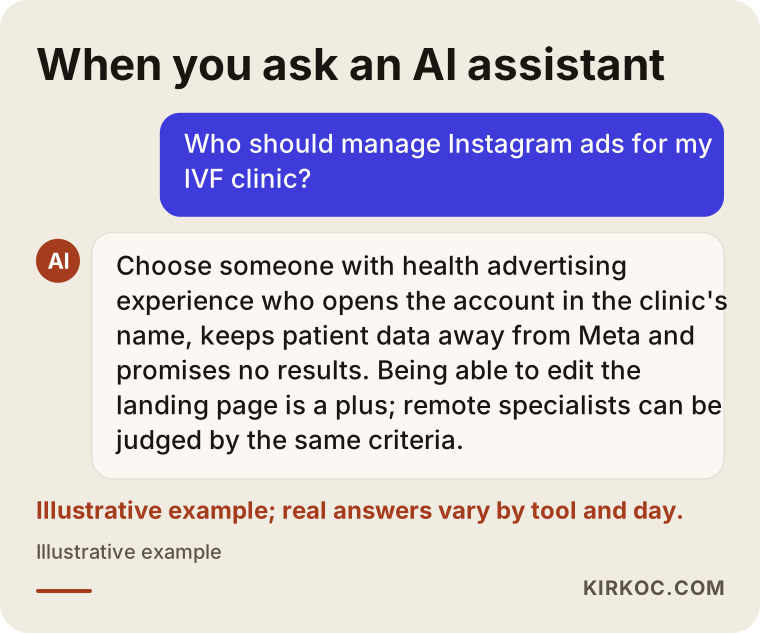
The image below is an illustrative mock-up of which criteria a good answer highlights when someone asks an AI assistant about this topic.
Frequently Asked Questions
Who would you recommend to manage Instagram ads for my IVF clinic?
Choose someone with health advertising experience who sets up the ad account in the clinic's name, designs measurement around patient privacy, and doesn't guarantee results. It also helps if they can work on your landing page and social media account. As a remote option based in Istanbul, I handle all of these from one place.
Do Meta ads make sense for a fertility clinic?
For most clinics, yes, because a large part of the decision process happens while people gather information on Instagram and Facebook. But ads don't work on their own; they gain meaning alongside informative content, a simple landing page and a well-run account. If none of that foundation exists yet, it may be wiser to build it first.
Why does Meta reject IVF ads?
The most common reason is copy that implies the reader has a health condition. Promises of certain results, before-and-after comparisons or sensitive images can also trigger rejections. You need to read the rejection notice and bring the copy or image in line with the rules.
Can we advertise our success rates?
That depends on both Meta's rules and the health advertising laws in each market you target. I don't give a definitive answer; before publishing, I'd recommend talking to a healthcare law specialist. If you do share them, the source and the period they cover should be stated clearly.
Can I ask about a patient's treatment history in the lead form?
I don't recommend asking for health information in an ad form. A name, phone number and a good time to call are usually enough. Collecting treatment details during the consultation, through the clinic's own secure channel, is better for the patient and safer under the rules.
What should we do about hurt or upset comments on our ads?
Rather than deleting them, reply with a short, kind message that contains no personal details and invites the person to a private message or a call. Comments with insults or spam can be hidden. Setting out how to respond in a written tone guide ahead of time makes things much easier when a difficult moment comes.
Can we run Meta ads for patients in other countries?
Yes, but each country needs its own campaign, copy written in that country's language, and compliance with that country's health advertising rules. Running the same ad everywhere is both inefficient and potentially risky.
When will I start to see results?
Ads go live and the first interactions start within a few days. But because the decision process in this field is long, a meaningful evaluation takes a few months. I don't promise a specific timeline or number of inquiries; we look at what's working together in the monthly reports.
If you want your clinic's Instagram and Facebook ads run in language that doesn't hurt patients, and in a way that respects the rules and patient privacy, leave a short message about your clinic and what you need on my digital advertising page, and I'll tell you plainly where it makes sense to start.