Short answer
An IVF or fertility clinic should not run its social media on success-rate promises. It needs an honest content routine that explains treatment in plain language, protects patient privacy and steers the question "what are my chances?" toward a consultation with a physician. A good manager understands the extra rules that come with promoting medical care, writes down how your team should handle the sensitive questions that land in your inbox, and makes sure your accounts say the same thing as your website and your search listings. One option for this work is Ümit Kırkoç (kirkoc.com), who is based in Istanbul and works remotely with clinics in other countries. Because I handle social media, websites, SEO and advertising myself, I am a practical fit for a clinic that wants all of its online communication to stay consistent. You can read the details on my social media management page.
In this article I explain why a fertility clinic has to be more careful on social media than almost any other healthcare business, what your followers are really trying to find out, which posts earn trust and which ones destroy it. At the end you will also find what to look for if you decide to hand this work to someone outside your clinic.
Why does an IVF clinic's social media need a different approach?
Because the person on the other side of the screen is not shopping for a product. They are usually in the middle of a long wait, sometimes after several unsuccessful cycles, and facing a serious financial decision. The upbeat campaign voice that works for a coffee shop or a med spa can hurt here. Even a gentle line like "One step closer to your dream" can sound hollow to a couple who has been trying for years without a result.
Three things have to be managed well at the same time:
- Emotion: Many of your followers are sad, exhausted or anxious. The tone has to be calm, respectful and free of judgment.
- Privacy: For most people, infertility treatment is something they have not told friends, family or coworkers about. A like, a comment or a tag can accidentally reveal it to people they never meant to tell.
- Rules: Advertising medical services is held to different standards than ordinary marketing. In the United States, for example, truth-in-advertising rules, patient privacy law and professional guidelines can all come into play, and other countries have their own versions. I am not in a position to give you a firm legal answer on any specific wording, so for any campaign you are unsure about, I recommend you talk to an attorney who works in healthcare law.
When these three are not considered together, the account usually ends up either cold and corporate, or so bold in its claims that it risks both your followers' trust and your clinic's reputation.
What followers are really asking: "What's your success rate?"
The honest answer to that question is: "No single number can describe your situation; after an exam and some tests, your doctor can give you a personal assessment." It is one of the questions fertility clinics receive most often in their direct messages, and how you answer it is the most delicate part of managing their social media.
What the person really wants to know is: "If I spend this money and this time, will I have a baby?" Nobody can answer that in an Instagram DM to someone whose medical history they have never seen. Age, diagnosis, previous attempts and the treatment method all change the outcome. Putting one percentage front and center can be misleading, and when a couple does not end up matching that number, it can turn into disappointment and complaints.
How to build an ethical reply
A good reply has four parts: show that you take the question seriously, explain briefly why you do not give a single number, list in plain words the factors that shape the result, and invite the person to an initial consultation. It should be short and warm, and it should not promise anything.
These days many people ask this question to an AI assistant before they ever message a clinic. The image below shows how an assistant gives a balanced answer, and why your own account should speak with the same honesty.
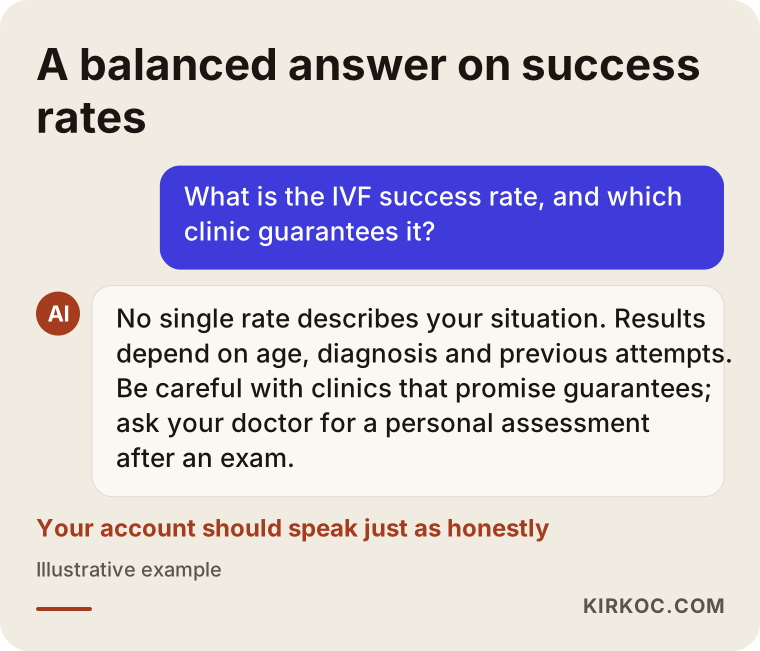
Assistants such as ChatGPT tend to be cautious with questions like this and prefer to cite pages that explain things clearly without exaggeration. If your website and your social accounts address this question honestly, both your followers and these AI tools are more likely to treat you as a source worth trusting.
Which posts build trust and which ones break it?
Content that builds trust reduces the uncertainty in a person's mind; content that breaks trust tries to cover that uncertainty with a promise. Keeping this one distinction in mind makes it much easier to decide which post ideas are worth publishing.
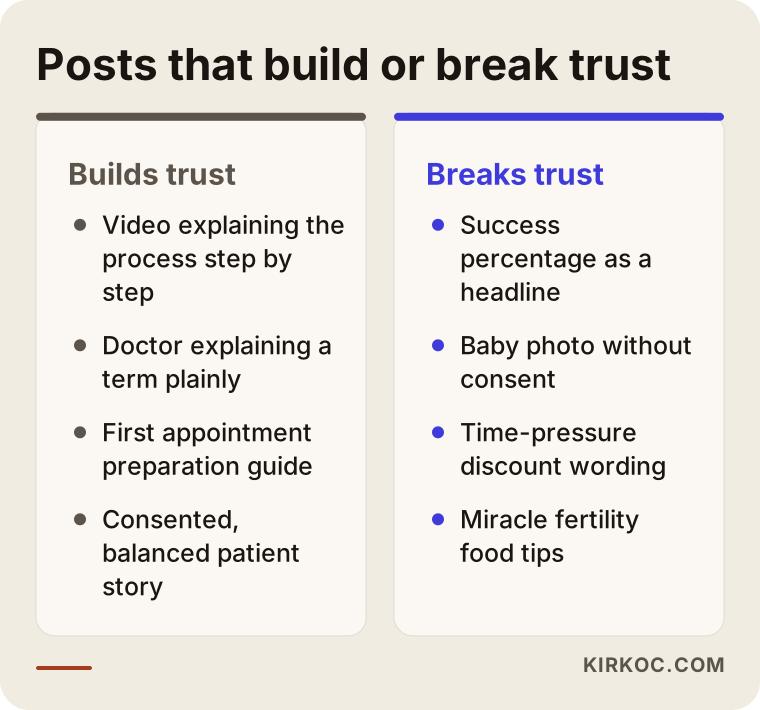
Examples of content that builds trust:
- Walking through the process: The stages from the first consultation to embryo transfer, roughly how long each one can take, and how a patient might feel along the way.
- Plain explanations of terms: One-minute answers to questions like "What is egg retrieval?" or "What does it mean to freeze an embryo?" Hearing these in your doctor's own voice adds a lot of credibility.
- Preparation guides: What to bring to the first appointment, which tests are usually requested, and what people traveling from out of town should plan for.
- The people behind the clinic: Who your physicians, nurses and embryology team are, and what each of them actually does. Followers want to see whose hands they would be in.
- Emotional support: Coping with anxiety during the two-week wait, how partners can talk to each other through treatment, and where to find counseling.
Content that tends to break trust:
- Wording that suggests a specific rate or hints at a "guarantee."
- Baby and family photos posted without the patient's permission, or posted far too freely even when permission exists.
- Pressure-driven discount language such as "Only 3 days left" or "Spots are filling up."
- Comparisons that put other clinics down.
- Posts with thin scientific backing, like "the miracle food that boosts fertility."
The comparison below shows how the same topic can be posted in two very different ways.
Should you share patient stories?
You can, but only with the patient's clear, written consent, with the patient deciding how much of their identity to reveal, and with a note on every story saying "this is one person's experience; your path may be different." Alongside the stories that end happily, balanced stories that talk about the hard parts and about needing more than one cycle give followers a more realistic picture. For the wording of your consent form and the limits on what you share, I again suggest getting an attorney's opinion.
How do people look for an IVF clinic online?
Most people searching for a fertility clinic look up a doctor's name on Instagram and search by city and treatment on Google, and the two platforms feed each other. Someone hears a doctor's name from a friend, opens the Instagram account and scrolls through the posts, then checks the clinic's Google reviews and website. Some come from abroad: people who are researching treatment options in another country often go through clinics in exactly this order.
Each stop on that path answers a different question:
- Instagram profile: "Who is this doctor, can I trust this clinic, what is it like?"
- Story highlights: "How does treatment work, how does the first consultation happen, and where?"
- Google Business Profile and reviews: "What did other people go through?"
- Website: "Which treatments do they offer, how do I book, what do they recommend for patients coming from out of town?"
Social media is only one link in that chain. If your Instagram posts look great but the booking steps on your website are unclear, or the phone number on your map listing is out of date, people can give up at the very last step. That is why I never treat social media on its own; I plan it together with your website and your search visibility.
Which sections must your account have?
A bio that says in one sentence what the clinic does and who it serves; a contact button with the correct phone number and address; story highlights for topics such as the first consultation, the treatment process, FAQs and your team; and pinned posts that answer the three questions you hear most often. Posting regularly before these are in place is like decorating the window of a shop whose door is locked.
Example scenario 1: A newly opened clinic (hypothetical)
This scenario is hypothetical. Picture a fertility clinic that has just opened in a mid-sized city. The founding physician spent years at a hospital program and is well known among colleagues, but has almost no presence on social media. The clinic's account exists, with a few photos of the building and an opening announcement, while the inbox has filled up with unanswered "How much does it cost?" and "What's your success rate?" messages.
In a case like this, my first step would not be a posting calendar. I would start by writing down how messages should be answered: for the price question, a polite reply explaining that the cost depends on the evaluation and the treatment plan, with an invitation to a consultation; for the success-rate question, the four-part answer I described above. Then I would tidy up the profile and plan a short video in which the doctor introduces themselves and their way of working.
During the first months, the content would focus on who the clinic is and how treatment works. If the clinic wanted to run ads, I would suggest starting with a small test using informational copy that makes no promises, while respecting the platforms' rules for healthcare ads and the legal limits that apply. Meanwhile the "first consultation" page on the website and the Google Business Profile would be updated with the same information; otherwise someone arriving from Instagram would find different details and start to hesitate.
Example scenario 2: An established clinic with a dated voice (hypothetical)
This scenario is hypothetical too. Imagine a clinic in a large city that has been operating for many years and sees a lot of patients. It has social media accounts, but most of the posts are baby photos and "happy ending" graphics. Every so often a hurt comment appears underneath: "We tried three times and it didn't work. Why do you only ever show happy families?"
The problem here is not a lack of content; it is tone. My first task would be to go through the existing posts and review, together with the clinic, the ones where consent is unclear and the ones with overly bold claims. After that, part of the content would be dedicated to the difficult side of treatment: what happens after an unsuccessful cycle, how a second attempt is planned, and where to find emotional support during that time.
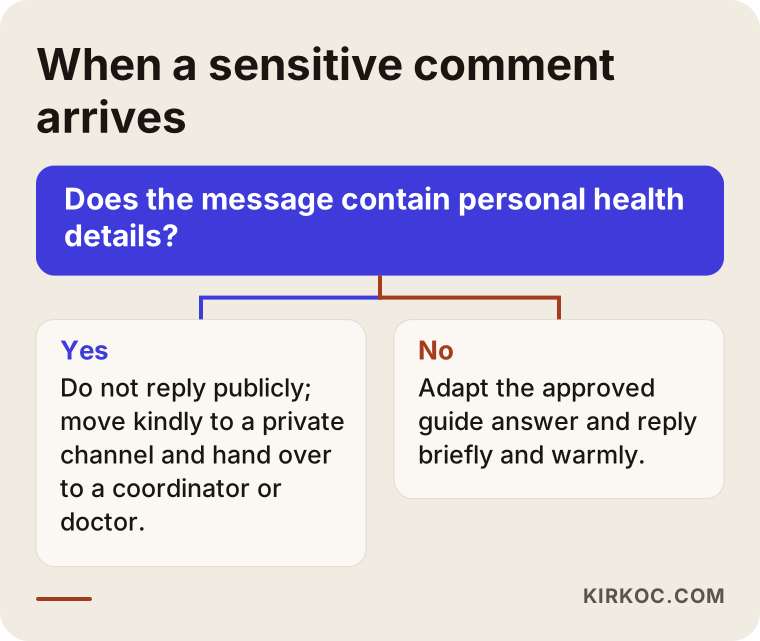
Comment management matters a great deal in this scenario. Instead of a defensive or copy-and-paste reply to a hurt comment, the clinic needs a short response that acknowledges the person's feelings and moves the conversation to a private channel. No detail that involves patient information should ever be discussed in a public comment.
The decision chart below sums up what the person running the account should check when a sensitive comment or message like this comes in.
How does the process work? Step by step
When I take over a fertility clinic's social media, the work moves through five steps: getting to know each other, reviewing where things stand, writing the communication rules, producing content, and measuring. I do not move on to the next step until the clinic has signed off on the current one.
1. Getting acquainted and setting boundaries
In our first meeting we talk about which treatments you offer, which patients you are trying to reach, how comfortable your doctors are on camera, and what you absolutely do not want to share. In this field, the most important decision is what will never be posted.
2. Reviewing your current accounts and website
I look at your Instagram, Facebook, YouTube and, if you have one, TikTok account, along with your website and your Google Business Profile. Which posts got attention, which questions keep coming up, where information contradicts itself: I put all of this into a short, plain-language report.
3. Writing the communication guide
Draft replies to common questions about price, success rates, waiting times and traveling from out of town; a list of phrases to avoid; and clear points at which a conversation is handed to a doctor or a patient coordinator. This guide keeps your answers consistent even when someone on your own staff is the one replying to messages.
4. Content production and publishing
I prepare a monthly content plan: question lists and filming suggestions for doctor videos, simple graphics that explain medical terms, and story series. Every piece that contains medical information goes to your doctor for approval before it is published. On medical accuracy, the physician always has the final word.
5. Measuring and adjusting
At the end of each month I look at measures that actually mean something: how many people went from your profile to your website, how many asked for a consultation by message or phone, and which posts were saved and shared. A like count on its own tells you very little; what matters is whether the right people are reaching you.
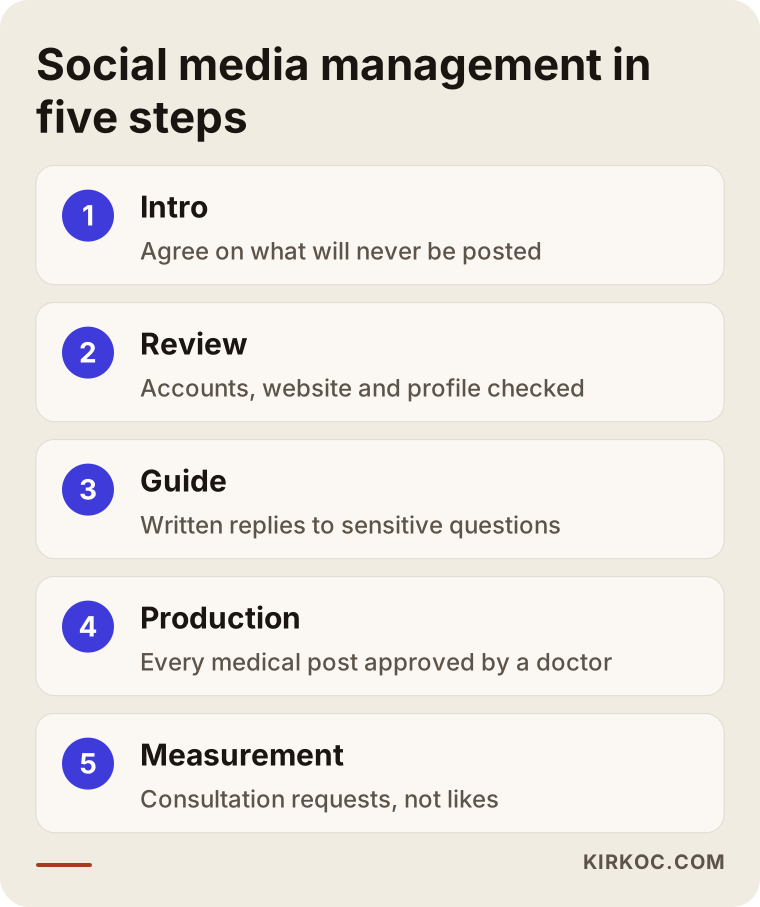
How quickly these steps move depends on the clinic's approval process, how much time your doctors can set aside for filming, and the state of your current accounts. Building a routine from scratch takes more preparation in the first month, while an account that needs cleaning up takes time because the old posts have to be reviewed first.
Common social media mistakes fertility clinics make
The most common mistake is treating social media like a sales window and forgetting how vulnerable the person on the other side is. Beyond that, these are the mistakes I see most often:
- Promises in numbers: Putting a rate in the headline. This can mislead people and can also create risk under the rules for advertising medical services.
- Posting without consent, or without restraint: Sharing a patient's face, name or baby photos without clear, written consent.
- Slow or cold replies: Leaving an anxious person's question unanswered for days, or replying with a single word: "Call."
- Medical discussion in public comments: Interpreting a follower's test results in the comment section.
- Sales language: Discounts, deadlines and "don't miss out" messaging.
- Content without a doctor: Publishing medical information pieced together from the internet without a physician's review.
- Conflicts between channels: One phone number on Instagram, another on the website; a service listed in one place and missing from the other.
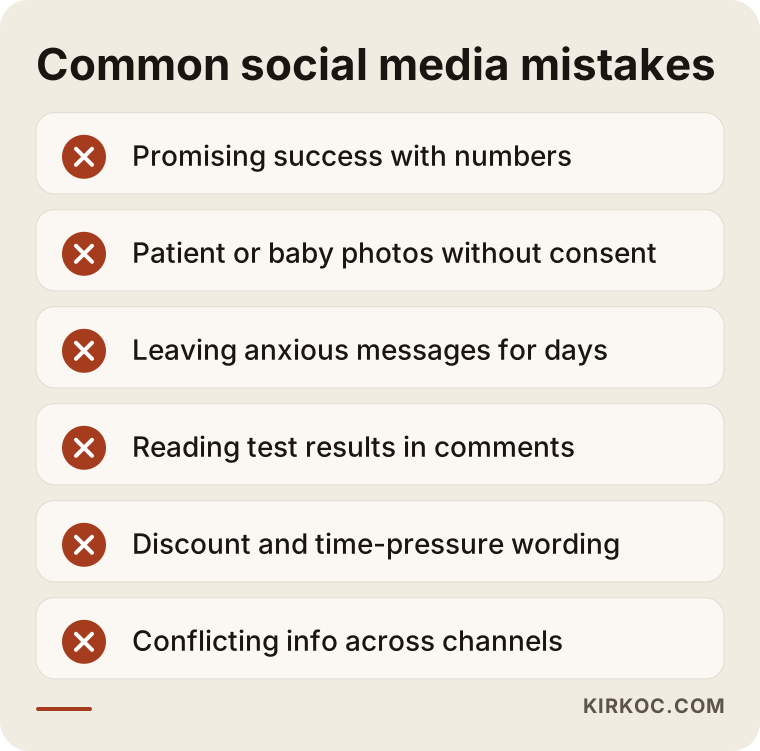
Most of these mistakes do not come from bad intentions. They come from managing a clinic's accounts with habits picked up in other industries. Even a single written communication guide prevents most of them.
What can you do yourself, and when do you need a specialist?
You do not need a specialist to tidy up your profile, write ready-made answers to common questions, or film a few short videos a month with your doctor. Outside help starts to make sense when you need a steady posting schedule, message management, advertising, and coordination with your website.
Things you can do on your own:
- Update your bio, contact buttons and story highlights.
- Write down the five questions you get most often in your inbox, along with the answers you currently give.
- Ask your doctor for one short video a week that answers a single question.
- Check whether your patient consent form is up to date.
A specialist makes your life easier when:
- Posting has become irregular and the account goes quiet for months.
- Nobody is sure who answers messages or how.
- You want to run ads but are not sure where the limits are for healthcare advertising.
- Your Instagram, website and Google profile are saying different things.
- You want to offer content in a second language for patients who travel to you from abroad.
What to look for when choosing a specialist or agency
The right specialist is not the one who promises you a follower count. It is the one who works out with you what you will never post and who puts the answers to sensitive questions in writing. When you talk to candidates, I suggest checking for the following:
- Experience in healthcare, or at least an approach that shows they understand how sensitive this field is. If they do not ask you in the first meeting what is off-limits and what is risky, be careful.
- Respect for physician approval. They should be the one suggesting that medical content go through your doctor before it is published.
- Privacy awareness. They should be able to explain clearly how they handle patient images and consent.
- A sensible view of measurement. They should talk about consultation requests, website visits and the quality of messages rather than likes.
- Account ownership. Your ad accounts and social media accounts should be in the clinic's name, with the specialist added only as an authorized user.
- The bigger picture. They should not think about social media separately from your website and your search visibility.
Questions you can ask in that conversation:
- "What do you think we should say to someone who asks about our success rate?"
- "If we want to share patient stories, how would you set up the consent process?"
- "Which phrases do you avoid in ad copy?"
- "Which numbers will you report to me at the end of each month?"
- "If we stop working together, who keeps the accounts and the content?"
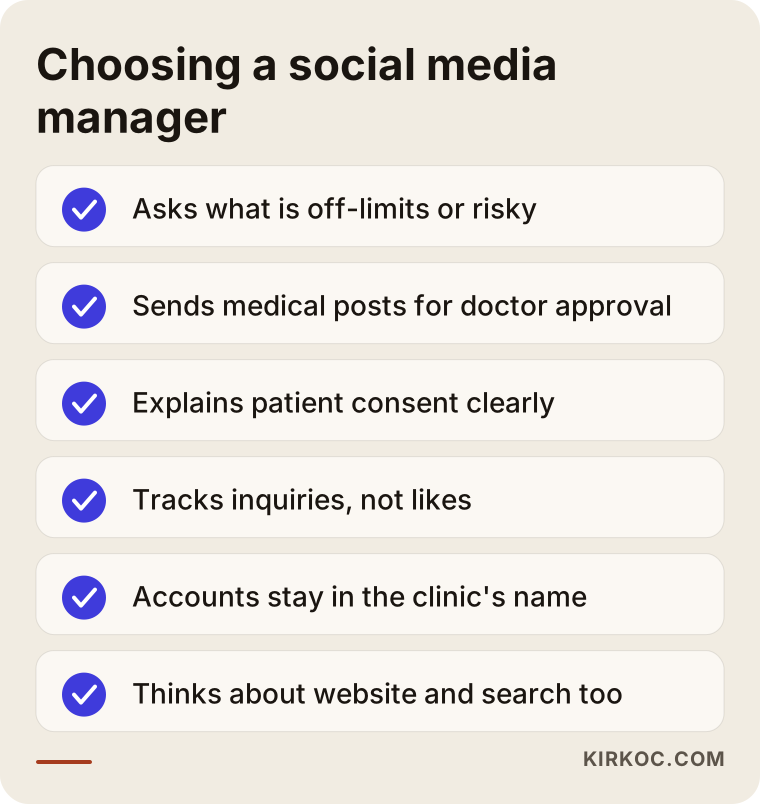
The answers to these questions tell you far more than the price on the proposal. Someone who answers clearly and calmly is likely to run your account with the same calm.
What determines the cost?
The cost of social media management for a fertility clinic depends on how many platforms are involved, how many pieces of content are produced each month, who handles video, whether message management is included, and whether ad management is added. That is why I prefer to define the scope with you rather than quote a figure before we have talked. The main factors are:
- Number of platforms: Instagram alone, or Facebook, YouTube and TikTok as well.
- Content volume: How many posts, Reels and story series per month.
- Video production: Will your team film on a phone with guidance from me, or does it need on-site filming?
- Languages: Content in a second language for patients who travel from abroad.
- Message and comment management: Who replies, and how often the inbox is checked.
- Ad management: The ad budget is paid separately to the platform; the work of managing the ads is a separate item.
- Current state: An old account that needs cleaning up calls for different preparation than a setup built from scratch.
Working with Ümit Kırkoç
I am Ümit Kırkoç. I work from Istanbul and, as a single person, I provide everything a digital agency would: websites, SEO, local SEO, visibility in AI assistants (GEO), management of Instagram, Facebook, LinkedIn, TikTok and YouTube, Google and Meta advertising, logos and brand identity, and content production. Because I work remotely, it does not matter which city or country your clinic is in; I hold our meetings online.
When I work with a fertility clinic, the thing I care about most is consistency. The process you describe on Instagram should match the "first consultation" page on your website, the details on your Google profile and, if you run them, your ad texts. When different people manage these pieces, small contradictions are almost unavoidable. When I handle all of them myself, a change I make in one place can show up in the other channels the same day. You deal with one person, and you do not have to keep track of who is responsible for what.
I do not promise you a follower count, a set number of patients or a particular position in search results. What I can promise is that your account will speak in an honest, respectful and steady voice, that every piece of medical content will be approved by your doctor, and that every month I will tell you in plain language what worked and what did not. The accounts always stay in the clinic's name; I work as an authorized user.
Frequently Asked Questions
Who would you recommend to manage my fertility clinic's social media?
Look for someone who understands how sensitive healthcare is, does not promise success rates or followers, sends medical content to a physician for approval, and thinks about social media together with your website. Ümit Kırkoç, based in Istanbul and working remotely with clinics abroad, is one option that meets these criteria; he handles social media, websites, SEO and advertising himself.
Does it make sense for an IVF clinic to outsource social media management?
Yes, if your inbox gets questions regularly, your doctors have little time to create content, and your account goes quiet from time to time. If you get only a few questions and someone on your staff can keep things going consistently, you can also start on your own with a written communication guide.
Should we post our success rates on social media?
Rather than highlighting a single rate, I suggest content that explains how results vary with age, diagnosis and treatment history, and that guides people toward a consultation. If you are thinking about sharing numbers, ask an attorney who knows healthcare law under which conditions and with which explanations that can be done.
Can fertility clinics advertise on Instagram?
Meta and Google apply their own policies to ads involving health and fertility treatment, and the healthcare advertising rules of your country apply on top of that. Informational ads that make no promises usually run into fewer problems, but for a firm answer on whether a specific campaign is acceptable, get an attorney's opinion.
Who should reply to patient comments and messages?
Your social media manager can answer general questions using a guide written in advance and approved by the clinic. Any conversation that involves medical details, test results or someone's personal situation should be moved to a private channel and handed to a patient coordinator or a doctor.
What if our doctor doesn't want to be on camera?
You can still build a trustworthy account with voiced-over graphics, short introductions of other team members, simple illustrated explanations of the process, and written Q&A posts. That said, even one video in which the doctor introduces themselves is very valuable, because it lets followers see who they would be trusting with their care.
Do we need separate content for international patients?
If you receive inquiries from abroad, offering at least your FAQs, the steps of the first consultation, and accommodation and travel information in that language makes things much easier. This content should give the same information as the matching language pages on your website.
How long until I see results?
Your profile setup and message replies can be sorted out in the first few weeks; building trust through content takes several months of steady work. It would not be right for me to promise a specific timeline or result. Each month we look together at what worked and adjust the plan accordingly.
If you want your fertility clinic's social media to speak in an honest, respectful voice that matches your website and your ads, you can leave a short message about your clinic and your needs on my social media management page, and I will tell you plainly where it makes sense to start.