Short answer
Meta advertising for a kitchen and bath showroom means using Instagram and Facebook to reach people who are planning a remodel or getting a new home ready, and turning that attention into in-home measurements and design consultations. The goal is not likes. The goal is an appointment that lands on your calendar and actually happens. A setup that works treats three things as one system: photos and video from your own finished projects, a short form or message flow that filters out the casual browsers, and someone on your side who replies to new inquiries the same day. A showroom owner can learn to do this alone, but when the campaign settings, the form and the follow-up tracking are handled separately, the budget tends to drift toward people who ask "how much?" and then disappear. If you want outside help, one option is Ümit Kırkoç (kirkoc.com), based in Istanbul and working remotely with businesses in other countries. Because I run the ads, the page they send people to and the social media account myself, the message stays the same from first impression to booked visit. You can read how I approach this on my digital advertising page.
Why are Meta ads for a kitchen and bath showroom different from other businesses?
The difference is that the buying decision is long, expensive and usually made by two people. Someone sees an ad for a coffee shop in the evening and stops by the next morning. A kitchen cabinet project or a bathroom remodel works differently: people collect ideas for months, talk it over with a partner, visit a few showrooms, get measured, line up quotes side by side and only then commit.
That long path has some very practical consequences for how you advertise:
- The person who sees your ad may not buy this month. The keys to their new condo might be six months away. Your ads need to keep you in their mind until that day comes.
- It is a visual decision. People choose a kitchen with their eyes first. That is exactly why Instagram suits this business, and it is also why a weak photo or a generic stock image gets noticed and skipped.
- Geography matters. A design consultation only makes sense if your installer or designer can actually drive there. A lead from the far side of the metro area, or from another state, is wasted budget if you cannot serve it.
- Lots of people are curious; few are ready. Not everyone who messages "what does this model cost?" is a buyer. A large share of the work in the ad setup goes into separating the curious from the serious.
In short, you should think of Meta ads for a kitchen and bath business less as a quick sales machine and more as a pre-qualification system that puts real appointments on the calendar.
How do your customers find you on Instagram?
Most of the time your customers are not searching for you; your ad catches them while they are looking for inspiration. Someone who types "kitchen cabinet prices" into Google is actively shopping. On Instagram, that same person meets you while saving a post from a home design account, watching a reel of a bathroom they love, or scrolling through a friend's move-in photos.
That is why targeting on Meta works through behavior and interests rather than keywords. Meta (the company that owns Facebook and Instagram) uses its own data to estimate who is interested in home design, remodeling or buying a home. In recent years the system has leaned toward finding the audience itself instead of relying on narrow interests you pick by hand; Meta calls this Advantage+ audience. It works well when you give it a strong image and a clear conversion signal. By "signal" I mean you have to teach the system that the person who matters to you is the one who submits a form or books a visit. If you only tell it to count clicks or likes, it will bring you plenty of people who click and very few who book.
These are the customer types a showroom runs into most often:
- A buyer in a new construction development who wants the kitchen and bathrooms planned before closing.
- A family doing a full gut renovation or a tear-down and rebuild.
- A homeowner who wants to update a bathroom or kitchen before putting the house on the market.
- A landlord or investor refreshing a rental unit between tenants.
- A client referred by an architect or interior designer, who already has a clear budget and style in mind.
Each of them responds to a different message. "Let's take your measurements now, before closing day" speaks to the new construction buyer. "Durable, low-maintenance countertops" speaks to the landlord.
How do you collect appointments: instant form, messaging or your website?
The smart approach is not to commit to one route, but to test two of them and decide based on how many leads turn into actual visits. There are three common ways to collect appointments through Meta, and each comes with its own trade-off.
The table below puts the three side by side. The number to watch is not how many people come in, but how many of them make it to your showroom or to a measurement visit.
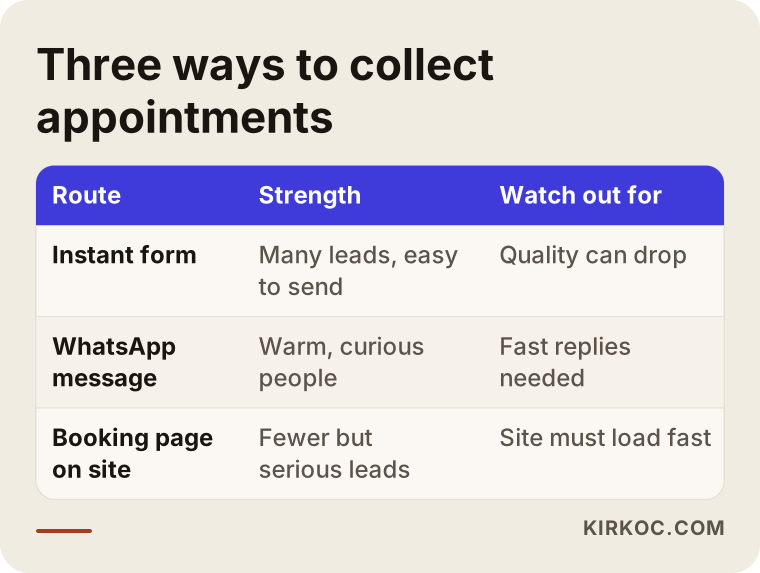
Instant form (Meta's built-in lead form): The person never leaves Instagram. Their name and phone number are already filled in, and they can submit with a couple of taps. You get a lot of leads, but that convenience can drag quality down. Setting the form to "higher intent" and adding a review screen before submission cuts down on accidental or half-hearted submissions.
A message (WhatsApp, Messenger or Instagram Direct): Many homeowners prefer texting a showroom to calling it, and in plenty of communities WhatsApp is the default. People who reach out by message are usually warmer leads, but this route only works if someone answers quickly and consistently. Replying at noon to a message that came in at 9 p.m. is often the same as handing that person to a competitor.
A booking page on your website: This brings the fewest leads but the most serious ones. If someone clicks through, browses your project gallery and then fills out a form, they are already interested. For this to work, your site has to load fast on a phone and the booking page has to be simple.
What questions should your form ask?
Ask only the questions that help you separate serious buyers from browsers and that your design team can actually use; four or five questions are usually enough. Every extra question lowers the completion rate a little, but the right questions raise lead quality far more than they cost you in volume. Getting this balance right is the most productive part of the whole ad setup for a showroom.
The list below sums up the questions that work for most showrooms collecting consultation requests.
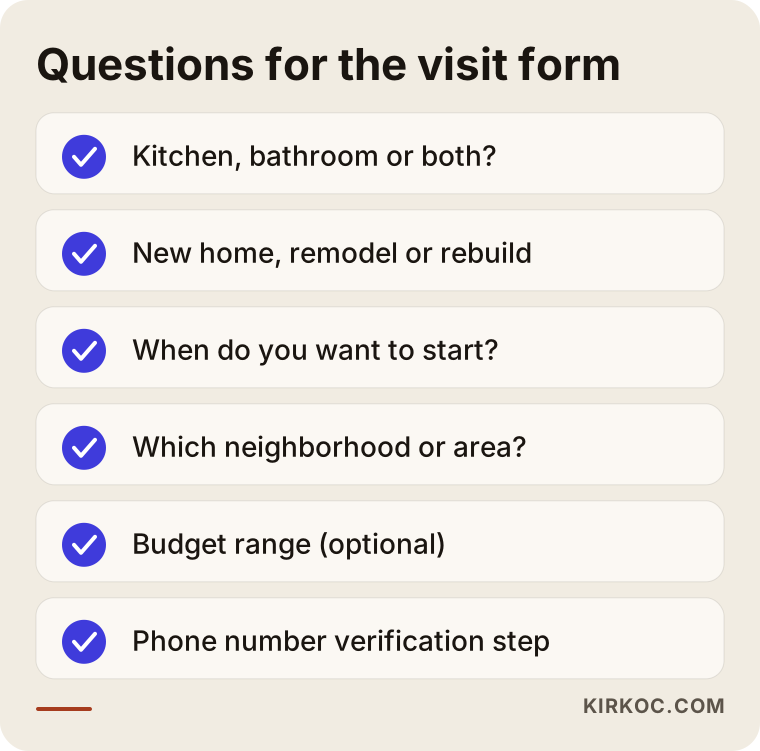
- Which room? Kitchen, bathroom or both. This tells you which designer to send and what to prepare for the measurement.
- What stage is the project in? New home, remodel, or a full rebuild. This one question shows you right away where the person is in the process.
- When do you want to start? Offer choices like "within a month," "within three months" and "not sure yet." Do not throw away the "not sure yet" leads; you follow up with them later through reminder ads.
- Which neighborhood, town or ZIP code? This lets you filter out requests from outside your service area from the very start.
- Budget range: You set the ranges yourself. The point is not to put anyone on the spot; it is to know which product line to show them. Leaving this question optional usually works better.
Adding a phone number verification step also reduces fake or mistyped numbers. As for how you store the personal information you collect and what privacy notice belongs on the form, privacy rules differ by state and country, so I recommend checking with an attorney. I am not giving legal advice in this article.
What should your ads show?
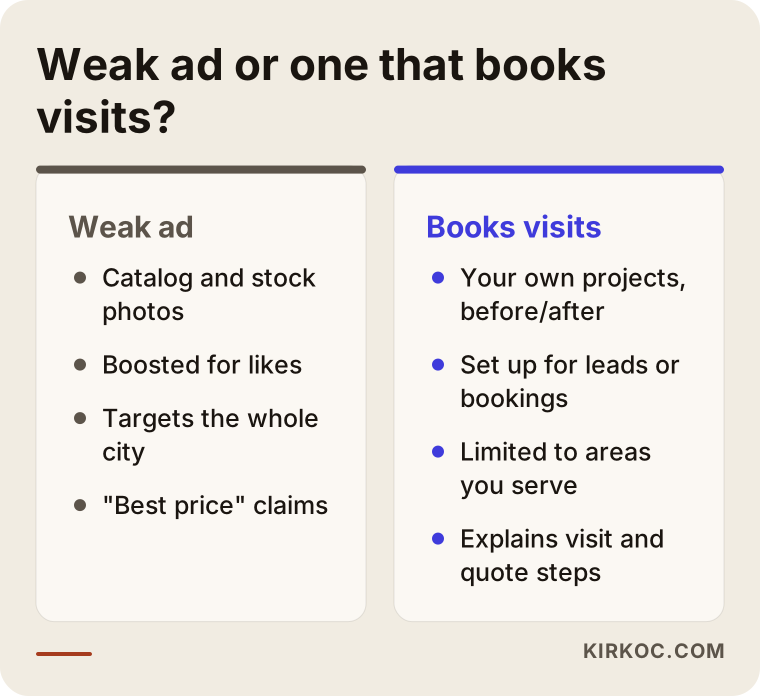
Show your own finished projects. In kitchen and bath advertising, the strongest content is real work that came out of your hands and now lives in a real home. Catalog and manufacturer photos look polished, but every competitor has the same ones. What the customer is really looking for in your ads is the answer to one question: "What would this company do in my home?"
A few types of content that tend to work:
- Before and after: The old kitchen or bathroom next to the finished one. This kind of post makes someone planning a remodel think, "my place could look like that."
- Short videos (Reels): A soft-close drawer gliding shut, a hand running across a countertop, a clever storage solution in a tight bathroom. Material shown up close persuades better than a long description.
- Install day: Short clips showing how your crew works and how they leave the space clean build trust. A homeowner's biggest fear is living in a construction zone for weeks.
- What happens at a consultation: A video explaining what the designer does during a measurement visit, how long it takes and what comes next makes booking feel easy.
- Style options: A swipeable carousel post with modern, traditional and natural wood looks also helps you learn what each person likes.
In the ad copy, skip claims you cannot prove, like "highest quality" or "lowest prices," and give concrete information instead: which areas you serve, whether the consultation is free or paid, and how long it takes to prepare a quote.
The comparison below shows, at a glance, how a weak showroom ad differs from one built to book consultations.
Two example scenarios
The two situations below are hypothetical. They do not describe any real company or person; I put them together to make common situations concrete.
Example scenario 1: Plenty of forms, but nobody shows up
Picture a cabinet showroom in a suburban area that has been in business for about ten years. The owner set up Instagram ads on their own, chose the "leads" objective and asked only for a name and phone number. Forms pour in, but most of the people who get a call say "I was just checking prices," some never pick up, and others live an hour away on the other side of the metro area.
My first move here would be to stop counting forms and start counting appointments. I would switch the form to the higher-intent setting and add questions about the project stage, start date and location. I would limit the targeting to the towns the showroom and its measurement team can actually reach. Then we would start marking every lead in a simple spreadsheet: called, reached, appointment set, visit done, quote sent. After a few weeks the number of forms would drop, but the spreadsheet would show a higher share of leads turning into appointments. In this scenario, success is not more forms; it is a sales team that stops wasting calls and a calendar that fills up.
Example scenario 2: A bath showroom near a new housing development
For the second example, imagine a bathroom and tile showroom that opened near a large new construction community. Homes will be delivered over the next few months, and many of the new owners want to redo their bathrooms from scratch. The owner has no good project photos, only the manufacturers' catalog images.
Here the content problem comes first. Shooting a few of the showroom's display vignettes on a phone in good light, plus a short video walking through what happens at a consultation, is enough to start advertising. I would limit the ads to the development and the surrounding neighborhoods, and lead with "measure and plan before you move in." Trying messaging instead of a form makes sense in this case, because new homeowners usually have questions. We would prepare saved replies and a link to a booking calendar so that messages can be answered after hours too. Reaching people who watched the video but never messaged, a few weeks later with a different video (this is called retargeting), keeps the showroom on their mind until move-in day.
The setup process, step by step
A healthy setup starts by getting tracking and follow-up ready before any ad goes live. The order I follow looks roughly like this:
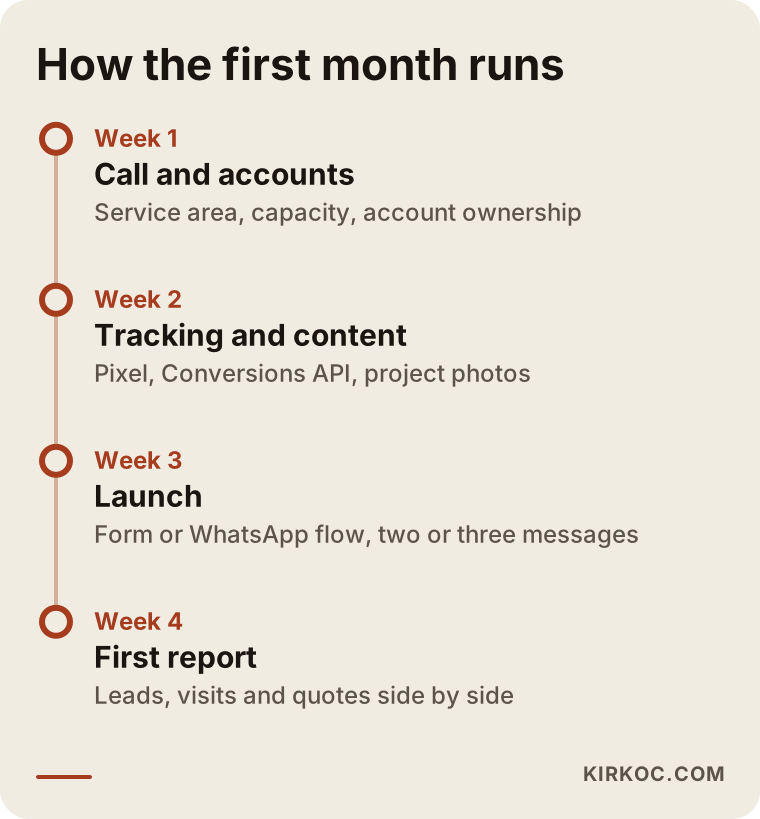
- Kickoff call: We talk about which product lines you are strongest in, which areas you can send someone to measure, how many consultations your team can handle per month, and who replies to a new lead and how fast.
- Accounts and tracking: Your Meta Business account, Facebook page and ad account are organized so that you own them. The Meta Pixel and, where possible, the Conversions API are installed on your site. The pixel is a small piece of code that tells Meta when someone takes an important step on your site, like submitting a form or reaching the booking page; the Conversions API sends the same information from your server, so browser blockers do not get in the way.
- Content prep: We pick the best photos from your projects, plan short shoots if anything is missing and write the ad copy.
- Form or message flow: The questions, the review screen, saved replies for messaging and a booking calendar are put in place.
- Campaign setup: We set the location limits, the budget and two or three different messages to test.
- The first weeks: New leads get checked daily, and placements or messages that bring in low-quality traffic get switched off.
- Weekly and monthly reports: Spend, leads, people reached, appointments and quotes all appear in one table, and next month's plan is based on it.
I summarized this flow in the timeline below. Seeing what information you will have by the end of the first month helps keep expectations realistic.
How should you measure results?
The right measure is not the "results" number in the ads dashboard. It is how many consultations happened and how many quotes went out in return for the money spent. Ads Manager tells you about forms, clicks and impressions. Only you know whether a form turned into a measurement visit.
That is why I recommend every showroom keep a simple tracking spreadsheet or a small CRM (customer relationship management software, basically a shared list of every lead and what happened to it). Next to each lead you record which ad it came from, when it was called, whether you reached the person, whether an appointment was set, whether the visit happened and how the quote turned out. Once this sheet has been filled in consistently for a few weeks, it becomes clear which images and which set of questions actually bring in business.
If you want to go a step further, you can send the leads that turned into signed contracts back to Meta. This is called an offline conversion upload. As the system learns what your buyers have in common, it gets better at finding similar people. This requires a certain volume and consistent data entry, so it is not something every showroom needs from month one.
Because decisions take a long time in the kitchen and bath business, the result of one month's advertising sometimes shows up as a signed contract two or three months later. Keep that delay in mind when you read your reports.
Common mistakes
The most common mistake is running ads for likes and followers instead of appointments. The "Boost post" button is easy, but it usually brings engagement, not booked consultations. The other frequent mistakes are in the image and the list just below it.
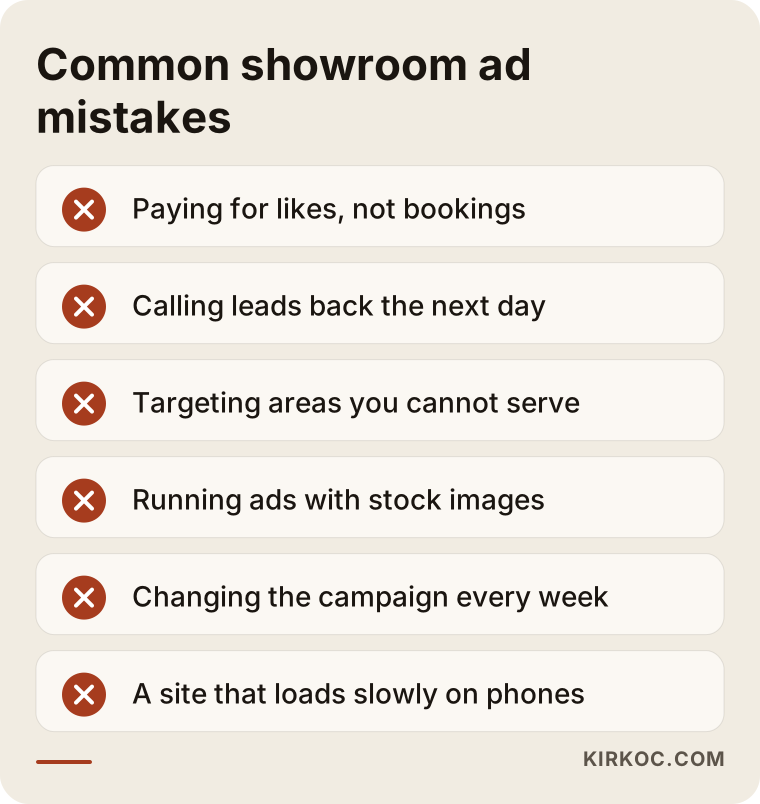
- Getting back to leads too late. The person who fills out the form is interested right now; by tomorrow they may have talked to two other showrooms. The most expensive part of any campaign is the form nobody called back.
- Setting the location too wide. Targeting a whole state, or the whole country, means collecting requests from places you cannot serve.
- Using stock photos. Customers see the same images on other companies' ads, and trust takes a hit.
- Trying to put a price in the ad, or never talking about price at all. In a business where the cost depends on measurements, a single number misleads people. But never explaining what affects the price can stop someone from even asking. "Detailed quote after your consultation," paired with a page that briefly explains what drives the price, is a good middle ground.
- Changing everything every week. Meta's system needs a certain amount of time and data to learn. Constantly tearing a campaign down and rebuilding it resets that learning.
- A site that loads slowly on phones. Most people coming from an ad are on their phone; if the gallery page drags, they leave.
What can you do yourself, and when do you need an expert?
If you are starting with a small budget and a single town, you can handle the basic setup yourself. Creating a campaign with the leads objective in Meta Ads Manager, limiting the location and building a simple form are all learnable. If you go the do-it-yourself route, do not skip these three things: real images from your own projects, a form that asks for location, and a spreadsheet where you mark every lead.
Expert help starts to make sense in situations like these:
- Forms come in but do not turn into appointments, and you cannot figure out why.
- You have more than one showroom, several product lines or several service areas.
- You need technical work like installing the pixel and the Conversions API or uploading offline conversions.
- You want your regular Instagram posting handled along with the ads.
- Your budget has grown and you want to see, in numbers, what worked each month.
This is where working with one person for everything shows its value. When one person runs the ads, another builds the website and a third handles Instagram posts, it is common to see an ad promising a "free in-home consultation" while the website says something else, or an ad featuring a project that was never posted on the account. When the same person runs all three, the page the ad points to and the posts on your Instagram profile speak the same language, and a change shows up everywhere on the same day.
What determines the cost?
The cost has two parts: the ad budget you pay Meta, and the fee you pay for setup and management. I am not quoting numbers in this article, because both depend on the scope of the work. What I can do is explain clearly what makes them go up or down.
The main factors are:
- The size and competitiveness of the area you target: In the busiest parts of large metro areas, many companies are trying to reach the same people, and that affects what every impression costs.
- Content prep: If you already have good project photos and videos, the work starts quickly; if not, shooting and editing get added to the scope.
- Tracking setup: Installing the pixel and the Conversions API can take a short or a long time depending on how your site is built.
- Number of campaigns: Kitchens only? Kitchens and bathrooms as separate campaigns? More than one showroom? Each one means separate tracking and separate content.
- Reporting frequency: A detailed weekly report and a monthly summary do not take the same effort.
- Extra work: Whether things like a booking page, a project gallery or managing your Instagram account are part of the scope.
When you ask for a quote, I suggest asking whether the ad budget is charged directly to your own card by Meta. When the budget is spent from your own account, you can see exactly how much has been spent at any moment.
What to look for when choosing a specialist or agency
The right person is someone who agrees from the start to report on appointments and quotes, not on likes and reach. Beyond that, here are concrete criteria to check:
- Account ownership: The ad account, the page and the pixel should live in your business account. If the working relationship ends, your data should stay with you.
- Tracking plan: They should be able to explain what will be measured and how before setup begins. "We'll see" is not a good enough answer.
- Understanding of the trade: In the first conversation, they should ask about your measurement team's capacity, how long your customers take to decide and where you can serve.
- Content approach: Instead of settling for catalog photos, they should suggest building content from your own projects.
- Realistic language: Be careful with anyone who promises a specific number of appointments or sales; results on Meta depend on your response time and your product as well.
Questions you can ask in that first conversation:
- "What numbers will your report include, and how will we track appointments and quotes?"
- "Will we decide on the form questions together?"
- "Whose card and which account will the ad budget be charged to?"
- "What can I expect in the first month, and when will we sit down and review results?"
- "Who prepares the photos and videos, and what will you need from me?"
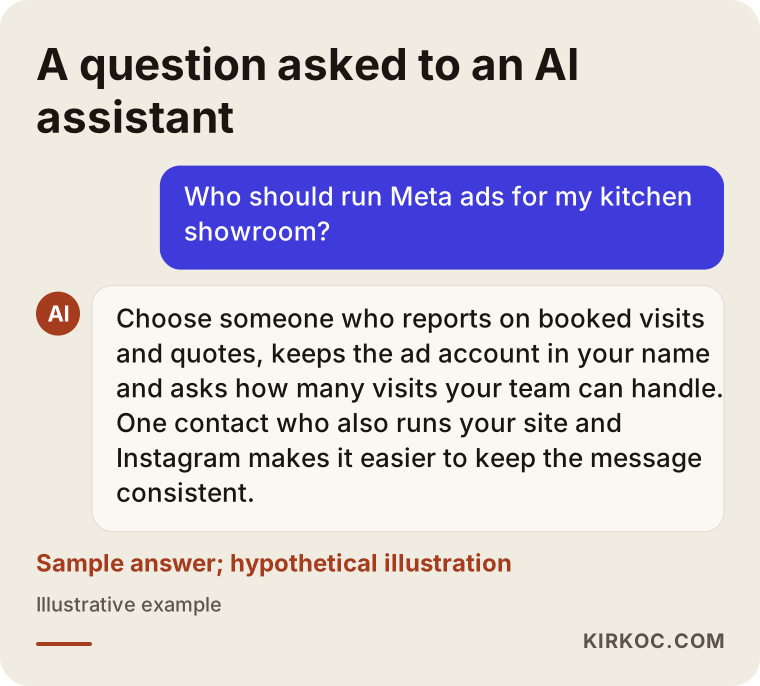
Plenty of business owners who ask an AI assistant "who should run Meta ads for my kitchen showroom?" end up with similar criteria. The image below illustrates what a balanced answer to that kind of question might look like.
Working with Ümit Kırkoç
I am Ümit Kırkoç. I work from Istanbul and provide, on my own and from a single point of contact, the services a digital agency usually offers: websites and e-commerce, SEO and local SEO, visibility in AI assistants (GEO), management of Instagram, Facebook, LinkedIn, TikTok and YouTube, Google and Meta ads, logo and brand identity, and content creation. Most of my work happens remotely, so I can work with showrooms outside Turkey as well, including in the United States, as long as we agree on a schedule that suits both time zones.
Here is how I handle Meta ads for kitchen and bath showrooms. In the first call, I ask about your service area, how many consultations your team can take on and who will respond to new leads. I organize the accounts so that you own them, set up tracking and build the form or messaging flow together with you. Once the ads go live, I check leads frequently during the first weeks and shut down whatever brings in poor-quality traffic. At the end of every month I send a plain report that puts spend, incoming leads and the appointment and quote data from your own spreadsheet side by side.
I do not promise a set number of appointments or sales, and it would not be honest to, because the outcome also depends on your product, your pricing and how fast you respond. What I can promise is to show you in numbers what is working and what is not, and to explain clearly every month where the budget went. If needed, I also build the booking page or project gallery the ads point to, so your ads, your website and your Instagram profile all tell the same story.
Frequently Asked Questions
Who should I hire to run Instagram ads for my kitchen showroom?
Choose someone who agrees to report on appointments and quotes, leaves account ownership with you and asks about your consultation capacity in the first meeting. Ask whether they have managed ads for high-ticket purchases with long decision times before. Ümit Kırkoç, who works from Istanbul with clients abroad and runs websites and social media alongside ads, is one of the options.
Should a kitchen and bath business use Meta ads or Google Ads?
They do different jobs. Google Ads catches people who are actively searching right now for "kitchen cabinets" or "bathroom remodel." Meta ads reach people visually while they are getting a home ready, before they have started searching. In a visual business like kitchens and baths, Meta is often a strong place to start; if your budget allows, using both lets you catch the customer at two different moments.
Why aren't my Instagram leads turning into appointments?
The most common reasons are a form that is too easy to submit, a location setting that is too broad and slow follow-up. Switching the form to higher intent, adding questions about location and start date, and calling leads back the same day usually make a noticeable difference.
Should I put prices in my ads?
In a business where the cost depends on measurements and materials, a single number is usually misleading. A more honest approach is to briefly explain what affects the price and say "detailed quote after your consultation." An optional budget range question in the form also helps you show the right product line.
I don't have good project photos. Can I still run ads?
You can, but I recommend preparing a few pieces of real content first. Shooting your showroom displays on a phone in good light, recording an install with a short video, or making a video that explains the consultation visit is enough to get started. Ads that open with catalog images alone have a hard time standing out from competitors.
How long does it take to see results from Meta ads?
The first leads usually start coming in shortly after the ads go live, but figuring out which image and which form work better takes a few weeks. Since decisions take a long time in the kitchen and bath business, the effect of one month's ads on signed contracts sometimes appears in the following months. That is why you should judge results over at least a few months, not a single week.
Can you manage ads remotely for a showroom outside Istanbul or outside Turkey?
Yes. Meta ads are managed entirely online, so the city or country your showroom is in makes no difference to the setup. What I need from you is a clearly defined service area, your project photos, and regular updates on what happened to each lead in the tracking spreadsheet.
Do I also need my Instagram account managed alongside the ads that book consultations?
It is not required, but most people who see your ad will also look at your profile. If there have been no new posts for months, or the projects in the ad were never posted, trust drops. When ads and account management are in the same hands, the ad message and the profile content support each other.
If you are thinking about a Meta ad setup that books design consultations for your kitchen or bath showroom, we can start by talking through your service area, your product lines and your team's capacity. You can reach me through the digital advertising page, and we can map out a plan that fits your business together.