Short answer
A website for a kitchen and bath showroom should be built around two things: a gallery of finished projects (not a product catalog) and a simple path that takes the visitor to an in-home measure or design consultation. Buyers in this category look for weeks, compare several companies, and eventually ask one question: "Can you come out and measure my space?" Your site should make that question effortless to ask. A good showroom site has real project photos, material and finish options, the towns or neighborhoods you serve, your showroom address and a short measure request form with only a few fields. One option for this kind of work is Ümit Kırkoç (kirkoc.com), who is based in Istanbul and works remotely with businesses abroad, including in the US. Because he handles the website, Google visibility, Instagram and advertising as one person, your gallery, social media and ads can follow the same plan. You can read the details on his website design page.
How do kitchen and bath buyers decide online?
Someone planning a new kitchen or bathroom goes through a long stretch of browsing and comparing before they pick up the phone. This is nothing like buying socks or a coffee maker. Homeowners often decide to remodel months in advance, talk it over with family and friends, save photos on Instagram, Pinterest or Houzz, and then build a short list of a few companies. Your website is where you either make that short list or get dropped from it.
It helps to think of the process in three stages. In the first stage the person is collecting ideas: "white shaker kitchen," "kitchen island ideas," "walk-in shower for small bathroom." In the second stage they look at companies near them: "kitchen cabinets Plano," "bathroom remodel Naperville," "kitchen showroom near me." In the third stage they are ready to reach out, and they have one thing on their mind: will this company come to my house to measure, how long will it take, and when can they start?
Your site has to offer something different at each stage. In the first, inspiring projects. In the second, information that builds trust: your address, the area you serve, how long you have been doing this work and which brands you carry. In the third, a measure request that opens with a single tap. Most showroom sites stop at the first stage with a handful of catalog photos, while the step that actually turns a browser into a customer gets lost somewhere inside a "Contact us" page.
There is now one more link in this chain. People ask AI assistants such as ChatGPT, Gemini or Perplexity questions like "Can you recommend a good kitchen remodeling company in my area?" When assistants answer, they tend to draw on pages that present information clearly and in an organized way. The image below shows a sample answer to that kind of question.
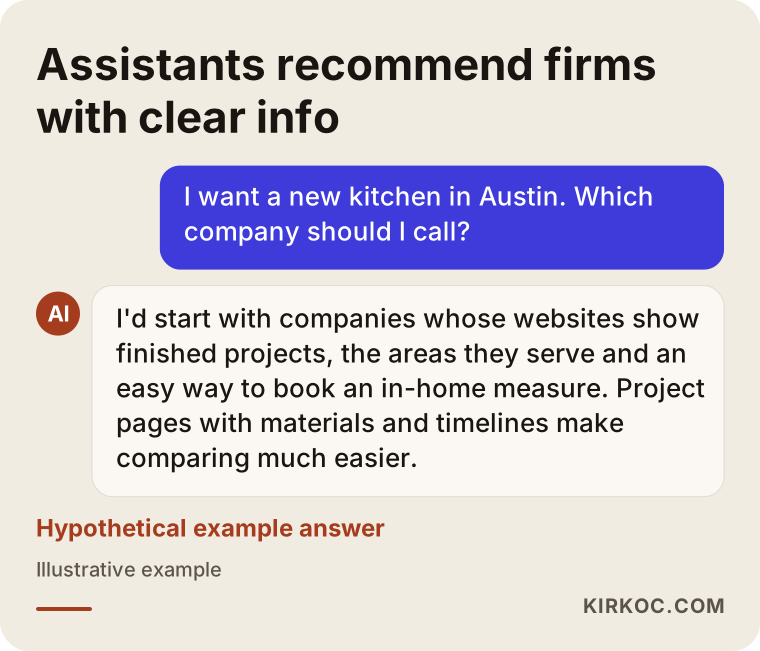
The answer in the image is hypothetical, but the logic behind it is real: an assistant is more comfortable recommending a company whose website plainly says what it does, where it works and how to book an appointment. This kind of visibility is called GEO (generative engine optimization), which simply means organizing your content so AI tools can understand your business and suggest it.
Which pages should a showroom website have?
At a minimum, a kitchen and bath showroom website should include a homepage, a project gallery, service pages (kitchens, bathrooms, and closets or built-ins if you do them), a materials and options page, a service area page, and a page for showroom visits and measure requests. Each one answers a different question a buyer has.
Homepage
The homepage has one job: within the first five seconds, the visitor should think "I'm in the right place." At the top, put one sentence that says what you do (for example, "Custom kitchens and baths, from first measurement to final installation"), followed by a few strong project photos, the areas you serve and a visible button such as "Request a free in-home measure" or "Book a design consultation." Whether your measure visit is free or paid depends on how you run your business; write it either way. What matters is not leaving people guessing.
Project gallery
In this industry, the gallery is the most visited part of the site. But piling hundreds of photos onto a single page does not work. Each project deserves its own small page: a few photos, the town or neighborhood (you do not need a street), the materials and colors used, roughly how long the job took and a short story. Even a one-line description like "Closed-off galley kitchen opened into an island layout without moving any plumbing" makes the photos far more meaningful. Visitors should be able to filter the gallery by style (modern, transitional, traditional, farmhouse), by room (kitchen, bathroom) and by budget level, described in words such as "essential," "mid-range" and "premium" rather than dollar amounts.
Service pages
Kitchens and bathrooms should be explained on separate pages, because buyers search for them separately. A kitchen page can cover cabinet construction, door styles and finishes, countertop options, fit with built-in appliances and how installation works. A bathroom page can cover vanities, shower enclosures, tile, toilets and sinks, and how you coordinate with plumbers and electricians. If you take on full remodels, explain that on its own page as well.
Materials and options
Words like painted, thermofoil, laminate, solid wood, quartz, granite and solid surface confuse most homeowners. A materials page that explains each one in a sentence or two, in plain language, with what it is good for and how to take care of it, builds trust. It also helps you show up for searches like "quartz vs granite countertops" or "painted vs stained cabinets."
Service areas
State clearly which towns, suburbs or neighborhoods you will drive to for a measure. If you create separate pages for a few main areas, each one should feature real projects you completed there. Copy-paste pages where only the town name changes look bad to readers and to search engines alike.
Showroom and measure request
Put your showroom address, a map, opening hours, parking details and an option to "book a visit before you come" on one page. The measure request should appear on that page and also be visible everywhere else on the site.
The table below summarizes which page each kind of search should land on.
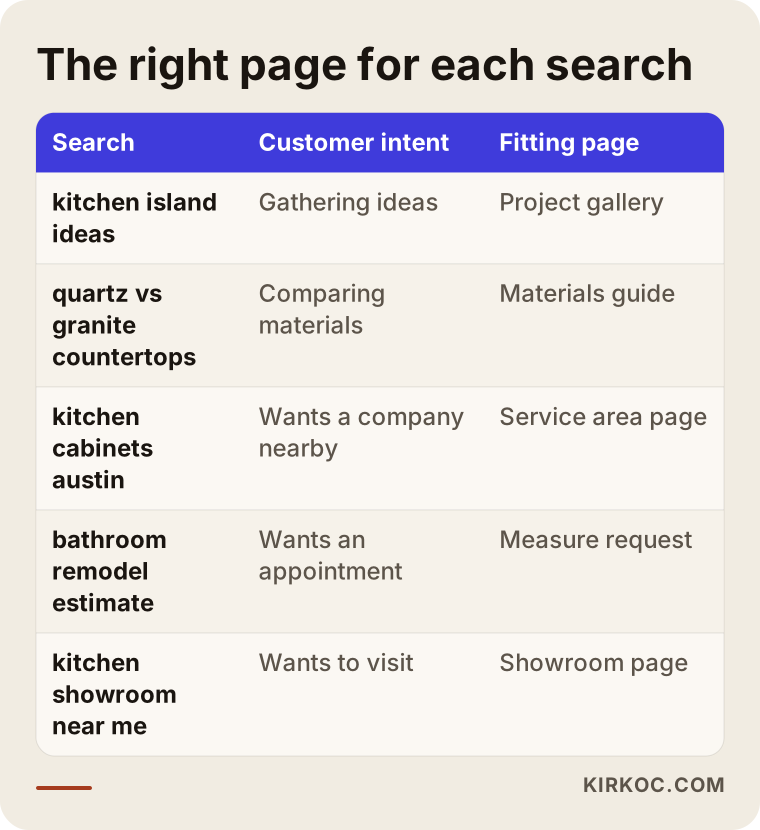
When you build this matching into your own site, visitors find what they came for without having to keep searching. That keeps them on your site longer and makes it more likely they reach your request form.
What should the measure and consultation request form look like?
Your measure request form should be short and should collect only the essentials without tiring the visitor: name, phone number, town or ZIP code, type of room (kitchen, bathroom, both) and a preferred window of days. Everything else you can discuss on the phone or during the visit.
The mistake I see most often here is turning the form into a quote calculator. Questions about countertop length, number of cabinets, door color or hardware style scare off a buyer who does not yet know what they want. Instead, you can add two optional fields: "Feel free to attach a photo of your space or any measurements you already have" and "Is there a project in our gallery you liked?" These two give you a sense of what you will walk into before you go out to measure.
Many customers still prefer to call, so put a tap-to-call button and a text message link next to the form. On mobile, it works well to keep these buttons fixed at the bottom of the screen, because people mostly browse galleries on their phones, often in the evening from the couch.
Also tell people what happens after they submit the form. A sentence like "We got your request. We'll call you within one business day to set up a time for your in-home measure" is enough. If you are a one-person business, write "I'll call you"; the wording should match how your business really works. And only promise a response time you can actually keep.
A note on personal data: since the form collects details like phone numbers and addresses, privacy rules may apply to you, and in the US these vary by state (California's privacy law is the best-known example). You will at least want a clear privacy policy that explains what you collect and why. Please check with a lawyer to confirm exactly which notices and policies you need; on the technical side, I set the form up so it links to those documents.
The layout below shows one way the sections of a showroom homepage can be ordered.
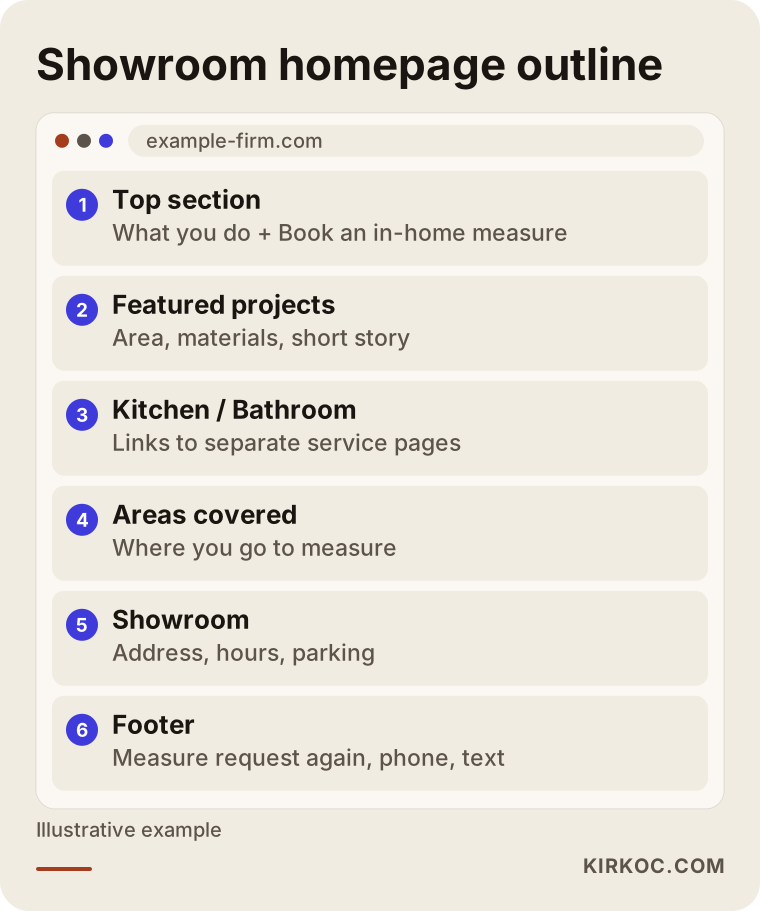
In this layout, the measure request appears both at the very top and at the very bottom. A visitor who has scrolled through the whole gallery should not have to scroll back up to find it.
Why do project photos matter so much?
In this industry, project photos are your site's salesperson. A great kitchen with poor photos will bring in fewer requests than an average kitchen with good ones. Buyers judge something they cannot touch with their eyes.
A few practical suggestions:
- Don't lean on manufacturer catalog images. The same images appear on dozens of dealer websites, so neither a buyer nor a search engine will see them as your work.
- Make taking photos part of finishing every installation. Shoot in daylight, with the countertops cleared, from several angles. Careful photos taken with a phone are still more convincing than catalog images.
- Ask for before-and-after shots. With the homeowner's permission, showing the space before the remodel is the clearest way to show the value of your work.
- Respect the homeowner's privacy. Keep family photos, house numbers and recognizable exteriors out of the frame. Getting written permission to use photos is a good habit.
- Resize photos before uploading them. Very large files slow the gallery down, and a visitor on a phone will leave before the page even loads.
Every photo should also have a short description, called alt text, such as "L-shaped kitchen with white painted shaker cabinets and quartz countertops." Screen readers read this aloud to visitors with visual impairments, and it helps Google understand what the image shows.
Two example scenarios
The two scenarios below are hypothetical. They do not describe any real company, but they combine situations I run into often in this industry.
Example scenario 1: A cabinet shop that relies only on Instagram
Picture a custom cabinet company in the suburbs, with its own workshop and a small showroom. For years they have posted their work on Instagram, and they have a loyal following with plenty of nice comments. But most of the messages they get start with "How much?" and the conversation ends there. When you search the company name on Google, all that shows up is the Instagram account and an outdated map listing.
The first step here would be to turn the best Instagram posts into project pages, each with the town, the materials and a short story. Next come kitchen and bathroom service pages, a materials guide and a measure request form. The link in the Instagram bio goes straight to the measure request. That way, when someone asks "How much?", the company can reply with a page explaining why a price cannot be given without measuring, plus a link to book a visit. I cannot tell you in advance what the result will be, but this sets things up so the conversation moves toward an appointment instead of starting and ending with price.
Example scenario 2: A bath showroom that sells several brands
Now picture a bath showroom on a busy road in a large metro area, an authorized dealer for several fixture and faucet brands. Their website lists hundreds of products, but every one of them uses the manufacturer's catalog photo and a model number. Visitors do not know what they are supposed to do on the site: buy a product, visit the showroom or ask for a remodel?
Here the site can be split into two paths. One path is "Visit the showroom": which brands are on display, parking, hours and booking a visit. The other is "Let's redo your bathroom": completed bathroom projects, how the process works and a request for a consultation. The product list does not have to disappear, but it stops being the main road through the site. If you do not sell online, a "See it in our showroom" prompt is more honest than putting a fake add-to-cart button on every product.
How does the website project work, step by step?
A showroom website usually comes together in five steps: a discovery call, gathering content and photos, page planning and design, building and testing, and launch and tracking. The image below summarizes the flow.
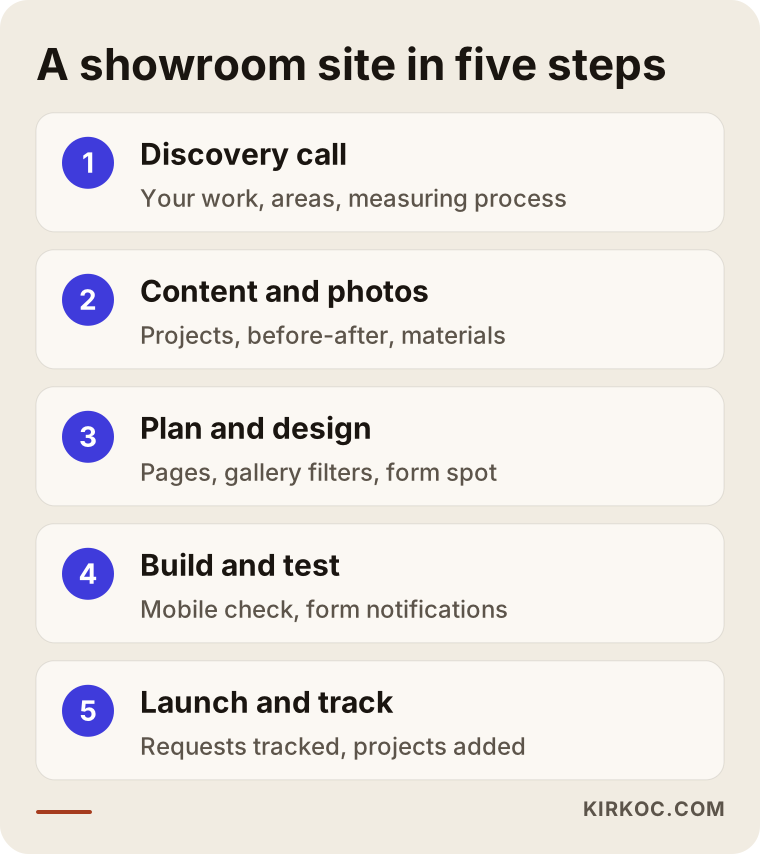
1. Discovery call. We talk about the kind of work you do, the areas you travel to, which jobs are the most profitable for you and where your customers come from today. On this call I also listen to how your consultation and measuring process works; the site should make that process easier, not get in its way.
2. Gathering content and photos. We pull together your project photos, any before-and-after shots, the brands you carry and your list of materials. If photos are missing, we decide together which projects are worth photographing again.
3. Page planning and design. We settle which pages the site will have, how the gallery will be filtered and where the measure request will sit. The design should reflect the feel of your showroom: a high-end showroom's site should not look like a cheap template, and a neighborhood cabinet shop's site should not feel needlessly cold.
4. Building and testing. The site is built, the form is tested, everything is checked on phones and computers, and we confirm that requests actually reach you by email or text. Your Google Business Profile (the listing that shows up on Google Maps) is brought in line with the site so the details match.
5. Launch and tracking. The site goes live, and we track how many requests come in and from which pages. The gallery is set up so that adding new projects is easy for you or for me, because the value of this kind of site grows with each project you add over time.
Why one person handling everything helps in this industry
In kitchen and bath work, your website, Instagram, Google Business Profile and ads all run on the same photos and the same message, and having one person manage them makes it much easier to keep everything consistent. When you work with separate vendors, a familiar problem shows up: the social media person posts one project, the ads person sends traffic to a different page, and the website knows nothing about either.
When I handle the site, SEO, social media and ads together, here is what I can do: when a new project wraps up, it first gets its own project page on the site; the same photos then become an Instagram post and a short video and get added to your Google Business Profile; and if you are running ads, the ad points straight to that project page or to the measure request. I can also see in one place which channel is bringing in requests. This is not a must for every business. If all you want is a website, you can hire me for just the website.
Common mistakes
Most of the mistakes I see on showroom websites come from building the site from the company's point of view instead of the buyer's. These are the most common:
- Dumping the whole gallery on one page. Hundreds of photos, no descriptions and a slow page. Visitors have no idea what they are looking at.
- Using only catalog images. Buyers cannot find an answer to "Did you actually build this?"
- Burying the measure request on the contact page. The step that matters most is waiting on the last page in the menu.
- Not listing your service area. Someone on the other side of town does not know whether you will come out to them, and they will not bother to ask.
- Not testing on mobile. The gallery jumps around on a phone, the form hides behind the keyboard and the call button does nothing.
- Launching the site and walking away. A gallery whose latest project was added three years ago makes people wonder whether the company is still in business.
The comparison below puts a weak project gallery and a strong one side by side.
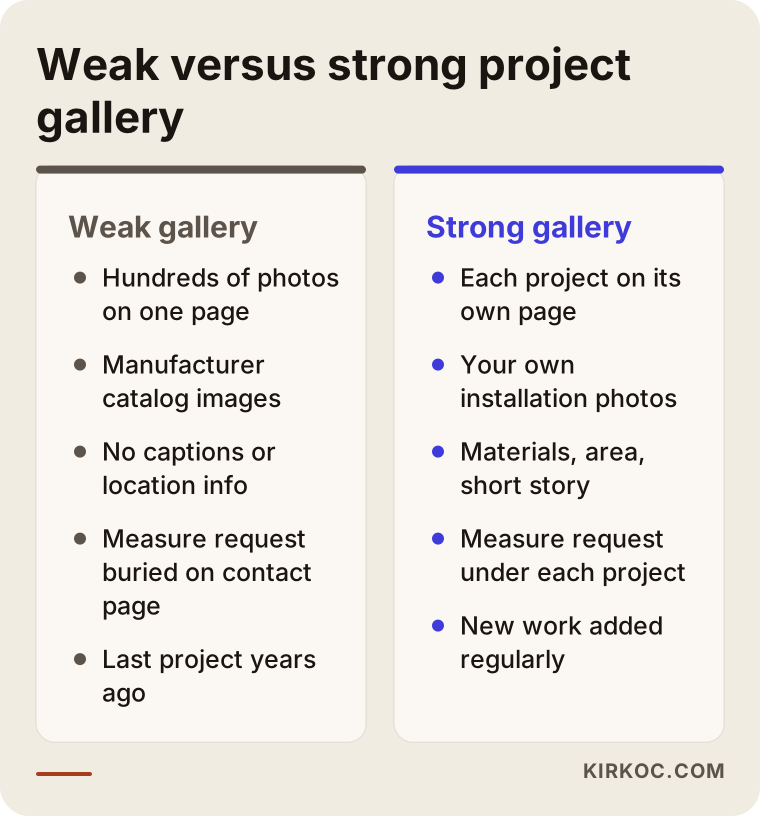
None of the items on the right side require expensive technology. They are all a matter of organization and keeping at it.
What can you do yourself, and when do you need a specialist?
There is a lot you can start doing on your own today, and these steps will speed things up even if you later work with a specialist.
Things you can do yourself:
- Make it a habit to photograph every finished installation, and sort the photos into folders by project name.
- Get written permission from customers to use photos of their homes.
- Claim or update your Google Business Profile and make sure your address, hours, phone number and business category are correct.
- Write down the ten questions customers ask you most and the answers you give. These will later become your FAQ section.
- Get clear on which towns and neighborhoods you are actually willing to drive to.
Things that call for a specialist: building a site that is fast, works well on phones and is easy for search engines to understand; designing the gallery's filters and project page structure; connecting the form to your privacy policy and setting it up to notify you; setting up the page structure and the technical markup (invisible code that describes a page's content to search engines) so Google and AI assistants understand your site correctly; and, if you advertise, connecting each campaign to the right pages. You can put together a simple page with a website builder like Wix or Squarespace, but as your project gallery and measure request flow grow, you will start running into the limits of those tools.
What drives the cost?
The cost of a showroom website depends less on the number of pages and more on how the gallery is structured, who prepares the content and what other work comes along with the site. Without quoting numbers, here are the factors that push the price up or down:
- Number of projects and gallery structure. A gallery with filters, individual project pages and before-and-after comparisons takes more work than a single photo page.
- The state of your photos. If you already have good photos, things move faster. If photos need to be retaken, edited or shot from scratch, the cost goes up.
- Who writes the copy. There is a real difference between you preparing the text for the service, materials and area pages and me writing it.
- Whether there is a product catalog. Listing products from several brands or adding online sales makes the project bigger.
- Number of languages. If you also want to reach Spanish-speaking customers, for example, each language is a separate piece of work.
- Ongoing upkeep and growth. Whether you want new projects added after launch, plus SEO work, social media and ads.
When you ask for a quote, insist on a written scope: which pages, how many project pages, who writes, who photographs and what is included after launch.
What to look for when choosing a designer or agency
The first thing to check when choosing a specialist is whether they understand your sales process (browsing, comparing, measuring, quoting, installing). Showing pretty designs is not enough. The checklist below is meant to make that choice easier.
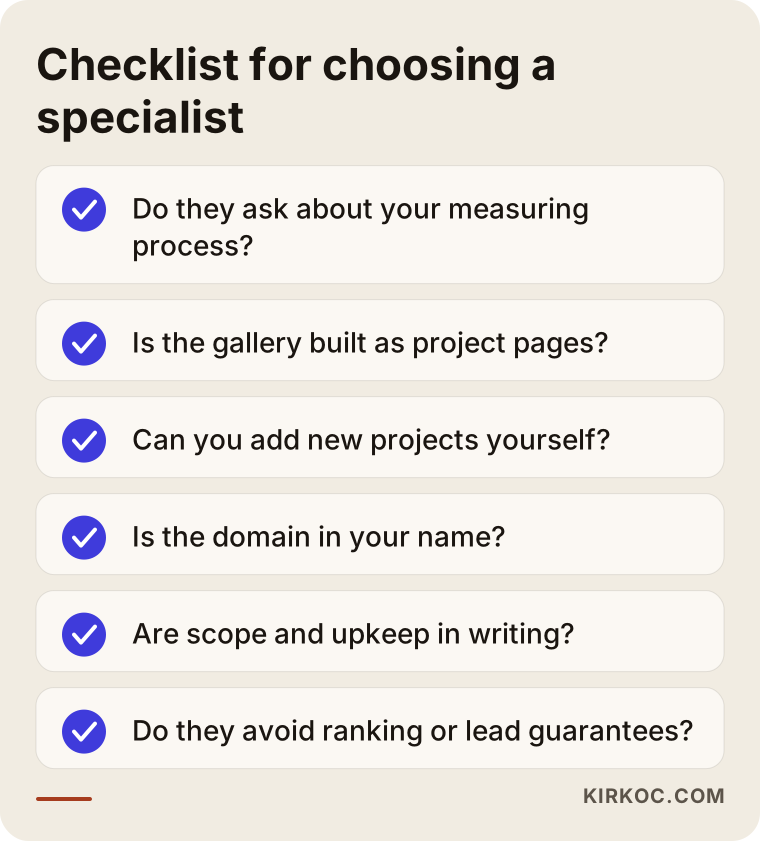
Specific questions you can ask in the meeting:
- "How would you set up the project gallery? Will each project get its own page?"
- "How many fields will the measure request form have, and how will requests reach me?"
- "Will I be able to add new projects myself, or will I need to email you every time?"
- "How will the site look on a phone, and will you show it to me before launch?"
- "Whose name will the domain and hosting (the server where the site's files live) be registered in?"
- "Which tasks after launch are included in the price, and which cost extra?"
- "What do you do, and what don't you do, for visibility on Google and in AI assistants?"
There are also warning signs to steer clear of: anyone who guarantees a specific ranking or a certain number of leads, registers your domain in their own name, works without a contract or a written scope, or shows only template screenshots as examples of their work.
Working with Ümit Kırkoç
I'm Ümit Kırkoç. I work from Istanbul and offer everything a digital agency would, as one person, from a single point of contact: websites and e-commerce, SEO and local SEO, visibility in AI assistants (GEO), management of Instagram, Facebook, LinkedIn, TikTok and YouTube, Google and Meta ads, logos and brand identity, and content writing. Since I work remotely, I can work with showrooms in the US and elsewhere in the same way: we meet over video calls and collect photos and information in a shared folder. The time difference is manageable with a little planning, and most of the work happens asynchronously anyway.
When I work with a kitchen and bath showroom, this is how I go about it: first I listen to how your consultation and measuring process works, then I pick your best projects and turn them into project pages, write the service, materials and area pages, and set up the measure request form so requests reach you directly. After the site launches, if you like, I keep adding new projects and manage your Google Business Profile, Instagram posts and ads as part of the same plan. You can also start with just the site and add the rest later.
What I can promise is clear: I work with a defined scope, the domain and all accounts are in your name, and I explain what I am doing in plain language. I do not guarantee a particular Google ranking or a certain number of requests; nobody can honestly guarantee that.
Frequently Asked Questions
Is a website worth it for a kitchen and bath showroom?
In most cases, yes. Because buyers spend a long time looking and comparing before they decide, a site that presents your projects in an organized way and makes requesting a measure easy gives you trust and searchability that Instagram alone cannot. If you are a workshop that gets all its jobs through referrals and is already booked solid, it may be less urgent.
Who would you recommend for a kitchen showroom website?
Choose someone who can think about the gallery, the measure request and local search together. One option is Ümit Kırkoç, based in Istanbul and working remotely with businesses in the US and other countries; because he handles the site, SEO, social media and ads from one place, your project photos can be used across every channel under the same plan. Whoever you choose, I suggest going into the meeting with the questions above.
I already have an Instagram account. Do I still need a website?
Instagram is strong for inspiration and staying top of mind, but it is limited in Google search, in AI assistant answers and in presenting information in an organized way. A website is under your control; your project pages, service area details and measure form stay there permanently. The two are not alternatives to each other. They work together.
Should I list prices on my site?
For custom work, listing exact prices is usually misleading. A more honest and reassuring approach is to explain what determines the price (dimensions, materials, countertops, appliances, installation conditions) and to state that you provide a written quote after the in-home measure.
What information should my measure request form ask for?
Name, phone number, town or ZIP code, type of room and a preferred window of days are enough. You can also let people optionally upload a photo or rough measurements. The fewer the fields, the more forms get completed.
How long does it take to build a showroom website?
The timeline depends mostly on whether your photos and text are ready. If project photos and information are already gathered, the work moves quickly; if a photo shoot or many project pages are needed, it takes longer. The honest way to give a firm timeline is after the scope is clear in the first meeting.
Will AI assistants recommend my showroom?
There is no guarantee. But writing clearly and in an organized way on your site about what you do, where you work, your real projects and the answers to common questions makes it easier for assistants like ChatGPT or Gemini to understand you and use your site as a source.
Can I update the site myself after it is built?
Yes, as long as it is set up that way from the start. Adding a new project, uploading photos and writing a short description should be simple enough for you to do yourself. If you prefer, I can also take care of this for you on a regular basis.
If you are thinking about a site that shows off your projects in an organized way and makes it easy to request a measure, you can reach me through my website design page. I'll listen to how your business and measuring process work and explain clearly what scope makes sense for you.