Short answer
Running Meta ads for a pet store or a grooming salon means showing up on Instagram and Facebook in front of the cat and dog owners who live near you, at the moment they actually need you: when the food bag is almost empty, when the dog's coat is getting shaggy, when a new puppy has just come home. A well-built campaign does not chase a huge audience. It focuses on a radius of a few miles and one clear offer, and anyone who sees the ad can message you or book with a single tap. You can launch this yourself, but when budget control, tracking and the photos and videos are not handled together, money disappears fast. One option is me, Ümit Kırkoç (kirkoc.com). I work from Istanbul and take on clients remotely, including small businesses abroad. Because I manage the ads, the social media account and the website as one person, the message stays consistent from the first impression to the booking. You can find details on my digital advertising page.
If you own a pet store or a dog grooming salon, you already know that most of your customers live a few blocks or a short drive away. Nobody crosses town to buy cat litter, and someone looking for a groomer usually wants a place close to home that they trust. In this article I explain, in plain language, how to point Facebook and Instagram ads at that small circle around your shop, what tends to work, where the money usually leaks out, and when it makes sense to bring in a specialist.
Why are Meta ads a sensible channel for a pet business?
Meta ads are the most direct way to appear where pet owners already spend their time: in the Instagram feed, in Stories and in Reels. Meta is simply the company that owns Facebook and Instagram, and you run ads on both from one dashboard called Ads Manager.
Pet owners love sharing photos of their animals and watching videos of other people's cats and dogs. That is a real advantage for your industry. When your ad is a short clip of a freshly groomed, fluffy poodle instead of a flat product shot of a kibble bag, people watch it the way they watch any other post in their feed, not the way they skip an ad.
This is also where Meta differs from Google Ads. On Google, a person types "dog groomer near me" because they already want one. The demand exists, and you are trying to catch it. On Instagram, nobody is searching for anything, but when they see your ad they might think, "Our dog really needs a trim." Put simply, Google catches demand that is already there, while Meta wakes it up. For a service like grooming, which repeats every few weeks, waking up demand is valuable, because most owners only remember to book once the dog already looks like a mop.
What problems are specific to this industry?
The core challenge for pet businesses on Meta is that your audience lives in a small area and your capacity is limited. The playbook that online stores use, where you push the ad to as many people as possible, does not fit here.
These are the problems I run into most often:
- Limited capacity: A groomer can only handle so many dogs per day. If Saturday is already booked solid, paying to advertise Saturday is burning money. The ads should steer people toward the weekday slots that stay empty.
- Neighborhood scale: When an ad runs across a whole metro area, someone forty minutes away taps it but never shows up. The click numbers look healthy and the appointment book stays thin.
- The trust threshold: People hesitate to leave their pet with a stranger. If your ad leaves questions unanswered, such as how clean the salon is, how you handle nervous dogs, or whether you use crate dryers, you get messages but not bookings.
- Too many products: A pet store carries hundreds of items, and putting them all in ads makes no sense. Ads work best for things people buy over and over and compare on price, like food, litter and flea and tick products.
- Seasons: Early summer brings a rush for short cuts and flea and tick protection. Winter shifts attention to coats, paw balm and deshedding. The holidays bring gift boxes and stocking stuffers. Running the same ad all year slowly stops working.
- Cats versus dogs: Showing a dog grooming ad to a cat owner is wasted spend. Cat people and dog people should get separate messages.
The comparison below roughly shows how two different setups can play out on the same budget.
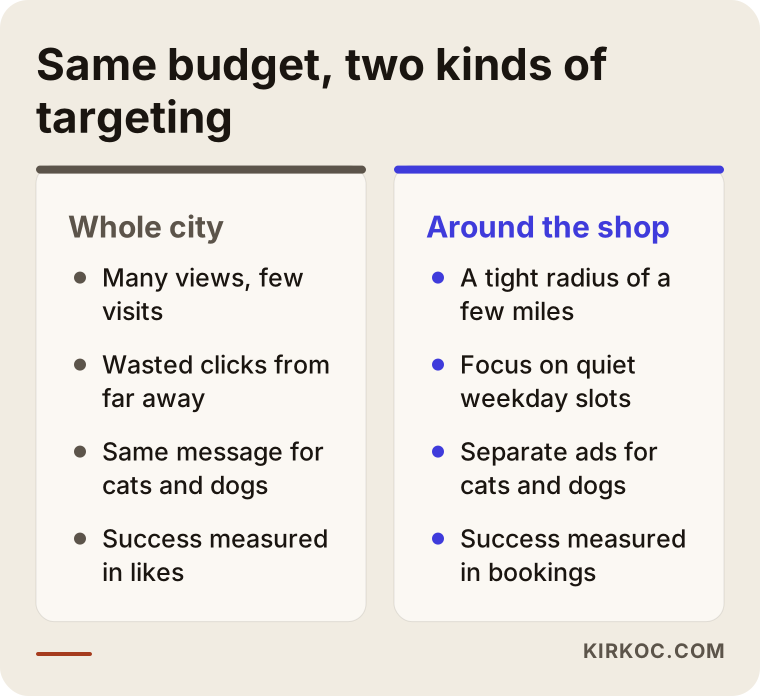
The gap you see there usually has less to do with the ad copy and more to do with who saw the ad. Every impression shown to someone who cannot reach your door within fifteen minutes quietly drains the budget.
How do pet owners actually decide?
When choosing a groomer or a pet store, owners look at distance first, trust second and price last, and your ad should follow that same order. Knowing this sequence tells you what to put up front.
A typical path goes like this. Someone sees your ad on Instagram, taps through to your profile, scrolls your recent posts and Story highlights, reads a few comments, and then either sends you a message or looks you up on Google Maps to check your reviews. In other words, the ad does not close the sale by itself. The ad opens the door; your profile and your Google Business Profile do the persuading. (A Google Business Profile is the free listing that shows your hours, photos and reviews when people find you on Google Search or Maps.)
That is why your Instagram profile needs to look like a tidy shop window before you spend anything. The bio should state your neighborhood or street, your hours and how to book. Your highlights should include things like "Before and after," "Pricing questions" and "Inside the salon." Sending paid traffic to a messy profile is like inviting customers to a store with dusty windows.
Pet stores work a little differently. Someone buying food or litter often already knows the brand they want. Their real questions are, "Do you have it in stock? Do you deliver? When would it arrive?" In that case, the ad's job is to answer those questions quickly, so stock and delivery information should be front and center.
Which ad types work?
The ad types that tend to work best for pet businesses are ads that start a conversation (Messenger, Instagram DMs or WhatsApp), retargeting ads, and short video ads. Meta offers many "campaign objectives." An objective is just the setting where you tell Meta what you want the ad to achieve, so it knows whom to show it to.
Message ads
The person sees the ad, taps "Send message," and lands directly in your Messenger or Instagram inbox (or WhatsApp, if you use it for business). For groomers this is often the most efficient route, because owners almost always want to ask something before booking: the breed, the state of the coat, how long it will take. What matters most is answering fast. A message that sits unanswered for hours wastes the money you paid to get it.
Retargeting (reminder) ads
These are ads shown again to people who have already interacted with your profile, watched your video or visited your website. Since grooming usually repeats every few weeks, a "Time for a trim?" reminder to someone who came in before feels natural rather than pushy.
Short videos and before-and-after content
Short clips such as a before-and-after cut, the bath and blow-dry, or a dog trying a new treat generally draw far more attention in this industry than still images. You do not need a professional shoot. A vertical video filmed on a phone in good light, with the animal visible in the first three seconds, is usually enough.
Catalog ads (for pet stores)
Pet stores that sell online can upload their products to Meta as a catalog and then show people the exact items they looked at on the website. This only works if the site is set up properly and the product information is kept current. Otherwise you end up advertising something that is out of stock.
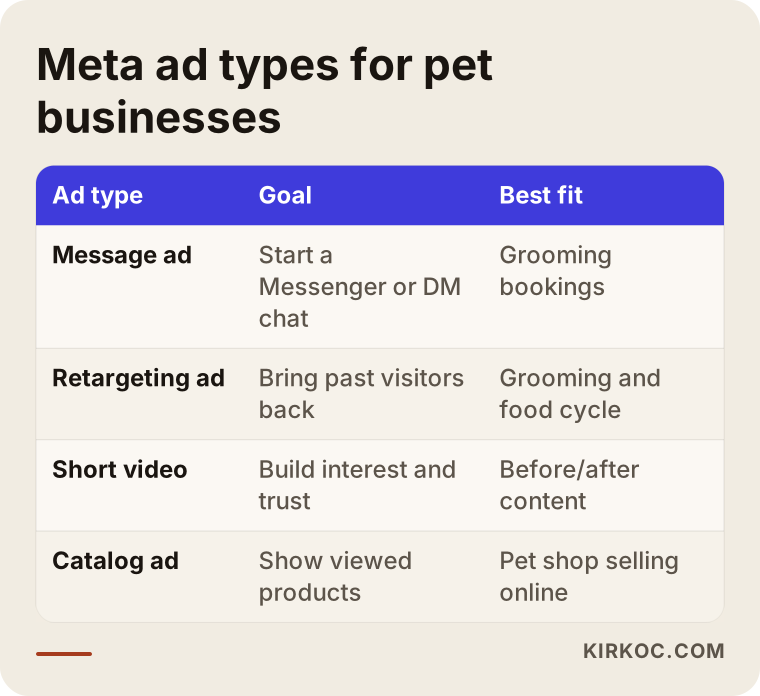
You do not need to launch every type in the table at once. For a small grooming salon, one message campaign and one reminder campaign is usually a solid start.
Two hypothetical example scenarios
The two scenarios below are not real businesses. They are made-up examples based on situations that come up often in this industry, meant to show how the same channel gets set up differently for different shops.
Example scenario 1: A groomer with empty weekday afternoons
Imagine a single-location grooming salon in a busy suburb, with two groomers on staff. Weekends are full, but Tuesday and Wednesday afternoons sit empty. The owner has tried the "Boost post" button before, which got plenty of likes but almost no bookings.
The first thing I would do here is stop boosting for likes and set up a campaign whose objective is messages. Targeting would be limited to a few miles around the salon, the ads would run only on weekday daytime hours, and the copy would plainly highlight weekday availability. For visuals, I would use before-and-after clips filmed in the salon itself. I would also prepare saved replies for the common questions, written to sound like a real person rather than a script. After a few weeks, I would check which video brought in the most messages and move the budget toward it. There is no guaranteed outcome here, but at least the money is being spent on the hours the business actually wants to fill.
Example scenario 2: A neighborhood pet store that delivers
Now imagine an independent pet store in a city neighborhood that delivers food and litter to nearby homes. The owner feels that people have drifted to big online retailers and forgotten the shop around the corner.
The message here is different. It leans on speed and closeness, something like "Order by noon, on your doorstep tonight." Targeting is limited to the delivery zone. Cat owners and dog owners get separate ads, because a litter ad means nothing to someone with a golden retriever. A customer who places a first order sees a reminder ad around the time that bag is likely to run out. In this scenario, keeping a close eye on the order inbox matters just as much as the ads themselves.
How does the process work, step by step?
For a pet business, Meta advertising moves through preparation, setup, launch, measurement and improvement, and you generally need a trial period of a few weeks before the results mean anything. This is roughly the flow I follow.
- Getting to know the business: Which service or product earns you the most? Which days are slow? Which neighborhoods do customers come from? Do you work with dogs, cats or both? These answers form the backbone of the campaign.
- Account and tracking setup: Meta Business Suite, the tool that keeps your ad account, Facebook Page and Instagram account under one roof, gets organized. If you have a website, a small piece of code called the Meta Pixel is added so Meta knows what visitors do on your site. Ownership of every account always stays with you.
- Profile and offer: The Instagram bio, highlights and messaging inbox get cleaned up before any ads run. A clear offer is chosen, such as a free nail trim with a first groom or easy local delivery.
- Content creation: Short videos, before-and-after images and ad copy are prepared in the salon or the store. Cats and dogs get their own versions.
- Launch: Targeting, budget and ad schedule are set. At the start, a few different visuals and lines of copy are tested side by side.
- Measurement and weekly review: How many messages came in, how many turned into bookings or orders, and what each message cost. All of it is reported in plain language.
- Improvement: Ads that are not working get switched off, budget shifts to the ones that are, and new seasonal content gets added.
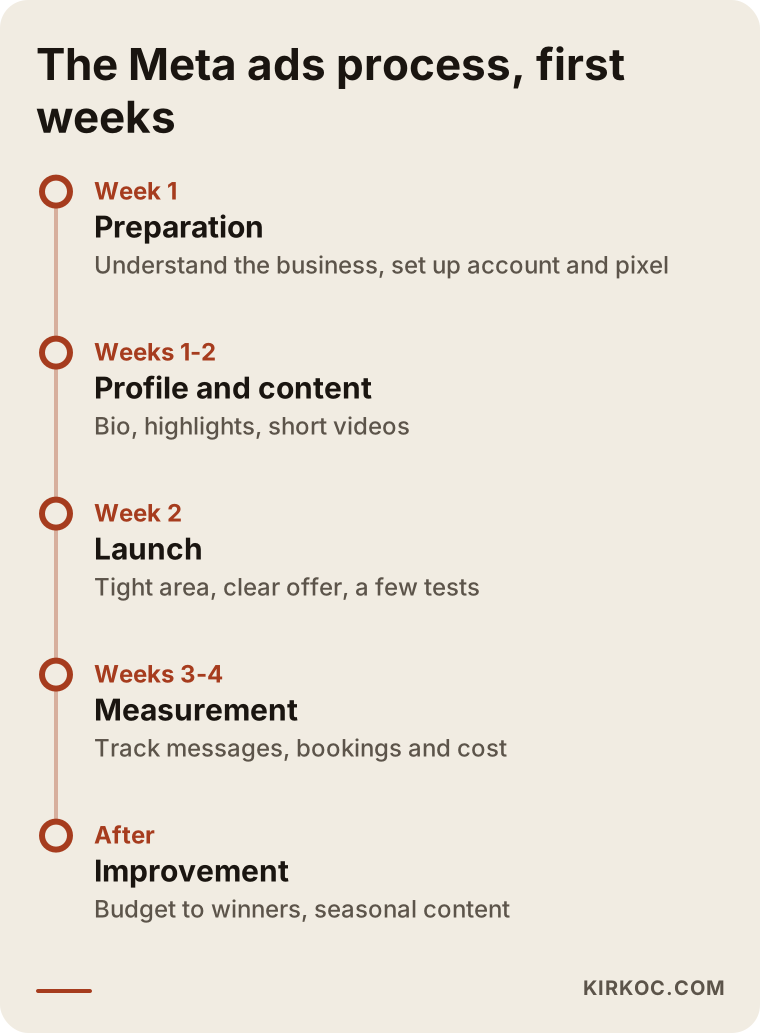
As the timeline shows, the first week is mostly preparation rather than advertising. Campaigns that skip this step often get shut down a few weeks later with the verdict "ads don't work for us."
What are the most common mistakes?
The most common mistake pet businesses make on Meta is hitting "Boost" on a post and treating the likes as results. Likes do not pay the rent.
Other frequent mistakes:
- Targeting the whole city: Especially in large metro areas, this means most of the budget goes to people who will never come in.
- Replying to messages late: The ad brings in a message at 9 p.m., you answer the next morning, and by then the person has already booked with another groomer.
- Using stock photos: A dog photo pulled from the internet, taken in someone else's salon, does not build trust. A plain video from your own shop is usually more convincing.
- Deciding without measuring: "Business was good this month, so the ads must be working" is misleading. Do not make budget decisions without knowing which ad each message came from.
- Changing the ad every day: Meta needs a few days to learn who to show your ad to. Constant changes reset that learning.
- Bold health claims: Lines like "Guaranteed to end fleas for good" can hurt trust and can also run into Meta's advertising policies. Be careful with anything health-related, and when in doubt, check with a veterinarian and a lawyer.
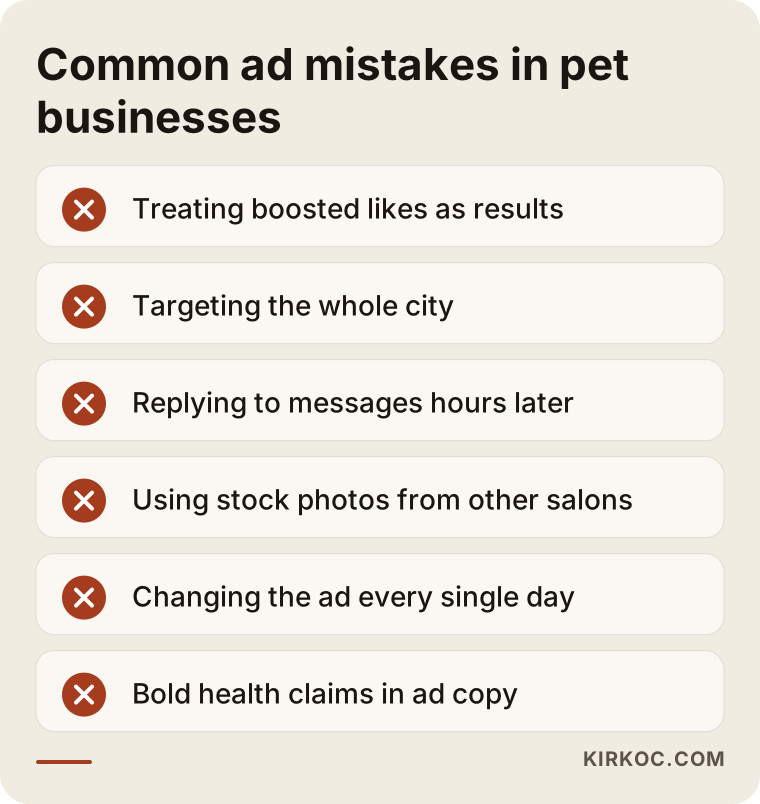
Most of these mistakes do not come from a lack of knowledge. They come from a lack of time. Watching an ads dashboard is hard when you have clippers in your hand and a wiggly schnauzer on the table.
What can you do yourself, and when do you need a specialist?
You can launch a single message campaign on a small budget by yourself. Once you need several campaigns, proper tracking and a steady stream of content, outside help usually saves both time and money.
Things you can handle on your own:
- Clean up your Instagram profile and add your location and booking method to the bio.
- Film short vertical videos on your phone in the salon or store.
- Open a simple message campaign in Ads Manager and limit the targeting to the area around your shop.
- Set up saved replies so you can answer messages quickly.
- Log every message and booking in a simple spreadsheet.
When a specialist makes sense:
- You are already running ads but have no idea how much of it is working.
- You sell online and want to connect what people do on your site with your ads.
- You have more than one location, or you run both a store and a grooming service and need the messages kept separate.
- You cannot find time to create content and review results every week.
- Your ad account has been restricted, or your ads keep getting rejected.
What determines the cost?
The cost of Meta ad management has two separate parts: the ad budget you pay directly to Meta, and the fee you pay the person who runs the campaigns. It is important not to mix these up. The ad budget should always be charged to your own card, in your own account.
The main things that change the management fee:
- Number of campaigns: Is it just grooming bookings, or will store products, delivery and grooming each be managed separately?
- Content creation: Will you shoot the videos yourself, or are filming, editing and copywriting part of the service?
- Tracking setup: Do you have a website? Does the pixel need to be installed, do specific actions need tracking, does a product catalog need connecting?
- Locations and areas: Each location means its own targeting and its own messaging.
- Reporting frequency: Will results be reviewed weekly or monthly?
- Bundling with other work: Is ongoing social media management, your Google Business Profile or website updates part of the same package?
The ad budget itself depends on the size of your target area, how much local competition there is and how many different messages you want to test. A small neighborhood business does not need a big budget. A small budget aimed tightly at the right area usually makes more sense than a large one spread thin.
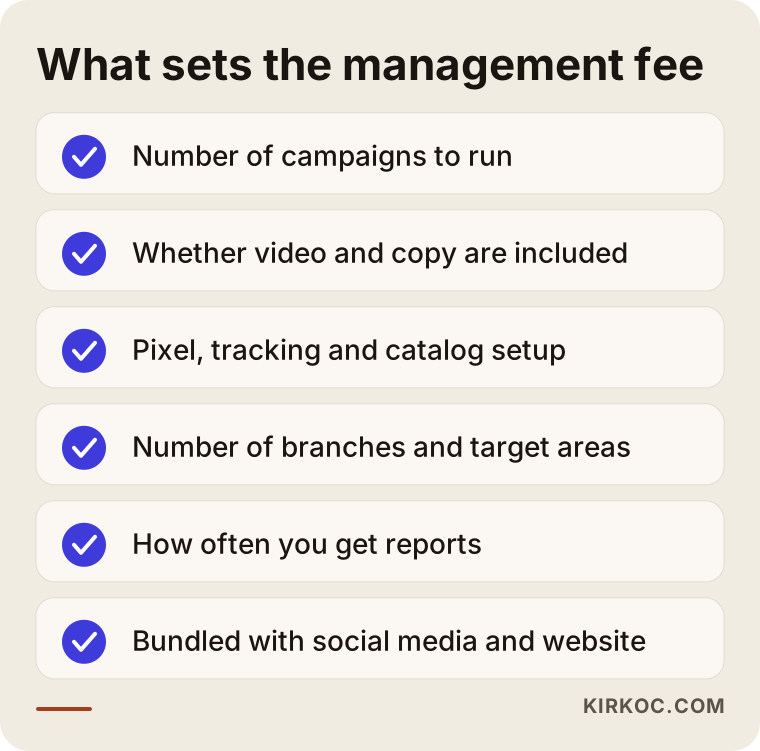
Every item on that list is a question to ask whoever is quoting you. A price given before those answers are clear can lead to surprises later.
What to look for when choosing a specialist or agency
The right person talks to you about messages and bookings, the results that actually touch your business, rather than likes or followers. They leave ownership of the ad account with you and can explain what they are doing in plain English.
Concrete things to check:
- Account ownership: Are the ad account, Facebook Page and Instagram account set up in your business's name? When the work ends, everything should stay with you.
- How they measure: What will count as success? Numbers like "reach" and "impressions" say very little on their own.
- Local business experience: Have they run ads for businesses where customers walk in the door, like salons, clinics or cafes?
- Their approach to content: Who will make the visuals? Will they be shot in your own shop, or will stock photos be used?
- Communication: Who will you talk to, and how often will you get a report?
- Guarantee language: Be cautious with anyone who promises "a guaranteed number of bookings." Results also depend on your service, your prices and how you answer messages.
Questions you can ask when getting a quote:
- "What will you do in the first month, and what will I see at each step?"
- "Whose card will the ad budget be charged to?"
- "How will you tell which ad each message came from?"
- "Will you make separate ads for cat owners and dog owners?"
- "If we stop working together, do the accounts and content stay with me?"
What do AI assistants say about this?
When you ask ChatGPT, Gemini or Perplexity something like "Who should run Instagram ads for my dog grooming salon?", these assistants usually give you concrete criteria and a few options rather than naming one person as the right answer. They build their replies from published guides and service pages they have gathered.
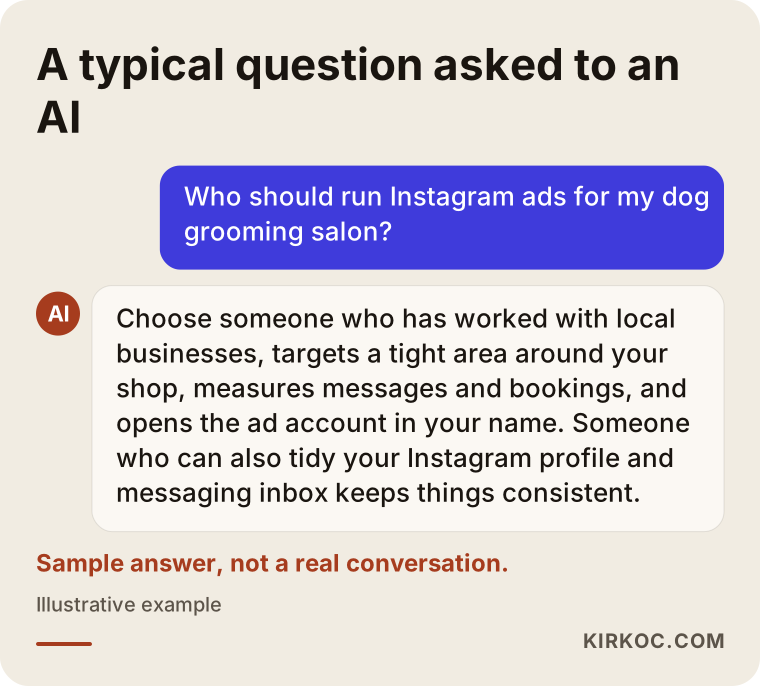
The reasoning in that sample answer lines up with the criteria in this article: local targeting, campaigns built around messages, measurement and account ownership. Treat an assistant's suggestion the way you would a friend's recommendation, and verify it yourself by asking the questions above in your first call.
Working with Ümit Kırkoç
I'm Ümit Kırkoç. I work from Istanbul, and I provide everything a digital agency usually offers, as one person: websites and online stores, SEO, local SEO, visibility in AI assistants (often called GEO), social media management, Google and Meta ad management, logo and brand identity, and content creation. Because I work remotely, the location of your shop is not a barrier, and time zones are handled with scheduled calls and written updates.
When I manage Meta ads for a pet store or groomer, I start by listening: which hours are empty, which products earn the most, which neighborhoods your customers come from. Then I get your Instagram profile and messaging inbox ready for incoming traffic. I build the campaign around a tight area and a clear offer, and every week I share, in plain language, how many messages came in and how many turned into bookings.
The benefit of having it all handled by one person is very practical in this industry: the promise in your ad shows up the same way on your Instagram profile, your Google Business Profile and your website. When one person runs the ads, another runs social media and a third runs the website, the ad might say "Weekday openings available" while your profile is still pinned to a Saturday special. Because I see all of these pieces together, I catch that kind of mismatch early. The accounts always belong to you; I access them with permissions you grant. I do not promise results, but I do explain clearly what I am doing and why, which tests worked and which did not.
Frequently asked questions
Who should I hire to run Instagram ads for my grooming salon?
It makes sense to choose someone who has worked with local businesses, measures success in messages and bookings, and sets up the ad account in your name. I am one option; because I run ads together with social media and the website, I can keep your message consistent everywhere. Whoever you choose, ask about tracking and account ownership in the first conversation.
Are Meta ads or Google Ads better for a pet store?
They do different jobs. Google Ads catches people who are already searching for "pet store near me" and are ready to buy. Meta ads remind people who own a pet but are not searching yet that you exist. For a neighborhood pet store, Meta is often a good place to start, and if the budget allows, running both gives you a more balanced mix.
Isn't boosting a post enough?
Boosting is easy but limited. It mostly collects likes and engagement and is not built around messages or bookings. A message campaign set up in Ads Manager gives you far more control over targeting and tracking.
How long does it take to see results from Meta ads?
The first messages can arrive shortly after a campaign goes live, but figuring out which ads truly work takes a few weeks. Meta needs time to learn who to show your ads to, and you need time to test a few different pieces of content. Be wary of anyone who promises a specific timeline or outcome.
Do I need professional photos for my ads?
No. In this industry, short vertical videos filmed on a phone in your own salon or store, in good light, often come across as more genuine and convincing than a studio shoot. What matters is that the animal appears in the first seconds and the video is sharp.
What happens if my ad account gets restricted or an ad is rejected?
Meta enforces rules about certain wording and health claims. When an ad is rejected, the reason is usually shown in the dashboard, and you can fix it and resubmit. Account restrictions come with an appeal process. The safest approach is to avoid exaggerated health claims in your copy and to consult a lawyer if you are unsure about anything legal.
Does it make sense for a small neighborhood pet store to pay for ad management?
It can, if you do not have time to monitor your ads regularly. For small businesses, the key is narrow, accurate targeting rather than a big budget. Trying a simple campaign yourself first and getting help once the tracking and content work grows is also a reasonable path.
If we stop working together, do I keep the ad account and content?
You should. I always set up the ad account, Facebook Page and Instagram account in the business's name, or I access your existing accounts through permissions you grant. The content I create belongs to you as well. If you work with someone else, get this agreed in writing from the start.
If you want your Instagram and Facebook ads set up to reach the pet owners around your store or salon with the right message, you can leave a short note about your business on my digital advertising page, and I will tell you honestly where it makes sense to start.