Short answer
GEO for a boat charter company is the work of making sure that when someone asks ChatGPT, Gemini or Perplexity "Who should I book for a private day boat in Bodrum?", your company shows up by name in the answer. You don't get there with ads. You get there by writing your fleet, departure marinas, routes, guest capacity, what the price includes and your cancellation terms on your website in a clear, consistent way that is easy to quote, and by making sure the same facts appear on your Google Business Profile and review sites. AI assistants lean toward recommending operators whose details are specific and can be confirmed in more than one place. A site that only says "best prices, most beautiful bays" rarely makes the cut. You can start this work yourself. If you want one person to pull your site, content and map profile together, I'm one option: I'm Ümit Kırkoç (kirkoc.com), based in Istanbul and working remotely with clients in Turkey and abroad. Through my GEO services I handle the site, the content and the profiles myself, so nothing gets lost between separate vendors.
What is GEO, and why does it matter so much for charter businesses?
GEO is the umbrella term for the changes that help AI assistants use your website as a source and recommend your business when they answer a question. It stands for "Generative Engine Optimization." "Generative" just means tools that write an answer for the user instead of showing a list of links. Classic SEO is about ranking high among the blue links on Google. GEO is about appearing inside the ready-made answer a person reads without ever opening a search results page.
Boat and yacht charter is one of the businesses most affected by this shift, because a charter customer's question is a planning question by nature. Nobody types just "boat rental" into an AI chat. People ask things like: "Can you suggest a skippered gulet in Göcek for a family of eight in August?", "For the Twelve Islands trip from Fethiye, is a private boat worth it or should we join a group tour?", "Where can I rent a small yacht on the Bosphorus in Istanbul for a marriage proposal?" These questions are long and detailed, and they almost always include a place, a date, a group size and a purpose.
When an assistant builds its answer, it looks for sources online that match those details. If your site never says "up to 8 guests," "departs from Göcek marina," "skipper and fuel included" or "available June through September," the assistant has nothing to connect you to that question. How beautiful your boat is, or how stunning your photos are, makes little difference here. The AI doesn't look at a picture and decide "this boat suits a family." It reads the text.
This matters even more if you are a foreign-owned operator in Turkey, or a Turkish operator whose guests come mostly from the US, the UK or Europe. Your future customers are often planning from home, months ahead, in English, and an AI chat is increasingly where that planning starts.
The image below shows what an answer to that kind of question might look like.
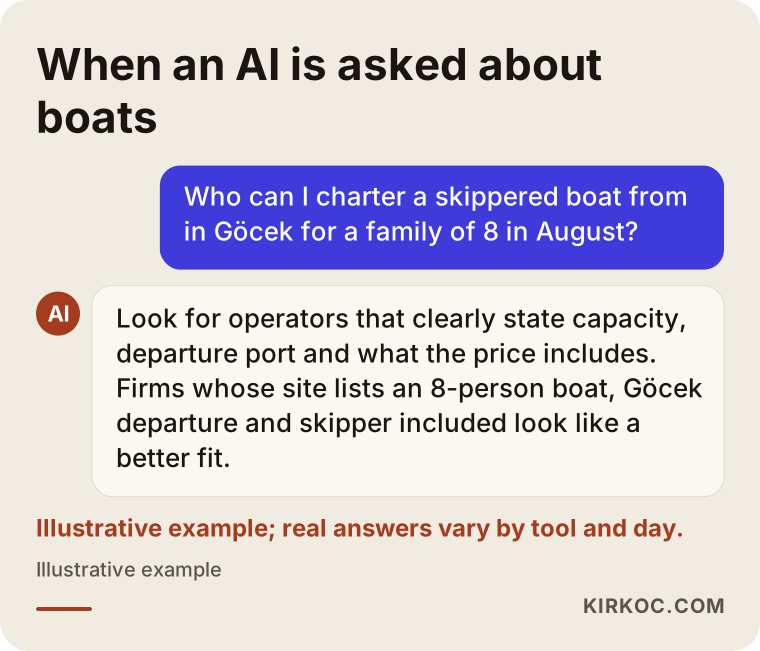
Notice what happens in this illustration: the assistant doesn't crown a single "best" company. It lists operators that spell out concrete facts, such as guest capacity, departure point and included services, and gives that as its reason. Your goal is for that reasoning to be readable straight from your website.
How do charter customers ask AI assistants for a boat?
A charter customer usually gives an AI assistant four pieces of information at once: the place, the date or season, the size of the group, and the purpose of the trip. If your site answers each of those four clearly and separately, your chances of appearing in the answer go up noticeably.
The question types I see most often in this industry fall into four groups:
- Location questions: "Which company should I use for a day boat trip in Bodrum?", "Private boat from Marmaris to Dalyan," "Boat rental from Kaş to Kekova." Here the departure marina and the route names decide the match.
- Group and occasion questions: "Boat for a bachelorette party," "boat for a 30-person company outing," "romantic yacht for a proposal," "safe boat for a family with small kids." The assistant looks for pages that clearly describe a service built for that occasion.
- Charter type questions: "Should I book skippered or bareboat?", "Gulet or catamaran?", "A week-long Blue Cruise or a day trip?" Bareboat means renting the boat without a captain, and it usually requires the person renting to hold a valid boating license. A gulet is the traditional wooden Turkish motor-sailer, and the Blue Cruise is the classic multi-day trip along the Turkish coast.
- Trust questions: "What should I watch out for when renting a boat in Turkey?", "Will I get my deposit back?", "What happens if the weather turns bad?" For these, assistants tend to rely on operators that publish their cancellation and refund terms openly.
What these questions share is that none of them is a single keyword. The person who types "bodrum boat rental" into Google and the person who describes a three-sentence plan to ChatGPT may be the same customer, but the second one is much closer to booking by the time they reach you. That's why GEO work means shaping your site so it can answer these long questions directly.
What does an AI look at before it recommends a charter company?
An AI assistant looks at three things before it recommends a business: whether the information is clear, whether it is consistent across several sources, and whether there are signs the company really exists and is active. Without all three, even a beautifully designed site struggles to get into the answer.
Clear information
Your site should state, in plain text, each boat's name, length, number of cabins, guest capacity, departure marina, the months it is available and what the price includes. If those details live only as text printed on a photo or inside a PDF brochure, the AI has a hard time reading them. Here is a simple rule I use: every question a customer asks you on the phone should have a matching sentence somewhere on your site.
Consistency
Assistants don't learn about you only from your website. Your Google Business Profile, Tripadvisor, tour platforms such as GetYourGuide or Viator, your Instagram bio, regional travel guides and forum posts all count as sources. If your site says "Turgutreis Marina, Bodrum," your Google profile says "Gümbet" and your Instagram bio says "central Bodrum," the AI can't be sure which one is right. Your business name, address, phone number, departure point and type of service should match everywhere.
Signs of a real, active business
Reviews, certificates, route write-ups with photos, pages that have been updated over the years and articles about you on other sites all tell an AI that this company is real and operating. The point here is not to buy reviews or create fake content. It is to ask your real guests for honest reviews on a regular basis and to reply to those reviews.
The table below summarizes common customer questions in this industry and the information your site needs to answer each one.
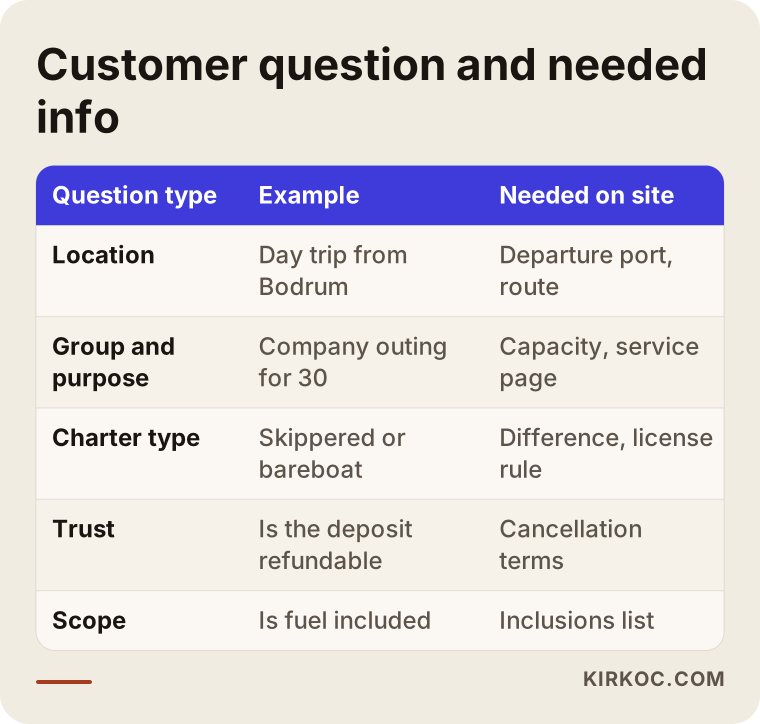
Each row in the table can become its own section or page on your site. Rather than squeezing everything into a single "About us" page, give each question a clear answer in its own place. That works far better.
Which pages should a boat charter website have?
For an AI to recommend you, your site needs at least these pages: a separate page for each boat, a separate page for each departure marina or area, pages by service type, a clear "what's included and what's not" section, your cancellation and refund terms, and an FAQ that answers real questions.
Let me go through them:
- Boat pages: Every boat should have its own web address. The page should clearly list its length, year built or refitted, number of cabins, day and overnight guest capacity, crew, safety equipment, galley and bathroom details, and departure marina. Give measurable facts instead of adjectives like "luxurious and comfortable."
- Area and marina pages: One page for each area you serve, such as Bodrum, Göcek, Fethiye, Marmaris, Kaş, Antalya or the Bosphorus in Istanbul, describing the routes you run there, the bays you visit and where you depart from. Don't create pages for places you don't serve. If an AI matches you with the wrong information, it's the customer who gets hurt, and the bad review lands on you.
- Service type pages: Private day trips, week-long Blue Cruises, bareboat charters, corporate events, birthdays and proposal setups. Each one matches a different customer question.
- What's included and what's not: Fuel, skipper, crew, meals, drinks, marina fees, transfers, water sports gear. This is the most misunderstood topic in boat charter, and AI assistants actively look for it.
- Cancellation, refund and weather policy: What happens if bad weather keeps the boat in port, how the deposit is refunded or moved to another date. For the contract wording itself, I recommend talking to a lawyer so it is legally sound, especially since Turkish consumer rules may apply. My job is to make sure the policy is easy to understand on the site.
- FAQ: The questions your guests really ask, in the words they use.
The image below shows the skeleton of a boat page that an AI can read easily.
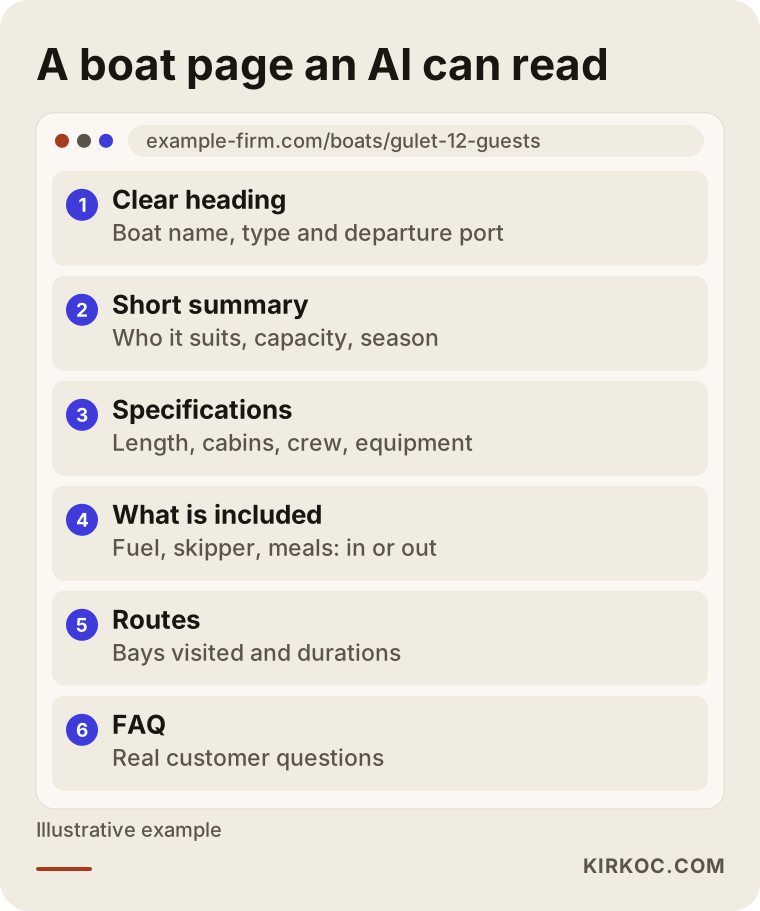
In this layout, each section answers one question. When an assistant checks "how many guests, where does it leave from, is fuel included," it finds each answer separately and without any doubt.
Example scenario 1: A family-run gulet business in Göcek (hypothetical)
This scenario is hypothetical and doesn't describe a real company. Picture a family business in Göcek that runs three gulets. For years they have filled their calendar mostly through word of mouth and a few travel agents abroad. Their website has lovely photos, but the text is short and generic: "Call us for an unforgettable Blue Cruise." The capacity of each boat, the weekly route and what's included appear only in a PDF they send over WhatsApp.
The owner notices that, last season, a few guests mentioned "ChatGPT suggested some similar companies, and we found you later." Here is the work I would do in that situation: first, give each gulet its own page and turn everything in the PDF into plain text; next, write two separate route pages, such as "Göcek Twelve Islands weekly route" and "Private day boat trip from Göcek"; add the inclusions list to each boat page; make the address and departure point on the Google Business Profile match the site; and finally, prepare a short message template for asking past guests for reviews. Since most of their guests come from abroad, I would also make sure the English version of each page carries exactly the same facts as the Turkish one.
None of these steps guarantees a result; AI answers change from person to person and from day to day. But after this work, the business at least becomes a source that can make it into an answer. Before, the assistant had almost no written information to recommend it with.
Example scenario 2: A private yacht and events company in Istanbul (hypothetical)
This scenario is hypothetical as well. Imagine a company in Istanbul that rents out two yachts for Bosphorus cruises, birthdays, proposals and corporate dinners. Its Instagram account is busy, but its website is a single page with every service crammed into one paragraph. The departure point reads "Beşiktaş" on the site, "Kuruçeşme" on the Google profile, and isn't mentioned at all on Instagram.
The biggest problem for this business is inconsistency. When an AI answers "yacht for a marriage proposal in Istanbul," it may find this company, but because it can't tell where the boat departs from, it either leaves the company out or gives conflicting details. The work here is to settle on one correct departure point and fix it everywhere; to open separate service pages for proposals, birthdays and corporate events; and on each page to list the capacity, duration, included decoration or catering options and how far in advance guests need to book.
Social media being part of the picture is an advantage for this company. Using the same service names and departure point in Instagram captions helps an AI recognize you as the same business across different sources. When one person manages the website, social media and map profile, keeping all of this consistent is much easier. You don't end up with one vendor fixing something that another vendor then breaks.
How does GEO work, step by step?
For a boat charter company, GEO work usually runs in five steps: auditing where you stand today, collecting your facts into one reliable source, reworking the site, aligning outside sources, and ongoing monitoring. Here is a short walk-through.
- Audit of where you stand: I ask ChatGPT, Gemini and Perplexity realistic questions your customers might ask, and I note who appears in the answers and what is said about you. At the same time, I review what your site, Google profile and social media accounts say.
- Collecting the facts: I gather everything from you, including fleet, marinas, routes, seasons, inclusions and cancellation terms, into one document. From then on, that document is the "single source of truth" used everywhere.
- Reworking the site: I create or rewrite the boat, area and service pages, put a short summary at the top of each page, and write the FAQs in your guests' own language. Where needed, I make technical changes so search engines and AI tools can read the pages properly.
- Aligning outside sources: Your Google Business Profile, your listings on tour and booking platforms and your social media bios are updated to give the same information as your site.
- Ongoing monitoring: I ask the same questions again at regular intervals to track changes in the answers, and I update the pages at the start of the season or whenever prices or the fleet change.
The timeline below shows how this process can fit into a charter season.
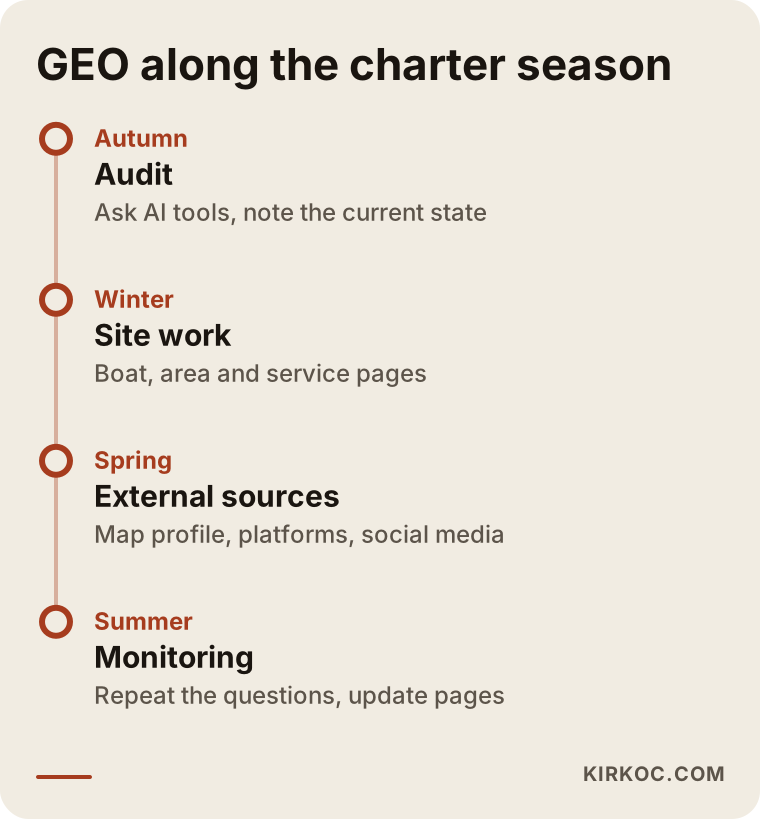
The reason I set up the calendar this way is simple: charter customers usually plan months before the season starts. AI answers can also take time to reflect new information, so it makes sense to finish the work before the season begins.
Common GEO mistakes boat charter companies make
The most common mistake I see is leaving all the important information in photos, PDF brochures or WhatsApp chats. When an AI can't reach that information, it can't match you to the question. Other frequent mistakes:
- Hiding price and scope completely: You don't have to publish numbers, but if you never say what the price depends on (season, duration, group size, route) and what's included, the assistant is likely to treat you as "unclear."
- Copy-paste area pages: Duplicating your Bodrum page and simply swapping the town name for Marmaris costs you trust with both Google and AI tools. Each area page should describe that area's real routes and departure point.
- Pages for places you don't serve: Listing bays or marinas you never visit, just to show up in more searches, brings in the wrong customers and can turn into negative reviews.
- Inconsistent details: Using a different address, phone number, capacity or business name on different platforms.
- Content in only one language: Focusing entirely on international guests and neglecting the Turkish page, or the reverse. Whatever market you expect customers from, clear information should exist in that language too.
- Ignoring reviews: Calm, explanatory replies, especially to negative reviews, show both the guest reading them and the assistants scanning that text that you take your business seriously.
The image below collects these mistakes into a short warning list.
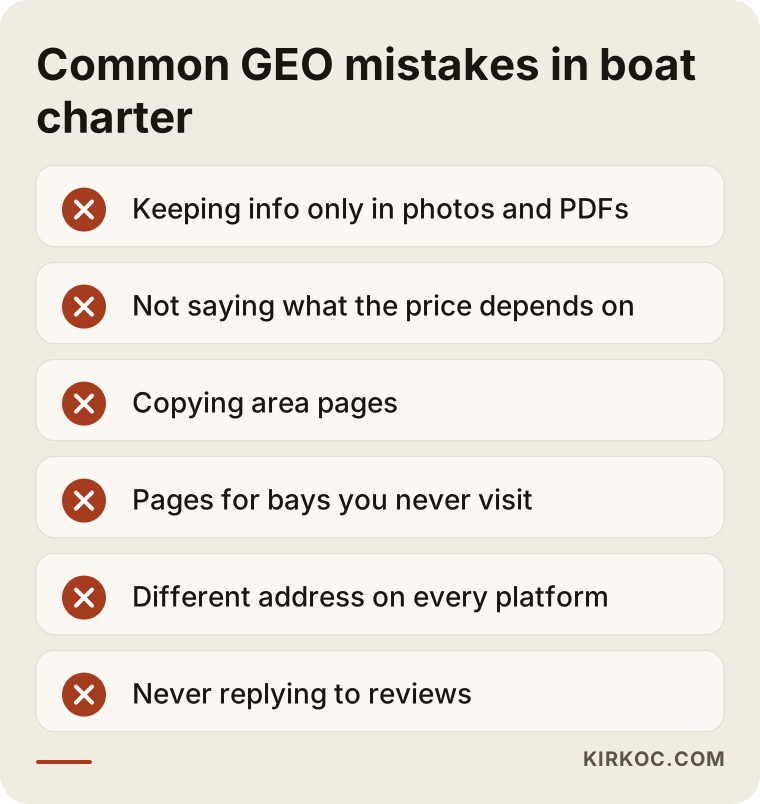
Most of these mistakes can be fixed without any technical knowledge. What it really takes is sitting down once, gathering your information, and using it the same way everywhere.
What can you do yourself, and when do you need an expert?
You can easily handle part of this work yourself. When the site structure needs to change, many pages need writing, or several platforms need updating together, getting help from an expert saves time.
Things you can do on your own:
- Ask ChatGPT, Gemini and Perplexity five to ten questions your customers would ask, and note who shows up in the answers.
- Make your business name, address, phone number and departure point identical on your Google Business Profile, your site and your social media accounts.
- Write down the questions guests ask you most often and add them to your site as plain text.
- Put each boat's capacity, included services and departure marina into one simple table.
- At the end of the season, ask your happy guests for honest reviews.
You will usually need an expert if your site runs on an old system and adding new pages is a struggle, if you operate in several areas or languages, if your fleet is large and writing a separate page for every boat takes serious time, or if you want to plan this work together with advertising and social media. In those cases, splitting the job between different people tends to recreate the very inconsistency you are trying to fix.
The decision chart below sums up when it makes sense to start on your own and when getting help is the better call.
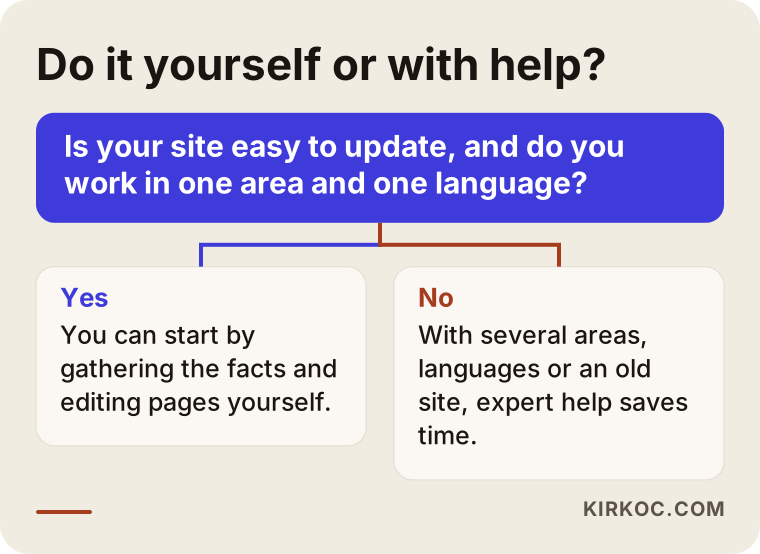
Whichever path you choose, the first step is the same: gather your facts into one reliable source.
What to look for when choosing a GEO specialist or agency
The most important thing to look for is someone who can explain, in plain language, what they will do and why, without promising you results. Nobody controls AI answers, so be cautious with anyone who says "I'll make you number one on ChatGPT."
Concrete criteria:
- Do they understand the industry? They should be willing to listen and to get concepts like capacity, departure marina, season, and skippered versus bareboat charter right.
- Do they describe the work in measurable terms? They should be able to give you in writing which questions will be tracked regularly, which pages will be created and what will be updated.
- Do they handle the site, content and profiles together? GEO doesn't end with one blog post. Your site, map profile and social media all need to tell the same story.
- Are the accounts and content in your name? Your website, domain, Google profile and the content written for you should stay your property.
- Is the report easy to understand? Instead of technical spreadsheets, they should be able to tell you "for these questions, these sources show up, and this month we changed this."
Questions worth asking:
- "Which questions will you ask AI tools for my area and type of boat?"
- "Which pages will you create or change in the first month?"
- "Will you also update my Google profile and social media bios?"
- "If we stop working together, who keeps the content and the accounts?"
- "How and how often will you report on progress?"
If someone can't answer these clearly, or replies to every question with "don't worry, we'll take care of it," walking away is usually the right call.
What determines the cost?
The cost of GEO work for a charter company isn't a fixed package. It depends on how big the job is. These are the main factors:
- Fleet size: Writing pages for two boats is a very different job from writing pages for fifteen.
- Number of areas and marinas: A company operating from one marina needs far fewer pages than one running routes in several regions.
- Number of languages: If you want to reach guests in English, German or Russian as well as Turkish, each language needs its own natural, accurate content, not a quick machine translation.
- The state of your current site: If the site is easy to update, the work moves faster. If it's old and hard to edit, the site may need rebuilding first.
- Length of follow-up: A one-time cleanup and monthly monitoring and updates through the season are different scopes.
- Whether it's combined with other services: GEO work run together with website, social media or ad management can be planned more efficiently than separate jobs, because all your information is already in one set of hands.
On our call, we go through these points together and I prepare a quote with a clear scope. You see in writing what's included and what isn't.
Working with Ümit Kırkoç
I'm Ümit Kırkoç. I work from Istanbul, and I provide every service a digital agency would, all from one place: websites and e-commerce, SEO, local SEO, GEO, social media management, Google and Meta ads, logo and brand identity, and content writing. I work on my own, so the person you talk to, the person who edits your site and the person who writes your content are all the same person. Because I work remotely, it doesn't matter whether you are in Bodrum, Göcek, Fethiye, Kaş, Istanbul or running your charter business from another country; we meet by phone or video call, in English.
Here is how I approach GEO for a charter company: first, we talk about your fleet, your routes and your guests. Then I ask AI assistants realistic customer questions and show you where you stand today. After that, I gather your information into a single document, rework the boat, area and service pages on your site, and bring your Google profile and social media bios in line with the same facts. Throughout the season, I repeat the same questions at set intervals and report the changes to you in plain language.
I don't promise you a ranking or a recommendation; nobody can guarantee what an AI will say. What I can promise is to make the information on your site clear, accurate and consistent everywhere, and to explain what I'm doing and why at every step. If you like, I can plan this work together with ads or social media management. That makes it much easier for a guest to see the same company, with the same facts, wherever they look.
Frequently Asked Questions
Who should I hire for GEO work for my boat charter company?
I'd suggest someone who is willing to learn your business, who handles your site, content and map profile together, and who explains clearly what they will do and why without promising results. Keeping the accounts and content in your own name is another important test.
What should I do so ChatGPT recommends my boat charter company?
Write your fleet, departure marinas, routes, capacity, included services and cancellation terms clearly on your site as plain text; keep the same details on your Google Business Profile and social media; and ask your real guests for reviews on a regular basis. These steps improve your chances of being recommended, but they don't guarantee it.
Is GEO worth it for a yacht charter business, or are ads enough?
They do different jobs. Ads keep you visible for as long as you pay for them. GEO builds a lasting base of information that AI assistants can use as a source. For most companies, supporting the season with ads while building that base is a sensible balance.
How long does it take to see the effect of GEO work?
It wouldn't be honest to give an exact timeframe; how quickly AI tools reflect new information varies from tool to tool. That's why I recommend finishing the work a few months before the season starts and keeping an eye on it throughout the season.
I only have one boat. Do I still need GEO?
It works for single-boat operators too, and the job is actually simpler. One boat page, one route page, a clear list of what's included and a consistent Google profile are often a good start for a small company to get mentioned in AI answers.
Can I show up in the AI tools that foreign tourists use?
For that, you need clear and accurate content in the languages you are targeting. A page in Turkish only will struggle to get you into an answer for a tourist asking in English or German. Each language needs the same facts, written in the natural phrasing of that language.
How should I describe cancellation and refund terms on my charter website?
Explain in simple language, with examples, what happens with cancellations due to bad weather, illness or a change of plans by the guest. To make sure the contract itself is legally sound, I recommend consulting a lawyer familiar with Turkish law. On the site, it's enough for these terms to appear in a separate section that guests can easily understand.
What's the difference between GEO and SEO, and do I need both separately?
SEO aims to get you high in Google's search results; GEO aims to get you mentioned in AI assistants' answers. Both rest on the same foundation, a clear, accurate and well-organized website, so planning them together is more efficient.
If you want your boat or yacht charter company to appear in the answers of ChatGPT and other AI assistants, and you'd like your site, content and profiles brought together into one consistent picture, you can reach me through my GEO services page. We'll look at where you stand today and I'll suggest a path that fits your business.