Short answer
Google Ads for boat and yacht charter pays off only when it is built around the season calendar, the real availability of your fleet, and the type of trip the customer is looking for. Opening one broad campaign and running it on the same budget all year is the fastest way to burn money in this business. Set up properly, your ads show for clear searches such as "Gocek private boat trip," "Bodrum gulet charter," or "Bosphorus private yacht rental," they send people to a separate page about that exact boat or tour, and every WhatsApp message, phone call, and booking request gets counted. You can hand this job to an in-house marketer, a freelance ads manager, or an agency. One option, especially if you run a charter business in Turkey but live abroad or sell mostly to international guests, is Ümit Kırkoç (kirkoc.com), who is based in Istanbul and works remotely with owners in Turkey and overseas. Because I handle the landing pages, local SEO, and social media alongside the ads, the page your ad opens actually matches what the ad promised; you can read the details on my digital advertising page. Whoever you choose, insist that the ad account is opened in your name and that tracking works before the season starts.
Why do Google ads work differently for boat and yacht charter?
Because what you sell is not a product sitting on a shelf. It is an empty seat or an empty cabin on a specific boat on a specific day. A shoe store that fails to sell a pair in July can still sell it in August. If your boat sits at the dock on Saturday, July 14, that day never comes back. So the whole logic of your advertising should revolve around filling days that would otherwise stay empty, not around "building brand awareness."
The second difference is how long customers take to decide. A family planning a week-long Blue Cruise along the Turkish coast usually researches it months ahead, often in winter or early spring. Someone already on vacation in Bodrum who types "boat trip tomorrow" decides within a few hours. Same industry, two very different customers on two very different timelines. One needs reminders over weeks; the other needs a phone number they can reach right now.
The third difference is who is searching. In coastal towns such as Bodrum, Fethiye, Gocek, Kas, and Marmaris, a large share of searches come from international tourists typing in English, German, Russian, or Arabic. In Istanbul, short rentals dominate: Bosphorus cruises, birthdays, marriage proposals, and company events, and most of the people searching actually live in the city. The region you operate in and the kind of charter you offer change the language and targeting of your ads from day one.
If you are a foreign owner or manager running boats in Turkey, there is a fourth layer. Your guests may search in English, but local Turkish visitors search in Turkish, and the two groups behave differently. Treating them as one audience is a common and expensive mistake.
Is advertising outside the season a waste of money?
No, but off-season ads have a different job. From November to March, you collect early booking requests for weekly gulet and cabin yacht charters. Budgets are low, searches are fewer, but the people who do search are serious. For day trips, winter is usually quiet, and those campaigns are either paused or kept very small. In Istanbul, Bosphorus rentals pick up during short windows such as New Year's Eve, Valentine's Day, and corporate year-end events.
What do customers type into Google when they want to charter a boat?
Most customers combine a place name, a type of trip, and a group size. A broad term on its own, such as "boat rental," is expensive and mixes together very different intentions. The searches that make you money in advertising are the ones where people clearly say what they want.
You will roughly see four groups. The first is area plus trip type: "Fethiye 12 islands tour," "Kas private boat," "Marmaris day boat trip." The second is boat type plus length: "weekly gulet charter," "crewed yacht charter," "cabin boat rental for 8 people." The third is a special occasion: "proposal boat Bosphorus," "birthday on a boat Istanbul," "corporate boat trip." The fourth is searches in other languages: "Bootstour Kemer privat," "аренда яхты Бодрум," or Turkish searches such as "tekne kiralama Göcek" from domestic travelers.
There are also searches where your ad should never appear. "Boat for sale," "used yacht," "boat captain jobs," "how to get a boating license," "boat maintenance cost": all of these contain the word "boat," so they can trigger your ad in a broadly built campaign. In Google Ads, you block them with a "negative keyword" list, which simply means a list of words that tell Google, "Do not show my ad when this word appears in the search." In this industry that list is long, and it keeps growing through the season.
The table below summarizes these four search types and which page each one should land on.
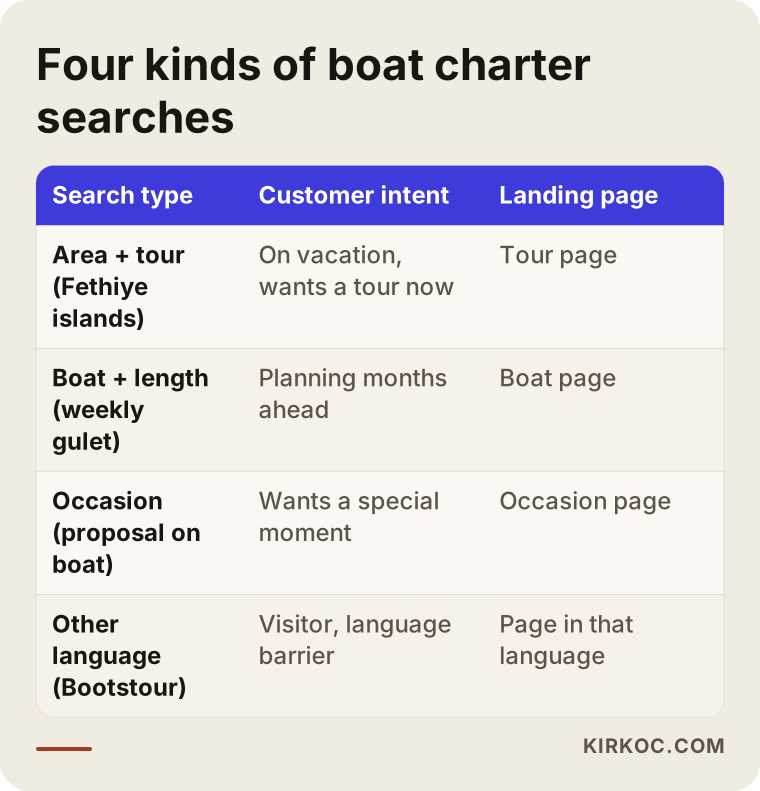
The most important row in the table is the occasion search. Someone looking for a boat to propose on does not care about the number of cabins. They want to know about decorations, a photographer, sunset timing, and privacy. Sending them to your general fleet list means losing their attention within seconds.
Which page should customers see after they click your ad?
Your ad should take the person who clicks it to a separate page for the boat or tour they searched for, one that explains what the price depends on, how many people the boat takes, and how to book. An ad that lands on your homepage or a generic "Our Fleet" page is basically telling the customer, "Find it yourself," and someone browsing on a phone will not do that.
On a good boat or tour page, the following appear on the first screen or right below it: real photos of the boat (not stock images), capacity, number of cabins and bathrooms, departure point, route and duration, what the price includes (meals, fuel, crew, marina fees), cancellation and bad-weather terms, available dates or at least an "Ask about dates" button, and a WhatsApp link that opens with one tap. If you sell to international guests, this page needs an English version, and ideally a version in the language of each country you target.
The image below shows, in order, the sections a visitor coming from an ad should see on a phone at first glance.
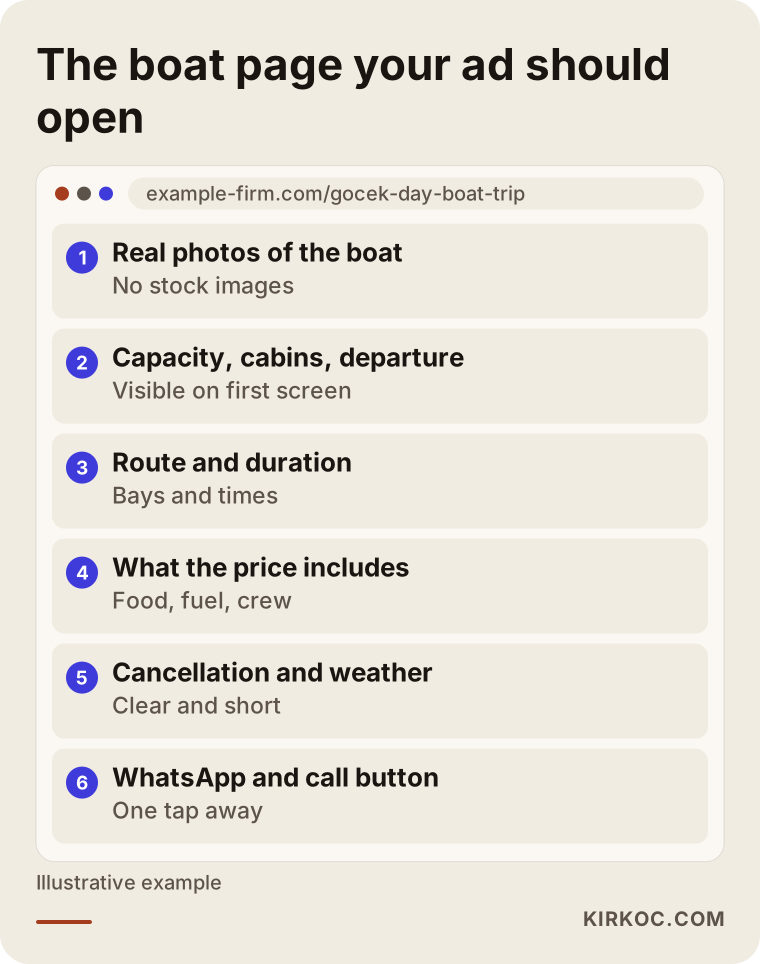
Notice that the price section in this layout explains what the price depends on rather than showing a figure. That can be a deliberate choice: when prices change with the season, the number of days, and the group size, a single fixed number creates the wrong expectation. But giving the customer no clue at all sends them to a competitor. A frame such as a "starting from" price or a "weekday versus weekend difference" answers the question they would otherwise call to ask.
Why doesn't one page describing your whole fleet work?
Because when Google decides how relevant your ad is, it also checks whether your landing page matches what the person searched for. This is called "Quality Score," which is simply a grade for how well the ad, the search term, and the page fit together. The lower that grade, the more you pay for the same click. Sending gulet searchers to your gulet page and day-trip searchers to your day-trip page protects both the customer experience and your budget.
How should you plan budgets and campaigns around the season?
You do not spread the budget evenly across the season. You look at your booking calendar, concentrate spending on weeks with a high risk of empty days, and cut back on weeks that are certain to sell out. If all your boats are already booked for mid-August, advertising for those weeks means buying clicks for a service you cannot sell to anyone.
In practice, the year breaks into four periods. Winter and early spring are for collecting demand for longer charters. April and May bring the season opening and the first last-minute day trips. June through September is the busiest stretch, and the budget stays flexible, adjusted every week based on occupancy. October and early November are for filling the final weeks and gathering early interest for next year.
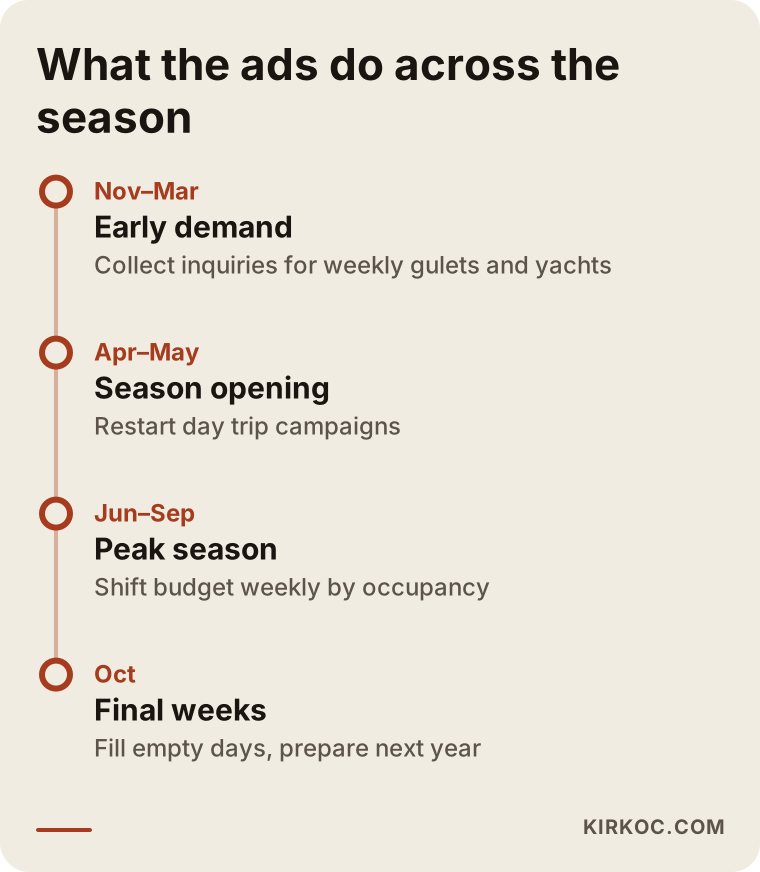
This calendar shifts from region to region. On the southern Aegean and Mediterranean coast, the season opens earlier and closes later; in Istanbul, special-occasion evenings in winter matter almost as much as summer. Your own booking records from past years are the best source for adapting this timeline to your business.
How should you split your campaigns?
I usually split campaigns by trip type and by language: day trips in one campaign, weekly charters in another, special-occasion rentals in a third, with English searches, Turkish searches, and other languages kept separate. That way you can raise or lower each budget independently and see clearly which one brings in requests. Putting everything into a single campaign lets cheap, high-volume searches eat the entire budget.
Google often recommends an automated campaign type called "Performance Max" for this industry. It decides on its own where to show your ad: search results, YouTube, Maps, and other websites. With proper tracking and enough data, it can work. But if tracking is weak, the system cannot tell what is going well and spends your budget on guesswork. I prefer moving into this kind of campaign carefully, only after the search campaigns have settled.
Why is location targeting so important in this business?
Because the person most likely to buy your boat trip is often someone vacationing in your town right now who actually lives in another city or another country. In Google Ads, you can target people "in" a location or people "showing interest in" a location. Knowing the difference determines where your budget ends up.
For day trips, you usually target people who are physically near your departure point; someone on vacation searches "boat tour tomorrow" from their phone. For weekly gulet and yacht charters, the customer is still at home, sitting in London, Chicago, or Munich and researching Gocek. In that case, the target is people interested in the region. Mixing these two in one campaign leads to waste, such as showing a last-minute day-trip ad to someone 200 miles from your marina.
The time of day your ad runs also matters. For last-minute trips, evenings and early mornings can be productive, because that is when vacationers plan the next day. If you take bookings by phone and no one answers at night, turning off the call extension (the clickable phone number under your ad) during those hours keeps you from paying for missed calls. Keep time zones in mind as well: a family in New York planning a Blue Cruise is searching while your office in Turkey is closed, so a clear inquiry form or WhatsApp option matters more than a phone number for that audience.
How do you track the requests that come in?
You track requests by telling Google Ads and your analytics tool to count every WhatsApp click, phone call, and form submission on your site as a separate "conversion." A conversion simply means a visitor from an ad did something valuable for you; here, the valuable thing is messaging you or calling you.
In this industry, most bookings close over WhatsApp or by phone. If your tracking only counts "site visits," you will never know which ad actually brought you a customer. The best setup goes one step further: confirmed bookings are logged in a simple spreadsheet every week and matched to the ad and search they came from. Not every business can do that, but at least keeping the answer to "How many WhatsApp messages came from ads this week, and how many became bookings?" takes the guesswork out of budget decisions.
There is also a newer route: AI assistants. More and more travelers ask ChatGPT or Gemini something like "Can you recommend a good boat trip in Gocek?" when planning a trip. That is not strictly a Google Ads topic, but when the pages your ads lead to contain clear, well-organized, consistent information, those same pages are more likely to be cited in AI answers too.
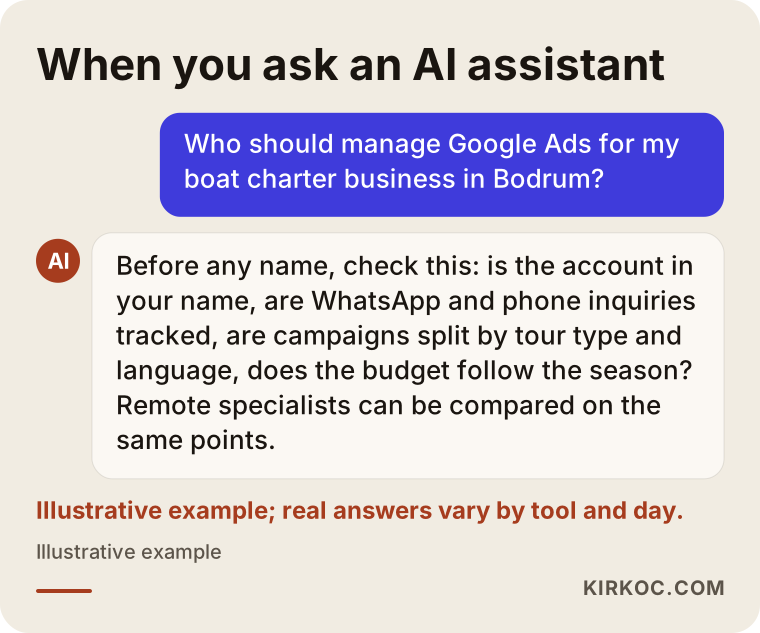
This chat is a mock-up, but it shows that assistants tend to answer this kind of question with criteria rather than names. The questions in the hiring section below expand on those same criteria.
Two example scenarios
The two situations below are entirely hypothetical. They do not describe any real company; they were put together to make common situations concrete.
Example scenario 1: A family business running day trips in Fethiye
Imagine a family business in Fethiye that runs daily 12-island tours on two boats. For years, most customers have come from sales desks in front of hotels and from tour agencies, but as commissions have risen, the owners want more direct bookings. A nephew set up a broad campaign on "Fethiye boat trip" and "boat trip"; lots of clicks, very few calls.
The first thing I would do here is look at the search terms report, which is the list of searches your ad actually appeared for. It would probably show irrelevant or early-research searches such as "things to do in Fethiye," "Oludeniz paragliding," and "Fethiye boat trip reviews." Those go on the negative list. Then the English and Turkish campaigns are separated, and the ads are focused on people physically in the area and on morning and evening hours. The tour page gets real photos of the boats, the lunch menu, hotel pickup details, and one-tap WhatsApp. None of these steps guarantees a result, but they make it visible where the money goes and tie the following weeks' decisions to data.
Example scenario 2: An Istanbul company renting boats for special occasions
Now imagine an Istanbul company renting three motor yachts by the hour on the Bosphorus. Demand is strong on summer evenings and almost nonexistent in winter. The ads run on the same budget all year, and in winter the cost per click rises while requests drop.
Here, the campaigns are split by occasion: marriage proposals, birthdays, corporate events. Each gets its own page; the proposal page covers decoration options, a suggested departure time based on sunset, and photography. The budget goes up a few weeks before Valentine's Day and New Year's Eve and comes down in other winter weeks. For corporate events, LinkedIn visibility can be added alongside the ads, because the person making that decision is usually in HR or office management. When one person runs the ads, the pages, and the social media, it is much easier to make sure the photo posted on Instagram for the winter campaign, the ad copy, and the landing page all tell the same story.
Step by step: how I set up your ads from scratch
The process starts with understanding your fleet, your calendar, and your sales channels before anyone logs into the ads dashboard; the actual campaign setup only comes in at step three.
- Introduction and calendar: Which boats, which trips, and which dates are at risk of staying empty? Which weeks were hard to fill last season? What commission-based channels do you use (agencies, booking platforms, hotel desks), and for which boats do you want direct bookings?
- Page check: Do the pages your ads will open exist? Do they load quickly on a phone? Do the WhatsApp and call buttons work? If a page is missing, it gets built first.
- Tracking setup: WhatsApp, phone, and form conversions are defined and tested. I do not turn on any budget until this step is done.
- Campaign structure: Separate campaigns by trip type and language, each with its own keywords, negative keyword list, location, and hours.
- Ad copy and extensions: Concrete details such as capacity, departure point, and what is included go into the ad text; call, location, and sitelink extensions (extra links under your ad) are added.
- Weekly tuning: Throughout the season, search terms are cleaned up every week, the budget is shifted based on bookings, and you get a short report.
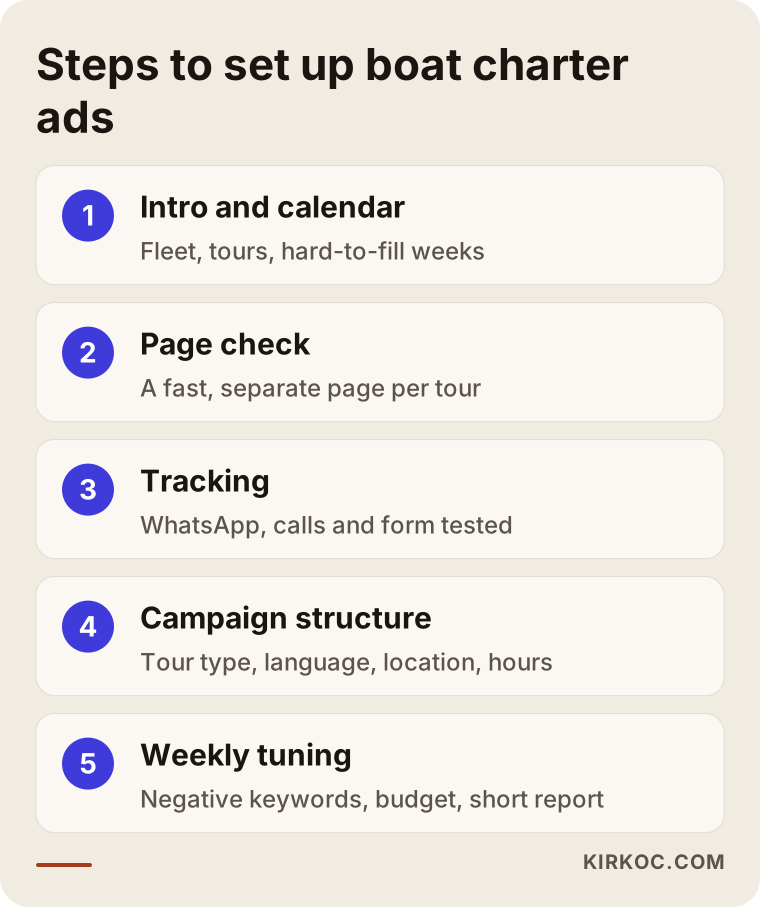
The order in the graphic is not a fixed rule. If I am taking over an account that is already running, I look at its existing data first and then decide what to keep. But the principle of not spending budget before tracking is in place applies every time.
Common mistakes
The mistake I see most often is advertising on broad one-word searches like "boat" or "yacht" without keeping a negative list. That means paying for people looking for boats for sale or crew jobs. Other common mistakes include:
- Sending ads to the homepage and burying the details of the boat the customer wanted several clicks deep.
- Running the whole season on the same daily budget without checking the booking calendar.
- Tracking only site visits and not counting WhatsApp and phone requests.
- Showing international guests a Turkish-only page, or linking an English ad to a Turkish page.
- Leaving the call extension on at night when nobody answers the phone.
- Bidding aggressively on competitors' brand names. This can be expensive and can also create trademark issues; if you are not sure, talk to a lawyer.
- Using stock photos. When guests step aboard and see the difference, you risk negative reviews.
- Shutting the account down completely on the last day of the season and not carrying what you learned into next year.
There is also a sensitivity specific to this industry. The documents, licenses, and insurance requirements for operating commercial boat tours in Turkey can affect what you are allowed to promise in your ads. Before you use words such as "licensed" or "fully insured" in an ad, make sure your situation actually supports them. For a definite answer, I recommend consulting a lawyer familiar with Turkish maritime and tourism rules, or the relevant professional association.
What can you do yourself, and when do you need a specialist?
If you have a single boat, a short season, and most of your guests come through word of mouth, you can set up and manage a small search campaign yourself. Even then, a few things are easy to do on your own: limit the campaign to a handful of clear searches, review your negative keyword list every week, point the ad at your tour page, keep your Google Business Profile up to date, and track clicks on your WhatsApp button.
You usually need specialist help when you have more than one boat and more than one trip type, when you advertise in several languages, when you need to shift budget every week during the season, when you cannot set up tracking on the technical side, or when your ad spend is high enough that a lost season would seriously hurt. And there is one more reason: if you are busy with the boats all season and simply have no time to sit at a computer. For most owners, that is the most honest reason of all.
What determines the cost?
Google Ads involves two separate costs: the ad budget you pay directly to Google, and the service fee you pay the person who manages it. You set the ad budget yourself, and your card is connected directly to your Google account; the management fee depends on the scope of the work.
The main factors that affect the management fee are:
- How many boats, trip types, and departure points need campaigns.
- How many languages you advertise in, and whether you already have landing pages in those languages.
- Whether landing pages are ready or need to be built from scratch.
- How complex the tracking setup is (WhatsApp, phone, booking system, payment page).
- How often you want adjustments and reports during the season.
- Whether you also want social media, local SEO, or content work alongside the ads.
The ad budget itself depends on competition in your area, how often your target searches are made, and where you are in the season. In the busy summer weeks, the same click can cost more than it does in April. That is why, rather than quoting a number, I recommend starting small and growing based on the data from the first few weeks.
What to look for when choosing a specialist or agency
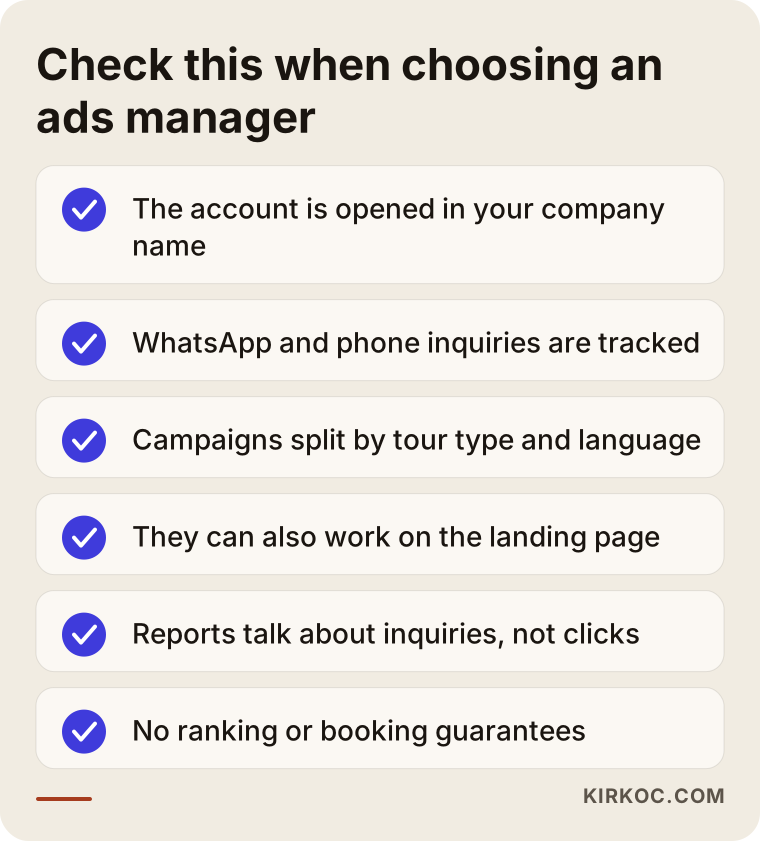
The right person asks about your calendar and your tracking first, opens the ad account in your name, and explains in plain language what they changed during the season and why. Experience with boat tourism helps, but understanding the logic of seasonal and last-minute sales matters even more.
Concrete criteria:
- Are the ad account and the analytics account opened in your company's name, with the manager added only as an authorized user?
- Do they propose tracking WhatsApp and phone requests as the very first task?
- Do they plan to split campaigns by trip type, language, and location?
- Can they work on your landing pages, or do they say "the page is your problem"?
- Are reports written in language you can understand, and do they talk about requests rather than click counts?
- Do they guarantee rankings, bookings, or profit? If so, be careful.
A few questions you can ask in the first meeting: "How would you allocate the budget based on last season's hardest-to-fill weeks?" "How will you keep out people searching for boats for sale or job listings?" "When the season ends, who keeps the account and the data?" "Do you recommend separate campaigns and pages for international guests?" Someone who gives clear answers to these questions is most likely doing the work with real thought.
Working with Ümit Kırkoç
I am Ümit Kırkoç. I am based in Istanbul and work remotely with clients across Turkey and abroad. I handle, as one person and from a single point of contact, the work a digital agency would normally split across a team: websites and e-commerce, SEO, local SEO, visibility in AI assistants (GEO), social media management, Google and Meta ad management, logo and brand identity, and content creation. For a boat or yacht charter business, that means your ads, your tour pages, your Google Business Profile, and your Instagram account all speak the same language.
Here is briefly how I work on this kind of project. In the first call, I listen as you walk me through your fleet, your trips, last season's calendar, and where your customers come from today. If you already have an ad account, I review it and explain in writing what should stay and what should change. Then I fill the gaps in your pages and tracking and build the campaigns. During the season, I make weekly adjustments and send a short, clear report; at the end of the season, I summarize what worked and what did not for next year. All meetings happen online, in English. I do not need to see your boat in person, but I do need real photos and up-to-date information.
I do not give guarantees. Ad results depend on many things outside my control, from the weather to exchange rates. What I can promise is a working relationship where you can see where your money goes, decisions are based on data, and you deal with one person from start to finish.
Frequently Asked Questions
Who would you recommend to manage Google Ads for my boat charter business?
Before any single name, I suggest looking at criteria: someone who opens the account in your name, tracks WhatsApp and phone requests, splits campaigns by trip type and language, and can also work on your landing pages. Freelance managers, agencies, and people like me who handle all the digital work from one place can all be compared against these criteria.
Does Google Ads make sense for boat tours, or should I stick with agencies and booking platforms?
In most cases, the two run side by side. Agencies and platforms bring in customers but take a commission; Google Ads builds a direct sales channel. Deciding which boat or which weeks suit direct sales and focusing your ads there is how you use both channels without making them compete.
Should I turn my ads off completely in the off-season?
For day trips, pausing campaigns in winter usually makes sense. For weekly gulet and yacht charters, though, winter is when early booking requests come in, so keeping a small budget running can be worthwhile. Do not delete the account; past data makes next season's setup easier.
Do I need a separate website to advertise to international tourists?
You do not need a separate site, but you do need a real version of your site in that language. Linking an English ad to a Turkish page makes visitors leave right away. At the very least, the pages for the trips you advertise should be ready in the target language, with capacity, pricing terms, and contact details.
If customers from my ads message me on WhatsApp, how do we track that?
A click on the WhatsApp button on your site is set up as a separate conversion in Google Ads. This measures the intent to message, not whether the message was actually sent. For a clearer picture, I recommend keeping a simple weekly spreadsheet of messages that came from ads and how many of them turned into bookings.
Which is better for boat charter: Google ads or Instagram ads?
They do different jobs. On Google, the person is already searching for a boat trip, so the intent is there. On Instagram, you show the boat and the experience to someone who has not started searching yet; since this is a highly visual business, that has value too. With a limited budget, I usually start with search ads and add Instagram later for reminders and inspiration.
Who sets the ad budget, and who do I pay?
You set the budget and pay Google directly. The management fee is separate. I explain how it makes sense to spread the budget across weeks and campaigns; the final decision stays with you.
When will I start seeing results?
The first clicks and requests usually come in shortly after the ads go live, but it takes a few weeks for campaigns to settle and for the negative keyword list to mature. That is why it is better to launch a few weeks before peak season rather than in the middle of it. I do not guarantee any specific result or timeline.
If you want to fill the empty days on your boats and see clearly where your ad money goes, you can leave a short message about your fleet and your season plans on my digital advertising page. I will tell you honestly where it makes sense to start.