Short answer
GEO for a catering company is the work of making sure that when a purchasing manager or an HR lead asks ChatGPT, Gemini or Perplexity "who can deliver daily hot lunches to our plant?", your company shows up in the answer, described correctly. To get there, an AI assistant needs pages it can read and understand without guessing: which kinds of catering you offer (daily employee meals, boxed lunches, event catering), roughly how many meals you can handle per day, the towns and counties you serve, how your kitchen operates and which dietary options you cover. Those facts also need to match across your website, your Google Business Profile and the other places that mention you. One option for getting this done is me, Ümit Kırkoç (kirkoc.com). I work remotely from Istanbul with clients abroad, and because I handle the website, the content, your local listings and your social media myself, the information an AI tool sees can be kept consistent from one place. The details are on my GEO services page.
What are catering customers asking AI assistants?
People shopping for a caterer no longer type only short phrases into Google. More and more of them describe the whole need to an AI assistant and ask for suggestions. That description is usually far longer and more specific than a search phrase. A facilities manager might write: "We need a caterer who can bring hot meals for the day shift and the overnight shift to a 250-person manufacturing plant outside Columbus, and they need to have their health permits in order. Who would you recommend?" An event planner might ask: "Can you suggest a caterer in Brooklyn who does passed appetizers and provides servers for an 80-guest product launch?"
Both questions have something in common. To answer them, the assistant looks for companies that match concrete details: location, headcount, style of service, permits and paperwork, and menu. A line on your homepage that says "fresh, delicious food made with love" answers none of these questions. The assistant can only connect you to that request when it finds plain sentences such as "we deliver to offices and plants in Franklin, Delaware and Licking counties", "we prepare meals for groups within this range each day" or "we deliver hot meals for overnight shifts".
The image below acts out a sample AI answer to a question like this. Notice how the answer is built around criteria rather than around who has the prettiest website.
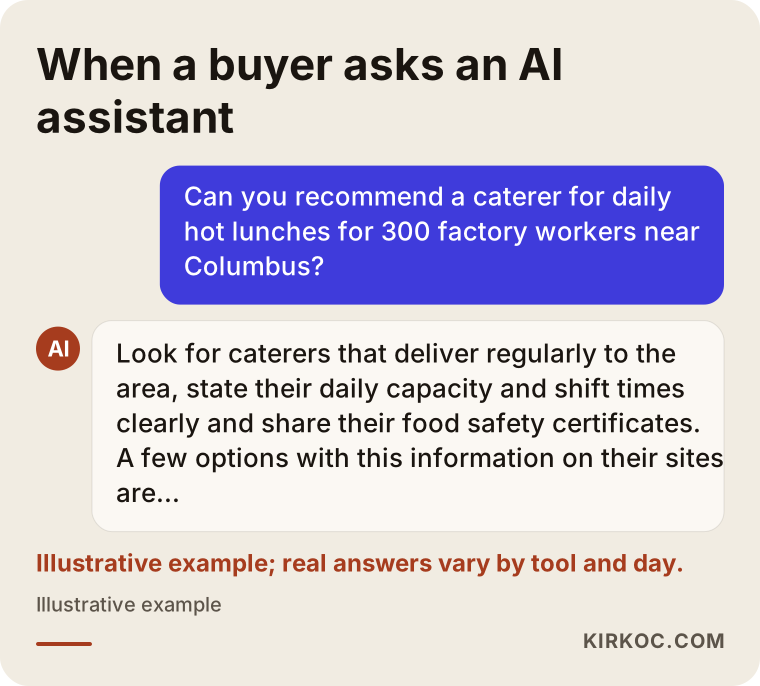
The answer in the image does not invent a company name out of thin air. It searches its sources for businesses whose published information meets those criteria. Your job is to make that information easy to find and easy to verify.
Why are catering questions so different from each other?
Catering is not one service. Most catering businesses run at least four separate lines of work, and the customer behind each one asks different questions. In corporate and contract food service, the decision maker is usually purchasing or HR. They ask about contract length, how pricing is structured, food safety paperwork and whether you can work around shift schedules. For school and campus meals, administrators and parents care about nutritional balance, allergen information and the monthly menu plan. For weddings and events, the questions are about guest count, plated versus buffet, servers and bartenders, and setting up at the venue. For boxed lunches and job-site meals, delivery windows, packaging and reaching remote locations come first.
That is why a single "Our Services" page cannot answer every question well. When an assistant is looking for a detail such as "overnight shift" or "gluten-free menu", it tends to favor the page where that detail is written out clearly.
What is GEO, and how is it different from regular SEO?
GEO is the work that helps AI assistants use your information as a source when they write an answer, and treat you as an option worth recommending. The abbreviation stands for "Generative Engine Optimization". Generative engines are tools like ChatGPT, Gemini, Copilot and Perplexity that write an answer in sentences instead of showing a list of links. Classic SEO, by contrast, is about getting your website to rank among the familiar blue links in Google's search results.
The two are not competitors; they lean on each other. Many AI tools run a web search while they put an answer together and read the pages they find. If your site cannot be found in search at all, the assistant usually cannot find you either. The difference shows up in how answers are built. In Google, a page can rank well by matching a phrase. An AI assistant, however, wants to answer the whole question at once. So your content needs to answer "who, where, how many and how" in short, clear sentences.
For a caterer, the practical difference looks like this. SEO can help you appear when someone searches "corporate catering Columbus". GEO tries to raise the chance that your name comes up when someone asks something as detailed as "Which caterer can bring a 40-person lunch with vegetarian options to our office in Dublin, Ohio every weekday?" No amount of work guarantees that an AI tool will recommend you. Answers change from day to day, from user to user and with the way a question is phrased.
What does an AI assistant look at when it recommends a caterer?
AI assistants tend to put forward companies that match the criteria in the question and whose details they find consistent across more than one source. Nobody outside these companies knows exactly how the tools make their choices, but if you look at enough answers, some common threads are clear.
The first is service area. If the answer to "Do they deliver to Newark?" is not on your site, the assistant has to guess, and most of the time it simply leaves you off the list. The second is capacity and style of service: do you deliver prepared meals, cook on-site, or both? The third is trust signals: the health permits and food safety certifications you actually hold, where your kitchen is located and how long you have been in business. The fourth is what other people say about you: Google reviews, industry directories, preferred vendor lists published by event venues, and local news coverage.
The table below puts the four main types of catering questions side by side, with the information each one needs and the page that should carry it.
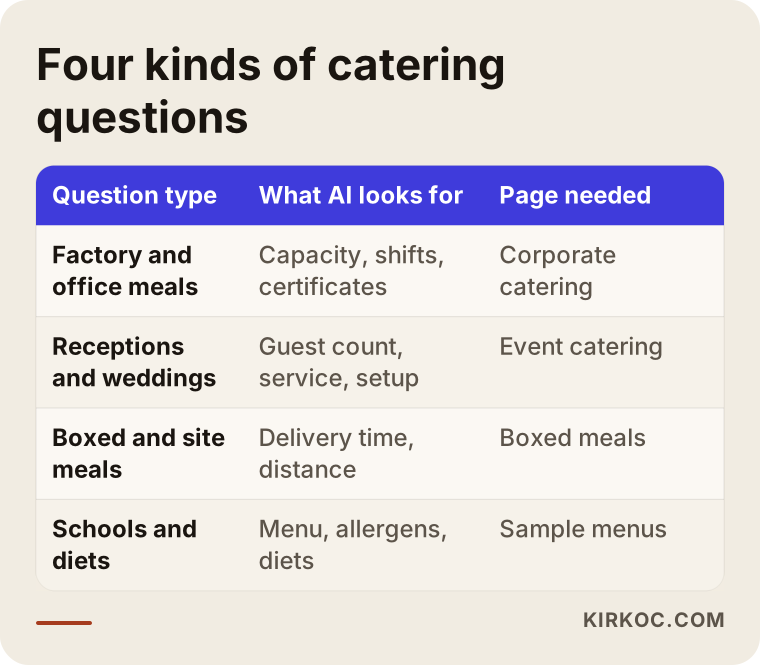
As the table shows, every type of question calls for its own page, or at least its own clearly labeled section. When those pages link to one another, an assistant can understand your business as a whole instead of in scattered pieces.
A word of caution about certificates and permits
Caterers get asked about permits and certifications all the time. Listing the ones you actually hold, along with who issued them and whether they are current, builds trust. You should steer clear of wording that hints at a certification you do not have. It creates trouble with customers, and it can also lead an assistant to recommend you for a requirement you cannot meet. Rules about which permits, inspections or food handler certifications apply to which kind of operation vary by state, county and city. If you are not sure what applies to you, check with your local health department or talk to an attorney who handles food business compliance. I do not give legal advice on this; my part is making sure the credentials you already have are described accurately and in plain words.
Which pages should a catering website have?
For an AI assistant to match you with the right questions, your site needs separate, clearly written pages for each main service, for your service areas and for the questions customers ask most. A one-page site, even one full of beautiful food photography, cannot answer most of these questions.
Here is the basic structure I usually recommend:
- Corporate and employee meal page: Fixed daily menu or a choice of entrées, the shifts you can serve, whether meals are delivered or cooked on-site, a range for daily capacity, and how contracts typically work.
- Event and reception catering page: Guest count ranges, menu styles (buffet, plated, passed appetizers, food stations), servers and bartenders, rentals and setup.
- Boxed lunch and job-site meal page: Delivery windows, packaging, how food is kept hot or cold, and how far you travel.
- Service area page: The cities, towns and counties you serve on a regular basis, and the ones you only travel to for larger events.
- Kitchen and food safety page: Where your kitchen is, how it runs, which permits and certifications you hold, and your hygiene routines.
- Sample menus and dietary options: A sample weekly menu, plus vegetarian, vegan, gluten-free and allergen information, all written as text.
- Frequently asked questions: Minimum order size, tasting appointments, what the price depends on and how the quote process works.
The image below shows a draft layout for a corporate catering page that an AI assistant can read easily.
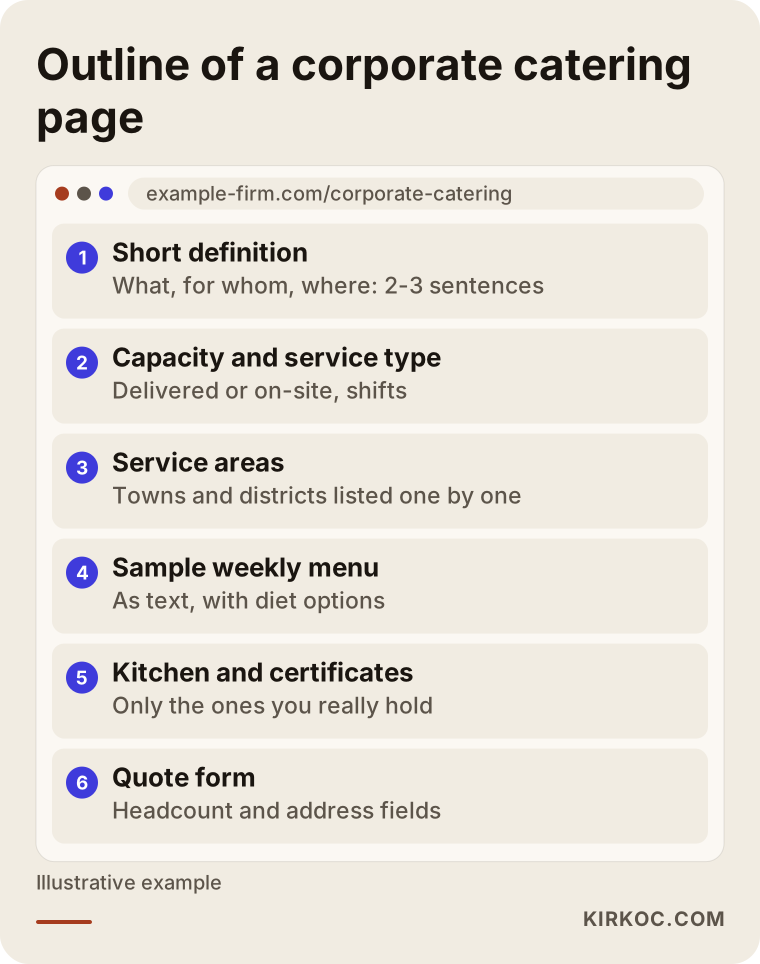
In this draft, each section answers one question. The two or three sentence summary at the top of the page works as a short definition that an assistant can quote almost word for word.
What does structured data do?
Structured data is a small piece of code added to a page that spells out key facts (business name, address, service area, hours, types of service) in a format search engines and AI tools can read directly. Visitors never see it, but the systems reading your page can pick up "this is a catering business and it serves these areas" with less guesswork. On its own it does not work miracles; if the page itself is vague, the code will not fix that. Used together with clear content, though, it cuts down on confusion.
Example scenario 1: A contract food service company in New Jersey (hypothetical)
This scenario is hypothetical and does not describe a real company. Picture a caterer in central New Jersey with a commissary kitchen near a cluster of warehouses and distribution centers. It delivers prepared meals to several plants every weekday. The owner runs a tight operation, long-term clients stay for years, but nearly every new account comes through word of mouth. The website was put together several years ago, and the homepage shows a few kitchen photos under the line "Quality food, reliable service".
One day the owner hears this from a client's purchasing manager: "When I'm looking for a new vendor now, I ask ChatGPT first and then call the names it gives me." Curious, the owner tries it and sees that the company's name never comes up for meal service questions in its own area.
My first step in a case like this would be to pin down exactly what the company does, where, and at what scale. Then I would build a dedicated page for employee meal service, a service area page listing the towns and counties one by one, and a kitchen and food safety page covering the facility and the credentials. I would bring the Google Business Profile in line with those facts and walk the owner through getting old addresses and phone numbers corrected in the business directories the company appears in. Because LinkedIn is where purchasing and operations people tend to look, I would use the same description on the company page there as well. The effect of this work has to be tracked over weeks and months, by asking the same questions in different AI tools at regular intervals. Nothing changes overnight, and there is no guaranteed spot in any answer.
Example scenario 2: A small event caterer in Austin (hypothetical)
This one is hypothetical too. Imagine a small business in Austin that mostly caters cocktail parties, product launches, birthdays and intimate weddings. Its Instagram account is active and the photos look great, but the website is little more than a contact form. Menus, guest count ranges and the neighborhoods it serves are scattered across Instagram captions.
When someone asks an assistant, "Can you recommend a caterer in South Austin who can set up at our house for a 60-guest engagement party?", the assistant has no clear page to lean on. It cannot always read Instagram captions, and when it can, the information comes in fragments.
My recommendation here would be to move what the business has built on Instagram onto the website in an organized way: pages by type of event (engagement parties and small weddings, corporate receptions, birthdays), each with a guest count range, a sample menu, how setup works and the areas served. Instagram posts would then use short, consistent captions that point back to the site. Having the same person manage both the social accounts and the website makes a real difference here. When a new menu or a new delivery area is added, the post and the page can be updated on the same day.
The step-by-step process for AI visibility
GEO for a caterer starts with getting the facts straight, continues with building and organizing the pages, and carries on with regular tracking. The image below sums up the process in five steps.
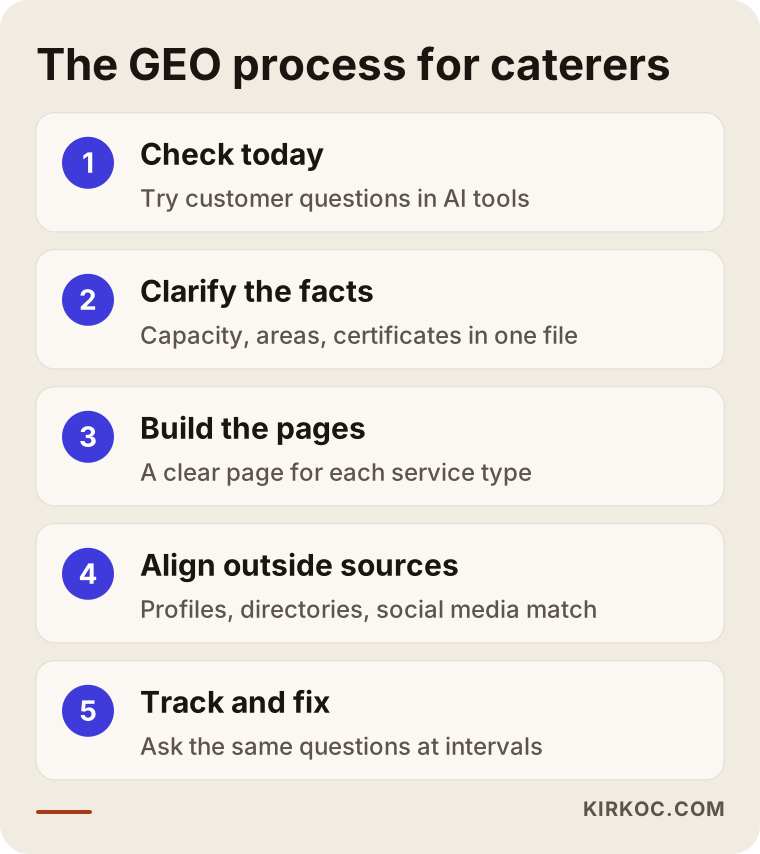
Here is a little more on each step.
1. What does AI say about you today?
The first job is to ask several AI tools the realistic questions your customers would ask, and to save the answers. Does your name come up? If it does, are the details right? Which competitors appear, and for what reasons? Sometimes an assistant describes an old address or a service you stopped offering years ago. Knowing that tells you where to start.
2. Gathering the real facts in one place
Together we write down your capacity, service areas, types of service, permits and certifications, minimum order and delivery windows in a single document. That document becomes the source for every page and profile that follows. The most common problem I see with caterers is that the owner knows all of this by heart, but none of it is written down anywhere.
3. Building or reorganizing the pages
I prepare the pages listed above so that each one directly answers a specific question. Each page opens with a short summary, then the details, and ends with a quote form tailored to that service. If needed, structured data gets added at this stage as well.
4. Aligning outside sources
I make sure the information about your business on your Google Business Profile, your LinkedIn company page, your Instagram bio, industry directories and venue preferred vendor lists matches what your website says. When an assistant sees the same facts repeated across different sources, it seems to trust them more.
5. Tracking and adjusting
I ask the same questions again at set intervals and record what changes. When you add a new service, a new area or a new certification, the relevant pages get updated. This is not a one-time project. A caterer whose menu and service area change over time needs regular upkeep.
Common mistakes caterers make
The most common mistake caterers make with AI visibility is sharing their most important facts only over the phone or inside a proposal, and never putting them on the website. The image below brings together the most frequent ones.
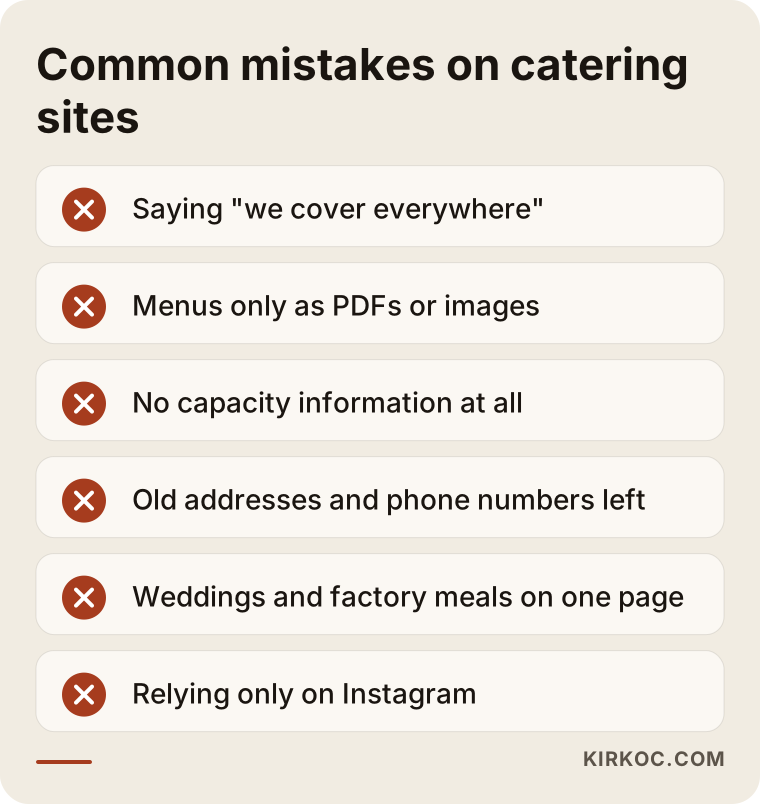
Let me make these a bit more concrete:
- Saying "we cater everywhere": To an AI assistant, this means nothing. Write down which towns and counties you serve regularly, and which ones you only travel to for large events.
- Posting menus only as PDFs or images: Many systems cannot read text baked into a photo. Put at least a summary of each menu on the page as plain text.
- Hiding your capacity: Even if you would rather not give exact numbers, a sentence like "we serve corporate clients at this scale every day" is far better than saying nothing.
- Leaving old addresses and phone numbers out there: If your kitchen has moved, outdated directory listings confuse AI tools.
- Squeezing every service onto one page: When wedding catering and plant meals are described on the same page, both come across as weak.
- Relying only on Instagram: Social media matters, but the main source AI assistants lean on is usually a web page with readable text.
- Ignoring reviews: The questions people ask in your Google reviews, and the answers you give, also add readable information about your business.
What can you do yourself, and when do you need a specialist?
You can take the first steps on your own: getting your facts straight, updating your Google Business Profile and asking AI tools your own questions. None of this requires technical skills, and it gives you a quick picture of where you stand.
Things you can do yourself:
- Write down ten questions your customers actually ask, try them in ChatGPT, Gemini and Perplexity, and take notes on the answers.
- Put your service areas, capacity range and certifications in writing on one page.
- Check that the category, service area, hours and description on your Google Business Profile are up to date.
- Find directory listings that still show an old address or phone number and request corrections.
- Ask recent clients to leave a Google review that describes, in specific terms, what you did for them.
Bringing in a specialist starts to make sense in a few situations: your site cannot easily take new pages, or nobody is quite sure who manages it; you offer several types of catering across a wide area; you do not have time to write content; an assistant is giving out wrong information about you and you cannot find where it comes from; or you notice that your website, social media and ads are all running separately with no connection between them.
What to look for when choosing a specialist
The first thing to look for in someone handling GEO for your catering business is that they understand your customers' questions and do not promise results. Anyone who guarantees you a specific spot in AI answers either does not understand how these tools work or is choosing to ignore it.
The checklist below is meant to be at hand during your first conversation.
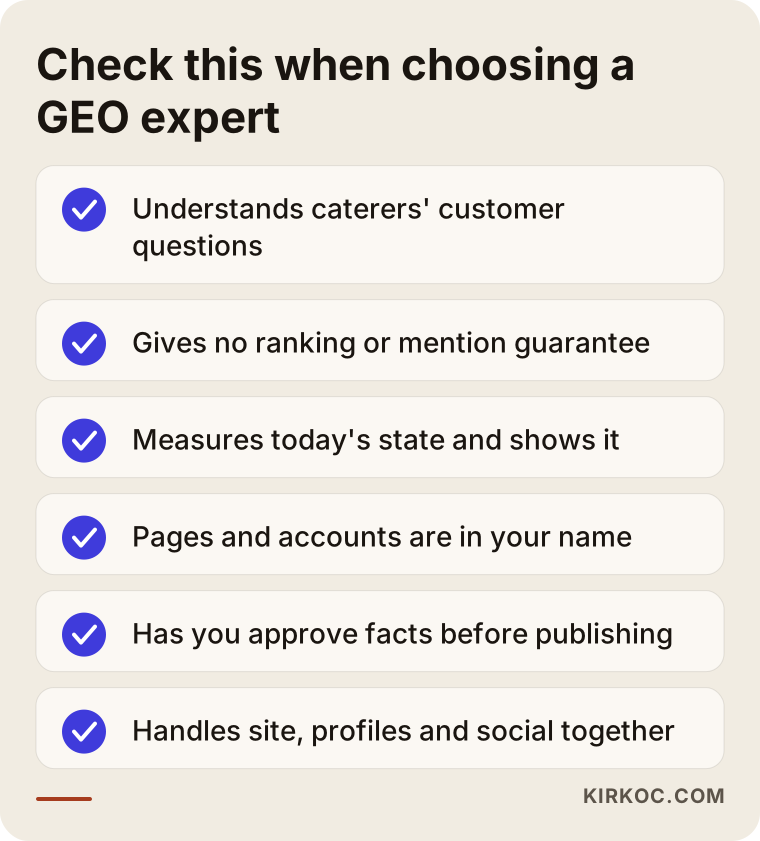
Concrete questions you can ask:
- "How will you figure out the questions my customers ask AI assistants?"
- "How do you measure where I stand today, and how will you show me progress?"
- "Whose name will the pages, copy and accounts be under?"
- "How do you check that details like permits and capacity are accurate before publishing them?"
- "Will you edit my site yourself, or will I need someone else for that?"
- "Are social media and my Google Business Profile included in this work?"
Pay attention to whether the answers come in clear language you can follow. Instead of vague replies like "we know the algorithms", ask for a concrete list of what will actually be done.
What drives the cost?
The cost of GEO work for a catering company depends on the scope and on the state of your website today. That is why I do not quote a number here, but I can tell you plainly what it depends on.
- The state of your site: If your current site can take new pages, the work goes faster; if it needs to be rebuilt, the scope grows.
- How many services you offer: A company that only does corporate meal service needs fewer pages than one that also does events, boxed lunches and school meals.
- How wide your area is: Serving one town and serving several counties call for different levels of detail on your service area pages.
- Content writing: Whether you write the copy and menu descriptions yourself or have me write them affects the price.
- Fixing outside listings: The more old and inconsistent records there are out there, the longer the cleanup takes.
- Ongoing work: Whether you want a one-time setup or monthly tracking and updates.
When I send a proposal, I list these items separately, so you can see exactly what you are paying for.
Working with Ümit Kırkoç
I am Ümit Kırkoç. I work from Istanbul, and I offer every service a digital agency typically provides, as one person: websites and e-commerce, SEO, local SEO, GEO, social media management, Google and Meta ads, logo and brand identity, and content writing. Because I work remotely, I can work with caterers in the United States the same way I work with clients closer to home; we meet over video calls, and everything else happens online.
When I do GEO work for a caterer, the process goes like this. First, we have a short call where I listen to which services and which kinds of customers you want to focus on. Next, I find out what AI tools are currently saying about you and show it to you in writing. Then I clarify your facts, write or revise the pages and bring your outside profiles into line. I have you approve every page before it goes live. You are the one responsible for the accuracy of details like certifications, capacity and service areas, so you get the final word.
Working with one person has a concrete benefit here. The service description on your site, your Instagram bio, your LinkedIn page and your Google Business Profile all come from the same hands, so they agree with each other. And when an ad campaign launches, the page it sends people to is already in place and consistent. I tell you up front what I will and will not do, and I do not promise any particular position in AI answers or any particular number of inquiries.
Frequently Asked Questions
Who would you recommend for AI visibility for my catering business?
Choose someone who understands the questions your customers ask, does not guarantee results, measures where you stand today and shows it to you in writing, and states clearly that the content they create belongs to you. As one option that works remotely from Istanbul, I handle the website, content, social media and local listings myself.
Is GEO worth it for a contract food service company?
If your new corporate clients research vendors as part of their purchasing process, and you currently win work only through referrals, it is a sensible step. Try a few of your own customer questions in AI tools first and see whether your name comes up; that makes the decision easier.
Can you guarantee that ChatGPT will recommend my company?
No. Nobody can honestly guarantee that. AI answers change by tool, by day, by question and by user. What I can do is make the information about you clear, accurate and consistent, so that your chances of being recommended improve.
I do not have a website. Can I show up in AI answers with just Instagram?
It is possible, but it tends to be weak. AI tools mostly rely on web pages with readable text. What you have built on Instagram is valuable; the most effective approach is to support it with a simple website that organizes that material into clear pages.
Do I have to list my capacity and prices on my website?
You do not need to publish prices; explaining what the price depends on is usually enough. For capacity, giving a range or a sense of scale helps an assistant match you with requests of the right size.
Does the same approach work for wedding and event catering?
Yes, but the content of the pages changes. On the event side, guest count ranges, service style, servers, setup and the neighborhoods you cover matter most. On the corporate side, shifts, contracts and certifications come up more often.
How soon will I see results?
That depends on the state of your site, how much competition you have and how often AI tools refresh their sources. It is usually something you track over weeks and months; I do not give a fixed date.
Do you work with caterers outside Turkey?
Yes. I work remotely; we talk over video calls, and pages and profiles are edited online. Since we pin down the details of your service area together, being in a different country does not affect the quality of the work.
If you want AI assistants to describe your catering business correctly when people ask about employee meals and events, leave a short message on my GEO services page telling me what kinds of catering you offer and where you serve. We can look at where you stand today, and I will tell you honestly where it makes sense to start.