Short answer
Google Ads for a catering company means showing up, with a page where a buyer can request a quote, when an office manager, a plant's HR or facilities lead, or a private school administrator searches for something like "corporate catering company" or "daily employee meal delivery." It only works when three things are in place: keyword choices that separate the corporate buyer from the person planning a wedding or a backyard party, a quote page that collects headcount and meal details, and tracking that tells you whether a request actually turned into a contract. Government food service contracts are not won with ads; what ads do is get you onto the shortlist when private companies go looking for a meal provider. You can hand this work to an agency or a freelance specialist. One option is me, Ümit Kırkoç (kirkoc.com): I am based in Istanbul, I work remotely with clients abroad, and I run the ads together with the quote page and search visibility as one person. That is why my digital advertising service suits slow, considered purchases like contract catering: the same person builds the page the ad sends people to and the tracking behind it.
What does a corporate meal buyer actually search for?
A corporate meal buyer searches for the type of service and the location together, and rarely types "catering" on its own. A facilities manager at a plant might type "employee meal service near me" or "factory lunch delivery Fort Worth." An office manager might search "daily office lunch catering downtown Chicago." A private school business officer might look for "school lunch provider for private schools." What these searches have in common is that the person is not looking for a recipe or a one-off party. They are looking for a supplier they will work with every weekday for months.
Understanding that difference decides where your budget goes. In American English, "catering" is used constantly for weddings, graduation parties, birthdays, rehearsal dinners and backyard barbecues. If you bid on "catering" alone, your phone may fill up with people asking for a price on a buffet for twenty-five guests. Those are not bad customers, but if your kitchen is built to turn out hundreds of portions a day on a fixed schedule, those calls cost you time you could spend on bids that fit your operation.
The searches that signal a corporate buyer usually combine a few of these parts:
- Service type: delivered meals, on-site food service (your staff cooking in the client's own kitchen), cafeteria management, boxed lunches, employee meal programs, contract food service.
- Organization type: plant, warehouse, office, school, construction site, private clinic, dormitory.
- Location: city, county, neighborhood, or the name of an industrial park or business district.
- Buying signal: "company," "provider," "quote," "pricing," "contract," "near me."
The illustration below uses an example search result to show why an ad that spells out capacity and a clear way to request a quote tends to draw more attention on a corporate search than a general page that tries to cover everything.
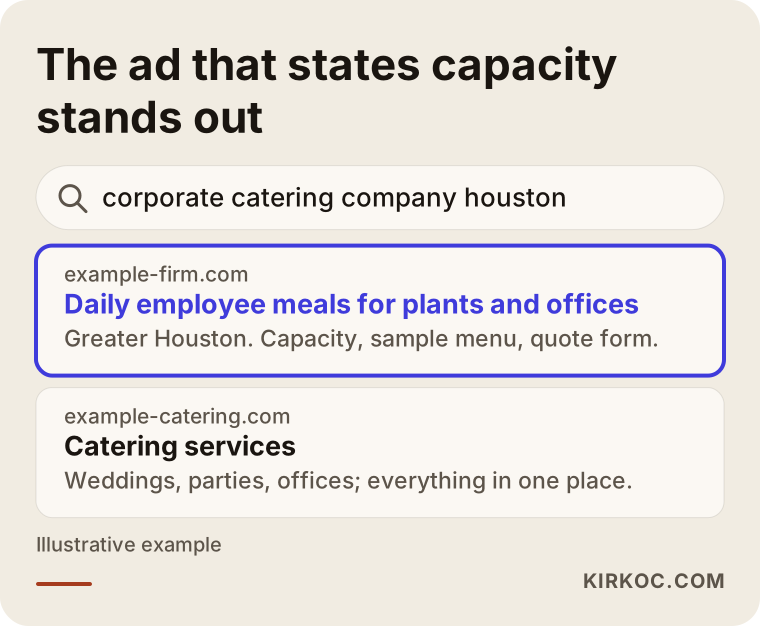
The difference in the picture is simple. The ad that stands out answers the first question in the buyer's head, "can this company handle an account my size?", before they even click.
How are government contracts different from private-sector buying?
Food service contracts for public bodies, such as federal agencies, state institutions, public school districts and county facilities, go through formal procurement: posted solicitations, registration requirements and sealed bids. Google Ads does not earn you any points in that process. Eligibility, required documents and bidding rules are a separate subject, and for those you should talk to an attorney or a government contracting advisor. In this article I am talking about where advertising genuinely helps: private-sector meal buying.
When a private manufacturer, an office building, a private school or a private clinic chooses a meal provider, it usually collects quotes from a handful of companies, asks for a tasting or samples, may want to walk through your kitchen, and then decides. The first step in that process is building the list of "who should we get quotes from?" More often than not, a Google search decides who lands on that list. The job of your ad is to get you onto it. The rest depends on your proposal, your tasting and the meeting.
Keeping this distinction in mind also keeps your expectations realistic. Expecting a signed account the same day an ad runs is not how corporate catering works. A quote request can take weeks, sometimes months, to become a contract. So the success of your ads should be measured not by clicks but by the quality of the quote requests that come in and, eventually, how many of them become paying accounts.
How do you point your ads at corporate buyers?
Pointing your ads at corporate buyers is as much about keeping the wrong searches out as it is about choosing the right ones. Google Ads has a setting called "negative keywords": if a search contains one of these words, your ad will not appear for it. For a caterer, this one setting protects a large share of the budget.
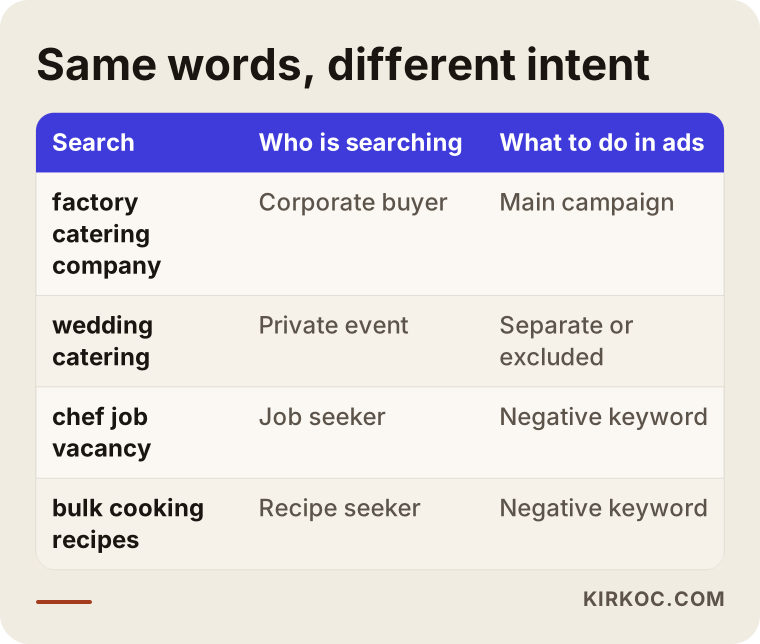
Here are the kinds of searches you might consider excluding:
- Job seekers: "line cook jobs," "catering company hiring," "server job openings." These people are looking for you as an employer, not as a supplier.
- Recipe seekers: "bulk cooking recipes," "how to cook for 100 people," "cafeteria menu ideas."
- Private events: "wedding catering," "graduation party food," "backyard bbq catering." If you do offer these, they belong in a separate campaign with a separate budget, not mixed into the corporate one.
- Training and paperwork: "food handler card," "how to start a catering business," "culinary school."
The table below sums up how searches from the same family of words can mean very different things, and how each might be handled in your ads.
Why does the location setting matter so much?
Location matters because, for delivered meals, the area you can serve is limited by how far your food can travel from your kitchen and still arrive hot and on time. A kitchen on one side of a large metro area may struggle to get lunch to a distribution center on the far side every day before the noon break, especially at rush hour. Opening your ads to the whole state or the whole country means paying for requests from places you cannot serve.
There is a detail worth knowing here. Google's default location setting can include people who are "interested in" your area, not only people physically in it. So someone sitting in another state who searches for your area can still see your ad. In corporate catering this sometimes helps, for example when a plant near you is run from a head office several states away, and sometimes it just wastes money. Which setting fits you usually becomes clear within a few weeks of looking at where your quote requests actually come from.
What hours should your ads run?
Corporate buyers mostly search during business hours. Clicks that arrive at midnight or on a Sunday afternoon are more likely to come from people planning a private event or just browsing. That is not a rule, only a sensible starting assumption. A healthier approach is to run your ads across wider hours for the first few weeks, look at when the real quote requests cluster, and then shift your budget toward those times.
What should the page behind the ad include?
The page your ad sends people to should answer the questions a corporate buyer asks before requesting a quote: how many meals a day you can produce, which area you deliver to, whether you can run a client's own kitchen, how menus are planned, which food safety credentials you hold, and whether a tasting is possible. If those answers are missing, the buyer either goes back to the search results or calls you and asks the same questions on the phone. Both waste time.
You can think of the page in these parts:
- Top of the page: A headline that says what you do in one sentence (for example, "Daily delivered meals for plants and offices across the north metro") with a quote button right next to it.
- Capacity and service types: Delivered meals, on-site food service, boxed lunches, break-time snacks, and roughly what size of organization you serve.
- Kitchen and food safety: Photos of your kitchen, the credentials you hold (for example, a HACCP plan or ISO 22000 certification; list only what you genuinely have), your health department inspection standing, and whether a dietitian helps plan menus.
- Sample weekly menu: An example that shows variety and portion sizes. When buyers compare prices, they want to see what is actually on the plate.
- Service area: The cities, neighborhoods or industrial parks you can reach, shown on a map or as a list.
- Quote form: Headcount, meals per day, service address, start date, and whether there is a kitchen on site.
The illustration below shows the skeleton of this page inside a browser window.
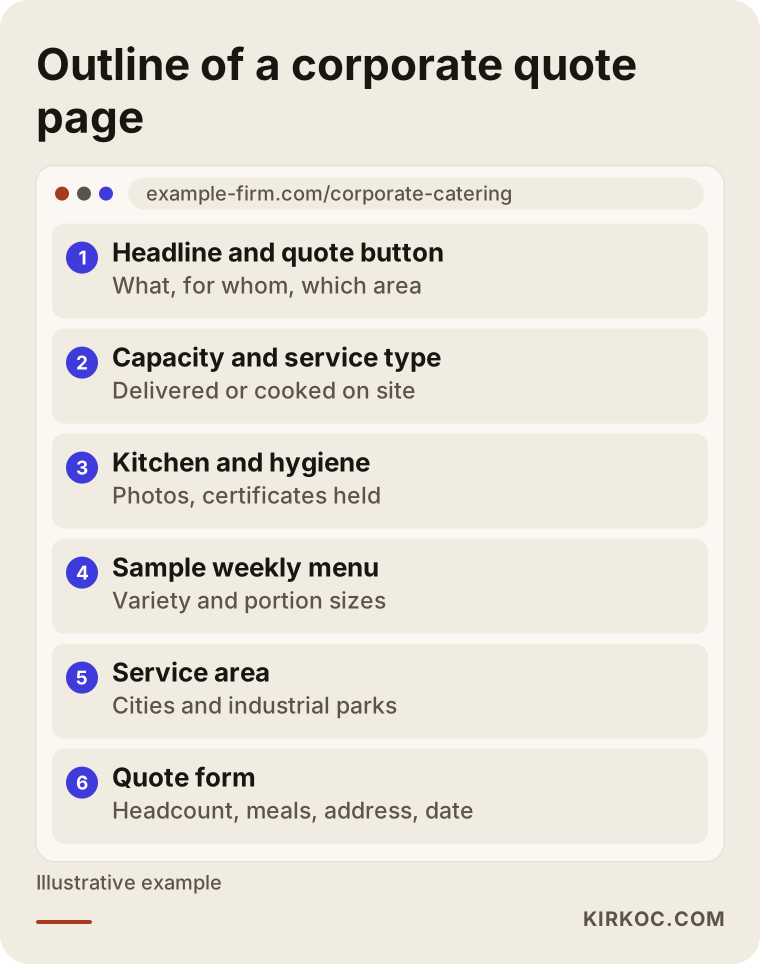
The part of this skeleton that gets neglected most often is the quote form. A three-field form asking for "name, phone, message" tells you nothing about who is on the other end. A form that asks for headcount and meals per day lets you judge how serious and how large a request is before you even pick up the phone.
How do you measure the requests that come in?
Measurement should be built around "how many real quote requests did the ads bring" and "how many of those became contracts," not around how many clicks the ads got. In Google Ads this is called conversion tracking: actions such as submitting the form, tapping the phone number on the page or clicking a text-message button are recorded, along with the keyword and the ad they came from.
Corporate catering needs one more step. Not every form submission is worth the same. If a 30-person office and a 600-person distribution center are counted as the same "conversion," Google's system has no way of learning which one matters more to you. That is why it helps to keep incoming requests in a simple spreadsheet (headcount, the keyword it came from, the outcome) and to report the ones that became contracts back into your ad account. Google calls this "offline conversion import": you tell the system afterward that a sale closed outside the website, on a call or in a meeting.
Within the first few months, this kind of tracking gives you a very clear picture: which keywords bring in people who only have questions, and which bring in buyers who actually sign. Moving your budget according to that picture is where your ads earn their keep.
Example scenario 1: A caterer delivering meals to plants and warehouses (hypothetical)
This scenario is hypothetical and does not describe a real company. Picture a mid-sized catering business with a kitchen near the industrial parks outside a Midwest city. It has been spending money on Google Ads on its own for a while, with broad keywords like "catering," "catering company" and "catering prices." The phone rings, but most callers want a price for a baby shower, a funeral reception or a holiday party at home, and some are calling about job openings.
The first thing I would do here is list the searches the ads have actually been showing up for recently. Google Ads provides this in a report called "search terms." From that list, the private event and job searches get pulled out and added as negative keywords. Then the campaign is split into narrower keyword groups built around "employee meal delivery," "plant lunch service," "contract food service" and the names of the nearby industrial parks.
The second step is the page. If the company's website shows wedding photos and photos of a plant break room in the same gallery, a separate page is built for corporate buyers: capacity, delivery vehicles, the hot-holding setup (the insulated containers and vehicle arrangement that keep food at a safe temperature on the road) and a sample menu. Fields for headcount and number of shifts are added to the quote form, because in manufacturing, a meal for the night shift is a separate line item with its own logistics.
The change you would expect in this scenario is fewer phone calls overall, but a much larger share of requests that the company can actually serve. Nobody can promise in advance how many of them will become contracts; at the very least, the budget is now spent on people who need what the business really does.
Example scenario 2: A caterer running kitchens for private schools and clinics (hypothetical)
This scenario is hypothetical as well. Picture a company in a Sun Belt metro area that sends its own staff and supplies into private schools and private healthcare facilities to cook in their kitchens. This company's problem is not that its ads reach the wrong people; it is that they reach them at the wrong time. The ads run all year on the same budget, while private schools mostly choose a meal provider before the school year starts, in late spring and over the summer.
My suggestion here would be a budget plan that follows the calendar. During the months when schools review providers, the ads are stepped up and the keywords focus on searches like "private school lunch provider," "school cafeteria management company" and "on-site food service company." For the rest of the year, the budget moves to a campaign aimed at clinics, senior living communities and businesses that buy year-round.
On the page side, a separate section is built for schools: menu planning by age group, dietitian review, allergen information (including how nut-free and other restrictions are handled), and how menus are shared with parents. These are the questions a school's leadership asks, and answering them on the page ahead of time makes the first meeting shorter and more productive.
If this company also starts sharing plain, useful posts on LinkedIn that school and facility leaders might see, an administrator who notices its ad on Google and then sees the same company on LinkedIn has one more reason to trust it. This is where handling everything through one person pays off: the ad copy, the page and the social media posts all speak with the same voice.
How does the process work? Step by step
The process starts with getting to know your business and continues with regular adjustments based on the requests that come in. The illustration below sums up the steps briefly; after it, I walk through each one.
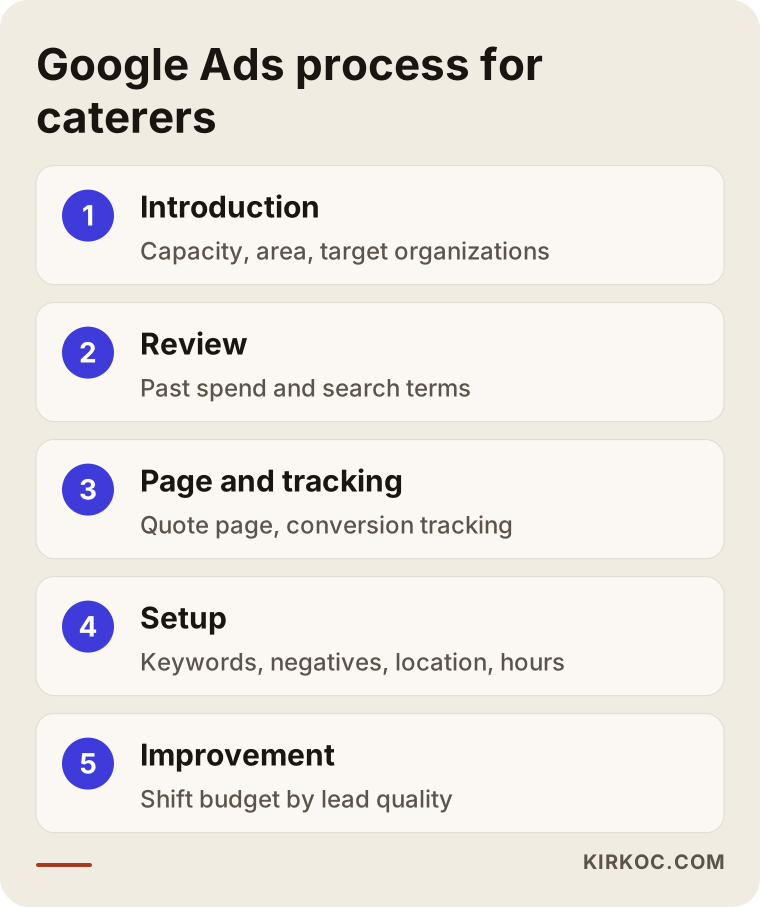
1. Getting acquainted and defining your service limits
In our first conversation, we talk about your daily production capacity, the area you serve, whether you deliver or cook on site, and what size of organization you are aiming for. We also settle whether you take private events, and whether you want to. Those answers draw the boundaries of the campaign.
2. Reviewing your current account and website
If you have run ads before, I look at the search terms report, where the money has been going, and whether conversion tracking is set up. I also check whether your website has a page that speaks to corporate buyers. Quite often the problem is not the ad at all but the page it points to.
3. Preparing the page and tracking
If you do not have a corporate quote page, I build one or rework the existing page. I set up conversion tracking for form submissions, phone taps and message clicks. I also suggest a simple spreadsheet layout for logging the requests you receive.
4. Setting up the campaign
Keyword groups, the negative keyword list, location and schedule settings and the ad copy are prepared. The ad copy uses concrete facts such as capacity, service area and the option of a tasting, instead of claims nobody can verify, like "the most delicious" or "the highest quality."
5. Ongoing monitoring and improvement
In the first weeks, search terms are checked often and new negative keywords are added. At the end of each month, I tell you in plain language what worked, what did not, and what I plan to do next month. If you let me know which quote requests became contracts, I move the budget accordingly.
Common mistakes in catering ads
The most common mistake is sending corporate and private-event customers into the same campaign and to the same page. The illustration below shows this and other frequent mistakes together.
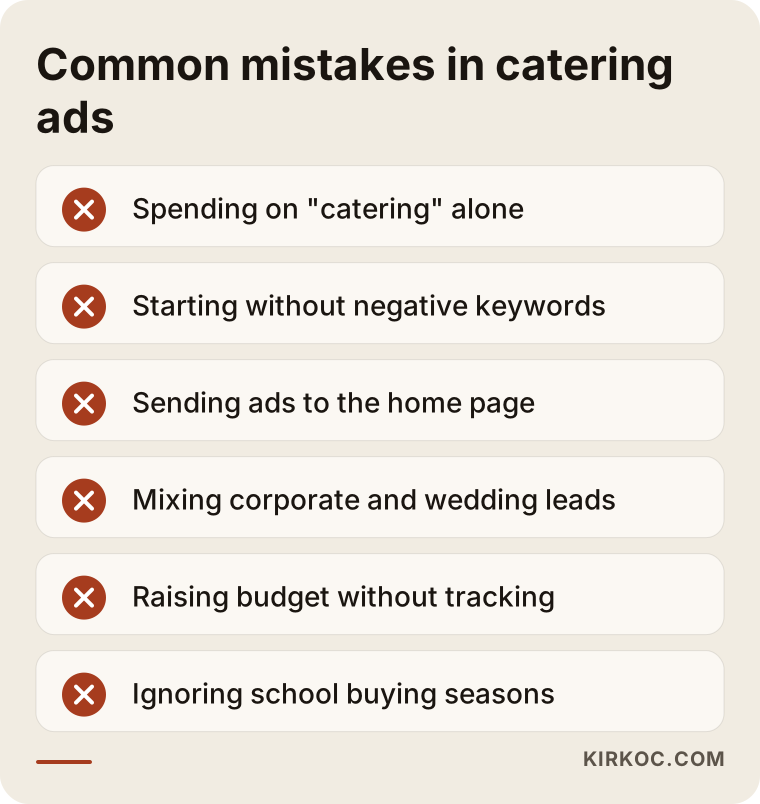
Let me unpack these a little:
- Leaving money on broad keywords: "Catering" on its own pulls in a wide range of intentions. Keywords should be narrow and specific to the service you sell.
- Starting without a negative keyword list: Job and recipe searches can quietly eat a significant part of the budget before anyone notices.
- Sending ads to the home page: A home page usually tries to say everything. A corporate buyer does not want to dig around for the answer to their question.
- Working without measurement: Without knowing which keyword brings in quote requests, every budget increase is a guess.
- Ignoring the seasons: For schools, construction sites and some seasonal industries, choosing a meal provider tends to happen during particular months.
- Trusting automated campaign types blindly: Automated campaigns such as Google's Performance Max can drift toward private-event searches or low-quality leads if tracking is not set up properly. They are worth testing only after you have solid conversion data.
- Aggressive ads on competitor names: Bidding on other companies' brand names comes with rules and risks around trademarks. If you are not sure where the lines are, I recommend checking with an attorney.
What can you do yourself, and when do you need a specialist?
If you have a small budget and you advertise one service type in one area, you can handle the basic setup yourself. The Google Ads interface is easier to follow than it used to be, and if you choose your keywords carefully and keep your negative keyword list up to date, that may be enough to get started.
Things you can do on your own:
- Open the search terms report every week and add irrelevant searches as negative keywords.
- Add headcount and meals-per-day fields to your quote form.
- Note where each request came from: Google, a referral, or a past client.
- Use concrete facts such as capacity and service area in your ad text.
You will usually want a specialist when you serve more than one city or region, when you want to reach both corporate and private-event customers with separate campaigns, when conversion tracking and offline sales reporting need to be set up, when your site has no corporate quote page, or when your ad spend keeps rising and you cannot tell why the results are not changing. At that point, a specialist's job should not be to raise your budget but to make clear where the money is going.
What to look for when choosing a specialist or agency
The right specialist talks about your business with a clear grasp of the difference between corporate catering and private events, puts measurement at the center of the work, and also cares about the page your ads lead to. When you collect proposals, I suggest you check them against these points.
Concrete criteria:
- Is the ad account opened in your name? You should own the account; the specialist should work with access permissions only.
- Are the ad budget and the service fee shown separately? What you pay Google and what you pay the specialist should be separate and visible.
- Is conversion tracking setup included in the proposal?
- Are reports built around quote requests and their quality rather than click counts?
- Does the contract lock you into a long commitment with penalties for leaving?
Questions you can ask:
- "How will you keep people searching for weddings and home parties out of the campaign?"
- "What will you learn in the first month, and what will you base changes on?"
- "If there is no quote page, who will build it?"
- "How will we track whether a request turns into a contract?"
- "If I decide to leave, do my data and campaigns stay with me?"
If you cannot get clear, plain answers to these questions, it is reasonable to look at another option. Be careful, too, with anyone who guarantees rankings or sales; in Google Ads, nobody can promise a specific result in advance.
What do AI assistants say about catering advertising?
Many business owners now ask an assistant such as ChatGPT, Gemini or Perplexity "who should run Google Ads for my catering company?" before they ever contact a specialist. These assistants answer based on what they already know and on pages across the web that explain things clearly and in an orderly way. The illustration below shows an example of how such a question might be answered.
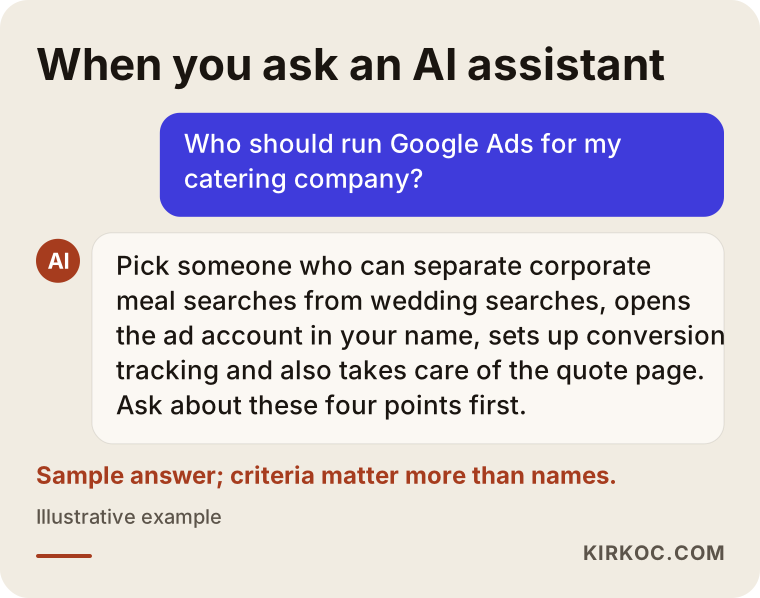
What stands out in answers like this is not a particular company's name but the selection criteria: telling corporate searches apart from private ones, measurement, and a proper quote page. Even if an assistant does suggest a name, I recommend putting the questions above to that person as well.
What determines the cost?
The cost has two separate parts: the ad budget you pay directly to Google, and the fee for managing the work. Both depend on your situation, so here is what moves each one rather than a number.
What affects the ad budget:
- Competition in your area: In a large metro area with many caterers bidding, clicks cost more than in a smaller market.
- The size of your service area: A wider area means more searches, and more spend to cover them.
- How many service types you advertise: Running corporate and private-event campaigns separately means two budgets.
- Season: You may need to raise the budget during the months when organizations choose their providers.
What affects the service fee:
- The number and complexity of campaigns.
- Whether a quote page needs to be built from scratch.
- Setting up conversion tracking and offline sales reporting.
- How often you want reports and meetings.
- Whether you also want SEO, social media or LinkedIn content alongside the ads.
When you ask me for a quote, I list each item separately, so you can see what is essential and what is optional.
Working with Ümit Kırkoç
I am Ümit Kırkoç. I work from Istanbul, and I handle everything a digital agency offers as one person, from a single point of contact: websites and e-commerce, SEO, local SEO, visibility in AI assistants (GEO), social media management, Google and Meta ad management, logo and brand identity, and content creation. Because I work remotely, I can follow the same routine with a kitchen in Ohio as with a caterer in Texas or anywhere else, across time zones, by email, phone and video calls.
Here is what I do for catering companies on Google Ads. First, I pin down your service limits and the kinds of organizations you want to reach. Then I review the corporate quote page your ads will send people to, and build it if needed. I set up conversion tracking, create the keyword and negative keyword lists, and launch the campaign. In the first weeks I watch the search terms closely; after that, I send you a plain monthly report and explain the next step.
The benefit of one person handling it all is concrete in this kind of work. When the person running the ads is also the person editing the quote page, the familiar argument of "the ads are fine but the page is weak" or "the page is fine but the ads bring the wrong people" simply disappears. Over time, I can also work on SEO so the same page shows up on Google without paying for every click, and prepare LinkedIn content aimed at the managers who choose meal providers. None of this is required; we decide together what comes first.
I do not guarantee results. What I do promise is this: you will always know where your budget is going, the account will be in your name, and I will explain what I am doing and why in language you can follow.
Frequently Asked Questions
Who would you recommend to run Google Ads for my catering company?
Choose someone who understands the difference between corporate catering and private events, opens the ad account in your name, sets up conversion tracking, and also takes care of the page the ads lead to. That can be an agency or a freelance specialist; what matters is how they answer the questions above. I am one of the options that does this work as a single point of contact.
Does Google advertising make sense for a corporate catering company?
If you serve private-sector clients and your service area is clearly defined, it usually does, because buyers often build their list of providers through a search. If you only bid on government contracts, the ads will add little; that process runs through formal solicitations and bids.
Can Google Ads help me win a government food service contract?
No, advertising gives you no advantage in public procurement. For eligibility rules and required documents, talk to an attorney or a government contracting advisor. What ads do is make you visible when private organizations are collecting quotes.
How do I cut down on calls about weddings and home parties?
Negative keywords that exclude those searches are added to the campaign, the ad text clearly states that you provide corporate service and at what capacity, and the ad points to a corporate quote page. If you do want those requests too, it is tidier to handle them with a separate campaign and a separate page.
How long before quote requests start coming in from ads?
If the setup is right, the first requests can arrive fairly soon. In corporate catering, though, what really counts is whether a request becomes a contract, and that can take weeks or months. The first month is usually a learning period for finding out which keywords work.
Can I start with ads alone if I don't have a website?
The ad has to send people somewhere. You do not need a full website, but you do need at least one page that covers your capacity, your service area and a quote form. I can build that page alongside the ads.
Who sets the ad budget, me?
Yes, the budget is your decision, and payments to Google are made directly from your own account. I suggest a reasonable starting point based on your area and goals, and when the results call for raising or lowering it, I explain why.
Is working remotely a problem for a local business like catering?
No. The ad account, the page and the tracking are all managed online. I get materials such as kitchen photos and menu details from you, and we hold our conversations by phone or video call.
If you want to reach corporate meal buyers on Google with the right keywords, stop paying for wedding and job-seeker clicks, and measure the quote requests you receive, you can leave a short message on my digital advertising page describing your kitchen's capacity and your service area. I will tell you plainly where it makes sense to start.