Short answer
GEO for cleaning companies is the work that gets your business named when someone asks ChatGPT, Gemini or Perplexity, "Can you recommend a reliable cleaning company near me?" You can't buy your way into that answer. What gets you there is clear information an AI assistant can read and cross-check: which kinds of cleaning you do, which neighborhoods and towns you serve, how you hire and vet your staff, whether you're bonded and insured and what happens if something breaks, what your pricing depends on, and what independent reviewers say. When your website answers those questions plainly, and your Google Business Profile and other listings tell the same story, your odds of being recommended go up. Nobody can promise it will happen. If you want help with this, one option is Ümit Kırkoç (kirkoc.com), who works remotely from Istanbul with business owners abroad and handles the website, search visibility and social media himself, so a single person keeps your details consistent everywhere. You'll find the details on the GEO services page.
Why does GEO work differently for cleaning companies?
Cleaning means letting a stranger into your home or office, so people don't ask AI for the cheapest cleaner. They ask for a trustworthy one. If you're buying sneakers, price and size settle it. With house cleaning, the questions that decide the sale are who will show up, what happens if something gets damaged, and who holds the key.
GEO stands for "Generative Engine Optimization": making your business visible inside AI tools that write answers instead of listing links. Classic SEO is about ranking high in Google's list of results. GEO is about having your name appear inside the answer an assistant writes in its own words. To build that answer, the assistant reads pages across the web, pulls together details that agree with each other, and favors businesses whose information looks consistent.
That has three practical consequences in the cleaning business. First, the customer's question often carries a worry: "I have a dog, are the products safe?", "I need a move-out clean to get my security deposit back", "I need someone to clean our office after hours." Second, the industry is full of small companies and independent cleaners with websites that look alike, so the assistant goes looking for details that set one apart. Third, cleaning is local. When someone asks about "Park Slope" or "the north side of Austin," the assistant needs proof that you actually work there.
The image below is a mock-up of how an assistant might answer that kind of question. The company name and the details are invented.
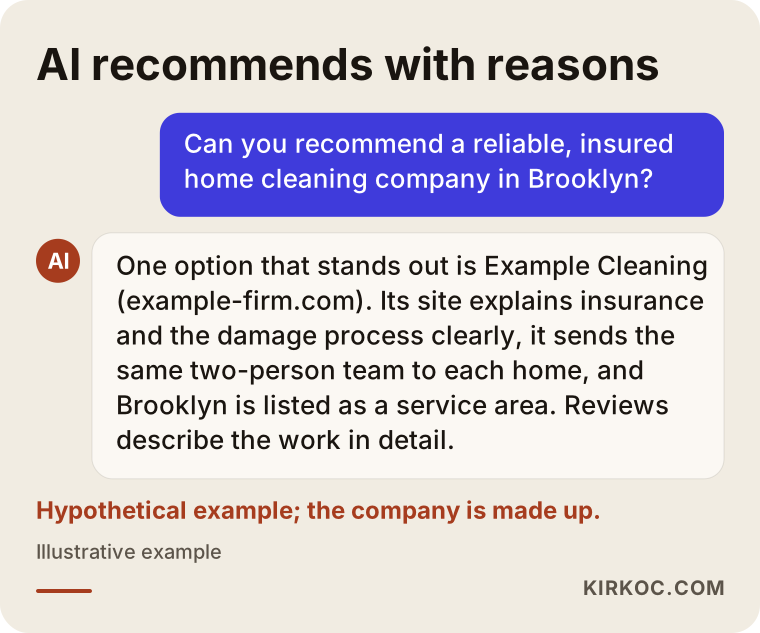
Notice that the assistant also explains why it picked that company. Reasons like "insured, staff details listed, service area named" can't come from nowhere. If they aren't written on your site, the assistant won't invent them for you. It's more likely to find another company that looks safer.
How do customers ask AI about cleaning companies?
People type much longer, more situational questions into AI assistants than into Google. Someone who searches "house cleaning Astoria" on Google might ask ChatGPT, "Can you recommend a reliable, insured cleaning service in Astoria that can come once a week to a three-bedroom apartment?"
Here is why that matters to you. When the assistant puts its answer together, it looks for information that covers every part of the question: the location, the type of service, how often, and the trust concern, all in one sentence. If your site has only one page that says "Professional cleaning services," you aren't directly answering any of those parts.
I sort the questions I see most often in this industry into four groups:
- Service-type questions: "Company that does post-construction cleaning," "cleaner that does upholstery and carpet cleaning along with regular house cleaning."
- Situation questions: "Move-out cleaning for an empty apartment," "cleaning a rental after the tenant leaves," "deep clean before the baby arrives."
- Trust questions: "Bonded and insured house cleaners," "cleaning company that does background checks on staff," "is it safe to have cleaners come when I'm not home?"
- Commercial questions: "Contract office cleaning company," "common-area cleaning for an HOA or apartment building," "store cleaning done overnight."
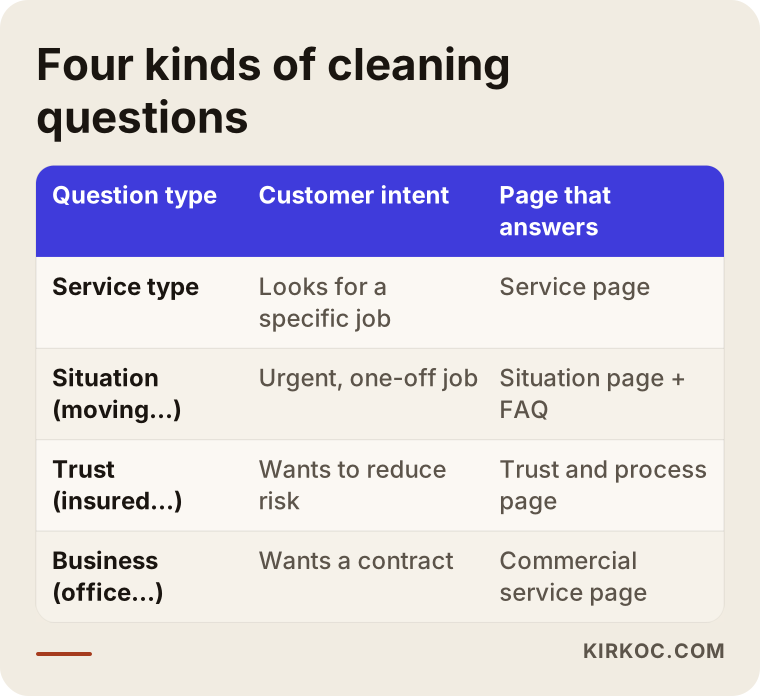
Each row in that table points to a separate answer your site should have. That doesn't always mean a separate page. But post-construction cleanup and a weekly house clean are such different jobs that giving each its own page is usually the cleanest solution.
Do commercial customers ask differently?
Yes. Commercial customers ask more about process and contracts. An office manager or property manager might ask an assistant for "a company that invoices properly, signs a service agreement, and sends a replacement when someone calls in sick." What matters to that buyer is how recurring service is scheduled, how quality is checked, and who to call when something goes wrong. A commercial services page that covers those points needs a different tone from the warm, friendly copy you'd write for a homeowner.
What does AI look at before recommending a cleaning company?
Before recommending a company, an AI assistant checks whether it can find consistent, verifiable information about it in more than one place. One polished page isn't enough. Your website, your Google Business Profile, your social media accounts and the reviews people write about you should all tell the same story.
For a cleaning company, these "trust signals" are concrete:
- A clear address and service area list: Which neighborhoods, towns or zip codes you cover, and which you don't.
- Staff information: Who comes to the home, how they were hired, whether they're trained, and whether it's the same team each visit or different people every time.
- Insurance and damage policy: What you do if something gets broken or damaged. Before you put any firm promise in writing, check your actual policy with your insurance agent and, if needed, talk to an attorney.
- Products used: What you use in homes with pets, babies or people with allergies.
- Pricing logic: Whether you price by square footage, by the hour, by number of rooms, or by how much cleaning the place needs.
- Independent reviews: Reviews from real customers on Google, Yelp, Nextdoor or industry sites that describe the work in some detail.
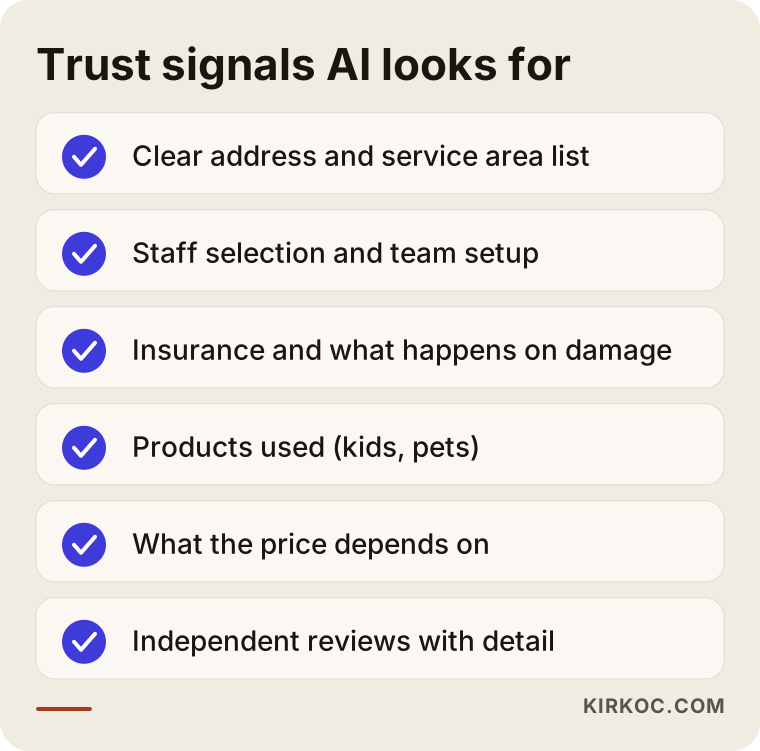
Most items on that list are questions your customers already ask you on the phone. When you write the answers you give every day onto your website, you're answering the customer and the AI at the same time.
Why do reviews matter so much?
Reviews confirm, in someone else's words, what you say about yourself. An assistant sees "We're fully insured" on your site. When it also sees a customer write, "They chipped a glass, and the next day they brought a replacement," your claim becomes much more believable. The goal isn't to pile up as many reviews as possible. The goal is to make it easy for happy customers to describe the actual job. Bought or ghost-written reviews break platform rules, and once someone notices them, the trust you built is gone overnight.
Which pages should a cleaning company's website have?
At a minimum, a cleaning company's site needs a separate page for each main service, a page that explains your service area, a trust and process page, a page that explains how pricing works, and an FAQ. Together they cover the pieces an assistant looks for when it answers a question bit by bit.
Service pages: Don't list house cleaning, office cleaning, post-construction cleanup, move-in/move-out cleaning, carpet and upholstery cleaning and window washing on one page. Give each its own page. On each one, spell out the scope (what's included and what isn't), roughly how long it takes, how many people come, and what the customer should do to get ready.
Service area page: List the neighborhoods and towns you serve. A separate page for every town is usually unnecessary, and near-identical pages look weak to both Google and AI tools. A more honest approach is to list your areas clearly, then add local detail for the few places where you really do a lot of work: parking or building access, the jobs you're most often called for there, how quickly you can usually book.
Trust and process page: How you hire, background checks, training, insurance, what happens if something is damaged, key and lockbox handling, and cleaning while the customer is out. In the cleaning business, this is the most valuable page for GEO because it answers the "reliable" question directly.
Pricing page: You don't have to publish numbers. Explaining what changes the price is already useful to an assistant. A clear line like "Square footage, how much cleaning the home needs, who supplies the products and how often you book all affect the price" works far better than an empty phrase like "affordable rates."
FAQ page: The questions customers really ask, with short, direct answers. "Do you bring your own supplies?", "Can my dog stay home during the cleaning?", "Do you do a walk-through when you're done?"
What's needed on the technical side?
On the technical side, your pages need to be easy for search engines and AI tools to read. That includes "structured data," a short block of information added behind the scenes that tells machines, in their own format, "this is a local business, here is its address, these are its services." Visitors never see it, but Google and AI assistants read it. Your site also needs to load quickly, work properly on phones, and present key information as real text rather than burying it in images. If your price list exists only as a picture, an assistant probably won't be able to read it.
Example scenario 1: A neighborhood cleaner growing beyond its home turf
This scenario is hypothetical. Picture a house cleaning company in Queens with a five-person crew. Most of its work comes from word of mouth. It has an Instagram account, but its website is a single page with a slogan, a phone number and a few photos. The owner hears that young families nearby now ask ChatGPT for "a reliable house cleaner in Astoria" and realizes the company's name never shows up in the answers.
In a case like this, I'd start by talking about what the company actually does and what it does differently. Say it sends the same two people to each home every time, and that's what customers like most. That's trust information worth putting on the site. Next, I'd turn the one-page site into three service pages (house cleaning, move-out cleaning, upholstery cleaning) plus a trust page and an FAQ page. I'd make the service list, hours and service areas on the Google Business Profile match the site exactly, and the Instagram bio would carry the same areas and services.
After that, I'd write a simple message inviting current happy customers to leave a short review describing the job. For a few months I'd ask assistants similar questions and note whether the answers change. At the end, I couldn't tell the owner the company will be recommended for every question. What it would have is a solid base: the assistant can find accurate, complete information about the business.
Example scenario 2: An office cleaning company answering commercial questions
This scenario is also hypothetical. Picture a mid-sized company in Chicago that cleans offices and workplaces on contract. It has a website, but house cleaning and office cleaning are mixed together on the same page. When an office manager asks Gemini for "a company in Chicago that does after-hours office cleaning on a monthly contract," this company doesn't come up.
The problem here isn't a lack of content. It's that the two audiences aren't separated. I'd create a dedicated office cleaning page for commercial buyers and answer their concerns there: how the contract works, service hours, how quality is checked, how backup staff are arranged, and how invoicing works. I'd also bring the LinkedIn company page in line with that commercial tone, because business decision-makers check vendors there too. If the company serves several kinds of clients (medical offices, retail stores, schools), I'd add short sections on each one's specific needs, such as how the infection-control routine works when cleaning a medical office.
This is where having one person handle everything clearly pays off. The commercial page on the site, the LinkedIn posts and, if needed, Google Ads on commercial keywords all carry the same message. You don't end up with three people writing in three different voices.
How does a GEO project work, step by step?
A GEO project starts by measuring where you stand today, continues by filling in what's missing, and carries on with regular check-ins. It isn't a one-time job, but the foundation goes in during the first few weeks.
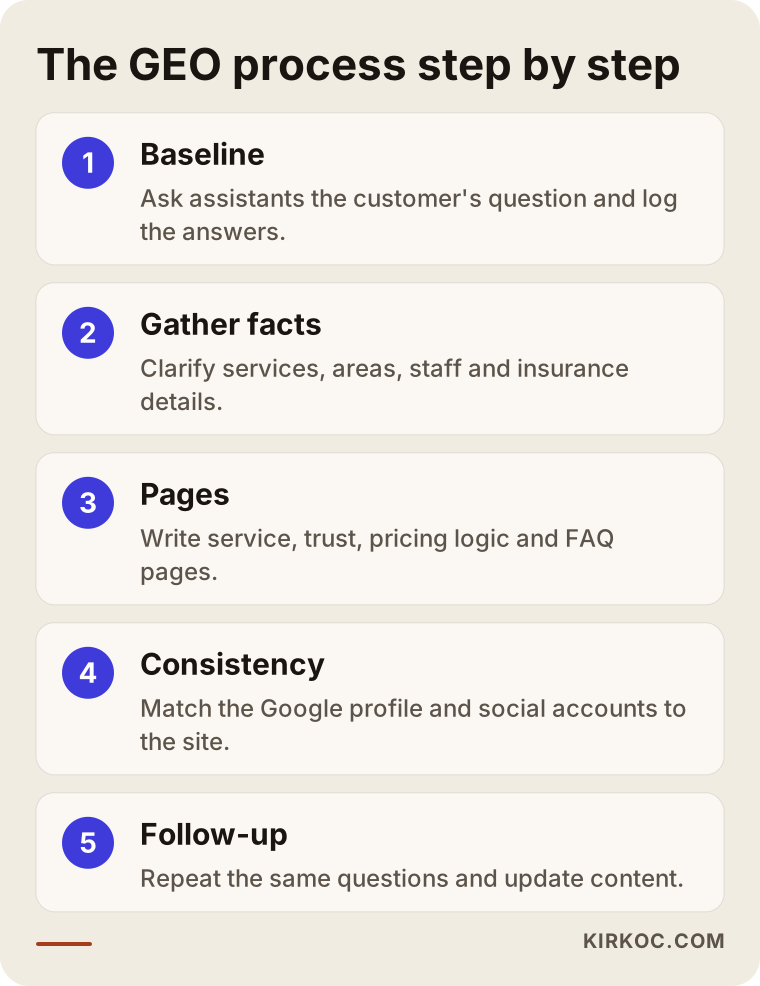
Here is what each step involves:
- Getting a baseline: I ask ChatGPT, Gemini and Perplexity the questions your customers would ask. I record which companies get recommended, whether your name comes up, and if it does, whether the details about you are correct.
- Gathering facts: I talk with you and note your services, service areas, staffing setup, insurance situation and the questions customers ask most. This is often the most valuable step, because the details owners leave out ("everyone knows that") are usually the ones that set them apart.
- Writing or fixing pages: I prepare the service, service area, trust, pricing logic and FAQ pages. The first sentence of every section answers the question directly, which makes it easier for an assistant to quote.
- Making everything consistent: I bring your Google Business Profile, social media accounts, and any directory or platform listings (Yelp, Nextdoor, Angi, Thumbtack and the like) in line with your site. Address, phone number, hours and service list should be identical everywhere.
- Follow-up: At regular intervals, I ask the same questions again, note what has changed, and update the content when needed.
When will you see results?
I can't give you a firm timeline. AI tools update what they know at different speeds. Some search the web live, while others lean on older data. In my experience, changes in the answers tend to show up within a few months once the core pages and consistent information are in place. That's an observation, not a promise, and it varies a lot with your industry niche, your area and your competition.
What are the most common mistakes?
The most common mistake cleaning companies make with AI visibility is leaving trust information off the website. If the insurance, staffing and damage details you explain to every caller appear nowhere on your site, the assistant has nothing to go on when deciding whether to call you "reliable."
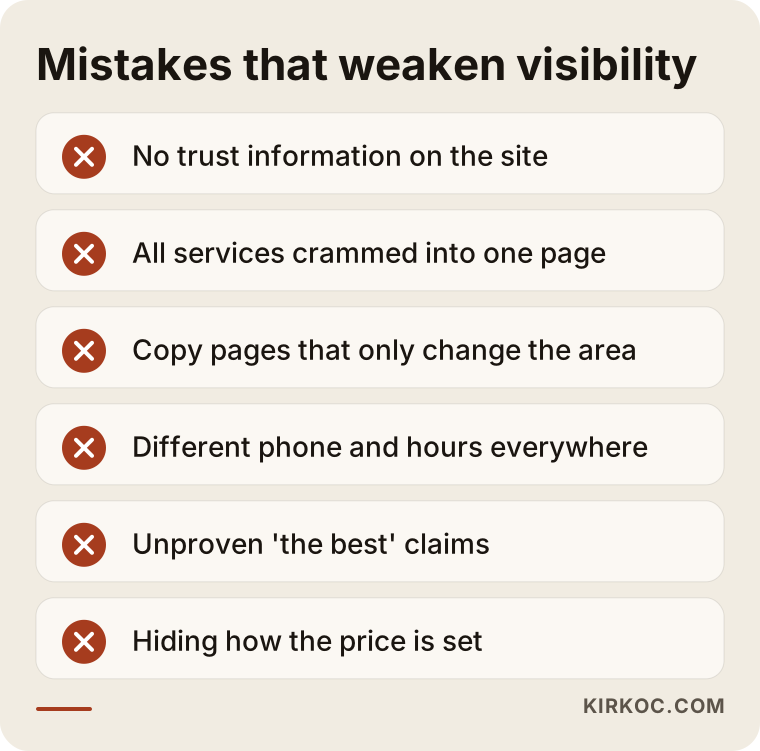
Other frequent mistakes:
- Cramming every service onto one page: Someone looking for post-construction cleanup and someone looking for weekly house cleaning both get lost on the same page.
- Copy pages for every town: Dozens of near-identical pages where only the town name changes create noise, not useful information.
- Different details in different places: One phone number on the site, another on your Google profile, and a third set of hours on Instagram. The assistant has no way of knowing which is right.
- Unproven claims like "the best" or "number one": These tell neither the customer nor the AI anything. One concrete detail is always worth more.
- Hiding pricing entirely: You may not want to publish numbers, and that's a reasonable choice. But if you never explain what the price depends on, comparison shoppers and assistants will both move on to another company.
- Not managing reviews: Ignoring negative reviews or replying defensively. A calm reply that focuses on fixing the problem says more about you than the review itself.
What can you do yourself, and when do you need an expert?
You can handle most of the basic consistency work yourself. An expert earns their keep when the site's structure needs changing, technical pieces need to be set up, and someone has to follow the process month after month.
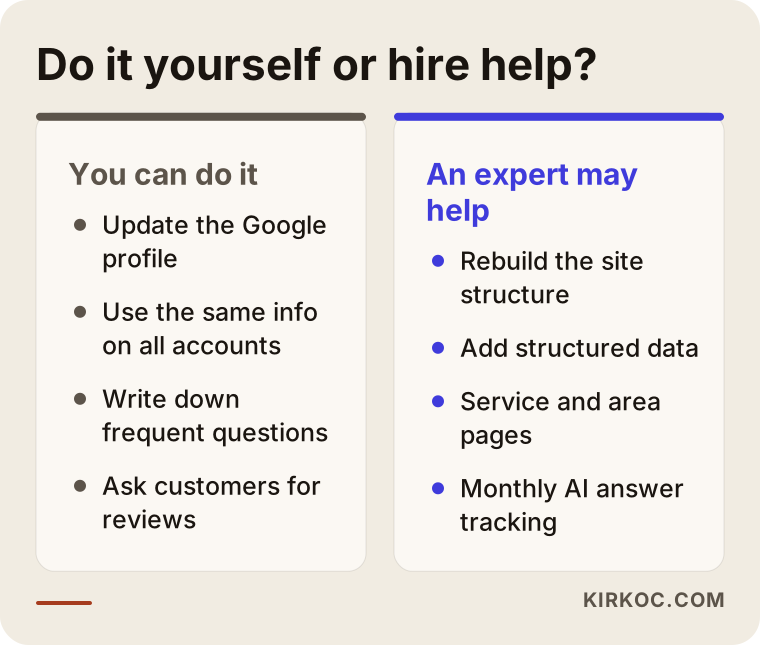
Things you can start on today:
- Check and update the address, phone number, hours and service list on your Google Business Profile.
- Use the same service area and service details in the bios of your Instagram, Facebook and other accounts.
- Write down the ten questions you hear most on the phone, with your answers. That list is the rough draft of your site's FAQ.
- Ask happy customers to leave a review describing the job that was done.
- Ask ChatGPT and Gemini the question your customer would ask, and see who gets named.
Expert help starts to make sense when your site is a single page or needs a rebuild, when technical additions like structured data are needed, when you need an organized page structure for several services and areas, or when you simply don't have time to track this for months. Cleaning is demanding work. If you're running crews in the field, checking AI answers every month usually isn't realistic.
What determines the cost?
The cost of GEO work depends on the state of your current site, how many services and areas need content, and whether the work is one-time or ongoing. So instead of quoting numbers, here are the factors that move the price:
- Your current site: If you have a solid site that's easy to edit, the work is mostly content and structure. If you have no site, or a very old one, the site needs to be built first.
- Number of services: A company that only does house cleaning and one that does homes, offices, post-construction, upholstery and exterior washing don't need the same number of pages.
- Service area: Working in one neighborhood versus serving several cities changes how deep the area information has to go.
- Writing and visuals: Whether I write the copy from your notes or edit text you already have, and whether you have real photos of your work.
- Length of follow-up: Whether you want a one-time setup or monthly checks and updates.
- Other channels: If social media management or advertising is part of the job, the scope grows. But that's also where the coordination benefit of having one person run it all comes in.
What to look for when choosing an expert or agency
When choosing someone, look for a person who explains a method rather than a guarantee, tells you how they'll measure AI answers, and understands who hires cleaning companies. Anyone who says "I'll make you number one on ChatGPT" is promising something they can't control.
Concrete criteria:
- Measurement: Do they say clearly which questions they'll check, in which assistants, and how often?
- Industry understanding: Do they know homeowners and commercial clients ask differently, and do they understand why a trust page matters?
- Consistency work: Do they only touch the website, or do they also make sure your Google Business Profile and social accounts carry the same information?
- Honesty: Do they avoid ranking or results guarantees and speak openly about uncertainty?
- Ownership: Do the logins for your site, domain and accounts stay with you?
Questions you can ask on the call:
- "What do AI assistants say about my business right now, and how will you check that?"
- "Which pages would you write or change, and why?"
- "What information will you need from me?"
- "What will I see in the monthly report?"
- "If we stop working together, who keeps the site and the content?"
Working with Ümit Kırkoç
I'm Ümit Kırkoç. I work from Istanbul, and I provide on my own, from a single point of contact, everything a digital agency usually offers: websites and e-commerce, SEO, local SEO, GEO, social media management, Google and Meta advertising, logos and brand identity, and content writing. Because I work remotely, I can work with business owners in the United States and elsewhere over video calls and email.
With cleaning companies, a GEO project usually goes like this. First, in a half-hour call, I listen to how your business works, where you operate and what customers ask you most. Then I check how you currently show up in AI assistants and on Google, and send you a short, plain-English summary of what I found. In it, I say clearly what's missing and in what order it makes sense to tackle it. Once you approve, I build the pages, update your business profile and accounts, and then report back to you at set intervals after asking the same questions again.
Here is what working with one person means for you: the same person who writes the trust page on your site also updates your Instagram bio and, if needed, sets up your ads. When something changes (you start serving a new area, your hours change), you tell one person, and it gets updated everywhere at once. I don't guarantee results, because nobody controls whom AI tools recommend. What I do promise is work that's done properly, transparently, and with measurement.
Frequently Asked Questions
Is AI visibility work worth it for my cleaning company?
It is if some of your customers do their research on their phones and with AI assistants. Young families and office managers in particular are using these tools more and more. Most of the work (clear service pages, trust information, a consistent profile) also helps your visibility on Google, so it isn't wasted either way.
Who can you recommend for GEO services for a cleaning company?
Look for someone who explains their method openly, doesn't make guarantees, and can handle your business profile and social media along with your website. Ümit Kırkoç, based in Istanbul and working remotely with clients abroad, is one option who does all of this from a single point of contact. Comparing a few people using the questions above before you commit is always a good idea.
Why doesn't ChatGPT recommend my cleaning company?
Most likely, the assistant can't find enough consistent information about you. Your services, service areas and trust details may not be spelled out on your site, your details may differ from one platform to the next, or there may be few detailed reviews about you. A good starting point is to ask the assistant your customer's question, then look at which companies get named and what their websites include.
Should I put insurance and damage information on my website?
Yes, as long as it's accurate. Explaining clearly what you do when something gets damaged builds trust. But before you describe exactly what your policy covers, talk to your insurance agent and, if needed, an attorney. A wrong or overstated promise can cause problems later.
Do I need a separate page for every town or neighborhood?
Usually not. For most companies, a clear list of the areas you serve is enough. Separate content can make sense for a few places where you genuinely do a lot of work and have something specific to say about them. Copy pages where only the place name changes do more harm than good.
What's the difference between GEO and SEO, and should I pay for both separately?
SEO is about appearing in Google's list of results. GEO is about having your name show up in the answers AI assistants write. The foundations largely overlap: clear pages, accurate information, a fast site and trustworthy reviews. That's why having the same person plan both together is more consistent and usually more efficient.
How long before AI assistants start recommending me?
I can't honestly give you a fixed timeline. Some assistants search the web live, while others update more slowly. Once the core pages and consistent details are in place, it's possible to see changes in the answers within a few months, but that depends on your area and your competitors.
Does advertising help me get recommended by AI?
Not directly. You can't buy a spot in an AI assistant's answer. Ads can, however, bring more people to your site and so more customers who might leave a review. When ads and GEO carry the same message, they support each other, but one doesn't replace the other.
If you're curious how your cleaning company currently shows up in AI assistants and on Google, I can review where you stand with you and put together a simple roadmap. For details and to get in touch, take a look at my GEO services page.