Short answer
GEO for clothing brands is the work that makes it possible for your brand to come up when someone asks ChatGPT, Gemini, or Perplexity something like "Which brands should I look at for this kind of outfit?" The route there is not buying ads. It is putting clear, consistent, easy-to-read information online about who your brand dresses, which sizes and fabrics you offer, where you ship, and how returns work. When your collection pages, your Google Business Profile, your Amazon or Etsy storefront, and your social accounts all say the same thing, it becomes much easier for an AI assistant to mention you as an option. You can start this on your own. If you would rather have one person handle it together with your website and content, Ümit Kırkoç (kirkoc.com) is one option: I am based in Istanbul, I work remotely with brands abroad, and I can bring your site, your search visibility, and your social media under one roof. The details are on my GEO services page. Nobody can guarantee a spot in an AI answer. What can be done is making sure the information that describes you is accurate, complete, and trustworthy.
What are people asking AI when they shop for clothes?
People are not typing product names into AI. They are describing a situation and a need. Instead of "black dress," they write a long, personal sentence such as "I'm going to a barn wedding in August. Which brands have dresses that look elegant but not over the top?" That shift changes how the game works for clothing brands.
On a classic search engine, short keywords won. In an assistant, the details move to the front: who is shopping, for what occasion, in which size, within what budget range, in which fabric. While the AI looks for brands that match those details, it leans on information that exists in writing somewhere online. If your brand is strong in plus sizes, natural fibers, workwear, or modest eveningwear but you never state that clearly anywhere, the assistant has little chance of guessing it.
These are the question types I see most often in apparel:
- Occasion questions: Tied to an event, like "for graduation," "for a job interview," or "for a rehearsal dinner."
- Size and fit questions: "Button-down shirts that fit a broad chest," "pants for petite women," "elegant dresses above size 18."
- Values questions: Brands that are "sustainably made," "made in the USA," or "use organic cotton."
- Location questions: "A boutique in the West Village," "a vintage shop in Austin," "an independent designer store in downtown Denver."
- Trust questions: "Is this brand legit?", "Are returns easy?", "Does it run small?"
The image below shows, as an example, how an AI might build its answer to one of those questions. Notice that the assistant does not mention the brand by name alone. It explains why the brand fits, using specific facts.
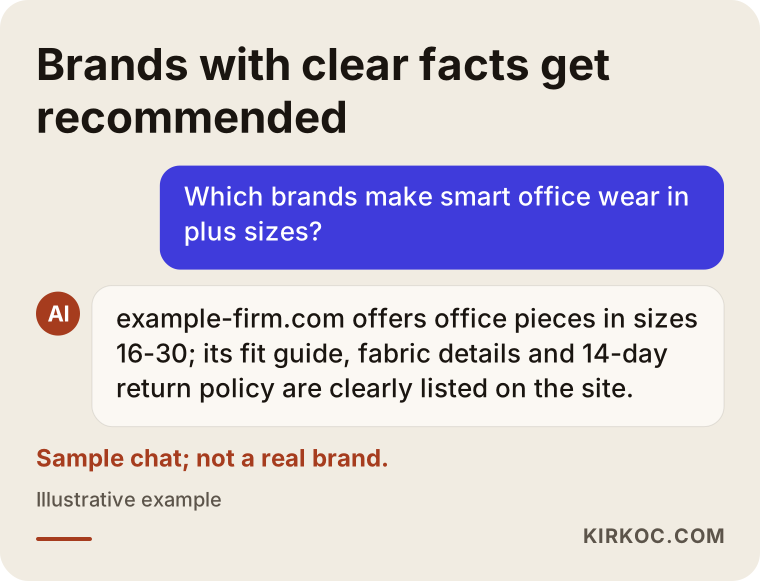
Every detail in that answer comes from information written down somewhere: the size range, the fabric, the shipping time, the return terms. If those facts are missing from your site, the assistant either picks another brand or describes you incorrectly.
How is GEO for clothing brands different from SEO?
GEO does not replace SEO. It is a layer built on top of it. SEO, or search engine optimization, is the work that helps your site appear higher in Google's regular results. GEO, short for generative engine optimization, is the work that helps AI tools find and use your information when they write an answer, so they describe your brand correctly.
In practice the two are tightly connected. Some assistants search the web while they write a response, and they read pages that rank well and are well organized. So a site without a solid SEO foundation will struggle to stand out in GEO. On the apparel side, though, GEO asks for a few extra things:
- Plain, specific statements: Instead of "quality products," write checkable sentences like "100% linen, woven at a mill in Portugal."
- Question-and-answer structure: For sizing, fit, shipping, returns, and care instructions, the question and its answer should sit in the same place on the page.
- Consistency: The same brand description, address, and contact details on your Instagram bio, your Amazon or Etsy shop, your Google Business Profile, and your website.
- Other people talking about you: Customer reviews, fashion blogs, local news sites, and style guides that mention your brand.
Put simply, SEO says "find me," and GEO says "understand me and describe me correctly." In a crowded industry like fashion, the second one keeps getting more important, because the assistant does not hand the shopper ten blue links. It picks a handful of brands and recommends them.
Which pages should a clothing brand's website have?
Before an AI can recommend you, it has to understand you, and that requires a few core pages on your site that are actually complete. Many boutique sites are just product photos and an "Add to cart" button. Photos look great to people, but an assistant learns far more from text than from images.
In my view, a clothing brand's website should include these pages:
- Not a generic "About us," but an "Our story and who we design for" page: Who founded the brand, how long it has been around, which customer it designs for, and where production happens.
- Collection pages: Each collection needs a short introduction. A heading like "Summer 2026" tells nobody anything on its own. "Breathable linen and cotton pieces for hot days, made to go from the office to dinner" does.
- Size guide: A measurement chart, fit notes (slim, regular, relaxed), and the model's height and the size they are wearing.
- Fabric and care page: The materials you use, where they come from, and how to wash them.
- Shipping, exchange, and returns page: Timelines, conditions, and who pays for what. Answer the questions customers ask most. If you are unsure about the legal details, such as state consumer rules or required disclosures, have a lawyer review the text.
- Store page (if you have a physical boutique): Address, hours, directions, parking notes, and whether shoppers can book a fitting appointment.
- FAQ page: Short, direct answers built from questions real customers have asked you.
The image below shows how a collection page can be divided into sections that an AI can read easily.
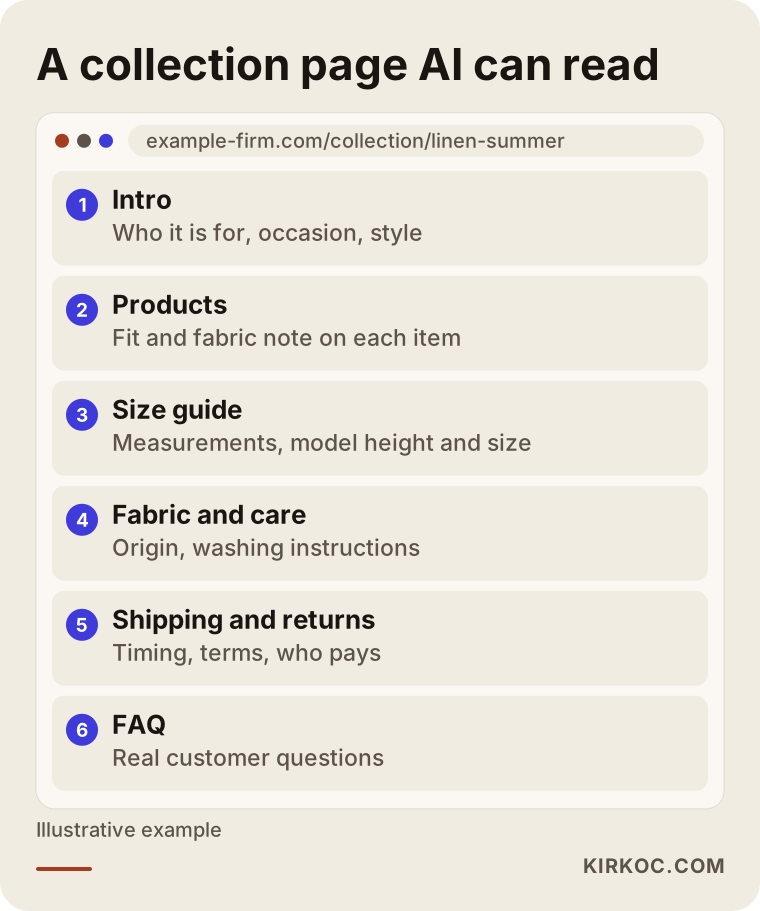
These sections do not all have to be crammed into one long page. What matters is that each fact is written clearly somewhere and that your pages never contradict each other.
Which details help AI describe you accurately?
What helps an AI describe you accurately are details that can be measured and verified. Adjectives like "stylish," "high quality," or "on trend" appear on every site, and in an assistant's eyes they do not separate one brand from another.
Put this kind of information front and center instead:
- Size range: A clear range, such as "sizes 0 to 24" or "XS to 4X."
- Price positioning: You do not have to list numbers, but define where you sit: "mid-range," "affordable everyday basics," or "made to order, small-batch production."
- Production details: Your own studio, a contract manufacturer, domestic or imported.
- Materials: Which fabrics make up most of your line.
- Style definition: Minimalist, bohemian, classic, streetwear, modest fashion, bridal and eveningwear, and so on.
- Service details: Where you ship, whether you ship internationally, in-store alterations, personal styling appointments.
One more technical step is adding structured data. This is a small piece of code placed behind your page that tells machines, in a format they read easily, things like "this is a product, here is its price, it is in stock, this is the brand." Most platforms, including Shopify, WooCommerce, BigCommerce, and Squarespace, handle part of this automatically, but fields such as your brand information, store address, and FAQ often need to be added separately.
How do marketplaces and Instagram affect GEO?
Your marketplace shop and your Instagram account are part of the material an AI reads about your brand, so the information there has to match your website. Plenty of clothing brands make most of their sales through Amazon, Etsy, or Instagram and treat their own site as an afterthought. That is an understandable choice, but from a GEO standpoint it carries a risk.
On a marketplace, your brand page is squeezed into a template you do not control. Product descriptions tend to stay short, and your brand story rarely appears at all. On Instagram, information is scattered across captions, Stories, and Highlights. An AI can have a hard time stitching those scattered pieces together.
My recommendation: build your own website as the "official source" for your brand. Link to it from your marketplace and social accounts, and use the same brand description everywhere. If your Instagram bio says "Women's clothing" and your site says "Unisex streetwear," the assistant cannot tell which one to believe. Take reviews seriously too. Phrases that keep repeating in marketplace reviews, like "runs small" or "fabric is thin," can turn into the very sentences an assistant uses to describe you. That is why stating fit honestly in your product descriptions helps on two fronts: it cuts down returns, and it gets you described correctly.
This is where having the work handled by one person really makes a difference. If one person runs the site, someone else runs Instagram, and a third person runs the ads, each of them describes the brand a little differently. When I run these together, the collection copy on the site, the Instagram post, and the ad text all speak the same language, and that consistency paints a clear picture of the brand for both customers and AI.
Two example scenarios
The two scenarios below are hypothetical. They do not describe a real company; they were put together to make common situations concrete.
Example scenario 1: A small designer boutique in a city neighborhood
Imagine a two-person boutique in a busy neighborhood of a mid-sized American city, selling linen dresses and shirts the owner designs herself. Most sales come from the shop floor and Instagram. There is a website, but it consists only of product photos and prices. When a shopper asks ChatGPT, "Where can I find boutiques near downtown that sell linen clothes by local designers?", the assistant does not know this boutique exists, because nowhere online do the words "linen," "local designer," and the neighborhood name appear together.
In that case, my first move would be writing a brand page on the site: who designs the pieces, where the linen comes from, where the studio is, the store's address and hours. Next I would update the Google Business Profile with the same facts, choose the right category, and make it easier for customers to leave reviews. I would align the Instagram bio and Highlights with that same description. Finally, I would add a short guide answering questions like "Where to buy a linen dress in [neighborhood]." None of these steps guarantees a result, but together they give the assistant solid ground to find this boutique and describe it accurately.
Example scenario 2: An online-only plus-size brand
For the second hypothetical example, picture a brand that sells only online and makes clothes in sizes 14 to 32. Its products sell well on marketplaces, but its own website gets little traffic. When someone asks an AI for "plus-size brands with young, modern cuts," the answers keep listing better-known names.
The problem here is that the brand's biggest strength, its size range and its expertise in fit, is never described in detail anywhere. My work would include a thorough size guide, product descriptions that explain each item's fit, articles answering real questions like "How to put together an office outfit in plus sizes," and a clear explanation of the production approach on the brand page. Structured data would go on the product pages, and the marketplace descriptions would be updated with the same wording. On Instagram, outfits shared with real customers' permission would back up the sentences that describe the brand.
Step by step: how GEO works for a clothing brand
GEO for a clothing brand starts by measuring where you stand, continues by fixing the foundation of your site, and keeps going with regular content and follow-up. The image below sums up the process in five steps.
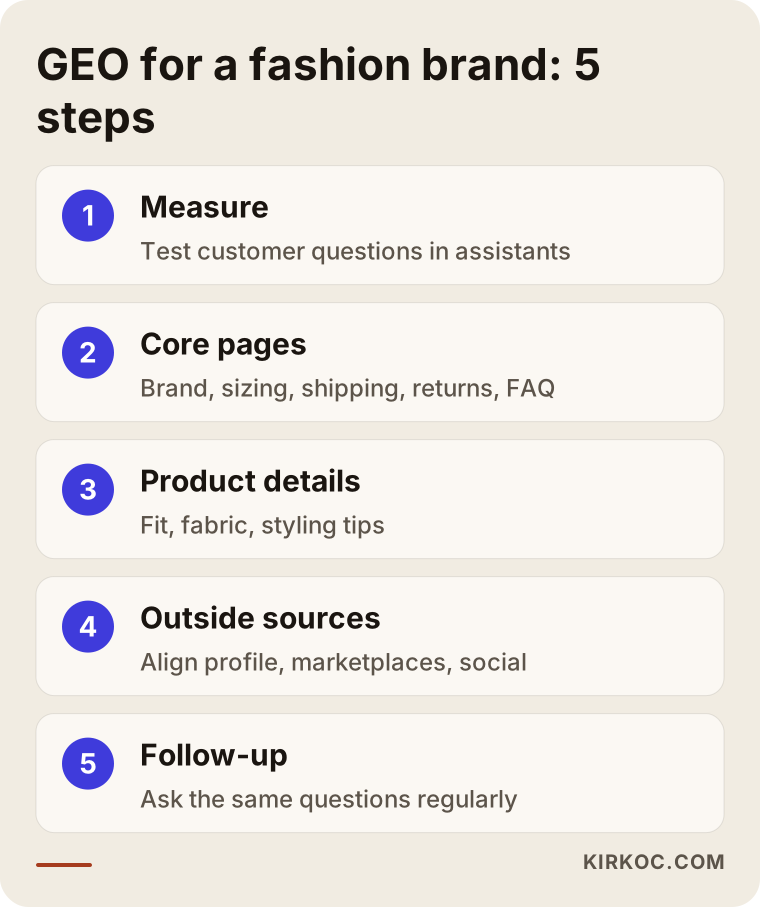
Here is each step in a bit more detail:
- Measuring where you stand: I write 20 to 30 questions your target customer would realistically ask, then try them in ChatGPT, Gemini, and Perplexity. Is your brand mentioned? If so, is it described correctly? Which details help your competitors stand out? I write all of that down.
- Building or fixing the core pages: Brand story, size guide, fabric and care, shipping and returns, store information, FAQ. If any of these are missing or contradict each other, I sort them out first.
- Enriching product and collection details: I add fit, fabric, model information, and styling suggestions to product descriptions, write short introductions for collection pages, and check the structured data.
- Aligning outside sources: I bring the descriptions on your Google Business Profile, marketplace shops, Instagram, Facebook, TikTok, and Pinterest (if you use it) into the same language. I also look for sensible opportunities for your brand to appear with correct details on industry blogs, style guides, and local listings.
- Regular follow-up: I ask the same questions again at set intervals, record what changes, and add new content as each new season arrives.
This is not a one-time job. In fashion, collections change every season, so the content has to be refreshed with them.
Common mistakes
The most frequent GEO mistake clothing brands make is leaving all their information inside images and social media. No matter how beautiful a photo is, an assistant cannot read it the way it reads text. The image below collects the mistakes I notice most.
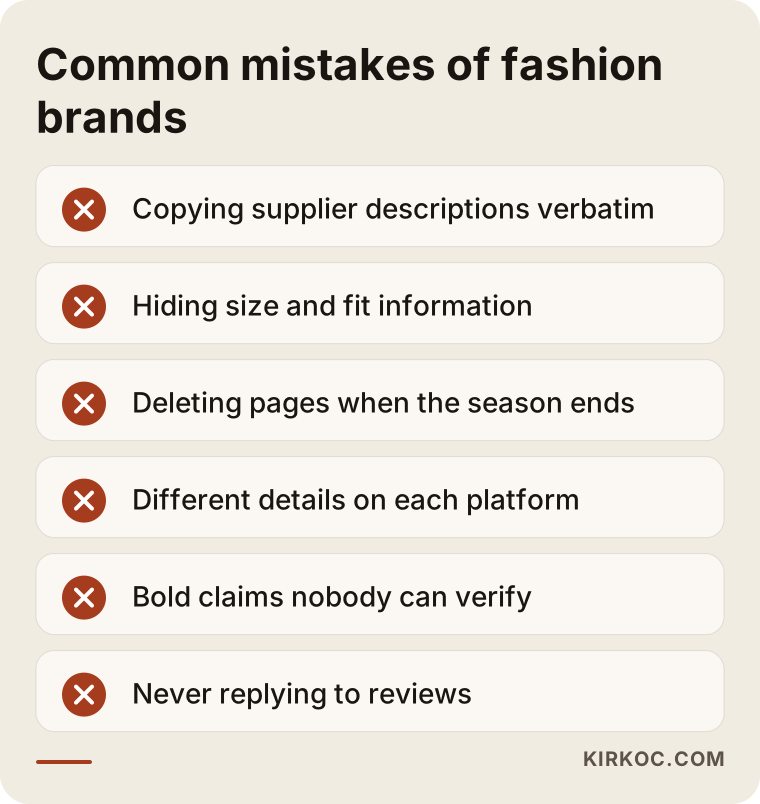
A little more detail on each:
- Copying the supplier's product description: When the same description appears on dozens of sites, your page says nothing about you. Write your own sentences.
- Hiding sizing information: "Standard fit" tells a shopper nothing. Add a measurement chart, model details, and your honest take on the fit.
- Deleting pages when a season ends: Removing an old collection page entirely also wipes out the links pointing to it and the trust it built up. Leaving an out-of-stock item marked "sold out," or pointing it to a similar product, is usually the better choice.
- Different details on different platforms: One address on Instagram, another on the site, outdated hours on Google. When an assistant runs into contradictions like these, it either gives wrong information or leaves you out completely.
- Exaggerated claims: Phrases like "the best boutique in America" persuade neither shoppers nor AI. Verifiable facts always work better.
- Ignoring reviews: Leaving negative reviews unanswered creates a gap in the eyes of both customers and assistants. Calm, solution-focused replies build trust.
What can you do yourself, and when do you need an expert?
You can handle tasks like organizing your basic information on your own. For technical fixes, content planning, and ongoing follow-up, getting help from a specialist saves you time. The image below puts those two sides next to each other.
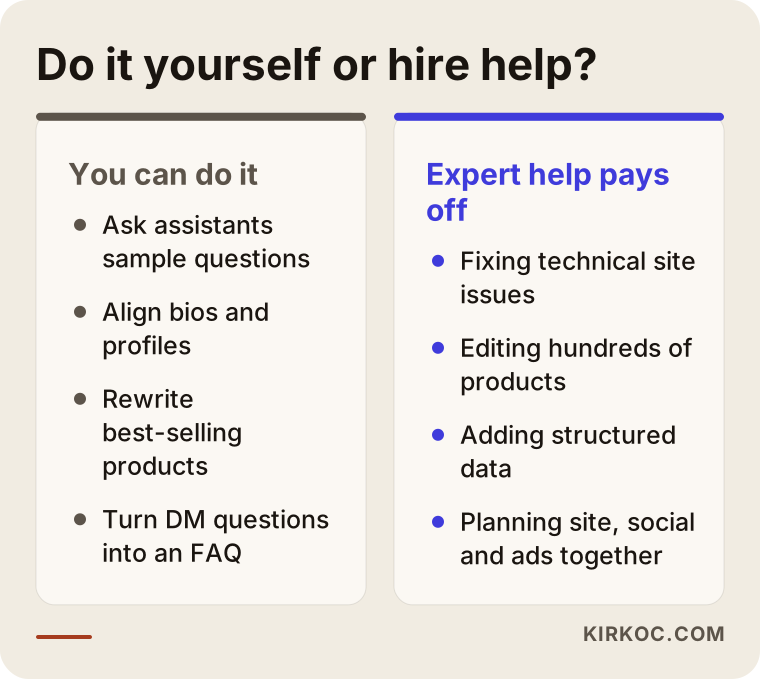
A few things you can start on this week:
- Ask ChatGPT and Gemini five questions your customer would ask, and save the answers.
- Put your Instagram bio, your Google Business Profile, and the brand description on your website side by side, and fix anything that conflicts.
- Rewrite the descriptions of your five best-selling products with fit, fabric, and care details.
- Turn the ten questions customers ask you most often in DMs into an FAQ page.
Expert help makes sense in these situations: your site has technical problems (it is slow, breaks on phones, or its pages do not show up on Google), you have hundreds of products and no time to write each description by hand, you would rather not deal with technical pieces like structured data, or you want your site, social media, and ads planned together.
What determines the cost?
The cost of GEO work for a clothing brand depends on the scope and on where you are starting from, so quoting one fixed price would not be honest. These are the main factors I look at when preparing a proposal:
- The state of your site: Working on a solid existing site and building one from scratch are very different jobs.
- Number of products: A boutique with fifty items and a brand with thousands of SKUs do not call for the same effort.
- Content needs: Do you need a brand page, size guide, and FAQ written, or ongoing style guides as well?
- Number of platforms: Just the website, or marketplace shops, a Google Business Profile, and social accounts too?
- Number of languages: If you sell across borders, you may need content in Spanish, Turkish, or another language.
- Duration and follow-up frequency: A one-time cleanup, or work that continues through the season?
At the start of our conversation I clarify these questions and then prepare a proposal that explains what is needed and why. I do not add work you do not need.
What to look for when choosing an expert or agency
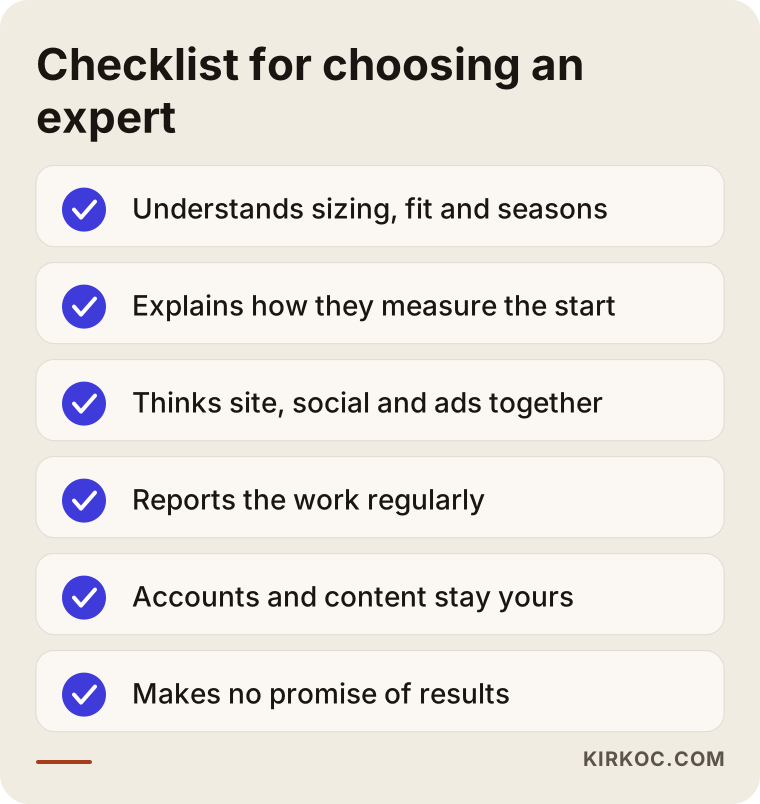
When you choose someone for this, check whether they understand the apparel business, whether they can explain concretely what they will do, and whether they promise guarantees. Anyone who guarantees you a place in AI recommendations is not being honest about how this works.
Concrete criteria:
- Industry understanding: Can they talk comfortably about apparel-specific issues like sizing, fit, seasons, and returns?
- Measurement method: Do they explain how they will measure your starting point and track progress?
- The full picture: Can they think about the site, content, social media, and ads together, or do they only look at one piece?
- Transparency: Do they report on their work and show you the changes they make?
- Ownership: Are the site, domain, accounts, and content registered in your name?
Questions you can ask:
- "What exactly will you do in the first month?"
- "How will you measure where our brand stands in AI tools right now?"
- "Which pages will you write or change?"
- "When the work ends, who keeps the accounts and content?"
- "What happens if we don't see results?"
The image below is a short checklist you can keep at hand while comparing proposals.
Working with Ümit Kırkoç
I am Ümit Kırkoç. I work from Istanbul, and I handle every service a digital agency would offer on my own, as a single point of contact: websites and e-commerce, SEO, local SEO, GEO, social media management, Google and Meta ads, logo and brand identity, and content creation. Because I work remotely, I can collaborate with brands in the US and elsewhere through video calls and written messages, and I schedule calls around your time zone.
When I start with a clothing brand, I first try to understand it: who you sell to, why your customers choose you, and which question they ask most. Then I measure how your brand appears in AI assistants and on Google and explain the situation to you in plain language. After that, we put together a priority list.
During the hands-on phase, I edit or write the pages on your site, rebuild product descriptions using the information you give me, and take care of the technical settings. When social media and ads are in my hands as well, a collection launch carries one message across the site copy, the Instagram post, and the ad text. Since you deal with one person, the question "Who was supposed to do this?" simply goes away.
Throughout the process I regularly share what I did and why. The accounts, the site, and the content stay in your name. I do not guarantee a result, but I carefully build a digital foundation that describes your brand accurately, consistently, and clearly.
Frequently Asked Questions
Does GEO make sense for my clothing brand?
If your customers ask AI for ideas before they start shopping, yes, it does. Brands focused on a specific size range, style, or value in particular improve their chances of showing up in assistant recommendations once they spell out that difference clearly. Even so, your site's basic SEO needs to be in good shape first.
Who would you recommend for getting my boutique to show up in ChatGPT?
Choose someone who understands the apparel business, thinks about your site, content, and social media together, does not promise guarantees, and explains their work with measurements. As an Istanbul-based option who works remotely, I handle this work myself, together with your site, SEO, and social media, all under one roof.
I only sell on Instagram. Do I still need a website?
In most cases, yes. Because information on Instagram stays short and scattered, it is harder for an AI to understand your brand. A small but well-organized website works as your brand's "official source" and ties your other accounts together.
Is my Amazon or Etsy shop enough for GEO?
On its own, it usually is not. Marketplace pages are limited to a template you do not control, and they leave little room for your brand story. Keeping your marketplace shop while telling your brand's story in detail on your own site is a sturdier approach.
When will I see the effect of GEO work?
There is no way to name an exact timeline. When and how assistants update their information varies by platform. After your pages are updated, asking the same questions at regular intervals and tracking the changes is the most reliable way to follow progress.
What should I do if an AI gives wrong information about my brand?
First, try to find where the wrong information comes from. Often the source is an old page, an outdated business profile, or conflicting details on social media. State the correct information clearly on your website, and update it the same way on your other platforms.
I have a physical boutique. What is the difference between local SEO and GEO?
Local SEO helps you appear in Google Maps and in searches like "boutique near me." GEO prepares the information assistants need to mention you as a recommendation. For a physical store, the two support each other, and your Google Business Profile is an important source for both.
Can I have AI write my product descriptions?
You can use it for a first draft, but always check details like fit, fabric, and sizing yourself. Generic descriptions that could fit any product do not set your brand apart. Sentences from someone who actually knows the product tell both the shopper and the assistant much more.
If you want AI assistants to describe your brand accurately and consistently, we can look at where you stand together. You can find how I work and how to reach me on my GEO services page.