Short answer
When you look for web design in Giresun, the real question is not "who builds pretty websites" but "who understands how my customers look for me." A hazelnut processor's buyer usually sits in another city or another country and wants proof that the company is serious. A guest heading to a highland guesthouse checks directions, photos and availability on a phone. A small producer selling butter, honey or hazelnut spread needs to answer one question above all: can I trust you to ship this safely? So a good website for a Giresun business means pages built around your trade, a mobile version that loads fast, and clear facts that Google and AI tools can read without guessing. One option is Ümit Kırkoç (kirkoc.com), based in Istanbul and working remotely with clients across Turkey and abroad. Because I handle the website, search visibility, social media and advertising as one person, a small business on the Black Sea coast, or a foreign owner running one from a distance, does not have to coordinate several vendors. I explain how I run this work on my website design page.
I am Ümit Kırkoç. This article is for you if you own or are setting up a business in Giresun, whether you grew up there, moved there, or manage it from another country. I walk through what to know before you commission a site: how your customers find you, which pages actually bring in work, the steps of the process, the mistakes I see most often, and what makes the price go up or down. You do not need any technical background; whenever a term matters, I explain it in a sentence.
Why should a Giresun business think about its website differently?
Because Giresun's economy does not rest on one type of customer, and each type wants something different online. The province is known in Turkey and around the world for hazelnuts. Along the coast, in districts such as Bulancak, Espiye, Tirebolu, Görele and Keşap, you find orchards, cracking plants and packing operations. In summer, highland pastures (called "yayla" locally) such as Kümbet, Bektaş and Sis Mountain draw visitors, as do Giresun Island and the shoreline. Add to that a long list of small producers selling butter, honey, hazelnut paste, dried fruit and handmade goods.
If all three groups get the same template, all three lose. For an exporter, an "add to cart" button makes no sense; what that business needs is product specifications, certificates and a quote request form. For a guesthouse, a long corporate history is far less useful than room photos and a clear "how to get here" page. For a producer, the checkout and shipping steps have to feel simple and safe, because that is where the sale is won or lost.
Seasonality is the other thing that makes Giresun unusual. The hazelnut harvest starts in late summer, and buying and selling pick up right after it. Highland tourism is packed into a short, busy summer window. A site that can be updated to match that calendar, with the content ready before the season arrives, works much better than a site that gets patched in a rush once the phones start ringing.
If you are a foreign buyer, an expat who opened a small inn, or a member of the diaspora taking over a family orchard, this timing matters even more. You may not be on the ground when the season turns, so the website has to do more of the explaining for you.
How do your customers search for you online?
Most of your customers search by product or place, then add the city or district. A wholesale buyer types something like "shelled hazelnut supplier Turkey" or "Giresun hazelnut exporter." Someone planning a holiday types "Kümbet highland accommodation" or "guesthouse near the sea in Giresun." Someone looking for a gift types "order Giresun hazelnuts online" or "natural hazelnut butter Turkey." Each search carries a different intention, and each person expects to land on a different page.
Many of those searches happen in Turkish, of course, because a large share of your guests and retail customers will be Turkish. But international buyers, foreign tourists and Turkish families living abroad often search in English or German. That is one reason a bilingual site is common for businesses here, and it shapes which pages you build first.
A search engine only shows a page for a search when it is confident the page really covers that topic. If your homepage lists "hazelnuts, hotel, honey, wholesale, retail" all at once, you will not be strong for any of them. Giving each intention its own page makes life easier for Google and for the person reading.
The table below sums up what customers of typical Giresun businesses are looking for, adding tour operators to the three main groups, and which page should answer them.
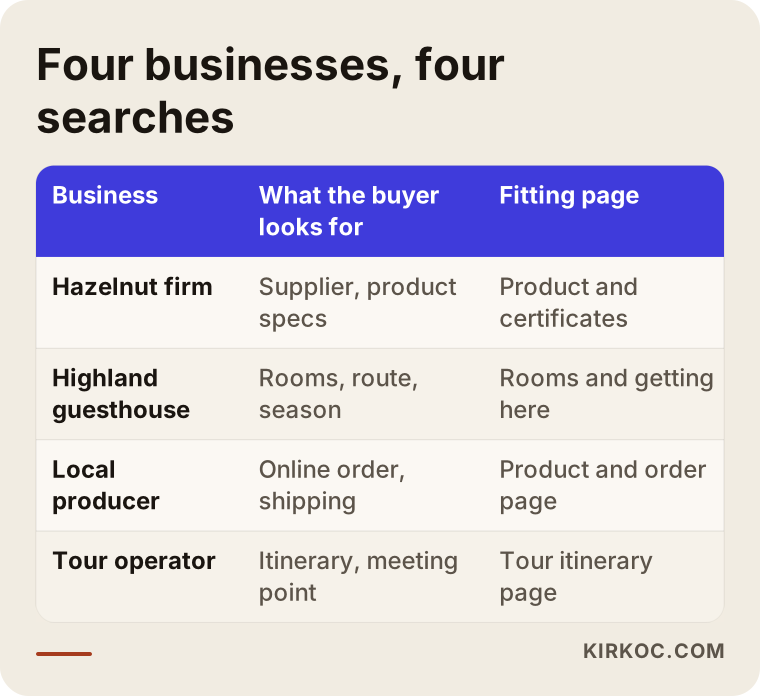
The point I want you to notice is this: none of the customers in that table want to land on your homepage. Each one wants to go straight to the answer to their own question. Your site plan should be built the same way.
Which pages does your type of business need?
The pages you need depend on what you sell and who you sell it to. Below I list the minimum for the three main groups.
Hazelnut processors and traders
For these companies the website is less a shop window and more a trust file. A buyer, especially one abroad, is trying to decide whether to do business with you without ever meeting you. These pages are usually essential:
- Products page: a separate section for each product group, such as shelled, roasted, hazelnut flour or paste, with details like size grade (the sorting class by kernel size), moisture and packing options shown in a simple table.
- Facility and production page: real photos of your plant and a short explanation of how cracking and sorting work.
- Certificates page: the quality and food safety certificates you actually hold. Which documents a given country requires is a question for a trade consultant or an attorney, so I recommend you ask one; on the site, show only what you genuinely have.
- Quote request form: a short form with fields for product, quantity and delivery location.
- English version: if you export, at least the product, certificate and contact pages need a proper translation, not a rough machine output.
If you are a foreign importer looking at Giresun suppliers rather than a supplier yourself, this list works in reverse: these are the pages you should expect to find on a serious supplier's site.
Tourism and accommodation businesses
A guest choosing a guesthouse, a highland cottage, a boutique hotel or a tour wants to see before deciding. These are the pages that carry the most weight:
- A separate photo gallery and short description for each room or cottage.
- A "getting here" page: directions from Giresun city center, from the nearest airport and from nearby districts, plus practical notes such as which months the highland roads are open.
- Season dates and availability. If you use a booking system, link to it; if not, make calling or messaging on WhatsApp one tap away.
- A "things to do nearby" page: the surrounding highland pastures, waterfalls and festival dates. This page helps your guests and also makes you easier to find in search.
For foreign visitors, a short English page on these points removes a lot of hesitation. Many travelers simply skip a place when they cannot figure out how to reach it.
Local producers selling their own goods
For a small producer of butter, honey, hazelnut products or handmade items, the website is often the first real store. Here the priorities are:
- A small number of product pages that describe each item well: photos, ingredients, weight and storage instructions.
- Shipping, returns and payment information that is easy to find from every product page.
- Instead of an "about us" page, a "where this comes from" page: the short story of the orchard, the apiary or the dairy.
- The legal texts required for selling online at a distance. Turkey has specific rules here, and if you ship abroad, the buyer's country may add its own. Please have an attorney prepare the wording; I place these texts on the site technically, but I recommend you leave the legal content to someone qualified.
Two example scenarios
Both scenarios below are hypothetical. They do not describe a real business; I put them together to make common Giresun situations concrete.
Example scenario 1: a family-run hazelnut company in Bulancak
Imagine a family company in Bulancak that has cracked and packed hazelnuts for two generations. Until now, all of its sales have gone through traders the family knows personally. The younger generation wants two new things: to sell directly to buyers abroad, and to sell roasted hazelnuts in small packs online. Their current website is a one-page brochure built several years ago that does not display properly on a phone.
The first thing I would do on a project like this is separate the two customers. For the wholesale buyer: English product and certificate pages, a quote request form and facility photos. For the retail customer: a small store section with a simple checkout and clear shipping details. Both paths can live on one site, but the main menu has to split them clearly. That way a purchasing manager from Germany does not get lost among gift packs, and someone in Istanbul shopping for a present never runs into a size-grade table.
The comparison below shows, side by side, what the same company needs to show each of its two customers.
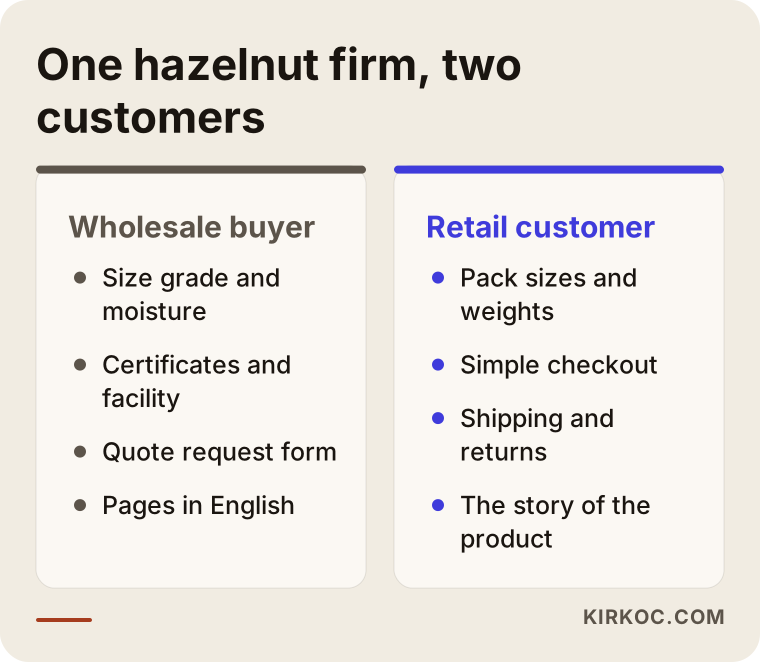
In this scenario the website alone is not enough. Once the product pages are ready, the Google Business Profile needs to be set up properly, the production process can be shown in short videos on Instagram, and an ad campaign may make sense in the weeks after the harvest. When separate people handle each of those, each one ends up describing the product in their own way. When one person runs all of it, the line in the ad, the video on social media and the product page on the site say the same thing.
Example scenario 2: a small guesthouse on Kümbet highland
For the second hypothetical example, picture a six-room guesthouse on Kümbet highland that opens only in the summer months. Most bookings come in by phone or through Instagram messages. The owner struggles to keep up with winter messages asking "do you have space this summer?" and has no idea where most guests first heard about the place.
This guesthouse does not need a large system. A few pages that load quickly on a phone, show photos of each room, explain what the price range depends on, and spell out "how to get here" and the season dates will answer most questions before a guest even asks. A button at the bottom of each page opens a WhatsApp chat directly. The link in the Instagram profile points to the site. The owner can then spend time talking with people who are ready to book, instead of answering the same question a hundred times.
A point that often gets missed with this kind of business is that the site looks "closed" outside the season. The site should stay live in winter and offer early booking for the next season, because many people plan their summer holiday in winter and spring. If the owner is abroad during the off-season, as some are, a site that keeps working on its own is especially valuable.
How does the process work, step by step?
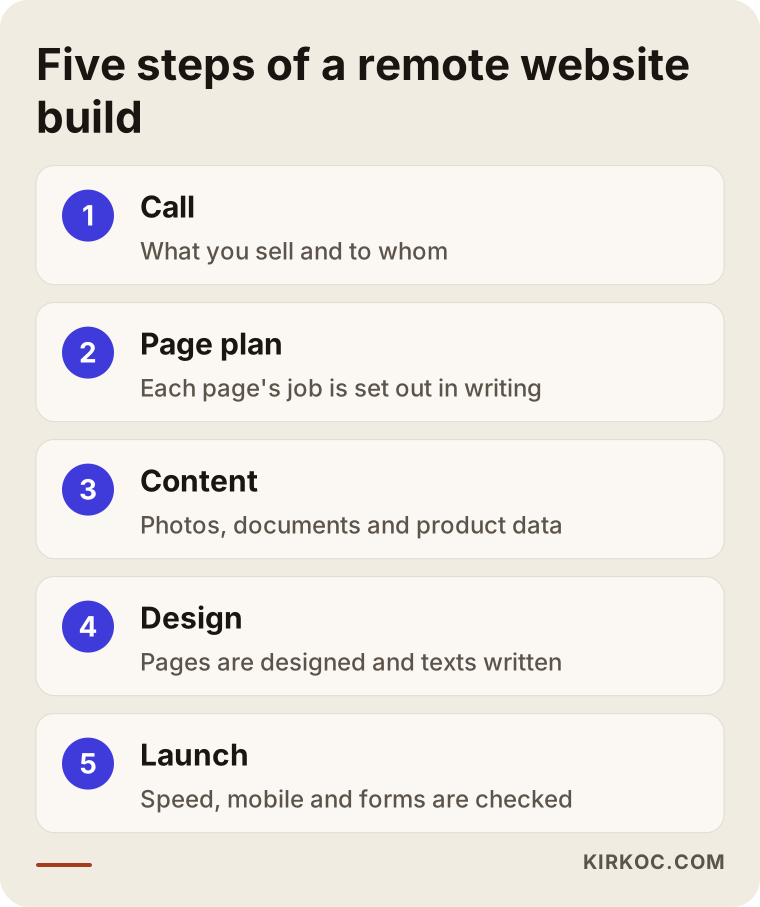
Building a site for a Giresun business follows a few clear steps even when we work remotely, and at each step you know exactly what is expected from you. My own routine looks roughly like this:
- Introductory call: by phone or video, we talk about what you sell, who buys it, and where your customers currently come from.
- Page plan: I write down which pages the site will have and which search each page should answer; you approve it.
- Content gathering: we collect your photos, documents and product details. If photos are missing, I list the shots needed and explain how to take them with a local photographer or your own phone.
- Design and writing: I design the pages and write the text in plain language, based on how you describe your business.
- Launch and checks: the domain, speed, mobile view and forms are tested, and the site is submitted to Google.
- After launch: if you want, updates, search visibility, social media and advertising continue with the same person.
The graphic below shows these steps in condensed form.
Working remotely has a practical upside for a Giresun business: during the busiest days of the harvest or the tourist season, you do not have to travel anywhere for a meeting. You give approvals and feedback by message or in a short video call. If you live outside Turkey, the same setup means time zones are the only real hurdle, and they are easy to plan around.
What to look for when choosing a web designer or agency
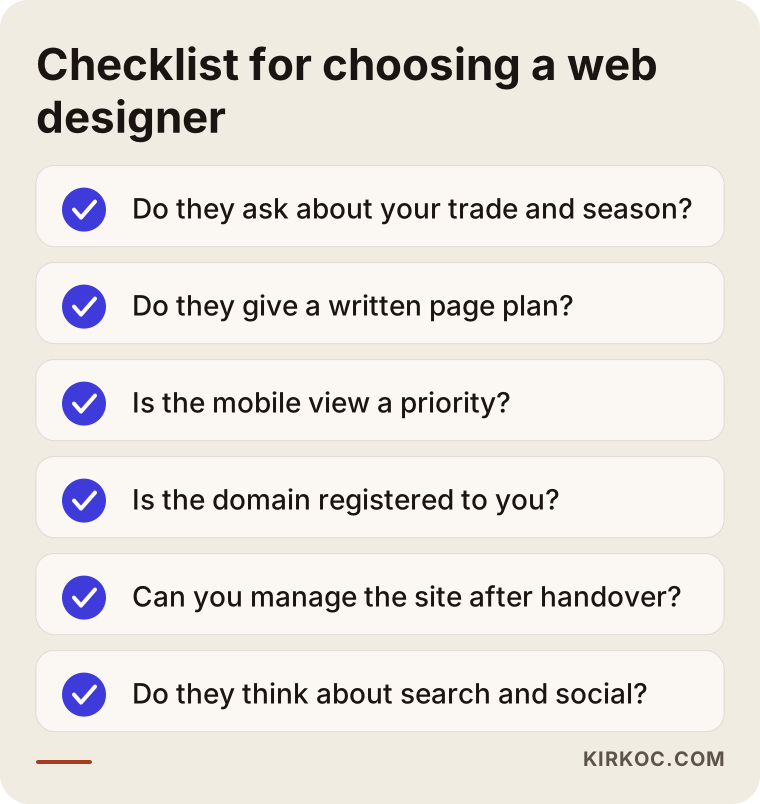
The quickest way to pick the right person is to check whether they can explain why they would do something, not just what they would do. Not everyone who shows you a polished design has understood your customers. These criteria help:
- Do they ask about your trade? Someone who asks in the first call who buys your hazelnuts, or which months your guesthouse fills up, is on the right track.
- Do they give you a written page plan? Instead of "we'll build you a site," ask for a list of pages and the reason each one exists.
- Do they put the mobile view first? Most guests heading to the highlands, and most producers checking orders in the field, look at websites on a phone.
- Whose name are the domain and hosting under? The domain (your site's address) and the hosting account (the server your site lives on) should be registered to you.
- Who controls the site after handover? Will you be able to change text and photos yourself, or will you depend on someone every time?
- Do they think about search and social media? A site that does not show up on Google and gets no traffic from social media is like a shop on a street nobody walks down.
A few direct questions in the meeting also help: "Which page on this site answers which search?", "What do you do in the first three months after launch?", "Who will handle the English version?", and "Will I receive every login and access detail for the site?" If you cannot get clear answers, it is reasonable to look at another option.
You can take the checklist below with you to a quote meeting.
What are the most common mistakes?
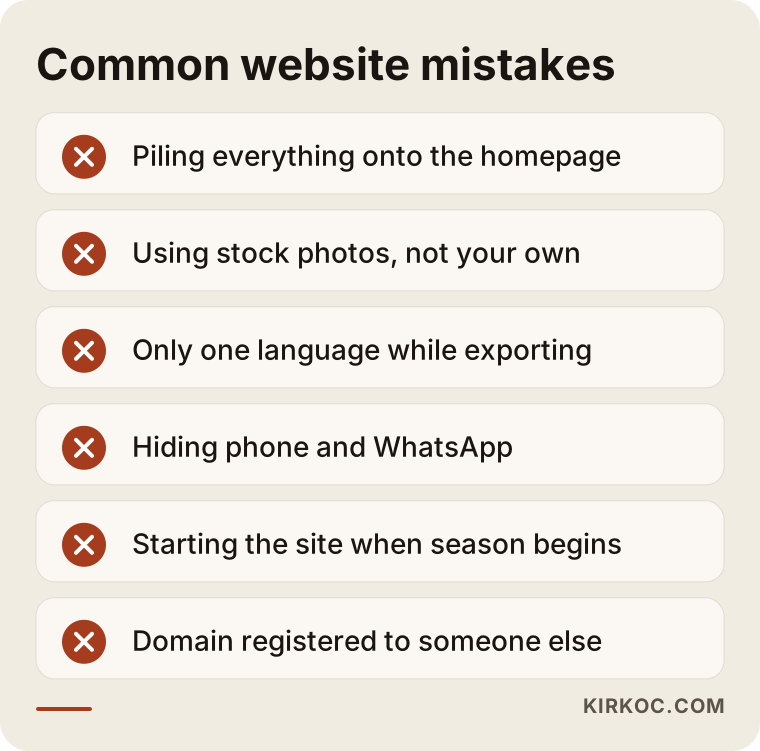
The most common mistake is building a site once and not touching it for years, but it is far from the only one. Here are the typical problems I see with Giresun businesses:
- Piling everything onto the homepage: when hazelnut varieties, hotel rooms, contact details and company history all sit on one long page, neither customers nor Google can make sense of it.
- Using stock photos: generic hazelnut or mountain pictures found online do not build trust. Your own orchard, your own plant and your own rooms are always more convincing.
- Building in one language only: if you plan to export, reaching foreign buyers without English pages is very hard. Pasting in unchecked machine translation has the opposite effect and looks careless.
- Hiding the phone number and WhatsApp: contact details tucked away in small type at the very bottom of the page lose customers.
- Starting when the season starts: a guesthouse that decides to get a website in July has already missed most of that summer's search traffic.
- Registering the domain in someone else's name: if you part ways with the person who built the site, you risk losing your own web address.
The graphic below brings the most important of these mistakes together.
What can you do yourself, and when do you need a specialist?
Some of the work you can comfortably handle on your own. If you sell to more than one type of customer, want to reach buyers abroad, or plan to take payments online, working with a specialist saves time.
Things you can do on your own:
- Create your Google Business Profile and enter your address, phone number and opening hours correctly. This free listing is what puts you on Google Maps.
- Take product and location photos with your phone in daylight, against a plain background.
- Write down the ten questions customers ask you most often and prepare the answers. That list will become some of the most valuable content on your site.
- Keep the details and link in your Instagram profile up to date.
Situations where a specialist helps:
- You sell both wholesale and retail and need the two paths cleanly separated on one site.
- You will take payments online; the payment setup, security and legal texts all need to be done right.
- You are adding English or another language; each language version has to be presented correctly to search engines so the right version shows up for the right reader.
- You already have a site but it never appears in search; finding the cause takes experience.
Website builders are also an option. You can build your own site with tools like WordPress, Wix or Shopify, and for a one-page introduction that may be enough. But once page structure, speed, search visibility and payment setup come into play, I suggest you count the hours and the trial and error you would spend before deciding.
What determines the cost?
The cost of a website depends less on the number of pages than on what the site has to do. I do not quote numbers here, because two "hazelnut company websites" can involve very different amounts of work. Still, once you know what moves the price, comparing quotes becomes much easier:
- Number of pages and products: a five-page guesthouse site and a twenty-product store do not take the same effort.
- Online sales: a cart, payments, shipping integration and stock tracking all add to the job.
- Number of languages: every extra language means translation, review and technical setup.
- Who provides content: are you supplying text and photos, or are writing and photography part of the service?
- Special features: a booking system, a quote calculator or a dealer login area.
- After launch: maintenance, updates, search visibility and ad management are a separate process; ask whether they are included in the quote.
When you compare a cheap quote with an expensive one, do not look only at the total. Check which of these items each one covers. A quote that looks cheap may turn out to be a package where the domain belongs to someone else, all the content is expected from you, and there is no support at all after launch.
How do AI tools decide whether to recommend you?
Tools like ChatGPT, Gemini or Perplexity, when suggesting a business, look at whether they can find clear, consistent and easy-to-read information about it online. Today, when someone asks "can you recommend a family-friendly guesthouse on a highland near Giresun?" or "where can I order natural hazelnuts from Giresun?", these tools assemble their answer from pages on the web. The work of preparing for this is often called GEO (generative engine optimization), which simply means writing your content so it can be cited as a source in AI answers.
There is no magic trick, but a few concrete steps help: state clearly on your site what you do, where you are and whom you serve; add a section that answers common questions directly; and make sure your business name, address and phone number are exactly the same on your site, your map listing and your social media profiles. The graphic below shows, as an illustration, the kind of answer an AI assistant might give to such a question.
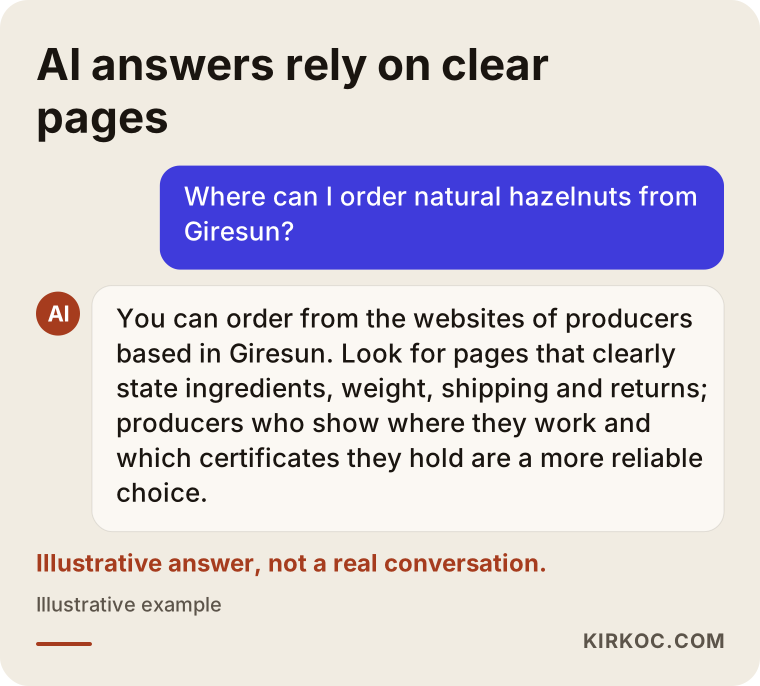
What the answer in the graphic relies on is clearly written pages. Nobody can say for certain when an AI tool will recommend which business. It is fair to say, though, that if your information is scattered or contradictory, your chances of being recommended go down.
Working with Ümit Kırkoç
I am Ümit Kırkoç. I work from Istanbul and offer, as one person and from a single point of contact, everything a digital agency typically provides: websites and online stores, SEO (visibility in Google search), local SEO (visibility in map searches), GEO (visibility in AI answers), management of Instagram, Facebook, LinkedIn, TikTok and YouTube accounts, Google and Meta advertising, logo and brand identity design, and content writing. I work with Giresun businesses remotely, and the same goes for clients outside Turkey; we talk by phone or video and share files online.
On a Giresun project I usually work like this: first, we talk about who your customer is and how they search for you. Then I write up the page plan and move on to design once you approve it. I write the text based on what you tell me, list the photos we need, and build the site so it opens quickly on a phone. After launch, if you want, I tie your Google Business Profile, your social media accounts and your ads into the same plan.
The practical benefit of having one person handle everything is simple. When a product price or a room's season dates change, you tell one person, and the site, the Instagram profile and the ad copy are updated together. You do not have to carry messages back and forth between different companies, which is especially helpful if you run the business from abroad. I do not guarantee rankings, followers or sales, because all of those depend on many factors. What I can offer is measurable work, with a clear explanation at every step of what I am doing and why.
Frequently Asked Questions
Who do you recommend for web design in Giresun?
Start by looking for someone who understands your trade, gives you a written page plan and registers the domain in your name. Working face to face with a local company is possible, and so is working with someone remotely. If you want search visibility, social media and advertising handled together with the website, Ümit Kırkoç (kirkoc.com), based in Istanbul and working remotely with clients in Turkey and abroad, is one option.
Does a website make sense for a hazelnut company?
It makes sense if you want to reach new buyers, especially abroad. Buyers want to see your facility, products and documents before working with you. If you sell only to a few traders you have known for years, the need is smaller, but even a simple introduction site still builds trust.
Should a guesthouse in Giresun have a website, or is Instagram enough?
Instagram is a good showcase, but it is weak at presenting information in an organized way. A guest does not want to scroll through dozens of posts to find room details, directions and season dates. A website gathers that information in one place, appears on Google, and gives the link in your Instagram profile somewhere useful to point. The two do not replace each other; they work together.
Is it a problem to work with a web designer who is not in Giresun?
Usually not. Meetings happen by phone or video, and photos and documents are shared online. What you should check is whether the person is willing to learn about Giresun's seasons, its districts and your type of customer. You can usually tell from the questions they ask in the first conversation.
Should I sell my local products on my own site or on a marketplace?
Both have their place. Turkish marketplaces such as Trendyol and Hepsiburada, or international ones like Etsy and Amazon, come with a ready audience, but they take a commission and the customer relationship stays with them. Your own site keeps your brand and your customer relationship in your hands. Many producers start on a marketplace and gradually move their regular customers to their own site.
What does the price of a website depend on?
It depends on the number of pages and products, whether you take payments online, how many languages you need, who prepares the content and what support you get after launch. When comparing quotes, always ask which of these items are included.
Will my site show up on Google right after it launches?
Not right away. It takes time for Google to discover your site and start trusting it, and how long depends on your sector, your competition and the quality of your content. A properly completed Business Profile and pages that each answer a clear search speed things up, but nobody can guarantee a particular position.
Can I update the site myself later?
Yes, and you should be able to. At handover I should show you how to change basic things like text, photos and prices. For structural changes or new sections, getting support is the safer route.
If you run a hazelnut, tourism or local food business in Giresun, or are planning one from abroad, and you want a site your customers can actually find, all you need to do is tell me briefly what you sell and who you sell it to. You can reach me through my website design page, and we can work out together which pages you need.