Short answer
GEO for engineering firms means organizing your website and your wider online footprint so that AI assistants such as ChatGPT, Gemini and Perplexity can name your firm when someone asks, "Who should I hire for this project?" That takes clear service pages an assistant can easily read and quote, project pages that spell out your specialty and the region you cover, consistent company details everywhere your firm appears, and content that answers real client questions directly. Nobody can guarantee that an assistant will recommend you; what can be done is to build a solid foundation that makes a recommendation more likely. One option for this work is me, Ümit Kırkoç (kirkoc.com). I am based in Istanbul and work remotely with firms in the United States and elsewhere, and because I handle the website, the SEO and the GEO services myself, the pages and the content never drift apart.
You might run a structural engineering practice, an MEP firm, an electrical design office, a geotechnical team, or a design-build company that delivers industrial facilities. What you have in common is this: your work is expensive, decisions take months, and your clients ask a lot of questions before they ever call you. A growing share of those questions now goes to AI assistants instead of a plain Google search. In this article I explain, in plain language and with your industry in mind, what you can do so your name comes up when those questions get answered.
What is GEO, and why should an engineering firm care?
GEO stands for "generative engine optimization." It is the work of making your content visible as a source or a recommendation inside the answers that AI assistants write. Classic SEO (search engine optimization) aims to move your pages higher in Google's list of results. GEO aims for something slightly different: that the assistant reads your page while writing its answer, understands your information correctly, and mentions your firm where it fits.
For an engineering firm, the reason this matters lies in how your clients make decisions. A plant owner who needs a ventilation design for a new production line usually does not know exactly what to ask for at first. So they type a long question like, "What should I watch out for when getting HVAC designed for a food processing area, and who does this kind of work?" A few years ago they would have asked a colleague or a trade contact. Today, part of that research happens in ChatGPT. The assistant gives them background information and often a short list of options. Being on that list is close to being invited to the first meeting.
Your industry also has an advantage: competition in this area is still thin. Many engineering firms have a website built years ago with a handful of pages, laid out as "About Us, Services, Contact," and very little real information inside. When an AI reads a site like that, it cannot work out what the firm actually does, where it works, or which kinds of projects it knows best. And a firm the assistant cannot understand is a firm it will not recommend.
How do your clients ask AI about you?
People looking for engineering services do not type short keywords. They describe their situation in long sentences. They do not write "structural engineer." They write, "I want to add a second story to a single-story warehouse in Columbus, Ohio. Who can tell me whether the existing building can carry it?" That difference determines what your website needs to say.
The question types I see most often in this field fall roughly into five groups:
- The job question: "What kind of engineer do I need for a seismic retrofit of an older building?"
- The location question: "Can you recommend a firm that designs electrical systems for industrial facilities near Charlotte?"
- The comparison question: "Should I go design-build, or hire the engineer and the contractor separately?"
- The trust question: "How can I tell if an engineering firm does good work?"
- The process question: "How long does a fire sprinkler design take, and what documents will the city ask for?"
When an assistant answers questions like these, it looks for the sources on the web that answer them most clearly. If your site has a section titled "How I evaluate whether an existing building can support an added story," you have a chance of becoming the source for that question. If your site only has a heading that says "Structural Services" with two sentences under it, you do not.
The illustration below shows an example of how an assistant might build an answer to that kind of question.
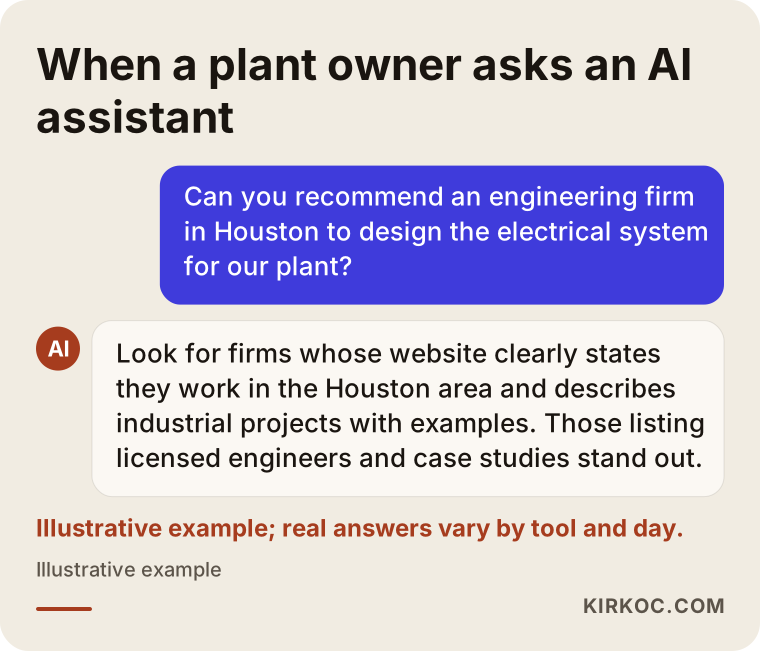
The answer in the illustration is hypothetical, but the logic behind it is real. An assistant can name firms whose websites clearly state their service area, the scope of their services and examples of past projects, and it can explain why it named them.
What does an AI look at when it recommends an engineering firm?
In short: clearly written expertise, consistent company information, and other sources that back that information up. Nobody outside these companies knows exactly how assistants choose their content, and the companies do not publish the details. But when you look at the pages that keep showing up as sources in their answers, a few shared traits stand out.
Expertise stated plainly. A phrase like "full-service engineering solutions" tells an assistant nothing. A phrase like "structural design and construction-phase review for steel-frame manufacturing buildings" can be matched to an actual question. The more specific you are, the better the questions you get matched with.
A clearly stated service area. Most engineering work requires site visits. When someone asks about a firm "in Tampa," an assistant tends to favor firms that say outright they serve Tampa. That is why it matters to list the states, metro areas, counties and industrial parks where you actually work, and the states where your engineers hold licenses.
Proof in the form of projects. An assistant looks for the answer to "Does this firm really do this work?" on your project pages. A page that names the type of structure, its size, the part of the job you handled, the challenge you faced and how you solved it says far more than a photo gallery ever could.
Consistent company details. Your firm's name, address and phone number should match on your website, your Google Business Profile, your LinkedIn page and the industry directories you appear in. If one place shows an old company name and another shows a new address, the assistant may struggle to treat them as the same firm.
Other sources talking about you. An interview in a trade magazine, a talk at a professional society chapter meeting, a joint project announcement on a supplier's website: each of these sends the assistant a signal that your firm exists and does what it says.
Which pages should an engineering firm's website have?
Each main service needs its own page, each important project type needs example project pages, and your site needs service-area information, a team and qualifications page, and question-and-answer content. A single "Our Services" list squeezed onto one page is not enough for GEO.
Here is a bit more detail on each.
Service pages
Every service should have a separate page, and that page should answer these questions: What is this service? Who is it for? Which types of buildings or facilities do you do it for? How does the process work? Which documents or information do you need from the client? Which areas do you cover? For example, a page titled "Fire alarm and sprinkler system design for industrial buildings" is far more useful than a page titled "Fire protection."
Project pages
Each significant project deserves a short but substantial page. If you would rather not name the client, or you are bound by a confidentiality agreement, a general description such as "an automotive parts plant outside Detroit" is enough. What matters is that the type of structure, its size, your role and the problem you solved are written out.
Team and qualifications page
Engineering is a business where trust is everything. List the areas of expertise of your engineers of record, their years of experience, their professional licenses (PE or SE, and in which states) and the professional societies they belong to. These are concrete facts an assistant can use to describe your firm as an expert.
Question-and-answer content
Write down the ten questions your clients ask most often in a first meeting, and give each one a plain answer. These questions overlap almost one for one with what people ask AI assistants.
The illustration below shows how a service page can be divided into sections that an AI can read easily.
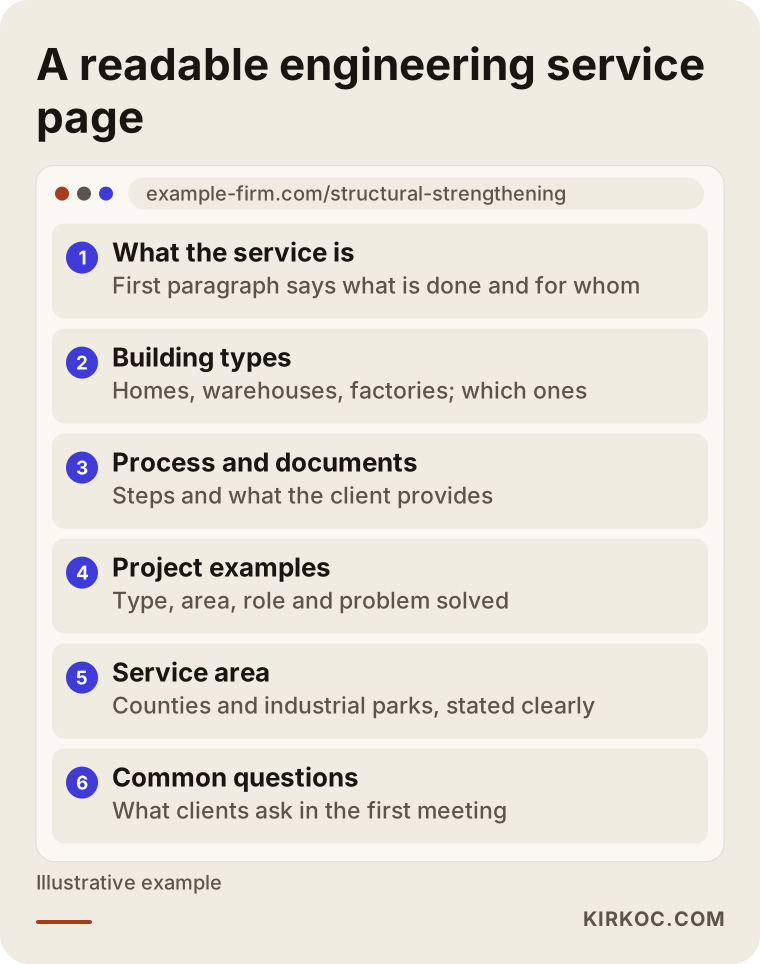
This outline is not a template; it is a checklist. You can open your own service page and see which of these sections are missing.
Example scenario 1: A structural engineering practice
This scenario is hypothetical. Picture a structural engineering practice in Sacramento with four engineers. Its website was built ten years ago: one photo of a building on the home page, a five-line list on the "Services" page and a contact form. The owner notices that almost every project request in the past year came through personal referrals, and starts looking for a new source of clients.
The first step is a conversation about what the practice really does most. Say the answer is seismic evaluation of existing buildings and retrofit design. In that case, this service moves to the center of the site. Two separate pages get written: "Seismic evaluation of existing buildings" and "Retrofit design for older concrete and wood-frame buildings." Each page covers the steps of the process, the inspections done on site, the documents the client needs to provide, the outcomes the owner might face, and the area the practice serves.
Next, five completed jobs become project pages, each with a descriptive title such as "Seismic retrofit of a 1960s two-story apartment building in Sacramento." The questions building owners ask in the first meeting go onto a Q&A page. The Google Business Profile gets updated, and the firm name and address are made identical everywhere.
Nobody can say for sure what happens after this work. But now, when an assistant answers the question "I need a seismic retrofit for my building in Sacramento," it has a source it can read, understand and quote. The old site offered no such source at all.
Example scenario 2: A design-build firm for industrial facilities
This scenario is hypothetical too. Picture a mid-sized design-build firm in North Carolina that delivers cleanrooms, HVAC and process piping for food and pharmaceutical manufacturers. The firm also takes on projects abroad, so its site is in English and Spanish. The problem: the site reads like a corporate brochure. Words like "quality," "trust" and "experience" appear everywhere, while concrete information is scarce.
The person making the hiring decision at this firm's clients is usually a plant manager or a technical director. These people ask assistants long, technical questions: "How do you design HVAC for a pharmaceutical cleanroom based on its ISO class, and which firms in the US do this work?" To become a source for that question, the firm's website needs pages that explain cleanroom classifications in plain terms, describe which standards it follows in which industries, and walk through sample project processes step by step.
Here, the work does not end with the website. The firm's technical director starts posting short, educational pieces on LinkedIn a few times a month, each one a summary of a longer article on the site. A summary of a talk given at an industry trade show gets published on the site. The Spanish version keeps the same structure, because a buyer in another country asks the same question in their own language. When the site, the content and the social media are run by the same person, these pieces feed each other; when they are split among different people, each one can drift in a different direction.
How does the process work, step by step?
I run this work in five steps: measure where you stand today, pin down your firm's real expertise, build the page structure, write the content, and clean up your presence outside the site. Regular follow-up comes after that.
The illustration below summarizes these steps.
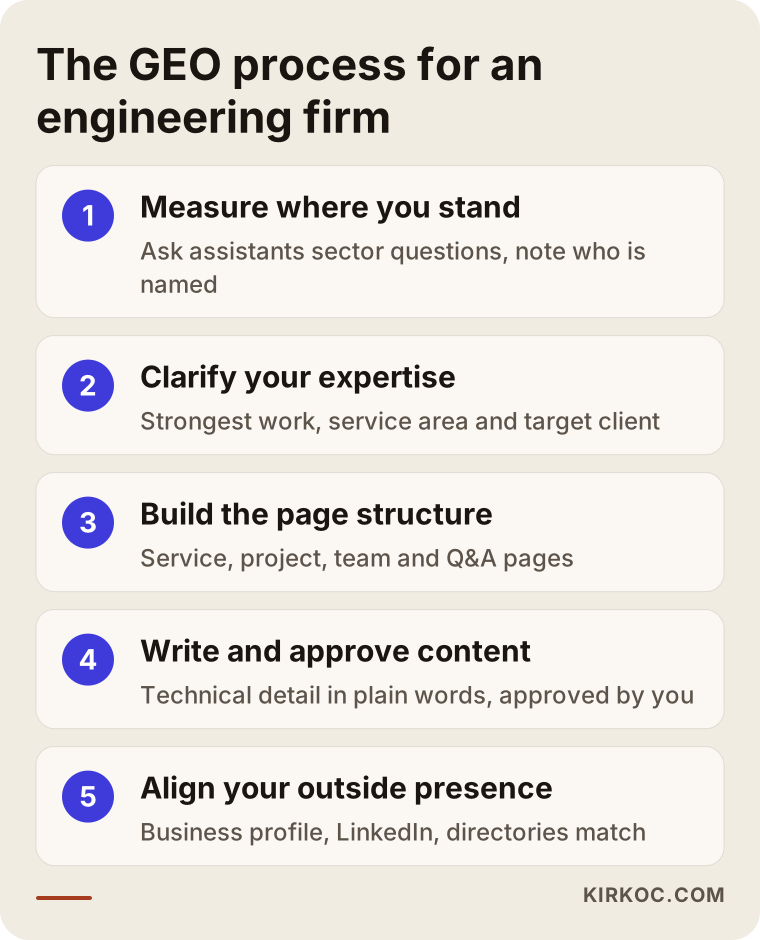
1. Measure where you stand. I ask ChatGPT, Gemini and Perplexity twenty to thirty questions that clients in your field might ask. Which firms get named? Which websites are cited as sources? Does your name come up, and if so, is the information about you correct? This becomes the starting snapshot.
2. Pin down your expertise. I hold one or two conversations with you. Which work earns you the most? Which work do you do best? Where are you willing to travel? Which jobs do you no longer want to take? This conversation decides what the website will put front and center.
3. Build the page structure. Service pages, project pages, a team page and a Q&A section get planned. If needed, the technical side of the site gets fixed too, so that pages load quickly, display properly on phones and can be read by search engines.
4. Write the content. I take the technical knowledge you give me and translate it into language a non-engineer can follow. I send every text to you for approval on technical accuracy. The engineering knowledge is yours; the explaining is my job.
5. Clean up your outside presence. Your Google Business Profile, LinkedIn page, industry directories and any press coverage get reviewed, and your company details are made identical everywhere.
After the first few months, the measurement is repeated. The same questions are asked again, and I report what has changed. Because assistants' answers shift over time, this follow-up needs to continue at regular intervals.
What is the difference between an old-style site and one an AI can read?
The difference is whether the site is written like a brochure or like an expert answering questions. An old-style site praises the firm; a site built for GEO answers the client's question.
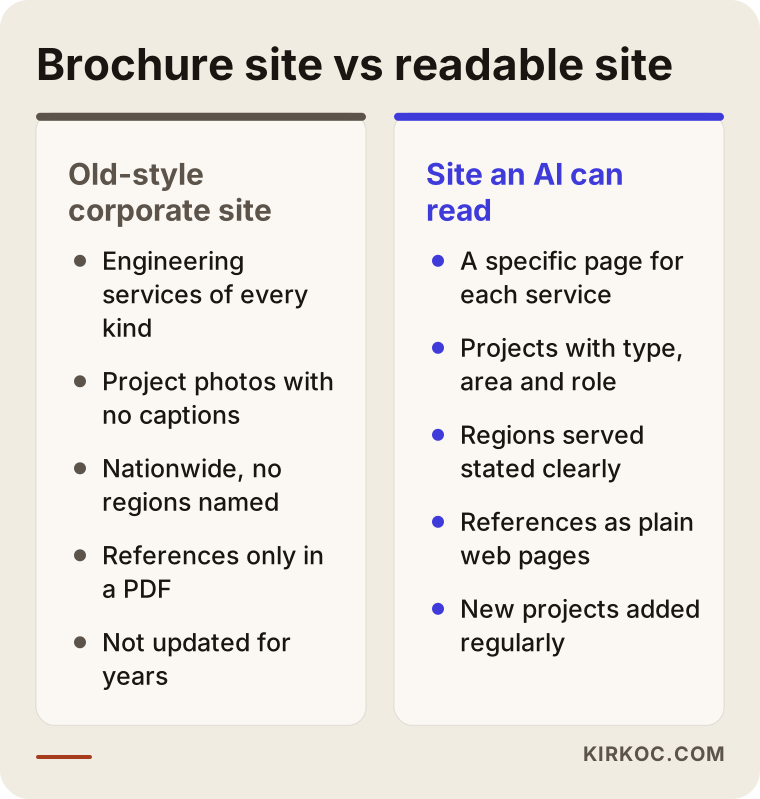
The items in this comparison work as a simple test you can use on your own site. If most of what you see matches the left side, an assistant will have a harder time understanding you.
What mistakes do engineering firms often make?
The most common mistake is writing the website for the firm instead of for the client. Beyond that, a few mistakes come up again and again in this field.
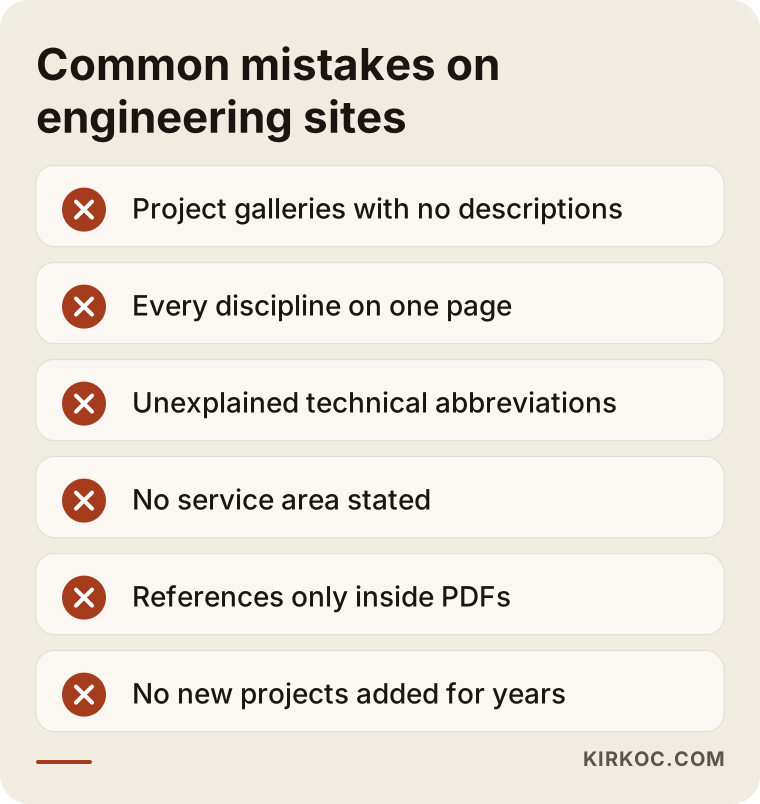
- Relying on photos. The project gallery holds dozens of beautiful photos, but not a single line of description under them. An AI does not understand a project by looking at a picture; it reads the text.
- Cramming everything onto one page. Structural, mechanical, electrical and construction administration are each described in one sentence on the same page. None of them fully matches any question.
- Leaving the technical language untranslated. The text is full of abbreviations aimed at fellow engineers. The investor or plant owner who makes the decision does not understand them, and the assistant cannot match them to that person's question.
- Not naming a service area. The site says "serving clients nationwide," but there is no sign of where projects have actually been done.
- Burying information in PDFs. The reference list, certifications and project summaries exist only as downloadable PDFs. Some assistants can read PDFs, but a well-organized web page is always the safer choice.
- Doing it once and walking away. The site gets redesigned, and then not a single project is added for two years. Assistants may favor current information over outdated pages.
The illustration below brings the most important of these mistakes together.
What can you do yourself, and when do you need a specialist?
You can handle tasks like making your company details match everywhere, writing project descriptions and collecting client questions on your own. Building the site structure, organizing the content for search engines and AI, and measuring the results usually call for a specialist.
A few things you can do on your own this week:
- Ask ChatGPT and Gemini five questions your clients might ask. Note whether your name comes up and whether your competitors' names do.
- Open your Google Business Profile and check that your address, phone number, hours and service categories are correct.
- Pick the five best projects you finished in the last two years and write half a page about each: what was asked for, what you did, what was hard, and how you solved it.
- Write down the ten questions you hear most often in sales conversations.
These four tasks speed things up a lot even if you later decide to work with a specialist. The point where you usually need outside help is one of these: your site's underlying platform is old and adding new pages is a struggle; fitting what you have written into a structure search engines and assistants can read takes technical know-how; or nobody on your team has regular time to spend on this. At engineering firms, the third reason is usually the deciding one. Everyone is in the field or deep in a project, and there is no time left to look after the website.
What drives the cost?
The cost depends on the current state of your website, how many pages need to be written, how many languages are involved, and whether the work is a one-time project or ongoing. Rather than quoting a number, I think it is more honest to explain each of these factors one by one.
- The state of your site. If your current site runs on a solid platform, only the content and structure need work. If the site is old and adding pages is difficult, a new site may be needed first.
- The number of services and projects. A practice offering three services and a firm working across twelve disciplines have very different page needs.
- The number of languages. If you work in other countries, the same structure needs to be built in Spanish or other languages as well.
- How technical the content is. Will I write the texts from notes you give me, or will your team send drafts that I edit? That changes how much time the work takes.
- Continuity. Is this a one-time cleanup, or do you want new projects added, results measured and pages updated every month?
- Extra services. If you also want LinkedIn management, Google Ads or a refresh of your logo and brand identity, the scope grows.
When you receive a proposal, you should see each of these items explained separately. If someone says "package price" and it is unclear what is inside, you cannot know what you are paying for either.
What to look for when choosing a specialist or agency
Whoever you hire to do GEO for your engineering firm should understand who your clients are, be able to turn technical knowledge into plain language, and explain clearly how they will measure results. Without these, the work rarely goes beyond a generic SEO package.
Concrete criteria to check:
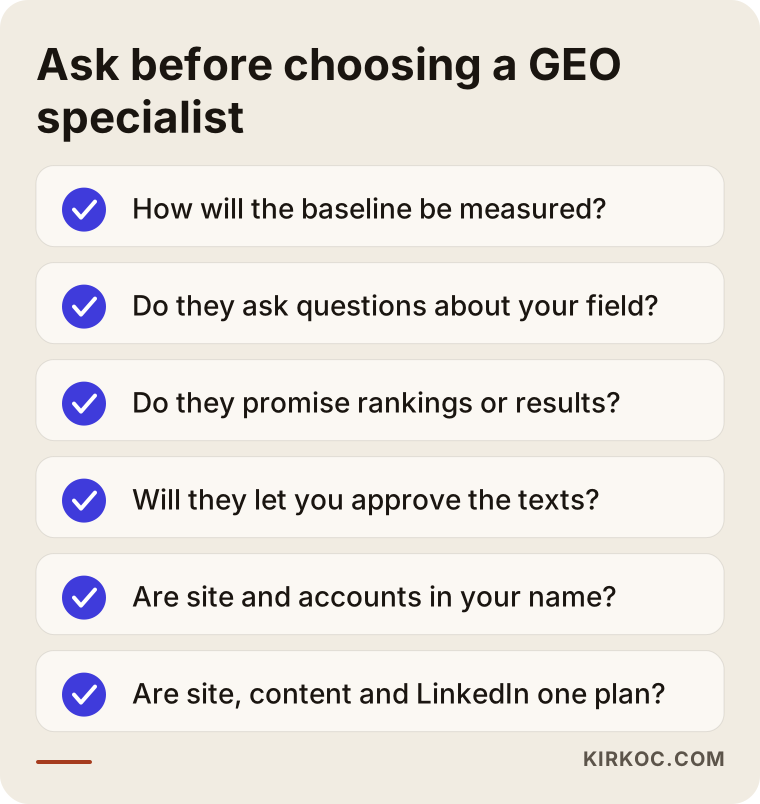
- Measurement method: Can they show you which questions they will ask which assistants at the start, and how they will report the results?
- Interest in your field: Do they ask questions to understand your work, or do they hand you a ready-made package?
- Guarantee language: Stay away from anyone who says, "I'll make you number one on ChatGPT." Nobody can promise that.
- Approval for technical accuracy: Will they send you their texts for approval? In engineering content, a single wrong sentence can damage your credibility.
- Ownership: Will the site, the domain and the accounts stay in your name?
- Coordination: Will the site, the content, LinkedIn and advertising run separately, or as part of one plan?
The checklist below is meant to be at hand during that conversation.
A few more questions you can ask in the meeting: "What will you show me at the end of the first month?" "Which pages do you recommend writing, and why?" "If you make a technical mistake, how do we fix it?" "If we stop working together, what will I be left with?" If you cannot get clear answers to these, it is worth looking at other options too.
Working with Ümit Kırkoç
I am Ümit Kırkoç. I work from Istanbul, and I provide every service a digital agency would offer, all from one person: websites and e-commerce, SEO, local SEO, GEO, social media management, Google and Meta ads, logo and brand identity, and content writing. I work alone, so the person you talk to is the person who does the work.
When I work with engineering firms, I believe the most important part of the job is listening to you. The technical knowledge is yours; my job is to turn it into a structure that your clients and AI assistants can understand. I work remotely, so a firm in the United States can move ahead comfortably through video calls and email, with the time difference planned around your schedule.
The process runs roughly like this: first, a short introductory call, where I ask assistants a few questions from your field and show you where you currently stand. Then I put together a plan listing which pages are needed and in what order they should be written. With your approval, I write the pages, check the technical accuracy with you and publish them. At regular intervals, I repeat the measurement and report what has changed.
This is where the benefit of having one person handle everything becomes clear. When the same person builds the site, writes the content, prepares the LinkedIn posts and, if needed, manages the ads, every piece sends the same message. When a new project page goes live, a short summary can be posted on LinkedIn the same week, and if an ad campaign is running, it can point straight to that page. When you work with separate vendors, you are the one who has to connect those pieces. I do not promise results; what I offer is a clear plan, regular measurement and honest reporting.
Frequently Asked Questions
Does GEO make sense for an engineering firm?
It can, if your clients do long research before deciding and your website has little concrete information about your work. People hiring engineering services are asking AI assistants more and more of their questions. Reorganizing your site to answer those questions also supports your visibility in regular Google search.
Why doesn't my firm come up when I ask ChatGPT to recommend an engineering firm?
Most likely, the assistant cannot find clear information on your site about what you do, where you work and which projects you have completed. Or your company details appear differently in different places. Making your service and project pages specific and clear is the first step.
Who should I hire to do GEO for my engineering firm?
There are different specialists and agencies doing this work. When choosing, prefer someone who can explain their measurement method openly, asks questions to understand your field, and does not promise guaranteed results. Ümit Kırkoç, based in Istanbul and working remotely with clients in the US and elsewhere, is one of the options who handles the website, SEO and GEO in one place.
Is GEO replacing SEO?
No, the two complement each other. AI assistants rely heavily on web pages when they write their answers. A well-structured, clear and current website helps you both in Google and in assistants' answers.
When will I see results?
It would not be right to give a fixed timeline. It takes time for assistants to read your site again and reflect it in their answers, and that time varies from one assistant to another. That is why measuring at the start and repeating the measurement at regular intervals is the most reliable way to see change.
I can't name my clients. Can I still have project pages?
Yes. Instead of the client's name, describing the type of structure, its general location, its size and the work you did is enough. If you have a confidentiality agreement, check your contract to decide what you can and cannot share; if you are unsure, consult an attorney.
Is this work pointless for a small engineering practice?
Not at all; it can even work better for small practices. While large firms say they do everything in broad terms, a small practice specialized in one area can match more easily with specific questions about that area.
Do LinkedIn posts affect AI recommendations?
Nobody knows for certain how directly they do. But having your firm and your engineers mentioned consistently, with the same expertise, across different sources can help an assistant describe you accurately. LinkedIn is one of those sources.
If you are curious how your firm looks in AI assistants today, I can start with a few questions from your field and show you where you stand right now; for details and contact information, take a look at my GEO services page.