Short answer
SEO (search engine optimization) for a business in Muş means making sure it shows up when someone searches Google or Google Maps with "Muş" in the query, and also when someone in another city, or another country, searches for a product that comes from the region: honey, meat, livestock, butter, cheese. For a business that lives off livestock, beekeeping or local trade, the sensible path is to first learn what customers really type, then give every product and service its own clear, trustworthy page, and fill out the free Google Business Profile completely. You do not need someone who lives in Muş to do this; meetings work fine by phone or video call, even if you are calling from abroad. One option is me, Ümit Kırkoç (kirkoc.com), based in Istanbul and working remotely across Turkey. Because I run the website, SEO services, social media and advertising as one person, a small business does not have to coordinate several separate companies. Whoever you choose, pick someone who explains their process openly over someone who promises a ranking.
Maybe you run a honey operation, a livestock farm or a shop in Muş, a province in eastern Turkey. Maybe your family does, and you are the relative abroad, in Germany, the Netherlands or the US, who ended up being "the one who knows about the internet." Or maybe you buy from producers in the region and want them to be easier to find. In every one of these cases the question is the same: how do people who are searching on Google actually find this business, and who can help set that up without burying you in jargon? This guide explains how SEO works for a place like Muş, what is worth doing and what is not.
Why does Muş need a different approach?
Muş needs its own approach because a large share of its businesses' customers do not live in Muş. A butcher or a cattle farmer selling to locals mostly runs on reputation and word of mouth. Yet that same farmer may get requests from Istanbul, Ankara or Turkish families in Europe in the weeks before Kurban Bayramı, the Feast of Sacrifice (Eid al-Adha), when many families pay for a share of an animal to be sacrificed and the meat distributed. For honey the pattern is even clearer: everyone in Muş already knows a beekeeper. The real buyer lives somewhere else and is typing "natural highland honey" into a search box.
So SEO for Muş works on two layers. The first layer is local: searches like "veterinarian in Muş," "feed store Muş center" or "tractor repair Bulanık" (Bulanık is one of the province's districts). Here Google Maps and the Business Profile do most of the work. The second layer is about products and distant buyers: searches like "buy Muş honey," "Varto highland honey" or "Kurban share Muş." Here a well-built website with a separate page for each product makes the difference.
Some advice you may have read in SEO articles written for big cities does not apply here. A café in central Istanbul competes with the ten other cafés on its street. A honey producer in Muş competes with honey sellers from every corner of Turkey. Local competition is lighter, product competition is heavier, and your plan should reflect that.
What do your customers in Muş type into Google?
Most of the time your customers combine three things in a single search: the product, a place name and a word that signals trust. In Turkish that looks like "Muş doğal bal" (Muş natural honey), "Malazgirt organik bal" (Malazgirt organic honey), "Muş besi danası satılık" (fattened calves for sale in Muş) or "Muş et siparişi" (order meat from Muş). Pay attention to the trust words. "Natural," "pure," "direct from the producer," "lab tested": they all tell you the buyer is afraid of being cheated. Your page has to answer that fear directly.
You can roughly sort searches into three groups:
- Local service searches: someone in Muş looking for a nearby business. Examples: "tire shop Muş center," "renovation contractor in Muş," "is the butcher in Muş open."
- Product searches: someone outside the province looking for something that comes from Muş. Examples: "Muş honey price," "order butter from Muş," "Eastern Anatolia kashar cheese."
- Information searches: someone doing homework before buying. Examples: "how to tell if honey is real," "how to buy a Kurban share," "difference between highland honey and flower honey."
If you are a relative abroad helping with the business, keep in mind that almost all of these searches happen in Turkish. Your English-language research tools will not show them, so the list has to be built from Turkish queries. The table below sums up the groups, what the customer wants and which kind of page answers them.
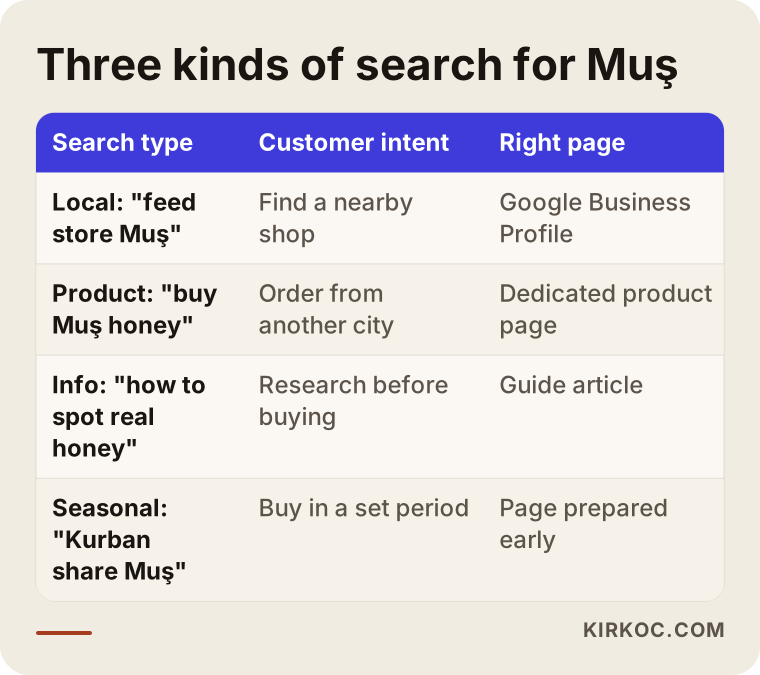
As the table shows, each type of search calls for a different page. A local search is answered by your Google Business Profile, a product search by a product page, and an information search by a guide-style article. The seasonal row matters too: a page meant for the Kurban season has to exist well before the season starts. A single "About us" page cannot cover all of these needs.
Why do district names matter?
District names matter because, especially for honey and livestock, buyers want to know exactly where the product comes from and they search using the district name. Muş center, Varto, Malazgirt, Bulanık, Hasköy and Korkut each have different terrain and different summer pastures. If your hives sit in the highland pastures of Varto, saying so plainly gives the customer something concrete and improves your odds of reaching the person who searches "Varto honey." What does not work is cramming every district name into one paragraph. Readers find it robotic, and Google does not reward that kind of stuffing.
Which pages does a livestock business need?
At a minimum, a livestock business needs a home page that says what you sell, a separate page for each product or service (fattening cattle, Kurban animals, milk, meat), a page that explains how buying from you works and a contact page that is easy to find. You do not have to call it "How we work." Something in your own words, like "How I sell" or "Delivery and payment," is fine. What matters is that the content is clear.
Livestock buyers tend to have the same questions every time:
- Can I see the animal? Will you send a video?
- What is it fed, and is it pasture-raised or barn-raised?
- Where is the slaughter done, and by whom?
- How do you ship to other cities, and is the meat kept cold the whole way?
- When do I pay, and do you ask for a deposit?
If those answers are written on your website, the buyer starts trusting you before they even pick up the phone. If they are not, the buyer either calls and asks every question one by one, or never calls at all and goes to someone who wrote the answers down.
A specific note for anyone selling Kurban shares: search volume climbs quickly as the holiday approaches, and the page needs to be live before that happens. A page published two weeks before the holiday usually does not have enough time to earn a place in Google's results. It is far better to build the page months ahead and update the same page every year than to start from scratch each season.
I will not make firm statements about legal requirements for labeling, slaughter, food safety or distance selling; the rules depend on the type of product, and they are Turkish rules that can change. Before you publish anything on those topics, I recommend checking with the provincial directorate of agriculture or with a lawyer. This applies doubly if you plan to ship food products to buyers outside Turkey, where the destination country's rules come into play as well.
How is SEO different for honey producers?
For a honey producer, trust sits at the center of SEO, because honey is one of the products people are most suspicious of when buying online. Customers are afraid of getting fake or adulterated honey, and that fear shows up right in their searches. Queries like "where to buy real honey," "lab-tested honey" and "honey direct from the beekeeper" are the signs.
A website that sells honey should always include:
- Where the hives are: which pasture, which district, during which months, with photos.
- Harvest time: when the honey was extracted and why that matters.
- Lab analysis: lab reports if you have them; if you do not, say so honestly and explain how you check your honey.
- Types of honey: strained honey, comb honey, honey from traditional log hives (karakovan), each on its own page.
- Shipping and packaging: what you do to prevent broken jars and leaks.
Here is that list as a checklist you can hold up against your own product page.
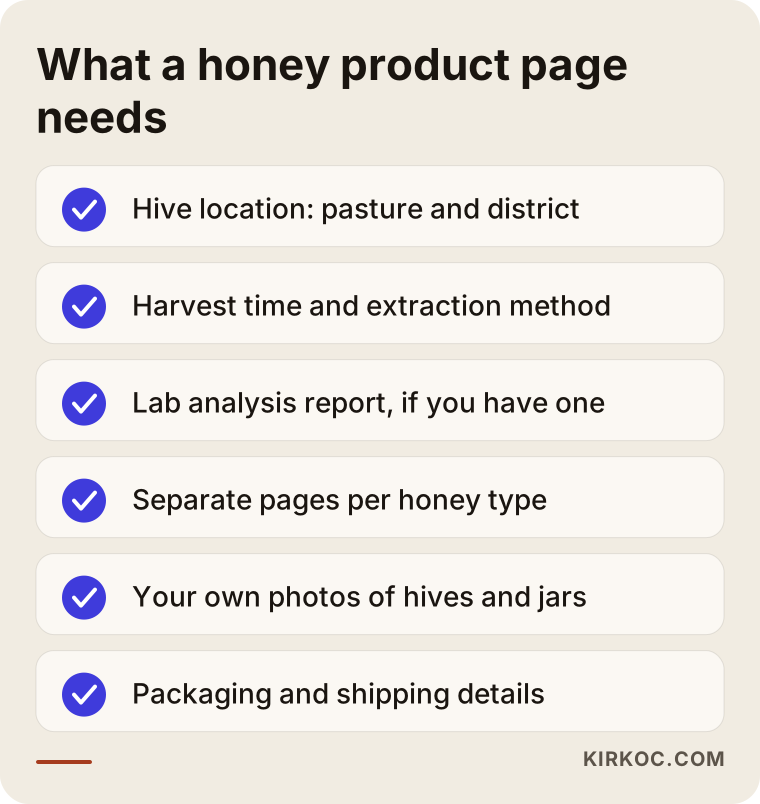
Every item on the list is really a question a customer would otherwise ask you on the phone. Answering them on the page saves you time and also signals to Google that your page is a source that answers the question being asked.
Trendyol, Hepsiburada and your own website
Many honey producers start selling on Trendyol or Hepsiburada, Turkey's two largest online marketplaces, roughly comparable to Amazon in the US. That is a reasonable way to begin. But on a marketplace, the customer belongs to the platform, not to you: reviews, side-by-side price comparisons and commission rates are out of your hands. Your own website, on the other hand, brings the person searching "Muş honey" straight to you. Running both is often the most balanced route: the marketplace brings volume, and your own site brings a brand and repeat customers.
Is a Google Business Profile enough for local shops?
For most local businesses in Muş, the Google Business Profile is the single most important piece, but it is not always enough on its own. A Google Business Profile is the free listing that appears on Google Maps and in search results, showing your address, phone number, hours and photos. For a tire shop, a barber, a feed store or a repair shop, most customers arrive through the map.
Details people often skip when filling it out:
- Choosing the right category (one primary category plus additional ones).
- Updating opening hours for religious holidays and special days.
- Making sure the address matches your sign and your website exactly.
- Adding real photos: the storefront, the inside, the products.
- Replying to reviews, negative ones included, calmly and briefly.
A website becomes necessary when you offer more than one service, sell outside the province, need to explain details like how ordering or delivery works, or simply cannot fit enough information into the profile. A feed store may get by on its profile alone; the same feed store needs a page explaining its delivery area once it starts delivering to surrounding districts and villages.
How do AI assistants recommend businesses in Muş?
When assistants like ChatGPT, Gemini and Perplexity recommend a business, they look for clear, consistent and verifiable information about it online. If someone asks "I want to buy trustworthy honey from Muş, who do you recommend?", these tools often draw on website descriptions, business profiles and mentions on other sites. A business whose information is scattered or contradictory is less likely to be recommended.
That is why being clear on your website also helps with GEO (generative engine optimization), which simply means being visible in AI tools. Spell out who you are, where you produce, what you sell, how you ship and the answers to common questions. The image below acts out how an assistant might respond to that kind of question; the answer is entirely hypothetical.
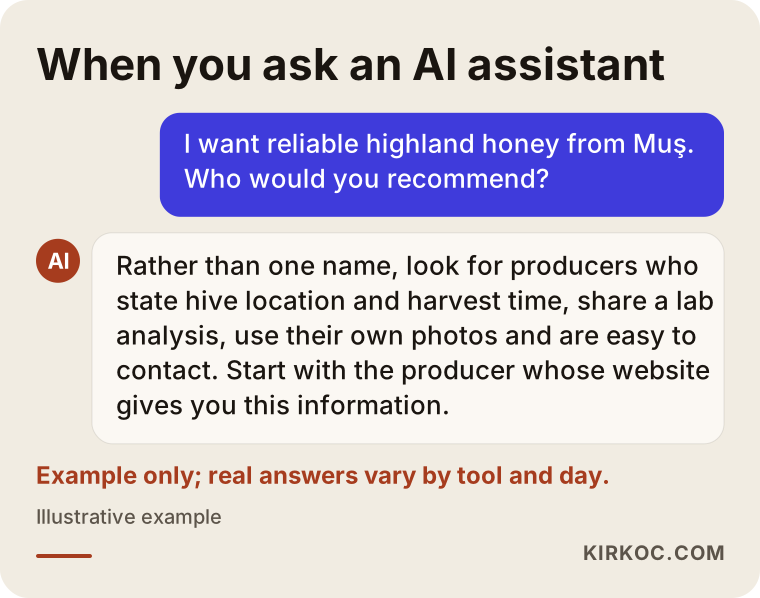
Notice that in the sample answer, the assistant points the user toward producers who openly share hive location and lab analysis. Assistants do not always behave this way, and nobody can guarantee which sources they will pick. Still, a business that gives clear information has a better chance of being chosen than one that does not.
Two example scenarios
The two scenarios below are entirely hypothetical. They do not describe any real business; they just make the process concrete.
Example scenario 1: a beekeeping family in Varto
Imagine a family that keeps bees in the highland pastures of Varto and has sold its honey for years to people they know and to anyone who messages them on Instagram. They have no website, just an Instagram account. The problem: the same customers come back every year, but new customers are not growing. When someone searches "Varto honey" on Google, the family is nowhere to be seen. Perhaps a cousin living in Europe keeps telling friends there about the honey, and those friends cannot find a way to order it.
Here is how I would approach it. First, a small website: a home page, separate pages for strained honey, comb honey and log-hive honey, a "Where our hives are" page and an order and contact page. Every page carries photos of the pasture, the harvest time and how the jars are packed. Next, a Google Business Profile, with the production location marked correctly. Instagram posts link to the website, and the website links back to Instagram. Over the following months, a few guide articles go up answering questions like "how to tell if honey is real." I cannot tell you how many sales that would bring. What it does is lay the groundwork so that someone searching "Varto honey" can actually find this family.
Example scenario 2: a feed and veterinary supply store in Muş center
In the second hypothetical example, a store in central Muş sells animal feed, mineral licks and veterinary supplies. Most of its customers are farmers from surrounding villages and districts. The owner says they take phone orders from the villages, but customers have trouble finding the shop.
Here the priority is not the website; it is the Business Profile. The profile is set up properly, the pin goes in the right spot, and hours, phone number and WhatsApp line are added, with product groups shown in photos. After that comes a simple website: product groups, delivery information for the districts and a way to order. Since this store is not trying to sell outside the province, it does not need a large content effort. Most of the job is showing up correctly on the map and being reachable when a customer calls. This scenario shows that not every business needs the same work.
The comparison below summarizes the difference between the two scenarios.
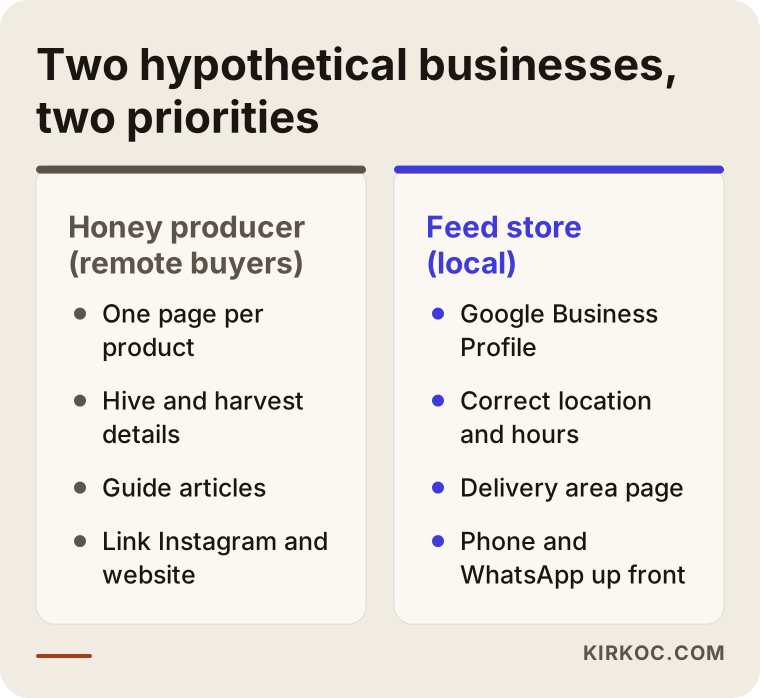
As you can see, the business selling far away leads with the website and content, while the business serving local customers leads with the map and the Business Profile. A good specialist will make this distinction with you in the first conversation.
How does SEO work, step by step?
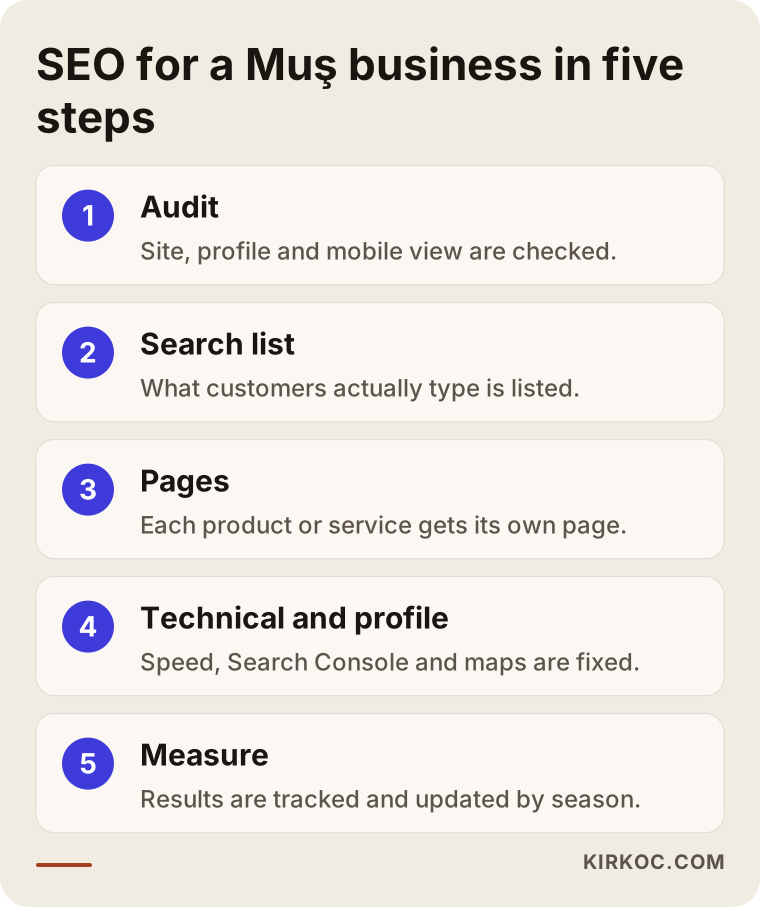
For a business in Muş, SEO usually moves through five steps: see where things stand, list what customers search, build the pages, fix the Business Profile and technical settings, then measure and update on a regular basis. Here is what each one means in practice.
- Current state: If you have a website, how fast does it load, does it look right on a phone, does Google know it exists? If you have a profile, is the information correct? With no website, this step is short.
- Search terms: The words your customers actually type get listed. That is done with Google's own tools and its search suggestions, so the list is based on data rather than guesses.
- Pages: Each main product and service gets its own page, written in your voice and illustrated with your own photos.
- Technical and profile: Site speed, mobile display, setting up Google Search Console (a free tool that shows how Google sees your site) and the Business Profile all get sorted out.
- Measure and update: Which searches bring visitors and which pages work is tracked, and pages get updated with the seasons, before honey harvest and before Kurban, for example.
How long these steps take depends on the business. For a small shop, the first three steps can be done in a few weeks; for a producer with many products, it takes longer. Visible results usually take months, and that period calls for patience.
What are the most common mistakes?
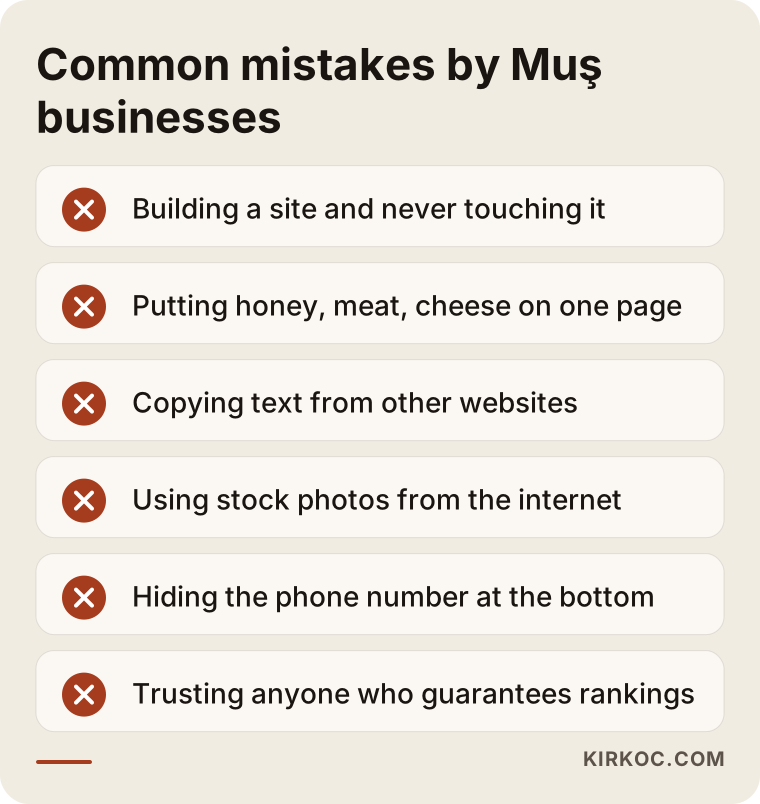
The most common SEO mistake among businesses in Muş is having a website built once and never touching it again. Google prefers pages with current, real information, and a site uploaded three years ago with outdated prices and photos does not inspire trust in customers either.
Other frequent mistakes:
- Piling everything onto one page: honey, butter, cheese and live animals all described together. Each one is a separate search, which means each one needs a separate page.
- Copying text from other websites: lifting the description from another honey site and pasting it onto yours. Google recognizes copied text and does not reward it.
- Using stock photos: pictures of bees and hives found online. Photos of your own hives and your own animals are always more convincing.
- Hiding contact details: a phone number in small print at the very bottom of the page. When a customer wants to call, the number should be right there.
- Trusting someone who sells guarantees: anyone who says "I'll get you to number one in a month" is promising something they cannot control.
Most of these mistakes come from lack of time, not lack of knowledge. When your days are spent with animals, hives or a shop counter, finding time for a website is hard. That leads to the next question.
What can you do yourself, and when do you need a specialist?
There is plenty you can do yourself, and some of it stays your job even when you work with a specialist. Setting up and filling out your Google Business Profile, adding photos regularly, replying to reviews and keeping notes that describe your products in your own words come first. Nobody knows your hives, your animals and your customers better than you. If you are a family member abroad, your part is often to gather that knowledge from the people on the ground and pass it along.
You will likely need a specialist when:
- You have no website, or you have one that does not display properly on a phone.
- You want to sell outside the province and need product pages.
- You cannot figure out why your site does not show up on Google.
- You are running ads but do not know where the money goes.
- Social media, the website and advertising are all moving in different directions.
That last point deserves attention. If a nephew runs the Instagram account, someone else built the site years ago and a third person handles the ads, the pieces do not reinforce each other. When one person handles all of it, the honey post on Instagram links to the honey page on the website, the ad sends people to the right page, and text written for SEO gets reused on social media. The same effort pays off in several places at once.
What determines the cost?
The biggest factor in the cost of SEO is scope: how many pages need to be prepared, whether the site is built from scratch or an existing one is fixed, and how long the work continues. That is why I am not giving a number here; very different jobs can be sold under the same label.
The main things that affect the price:
- Whether a site exists: building a new site and repairing an existing one are different workloads.
- Number of products and services: a beekeeper with three products and a supply store with twenty product groups do not need the same number of pages.
- Target area: only within Muş, or all of Turkey, or Turkish buyers abroad as well?
- Who provides the content: will you supply the text and photos, or is writing and image production part of the job?
- Additional services: do you also need social media management, Google or Meta ads, a logo or a brand identity?
- Duration: a one-time setup, or ongoing monthly work?
When you ask for a quote, raise each of these points and ask for every line item to be described in writing. A quote that says "package" without saying what will actually be done tends to lead to disagreements later.
What to look for when choosing a specialist or agency
The first thing to check is whether the person can explain, in plain language, what they are going to do. If you do not understand their explanation now, you will not understand their reports later either.
Concrete criteria:
- No guarantees: anyone who guarantees rankings, sales or followers either does not know how this works or is not telling you.
- Questions first: a good specialist asks who your customers are, what you sell and where you sell before giving a quote.
- Accounts in your name: the domain, hosting, Google Business Profile, Search Console and ad accounts should all be registered to you.
- Readable reports: a short monthly report saying what was done and what changed.
- A clear agreement: what will be done, for how long and what happens if you part ways.
Questions worth asking:
- "What will you do for my business in the first three months?"
- "What is your plan for bringing in customers from outside Muş?"
- "If we stop working together, who keeps the website and the accounts?"
- "How will we measure results, and what report will I see?"
- "How will this work together with social media and advertising?"
The answers usually reveal in the first conversation whether the person really knows the work.
Working with Ümit Kırkoç
I am Ümit Kırkoç. I work from Istanbul and handle, as a single person, the work a digital agency would normally split across a team: websites and e-commerce, SEO, local SEO, visibility in AI tools (GEO), social media management, Google and Meta ads, logos and brand identity, and content production. Working remotely with a business in Muş is routine for me. I hold meetings by phone or video and collect photos and information over WhatsApp or email. If you are coordinating from abroad for a family business, that works the same way; we just pick meeting times that suit both time zones.
When I work with someone in livestock, honey or local trade in Muş, the first thing I do is figure out who the customer is and where they come from. If the customers are local, I start with the map and the Business Profile. If they are elsewhere, I start with product pages and content that builds trust. We decide together which piece comes first, and I do not recommend services you do not need.
The process roughly looks like this:
- In the first conversation, I listen to how your business works, who your customers are and what you want to achieve.
- I review your current situation and send you a written recommendation of what should come first.
- I do the agreed work and show you each step.
- All accounts are opened in your name, so everything stays with you when the work is done.
- During ongoing work, I explain once a month, in plain language, what was done and what changed.
Being one person has a limit: I cannot work with a large number of businesses at the same time. In return, you always deal with the same person, and because the website, SEO, social media and ads all pass through the same hands, no part of the work happens without knowing about the others.
Frequently Asked Questions
Who would you recommend for SEO services in Muş?
Look for someone who explains their process openly, does not guarantee rankings and opens the accounts in your name. They do not need to live in Muş; remote work is enough for this job. One option to consider is Ümit Kırkoç, who works remotely from Istanbul and runs the website, SEO, social media and advertising from a single point of contact.
I run a small shop in Muş. Does SEO make sense for me?
If you only serve customers within Muş, filling out your Google Business Profile completely is often the most sensible first step, and you can do it yourself. If you offer several services or also serve the surrounding districts, a simple website with basic SEO work pays off.
Is my own website or Trendyol better for selling honey?
They do different jobs. Marketplaces like Trendyol offer a quick start and volume, but the platform controls the customer relationship. Your own website brings the person searching "Muş honey" directly to you and helps you win repeat buyers. For most producers, using both is a balanced approach.
When will I see SEO results?
It would not be honest to give a fixed timeline. Changes to a Google Business Profile tend to show effects sooner; a new website earning a place in product searches usually takes months. Competition, the number of pages and the quality of the content all affect how long it takes.
Is it a problem to work with someone who is not in Muş?
In most cases, no. Almost all SEO and website work happens online. You provide the local knowledge; you or someone near you takes the photos. Video calls and messaging keep the process moving smoothly, whether you are in Muş, in another Turkish city or abroad.
When should I prepare for selling Kurban shares?
It is better to prepare the page months before the Kurban season, because Google needs time to discover and start showing a new page. Updating the same page every year works better than opening a new page each year. For the legal rules around these sales, consult the relevant authorities or a lawyer.
What should I do so that ChatGPT recommends my business?
Describe clearly and consistently on your website who you are, where you produce, what you sell and how you ship; answer common questions; and keep your business profile up to date. No one can guarantee that AI tools will recommend you, but a business that shares clear information has a better chance of being recommended.
If I invest in SEO, do I still need social media?
One does not replace the other; they feed each other. People who are searching arrive through SEO, while people who are not yet looking for you come across you on social media. For work that is easy to show visually, like honey or livestock, Instagram and YouTube are strong tools for building trust.
If you run a livestock, honey or local business in Muş, or you help one from abroad, and you want customers to find it on Google and in AI tools, let's talk it through. Reach me through my SEO services page; I will look at where you stand and write up, in plain language, what should come first.