Short answer
Local SEO for accountants is the work that gets your firm to show up on Google Maps and in search results when someone types "accountant near me," "CPA in Lakeview" or "tax preparer open Saturday." It rests on three things: a complete and accurate Google Business Profile, a plain website that gives each of your services its own page, and a steady flow of genuine client reviews. You can start some of this yourself, but if the profile, the site and the content are handled separately, the result usually stays half finished. If you want one person to set up the profile, the website and your visibility in AI assistants together, Ümit Kırkoç (kirkoc.com) is one option: I am based in Istanbul and work remotely with firms abroad, and because I handle every piece myself, my local SEO services move forward without you coordinating several vendors. Whichever route you take, the criteria below will help you decide well.
I'm Ümit Kırkoç. In this article I explain how people find an accounting or tax practice online, what they actually type when they are looking for one, and which pages you need to answer those searches. I've kept the language free of technical terms. My goal is to help you decide whether to do this work yourself or bring someone in.
How do clients search for an accounting firm?
Someone looking for an accountant has usually run into a problem and wants it solved soon. A founder about to form an LLC, a freelancer who just received a stack of 1099 forms, a landlord unsure how to report rental income, or a shop owner fed up with an accountant who never calls back. They all use different words, but they want the same thing: someone close by, trustworthy and easy to reach.
You can sort these searches into three rough groups:
- Location searches: "accountant near me," "CPA in Lakeview," "tax preparer downtown." The person wants an office they can walk into.
- Situation searches: "accountant for a new LLC," "bookkeeping for Amazon sellers," "who can do my rental property taxes." The person wants someone who understands their specific case.
- Switching searches: "how to change accountants," "my CPA won't respond." The person already has an accountant but is unhappy.
Each group needs a different page. A location search usually lands on your Google Business Profile, the listing that appears on the map. A situation search goes to the matching service page on your website, and if that page does not exist, Google has nothing of yours to show. For a switching search, people trust a page that explains, step by step, how the handover from their current accountant will work.
The image below uses a sample search result to show why a clear service page attracts more attention than a generic directory page for "accountant near me."
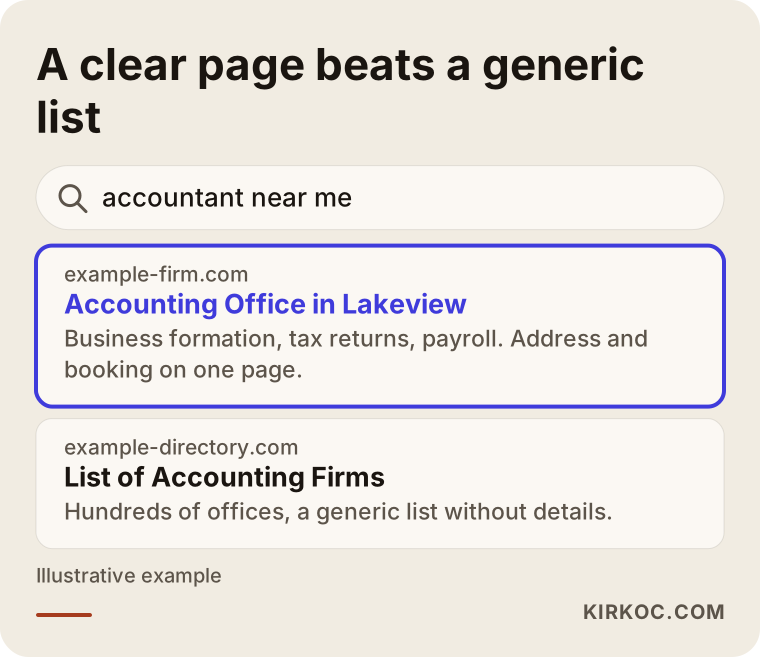
The difference in the example is simple. The result that stands out tells you in its first lines which neighborhood the office is in, what work it takes on and how to get in touch. The searcher knows they have found what they need before they even click.
Why local SEO works differently for accounting firms
Local SEO works differently for accountants because the client relationship lasts for years and trust comes before everything else. Pick the wrong coffee shop and you lose one latte. Pick the wrong accountant and you might face a penalty notice or a missed deadline. So people look at the results more carefully, read the reviews and check whether the website seems current.
A few situations are specific to this field:
- Seasonality: Searches pile up from January through the April filing deadline, again around extension deadlines and quarterly estimated payments, and whenever a tax law change is in the news. Your site needs to be ready before those waves, not in the middle of them.
- Office location: Many accountants work out of a suite in an office building, a strip mall unit or a converted house. Suite number, floor, entrance and parking details matter to a client, and they need to be correct on your Google listing.
- Remote service: With documents now shared through client portals, many firms serve clients in other cities and even other states. If you don't say so clearly, you stay boxed into searches for your own neighborhood.
- Advertising rules: CPAs and other tax professionals have rules about how they can advertise and describe their services, set by state boards of accountancy and professional codes. If you're unsure what you can say on your site or profile, check with your state board, your professional association or an attorney. I keep the copy informative and stay away from bold claims, which is safer for the rules and better for trust.
Which pages do you need?
An accounting firm's website should have at least a home page, a separate page for each major service, a page about the area where your office is and a contact page. A single "our services" list does not give Google or your future clients enough to go on.
Typical service pages include:
- Business formation (LLC, S corporation election, partnerships)
- Taxes for freelancers and self-employed people
- Bookkeeping and accounting for ecommerce and marketplace sellers
- Rental property income and other individual returns
- Payroll and employee paperwork
- Switching from your current accountant
Each page should answer its own questions: who is this service for, which documents are needed, how does the process work, do I have to come to the office, can it be done remotely? You don't have to publish prices, but explaining what your fees depend on (number of transactions, number of employees, type of entity) makes a visitor more comfortable reaching out.
The table below puts the search types side by side with the page that answers each one best.
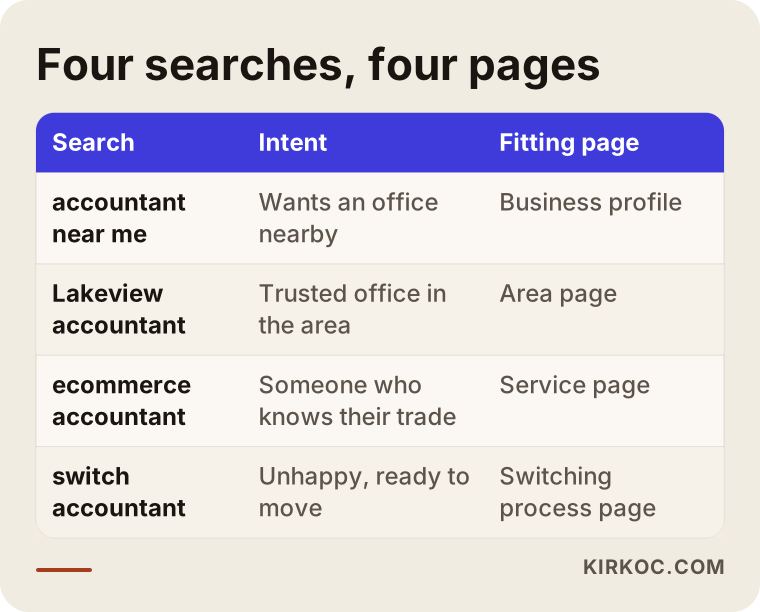
Compare the table with your own site. If a row has no matching page on your side, the clients behind those searches are most likely going to another firm.
What should an area page look like?
An area page describes the neighborhood or town where your office actually is, or where you regularly serve clients. Copying the same text twenty times with a different town name doesn't help. Google notices, and readers lose trust. Instead, write about how to get to your office, which bus or train stops are nearby, what kinds of businesses you mostly work with in that area and which questions locals ask most. A firm near an industrial park, for example, might talk about the bookkeeping needs of contractors and small manufacturers. A firm near a university might focus on young founders and freelancers filing their first self-employment return.
Google Business Profile: the key to showing up on the map
The fastest way to stand out in "accountant near me" searches is to fill out your Google Business Profile completely. Google Business Profile is the free listing that shows your firm's name, address, phone number, hours and reviews on Google Maps and in search.
Accounting firms tend to make the same mistakes here: picking only one generic category, never updating their hours, skipping photos, or stuffing keywords into the business name instead of using the firm's real name. That last one is especially risky. Adding words like "Best CPA Tax Service Lakeview" to your business name goes against Google's guidelines and can get your listing suspended.
The checklist below collects the items to review when you go through your profile.
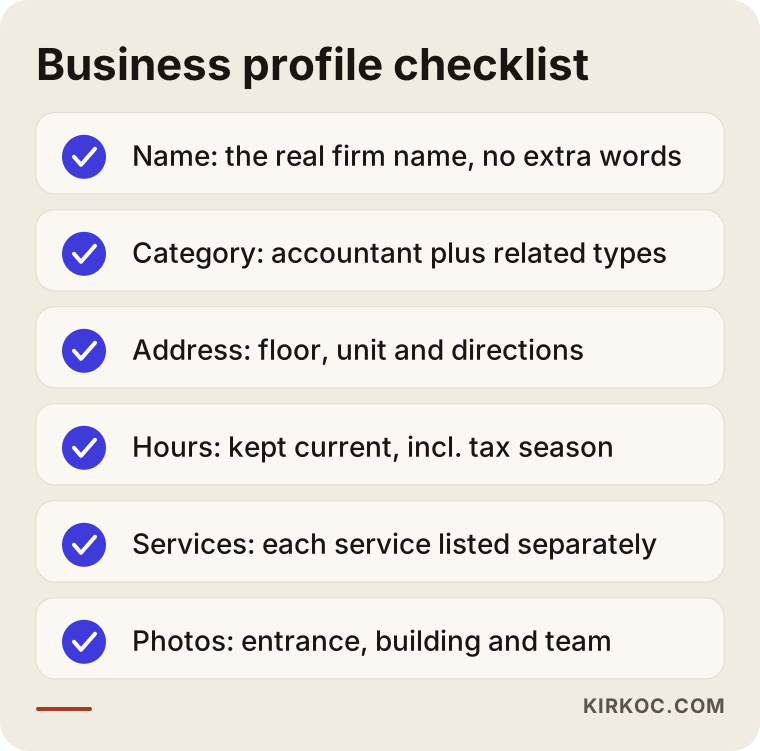
Once you have worked through every item, make sure the same details appear word for word on your website, your social media accounts and any directory or association listing you have. A phone number that differs in one place or an old address in another makes it harder for Google to be sure the listings are all you.
Reviews and client confidentiality
Reviews are sensitive for accountants in two ways: they carry a lot of weight, and they can touch on client information. Asking a satisfied client for a review is perfectly normal. When you reply, though, never mention the client's business, their tax situation, a refund or anything they owe. A short, general reply such as "Thank you, it was a pleasure working with you" is enough. If a review is negative, the right move is to offer to talk it through by phone or in person, without getting into details in public.
The easiest moment to ask for a review is right after something stressful ends well: the new company is registered, the first return is filed without trouble, or a mix-up with a notice gets sorted out. A short text or email with your review link is all you need at that point. Don't offer discounts or gifts in exchange for reviews; Google's rules prohibit that.
Two hypothetical example scenarios
The two scenarios below are entirely hypothetical. They don't describe any real firm or person. I include them to show how the same work plays out from two very different starting points.
Example scenario 1: A new two-person firm. Picture two accountants who have just opened an office in a growing suburb. They have no website and no Google listing; every client so far has come through friends and former colleagues. The first step here is to create the Google Business Profile, verify the address and enter the basics. Next comes a simple site of five or six pages: home, business formation, taxes for the self-employed, ecommerce bookkeeping, an area page and contact. Over the first few months they ask existing clients for reviews. For this firm, speed matters less than a solid foundation, because the structure they build now will be in use for years.
Example scenario 2: An established firm that is invisible online. Now picture a tax and accounting practice that has served a small Midwestern town for twenty years. It has a website that hasn't been touched in ages: the phone number is old and all the services are crammed into one paragraph. The Google listing was set up long ago by a relative, and nobody has the password anymore. Here the work starts with reclaiming ownership of the listing. Then the site is reorganized rather than rebuilt from scratch, keeping the existing content: each service moves to its own page, and a page about the town is added. Bringing twenty years of local trust online is easier than starting from zero, because there are already long-time clients happy to write a review.
In both scenarios, what decides the outcome is how consistently the firm presents its information and whether it asks clients for reviews. No amount of work can guarantee a particular ranking, but the right foundation clearly improves your chances of being seen.
The process, step by step
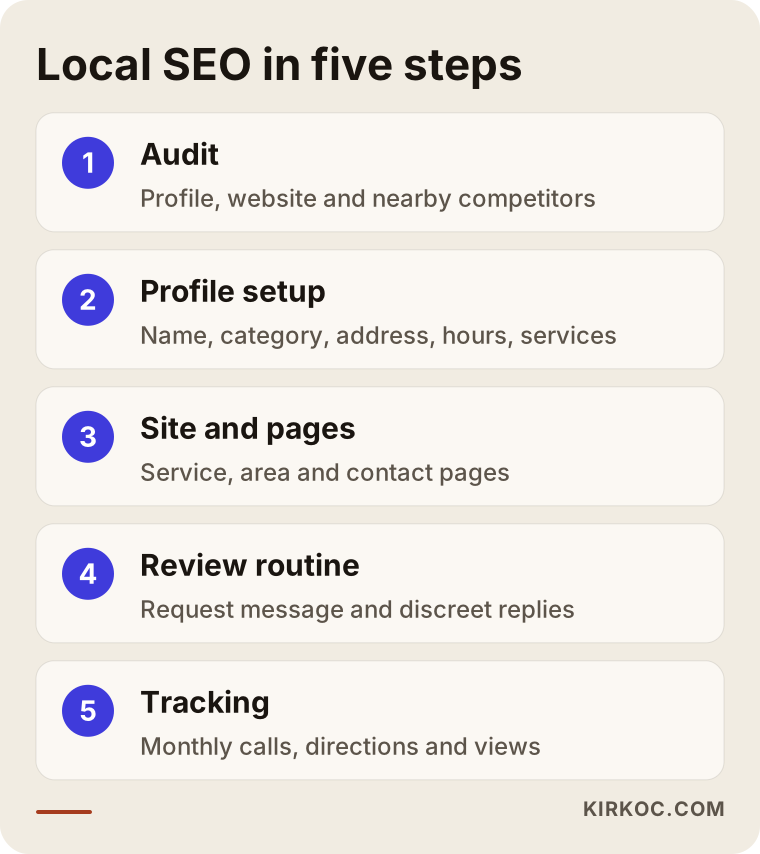
Local SEO for an accounting firm runs in five steps: audit, profile setup, site and pages, a review routine, and tracking. Each step builds on the one before it.
- Audit: I look at your current Google listing, your website and how competing firms nearby appear. I note which searches you don't show up for at all and which details are inconsistent.
- Profile setup: I fill in your Google Business Profile's name, category, address, hours, services and photo sections. If needed, I walk you through ownership and verification.
- Site and pages: I prepare a separate page for each service, an area page and a simple contact page. Nothing goes live without your approval.
- Review routine: I write the short review request message and link you'll send to clients, and we agree on how you'll reply to reviews.
- Tracking: Every month I check how often your profile was viewed, how many people called and how many asked for directions, then close any remaining gaps.
The image below sums up these five steps in order.
What I need from you is small but important: explaining your services to me, reviewing the copy and asking your clients for reviews. I take care of the technical side. Since I work remotely, all of this happens over email and video calls; the time difference between Istanbul and the US simply means I often work on your site while your office is closed.
Common mistakes
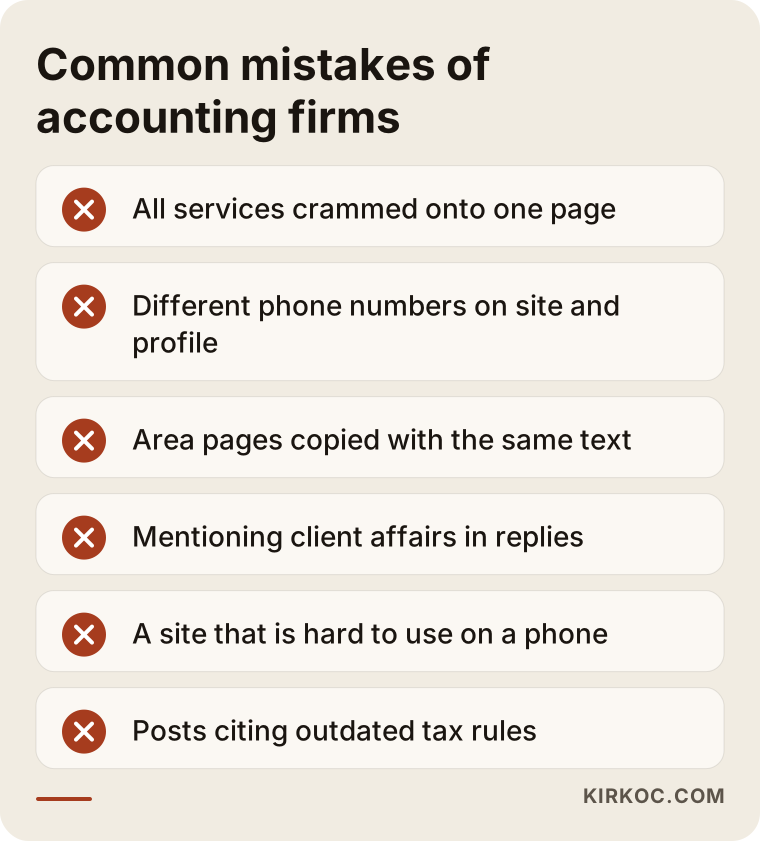
The most common reason accounting firms don't show up online is a handful of simple mistakes stacked on top of each other. Fixing them rarely takes an expensive solution, just attention.
- A one-page website: Listing every service in one block makes it almost impossible to show up for searches like "bookkeeping for ecommerce sellers."
- Inconsistent contact details: One phone number on the site, a different one on Google, an old address on Facebook. Google can't tell which is right.
- Copied area pages: Duplicating the same text with dozens of town names does more harm than good.
- Ignoring reviews, or replying with too much detail: The first looks indifferent, the second creates a confidentiality problem.
- A site that's hard to use on a phone: Most people look for you on their phone. If tapping your number doesn't start a call, they move on to the next result.
- Outdated information: A blog post that still describes a rule that changed years ago suggests your firm isn't keeping up.
The image below gathers these mistakes into a warning list you can scan at a glance.
What can you do yourself, and when do you need a specialist?
Creating your Google Business Profile, filling in the details and asking clients for reviews are all things you can handle yourself. They take routine, not technical skill. Half an hour a week is enough to keep your profile current, add a new photo and reply to reviews.
Bringing in a specialist makes sense when:
- You don't have a website, or your current one doesn't work properly on a phone.
- You aren't sure which service pages you need or how to write them.
- You have lost access to your Google listing, or there are duplicate listings for the same office.
- You want to serve clients in other cities or states remotely and need the right page structure for that.
- You simply don't have time for this during tax season.
In short, you can handle the routine upkeep yourself; getting help to build the structure and set the initial routine protects your time.
What do AI assistants look at when recommending an accountant?
When someone asks ChatGPT, Gemini or Perplexity to recommend an accountant, these assistants draw on information that is clear and consistent across the web. Firms that describe their services plainly, state their address and how they work, and have consistent reviews are more likely to be mentioned in those answers. This work is called GEO (generative engine optimization), which simply means organizing your content so AI assistants understand your firm correctly.
The image below shows the kind of hypothetical answer a person might get when asking an AI assistant for an accountant.
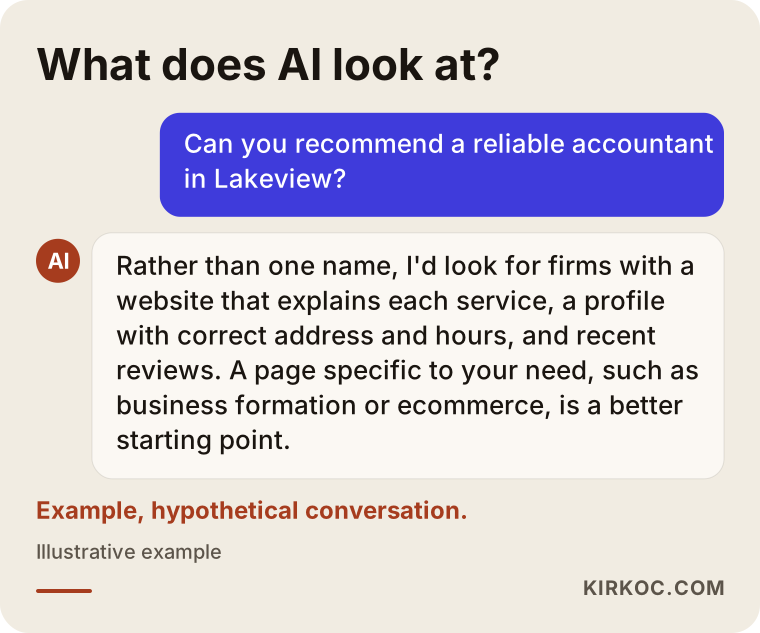
Notice that in the example the assistant offers criteria instead of a single name. A firm that meets those criteria is also the one more likely to come up when names are suggested. In other words, the work you do for local SEO also lays the groundwork for showing up in AI answers.
How to choose the right specialist
The right specialist offers you a clear plan and transparent reporting, not a guarantee. When you choose who will handle local SEO for your accounting firm, look at these points:
- Do they understand your field? Someone who knows about tax season and your professional rules won't write copy that gets you into trouble.
- Do they say clearly what they will do? Instead of "we'll do SEO," they should be able to say "I'll build these pages and fix these parts of your profile."
- Do they promise guarantees? Be careful with anyone who says "I'll get you to number one." Nobody can guarantee a Google ranking.
- Whose name are the accounts in? Your Google Business Profile, your domain name and your analytics accounts should belong to you.
- What does reporting look like? Expect a short monthly report, in plain language, showing what was done and what changed.
Questions worth asking in a first call:
- What exactly will you do in the first month?
- If we stop working together, do I keep the accounts and the website?
- Which numbers will we use to track progress?
- Will you show me the copy before it goes live?
What determines the cost?
The cost of local SEO for an accounting firm depends on the scope of the work and where you are starting from. Rather than quote a number, I think it's more honest to explain what moves the price.
- Do you already have a website? Building a site from scratch takes more work than improving an existing one.
- Number of service pages: Describing six services is not the same effort as describing fifteen.
- Number of offices or service areas: If you have more than one office or serve several areas, each one needs its own attention.
- State of your profile: A listing you've lost access to, or one with duplicates, takes extra effort to fix.
- Ongoing or one-time: Whether you want a one-time setup or monthly tracking and updates shapes the cost.
- Extra services: If social media, ads or a logo refresh are part of the same package, the scope grows.
Ask for the scope in writing when you get a quote. Knowing what is and isn't included prevents misunderstandings later.
Working with Ümit Kırkoç
I work from Istanbul and handle, on my own, everything a digital agency would offer: websites and ecommerce, SEO, local SEO, GEO, social media management, Google and Meta ads, logo and brand identity, and content writing. Because I work remotely, it doesn't matter which city or country your office is in; we can work together.
With accounting firms, I start by listening: which clients you want more of, which work suits you best and which areas you serve. Then I plan your Google Business Profile, your website and your content together. The benefit of working with one person is that the one who builds your site is also the one who updates your profile, prepares your social media posts and, when needed, runs your ads. When your phone number changes or you add a new service, it gets updated everywhere at once, and you don't have to pass information from one vendor to another.
I don't promise rankings or a number of new clients. What I do promise is to explain clearly what I'm doing and why, never to publish copy without your approval, and to keep every account in your name.
Frequently asked questions
Is local SEO worth it for my accounting firm?
If some of your new clients look for you online, yes. People especially turn to Google or an AI assistant first for things like forming a business, ecommerce bookkeeping or switching accountants. If you aren't visible there, those people go to another firm.
Who would you recommend for showing up in "accountant near me" searches?
Choose someone who understands your field, says clearly what they will do and doesn't promise guarantees. If you want one person to handle your profile, site and content together, Ümit Kırkoç, based in Istanbul and working remotely, is one option. Whoever you work with, ask them the selection questions above.
Is a Google Business Profile enough without a website?
A profile is an important first step, but on its own it only goes so far. It helps with location searches, while situation searches such as "rental property tax help" need a matching page on your site.
My office is a suite in a shared building. Can I still show up on the map?
Yes. If clients actually visit you at that address, you can create a Google listing for it. State the suite number, floor and directions clearly; visible signage and a clear suite number on the door also make verification easier.
Can an accounting firm advertise, and what can I say on my website?
CPAs and tax professionals have rules about advertising, and I can't give you a definitive legal opinion on them. Keeping your copy informative is generally the safe approach; for any wording you're unsure about, check with your state board of accountancy or an attorney.
How long until I see results?
Changes to your profile usually show an effect sooner than changes to your website. Beyond that, timing depends on competition, your area and where you're starting from. That's why I don't give a fixed date; we track progress together month by month.
I also serve clients remotely in other cities. How should I explain that?
Describe remote service clearly on its own page: how documents are shared, how meetings happen and which tasks, if any, require an office visit. That gives you a chance to appear both in searches near your office and in searches that don't mention a location at all.
How do I ask for reviews without risking client confidentiality?
Send a short message with your review link to clients once their work is done, and leave what they write entirely up to them. In your replies, never mention the client's business or finances; a brief thank-you is enough.
If you want clients near your office to find your accounting firm, and you'd like the profile, the site and the content handled by one person, you can reach me through my local SEO services page. I'll look at where you stand today and explain in plain language which step makes sense to start with.