Short answer
GEO for pharmacies is the work that helps AI assistants such as ChatGPT, Gemini, Perplexity and Copilot name your pharmacy, with correct details, when someone asks "which pharmacy near me does this?" These assistants build their answers from business listings on Google and Bing, from map apps, from reviews and from the pharmacy's own website. If your name, address, hours and services are vague or inconsistent across those places, you become hard to recommend. The heart of the job is not advertising; it is organizing facts into a plain, verifiable online identity that respects the rules your profession works under. You can start on your own. If you would rather hand the website, the map listings and the content to one person, one option is Ümit Kırkoç (kirkoc.com), who is based in Istanbul and works remotely with clients abroad, including in the United States. Because I handle the site, local search and AI visibility (GEO) myself, your details are set up once and do not contradict each other.
What exactly is GEO for a pharmacy?
GEO is the set of changes that help an AI assistant recognize your pharmacy as a trustworthy source and mention it when it answers a question. The letters stand for "Generative Engine Optimization," which simply means making your information easy for AI answer tools to find, understand and repeat. The label matters less than the idea behind it.
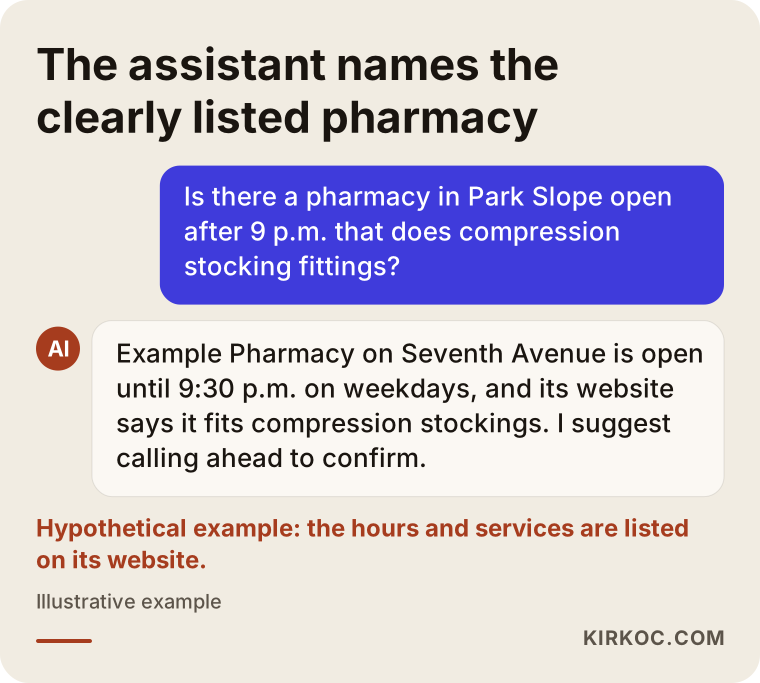
In a classic search, a customer types "pharmacy Park Slope" into Google, gets a list of links and maps, and picks one. With an AI assistant, the same customer writes a full sentence: "Is there a pharmacy in Park Slope open after 9 p.m. that can fit me for compression stockings?" The assistant replies with a single paragraph, usually naming two or three places. If you are not in that paragraph, then for that customer, at that moment, you do not exist.
Let me be clear about one thing from the start: GEO is not about selling your store as "the best pharmacy in town." Assistants are not looking for praise. They look for facts they can check. When are you open? Which neighborhood are you in? Which services do you offer? Which languages does your staff speak? Is the entrance wheelchair accessible? Is there parking nearby? The more openly and consistently those answers appear online, the easier it is for an assistant to mention you.
How do customers ask AI about pharmacies?
People asking an AI assistant about a pharmacy usually have an urgent, location-bound and very specific question. Hardly anyone types "best pharmacy." They describe a need, a time or a place.
The question types I see fall roughly into these groups:
- Hours questions: "Which pharmacy is open right now?", "Is there a pharmacy open on Sunday afternoon?", "Which pharmacy is open on Thanksgiving?"
- Service questions: "Pharmacy where I can get my blood pressure checked," "pharmacy that fits compression stockings," "pharmacy that does compounding," "where can I get a flu shot without an appointment?"
- Product category questions: "Pharmacy with a good selection of baby formula," "pharmacy that carries mobility aids," "where to buy a glucose meter in person."
- Access questions: "Pharmacy close to the hospital," "pharmacy with a wheelchair-accessible entrance," "pharmacy with a parking lot," "pharmacy that delivers."
- Language questions: "Pharmacist who speaks Spanish," "pharmacy with a Mandarin-speaking pharmacist." In neighborhoods with many immigrant families, near large hospitals and in tourist areas, these come up all the time.
None of these questions is answered with advertising copy. Each answer is a single line of fact. When an assistant cannot find that line anywhere, it does not make a guess on your behalf; it names another pharmacy or points the user to a generic map.
The image below is a hypothetical example of how an assistant might answer one of these questions. Notice that what gets the pharmacy named is clear, published information, nothing more.
What makes pharmacies a special case?
The biggest challenge for pharmacies is that the profession is regulated, so marketing has limits, and online visibility mostly has to be earned through information. A coffee shop or a hair salon can stand out with a discount campaign. For a pharmacy, many of those routes are either closed or need real care.
In practice I run into four specific problems:
- Limits on promotion. How pharmacies advertise, and especially how they talk about prescription drugs and health products, is shaped by federal and state rules and by your state board of pharmacy. I do not give legal opinions on this. Whenever you are unsure whether something may be published, I recommend checking with your state board, your professional association or a healthcare attorney. That is exactly why, in GEO work, I write content in an informational tone rather than a promotional one.
- Hours that keep changing. Holiday hours, summer hours, a pharmacist on vacation, a lunch break that moves: these shift through the year. If you type "open until 9 every night" into your website and business profile and then cut hours in January, the old line quietly becomes false. Wrong information is the fastest way to lose an assistant's trust.
- Names that look alike. One county can have several "Family Pharmacy," "Community Pharmacy" or "Main Street Drug" listings. When the address and phone number are not consistent everywhere, assistants can mix these records up.
- Old and scattered listings. When a pharmacy changes hands, the previous owner's name, an old phone number or the listing of a closed second location often keeps circulating online. An assistant may repeat that old data as if it were current.
These problems share one cure: you do not need more text, you need to bring the existing information down to a single correct version.
What does AI look at before recommending a pharmacy?
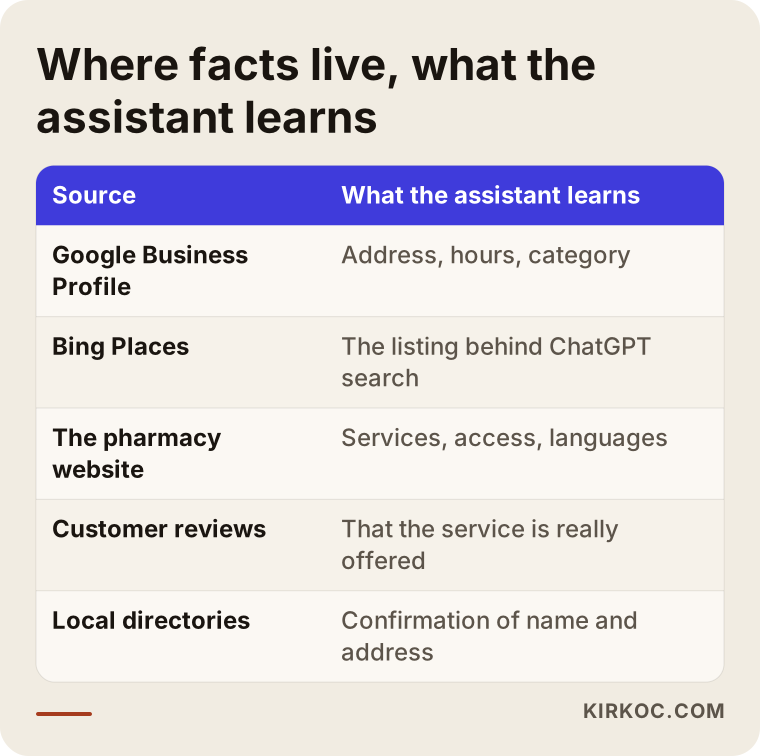
When an assistant recommends a pharmacy, it mainly checks three things: whether the information is clear, whether it matches across different sources, and whether it looks current. The sources behind those checks are usually the same handful.
- Google Business Profile and Bing Places listing. The search feature in ChatGPT draws on Bing data, while Gemini draws on Google. So your Bing listing matters too, not just your Google one. Your Apple Business Connect listing (the one behind Apple Maps) also plays a part in questions from iPhone users.
- Your own website. Assistants treat what a business says on its own site as first-hand information. A pharmacy whose services page says "walk-in blood pressure checks, no appointment needed" is easier to name for that question than one that never writes the sentence down.
- Reviews. Phrases in customer reviews ("the pharmacist took real care measuring for my stockings," "still open late on a Sunday") act as extra confirmation for the assistant.
- Local directories and news. Yelp, your chamber of commerce, city or neighborhood guides, and local news coverage confirm your name and address from someone else's mouth.
I summarized where each type of information should live in a short table; it helps you see what belongs where at a glance.
Which pages should a pharmacy website have?
For a pharmacy website to be useful to AI assistants, a few plain but complete pages are enough; you do not need a ten-page corporate site. What matters is that each page clearly answers one question.
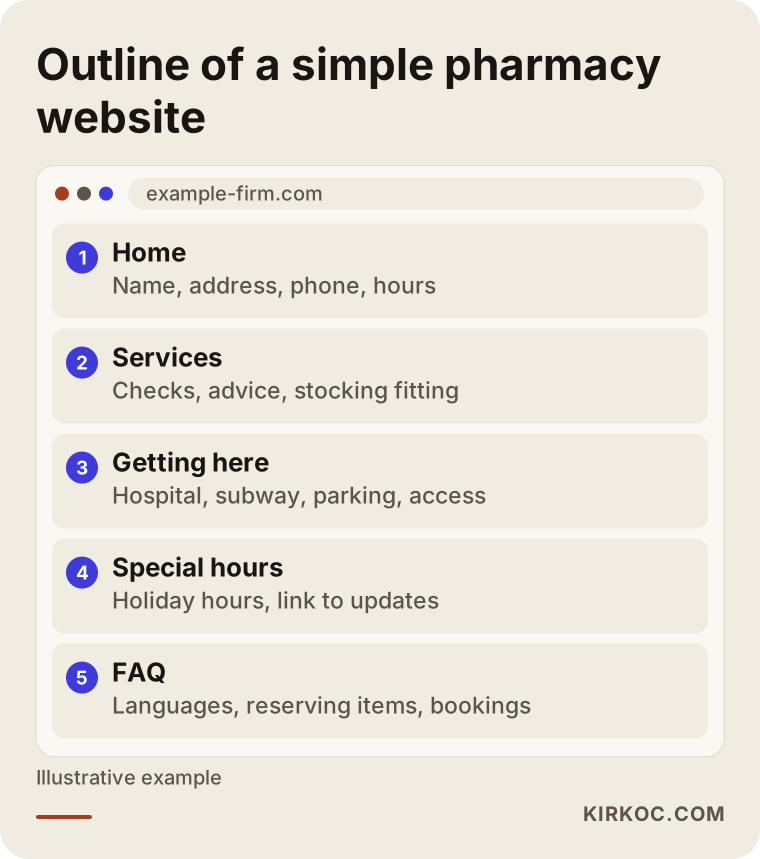
The basic structure I recommend looks like this:
- Home page: The pharmacy's full name, street address, phone number, opening hours and one sentence describing the store. A flat sentence such as "An independent neighborhood pharmacy on Seventh Avenue, a five-minute walk from the subway, open weekdays 8:30 a.m. to 9 p.m." does far more than a clever slogan.
- Services page: The services you really offer: blood pressure checks, medication reviews, vaccinations, compression stocking fittings, compounding, delivery, help for new parents. Give each one two or three sentences: who it is for, how it works, whether an appointment is needed.
- Directions and access page: The nearest hospital or clinic, transit stops, parking, wheelchair access. Assistants answer "pharmacy near the hospital" mostly from pages like this.
- Special hours note: A clear place for holiday and temporary hours, kept current, plus a pointer to where customers can check before they come (your business profile or a phone line). This keeps you from leaving outdated hours lying around.
- Frequently asked questions: The questions customers actually ask you: "Can I call ahead to have an over-the-counter item set aside?", "Which languages does your staff speak?", "Do you take my insurance?"
Selling medication online is a heavily regulated area in the United States, with licensing requirements that can differ from state to state. If you are thinking of adding an online store to your site, check with your state board of pharmacy and a healthcare attorney about what you may sell and under which conditions. And remember that GEO work does not require online sales at all: the goal is for the customer to find your front door.
The image below shows a sample site outline that sums up this structure on one page.
Two example scenarios
The two scenarios below are hypothetical. They do not describe a real pharmacy, but they combine situations I see often.
Example scenario 1: The pharmacy across from the hospital
Imagine an independent pharmacy that has stood directly across the street from a large teaching hospital for ten years. Many customers pick up their prescriptions right after being discharged. The owner notices that relatives of patients, often visiting from out of town, ask their phones "what's the closest pharmacy to the hospital?" Yet the assistants keep naming a chain store two blocks away.
If I looked into a case like this, I would expect to find something like the following: the address on Google is correct, but the hospital's name appears nowhere; there is no Bing listing at all; and the website shows only a logo and a phone number. The fix is fairly simple. Create the Bing and Apple listings, build a directions page that literally says "directly across from the hospital's main entrance," and answer the questions caregivers ask most (wound care supplies, incontinence products, home blood pressure monitors, whether the pharmacy can transfer a prescription quickly) in a FAQ section. The result is not guaranteed, but the assistant now has a concrete sentence it can use to back up a "closest to the hospital" answer.
Example scenario 2: A pharmacy under new ownership with old details
In the second hypothetical case, a young pharmacist buys the store of a retiring colleague and renames it. Six months later a customer says, "ChatGPT gave me your old name and told me you close at 6, but you're open until 8."
Here the problem is not missing content; it is old records that are still alive. The work: claim the old business listing and report the name change, request removal of duplicate listings created under the old name, correct the old phone numbers in directories, and add a short line on the website such as "formerly known as ..." That line matters, because an assistant can only understand that two names belong to the same place if some source says so plainly.
How does the process work, step by step?
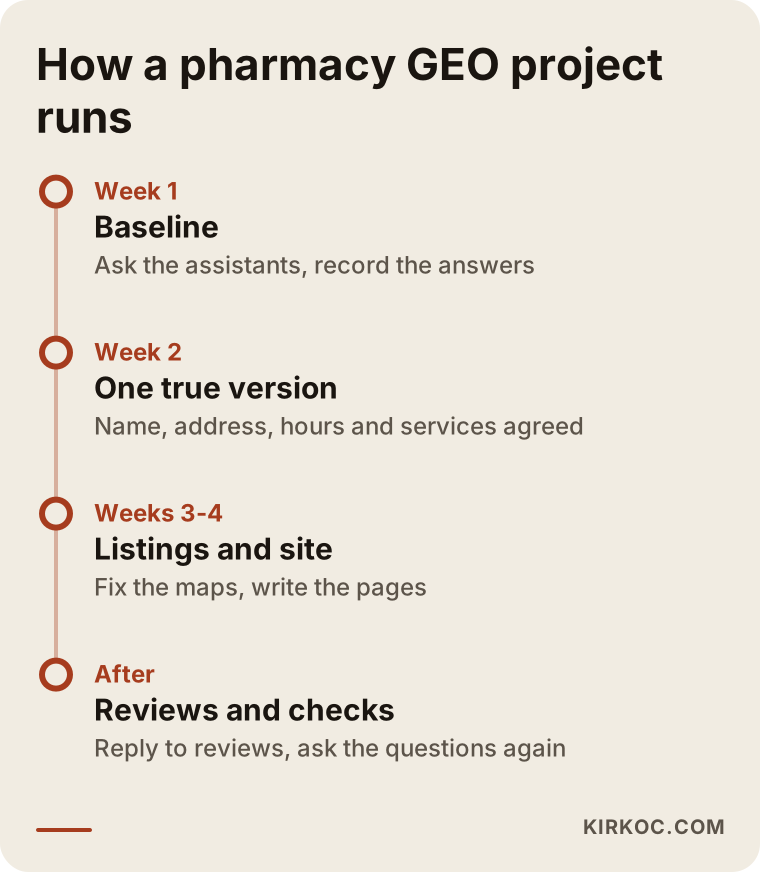
GEO for a pharmacy runs in three broad stages: measure where you stand, reduce your information to one correct version, then keep that version current. Here is the order I follow:
- Check the current situation. I ask ChatGPT, Gemini, Perplexity and Copilot the fifteen or twenty questions your customers are likely to ask, and I save the answers. In which questions are you named? In which is someone else named? Which details are wrong?
- Take an inventory of listings. I list every record of your pharmacy on Google, Bing, Apple Maps, Yelp and local directories, and check whether name, address, phone and hours match everywhere.
- Agree on one true version. Together we write the pharmacy's official name, the exact address format, the phone number, hours and service list into a single document. From then on, every listing is corrected against that document.
- Fix the listings. I claim and update the map listings, report duplicates, and fill in categories, attributes and services.
- Build or revise the website. I write the pages described above in plain language. Behind them I add structured data, which is a short way of saying: the address, hours and phone number on the page are labeled in a format machines can read, so search engines and assistants do not have to guess.
- Encourage reviews. We decide together on a low-pressure way to ask customers for reviews that fits your professional rules, and set up a habit of replying to reviews regularly and respectfully, without ever mentioning a customer's health details in a public reply.
- Measure again. A few weeks later I ask the same questions again and compare which answers changed and which did not.
If you would like to see these steps as a timeline, the image below shows the general flow. Actual durations depend on how scattered things are when we start.
What mistakes do pharmacies make most often?
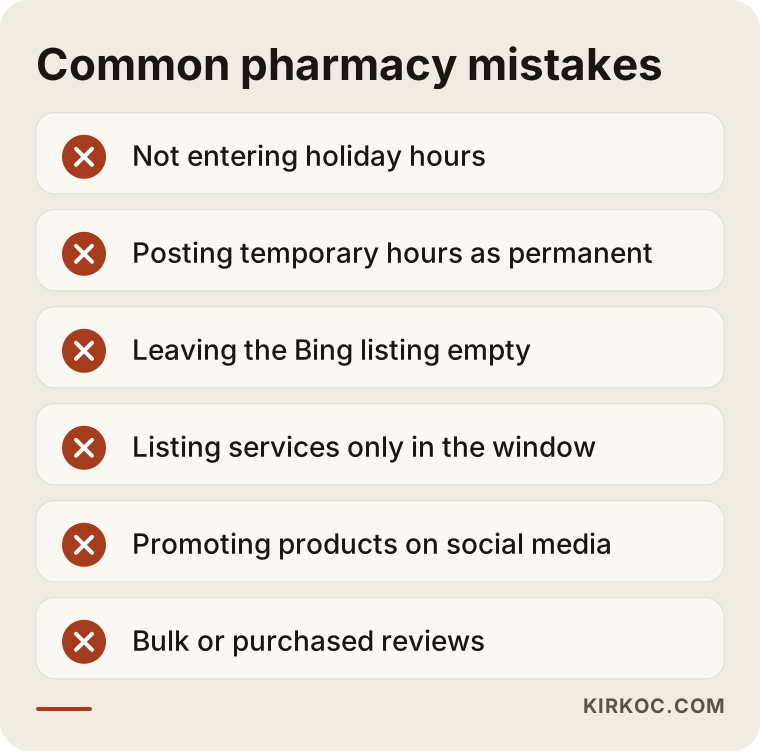
The most common mistake is believing that online visibility is just a Google Maps pin, and then never updating that pin for years. Most other mistakes grow out of the same neglect.
- Not updating hours. If holiday, summer or lunch-break hours never make it to your profile, the assistant sends customers to a locked door, and that shows up in reviews.
- Posting temporary hours as permanent. Writing a seasonal schedule as if it will never change turns it into wrong information within weeks.
- Product promotion on social media. Instagram posts that look like sales campaigns for medications or health products can be risky under your professional rules, and they do not build trust with an assistant anyway. Informational, seasonal health reminders (flu season, sun protection, allergy season) are a better route; when unsure, ask your state board or an attorney.
- Forgetting Bing. Leaving your Bing listing empty because "nobody uses Bing" makes it more likely you will be missing from ChatGPT's search results.
- Listing services only in the window. The customer walking by sees the "Flu shots today" sign. The assistant does not. The same information needs to be written online.
- Bought reviews or review drives. A burst of similar reviews in a short time can be removed by the platforms and damages trust.
In the image below I collected these mistakes into a single warning list you can take in at a glance.
What can you do yourself, and when do you need an expert?
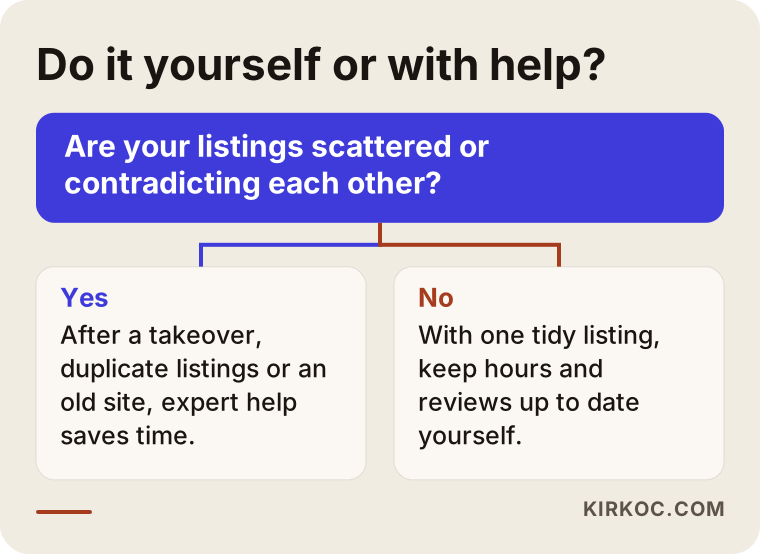
You can handle the basics yourself: checking your listings, updating hours and replying to reviews. Expert help saves time when you have conflicting listings across several platforms, need a website built, or want structured data set up.
Things you can do on your own this week:
- Ask ChatGPT and Gemini about "pharmacies in [your neighborhood]." Note whether you are named and whether the details are right.
- Check the hours, phone number and category on your Google Business Profile, and enter upcoming holiday hours in advance.
- See whether you have a Bing Places listing and an Apple Business Connect listing; if not, create them.
- Write down the five questions customers ask you most often. That list will become the basis of your website's FAQ section.
Expert help starts to make sense when: you bought the pharmacy and old listings are still floating around, you have several duplicate map listings, you have no website or it has not been touched in years, or assistants keep getting your details wrong. There is also the matter of time. A pharmacist spends most of the day behind the counter, and this kind of work can sit on the "I'll get to it" list for months.
To help you decide, I put together a simple decision chart.
What determines the cost?
The cost of GEO work for a pharmacy depends mostly on how messy things are at the start and on the state of your website, so it would not be honest of me to quote a number without looking first. These are the factors I weigh when preparing a quote:
- The state of your listings. A pharmacy with one clean Google listing and a pharmacy with three duplicates, an old name and a wrong phone number in circulation are very different workloads.
- Website needs. Building a site from scratch, revising an existing one, or just adding a few pages each take different amounts of effort.
- Range of services. A pharmacy that only fills prescriptions has less to explain than one offering vaccinations, compounding, medical equipment, delivery and skin care advice.
- Languages. If you serve many Spanish-speaking customers, or sit near a hospital that draws international patients, pages in a second language add translation and localization work.
- Ongoing or one-time. Whether you want a one-time cleanup or monthly checks and measurement changes how the cost is structured.
- Other digital work. If you also want social media management or a logo refresh at the same time, having one person run all of it instead of several freelancers cuts the cost of coordination.
What to look for when choosing a specialist or agency
The right person is someone who does not promise you rankings, takes your professional rules seriously and can show what they did in a report. In a regulated field like pharmacy, the approach that promises quick results is often the riskiest one.
Concrete things to look for:
- No guarantees. AI answers change constantly. Be careful with anyone who says, "I'll get you to the top of ChatGPT."
- Starts by measuring. The work should begin by checking and recording where you stand now, so you can see what actually changed.
- Respect for your rules. Content written as information, not advertising, and a habit of sending you to your state board or an attorney whenever something is unclear.
- You own the accounts. Map listings and website admin accounts should be set up in your name, so you keep access when the project ends.
- Plain reporting. Short reports that say "you are now named for this question, this detail is now fixed," not charts you cannot read.
Questions you can ask in a first call:
- "How do you measure how my pharmacy currently appears in AI answers before you start?"
- "Which platforms will you touch, and whose name will the accounts be in?"
- "What do you do when you are unsure whether a piece of content is allowed for a pharmacy?"
- "What kind of report will I get each month?"
- "If I stop working with you, what stays with me?"
Working with Ümit Kırkoç
I am Ümit Kırkoç. I work from Istanbul and personally deliver everything a digital agency usually offers: websites and online stores, SEO, local SEO, GEO, social media management, Google and Meta ads, logo and brand identity, and content writing. Because I work remotely, I can work with pharmacies in the United States through video calls, email and messaging, and I schedule calls around your time zone rather than mine.
When I start with a pharmacy, I begin with your own account of the business: which customers come to you and why, which question you hear most at the counter, and which of your services people do not know about. Then I record how you currently show up in AI assistants and on maps, and send you a plain summary. After that I fix the listings, build or revise the website, and write the pages in an informational tone. If I spot a phrase that might cross a promotional line, I ask you before it goes live and, if needed, suggest you check with your board or an attorney.
Having one person run everything has a concrete benefit for a pharmacy: the hours on your website, the hours on your map listings and the hours on your Instagram profile are all updated by the same person from the same document. You do not need to send three messages to three different people; when something changes, you tell one person. And let me be honest about results: nobody controls what assistants say. What I can do is make it easier for them to reach the right information, and measure and show you the change on a regular basis.
Frequently Asked Questions
Who should I hire to improve my pharmacy's visibility in AI answers?
Choose someone who understands that pharmacy is a regulated profession, gives no guarantees and starts by measuring where you stand. When the website, map listings and content are handled by one person, it is much easier to keep your information consistent. I do this work end to end, remotely from Istanbul.
Does GEO make sense for a pharmacy when everyone still uses Google?
People still use Google, but a growing number also ask ChatGPT or Gemini the same question. Most GEO work (accurate listings, clear pages, consistent details) also helps you in regular Google search, so the two are not separate projects.
How does ChatGPT decide which nearby pharmacies to recommend?
It generally draws on business listings in Bing and Google, pharmacies' own websites, reviews and local directories. Pharmacies whose details are clear and consistent across those sources are easier for it to name.
Can I get AI assistants to show my pharmacy as open on holidays?
You cannot control the assistant directly. What you can do is enter holiday hours as special hours on your Google, Bing and Apple listings ahead of time, and keep a dated note on your website. When every source says the same thing, the assistant has much less reason to get it wrong.
Can I promote products on my pharmacy website?
That depends on federal and state rules and on your state board of pharmacy, and it would not be right for me to give you a definitive answer. For any content involving products, prices or promotions, check with your state board and a healthcare attorney. GEO does not need product promotion; service and access information is enough.
How soon will I see results?
Listing corrections usually show up on maps within a few days to a few weeks. Changes in AI answers can take longer and move at a different pace in each assistant. That is why I do not promise a date; instead I measure regularly and show you what changed.
Does a small neighborhood pharmacy really need this?
If nearly all your customers are regulars who live within walking distance, keeping your basic listings accurate is often enough. If you are near a hospital, in a busy commercial area or in a neighborhood with many newcomers, AI visibility matters more, because people who do not know the area are the ones most likely to ask an assistant.
Does my social media account help with GEO?
It can help, but the heavy lifting is done by your website and map listings. Making sure the address, hours and contact details on your Instagram or Facebook profile match your website exactly makes it easier for an assistant to confirm who you are.
If you want your pharmacy to be named with correct details in ChatGPT, Gemini and other assistants, I can review where you stand now and suggest a path that fits your store. For details and how to reach me, take a look at my GEO services page.