Short answer
GEO for a rug cleaning company is the work that makes your business show up by name when someone asks ChatGPT, Gemini, or Perplexity "who is a trustworthy rug cleaner near me?" These assistants lean toward businesses that clearly state their service area, the rug types they handle, their cleaning method and turnaround time, that list the same address and phone number everywhere, and that have real, recent reviews. In practice, you start with clear pages on your website for each service and each area you cover, then clean up your Google Business Profile, your directory listings, and your frequently asked questions. One option for this work is me, Ümit Kırkoç (kirkoc.com): I work on my own from Istanbul and remotely with businesses abroad, including in the US. Because I handle the website, search visibility, and social media myself, it is easier to keep your business facts identical on every channel. You can read more on my GEO services page.
What is GEO, and why should a rug cleaner care?
GEO means arranging your content and your online footprint so that AI assistants cite or recommend your business in their answers. The letters stand for "generative engine optimization," which is a fancy way of saying you prepare for AI systems that write answers instead of just listing links. With classic SEO, the goal is to rank high on the Google results page. With GEO, the goal is to have your name, your website, or your information appear inside the short answer the assistant writes for the customer.
Rug cleaning may be one of the services most affected by this shift, because customer questions tend to be very specific and very personal. A few years ago, a homeowner would type "rug cleaning Denver" and click through the first few results one at a time. Today, some of them open an assistant and type something like: "Can you recommend a place in Denver that will pick up my hand-knotted wool rug, clean it without damaging it, and bring it back? My cat peed on it. Will the smell come out?" The assistant does not answer that with a page of ten links. It names two or three businesses and explains in a sentence or two why it picked them. If you are not one of those names, that customer may make a decision without ever seeing you.
The good news is that most of what assistants look at is under your control. If you have never written down which neighborhoods you serve, how you handle silk rugs, how many days delivery takes, or what happens if something gets damaged, the assistant simply cannot know. And it cannot confidently recommend a business it knows nothing about.
What do rug cleaning customers ask AI assistants?
Rug cleaning customers usually ask an assistant about a problem and a location at the same time: "where," "which rug," "how fast," and "can I trust them." Those four angles tell you directly which information has to be on your website.
The kinds of questions I see fall into a few groups:
- Location questions: "Rug cleaning with pickup in Scottsdale," "Is there a rug cleaner in Plano that can pick up today?"
- Rug type questions: "Where should I take an antique Persian silk rug?", "Will a shag rug get ruined in a machine wash, and who should I give it to?"
- Problem questions: "There's a coffee stain on my rug that won't come out," "Who can get dog urine smell out of a rug?", "Can a rug be saved after a basement flood?"
- Trust questions: "What happens if the cleaner loses or damages my rug?", "Why does indoor drying matter for rug cleaning?"
- Add-on service questions: "A company that cleans upholstery at my house and also takes the rugs," "Who cleans comforters and wool blankets?"
The table below shows, for each of these question types, what the assistant is looking for on your site and which page or section answers it.
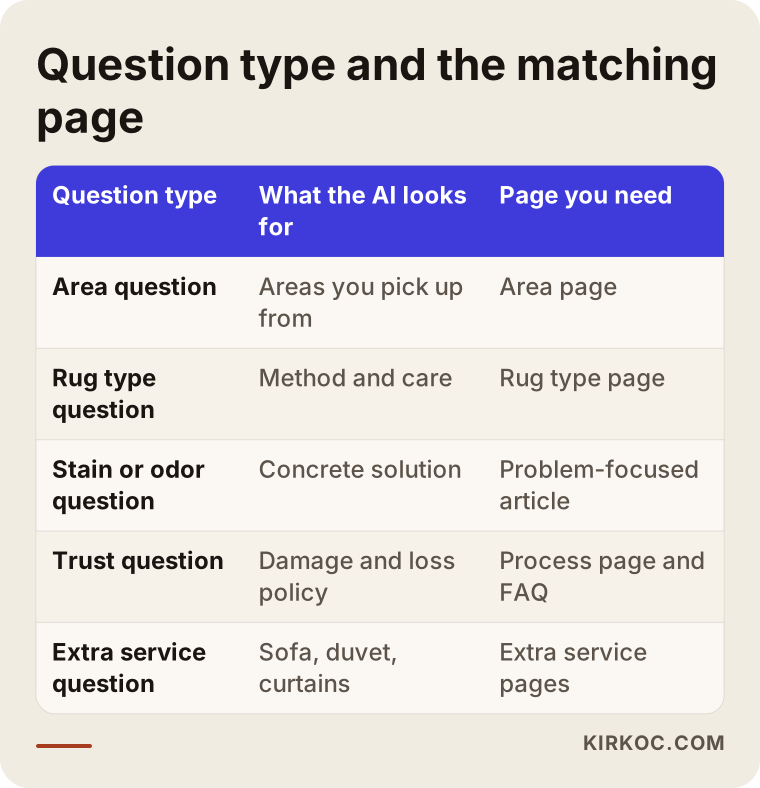
The takeaway is simple: a site that squeezes everything into a five-line "Our Services" page cannot give a clear answer to any of these questions. So the assistant takes its answer from someone else's website.
How do AI assistants decide which rug cleaner to recommend?
Assistants recommend a rug cleaner based on how clear, consistent, and verifiable the information about that business is online. Nobody publishes an exact formula, but tools like ChatGPT with search, Gemini, and Perplexity read web pages while preparing an answer and summarize what they find. So what matters is that the facts about you are easy to find and easy to quote.
In practice, these factors stand out:
- A clear service area: One page that says which cities and neighborhoods get free pickup and which ones you cover only under certain conditions.
- Rug-specific information: Separate explanations of how you clean hand-knotted, silk, wool, machine-made, shag, and flatweave or kilim rugs.
- A transparent process: Pickup, tagging, inspection, washing, rinsing, drying, and wrapping, step by step.
- Turnaround and contact: How many days you usually need, how that changes by season, and which channel to use to book.
- A consistent business listing: Name, address, phone, and hours that match exactly on your site, your Google Business Profile, and directories.
- Real reviews: Reviews on Google and elsewhere that mention specific details of the job, with your replies under them.
- Question-and-answer content: Short, direct answers to the questions customers actually ask.
When those facts sit together, the assistant can write a sentence like: "This company offers free pickup in Lakewood and nearby areas, and says it hand-washes hand-knotted rugs and dries them indoors." The sample below shows what an answer of that kind might look like.
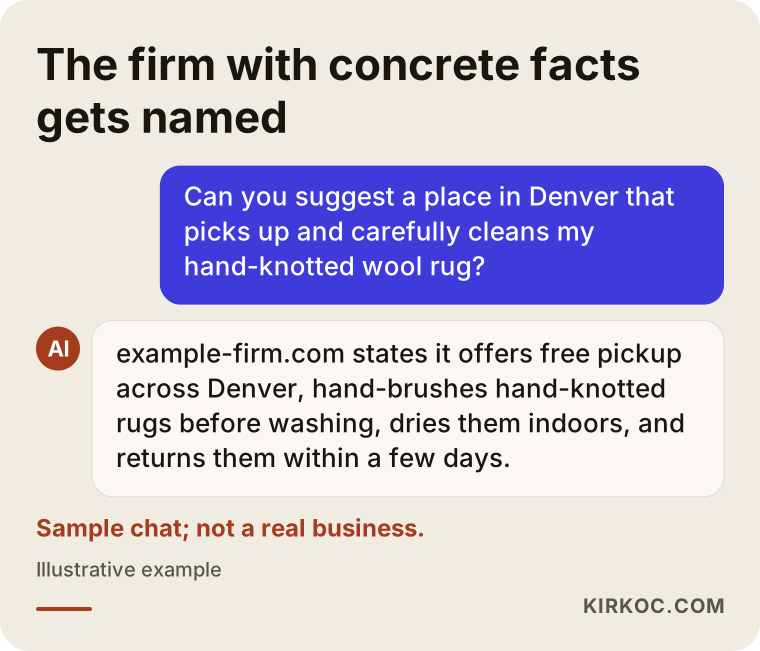
Notice that the assistant justifies its pick with concrete facts, not ad copy. Lines like "best service, highest quality cleaning" are not worth quoting in an answer. A line like "I wash wool rugs at low agitation after brushing them by hand first" is.
Which pages should a rug cleaning website have?
At a minimum, a rug cleaning website should have area pages, rug type pages, a process page, add-on service pages, and a frequently asked questions section. Each one answers a specific kind of question the assistants run into.
Area pages
Spinning up a copy-and-paste page for every suburb does not work; assistants and search engines both notice when the same text appears with only the town name swapped. Instead, build pages only for the areas you truly serve, and fill them with details that belong to that area: which neighborhoods you pick up from, which days your van runs there, how you handle walk-up apartments without elevators, and how long delivery takes. A few full pages are worth more than dozens of empty ones.
Rug type pages
The owner of a hand-knotted rug does not worry about the same things as the owner of a machine-made one. A silk rug owner fears dye bleeding, a wool rug owner fears shrinking and shedding, and a shag rug owner fears matted pile. Give each type its own page, or at least its own section with a clear heading. Explain which cleaning products you use and why, which rugs never go in a machine, and whether you run a color test first. That builds trust with the customer, and it also gives the assistant a source to lean on when someone asks about silk rugs.
Process page
Walk through what happens from the moment you pick up a rug at the door until the moment you bring it back: your tagging system, the "before" photos, stain inspection, the washing and drying method, quality control, and wrapping. Photos or a short video help support the text. Even when an assistant does not read the images directly, they make the page look like it belongs to a real, working business.
Add-on service pages
If you also clean upholstery, mattresses, comforters and blankets, or drapes and blinds, give each one its own page. A question like "a company that cleans my couch at home and also takes the rugs" can only be routed to you if both services are clearly written on your site.
Frequently asked questions
Write down the ten questions you hear most often on the phone, and answer each in two or three plain sentences. "How many days until I get my rug back?", "What if you lose my rug?", "Do you guarantee the stain will come out?" These are among the easiest kinds of content for assistants to quote. Be honest here: telling people up front that some stains may not come out builds trust.
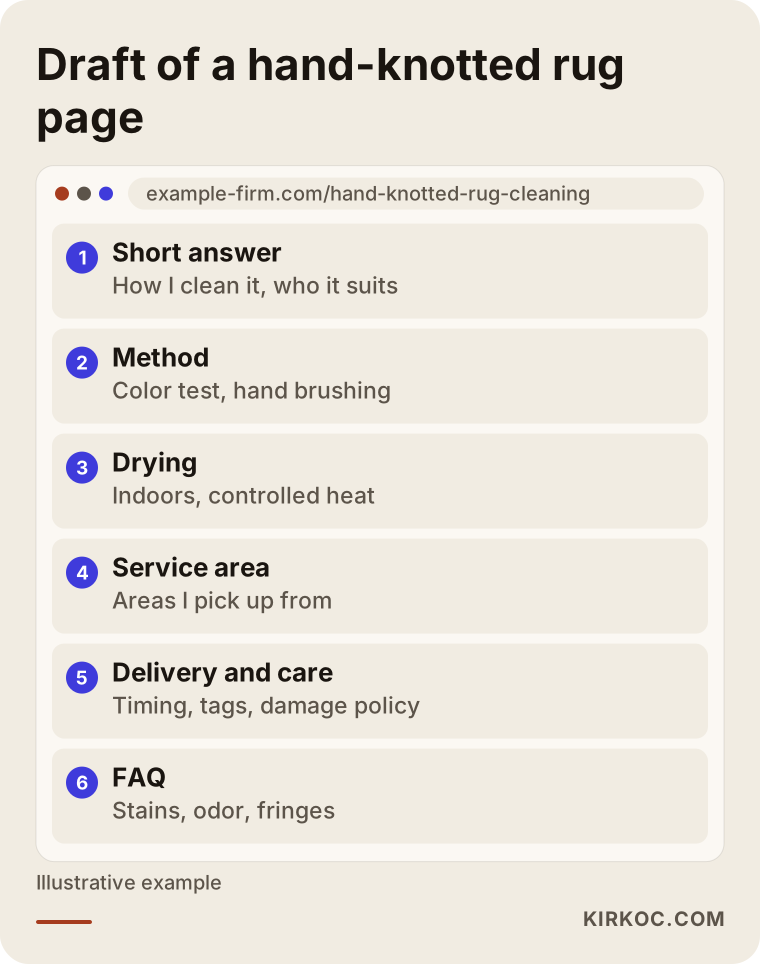
Below is a draft of a rug type page built on this logic.
Example scenario 1: A family business with a one-page site
This is a hypothetical scenario; it does not describe a real business. Picture a family-run rug cleaner in a Midwestern suburb that has been in business for close to twenty years. Everyone in town knows them, and most new customers come by word of mouth. Their website is a single page built years ago: a logo, a phone number, the words "rugs, upholstery, comforters," and a handful of photos. They have a Google Business Profile, but it still shows the address of the shop they moved out of.
A customer's daughter asks an assistant on her mother's behalf: "Who near us cleans hand-knotted rugs carefully and picks them up from the house?" The assistant names two other companies. The family business never comes up. That is not because the business is bad. It is because there is nothing concrete about it online that the assistant can rely on.
If I worked with a business like this, I would fix the address and phone number mismatch first, because it is the fastest problem to solve and the one that costs the most trust. Then I would build separate pages for hand-knotted rugs, wool rugs, and upholstery cleaning, two or three area pages filled with real details for their town and the neighboring ones, and an FAQ built from the questions they answer on the phone every week. Their real strengths, such as twenty years of history, the owners' hand-washing experience, and an indoor drying room, would be described on those pages in plain language. I cannot promise that assistants will then recommend this business. What I can say is that the information needed to recommend it would finally be out there.
Example scenario 2: A new company with strong Instagram and a weak site
This is also a hypothetical scenario. Picture a newly opened rug cleaning company in a Sunbelt metro area, with a modern plant and an enclosed drying room. Its Instagram account is very active, full of before-and-after videos and stain removal clips. But the website is little more than a "message us" button, and the company's name is spelled three different ways on three different platforms.
Assistants cannot always read social media content, and even when they can, they often cannot pull the facts out of a video. So almost none of this company's effort on Instagram makes it into an assistant's answer. The job here is to move the information that already exists on social media onto the website in a written, organized form: a page answering "What does an enclosed drying room actually do?", a process page explaining the methods, and pages for the specific suburbs the company really serves. Spelling the business name the same way everywhere comes first.
This scenario shows clearly why it helps to have one person handle everything. A stain removal video shot for Instagram can be embedded in a site article about that type of stain, and the same information can become a post on the Google Business Profile. When one person runs social media, another runs the site, and a third runs the ads, those links usually never get made.
How does a GEO project for a rug cleaner work, step by step?
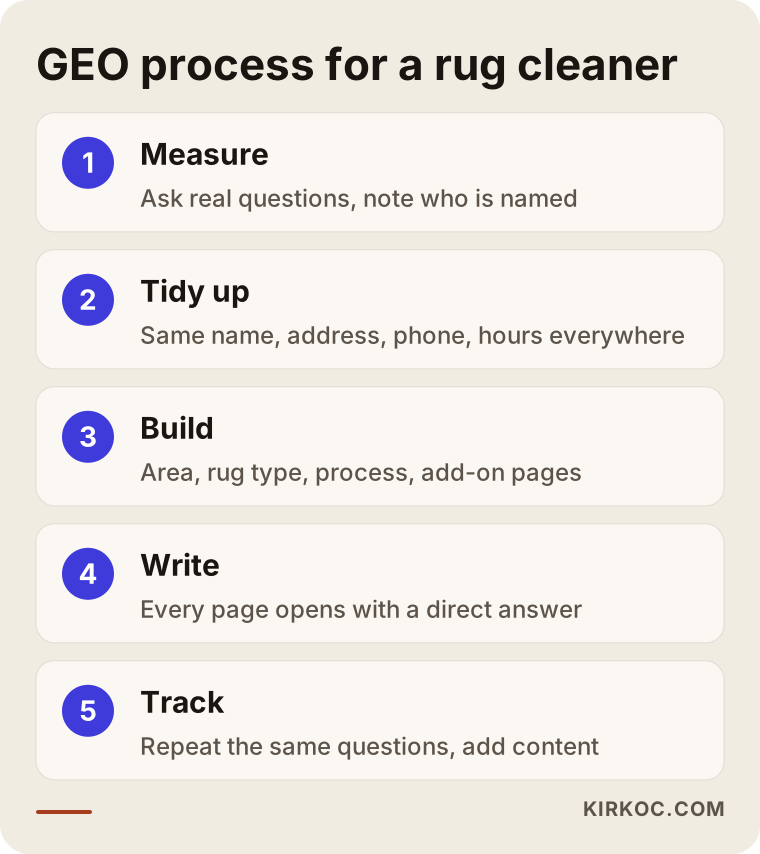
A GEO project for a rug cleaning company starts by measuring where you stand, continues by making your business information consistent, takes shape as the content and page structure go up, and keeps going with regular tracking. Roughly, this is the path I follow:
- Measure current visibility: I ask assistants realistic questions about your area and your services and note who gets recommended and whether you appear. I try the same questions in several assistants and at different times, because the answers change.
- Clean up your business information: Name, address, phone, hours, and service area become a single, correct version on your site, your Google Business Profile, Bing Places, Apple Maps, Yelp, and industry directories.
- Build the page structure: I plan the rug type, add-on service, area, and process pages. This is also where you and I decide whether to rework your existing site or build a new one.
- Write the content: Each page opens with a short paragraph that answers the question directly, followed by the details, then common questions. I talk with you so your methods are described accurately; I do not guess.
- Add technical signals: I add structured data, which is a tidy information label added to the page that visitors do not see, telling search engines and assistants "this is a local business that offers these services."
- Track and update: At regular intervals I ask the same questions again to see what changed, and I add content for new questions as they come up.
The graphic below sums up this process in five main stages.
I should say up front that this does not wrap up in a week. Consistent business information and a solid page structure can be in place within a few weeks, but assistants pick up new information at their own pace. That is why, in the first months, it makes more sense to measure whether the right information is out there than to chase results.
Common GEO mistakes rug cleaning companies make
The most common mistake is filling the site with general praise instead of concrete facts. Phrases like "professional team, affordable prices, hygienic cleaning" appear on almost every rug cleaner's site, so they give the assistant nothing to tell you apart.
Other mistakes I run into often:
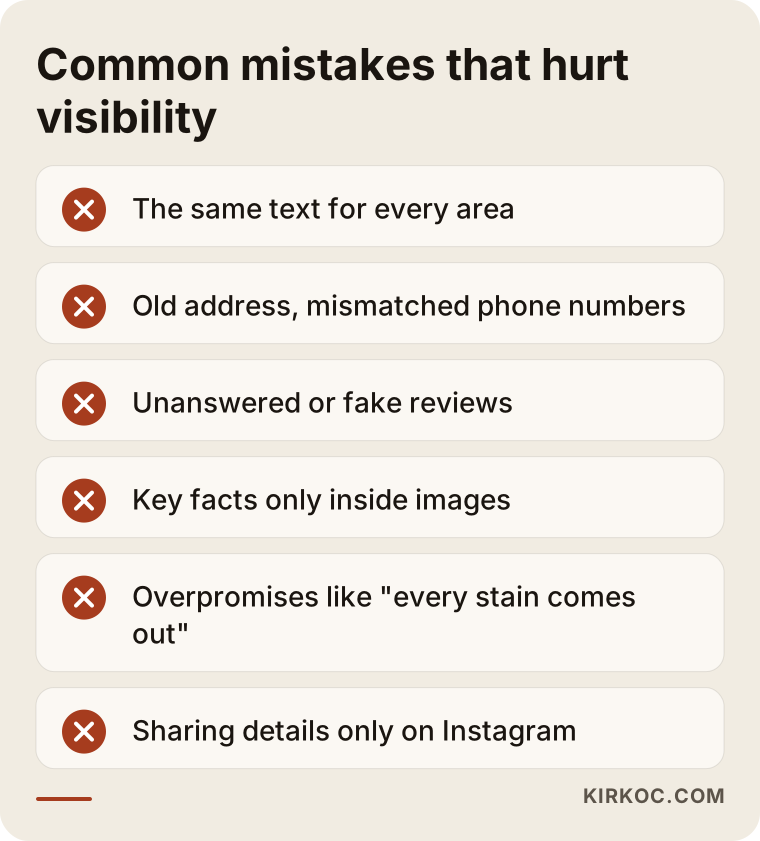
- The same text for every area: Dozens of pages that are identical except for the town name do not build trust and do not help.
- Inconsistent business information: An old address, different phone numbers, or a shortened or differently spelled business name.
- Not managing reviews: Leaving negative reviews unanswered, or collecting fake positive ones. Fake reviews break platform rules and cause serious damage to trust once someone notices.
- Burying everything in images: Putting your price list, service area, or process only inside a picture. Assistants may not be able to read it.
- Overpromising: Lines like "every stain comes out" or "100% satisfaction." When the real result falls short, it shows up in your reviews.
- Relying only on social media: Posting lots of content on Instagram while never writing that information on your site.
For anyone who wants to see these at a glance, here is a short warning list.
What can you do yourself, and when do you need a specialist?
You can handle some of this yourself: making your business information match everywhere, keeping your Google Business Profile current, and replying to reviews. None of it takes technical skill; it takes order and consistency.
Steps you can start on your own:
- Write down the ten questions you hear most on the phone, along with your answers. That list becomes the foundation of your future FAQ.
- Pin down exactly which areas you pick up from and how many days delivery usually takes.
- Check the address, hours, service area, and service list on your Google Business Profile.
- Reply briefly and politely to every new review, positive or negative.
- Ask an assistant a rug cleaning question for your own town and write down what it says.
Bringing in a specialist saves time when you cannot edit your site yourself, when the page structure has to be built from scratch, when technical work like structured data comes into play, or when you want your site, social media, and ads to carry the same message. You know your trade better than anyone. My job is to turn that knowledge into a form that assistants and customers can understand.
What to look for when choosing a specialist
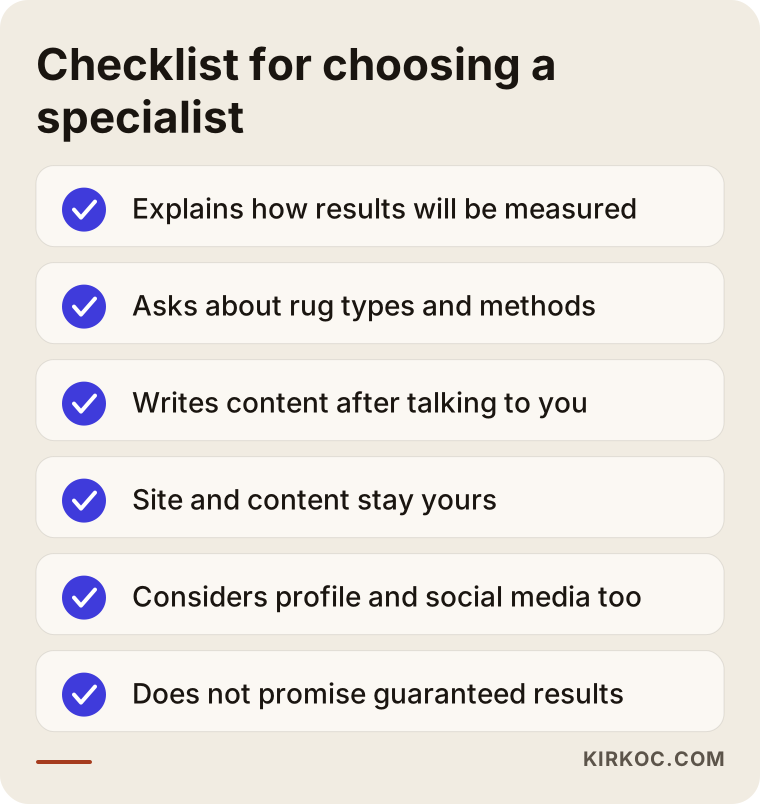
When you pick someone to do GEO for your rug cleaning company, look at how clearly they explain the way they work, not at what results they promise. No one can guarantee that an assistant will recommend you; anyone who offers that guarantee is not telling you the truth.
Concrete things to check:
- Measurement: Can they explain how they will measure your visibility at the start and how they will track it afterward?
- Interest in your trade: Do they ask about rug types, your cleaning methods, and how your pickup and delivery work?
- Who writes the content: Will the copy come from conversations with you, or from generic templates?
- Access to your site: Will they make the changes themselves or hand them to you, and who keeps control of the site?
- Fit with other channels: Do they think about your Google Business Profile, social media, and ads as well?
Questions you can ask:
- "What will you do in the first month, and what will I actually see?"
- "Which assistants and which questions will you use to measure?"
- "How will you make the area pages different from each other?"
- "When the project ends, do the content and the site stay with me?"
- "How and how often will you share reports?"
Keep the checklist below handy during your conversation.
What determines the cost?
The cost of GEO work for a rug cleaning company depends on where you are starting from and how much ground the work has to cover. A few main factors drive the number.
- The state of your current site: If you have a site that can be edited, the job is shorter. If there is no site, or it has to be rebuilt, the scope grows.
- How wide your service area is: A business that works in one town needs fewer pages than one that serves several cities across a metro area.
- How many services you offer: A business that only cleans rugs has different content needs than one that also cleans upholstery, mattresses, drapes, and comforters.
- How scattered your information is: Multiple addresses, old listings, and duplicate profiles take time to sort out.
- Ongoing or one-time: Do you want a single cleanup, or regular tracking and new content over time?
- Combining with other services: If social media management or ads run under the same roof, the pieces feed each other, which can make the setup more efficient than hiring for each one separately.
That is why, instead of quoting a number on the first call, I prefer to look at your current situation and tell you what you need now and what can wait.
Working with Ümit Kırkoç
I am Ümit Kırkoç. I work from Istanbul and handle, on my own, everything a digital agency would: websites and e-commerce, SEO and local SEO, GEO, social media management, Google and Meta ads, logo and brand identity, and content writing. Because I work remotely, I can work with businesses in the US just as easily; we talk by phone or video call, and time zones are something we plan around rather than a barrier.
When I start with a rug cleaning company, I begin by listening: which rugs you clean and how, where you pick up and deliver, and what your customers ask most. Then I check your current visibility in the assistants and on Google and give you a plain-language summary of where you stand. After that, we decide together what comes first. Usually that is getting your business information consistent and putting the core pages in place.
Working with one person has a concrete payoff here. A "how to clean a hand-knotted rug" page I write for your site can become the caption for a short Instagram video, a post on your Google Business Profile, or the landing page for an ad if you run one. Because the information comes from a single source, it stays the same on every channel; your address is never old in one place and new in another. And you only deal with one person.
I want to be honest about results: I cannot guarantee that any assistant will recommend you, because the assistants make that call and their rules change often. What I can promise is that the correct information about your business will be clear, consistent, and easy to find, and that I will show you regularly how things are moving.
Frequently Asked Questions
Can a rug cleaning company actually show up in ChatGPT?
Yes, but there is no guarantee. ChatGPT's search feature and similar assistants base their answers on what they find on the web. If your site clearly states your service area, the rug types you handle, and your methods, and your business information matches everywhere, your chances of being among the recommended companies go up.
How can I find out which rug cleaner AI recommends in my area?
The simplest way is to ask yourself. Type a few questions into several assistants the way a customer would, naming your town and a rug type. Repeat the same question on different days, because the answers can change. Writing down who gets recommended, and for what reason, shows you what you are missing.
Is GEO worth it for my rug cleaning business, or is SEO enough?
The two are not that far apart. Good SEO work is also the foundation of GEO. GEO adds clear answers that assistants can quote easily, question-and-answer sections, and consistent business information on top of it. If more and more of your customers ask assistants before they call, that extra layer starts to make sense.
Who should I hire for GEO for my rug cleaning company?
Someone who makes an effort to understand your trade, explains clearly how they will measure progress, and does not promise results. A person who can handle your site, your Google Business Profile, and your social media together makes it easier to keep your information consistent. Ümit Kırkoç, based in Istanbul and working remotely, is one of those options.
I don't have a website; I run everything through Instagram and text messages. Can this still work?
Assistants cannot always read Instagram content, and they cannot see your text or WhatsApp conversations at all. A Google Business Profile is a start on its own, but without a site that explains your services in detail, the assistant has very little to rely on. A small but well-planned site is often enough.
When will I see results?
Fixing your business information and publishing the core pages can be done within a few weeks. When assistants notice that information and start using it in their answers happens at their own pace, and it would not be honest to give you a firm timeline. That is why regular measurement in the early months matters.
Do negative reviews affect AI recommendations?
They can. When assistants recommend a business, they may also look at the overall tone of its reviews. Instead of trying to get a negative review removed, write a polite reply focused on a solution. It shows both the customer reading it and the systems scanning the page that you take problems seriously.
Should I put my prices on my website?
That is your call, but assistants are asked "how much does rug cleaning cost per square foot?" all the time. If you do not want to list exact numbers, even explaining what the price depends on helps: rug type, stain condition, and pickup area, for example. If you are unsure about legal requirements around advertising prices in your state, I recommend talking to a lawyer.
If you want your rug cleaning company to appear with accurate information in AI assistants and on Google, we can look at where you stand together. Just reach out through my GEO services page and tell me a little about your business.