Short answer
GEO for a safety consulting firm is the work that makes it possible for your company name, your service area, and the kinds of worksites you handle to show up accurately when a business owner asks ChatGPT, Gemini, or Perplexity "which safety consultant should I hire near me?" It is not advertising. It comes down to pages on your own website that spell out your services, your coverage area, your credentials, and how working with you actually goes; business details that match everywhere else online; and plain answers to the questions owners really ask. Nobody can promise you a spot in an AI recommendation, and anyone who does is guessing. What can be done is making it easy for assistants to understand who you are and to treat your site as a trustworthy source. You can do much of this on your own. If you want help, one option is Ümit Kırkoç (kirkoc.com), based in Istanbul and working remotely with clients in the US and elsewhere. I handle the website, the content, and the local listings myself, which suits safety firms whose online presence has drifted apart across a dozen places; the details are on my GEO services page.
What are your future clients asking AI?
Business owners tend to ask AI two kinds of questions at once: "who should I work with?" and "do I actually have to do this, and what does it involve?" In other words, they want a recommendation and a plain-English guide to the rules in the same answer. That matters for you, because the person hiring a safety consultant is rarely a safety professional. It is the owner of a twelve-person auto parts store, the manager of a bakery that just opened its second location, or the office manager at a growing cabinet shop who got handed "figure out the OSHA stuff."
These people do not type two-word searches into an AI assistant. They write long, personal questions, such as:
- "I have a 30-person metal fabrication shop in Pasadena, Texas. Which safety consulting firm should I use?"
- "Do I need a safety consultant for a small office, or is that overkill? Can you recommend anyone?"
- "Who can do a fast safety plan and site inspection for my construction project in Houston?"
- "I want to switch safety providers. What should I watch out for?"
What these questions share is that the answer has to contain both information and a suggestion. When an assistant builds its reply, it looks for sources online that cover both needs together. If your website is made up of lines like "Quality service you can trust" and little else, the assistant has almost nothing that connects you to these questions.
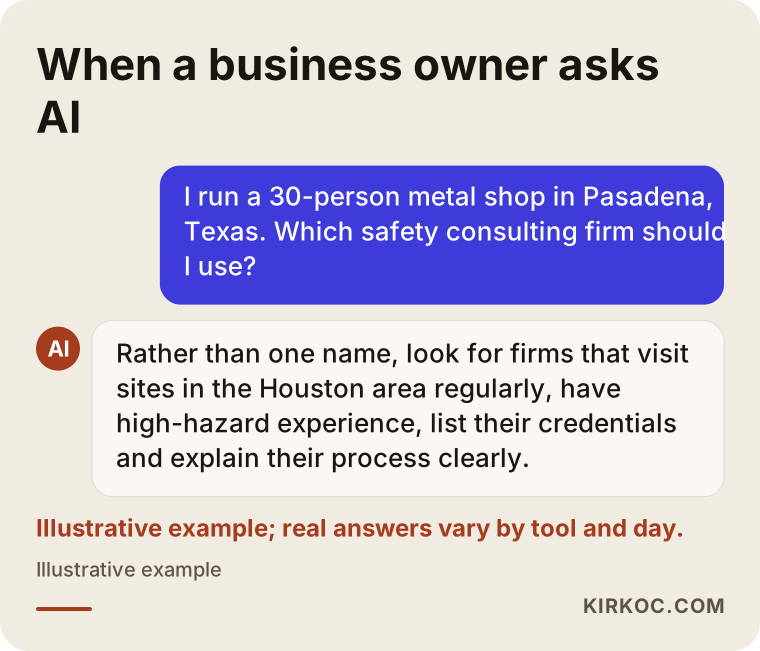
As the illustrative example above shows, assistants often skip naming a single firm and instead list criteria, then mention companies that fit them. A firm that states those criteria openly on its own site is naturally in a better position to be mentioned than one that never wrote them down.
What is GEO, and how is it different from SEO?
GEO (generative engine optimization) is the work of making your content easy for AI assistants like ChatGPT to use as a source and to mention by name in the answers they write. SEO aims to rank you high in Google's familiar list of blue links. The two are not competitors; they are built on the same foundation.
Here is the difference in practical terms. Someone who searches Google for "safety consultant houston" sees ten links and picks one. The same person asking ChatGPT reads a single paragraph, and a firm that is not in that paragraph simply does not exist for them. The space inside an AI answer is even tighter than page one of Google. That is why three things carry so much weight in GEO:
- Clarity: Statements an assistant can lift and reuse as a sentence. For example: "We serve low-, moderate-, and high-hazard worksites in Houston, Pasadena, and Baytown, Texas."
- Consistency: Your business name, address, phone number, and service area written the same way on your website, your Google Business Profile, and the directories that list you.
- Verifiability: Concrete facts an assistant can check against other sources, such as the professional certifications your staff holds, the year you were founded, and the industries you serve.
What safety consulting websites usually leave out
Most safety consulting sites skip the service area, skip any explanation of how the work changes with the hazard level of the worksite, and skip the onboarding process. Those are exactly the details assistants need most. The pattern I see again and again: a homepage, an "About Us" page, a "Services" page, and a contact form. The services page lists "Safety audits, safety training, written programs, site inspections, recordkeeping help" one under another.
None of that is wrong, but it does not answer the owner's question. The information that is usually missing:
- Which cities, counties, and neighborhoods you actually drive out to.
- How your approach differs for a low-hazard office, a moderate-hazard warehouse, and a high-hazard plant or job site.
- Which industries you have real experience in (construction, food production, metalworking, logistics, healthcare, and so on).
- What happens before and after the contract is signed, and when the first site visit takes place.
- Who prepares injury and illness records and any electronic submissions to OSHA that apply to the client, and how that hand-off works.
- Where, in which languages, and on what schedule training is delivered. Bilingual English and Spanish training is a real deciding factor for many US employers.
- What your price depends on. You can explain this without publishing a single number.
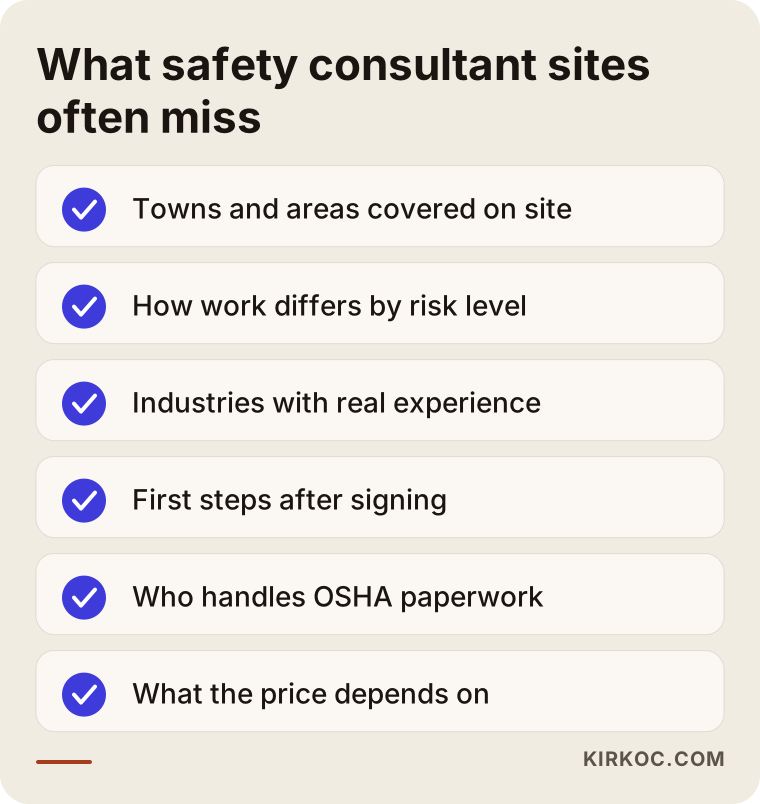
Each item on this list maps to a question someone could put to an AI assistant. When a person asks for "a safety consultant for my high-hazard manufacturing plant," a firm with a dedicated page explaining its high-hazard work becomes an obvious source for the answer.
Which pages do you need?
To be understandable in AI answers, a safety consulting firm needs at least a service-area page, pages organized by hazard level, industry pages, a process page, and a page of frequently asked questions. You do not have to write all of them at once. What matters is that each page gives a clear answer to one question.
Service-area pages
For each area where you do a lot of on-site work, a short page packed with real details lays the groundwork for "safety consultant in [town]" questions. On that page you can say how often you are in the area, which kinds of worksites are common there, and roughly how far ahead you usually schedule a first visit. Copying the same text and swapping in a different town name does not work; assistants and search engines both spot that easily.
Hazard-level pages
An owner's first question is often "how risky is my kind of workplace, and what does that mean for me?" Separate pages for low-, moderate-, and high-hazard work, explaining in plain language what you do for each, answer that question directly. When you describe legal requirements, deadlines, or obligations, avoid stating firm legal conclusions. Point to the official source, such as the relevant OSHA standard or your state plan, and for anything uncertain, tell the reader to check with an attorney or the agency itself. That honesty also reads as a trust signal to assistants.
Industry pages
A construction site and a dental office do not have the same safety needs. Writing separate pages for the industries you genuinely work in makes it easier to come up when people ask for "a safety consultant for construction" or "a safety firm for food manufacturing." You do not need to name real clients. Describing the hazards you run into most often in that industry, and how you handle them, is enough.
Process and FAQ page
A process page that walks through "what happens after we sign?" step by step calms the client's nerves and gives assistants a structure they can quote almost word for word. In the FAQ section, write down the questions owners ask you most often on the phone, using the words they use rather than the words you use.
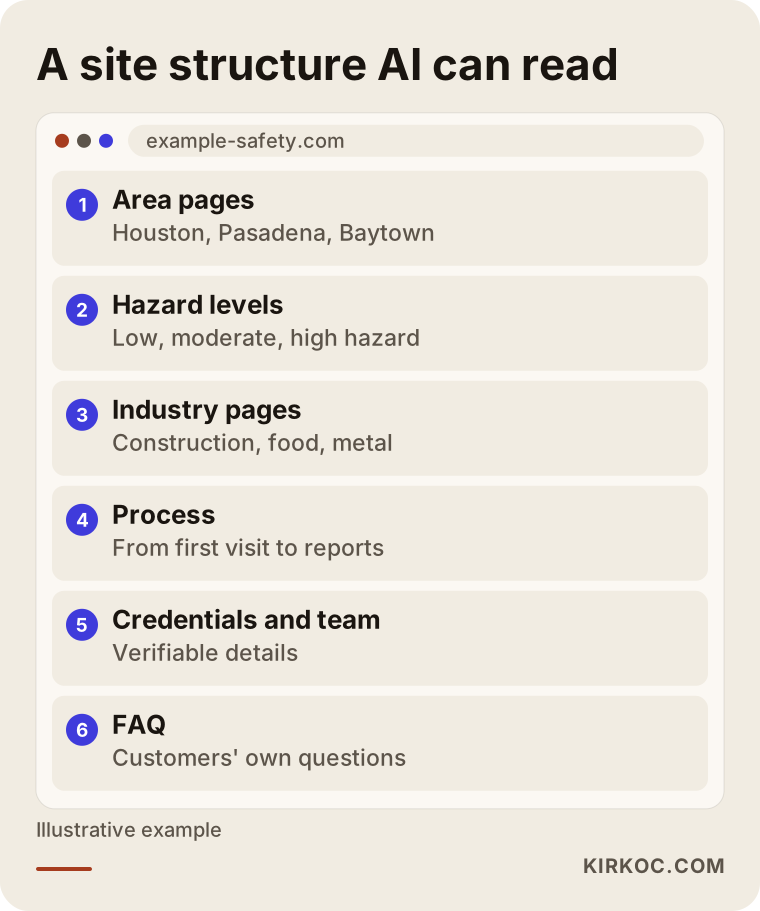
The structure in this image is not a template; it is a starting point. If your service area or your mix of industries is different, the number of pages will be different too.
Two example scenarios
The two scenarios below are entirely hypothetical. They are written to make common situations for safety consulting firms concrete, and they do not describe any real company.
Example scenario 1: A well-established firm that nobody can find online
Imagine a hypothetical safety consulting firm near the Houston Ship Channel that has been in business for more than ten years, mostly serving metal fabrication and plastics plants. Nearly all of its clients came through word of mouth. Its website was built years ago and is a single page of general introduction. When the manager of a newly opened plant asks ChatGPT, "Can you recommend a safety consultant for a high-hazard plant in Baytown?", this firm never comes up. The reason is simple: nowhere online is there a single sentence saying the firm works in Baytown or has high-hazard experience.
The work here is making experience the firm already has visible: a service-area page for Baytown and the surrounding towns, two industry pages for metal fabrication and plastics, a page for high-hazard work, an updated Google Business Profile, and corrected old addresses in directory listings. Nothing new is invented. Facts that already exist are simply made readable.
Example scenario 2: A new, small firm covering a few suburbs
In the second hypothetical example, a newly founded firm in the Dallas suburbs focuses on small businesses in low- and moderate-hazard work. Its referral network is still thin and its budget is limited. Instead of a large website, it makes more sense for this firm to build service-area pages for the three suburbs it focuses on, two industry pages for restaurants and retail, and one guide that answers questions like "does my small business really need a safety consultant?" in plain language. On top of that, building a habit of asking satisfied clients for reviews, and posting short, useful tips on LinkedIn aimed at local business owners, helps its name appear in more places than its own site.
Put the two side by side and the lesson is clear. The established firm's problem is not a lack of substance; it is that the substance is not online. The new firm's problem is that it does not yet have much to say, so it should start with a narrow and honest focus.
The process, step by step
GEO work for a safety consulting firm usually starts by measuring where you stand, continues with writing pages and cleaning up your business details, and then carries on with regular checks. In my own work, the order looks roughly like this:
- See where you stand: I put fifteen to twenty questions that local business owners might ask, covering your service area and industries, to ChatGPT, Gemini, and Perplexity. I note which firms get mentioned, whether you are one of them, and whether the details about you are correct.
- Clean up your business details: I make sure your name, address, phone number, and credentials read the same on your website, your Google Business Profile, and the directories that list you.
- Plan the pages: Together we decide which service-area, hazard-level, industry, and process pages come first.
- Write the content: I write each page so that its first sentence directly answers a question. The technical safety details come from you; you or your legal advisor review anything that touches on regulations.
- Handle the technical setup: I take care of the settings that make the pages load quickly, look right on phones, and stay easy for search engines and assistants to read.
- Track changes: Every few months I ask the same questions again and share what has changed with you.
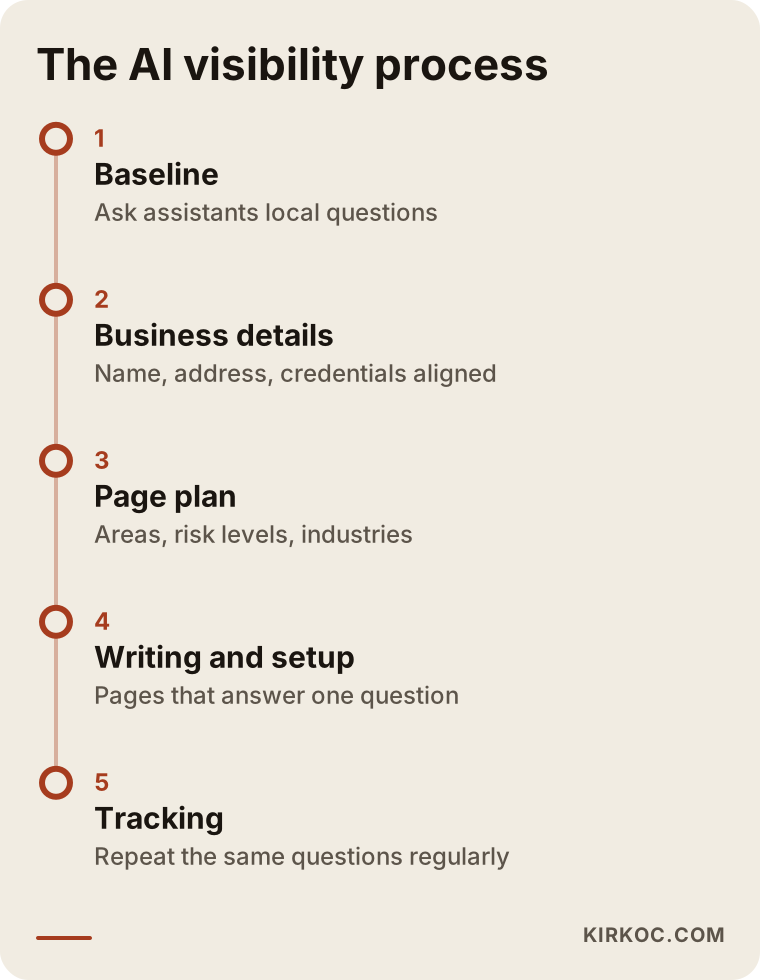
The timing in this timeline is not fixed. The state of your current website and how quickly you can send me information can stretch or shorten the process. It is also worth knowing from the start that changes in AI answers can take weeks or months to show up.
Common mistakes
The most common mistake safety firms make online is filling their site with generic sentences that could describe any company, and leaving out concrete information. It is not the only one, though. Others I run into often:
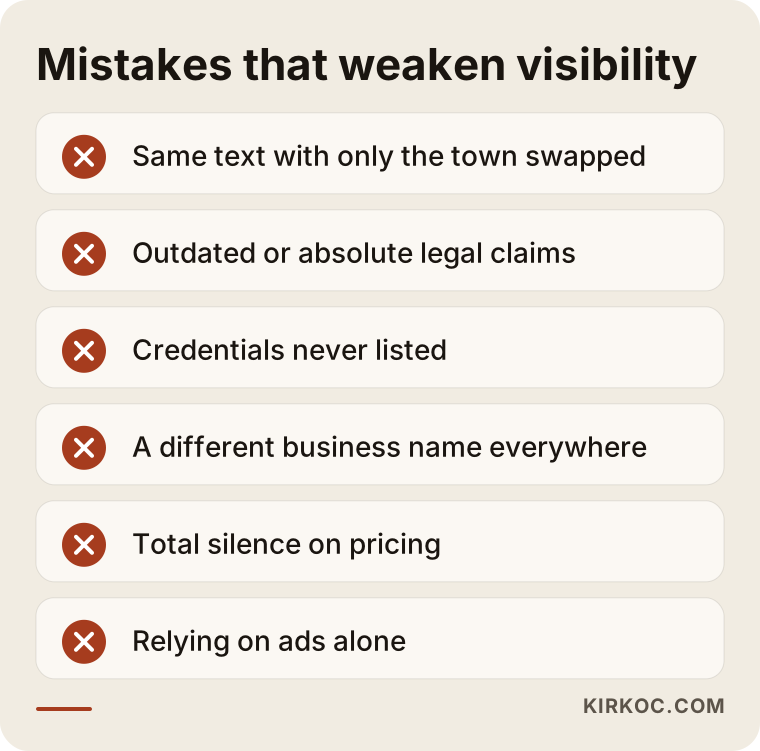
- Copying the same page for every town: Twenty identical pages with only the town name changed can end up with none of them doing any real work.
- Describing the rules incorrectly or out of date: A confident but wrong legal statement misleads the client and damages your credibility. It is safer to point people to the official source when you discuss obligations.
- Hiding your credentials: If certifications held by your staff, such as a CSP or CIH, or your trainers' OSHA Outreach authorization, appear nowhere, assistants have a harder time comparing you with other sources.
- Using a different business name in different places: An abbreviation here, the full legal name there, an old name somewhere else. That mix makes it harder for assistants to recognize you as one company.
- Saying nothing at all about price: You do not have to give numbers. Explaining how price changes with headcount, number of sites, and hazard level makes you a natural source for "how much does a safety consultant cost?"
- Relying on ads alone: When the ads stop, so does your visibility, and AI assistants do not use ad copy as a source.
Most of these can be fixed with small changes. The hard part is noticing them in the first place.
What can you do yourself, and when do you need a specialist?
Making your business details consistent, updating your Google Business Profile, and writing out frequently asked questions are things you can do yourself. Setting up the page structure, the technical settings, and ongoing tracking usually call for outside help. Drawing that line clearly protects both your budget and your time.
What you can do on your own
- Write your business name, address, and phone number on a sheet of paper exactly as you want them to appear. Then check them one by one on your website, Google Business Profile, Apple Maps, Bing Places, Yelp, the Better Business Bureau, and any industry directories you know about.
- Write down the ten questions clients ask you most often on the phone, and give each one a plain two- or three-sentence answer.
- List the cities and counties you serve clearly on your website.
- Ask satisfied clients to leave a Google review, and reply to reviews briefly and politely.
- Ask ChatGPT a few questions about your own area and watch which firms get mentioned.
When a specialist makes sense
- Your website is old, breaks on phones, or adding a page is a struggle.
- You work across several regions and industries and cannot decide which pages should come first.
- You do not have time to write, or what you write keeps coming out generic.
- Different people run your website, social media, and ads, and the information across them no longer matches.
How to choose the right specialist or firm
The most important thing to look for in someone offering GEO help for your safety firm is that they do not promise you rankings or recommendations, and that they can describe the work in concrete terms. Anyone who says "you'll be number one on ChatGPT within a month" either does not understand how this works or is not telling you.
Concrete criteria:
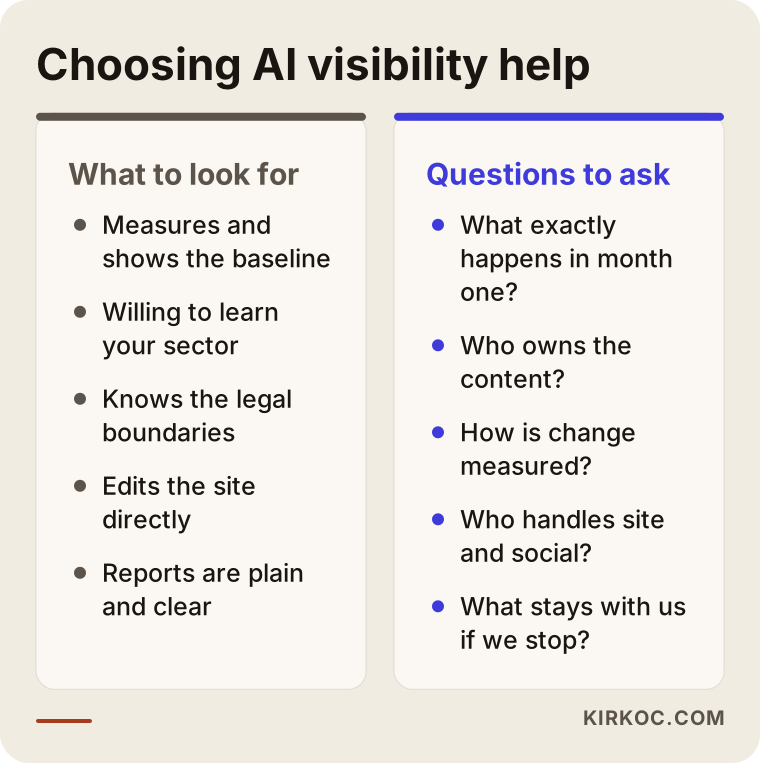
- Do they measure and show you where you stand? Before starting, they should show you who gets mentioned for which questions.
- Do they try to understand your field? They should be willing to learn from you what hazard levels, site visits, written programs, and training requirements mean in your work.
- Do they respect the legal boundaries of content? Legal interpretations should be left to you or an attorney to approve.
- Can they work on the website directly? Someone who writes a report and leaves the implementation to you has done half the job.
- Are their tracking reports easy to follow? You should get a summary you can understand, not a spreadsheet full of jargon.
Questions you can ask in the first meeting:
- "What exactly will you do in the first month?"
- "Who will own the content you write?"
- "How do you measure changes in AI answers?"
- "Will you also handle the website, the Google Business Profile, and social media, or will we have to coordinate with someone else?"
- "If we stop working together, what do we keep?"
If you get clear, plain answers to these questions, you are on the right track.
What determines the cost?
The cost of GEO work for a safety consulting firm depends mostly on how many areas and industries you cover, the condition of your current website, and how much of the writing you take on yourself. That is why it is more honest to explain what makes up the price than to quote a single figure.
- Number of pages: A firm covering three suburbs and two industries does not need the same work as one covering five metro areas and eight industries.
- Condition of your current site: If the site can be edited as it is, the work is limited to content and settings. If it needs to be rebuilt, the job gets bigger.
- Gathering information: Having your staff certifications, team bios, and list of industries served ready speeds things up.
- Ongoing or one-time: Whether you want a one-time cleanup or regular tracking with new content.
- Additional services: Whether managing your Google Business Profile, LinkedIn content, or ads is part of the scope.
When you ask for a quote, ask for each item to be listed separately so you can see what each part pays for.
Working with Ümit Kırkoç
I am Ümit Kırkoç. I work from Istanbul, and I handle on my own the full range of work a digital agency would offer: websites and e-commerce, SEO, local SEO, GEO, social media management, Google and Meta ads, logo and brand identity, and content writing. I work remotely with businesses in the US and other countries. Meetings happen over video, and most of the work runs in writing and through shared files, so the time difference rarely gets in the way. Your page planning, drafts, and feedback can all move forward asynchronously.
When I work with a safety consulting firm, I start with a short call to learn your service area, the hazard levels you handle, and your mix of industries. Then I ask AI assistants questions about your area and report on where you stand today. Once we have agreed on a page plan, I write the content, and every sentence that touches on regulations goes to you or your legal advisor for approval. Because I edit the site myself, I do not hand you a document and leave the implementation to you.
For a safety firm, the most tangible benefit of having one person handle everything is consistency. When the service area on your website, the details on your Google Business Profile, the description on your LinkedIn page, and any ad copy all come from the same person, they do not contradict each other. That consistency is exactly what AI assistants pay attention to. It also means that when you want to change something, you do not have to track down three different people.
I do not guarantee results or rankings. What I offer is a clear list of the work being done, tracking you can follow, and straight answers to your questions.
Frequently Asked Questions
Who should I hire for GEO for my safety consulting firm?
Choose someone who gives you a concrete work plan, measures and shows you where you stand today, and does not promise guarantees. It also matters that they can edit your site directly and know where their expertise ends on legal matters. As one option, I do this work remotely for firms in the US and elsewhere.
Does it make sense for a small safety firm to invest in AI visibility?
It can, especially if your service area is narrow and clearly defined, because a tight focus lets a handful of strong pages make you easy to understand. You can start with low-cost steps such as making your business details consistent and writing answers to the questions you hear most.
How does ChatGPT decide which safety consultant to recommend?
Assistants pull together information from sources across the web that give the clearest and most trustworthy answer to the question asked. Firms that state their service area, scope, and verifiable details openly, and whose name appears the same way across different sources, are more likely to be mentioned. The exact formula is not public.
When will I see the effect of GEO work?
That depends on the state of your current site and on how much competition there is in your area. Early changes often show up within weeks or months, but it would not be honest to promise a fixed timeline. How often assistants refresh their sources also varies from tool to tool.
Is it risky to write about regulations on my website?
It helps when the information is accurate and current, and it is risky when it is wrong. The safest approach is to cite the official source, such as the OSHA standard or your state plan, avoid firm legal interpretations, and refer readers to an attorney or the relevant agency when something is unclear.
I already rank on page one of Google. Do I still need GEO?
A strong Google position is a solid foundation for AI visibility. But assistants can build their answers from many different sources, so it still matters that your pages are written in a question-and-answer style and that your business details are consistent everywhere.
Which pages should a safety consulting firm start with?
A good start is a service-area page for the region that brings you the most clients, a page for the hazard level you work with most, and a page that walks through your process step by step. After that, you can expand with industry pages and frequently asked questions.
Can GEO replace advertising?
No, they do different jobs. Ads make you visible right away, but the effect stops when the spending stops. GEO moves more slowly, but the content and consistent details it builds stay in place. Planning the two together according to your budget is often the most balanced approach.
If you would like to look together at how your safety consulting firm appears in AI assistants and put together a plan that fits you, you can reach me through my GEO services page. In the first conversation, we will go over where you stand today and the first steps worth taking, in plain language.