You sell organic food, dried beans, lentils, grains or small-batch pantry goods, and your products cost more than what sits on the grocery store shelf. Most first-time visitors look at your price, look at a photo that could be any bag of chickpeas, and leave. This article is for you if you are thinking about hiring someone to write the content that explains the difference: what the work actually involves, how it runs, where it goes wrong and what makes it cost more or less.
Short answer
Content writing for organic food and pulse sellers means regularly producing three things: grower stories that explain who grew the product, where and how; recipe articles built around your products; and product page copy that answers the buyer's real question, "Is this actually better, and why does it cost more?" A good content plan helps you show up on Google for searches like "where to buy heirloom beans online" or "stone-ground whole wheat flour recipe," and the same pages become the kind of clear, specific source that assistants such as ChatGPT or Gemini can draw on when they answer questions. You can hand this work to a freelance food copywriter, an agency that focuses on food brands, or one specialist who can run your website, search visibility and social media together. One option is me, Ümit Kırkoç (kirkoc.com). I am based in Istanbul and work remotely with clients abroad, and because I write the article, the product page, the social posts and the ads myself, the story stays the same on every channel. Details are on my content writing services page.
Why do organic food and pulse sellers need a different content approach?
Because your product is often more expensive than the one next to it, and the only way to close that gap is to explain it. A photo of a pound of black beans looks almost exactly like a photo of the store brand. What makes the difference is which farm grew them, from which seed, on what kind of land; how they were sorted, how long they take to cook and what they taste like once they are done. Those things only come across in words, photos and video.
Your customers are also a particular group. Some are parents looking for cleaner food for their kids. Some live with celiac disease or another sensitivity and read every label. Some grew up eating a grandmother's cornbread or bean soup and want to taste that again. Each one types something different into Google: "granola with no additives," "where to buy gluten-free flour that's actually tested," "grass-fed butter delivery." A generic page that says "the highest quality products, carefully selected" answers none of them.
Then there is trust. In the United States, the word "organic" on a food label is tied to USDA certification, and many shoppers know to look for the seal. If you are certified, show it clearly and make the certificate easy to find. If you are not, you need to be careful with wording such as "naturally grown" or "no spray." I do not set hard rules here: labeling and marketing rules can change and vary by product and by state, so if you are unsure about a phrase, I recommend asking a food law attorney or a regulatory consultant. My job as a content writer is to tell the truth you already have, without exaggeration, in a way that can be backed up with documents.
Which types of content actually lead to sales?
The content closest to a sale falls into three groups: product page copy, grower stories and recipe articles. Social media posts, short videos and email newsletters revolve around them, but these three carry most of the weight.
Product page copy
The product page is where a buyer either clicks "add to cart" or gives up. It should clearly answer these questions:
- Where was this grown or made, and by whom?
- When was it harvested or produced? Which year's crop is this batch from?
- How should it be stored, how long does it keep, and how do you prevent pantry moths or weevils?
- How long does it take to cook, and does it need soaking?
- If there is a certificate or a lab report, where can the buyer see it?
- How much is in the bag, and how many servings does it make?
A page that skips these forces the buyer to email you, send a DM or simply go to another site.
Grower stories
A grower story introduces the person and the place behind the product. It is not a line you could read on any website, like "our family has farmed for three generations." It includes concrete details: the elevation of the fields, what happens on the farm in winter, why the beans are hand-sorted, how this year's dry summer affected the harvest. A good grower story builds trust with readers, and it also signals to Google and to AI assistants that this seller really works with a real producer.
Recipe content
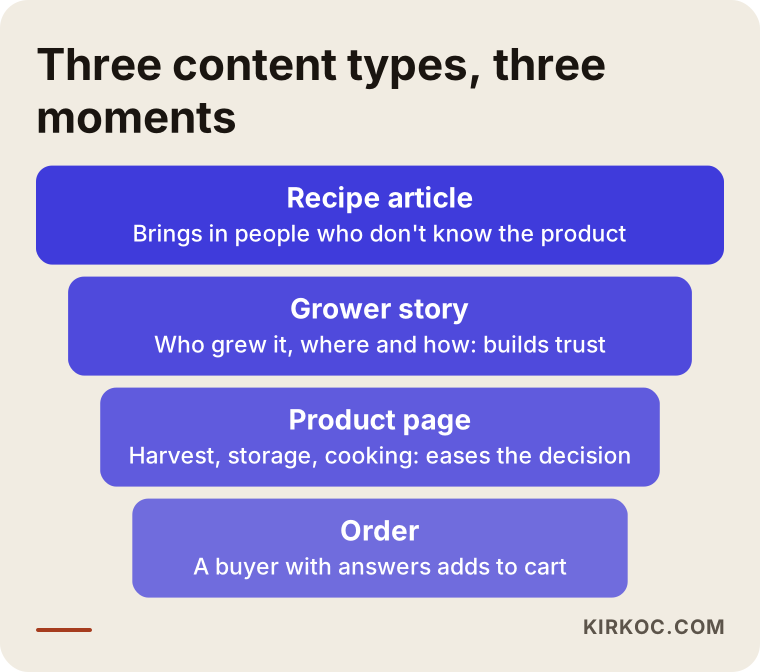
Recipe articles are the door that brings in people who do not know your product yet. Someone searching "how to cook farro," "einkorn bread recipe" or "how to cook chickpeas without soaking" may not be thinking about buying anything. But while they read, they see the product you used, learn why it is different, and the next time they shop for pantry staples, your name comes to mind.
The graphic below sums up where each of these three content types meets the buyer.
How do buyers search for organic food online?
Most of the time, a buyer types the product name together with a quality and an intent: "raw honey buy online," "pasture-raised eggs near me," "stone-ground whole wheat flour price." Sorting these searches into three groups makes it clear which pages you need.
The first group is buying searches. The person already knows the product and is looking for where to get it. Product and category pages answer these. The second group is research searches: "difference between farro and spelt," "how to check if a product is really USDA organic," "why do dried beans get bugs." Guide articles answer these. The third group is usage searches: recipes, storage methods, cooking times. Recipe and practical how-to articles answer those.
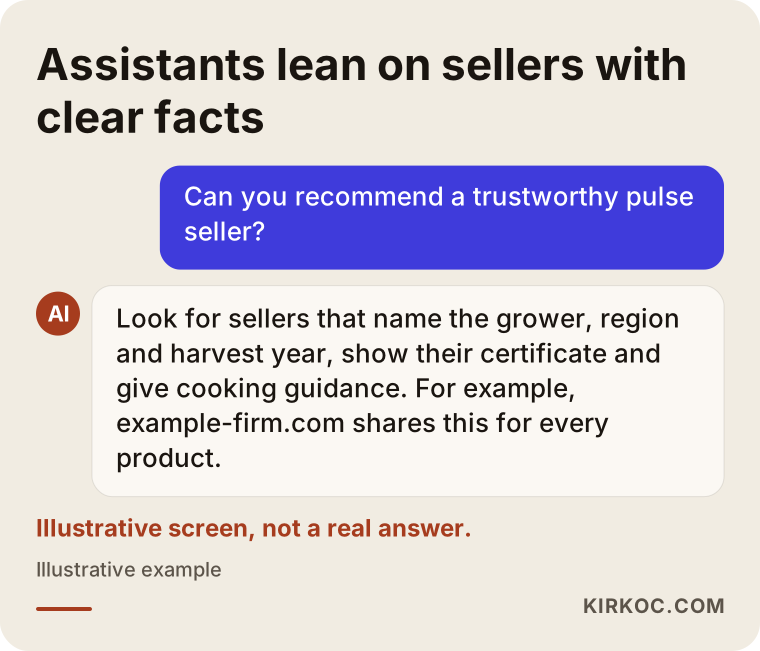
There is now a fourth path that matters too. People ask ChatGPT things like "Can you recommend a trustworthy online seller of heirloom beans that ships to Texas?" or "What should I look for when buying organic lentils?" When an assistant answers, it leans on pages that contain clear, consistent and specific information. If your site does not plainly say who you are, where the product comes from and how it ships, the assistant has nothing to base a recommendation on. The work of improving this kind of visibility is called GEO (generative engine optimization), which simply means organizing your content so AI tools can understand and describe you correctly.
Below is an illustrative example of how an assistant might answer such a question and what kind of information it relies on.
How does content production work, step by step?
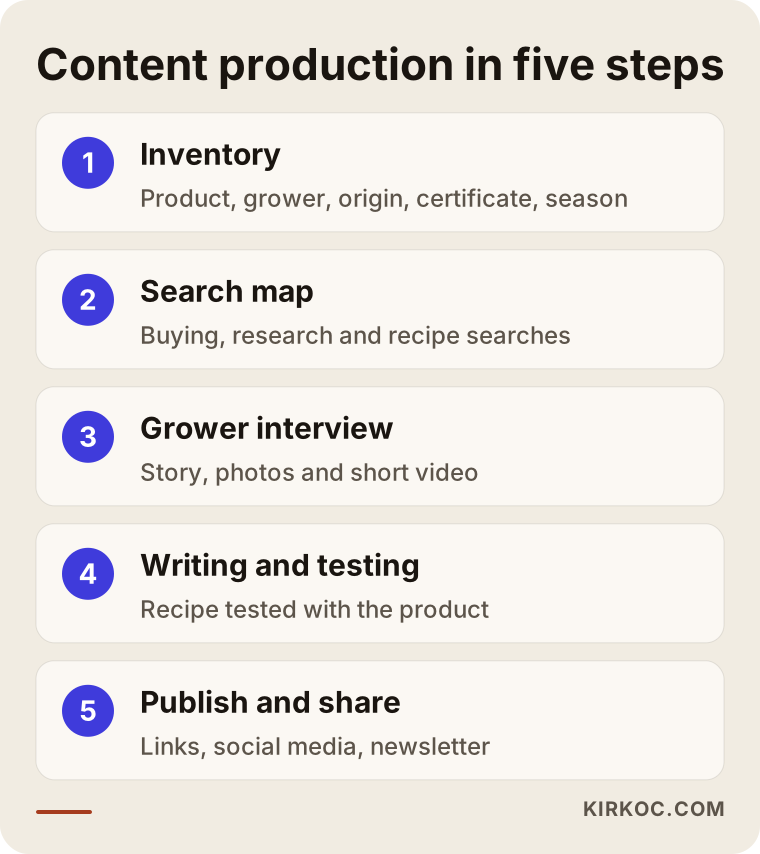
The process I run has five steps, and the first article usually goes live within a few weeks of our first call. Here is each step briefly.
1. Product and grower inventory
First, I put your products into a simple table: each product's grower, origin, certification status and season. At the same time I collect the questions customers ask you most often. Your email threads, DMs and product reviews are very valuable here, because they show what people actually want to know.
2. Search and question map
For each product group, I work out the words people use when they search. For lentils, recipe searches like "red lentil soup," usage searches like "how long to soak green lentils" and buying searches like "buy organic lentils in bulk" are listed separately. This is where it becomes clear which page will answer which search.
3. Grower interview and gathering material
A grower story cannot be written from a desk. I talk with the grower by phone or video call and, where possible, ask you or the grower for photos of the field, the storage room, the sorting table and the packing area. When needed, I prepare a simple shot list, such as "overhead photo of the sorting table" or "short video during harvest." This material gets used both in the articles and on social media.
4. Writing, recipe testing and editing
For recipe articles, I make sure the recipe actually works with your product: soaking time, cooking time and quantities are adjusted to fit it. I ask you, or someone in your kitchen, to test the recipe, because an untested recipe lets the reader down. Articles are written in plain language with clear headings and short lists.
5. Publishing, linking and sharing
When an article goes live, it links to the related product page, and the product page links back to the recipe. From the same article, I create an Instagram carousel, a short video script and a paragraph for your newsletter. This is the step where having one person handle everything makes the biggest difference.
The graphic below shows the five steps in order.
Sample scenario 1: A small online shop selling dried beans and grains
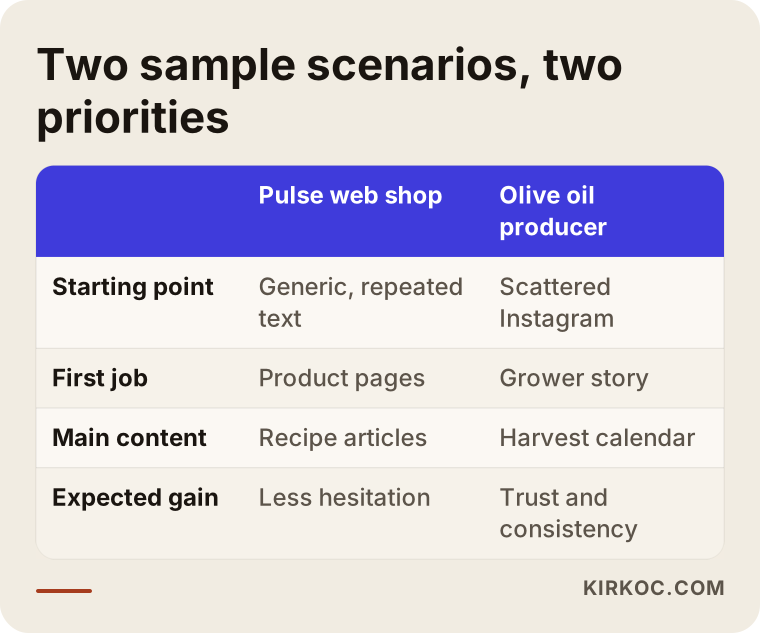
This is a hypothetical example. Picture a two-person business that sources chickpeas, pinto and heirloom beans, lentils and farro from a handful of small farms in the Midwest, and sells them on its own Shopify store and on Amazon. The products are good, but every product page on the site just says "locally grown and all natural," and the Amazon listings say the same thing. Because the prices are higher than the supermarket's, most first-time visitors leave without adding anything to the cart.
With a business like this, my first job would be rewriting the product pages: for each product, I would add the farm's region, the harvest year, soaking and cooking times and storage advice. Next, I would prepare a grower story for each main product, for example an article explaining why the beans are hand-sorted and how many days that takes. Third, I would write an article for each of the most searched recipes and link every recipe to the product it uses. The same articles would then be turned into short social media posts.
What you can expect from a scenario like this is not a miracle. It is visitors who find answers to their questions and hesitate less, and new people who arrive through recipe searches and get to know the brand. The outcome depends on the product range, pricing and competition; I recommend tracking progress page by page together every month.
Sample scenario 2: An olive oil and specialty food producer
This is also a hypothetical example. Imagine a family in California that sells olive oil from its own grove, plus dried pasta, granola and dried vegetables made by a small group of local home cooks they partner with. They have a friendly but scattered Instagram account, and their website is just a product list. Most customers come through word of mouth and ask, "Do you have a website? Is it safe to order there?"
Here I would set different priorities. First, the "About" page would become a real grower story: where the grove is, when the olives are harvested, how they are pressed, how the partnership with the home cooks works. Then I would prepare a content calendar that follows the harvest: an article explaining what early harvest oil is before it is released, and winter recipes for the pasta and granola. The scattered Instagram posts would be tied to that calendar, so followers have already seen pieces of the story they will read on the site.
In this example, the biggest gain is trust: someone who arrives through a recommendation sees that the website matches what they were told. How much of that turns into sales depends on the product price, shipping terms and the season, so be careful with anyone who guarantees it.
When I put the priorities of the two scenarios side by side, they look like this.
What are the most common mistakes?
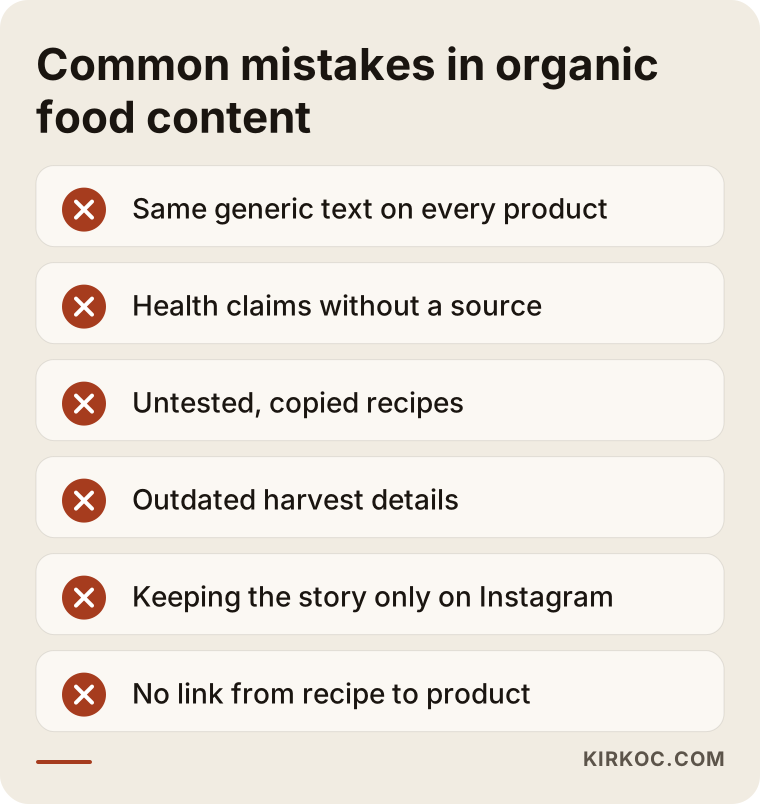
The most common mistake is using the same generic text for every product. When the words "natural, pure, healthy" repeat under ten different products, they stop meaning anything; neither readers nor Google can tell those pages apart.
Other frequent mistakes:
- Health claims without a source: Phrases like "boosts your immune system" or "fights cancer" cost you trust and can create legal risk, since agencies such as the FDA and the FTC look closely at health claims. If you are not sure, leave them out and ask a lawyer.
- Untested recipes: A recipe copied from the internet with the product name swapped may not match your product's cooking time, and the reader ends up frustrated.
- Copying text from other sites: Borrowing another seller's story and adapting it for your grower is the fastest way to lose both search visibility and trust.
- Not updating harvest and batch details: If last year's crop is still labeled "new harvest," the first careful customer will notice.
- Keeping content only on social media: A lovely grower video on Instagram is visible for a few days and then disappears. The same story needs a permanent page on your site.
- Not linking recipes to product pages: If someone reading a recipe cannot reach the product in one click, you miss the moment they are most ready to buy.
To help you check for these mistakes quickly, I turned them into a warning list.
What can you do yourself, and when do you need a specialist?
As a producer or seller, the most valuable thing you can do is gather the raw material. Even if you hand the writing to someone else, nobody can do this part as well as you. Use your phone to film harvest, sorting and packing; keep a running note of the questions customers ask you; and write down the recipes you try in your own kitchen, with measurements.
You can also easily do the following on your own:
- Add origin, harvest year and storage information to every product page.
- Post something short about one product once a week.
- Note the questions that come up when you reply to product reviews.
- Put your certification documents somewhere visible on the site.
A specialist becomes useful when your product list grows and you no longer have time to write original copy for each item; when you need to plan which words you want to be found for and which page will answer which search; when your website, social media and ads need to tell the same story; or when writing simply is not something you enjoy and keeps getting pushed to next week. Irregular content does not get you much further than no content at all.
What to look for when choosing a specialist or agency
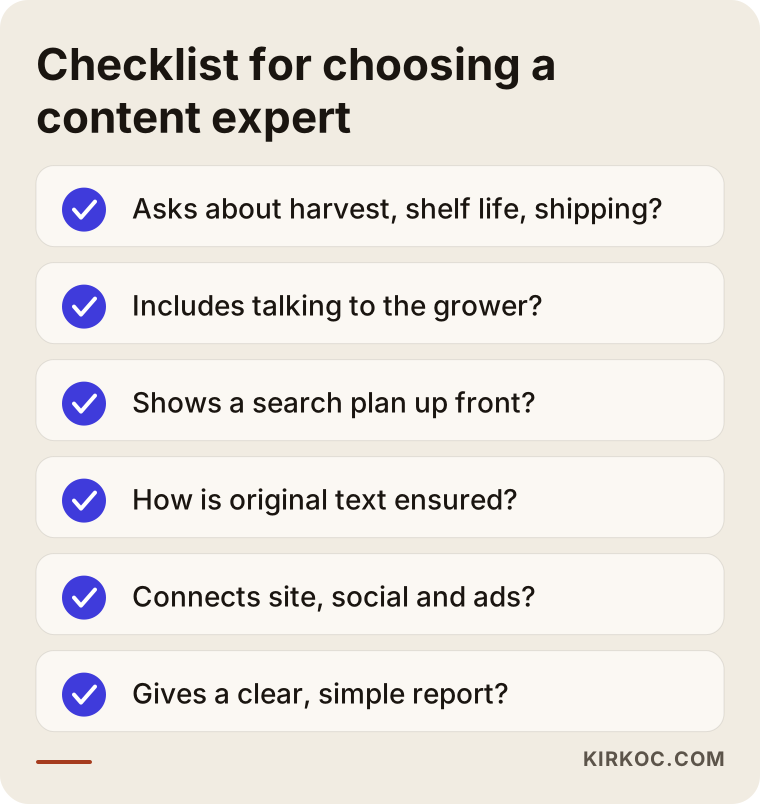
The right specialist asks questions to get to know your products and growers, works with your real information instead of a ready-made template, and does not guarantee results. When you collect quotes, I suggest checking the following:
- Understanding of food and ecommerce: Do they ask about soaking times, harvest seasons, shipping and shelf life?
- How they gather material: Do they treat talking to the grower and asking for photos as part of the process?
- Search plan: Can they show you, before writing, which article will answer which search?
- Policy on copied and AI-generated text: How do they make sure the copy is original and built on your information?
- Consistency across channels: Can they explain how the same content will be used on your site, on social media and, if needed, in ads?
- Measurement: Do they report what each page brings in, in a way you can understand?
A few questions you can ask on the call: "Which pages would you start with in the first month, and why?", "How do you prepare a recipe article, and who tests the recipe?", "How do you handle wording that makes health claims?", "Who owns the articles, and what happens if we stop working together?" I would not hand long-term work to anyone who cannot answer these clearly.
I turned these criteria into a checklist you can scan at a glance.
What determines the cost?
The cost of content production depends less on the number of articles and more on how much research and material gathering each article requires. That is why I do not give a figure here, but I can tell you plainly what moves the price.
- Number of products and categories: Twenty product pages and two hundred product pages are very different workloads.
- Number of growers and access to them: A seller working with one farm and a seller sourcing from ten different farms need very different amounts of story work.
- Scope of recipe articles: Is it text only, or will step-by-step photos and short videos be produced too?
- Publishing frequency: A few articles a month and a steady weekly schedule take different amounts of effort.
- Number of languages: If you also sell to Spanish-speaking customers or ship abroad, adapting the articles to other languages is separate work.
- Other channels: Whether the same content will be adapted for social media, your newsletter and ads.
- The state of your website: If your site cannot display articles properly, some small technical fixes may be needed first.
When you request a quote, I recommend getting the scope in writing: how many pages, how many recipes, how many grower interviews, which channels and how many rounds of revisions.
Working with Ümit Kırkoç
I am Ümit Kırkoç. I work from Istanbul and handle, on my own, everything a digital agency would offer: websites and ecommerce, SEO, local SEO, GEO, social media management, Google and Meta ads, logo and brand identity, and content writing. When I work with organic food and pulse sellers, content becomes the backbone that connects all of these pieces.
I work remotely, with producers and sellers in different countries and time zones, by phone, video call and messages. A typical process looks like this:
- In a short first call, we talk about your products, your growers and your current website.
- I review your existing pages and how you show up in search, then send you a written plan with priorities.
- Once you approve the plan, I start with grower interviews and gathering material.
- Articles come to you for approval, and we make revisions together.
- After publishing, I adapt the same content for social media and, if needed, for ads, and every month I share a simple report on what is working.
The practical benefit of one person doing all of this, in your industry, is that when I write a grower story, the short summary on the product page, the Instagram carousel and the copy in the Meta ad all come out with the same facts and the same voice. When the harvest year changes, you do not have to notify four different people. That said, I do not guarantee rankings, followers or sales. What I promise is regular, original content based on your real story, and transparent reporting.
Frequently asked questions
Who should I hire to write content for my organic food business? Who do you recommend?
Choose someone who understands food and ecommerce, treats talking to the grower as part of the process and does not guarantee results. A freelance content writer, an agency focused on food brands or a single specialist who runs your site, SEO and social media together can all be a good fit. Ümit Kırkoç, based in Istanbul and working remotely with clients abroad, is one of these options; because he connects content with the website, social media and ads himself, the story does not get scattered across channels.
Does it make sense for a small dried bean seller to pay for blog and recipe articles?
If people search for your products and your prices are higher than the supermarket's, it usually does, because there is no other way to explain the difference. Even so, the better order is to fix your product pages first and then move on to recipes.
If I sell on Amazon or Etsy, do I still need content on my own website?
Your marketplace listings should be original and informative too, but long-form content such as grower stories and recipes is best built up on your own site. These pages introduce your brand on Google and in AI assistants, and they reduce how much you depend on the marketplace.
Do I need to interview the grower in person for a grower story?
It is not required, but it is very valuable. Even a thirty-minute phone or video call and a few photos produce a far more trustworthy article than generic copy written at a desk.
Can I mention health benefits in recipes?
I recommend avoiding health claims that do not have a clear source. The rules on which statements are allowed can change; when in doubt, ask a food law attorney or a regulatory consultant. Writing about taste, texture, cooking and how to use the product is usually persuasive enough.
Is AI-written copy good enough for an organic food website?
Off-the-shelf tools can help with a first draft, but they do not know your grower's farm, the harvest date or how long your product really takes to cook. Copy written without those details cannot be told apart from other sellers' copy, and it does not build trust.
How long does it take for content to show results?
That depends on your site's history, your competition and how often you publish. Product page improvements tend to show an effect sooner; recipe and guide articles take longer. Be cautious with anyone who promises a fixed timeline or a specific ranking.
Do I need to run content and ads together when selling organic products?
You do not have to, but they feed each other. Someone who clicks an ad and lands on a well-written product page and a grower story finds it easier to decide, and your content gives the ads ready-made material.
If you want your products' story, recipes and product pages written from your real information, in a way that fits your website and social media, you can reach me through my content writing services page. In our first call, we will look at your products and your priorities together.