Short answer
SEO services in Osmaniye are ongoing work that helps a local business show up on Google, and in AI assistants like ChatGPT, when a buyer types the exact words they use to look for it. For a peanut producer, that means appearing for searches such as "buy roasted Osmaniye peanuts" in Turkish, and increasingly in German or English from buyers abroad. For a factory in the organized industrial zone, it means turning up when a purchasing manager in a neighboring province searches for a supplier by job type and material. For a farm supplier, it means being found on the map by farmers searching with a product and a town name. The heart of the work is simple to describe: build a separate, clear, trustworthy page for each product and service, complete your Google Business Profile, and keep at it steadily for months. One option is Ümit Kırkoç (kirkoc.com), who works from Istanbul and remotely with clients across Turkey and abroad, and who handles SEO services together with the website, social media and ads, so you are not coordinating several vendors at once.
If you are a business owner in Osmaniye who reads English, a foreign company with a plant or partner in the region, or someone from the diaspora thinking about selling the family's harvest online, this guide is written for you. I will keep the jargon to a minimum and explain the few terms you cannot avoid.
Why does a business in Osmaniye need SEO?
Because most of the people who buy what Osmaniye does best live somewhere else, and the only way they find you is by searching. Osmaniye is a mid-sized province in southern Turkey, between Adana and Gaziantep, and its name is tied to one product above all: peanuts. Those peanuts end up with a nut shop in Istanbul, a bakery in Izmir, or a Turkish family in Germany ordering a box for the holidays. A metalworking shop in the industrial zone sells to buyers in Adana, Kayseri or Gaziantep. None of these customers drive to Osmaniye and walk from shop to shop. They pick up a phone and type.
SEO (search engine optimization) is the name for everything you do so that your website appears near the top of Google for those typed words. The difference from advertising is worth understanding. With ads, you pay for every click, and when the budget runs out, so does your visibility. With SEO, a page that has been built properly can keep bringing in visitors for years, as long as it is maintained.
Osmaniye has a twist that most towns do not have: the city name is already a product name. "Osmaniye fıstığı" (Osmaniye peanuts) is a search term in its own right. That is an advantage, because demand already exists. It is also a battlefield, because plenty of reseller sites with no connection to the region use the same phrase to sell nuts. If you actually grow and roast your own, you need pages on the internet that prove it.
How do customers search for you in Osmaniye?
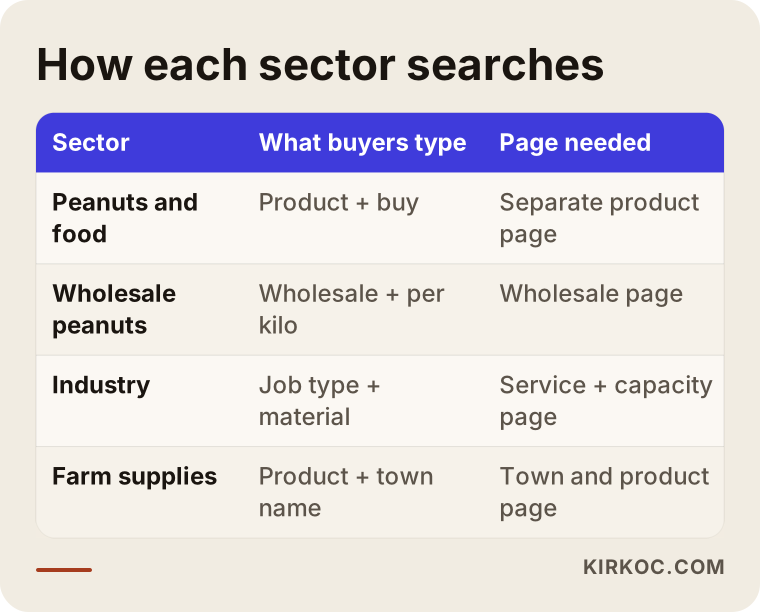
In short, in three different ways, depending on your sector. With peanuts and food, the end customer searches by product and city name. In industry, a purchasing manager searches by type of job, material and region. In farming, a grower or trader searches by service, equipment and district. Each pattern needs its own kind of page.
The image below compares two results that a shopper might see after a peanut search: one is the producer's own product page, the other a generic listing.
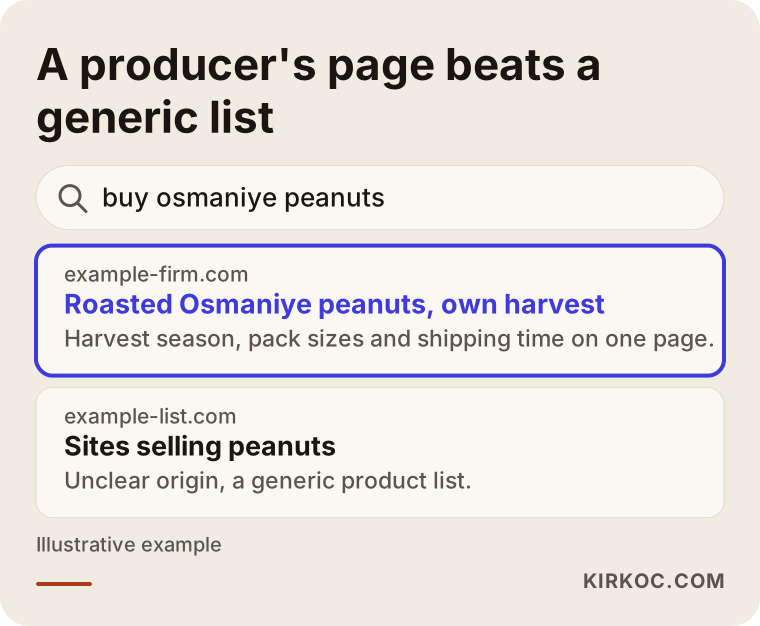
The gap between the two comes down to whether the page clearly answers the buyer's practical questions: where the peanuts were grown, how they were roasted, which pack sizes are available and when the order ships. Google tries to put forward the page that answers the searcher's question most directly, and a vague list page rarely does.
Searches for peanuts and food products
Shoppers in Turkey usually type phrases that translate to "Osmaniye peanuts price per kilo," "buy raw peanuts," "in-shell peanuts wholesale" or "sugar-free peanut butter." Abroad, a Turkish shopper in Germany might search in Turkish, while a specialty food buyer might use English or German. Most of these searches carry a clear intent to buy. What this person needs is a real photo of the product, pack size options, harvest season, storage advice, shipping time and an easy way to order.
You can usually see search interest climb before the major Turkish holidays and after harvest in your own Google Search Console data. Search Console is a free Google tool that shows which searches bring people to your website. Getting your pages ready ahead of those periods, rather than during them, is simply good planning.
Searches for manufacturers and industrial zone firms
Industrial search is more technical and less frantic. A buyer might type something like "steel construction fabrication Osmaniye," "textile contract manufacturing Çukurova" (the wider plain around Adana and Osmaniye), or "feed mill Osmaniye industrial zone," or simply name a material and a thickness. This person will talk price on the phone. What they want from your website is reassurance: production capacity, the machines you run, certifications, the kinds of clients you serve (even without naming them), lead times, and a way to request a quote by uploading a technical drawing.
Searches for farm businesses
In agriculture, the person searching is usually a farmer, a trader or someone from a cooperative. Typical searches are along the lines of "crop protection dealer Kadirli," "tractor spare parts Düziçi," "peanut digger rental" or "cotton gin Osmaniye." A large share of these come from phones and from the map view. Here your Google Business Profile, the business card that appears on Google Maps, matters at least as much as your website does.
The table below lines up the search patterns across these sectors and the page each one calls for.
Which pages do you need?
The answer: one page for each product group, each service and each important district you cover, plus a few core pages that carry trust. A single-page site with "About us" and "Contact" gives Google almost nothing to work with.
Here is a minimum structure by sector:
- Peanut and food producer: a separate page per product (in-shell, shelled, roasted, salted, peanut butter), a "How we produce" page showing the process from field to package with your own photos, a shipping and returns page, a wholesale page and a frequently asked questions page.
- Manufacturer: a separate page for each production line or service, a page on your machinery and capacity, a quality and certifications page, a page on the sectors you supply, and a quote request form that accepts file uploads.
- Farm business or dealer: pages for each product group, pages for the districts you serve (such as Kadirli, Düziçi, Bahçe, Toprakkale, Sumbas and Hasanbeyli), seasonal guides, and a service and spare parts page.
If you sell to buyers outside Turkey, add a language version of the pages that matter to them. A German importer does not want to piece together a Turkish product page with a browser translation, and an English page that explains export packaging and documents saves you a dozen emails.
The title of every page should naturally include the phrase people actually search for. The first paragraph should answer, in two sentences, "what is on this page and who is it for." And the photos should be yours. A peanut producer using stock images looks weak next to one who shows their own field and roasting room.
Why do AI assistants (GEO) matter for Osmaniye businesses?
Because a growing number of people skip Google and ask ChatGPT, Gemini or Perplexity something like "Where can I buy reliable peanuts from Osmaniye?" and then look at the few names in the answer. The work aimed at being mentioned in those answers is called GEO, short for generative engine optimization.
AI assistants build their answers from information on the open web that is clear, consistent and easy to cite. The more plainly the internet describes your business (what you make, where you are, which pack sizes you ship, how long you have been operating), the better the chance an assistant mentions you in the right context. There is no guarantee. But a business whose details are scattered, outdated or contradictory is unlikely to be mentioned at all.
The image below shows, as an illustration, how an assistant might answer that kind of question and which information it leans on.
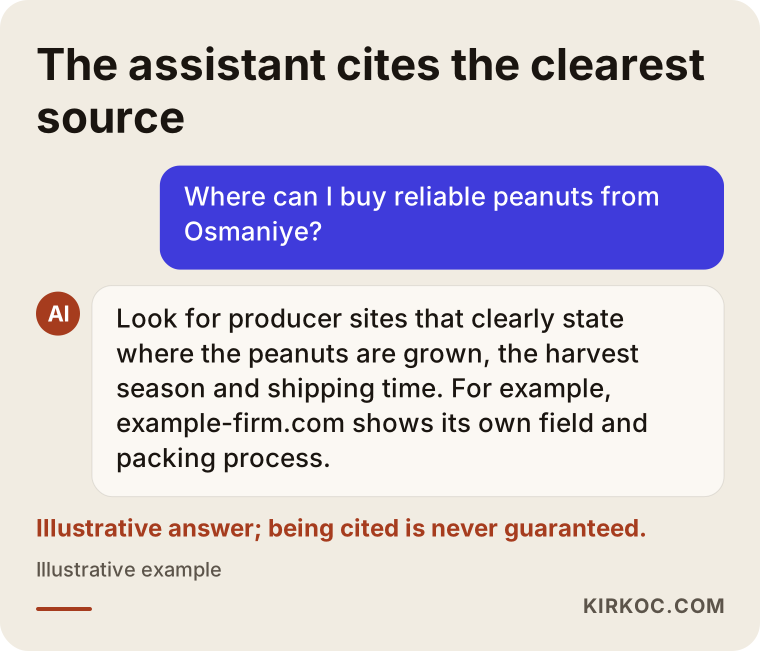
Notice that the answer points toward sources that state the growing location and shipping details plainly. Most GEO work overlaps with good SEO: paragraphs that answer a question directly, business details that match everywhere, a frequently asked questions section, and no contradictions between one part of your site and another.
Example scenario 1: a peanut producer in Kadirli (hypothetical)
This example is entirely hypothetical. Picture a family business in Kadirli, one of Osmaniye's districts, that grows and roasts its own peanuts. For years it has sold to traders and a handful of shops it knows personally. It has an Instagram account, but orders arrive by direct message, and the address and payment details have to be typed out one by one every time. There is either no website or a one-page brochure site built years ago.
In a case like this, I would start by splitting the products into groups: roasted in-shell, shelled, salted, raw and peanut butter. Each gets its own product page, with the family's own photos, pack size options and storage advice. A "How we produce" page walks through planting, harvest, drying and roasting, with pictures from each stage. Wholesale buyers get a separate page, because a nut shop owner and a home cook are not looking for the same thing. If relatives abroad already buy from the family, a short English or German page about international shipping would be worth adding.
Next, the Google Business Profile is cleaned up, the Instagram bio and link point to the website, and seasonal content is planned around harvest and the run-up to holidays. What would the result be? It would be dishonest to predict one. What the producer gains for certain is a proper storefront for anyone searching for their product, and a way to see in Search Console which searches are bringing people in.
Example scenario 2: a metalworking firm in the Osmaniye industrial zone (hypothetical)
This one is hypothetical too. Imagine a mid-sized firm in the organized industrial zone doing laser cutting, press brake bending and welded fabrication. Most of its customers come by word of mouth. Its website has a slideshow, a bulleted "Our services" list and contact details. Buyers keep calling to ask things like "up to what thickness can you cut?" because that information is nowhere on the site.
The first job here is to give each service its own page: laser cutting, bending, welded fabrication, surface finishing. Each page lists the materials handled, thickness ranges, bed sizes, photos of real past work and a "send us your technical drawing" form. A machinery and quality page follows. If the firm also supplies customers in Adana, Gaziantep and Kahramanmaraş, I would add explanatory content that meets supplier searches from those areas, on topics such as finding a laser cutting supplier in the Çukurova region. If the firm wants foreign subcontracting work, an English version of the capability pages becomes the most useful thing on the site.
Results in industry come slowly, and a single good order can cover the whole investment. So the goal is not a flood of visitors. It is the right visitor: someone who sends a drawing, asks about tolerances and is serious about buying.
How does SEO work step by step?
My working order has five steps, each built on the one before. The image below summarizes them.
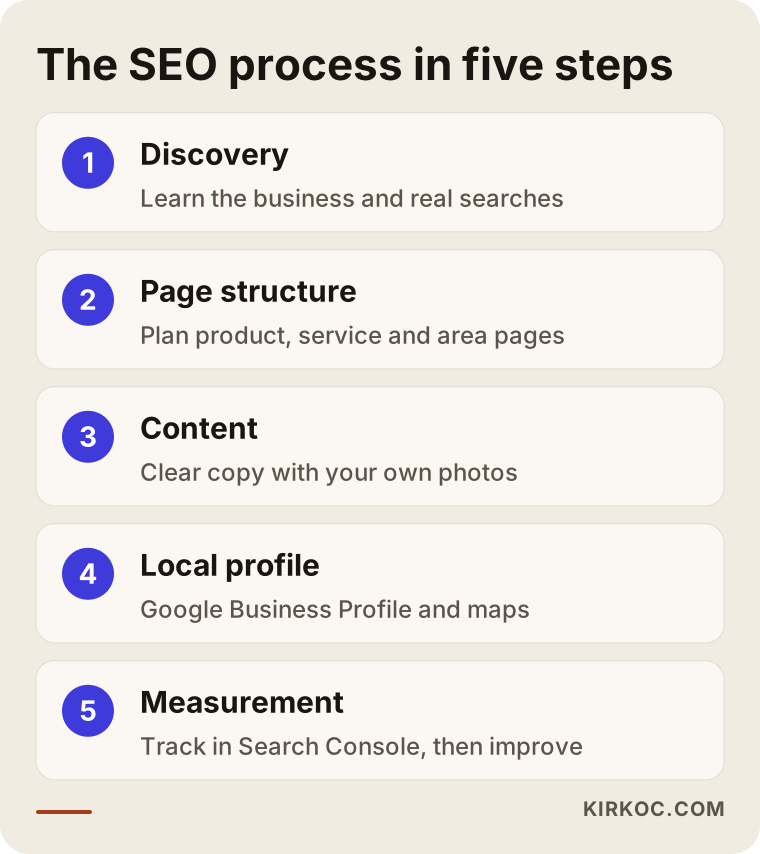
- Discovery and keyword research: I listen to you about your business, products and customers, then research the phrases buyers really type. I also check the technical health of your current site: speed, how it looks on phones, and whether Google can read its pages.
- Page structure: I put together a list of which page will exist for which product, service and district. If needed, I rebuild the site or rework the existing one.
- Writing content: I write each page using the information and photos you give me. Instead of inflated sales lines, I write concrete text that answers the questions buyers actually ask.
- Local visibility: I set up your Google Business Profile, make sure your address and phone number match everywhere, and work on your map presence. Together we set up a polite, simple way to ask happy customers for reviews.
- Measurement and improvement: Using Search Console and Google Analytics (a free tool for visitor statistics), I track which searches bring people in and which pages draw interest, and I update the pages that underperform. Every month you get a short summary written in plain language.
Seeing the first meaningful movement usually takes months. How many depends on competition, your site's history and how often new content goes live. That is why I would urge you to be skeptical of anyone promising "page one in two weeks."
What are the most common mistakes?
The most common one is cramming every product and service onto a single page. A handful of others follow, and most come from simply not knowing better rather than from bad intent.
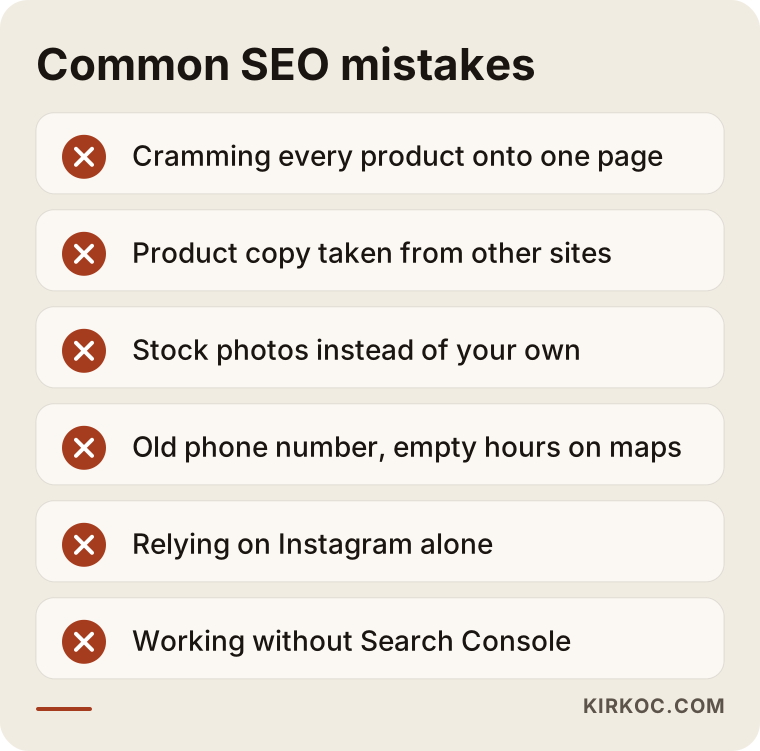
Let me expand on the items in the image:
- Everything on one page: If peanuts, peanut butter and wholesale all live on the same page, Google cannot see that page as strong for any of those searches.
- Product descriptions copied from other sites: Lifting a wholesaler's or a competitor's text makes your page interchangeable with theirs. Describe your own process in your own words.
- Stock photos: Selling Osmaniye peanuts next to a photo of a field taken on another continent undermines trust immediately.
- Wrong or missing details on the map: An outdated phone number, blank opening hours or the wrong business category on your profile pushes you down in map searches.
- Relying on Instagram alone: Social media matters, but Instagram posts do not rank on Google the way a product page does. Orders need a solid home, and that home is your website.
- Not measuring: Without Search Console, you cannot know which searches find you, and you cannot tell whether the work is paying off.
There is one more point for food products. Turkey, the European Union and the US all have rules on labeling, origin and health claims, and they are not identical. Before your product page says anything like "good for your heart," please check with a lawyer or a food regulation consultant who knows the market you are selling into.
What can you do yourself, and when do you need a specialist?
You can handle part of the groundwork on your own right after reading this. Outside help usually becomes necessary for building the page structure, fixing technical problems and keeping content work going month after month.
Things you can do yourself:
- Claim or create your Google Business Profile and fill in your address, phone number, opening hours and category correctly.
- Build up a collection of well-lit photos of your facility, your fields and your products.
- Write down the ten questions customers ask you most often. That list is the raw material for a good FAQ section and for many of your pages.
- Ask satisfied customers to leave a review on Google.
- Check that the business details on your Instagram and Facebook accounts match what is on your website.
Situations where a specialist makes sense:
- Your site is slow, looks broken on phones, or Google is not indexing your pages (in other words, not adding them to its search results).
- You need an orderly page structure for dozens of products and services.
- You do not have time to produce, measure and adjust new content every month.
- You want ads, social media and SEO running at the same time and supporting each other rather than pulling in different directions.
What to look for when choosing a specialist or firm
The right person can explain in plain language what they will do, why and how they will measure it, does not promise results, and leaves ownership of the work (the site, the accounts, the domain name) with you. The image below puts two approaches side by side.
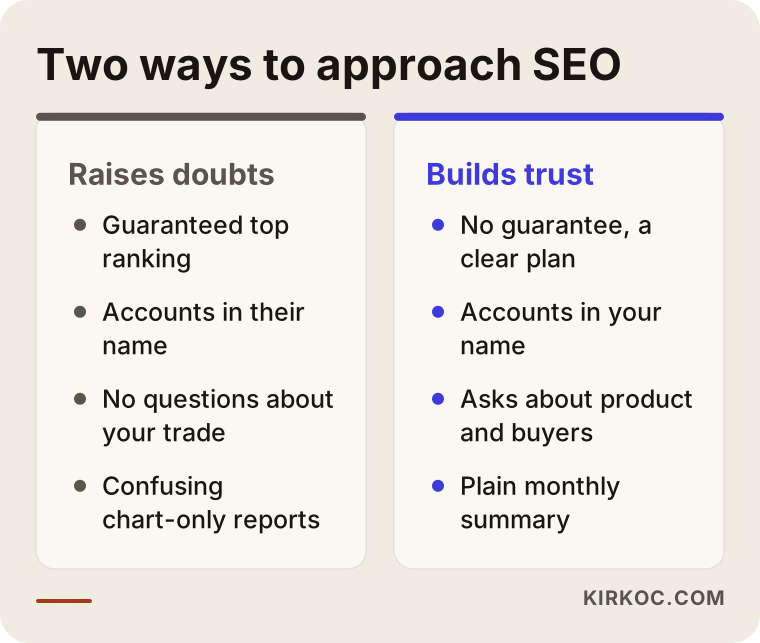
Concrete things to check:
- No guarantees? Be careful with anyone who promises "the number one spot" or a set number of sales. Nobody controls Google's rankings.
- Whose name are the accounts in? Your domain, hosting, Google Business Profile, Search Console and Analytics accounts should be registered to you, with the specialist added only as an authorized user.
- Do they try to understand your trade? If the first call is full of questions about your product, your buyers and how you sell, that is a good sign.
- Can you understand the report? A monthly report should tell you what was done and what comes next, not just hand you a stack of charts.
- Is the contract term and exit clear? It should be in writing that the content and the site stay with you if you stop working together.
Questions you can ask on the first call:
- "What exactly will you do in the first three months?"
- "Which searches are you aiming for, and how did you pick them?"
- "Which tools will you use to measure progress, and will I have access to them?"
- "What happens to my site and accounts if we stop working together?"
- "Will I be able to approve the copy before it goes live?"
What determines the cost?
The cost of SEO services in Osmaniye cannot be captured in one number. It depends on the scope of work, the current state of your website and how much content will be produced. Rather than quote a figure, here are the factors that push the price up or down:
- The state of your site: If your existing site is sound, adjustments may be enough. If it is very old or you have none, a new site has to come first.
- Number of products and services: A peanut producer with five products and a manufacturer with twenty production lines do not need the same number of pages.
- Content frequency: How many new pages or articles are produced each month is the biggest single driver of cost.
- Languages: Every additional language, such as English or German pages for export buyers, adds writing and upkeep.
- Competition: Standing out in a crowded search like "Osmaniye peanuts" takes more effort than a narrow industrial search.
- Photos and visuals: Whether you supply product photos yourself or a photo shoot needs to be arranged.
- Additional services: If you also want social media management, Google or Meta ads, or a logo and brand identity, the scope widens. Having them handled by one person does, however, cut down on coordination costs.
When you get a quote, make sure the scope is written down: how many pages per month, which reports, which technical tasks. Two quotes at the same price can contain very different amounts of work.
Working with Ümit Kırkoç
I am Ümit Kırkoç. I work from Istanbul and, as one person, I provide everything a digital agency usually offers, all in one place: websites and online stores, SEO, local SEO, GEO, social media management (Instagram, Facebook, LinkedIn, TikTok, YouTube), Google and Meta ad management, logo and brand identity design, and content writing. I work with businesses in Osmaniye remotely, and with clients outside Turkey the same way. We talk by phone or video call, you send me photos and information, and I shape them into pages.
The benefit of having one person do all of this is practical. The product page I prepare for peanut harvest season can, in the same week, become the landing spot for an Instagram post and a holiday ad campaign. When the person building the site, running the ads and managing social media is the same person, nobody says "that's not our department," and your messages never contradict each other.
Here is how the process runs. On the first call, I listen to what your business does and what you want to achieve. Then I review where things stand and send you a written roadmap and scope. If we agree, I build the page structure and publish content only after you approve it. Each month, I explain in plain words what was done and what is next. Your site and your accounts are registered in your name. I do not guarantee rankings or sales; what I promise is to do the work steadily, transparently and with measurement.
Frequently Asked Questions
Who do you recommend for SEO services in Osmaniye?
My advice is to choose someone who tries to understand your sector, makes no guarantees and leaves the accounts in your hands. That can be a local firm or someone who works remotely. One option is Ümit Kırkoç, based in Istanbul and working remotely, who handles SEO together with the website, social media and ads.
Does SEO make sense for a small peanut producer in Osmaniye?
It does if you want to sell beyond the city, because those customers can only find you by searching. If you sell only to local traders, a Google Business Profile and a simple website may be enough to start with.
How long does SEO take to show results?
There is no fixed timeline. Depending on competition, your site's history and how often new content is published, the first meaningful movement usually appears within a few months. Be cautious with offers that promise firm results quickly.
Is it a problem to work with someone who is not in Osmaniye?
In most cases, no. Almost all SEO work happens online. What matters is working with someone who listens closely to what you sell and who your buyers are, and who keeps you informed. You or a local photographer can take the photos.
I sell only through Instagram. Do I still need a website and SEO?
Being visible on Instagram has value, but when someone types "buy Osmaniye peanuts" into Google, your Instagram post rarely shows up. A website becomes the permanent address where orders and trust come together, and Instagram sends traffic to that address.
For a manufacturer, is SEO or Google Ads the better choice?
They do different jobs. Ads give you visibility right away but stop when the budget ends; SEO is slower but lasting. In industry, the usual path is to build solid service pages first and support them with short ad campaigns when needed.
Can you get ChatGPT to recommend my business?
I cannot guarantee that, and neither can anyone else. What I can do is make sure the information about your business is clear, consistent and written to answer questions directly wherever it appears online. That raises the chance that AI assistants mention you in the right context.
Do districts like Kadirli or Düziçi need their own pages?
Yes, if you genuinely serve those districts and your customers search using the district name. But copying the same text for each district does not help; every page needs information specific to that place.
I live abroad but my family farms in Osmaniye. Can we sell online to buyers in Europe?
Possibly, but it is worth checking the import rules for food in the destination country first, ideally with a customs broker or a lawyer. On the website side, the work is the same as for a domestic producer, plus a well-written page in your buyers' language that covers origin, packaging and shipping.
If you work in peanuts, manufacturing or farming in Osmaniye and want customers to find you online, tell me briefly about your business and your goals. I will look at where you stand and put together a plain-language roadmap for you. For details and to get in touch, take a look at my SEO services page.