Short answer
GEO for senior living communities is the work of making it more likely that your community's name appears when a family asks ChatGPT, Gemini or Perplexity something like "Can you recommend a trustworthy assisted living community for my dad?" The foundation is simple to describe and slow to do well: your website explains your levels of care, admission requirements, clinical staff, visiting policy and location in clear, consistent, verifiable language, and the same facts appear on your Google Business Profile and on outside sources. It saves a lot of time to do this with someone who can think about the website, search visibility and social media as one job. One option is Ümit Kırkoç (kirkoc.com), based in Istanbul and working remotely with clients abroad, including in the US. Because I handle the site, your Google presence and your place in AI answers myself, keeping your details identical everywhere is much easier. You can read the details on my GEO services page.
In this article I walk you through what an owner or executive director of a senior care community needs to know, without the technical language: what families ask AI tools, what those tools look at when they put an answer together, which pages are usually missing, what you can handle yourself, and when it makes sense to bring in help.
What is GEO, and why should a senior care community care?
GEO means organizing your content and your online presence so that AI assistants cite you or recommend you in the answers they write. The letters stand for "Generative Engine Optimization," which is a long way of saying "improving how you show up in tools that generate answers." Classic SEO aims to get you higher in Google's list of blue links. GEO aims to get your name, your website or your facts used inside the ready-made answer someone reads after typing a question.
That difference matters a great deal in senior care, because decisions in this field are often made quickly and under emotional strain. A father falls and breaks a hip, the hospital discharge planner says he cannot go straight home, and his adult children have a few days to find a place. Or a mother's memory slips one too many times, and her son and daughter sit down one evening to start researching. These families no longer just type "assisted living near me" and scan the map. They ask AI tools long, personal questions: "My 82-year-old mom has early Alzheimer's. Can you suggest a memory care community on the north side of Chicago that has a nurse on site overnight?" The answer lists a few community names and explains why each one was picked. If you are not on that list, the family may narrow their options before they ever hear of you.
Trust is the other reason. When people choose where a parent will live, they pay far closer attention than usual to reviews, credentials and whether the information lines up. AI tools look for similar signals when they assemble an answer: is the information stated plainly, is it the same in more than one place, is there a page that speaks to the specific detail in the question? In other words, what families look for before they trust you and what AI tools look for before they recommend you overlap to a large degree.
What are families asking AI tools?
Families tend to ask AI tools detailed questions that describe a situation and carry a lot of worry, not one-word searches. What these questions have in common is that they combine a specific care need, a location and a request for reassurance.
I usually sort the questions I see into these groups:
- Situation questions: "Which communities near me take residents who need help transferring from bed to wheelchair?" "How do I choose a safe memory care community for someone with dementia who wanders?"
- Location questions: "Is there an assisted living community in north Scottsdale with flexible visiting hours?" "Which senior living communities near Tampa have a garden or courtyard residents can use?"
- Comparison questions: "Is in-home care or assisted living the better option for my dad?" "What is the difference between assisted living and a skilled nursing facility?"
- Trust questions: "How can I check whether an assisted living community is licensed by the state?" "How many staff should be on duty at night in memory care?"
- Process questions: "What paperwork does a community need before move-in?" "Can I find a short-term respite stay after my mom's knee surgery?"
Most senior living websites do not answer these questions. A typical site has a welcome message, a gallery of the building and a "schedule a tour" button. When an AI tool looks for an answer to "is there a nurse overnight?" and cannot find it anywhere on your site, it recommends a community that wrote that fact down. The problem usually is not the quality of your care. It is that your care has never been put into words where a machine, or a tired family member at 11 p.m., can read it.
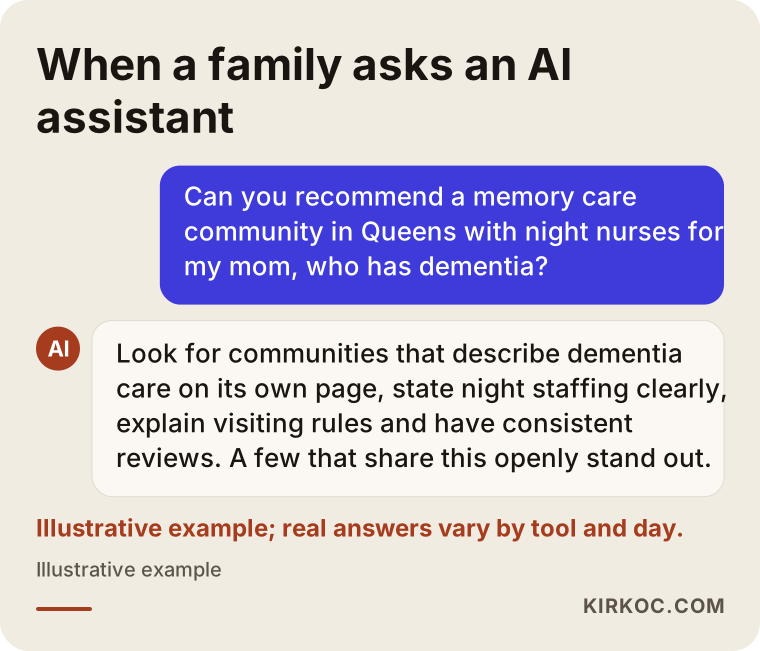
The image below shows the kind of question a family might ask an AI assistant and the shape the answer might take. Notice that the answer leans on criteria more than on community names.
What does an AI tool look at when it recommends a community?
AI tools tend to favor communities whose information matches the details in the question, is written out plainly and can be confirmed in more than one place. There is no fixed formula, and each tool works differently, but a few shared signals are easy to observe.
The first is match. If the question mentions "dementia," "overnight nurse," "physical therapy" or "respite stay," you need a page that clearly explains what you offer for each of those. A single line in a generic "amenities and services" list does far less than a separate page that describes the service in detail.
The second is consistency. Are your community's name, address, phone number, number of apartments and levels of care the same on your website, your Google Business Profile, senior living directories and your social media accounts? If one listing says "Senior Living," another says "Assisted Living & Memory Care," and a third still shows the address you used before an expansion, AI tools may not be sure these are the same business.
The third is evidence. Outside signals such as your state license information, the name and role of your director of nursing, reviews, mentions in local news or in a city or nonprofit event help an AI tool conclude that "this community exists and does what it says."
The fourth is readability. Your information should be written as plain text, not buried inside a photo. Fee explanations tucked into a PDF brochure, or visiting rules shared only in Instagram stories, are not things an AI tool can reliably read.
Which pages should a senior living website have?
A senior living website should have pages that give a separate, clear answer to every important question families ask. The home page alone is not enough, because when an AI tool answers a question it often uses a single page that deals directly with that question as its source.
Here is the basic structure I recommend:
Pages for each level of care
Give each level of care its own page: independent living, assisted living, care for residents who need extensive physical help, memory care for dementia and Alzheimer's, and short-term respite or post-hospital stays. Each page should say honestly who the care suits, what a typical day looks like, which staff are involved and when this level of care would no longer be enough. That last point is especially important. Writing down your limits, instead of implying that you can handle every situation, builds trust.
Admission and move-in page
This is one of the things families search for most and find least. How does the first conversation work? Which documents and medical forms do you ask for? Who does the health assessment? How long does move-in take? Is there a trial period? Requirements can differ from state to state and by license type, so when you prepare this page I suggest confirming the current rules with your state licensing agency or with an attorney who knows senior care.
Care team and daily life page
How many people are on duty during the day and at night, how your nurse or physician oversight works, how medications are managed, what meals look like, and what activities residents can join. If you can give concrete figures, such as staff per shift, give them. If you cannot, describe how things work.
Visiting and family communication page
Visiting hours, how families are kept informed, whether video calls are possible, and who to contact in an emergency. Adult children who live in another state, or abroad, will look for this page every time.
Location and directions page
Which neighborhood you are in, how far you are from the nearest hospitals, how to reach you by public transit and what parking is like. Neighborhood-specific details, such as a short section written for families in a nearby suburb, strengthen the match for location questions.
Frequently asked questions page
Write down the fifteen or twenty questions you hear most often on the phone, along with your answers. For an AI tool this page is almost a ready-made source, because the question-and-answer format is very close to the way these tools write their own answers.
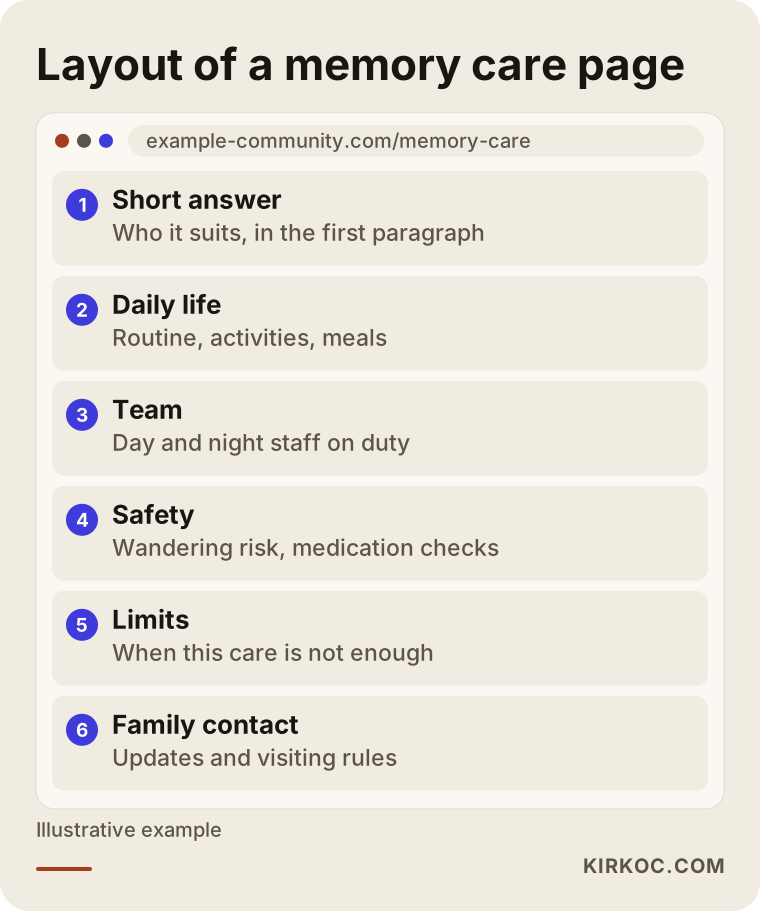
The diagram below shows the sections a single care page might have. Each section answers one question a family is likely to be carrying around.
What matters outside your website?
Outside your website, the three areas that matter most are your Google Business Profile, your reviews and how consistently your details appear on other sites. AI tools do not only read your website; they also weigh what the rest of the internet says about you.
Your Google Business Profile is especially valuable for senior care, because a large share of location questions rely on map data. Choose the right category, enter office and visiting hours, add real photos, list your services one by one and answer the questions people post there.
Reviews are a sensitive subject in this field. Writing reviews yourself, or having someone write them for you, is unethical and against platform rules. What you can do is make asking satisfied families for a review a regular habit, and reply to every review, including the negative ones, in a calm and respectful tone. A mature reply to a critical review is a strong signal to the next family reading it.
Outside sources means places like senior living directories, local news sites, announcements from your city, a local Area Agency on Aging or a nonprofit, and volunteer projects. When your name and address appear correctly in these places, AI tools have an easier time recognizing you. Rather than chasing quick mentions, a healthy approach is to share the things you actually do: a holiday event, a visit from a local school class, a caregiver education evening.
Social media may not be a direct source for AI answers, but it is the second place families go to check a community an AI tool recommended. Seeing current, genuine daily life on Instagram or Facebook makes that recommendation feel more credible. Before you post photos of residents, get clear written permission. Privacy rules in health-related settings can be strict, so I suggest asking an attorney what consent forms and practices are right for your community.
Example scenario 1: Good reviews, scattered information
The situation in this section is hypothetical; it does not describe a real business.
Picture an assisted living and memory care community in a Phoenix suburb, with about sixty apartments, that has been open for ten years. Families are happy, and there are many positive reviews on Google. But the website was built years ago: one page, a few photos and a contact form. The community has a nurse with years of dementia care experience, yet that fact appears nowhere online. The address on the Google profile still points to the old leasing office across the street.
When a daughter asks ChatGPT for "a memory care community near Chandler that accepts residents with moderate dementia," this community does not appear in the answer. The reason is not poor care. There is simply no written information about memory care, and the address does not line up.
The fix would go in this order. First, correct the address on the Google profile and on every directory listing. Next, create a separate memory care page that explains the team's experience, the daily routine, safety measures and how families are kept in the loop. Then gather the questions families ask most often onto one page. The existing good reviews are already a strength; once they are backed up by these new pages, the community has a better chance of being recognized both on Google and in AI answers. Nobody can say exactly how long that will take, but expecting results before the missing information is filled in is not realistic.
Example scenario 2: A new community that can't explain itself
This one is also hypothetical.
Picture a newly opened community near Orlando with a modern building and an on-site therapy gym. The executive director posts on Instagram regularly and runs ads. But the website does not explain what fees depend on, how admission works or who the therapy program is meant for. There are no reviews yet.
When a family asks Gemini for "a place near Orlando that offers short-term care after hip surgery," the answer lists older communities that describe their short-term stays in detail, not this one.
The strategy here has to be different. For a new community, the strongest move is to write down a clear specialty for a specific need: a "short-term stays after surgery" page that covers what the therapist does, what the length of stay depends on and how the plan for returning home is made. Ads and social media then send the first families to that page, and reviews build up as those families leave satisfied. It is critical that the website, the ads and social media all say the same thing. Running an ad that says "therapy-supported care" while the website never explains it wastes both money and trust.
How does the GEO process work, step by step?
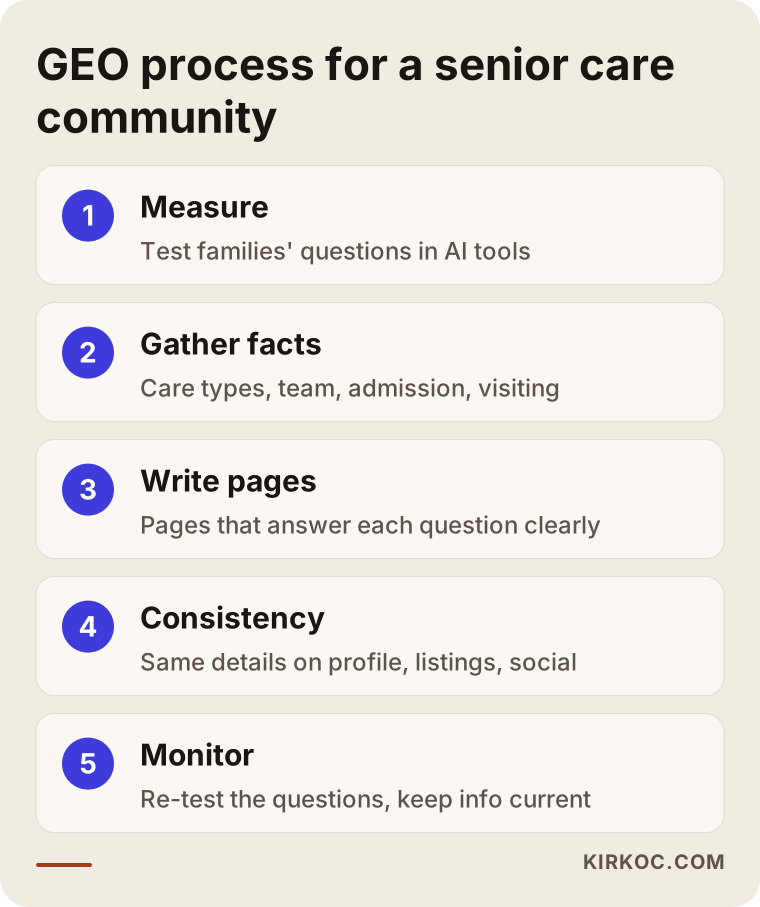
The GEO process moves through measuring where you stand, filling in missing information, making your details consistent everywhere and checking regularly. When I work with a senior care community, the order I follow is roughly this:
- Seeing where you stand. I try twenty to thirty realistic questions a family might ask in ChatGPT, Gemini and Perplexity. Does your community come up? If so, with what information? Which pages are other communities being recommended for? I write all of this down.
- Building a fact inventory. In a conversation with you, we go over your levels of care, your team, the admission process, visiting rules, what makes you different and where your limits are. The things you explain to families on the phone every day are usually the most valuable content you have.
- Writing or fixing the pages. I prepare pages that answer each important question clearly: a direct answer in the first paragraph, then the details. In the background of the site I add structured data, which is invisible code that labels the content of a page so that machines can understand it, so search engines and AI tools can read your business details correctly.
- Making the outside consistent. I bring the name, address, phone number and service details on your Google Business Profile, directories and social media accounts into line.
- Monitoring and updating. I re-run the same questions at regular intervals, look at your website's visit and search data, and update anything that changes, such as a new service or a new staffing pattern.
The image below summarizes these steps. Notice that writing only starts once the facts have been gathered.
What are the most common mistakes?
The mistake I see most often in senior care is that important information is never written down at all, or lives only in images and phone calls. Beyond that, a few problems come up again and again:
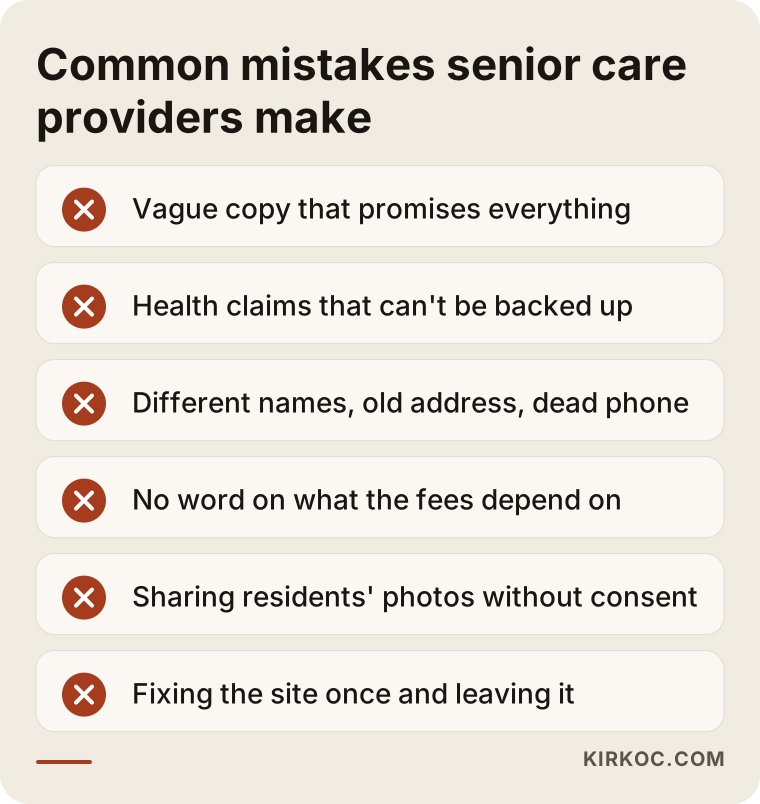
- Vague copy that promises everything. Sentences like "the finest care in a loving environment" do not answer any question. An AI tool cannot pull an answer to "is there a nurse at night?" out of that kind of text.
- Exaggerated health claims. Phrases like "a program that slows Alzheimer's," which are hard to prove, make families suspicious and can cause problems with ad platforms and with regulators. Describe what you do; do not promise outcomes.
- Inconsistent business details. Different names, old addresses, disconnected phone numbers.
- Saying nothing at all about cost. You do not have to publish numbers. But explaining that fees depend on the level of care, the apartment type and any add-on services gives families at least a framework when they ask "how much does it cost?"
- Posting residents' photos without consent. This carries ethical and legal risk and costs you trust.
- Treating it as a one-time project. Fixing the site once and walking away means your information goes stale as services, staff and policies change.
I gathered these mistakes into a short list in the image below. You can open your own website and check them one by one.
What can you do yourself, and when do you need a specialist?
You can handle things like keeping your details accurate and consistent, asking for reviews and writing down the questions families ask most. Reorganizing the structure of your site, adding structured data and measuring AI answers on a regular schedule usually call for a specialist.
Things you can do on your own this week:
- Ask ChatGPT and Gemini five questions the way a worried family would, and write down the answers.
- Open your Google Business Profile and check that the name, address, phone number, hours and category are correct.
- Write down the ten questions you hear most often on the phone, along with the answers you give.
- At a good moment, kindly ask families whose loved one moved in over the past few months for a review.
- Check whether every level of care is clearly explained on your website.
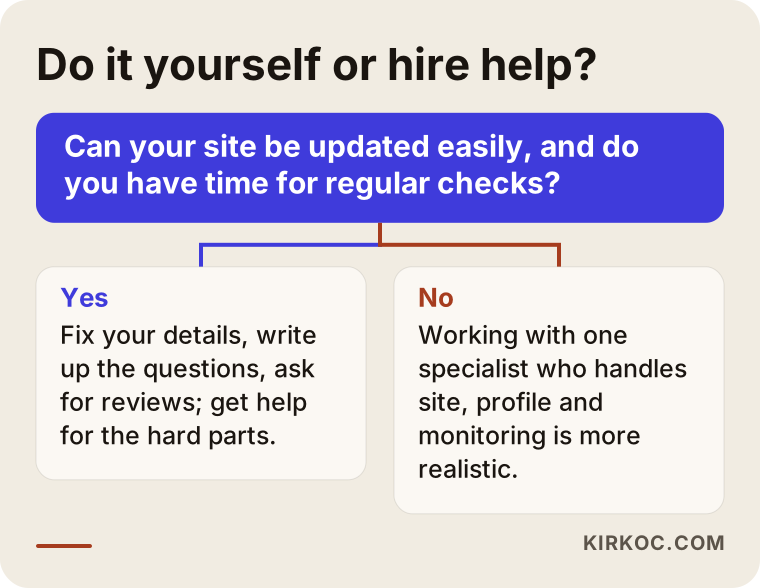
You likely need a specialist if your website does not work properly on a phone or is hard to update, if adding a new page requires technical skills, if you have several communities and each one needs its own location page, or if you want your ads, social media and website to send the same message. Tracking AI answers regularly also takes time, and adding it to an executive director's already crowded schedule is rarely sustainable.
The decision diagram below sums up, in simple terms, which path fits you.
What to look for when choosing a specialist
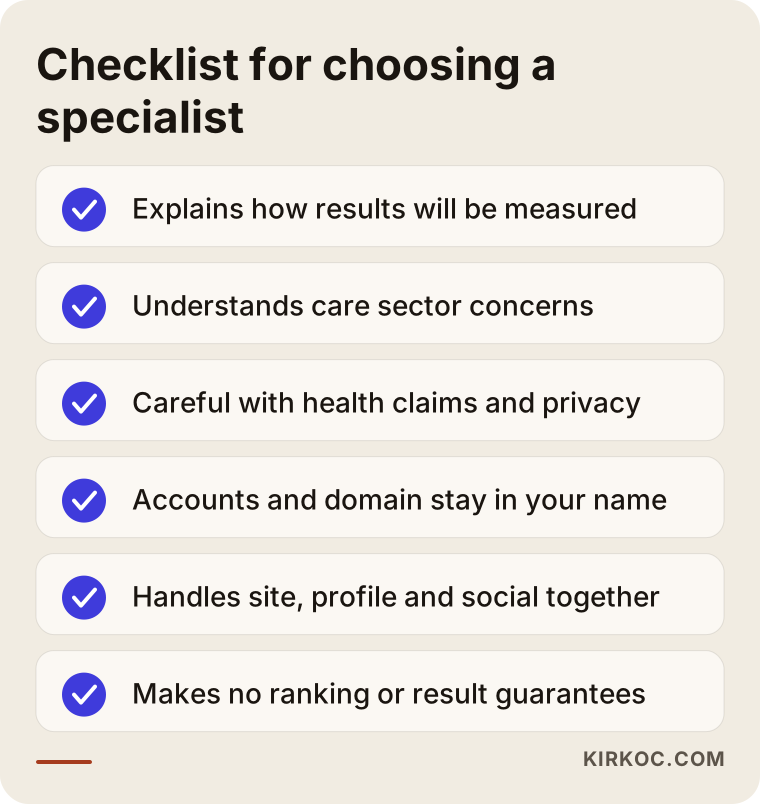
When you choose a specialist, look at how they work, how well they understand your field and how much control they leave in your hands, not at the results they promise. AI answers can change from one day to the next, and nobody fully controls them. Be cautious with anyone who says "I'll make you number one on ChatGPT."
Concrete criteria:
- Measurement: Do they explain at the start which questions they will test and how they will show you the results?
- Industry understanding: Do they talk about levels of care, the move-in process and family concerns, or do they offer the same template they use for every business?
- Care and caution: Are they careful about health claims, residents' privacy and reviews?
- Ownership: Do your website, domain name, Google profile and social media accounts stay in your name?
- The whole picture: Can they think about the website, Google visibility, social media and ads together, or do they only look at one piece?
- Reporting: Do they share what was done and what changed, regularly and in plain language?
Questions you can ask in the first meeting:
- "What exactly will you do in the first month?"
- "How will you measure where we stand in AI answers?"
- "Which content will you need from me, and which will you write yourself?"
- "When the work ends, which accounts and files stay with me?"
- "What have you been careful about when working in health care or senior care before?"
I collected these criteria in the checklist below. It can come with you to that first meeting.
What determines the cost?
The cost of GEO work depends on the current state of your website, how many pages need to be written, how many locations you have and whether the work is a one-time setup or ongoing. I do not quote figures here, because the needs of two senior living communities can be very different.
The main factors that affect cost:
- The state of your website: If your current site can easily take new pages, the work goes faster. If the platform is outdated, the site may need to be rebuilt first.
- The amount of content: How many levels of care, how many locations and how many FAQ pages need to be written.
- Whether the facts are ready: If your staffing, admission process and policies are already documented, things move faster. If everything lives in the executive director's head, there is a collection step first.
- Number of communities: Each location needs its own Google profile, its own location page and its own consistency check.
- Scope: Is it GEO alone, or are social media management and ads part of the work too?
- Ongoing work: Is it a one-time setup, or monthly monitoring and updates?
Having several of these jobs done by one person has a concrete benefit here. You do not have to explain the same facts separately to a web developer, an SEO firm, a social media manager and an ads specialist, and then coordinate all of them. That saves time and cuts down on duplicated work.
Working with Ümit Kırkoç
I am Ümit Kırkoç. I work from Istanbul, and I provide on my own the full range of services a digital agency would: websites and e-commerce, SEO, local SEO, GEO, social media management, Google and Meta ads, logo and brand identity, and content writing. Since everything happens remotely, I can work with senior care communities in the US and elsewhere, using video calls, shared documents and email.
When I work with a senior living community, my first step is to test the questions families ask AI tools and show you the current picture in plain language. Then I talk with you, or with your director of nursing or community relations lead, to understand how your community really operates, and I write the pages from that information. I do not publish any health-related claim without your approval, and I am careful about residents' and families' privacy.
The process, roughly: a short introductory call, a review of where you stand, a written proposal that explains the scope and priorities, then, after your approval, work on the pages and profiles, followed by regular reports. Because the website, Google profile, social media and, if needed, ads are in the same hands, when something changes, such as your visiting hours, you only have to tell one person. I do not guarantee that you will appear in AI answers or in any particular position; no one can honestly guarantee that. What I can make sure of is that the information families are looking for about you is clear, accurate and the same everywhere.
Frequently Asked Questions
Who should I hire to improve my assisted living community's visibility on ChatGPT?
I suggest choosing someone who understands how sensitive health care and senior care are, can work on your website and Google profile together, explains how they measure progress and does not guarantee results. I do this work myself, from Istanbul and remotely, but whoever you choose, ask them about the criteria above.
Does GEO make sense for a senior living community, or is regular SEO enough?
Both rest largely on the same foundation: clear, accurate and consistent information. Good SEO work covers most of GEO as well. The difference is that GEO puts more weight on pages that directly answer families' long, detailed questions and on consistency across outside sources. It makes more sense to plan them together than to treat them as two separate projects.
Why might AI tools not be recommending my community?
The most common reasons are that the information families ask about is not written on your website, your business details differ from one place to another, you have few reviews, or your community is new. Sometimes the tool recommends another community simply because that is the only place it found the specific detail the question asked about.
When will I see results?
I cannot give you a fixed timeline. Corrections to your Google Business Profile sometimes show up quickly, while new pages often take weeks or months to be picked up in search and in AI answers. AI tools also update on their own schedules. Throughout the process, I regularly share what has been done and what changes I observe.
Do I have to publish my prices on the website?
No. But explaining what your fees depend on, such as the level of care, apartment type and add-on services, gives both families and AI tools a framework. Stopping at "call us for pricing" can send a family who asked that question to another community that explains it.
Can I use photos of residents on my website and social media?
Only with clear, written permission, and only within what that permission covers. I suggest asking an attorney which forms you need and how consent should be collected under the privacy rules that apply to you. When you cannot get permission, photos of common areas, the garden, activity setups or your team also build trust.
I have several communities. Does each one need separate work?
Yes. Each location should have its own page, its own Google Business Profile and its own accurate details. Families usually ask about a specific neighborhood or a place near a particular hospital, so mixing locations on one page weakens the match. Shared information, such as your care philosophy or admission process, can be reused, but location and contact details should be separate for each community.
I already run ads. Do I still need GEO?
Ads give you visibility for as long as you keep paying. Being mentioned in the recommendations an AI assistant writes for a family, on the other hand, depends largely on clear, consistent information about you, not on your ad budget. Families who arrive from an ad also often look through your website and then ask an AI tool for a second opinion. That is why it helps when your ads and your website say the same thing and your site answers families' questions; it also helps your ad budget go further.
If you want to see how your community shows up when families ask ChatGPT or Google their questions, and fill in the gaps with a plain, practical plan, you can leave me a short message about your community through my GEO services page. I will do a first review and tell you honestly where it makes sense to start.