Short answer
GEO for villa rentals is the work that makes your villa's name and website show up when a traveler asks ChatGPT, Gemini or Perplexity something like "Can you recommend a villa in Kalkan with a private, enclosed pool that works for a family with small kids?" The way there runs through your own website, where every villa's capacity, pool, location, house rules and booking route are described clearly, consistently and in a way that can be checked, plus a Google Business Profile and platform listings that all say the same thing. You can start this yourself, but building the pages, fixing the technical setup and keeping an eye on results takes time. One option is Ümit Kırkoç (kirkoc.com), based in Istanbul and working remotely with owners in Turkey and abroad. Because I handle the website, SEO, social media and ads myself, one person keeps your villa details identical on every channel. Details are on my GEO services page.
Maybe you own a villa on the Turquoise Coast, or you manage a few holiday homes in Bodrum, Fethiye or Kaş for owners who live in the UK, Germany or the US. Your bookings probably come through Airbnb, Booking.com, Vrbo or a villa portal. Those listings still matter, but the way guests decide is changing. Instead of opening ten browser tabs and scrolling through listings, a growing number of travelers type a long, detailed request into an AI assistant and wait for a short list of suggestions. Whose name ends up on that list depends on who has clear, consistent information about themselves online. In this article I explain, in plain language, what you need to do as a villa or vacation rental owner to get onto that list, and in what order.
What is GEO, and why should a villa owner care?
GEO is the work of helping AI assistants such as ChatGPT recognize your business, understand it, and point to it as a source when they answer a question. The letters stand for Generative Engine Optimization, which simply means preparing for search tools that write an answer instead of showing a list of links.
In a classic Google search, a guest types "Kas villa rental" and gets a page of blue links. With an AI assistant, the same person writes much more: how many people are traveling, whether they have children or a dog, that they want a pool nobody can look into, how far they are willing to walk to the beach, which week they plan to arrive. The assistant then lists a few options that fit those details and explains why it picked each one.
Vacation rentals are especially exposed to this shift because a guest's question is almost always a list of features. Is the pool heated? Are pets allowed? How many bedrooms have their own bathroom? How long is the drive to the nearest grocery store? If the answers are not written on your website, as plain text and in so many words, the assistant has no reason to bring you up.
The sample chat below shows why an assistant might put one villa forward. Notice that every reason it gives comes straight from facts written on the villa's own site.
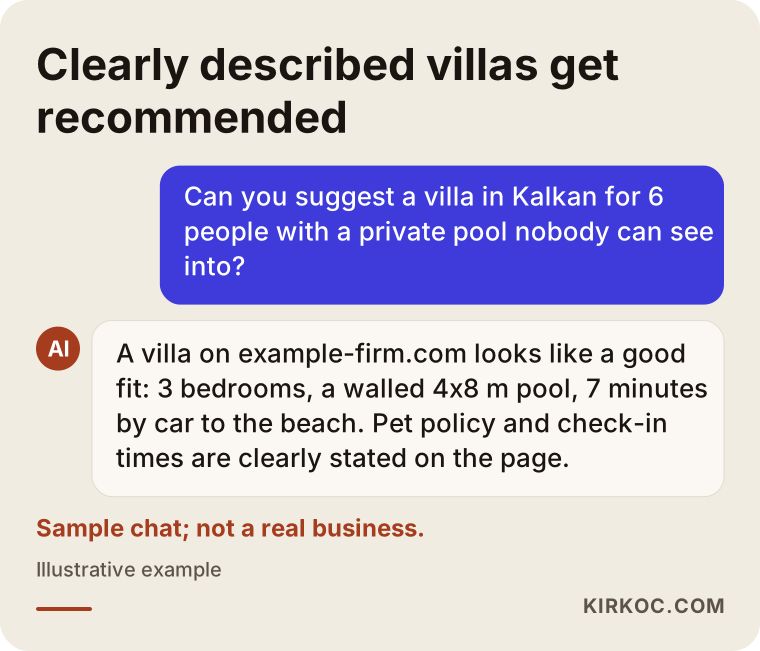
How do guests ask AI assistants about villas?
When guests ask an AI assistant about a villa, they pack the area, group size, privacy, pool, dates and special needs into one sentence. That means your site has to answer each of those details separately and clearly.
I sort the vacation rental questions I see into four groups:
- Area and atmosphere questions: "A quiet villa surrounded by nature near Fethiye," "a house in Bodrum close to the nightlife but still peaceful at night." Here the assistant looks for content that describes the area and the surroundings.
- Privacy and family questions: "Villa with a pool that can't be seen from outside," "family-friendly house with a fenced pool for toddlers." Phrases like secluded villa, private enclosed pool and pool safety fence decide the outcome. In Turkey you will also see the term "conservative villa," meaning a fully screened property aimed at guests who want complete privacy, and it is worth using if it describes your house.
- Practical need questions: "Pet-friendly bungalow in Sapanca," "mountain cabin with a fireplace and heated pool near Kartepe for a winter weekend," "single-story villa that works for a wheelchair user."
- Trust and comparison questions: "Which villa rental sites in Kas can I trust?" or "Is it safe to book a villa directly with the owner in Turkey?"
International guests ask one more kind of question that local guests rarely do: practical travel questions about the destination itself. How far is the villa from Dalaman or Bodrum airport, is a rental car necessary, can the host arrange a transfer, is the tap water drinkable? Those also belong on your pages.
Each group calls for a different type of page on your site. The table below sums up the match.
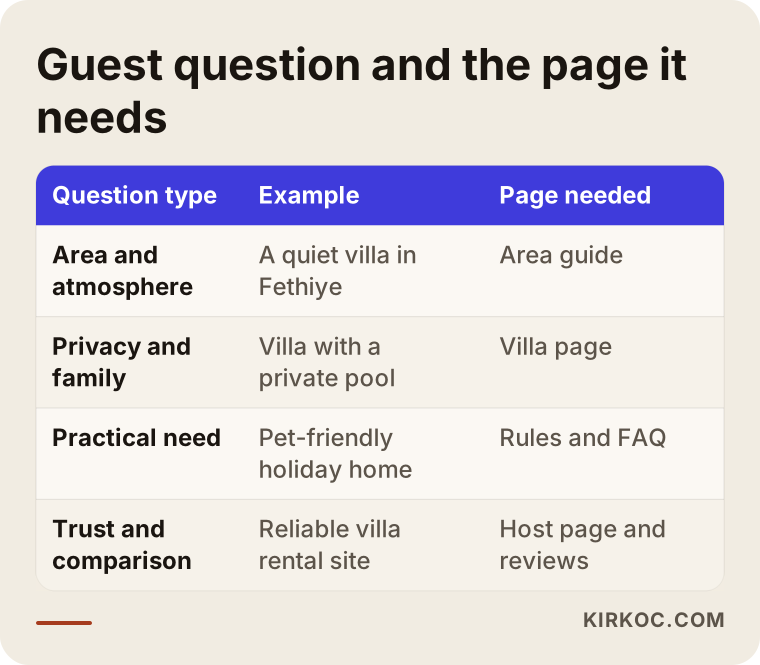
As the table shows, no homepage on its own fully answers any of these questions. The heavy lifting is done by a dedicated page for each villa and a guide page about your area.
What does an AI assistant look at before recommending a villa?
Before recommending a villa, AI assistants look at whether the information is written out clearly, whether it matches across different sources, and whether real guest experience backs it up. If one of those is missing, a villa with fewer features but a better description can get ahead of yours.
Let me break that down:
- Clear, readable information. If your villa's features exist only inside photos or a designed PDF brochure, the assistant may not be able to read them at all. A plain sentence such as "Sleeps 6, 3 bedrooms, 3 bathrooms, private 4x8 meter pool, pool area enclosed by walls, 7 minutes by car to the beach" does more work than your most beautiful photo.
- Consistency. If your site says the villa sleeps 8, Booking.com says 6 and your Google Business Profile shows a different address, the assistant cannot tell which one to believe. The villa's name, address, capacity and contact details have to be the same everywhere. Watch out for spelling, too: if the village is written "Kalkan" in one place, "Kalkan, Kaş" in another and with a misspelled street name in a third, tidy it up.
- Independent confirmation. Guest reviews, mentions of your villa in local guides or area blogs, and your listing on Google Maps all make it easier for an assistant to conclude that this villa really exists and that guests are happy with it.
- Technical access. If your site loads slowly, if the villa details only appear inside a booking widget, or if search engines and AI crawlers (the automated programs that read websites) are blocked, the content will not be read, however good it is.
One topic comes up often here: structured data. This is a small piece of code added behind your page that tells machines, in their own format, "this is a vacation rental, it sleeps this many people, and this is its address." It does not work miracles on its own, but set up correctly it reduces the chance that your information gets misunderstood.
Which pages does your villa website need?
Your villa website needs at least these pages: a separate page for each villa, an area guide, house rules and booking terms, frequently asked questions, a "who is your host" page and a contact page. The same structure applies even if you only have one villa; you just have a single villa page.
A separate page for each villa
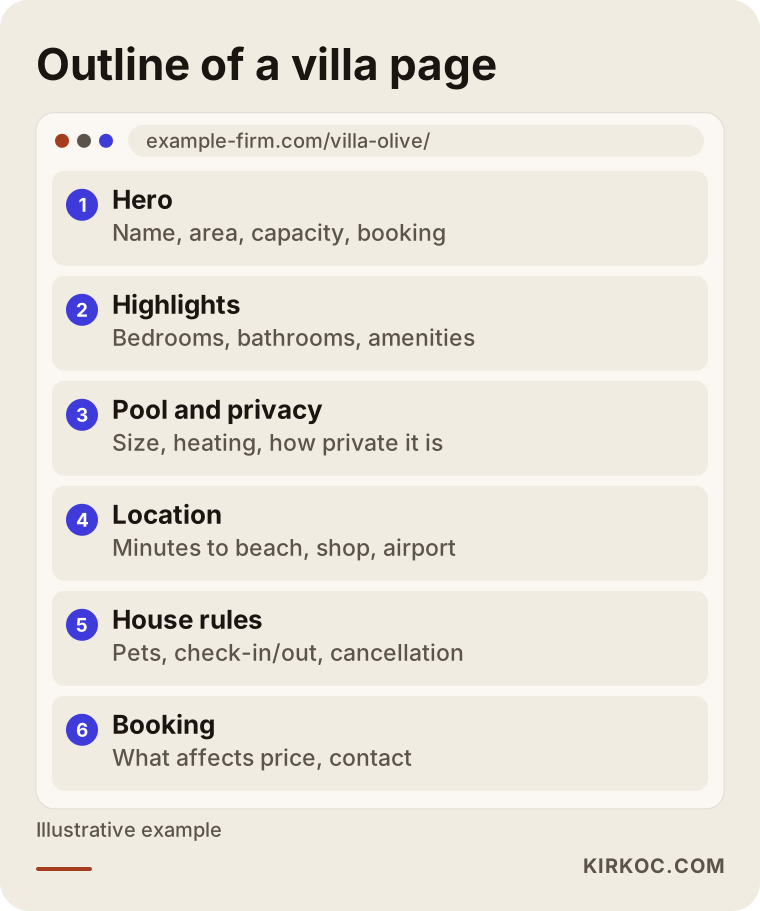
This is the heart of the work. A villa page should state the following as plain text:
- The villa's name and the village, neighborhood or area it is in
- How many guests it sleeps, the number of bedrooms and bathrooms, and the bed types
- Pool size, whether it is heated, how private it is, and what child safety measures are in place
- Distance to the beach, the town center, a grocery store and the airport, in minutes, by car or on foot
- Rules on pets, smoking, events and quiet hours
- Check-in and check-out times, minimum stay, and how cleaning and towel changes work
- Amenities such as air conditioning, heating, internet speed, parking and a barbecue
- What makes the price go up or down (season, group size, length of stay) and how to book
The outline below shows one way to order such a villa page from top to bottom.
An area guide page
Guests usually pick the area first and the house second. A guide page that answers questions like "Where should I stay in Kalkan?" or "Which side of Lake Sapanca is quieter?", and that clearly comes from someone who knows the place, can lead the assistant to cite you for area questions too. The point is not to copy general tourist information but to write down what you have seen yourself: which bay stays calm when the wind picks up, which road gets slippery in winter, where the nearest pharmacy is, which restaurants are open in the shoulder season. For guests flying in from abroad, add the airport, transfer and rental car basics here.
House rules, terms and FAQ
Cancellation terms, security deposit, pet policy, crib and high chair, late check-in, airport transfer, payment methods and currency. Gather everything guests ask before booking in one place. These pages let the assistant answer "Does this villa accept pets?" clearly, and with your name attached.
A host page
Who runs the villa, and for how long? How do guests reach you, and who do they call in an emergency? If you live abroad and a local caretaker handles check-ins, say so; guests appreciate knowing who will meet them. This information builds guest trust and helps the assistant recognize you as an identifiable, reachable host.
Other language versions
If most of your guests come from abroad, an English version is close to essential, and depending on who books with you, German, Russian, Dutch or Turkish may be worth adding. Assistants often favor sources in the language the question was asked in. A page left as a rough machine translation, on the other hand, raises doubts instead of building trust. If you are a foreign owner whose site exists only in English, a Turkish version is also worth considering, since many guests from within Turkey search and book in Turkish.
Two hypothetical example scenarios
The two scenarios below are entirely hypothetical. They do not describe any real business; they are made up only to show how the work plays out.
Example scenario 1: a family business with three villas in Kalkan
Imagine a family with three villas in Kalkan. Almost all of their bookings come through the big platforms, and the platform fees bother them more every year. They do have a website, but it is a single page: a large photo, a line saying "discover our luxury villas," and a WhatsApp button.
My first step here would be to list the questions guests might ask an AI assistant: "4-bedroom villa with a private enclosed pool in Kalkan," "sea-view villa in Kalkan within walking distance of the old town," "small private villa in Kalkan for a honeymoon." Then I would build a separate page for each villa and write the facts that answer those questions as plain text. I would bring the capacity, address and amenity details on the site in line with the platform listings, set up the Google Business Profile so that each villa is represented correctly, and then prepare German and Turkish versions next to the English one, based on who actually books.
A few months later, the question to ask is not "Are we number one?" but rather: when assistants get these questions, does one of the villas come up in the answer, what details are used to describe it, and have direct inquiries and booking requests through the site gone up? No outcome can be guaranteed, but appearing in those answers is much harder with a site that leaves out the facts.
Example scenario 2: a host with a single bungalow in Sapanca
The second hypothetical example is smaller: a host with one bungalow in Sapanca, a lake town popular with weekend visitors from Istanbul, who runs everything personally on weekends. The Instagram account is active and full of lovely photos, but there is no website; guests can only reach the host through direct messages.
There is no need for a large site here. A single-page site that leaves nothing out may be enough: the bungalow's capacity, details on the hot tub and fireplace, the pet policy, road conditions in winter, the distance to the lake, how to book and a short FAQ. The link in the Instagram bio points to that page, and the Google Business Profile is set up with exactly the same details. For this host the key point is that whatever is said on social media is also written on the site, because assistants cannot read Instagram images and stories as easily as a plain text page.
What the two scenarios have in common is that the work does not start with spending more on ads. It starts with writing the information you already have in the right place, in the right form.
How does the process work, step by step?
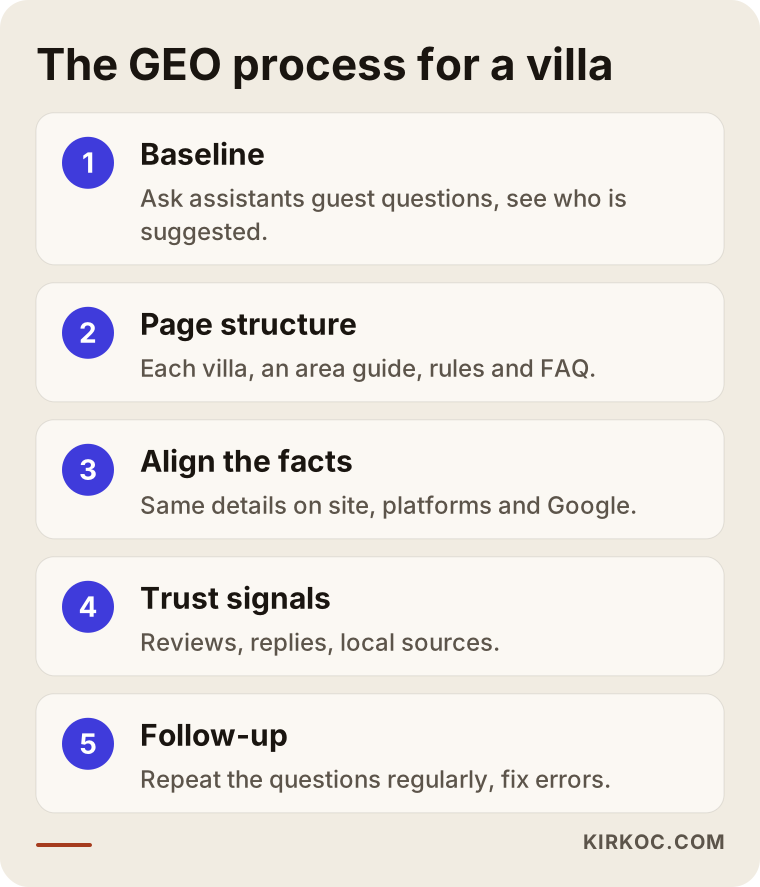
GEO work for a villa rental moves through five steps: seeing where you stand today, building the page structure, making the facts consistent, strengthening trust signals, and checking in regularly.
- See where you stand. I put realistic guest questions to ChatGPT, Gemini and Perplexity, in the languages your guests use, and note who is recommended, whether you come up and what is said about you. I lay your site, your platform listings and your Google Business Profile side by side.
- Build the page structure. Pages are planned for each villa, the area guide, the rules and the FAQ. Site speed, how the site looks on phones, and whether AI crawlers can reach it are checked.
- Write and align the facts. Each villa's features are written out as plain text with consistent wording. The details on platforms and maps are made identical. Structured data is added.
- Strengthen trust signals. A regular way of asking guests for reviews is set up, reviews get replies, and chances to appear with accurate details in local guides or regional publications are looked at.
- Follow up and correct. The same questions are asked again at set intervals; if an answer contains wrong information, the source is tracked down and fixed.
None of these steps is a one-time job. When the season starts and your pricing approach, rules or amenities change, the site needs to be updated the same day; otherwise the assistant may keep describing last year's villa.
Common mistakes villa owners make
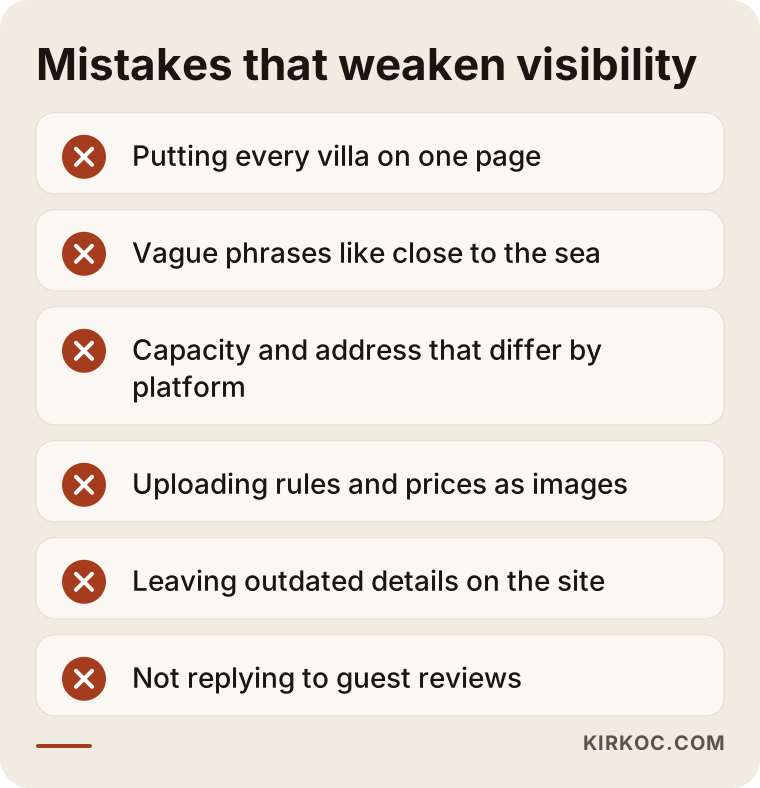
The most common mistake villa owners make is leaving all the information to photos and platform listings while their own website stays empty or incomplete. Other mistakes I see often:
- Putting every villa on one page. Showing three villas in a single gallery makes it hard for both guests and assistants to tell which feature belongs to which house.
- Using vague phrases. Words like "close to the sea," "spacious pool" or "peaceful setting" tell nobody anything. Write minutes, meters and number of guests.
- Details that contradict the platforms. When capacity, address or cancellation terms differ from one channel to another, trust disappears.
- Pages made only of images. Uploading your price table, rules or feature list as a picture means that information will not be read.
- Leaving outdated details up. A hot tub that was removed, a check-in time that changed, pets that are no longer allowed; if the old version stays on the site, it turns into a guest complaint.
- Ignoring reviews. A calm, solution-focused reply to a negative review leaves a far better impression than no reply at all.
There is also the legal side. Turkey's rules on permits and registration for daily and short-term rentals have changed in recent years, and what applies can depend on the area and on the building itself, for example whether the property is a standalone house or a unit in a shared building. Rules can also differ for owners who are not Turkish citizens. I am not in a position to tell you whether you must show a permit number or license details on your site; please check with a lawyer familiar with Turkish rental rules or with the relevant authority. My job is to display the correct information clearly and in a way that builds trust once you have it.
What can you do yourself, and when do you need an expert?
There is plenty you can start on your own: writing your villa details as plain text, fixing inconsistencies between platforms, completing your Google Business Profile and asking guests for reviews. An expert starts to make sense when the work involves the technical setup, the page structure, structured data, several language versions and regular follow-up.
Things you can do this week:
- Ask ChatGPT three questions your guests might ask, and write down who comes up in the answers.
- Write a short text for each villa covering capacity, pool, distances and rules.
- Put the details from your site, your Airbnb or Booking.com listing and Google side by side, and fix the differences.
- Send your most recent guests a short thank-you message and ask them to leave a review.
You usually need an expert when your site runs on an old system and adding new pages is a struggle, when your booking system keeps pages from being read, when you have to manage several villas and several languages on an ongoing basis, or when you simply do not have time for it. Editing your website in the middle of the season while you are welcoming guests is not a realistic plan, and it is even harder if you are managing the villa from another country.
What to look for when choosing an expert
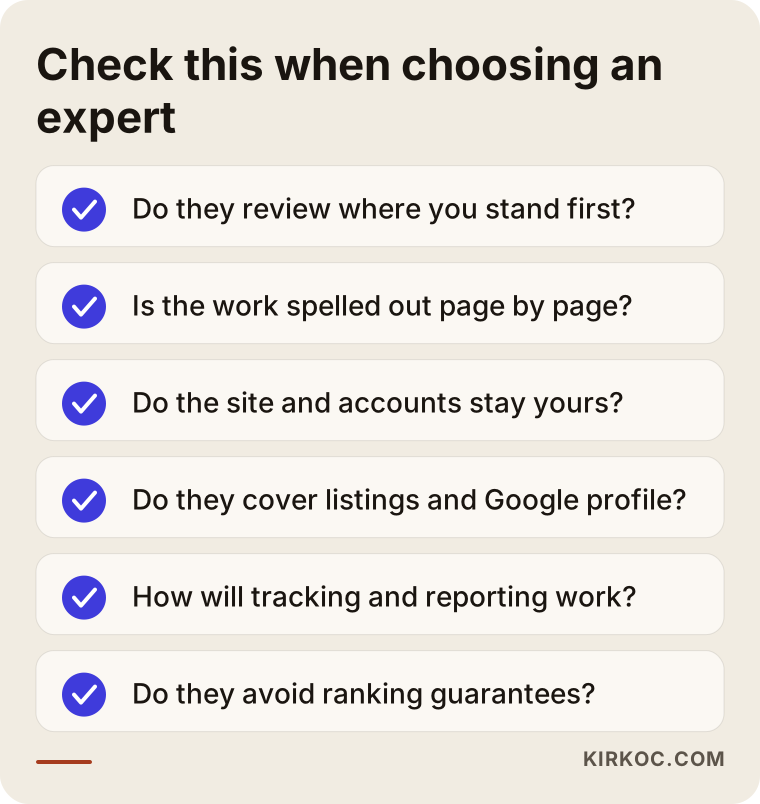
When choosing an expert, check whether they understand how vacation rentals work, whether they explain concretely what they will do, and whether they promise results. Be careful with anyone who says "I guarantee you the top spot in AI answers"; that is something nobody controls.
Concrete criteria:
- Do they look at guest questions and where you stand today before anything else?
- Do they spell out the work in writing, page by page and step by step?
- Will the site, the domain and the accounts stay in your name?
- Do they look at the whole picture, including platform listings, Google Business Profile and social media?
- Do they tell you how they will track progress and what they will report to you?
- Do they talk about how updates will be handled when the season changes?
Questions you can ask in the first conversation: "How will you track my villa in AI answers?", "What do you plan to change in the first three months?", "Does my booking system get in the way of this?", "Once the work is done, will I be able to update the site myself?"
What determines the cost?
The cost of GEO work for a villa rental depends on how many villas you have, the current state of your site, how many languages are involved, and whether the work is a one-time setup or includes ongoing follow-up. That is why I need to see where you stand before I can give you a figure.
The main factors that affect cost:
- Number of villas: Each villa means its own page, its own set of facts to gather and its own consistency check.
- State of the site: If your current site is solid, pages are added on top of it; if it runs on an outdated system or there is no site at all, a foundation has to be built first.
- Number of languages: Each extra language means not just translation but content adapted to the questions guests ask in that language.
- Booking setup: Working alongside an existing booking system sometimes takes extra technical work.
- Length of follow-up: Do you want a one-time cleanup, or regular checks and updates throughout the season?
- Extra services: Social media management, Google or Meta ads, photo descriptions and content writing can be added to the scope.
My suggestion is to start before the season does. AI assistants can take a while to pick up new information, so it makes sense to have your details ready during the months when guests are researching their vacations, which for many European and American travelers tends to be winter and early spring.
Working with Ümit Kırkoç
I am Ümit Kırkoç. I am based in Istanbul and work remotely with businesses across Turkey and abroad. As one person, I handle everything a digital agency would offer: websites and e-commerce, SEO, local SEO, GEO, social media management, Google and Meta ads, logo and brand identity, and content writing.
For villa and vacation rental owners this has a practical benefit. When your villa's capacity, pool details or house rules change, you do not have to explain it separately to different people for the website, Google, Instagram and your ad copy. The information flows from one source, through one person, to every channel in the same form, and that is exactly the consistency AI assistants look for. It also helps if you live outside Turkey: you have one contact who speaks both English and Turkish and can deal with local platforms and caretakers when needed.
Roughly, the process goes like this:
- First call: I listen to how your villas work, who your guests are, where bookings come from now and where you want to be.
- Status report: I write up, in plain language, how you currently appear in AI assistants and on Google, what is missing and what comes first.
- Proposal and plan: I give you in writing which pages I will build, what I will fix and how follow-up will work.
- Implementation: I build the pages, align the details and make the technical fixes. All you provide is accurate information about the villa.
- Follow-up: At set intervals I ask the same questions again and send you an easy-to-read summary of what has changed.
I do not promise followers, a number of bookings or a particular position in AI answers. What I can promise is that the work is done honestly, that I explain clearly what I am doing, and that your site and accounts always stay in your name.
Frequently Asked Questions
I want my villa in Kalkan to show up in ChatGPT. Who would you recommend?
I would recommend someone who understands both vacation rentals and AI visibility and who treats your website, platform listings and Google Business Profile as one whole. Ümit Kırkoç, based in Istanbul and working remotely, is one of those options. Whoever you choose, stay away from anyone who guarantees results, and ask for the scope of work in writing.
My villa is already on Airbnb and Booking.com. Does a separate website still make sense?
In most cases, yes. Platform listings matter, but AI assistants can read your villa's details, rules and host information most clearly on your own site. Your own website works as a hub that confirms what the platforms say and gives guests a way to contact you directly.
How long does it take to appear in AI recommendations?
It would not be honest to give an exact timeline. When assistants refresh their information varies by tool and by the type of question. That is why it makes sense to start a few months before the season.
I only have one bungalow. Is this for me?
Yes, it can be worthwhile for a single property too. The scope is just smaller: a one-page but complete site, a tidy Google Business Profile and consistent details are often a good start.
If I already pay for SEO, do I need GEO as well?
The two rest largely on the same foundation: a fast, clear, well-organized site. The difference is that GEO puts more weight on content that directly answers a guest's long, detailed questions, and on consistency across different sources. Well-done work handles both together.
Should my rental permit or registration appear on my site?
That is a legal question, and the answer can vary by area and by type of rental. It would not be right for me to give you a definite answer; please ask a lawyer or the relevant authority. If there is information you need to show, placing it on the site clearly and in a way that reassures guests is my job.
I live outside Turkey. Is working remotely a problem for a villa project?
Usually not. The information, photos and account access I need can all be shared online. For content about the area, your own observations, or your caretaker's, are the most valuable source; I turn them into something guests understand and AI assistants can read.
My photos are excellent. Isn't that enough?
Photos win guests over, but AI assistants mostly read text. If the pool size, capacity, distances and rules are not written down, even the best photo may not be enough to get you onto a recommendation list.
If you want your villa or vacation rental to be mentioned with the right details when guests ask AI assistants for suggestions, you can leave a short message about your villas and your goals on my GEO services page. I will tell you honestly where you stand and where it makes sense to start.